Section 3 Mixing and CP violation in mostly







- Slides: 29
Section 3: : Mixing and CP violation in (mostly) neutral mesons
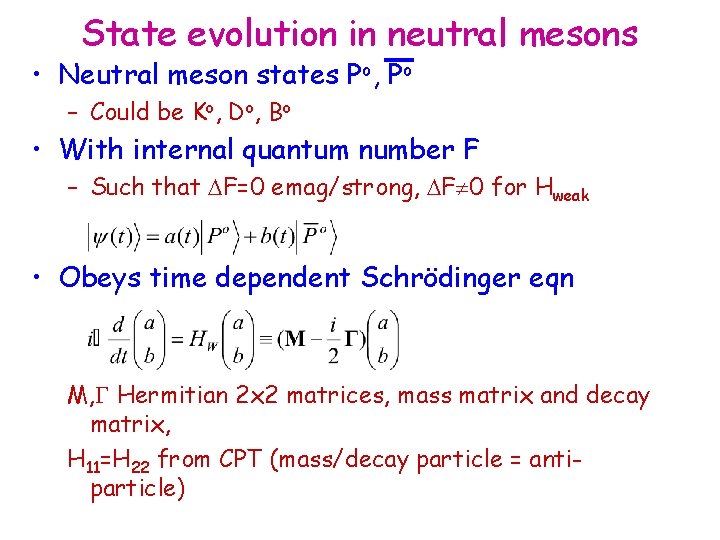
State evolution in neutral mesons • Neutral meson states Po, Po – Could be Ko, Do, Bo • With internal quantum number F – Such that F=0 emag/strong, F 0 for Hweak • Obeys time dependent Schrödinger eqn M, Hermitian 2 x 2 matrices, mass matrix and decay matrix, H 11=H 22 from CPT (mass/decay particle = antiparticle)
• Solve Schrödinger for Eigenstates of Hw Complex coeff. p, q obey |q|2+|p|2=1 • From characteristic equation • If E 1=M 1 -i 1/2, E 2= M 2 -i 2/2 and M=M 2 -M 1, = 2 - 1
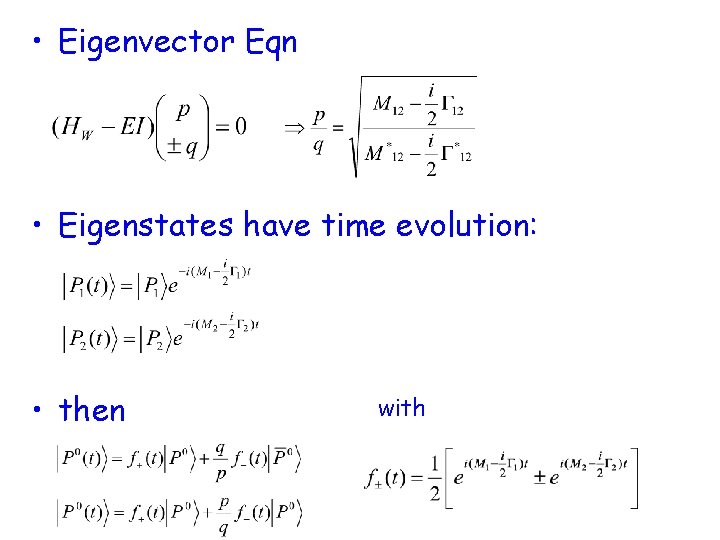
• Eigenvector Eqn • Eigenstates have time evolution: • then with
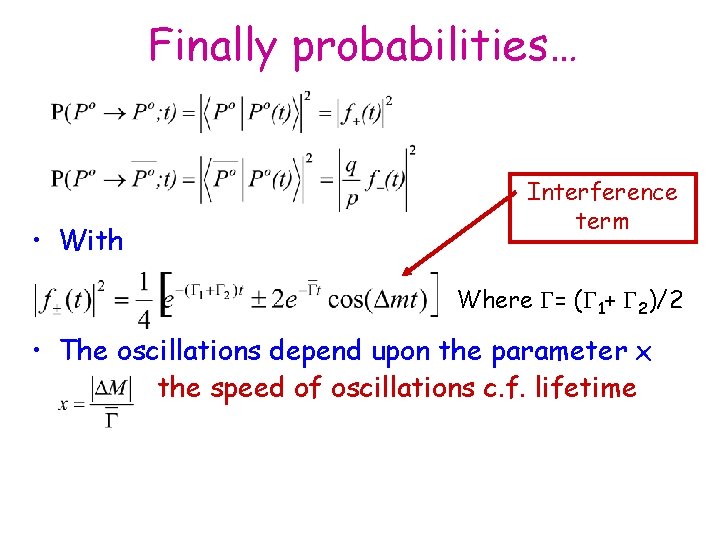
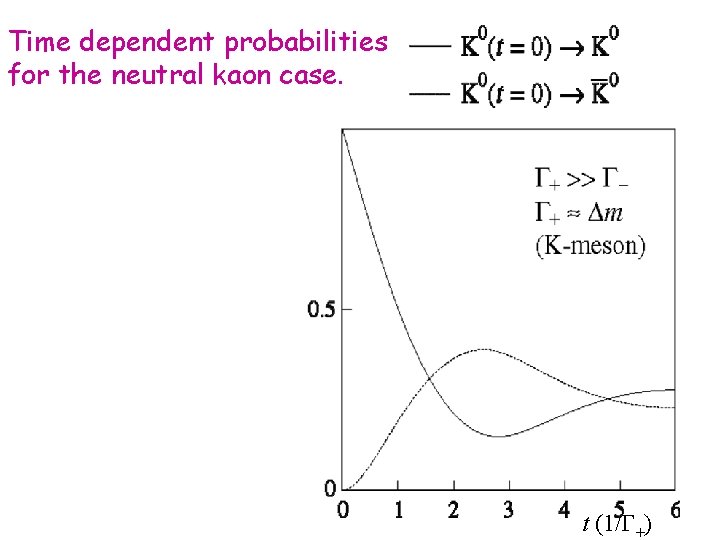
Finally probabilities… • With Interference term Where = ( 1+ 2)/2 • The oscillations depend upon the parameter x the speed of oscillations c. f. lifetime
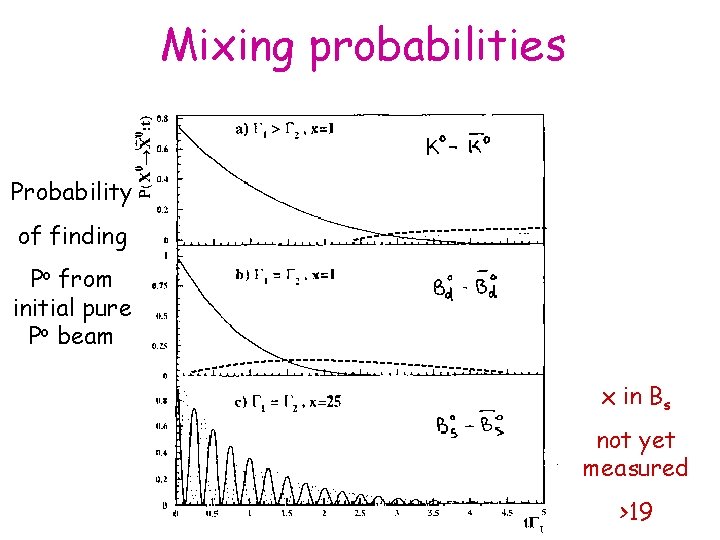
Mixing probabilities Probability of finding Po from initial pure Po beam x in Bs not yet measured >19
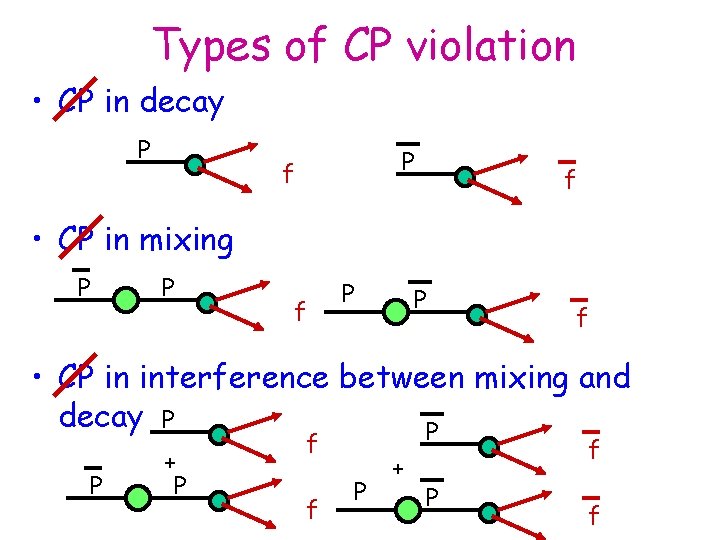
Types of CP violation • CP in decay P P f f • CP in mixing P P f • CP in interference between mixing and decay P P P + P f f P + f P f
1) CP Violation in mixing Indirect CP Violation • Mass eigenstates being different from CP eigenstates • Mixing rate Po Po is different to Po Po • If conserved with • If violated CP|P 1> = +1 |P 1> CP|P 2> = -1 |P 2> Such asymmetries usually small Need to calculate M, , involve hadronic uncertainties Hence, tricky to relate to CKM parameters
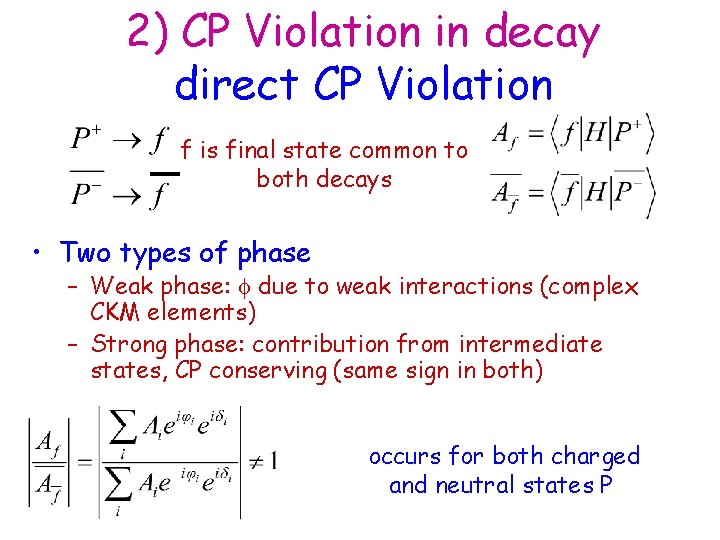
2) CP Violation in decay direct CP Violation f is final state common to both decays • Two types of phase – Weak phase: due to weak interactions (complex CKM elements) – Strong phase: contribution from intermediate states, CP conserving (same sign in both) occurs for both charged and neutral states P
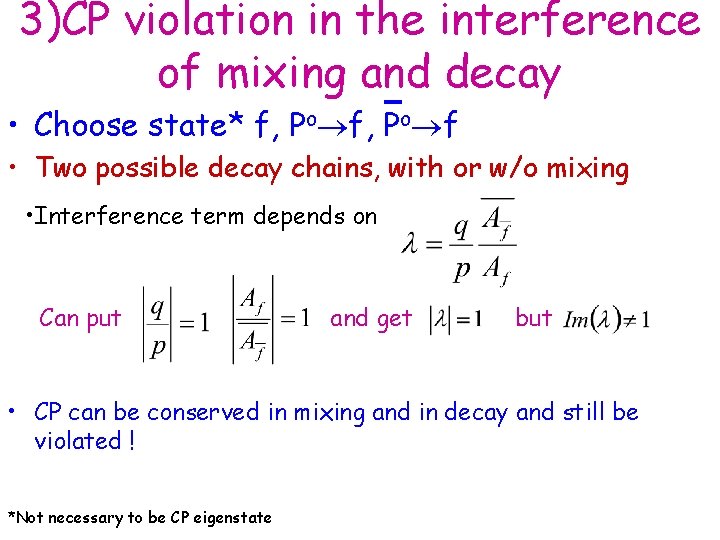
3)CP violation in the interference of mixing and decay • Choose state* f, Po f • Two possible decay chains, with or w/o mixing • Interference term depends on Can put and get but • CP can be conserved in mixing and in decay and still be violated ! *Not necessary to be CP eigenstate
Section 4: : Neutral Kaon system
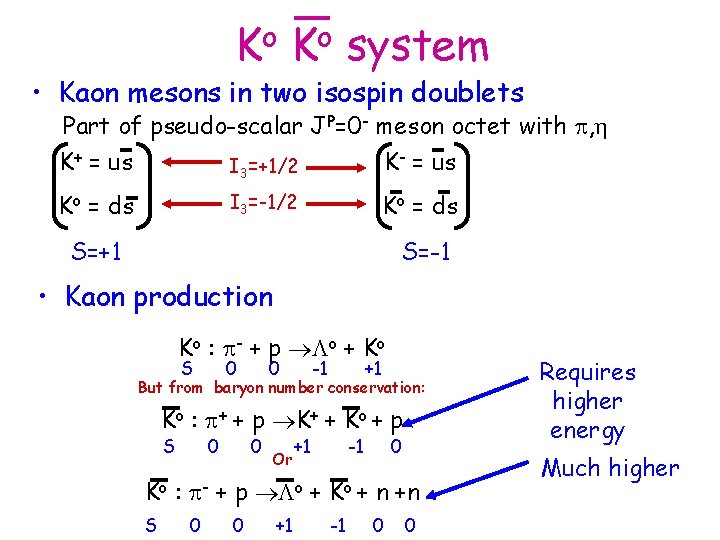
o K system • Kaon mesons in two isospin doublets Part of pseudo-scalar JP=0 - meson octet with , K+ = us I 3=+1/2 K- = us Ko = ds I 3=-1/2 Ko = ds S=+1 S=-1 • Kaon production Ko : - + p o + Ko S 0 0 -1 +1 But from baryon number conservation: Ko : + + p K+ + Ko + p S 0 0 Or +1 -1 0 Ko : - + p o + Ko + n +n S 0 0 +1 -1 0 0 Requires higher energy Much higher
Kaon oscillations d K 0 _ s d _ s s - W W+ u, c, t W - u, c, t _ __ u, c, t • So say at t=0, pure Ko, – later a superposition of states u, c, t _ d W+ s_ d 0 K
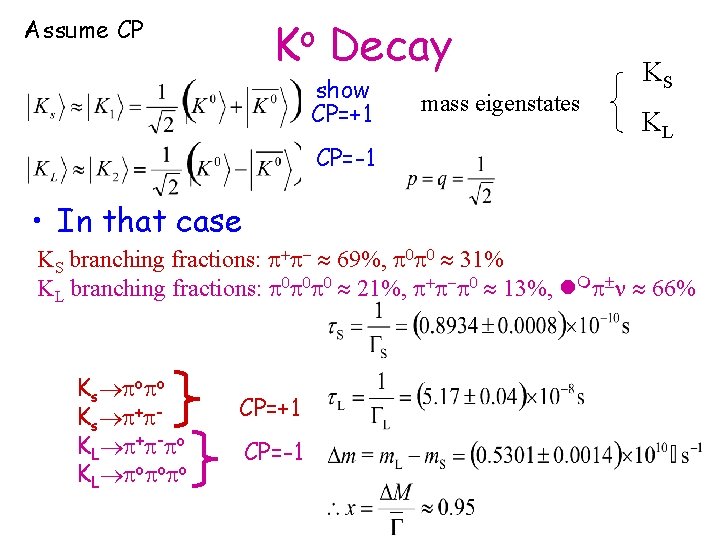
o K Assume CP Decay show CP=+1 CP=-1 mass eigenstates KS KL • In that case KS branching fractions: + - 69%, 0 0 31% KL branching fractions: 0 0 0 21%, + - 0 13%, n 66% Ks o o Ks + KL + - o KL o o o CP=+1 CP=-1
Time dependent probabilities for the neutral kaon case. t (1/ +)
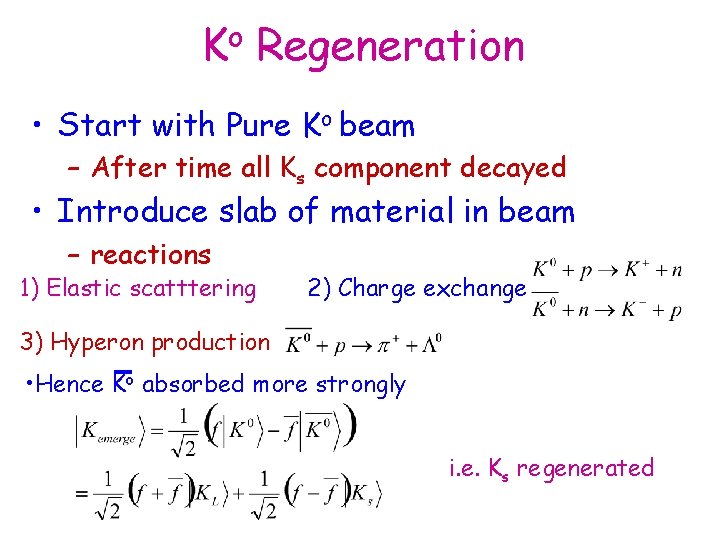
o K Regeneration • Start with Pure Ko beam – After time all Ks component decayed • Introduce slab of material in beam – reactions 1) Elastic scatttering 2) Charge exchange 3) Hyperon production • Hence Ko absorbed more strongly i. e. Ks regenerated
Discovery of CP Violation K 1 o o K 1 + - CP=+1 K 2 + - o CP=-1 So if KL =K 1 CP eigenstate, Observe no two pion component K 2 o o o But if broken get: Where quantifies degree of CP violation BUT Can one find KL decaying into + -?
J. H. Christenson et al. , PRL 13, 138 (1964) Discovery of CP violation • Mass and angular KL + -+X + -) < m m ( K spectrum p+- = p + + p q = angle between p. KL and p+If X = 0, p+- = p. KL : cos q = 1 If X 0, p+- p. KL : cos q 1 q KL KL m ( + -) = m. K m ( + -) > m. K cos q
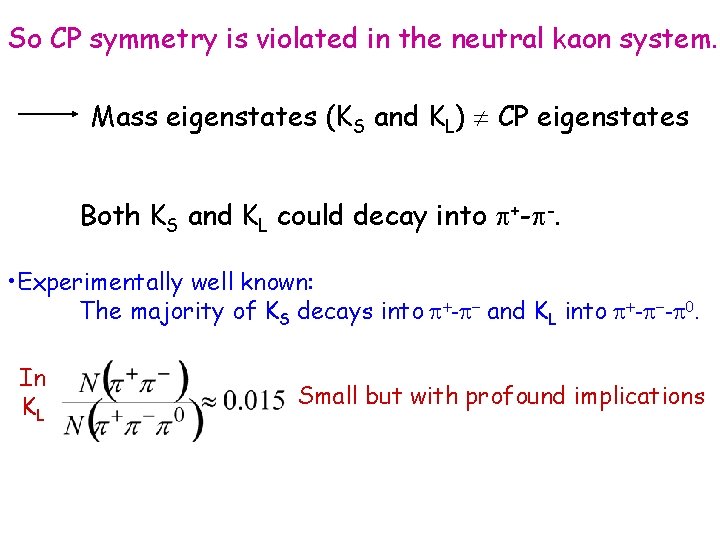
So CP symmetry is violated in the neutral kaon system. Mass eigenstates (KS and KL) CP eigenstates Both KS and KL could decay into +- -. • Experimentally well known: The majority of KS decays into +- - and KL into +- -- 0. In KL Small but with profound implications
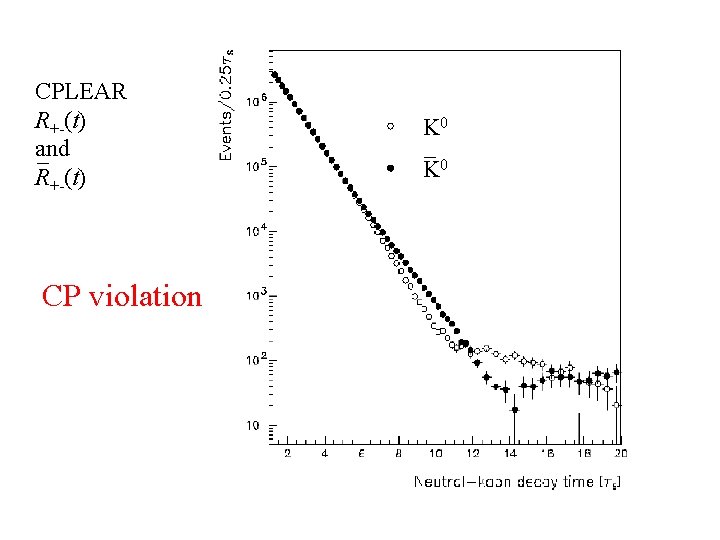
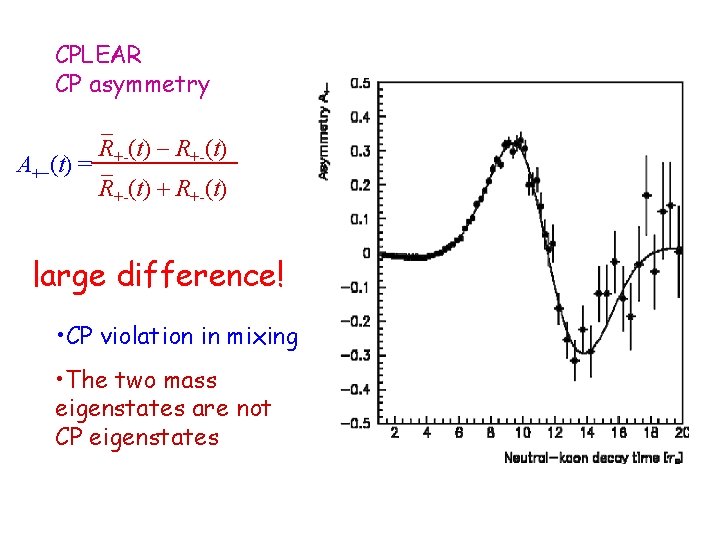
CPLEAR revisited Initial state at t = 0 S=0 Decay final state at time t +- - Spin( ) = 0 L - = 0 S=0 CP( +- -) = +1 i. e. CP eigenstate • Tag Ko/Ko from charged pion/kaon K 0 at t = 0 decays into + vs K 0 at t = 0 decays into + - any difference = CP violation
CPLEAR R+-(t) and _ R+-(t) CP violation K 0 _ K 0
CPLEAR CP asymmetry _ R+-(t) - R+-(t) A+-(t) = _ R+-(t) + R+-(t) large difference! • CP violation in mixing • The two mass eigenstates are not CP eigenstates
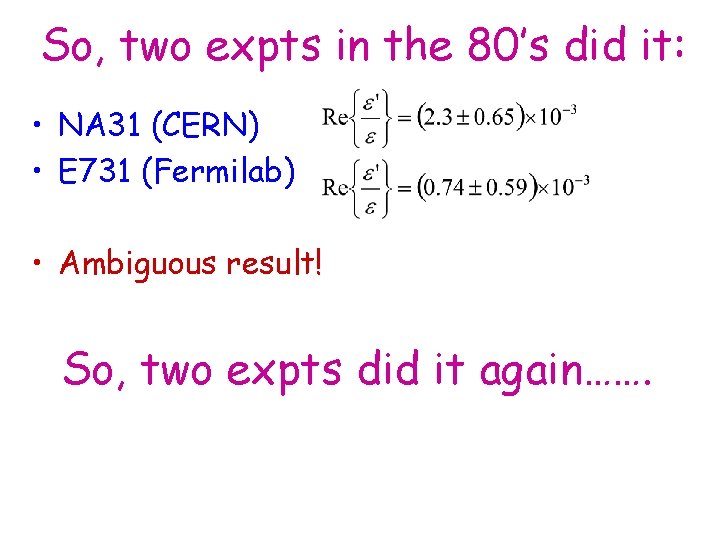
Kaons: CP violation in Decay CP violation first through existence of certain decay modes ~2. 3 x 10 -3 If CP violation is only in mixing, i. e. independent of decay So, put channel independent term and channel dependent ’ Hence, by measuring only rates: get
So, two expts in the 80’s did it: • NA 31 (CERN) • E 731 (Fermilab) • Ambiguous result! So, two expts did it again…….
NA 48
KTe. V
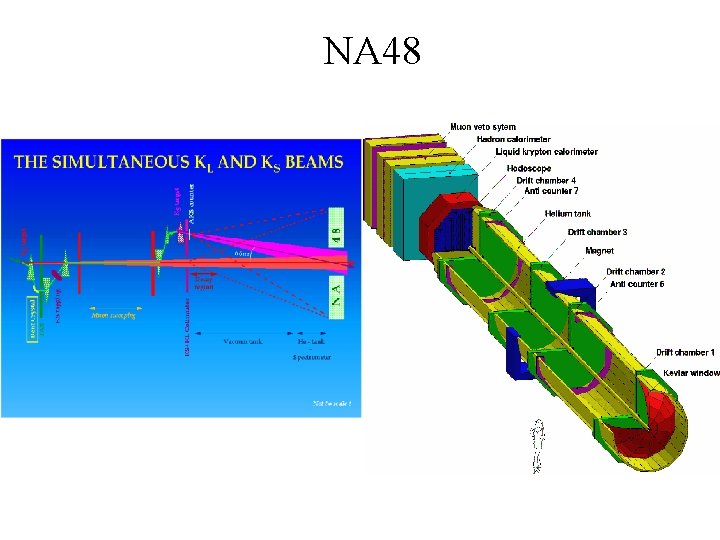
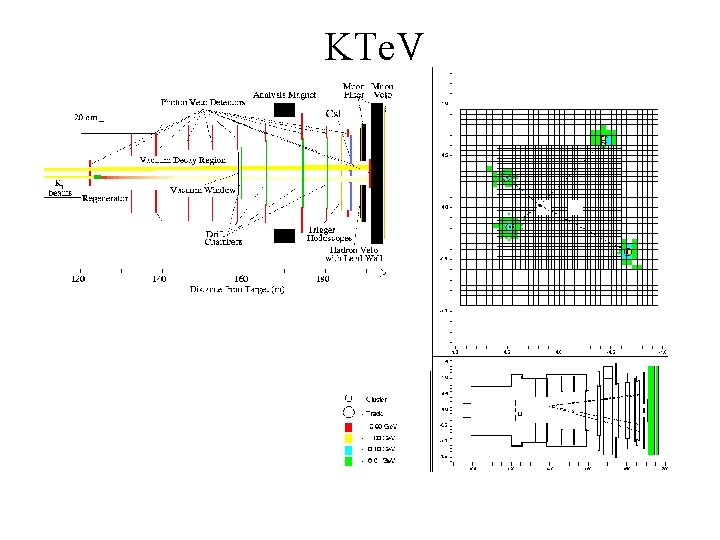
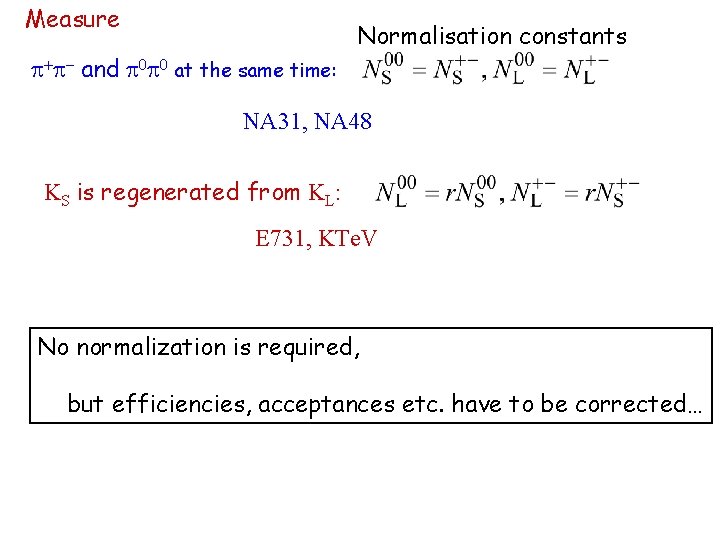
Measure + - and 0 0 at the same time: Normalisation constants NA 31, NA 48 KS is regenerated from KL: E 731, KTe. V No normalization is required, but efficiencies, acceptances etc. have to be corrected…
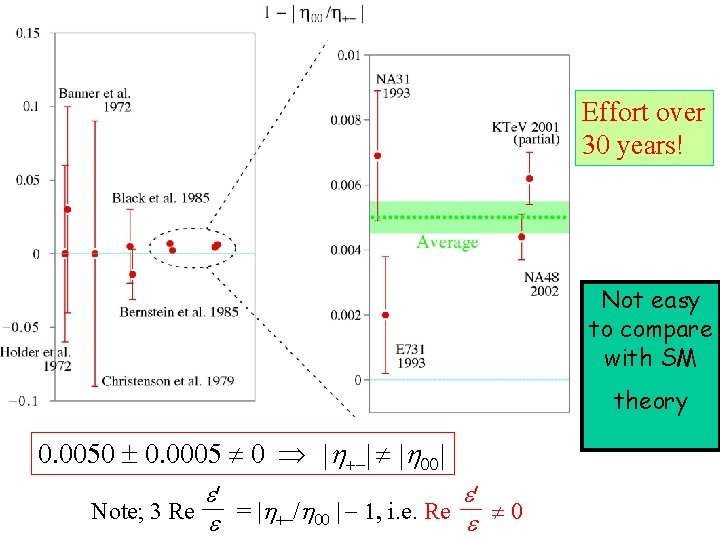
Effort over 30 years! Not easy to compare with SM theory 0. 0050 0. 0005 0 |h+-| |h 00| e e Note; 3 Re e = |h+-/h 00 | - 1, i. e. Re e 0
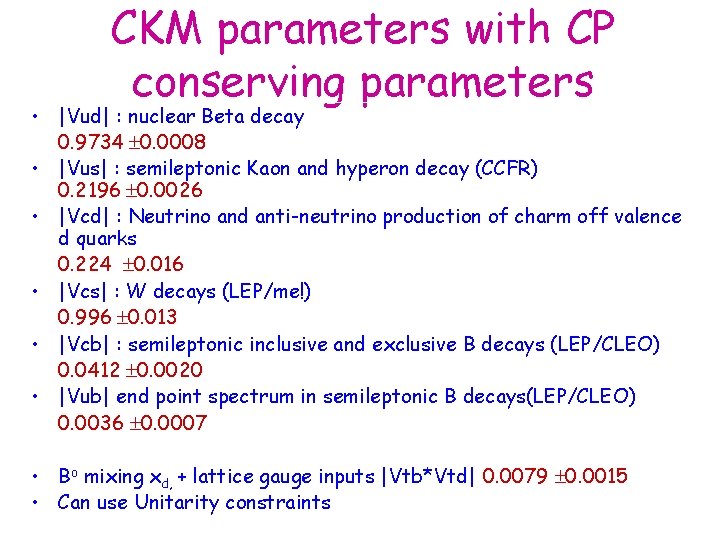
CKM parameters with CP conserving parameters • |Vud| : nuclear Beta decay 0. 9734 0. 0008 • |Vus| : semileptonic Kaon and hyperon decay (CCFR) 0. 2196 0. 0026 • |Vcd| : Neutrino and anti-neutrino production of charm off valence d quarks 0. 224 0. 016 • |Vcs| : W decays (LEP/me!) 0. 996 0. 013 • |Vcb| : semileptonic inclusive and exclusive B decays (LEP/CLEO) 0. 0412 0. 0020 • |Vub| end point spectrum in semileptonic B decays(LEP/CLEO) 0. 0036 0. 0007 • Bo mixing xd, + lattice gauge inputs |Vtb*Vtd| 0. 0079 0. 0015 • Can use Unitarity constraints