Search for streaming DM axions or other exotica



- Slides: 27
Search for streaming DM axions or other exotica. Why no axion signal yet? K. Zioutas University of Patras / Greece People interested-supported this work: V. Anastassopoulos, S. Bertolucci, G. Cantatore, S. Cetin, H. Fischer, W. Funk, A. Gardikiotis, D. Hoffmann, S. Hofmann, M. Karuza, M. Maroudas, B. R. Patla, Y. Semertzidis, I. Tkatchev , … www. nordita. org/axions 2016 Abstract: We suggest a new approach to search for galactic axions or any other particles. In addition, specific time windows, some of which are predictable and others not, could be utilized. We also suggest how to adopt the detection scheme of ongoing or planned DM axion searches. The required intervention will be explained. Actually no additional equipment is needed. Instead, more interdisciplinary expertise can strengthen the discovery potential of this proposal. Stockholm, 7/12/2016 1
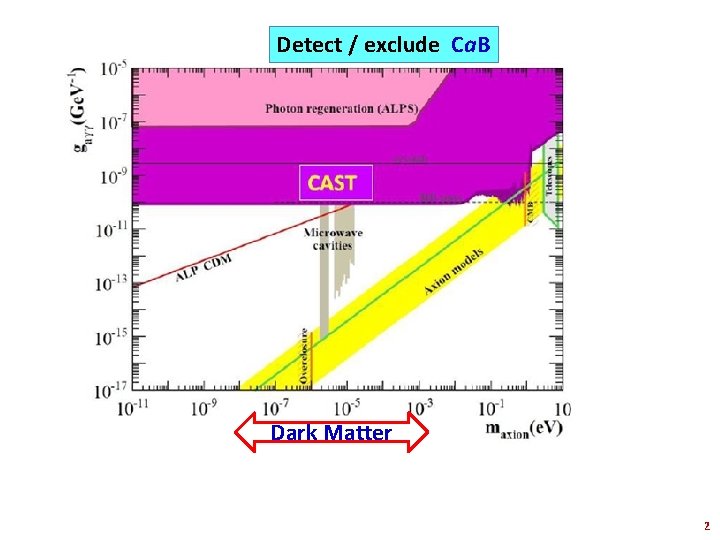
Detect / exclude Ca. B Dark Matter 2
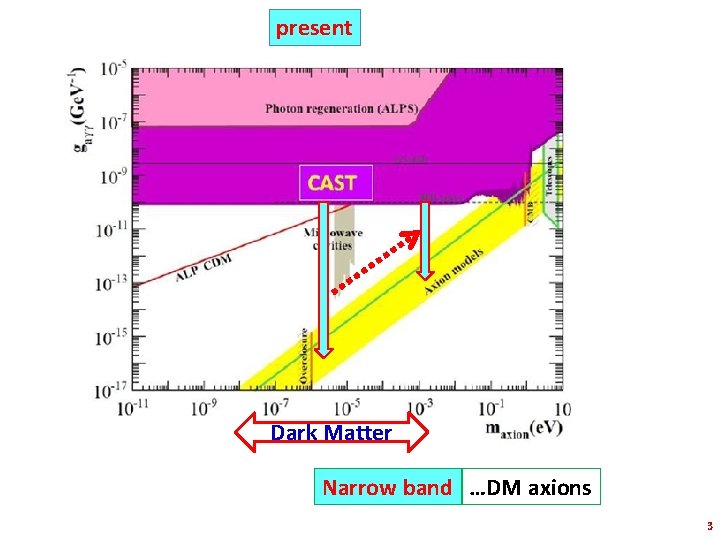
present Dark Matter Narrow band …DM axions 3
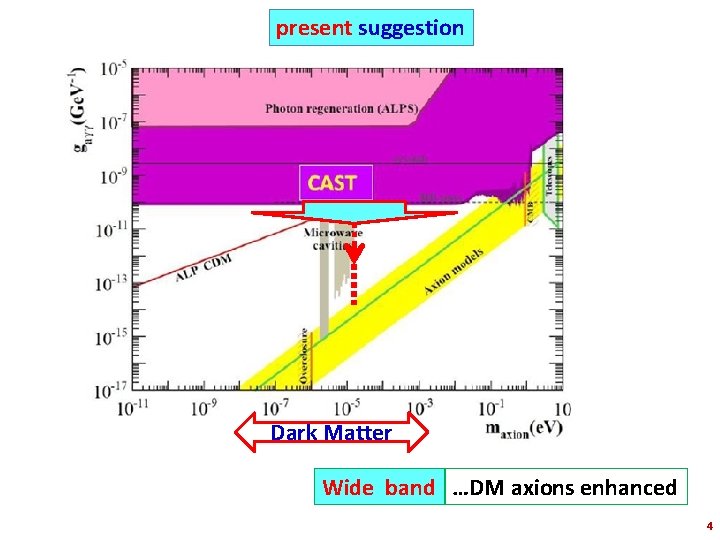
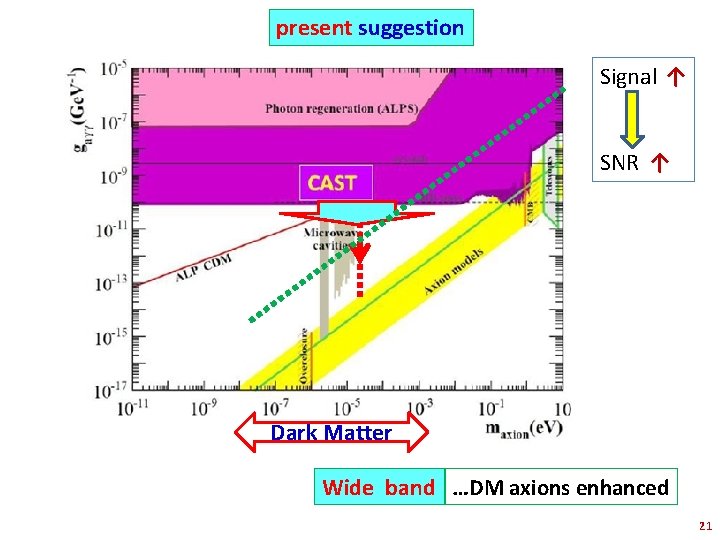
present suggestion Dark Matter Wide band …DM axions enhanced 4
How to do it? 5
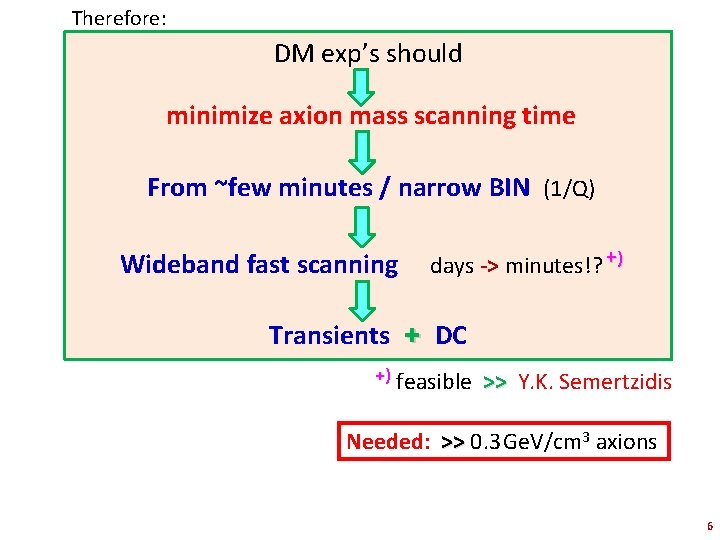
Therefore: DM exp’s should minimize axion mass scanning time From ~few minutes / narrow BIN (1/Q) Wideband fast scanning days -> minutes!? +) Transients + DC +) feasible >> Y. K. Semertzidis >> Needed: >> 0. 3 Ge. V/cm 3 axions >> 6
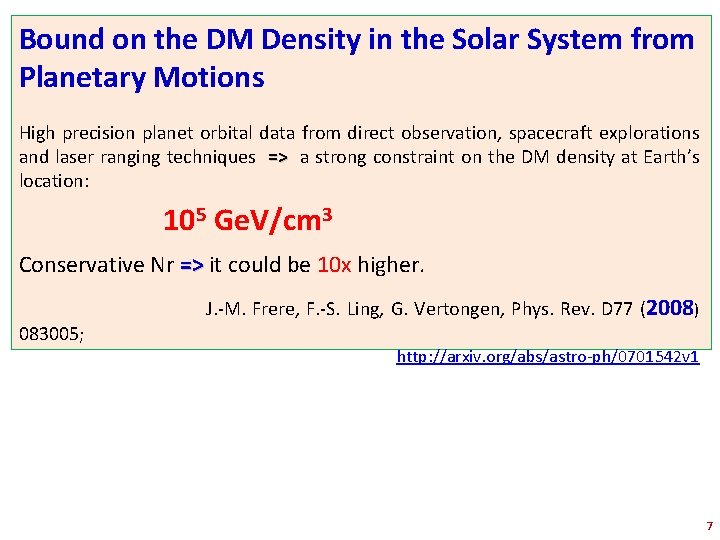
Bound on the DM Density in the Solar System from Planetary Motions High precision planet orbital data from direct observation, spacecraft explorations and laser ranging techniques => a strong constraint on the DM density at Earth’s => location: 105 Ge. V/cm 3 Conservative Nr => it could be 10 x higher. => J. -M. Frere, F. -S. Ling, G. Vertongen, Phys. Rev. D 77 (2008) 083005; http: //arxiv. org/abs/astro-ph/0701542 v 1 7
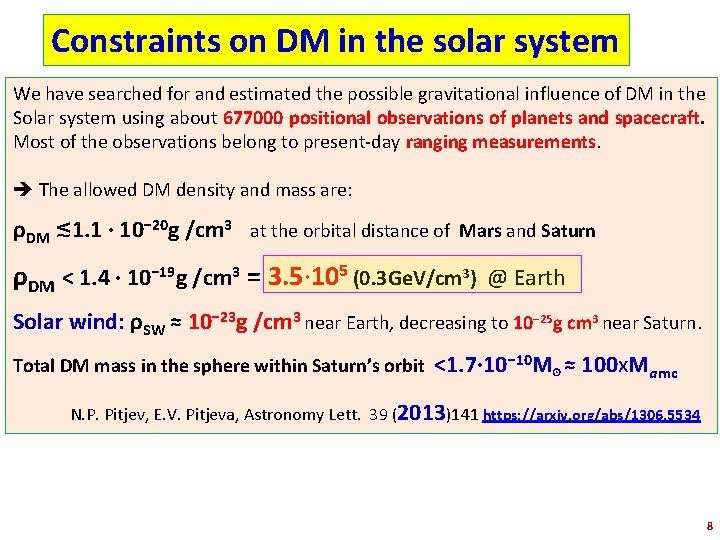
Constraints on DM in the solar system We have searched for and estimated the possible gravitational influence of DM in the Solar system using about 677000 positional observations of planets and spacecraft. Most of the observations belong to present-day ranging measurements. The allowed DM density and mass are: ρDM ≲ 1. 1 ∙ 10− 20 g /cm 3 at the orbital distance of Mars and Saturn ρDM < 1. 4 ∙ 10− 19 g /cm 3 = 3. 5∙ 105 (0. 3 Ge. V/cm 3) @ Earth Solar wind: ρSW ≈ 10− 23 g /cm 3 near Earth, decreasing to 10− 25 g cm 3 near Saturn. Total DM mass in the sphere within Saturn’s orbit <1. 7∙ 10− 10 M⊙ ≈ 100 x. Mamc N. P. Pitjev, E. V. Pitjeva, Astronomy Lett. 39 (2013)141 https: //arxiv. org/abs/1306. 5534 8
• Dark Matter disk? Even in the context of a "conventional" halo, the possibility exists that interaction with the visible disk leads to the formation of a DM disk, rotating at a comparable speed. • the "clumpy" nature of DM distributions could even plead for a pre-existing local excess, in which the Solar System would have formed. J-M Frère; Po. S CORFU 2014 (2015) 108 https: //arxiv. org/abs/1504. 08220 9
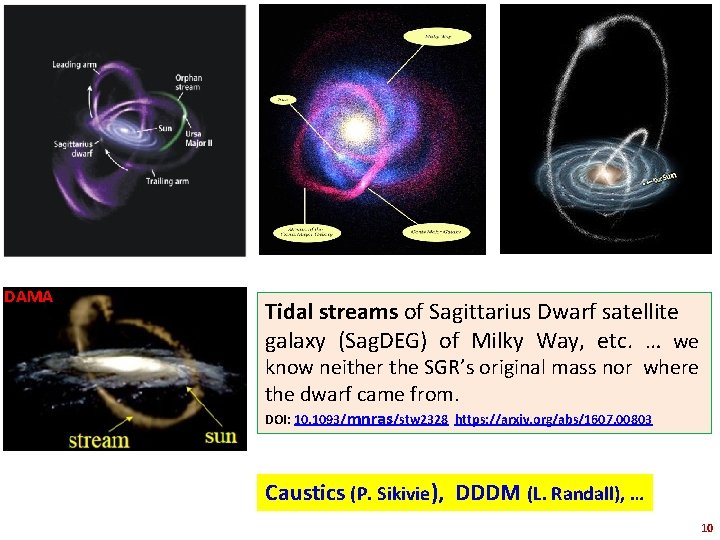
DAMA Tidal streams of Sagittarius Dwarf satellite galaxy (Sag. DEG) of Milky Way, etc. … we know neither the SGR’s original mass nor where the dwarf came from. DOI: 10. 1093/mnras/stw 2328 https: //arxiv. org/abs/1607. 00803 Caustics (P. Sikivie), DDDM (L. Randall), … 10
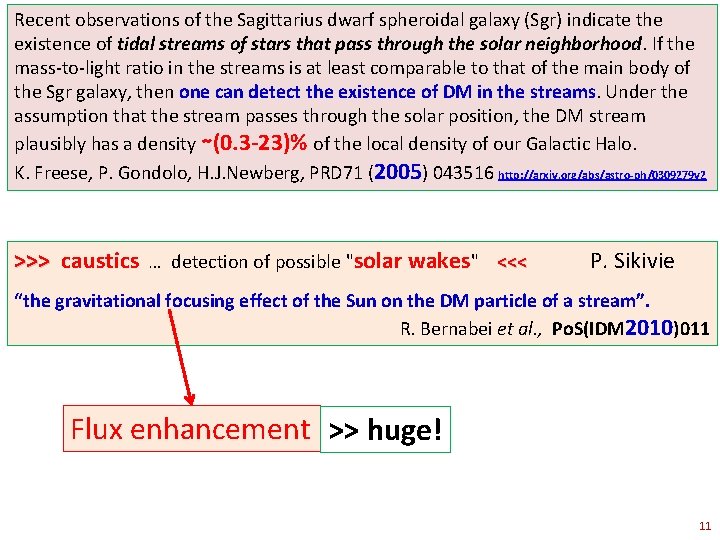
Recent observations of the Sagittarius dwarf spheroidal galaxy (Sgr) indicate the existence of tidal streams of stars that pass through the solar neighborhood. If the mass-to-light ratio in the streams is at least comparable to that of the main body of the Sgr galaxy, then one can detect the existence of DM in the streams. Under the assumption that the stream passes through the solar position, the DM stream plausibly has a density ∼(0. 3 -23)% of the local density of our Galactic Halo. K. Freese, P. Gondolo, H. J. Newberg, PRD 71 (2005) 043516 http: //arxiv. org/abs/astro-ph/0309279 v 2 >>> caustics … detection of possible "solar wakes" <<< P. Sikivie >>> “the gravitational focusing effect of the Sun on the DM particle of a stream”. R. Bernabei et al. , Po. S(IDM 2010)011 Flux enhancement >> huge! 11
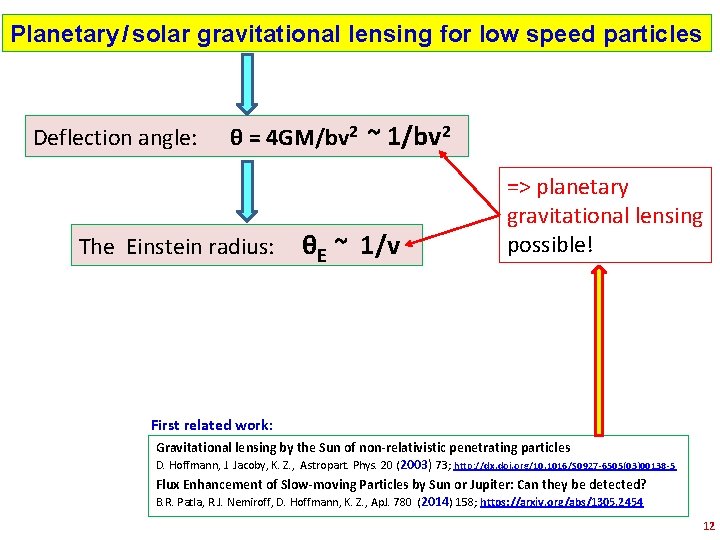
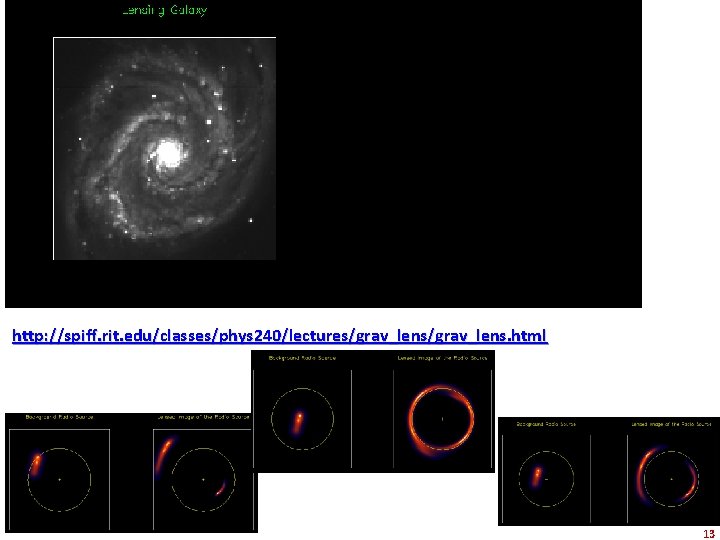
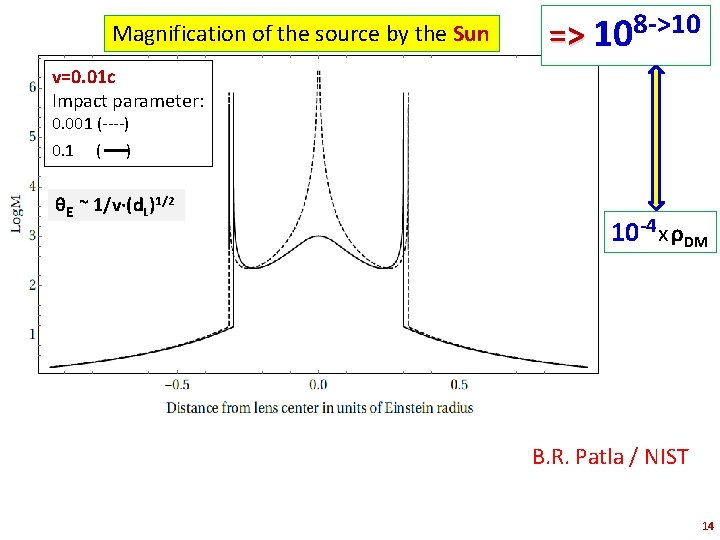
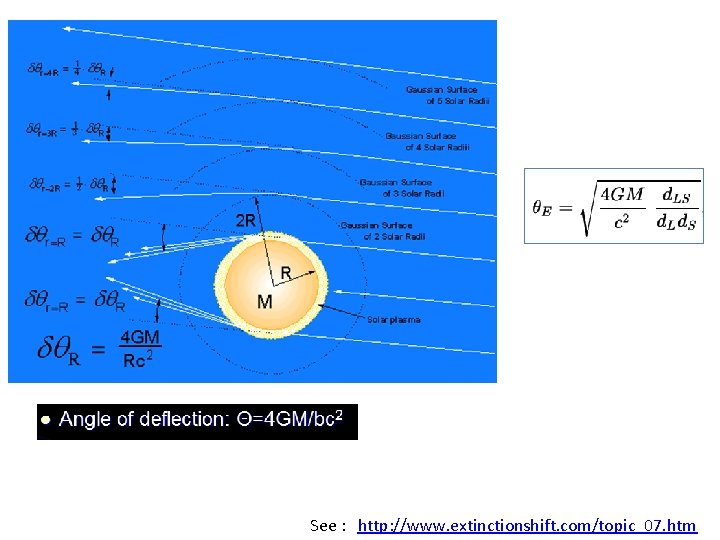
Planetary / solar gravitational lensing for low speed particles Deflection angle: θ = 4 GM/bv 2 ~ 1/bv 2 The Einstein radius: θE ~ 1/v => planetary gravitational lensing possible! First related work: Gravitational lensing by the Sun of non-relativistic penetrating particles D. Hoffmann, J. Jacoby, K. Z. , Astropart. Phys. 20 ( 2003) 73; http: //dx. doi. org/10. 1016/S 0927 -6505(03)00138 -5 Flux Enhancement of Slow-moving Particles by Sun or Jupiter: Can they be detected? B. R. Patla, R. J. Nemiroff, D. Hoffmann, K. Z. , Ap. J. 780 (2014) 158; https: //arxiv. org/abs/1305. 2454 12
http: //spiff. rit. edu/classes/phys 240/lectures/grav_lens. html 13
Magnification of the source by the Sun => 108 ->10 v=0. 01 c Impact parameter: 0. 001 (----) 0. 1 ( ) θE ~ 1/v∙(d. L)1/2 10 -4 x ρDM B. R. Patla / NIST 14
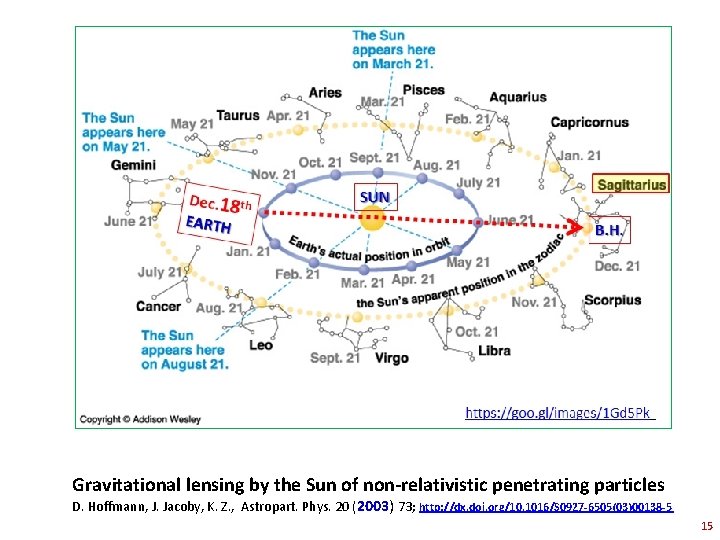
Gravitational lensing by the Sun of non-relativistic penetrating particles D. Hoffmann, J. Jacoby, K. Z. , Astropart. Phys. 20 (2003) 73; http: //dx. doi. org/10. 1016/S 0927 -6505(03)00138 -5 15
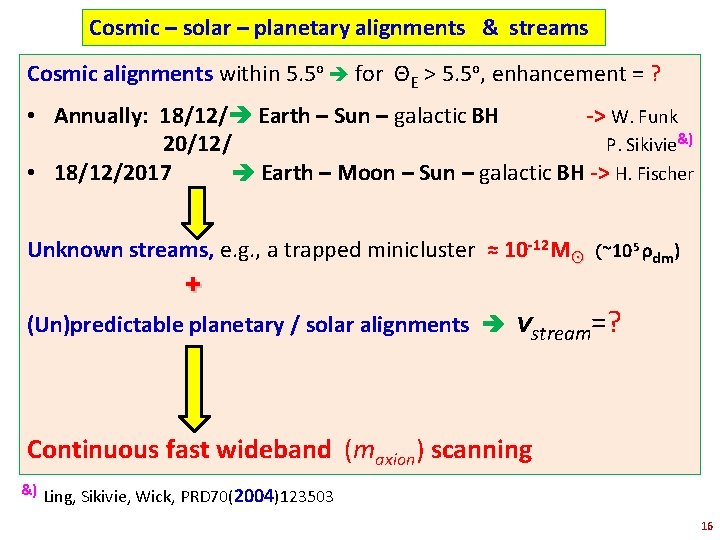
Cosmic – solar – planetary alignments & streams Cosmic alignments within 5. 5 o for ΘE > 5. 5 o, enhancement = ? • Annually: 18/12/ Earth – Sun – galactic BH -> W. Funk 20/12/ P. Sikivie&) • 18/12/2017 Earth – Moon – Sun – galactic BH -> H. Fischer Unknown streams, e. g. , a trapped minicluster ≈ 10 -12 M⊙ (~105 ρdm) + (Un)predictable planetary / solar alignments vstream=? Continuous fast wideband (maxion) scanning &) Ling, Sikivie, Wick, PRD 70(2004)123503 16
More DM axions @ solar system? 17
Tidal streams from axion miniclusters + direct axion searches In a wide variety of axion DM models, a sizable (or even dominant) fraction of axions is conned in a very dense axionic clumps, or miniclusters, with masses M~10 -12 M⊙. They originate from specific density perturbations which are a consequence of non-linear axion dynamics around the QCD epoch. There may be 1024 of such miniclusters in the Galaxy, their density in the Solar neighborhood being 1010/pc 3. Typical miniclusters have radius of 107 km and the density 108 Ge. V/cm 3. During a direct encounter of the laboratory with such a minicluster the local axion density increases by a factor of 108 for about a day. That would create a very strong signal in the tuned detectors devoted to direct axion searches. However, direct encounters with the Earth would occur only once in 105 yrs [4]. axion miniclusters. A fraction of these substructures is disrupted and forms tidal streams where the axion density may still be an order of magnitude larger than the average. Stream-crossing events would occur at a rate of about 1/(20 yr) for 2 -3 days, during which the signal in axion detectors would be amplified by a factor ∼ 10 . >> conclusion: The effect of the tidal disruption of axion miniclusters may be important for direct axion searches and deserves a more thorough study. P. Tinyakov, I. Tkachev, K. Z. , JCAP 1601 (2016) no. 01, 035 https: //arxiv. org/abs/1512. 02884 More? 18
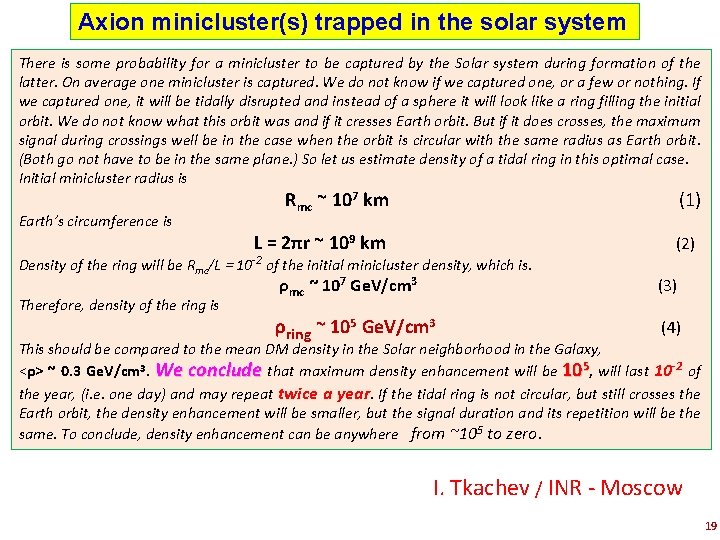
Axion minicluster(s) trapped in the solar system There is some probability for a minicluster to be captured by the Solar system during formation of the latter. On average one minicluster is captured. We do not know if we captured one, or a few or nothing. If we captured one, it will be tidally disrupted and instead of a sphere it will look like a ring filling the initial orbit. We do not know what this orbit was and if it cresses Earth orbit. But if it does crosses, the maximum signal during crossings well be in the case when the orbit is circular with the same radius as Earth orbit. (Both go not have to be in the same plane. ) So let us estimate density of a tidal ring in this optimal case. Initial minicluster radius is Rmc ~ 107 km (1) Earth’s circumference is L = 2πr ~ 109 km (2) Density of the ring will be Rmc/L = 10 -2 of the initial minicluster density, which is. ρmc ~ 107 Ge. V/cm 3 (3) Therefore, density of the ring is ρring ~ 105 Ge. V/cm 3 (4) This should be compared to the mean DM density in the Solar neighborhood in the Galaxy, <ρ> ~ 0. 3 Ge. V/cm 3. We conclude that maximum density enhancement will be 105, will last 10 -2 of the year, (i. e. one day) and may repeat twice a year. If the tidal ring is not circular, but still crosses the Earth orbit, the density enhancement will be smaller, but the signal duration and its repetition will be the same. To conclude, density enhancement can be anywhere from ~105 to zero. I. Tkachev / INR - Moscow 19
…. axion “drop": a stable gravitationally bound configuration https: //arxiv. org/abs/1603. 04249 ; Phys. Rev. D 93 (2016) 123509 Hydrogen Axion Star => a QCD Axion BEC with masses around 10 -11 M⊙. If the axion star is captured by the proto-stellar cloud, it could end up seeding the formation of a planet, or the star itself, as it would be a large density perturbation within the cloud. => small scale baryonic structure formation at a very early time. Y. Bai, V. Barger, J. Berger, https: //arxiv. org/abs/1612. 00438 + Planetary correlations? Bertolucci, Z. , Hofmann, Maroudas, ar. Xiv: 1602. 03666 20
present suggestion Signal ↑ SNR ↑ Dark Matter Wide band …DM axions enhanced 21
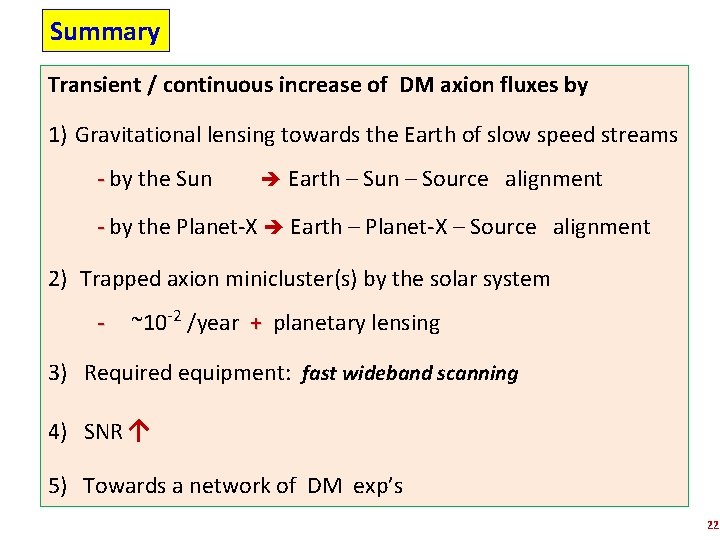
Summary Transient / continuous increase of DM axion fluxes by 1) Gravitational lensing towards the Earth of slow speed streams - by the Sun Earth – Sun – Source alignment - - by the Planet-X Earth – Planet-X – Source alignment - 2) Trapped axion minicluster(s) by the solar system -2 /year + planetary lensing - ~10 - 3) Required equipment: fast wideband scanning 4) SNR ↑ 5) Towards a network of DM exp’s 22
Tack! 23
Additional slides
See : http: //www. extinctionshift. com/topic_07. htm
if the lensing object isn't lined up exactly with the background source, then we don't see a bright ring of light; instead, we see a distorted, magnified version of the background source. The closer the lens and background source line up, the brighter and more distorted the image of the background source. If the two line up well enough that the true position of the background source falls within the Einstein ring radius of the lens, then multiple images appear! http: // spiff. rit. edu/classes/phys 240/lectures/grav_lens. html http: //spiff. rit. edu/classes/phys 240/lectures/grav_lens. html