SC HEALTHY CONNECTIONS MEDICAID OVERVIEW April 2017 1
- Slides: 49
SC HEALTHY CONNECTIONS MEDICAID OVERVIEW April 2017 1
South Carolina Department of Health and Human Services The South Carolina Department of Health and Human Services (SCDHHS) administers the Medicaid program, which provides health insurance coverage for eligible residents in South Carolina. The Medicaid program is a “need-based” government insurance program, and is jointly funded by the State and Federal governments. The Federal government requires coverage for certain mandatory eligibility groups, and gives states the option to cover additional groups; therefore, eligibility can vary from state to state. Eligibility for Medicaid is determined through an application process. The Healthy Connections Application (Form 3400 or Form 3401) must be completed to apply for coverage. Individuals who meet the categorical, financial, and non-financial requirements may qualify for benefits. 2
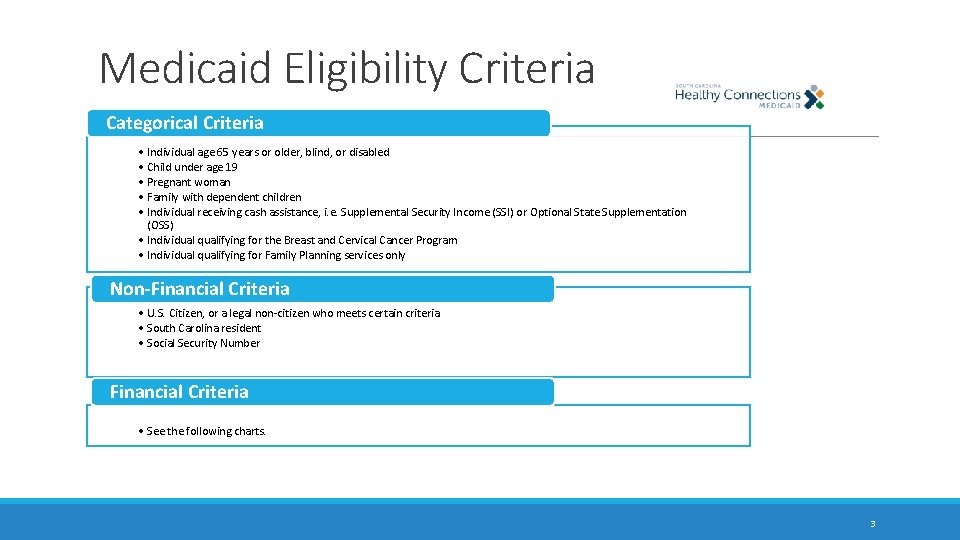
Medicaid Eligibility Criteria Categorical Criteria • Individual age 65 years or older, blind, or disabled • Child under age 19 • Pregnant woman • Family with dependent children • Individual receiving cash assistance, i. e. Supplemental Security Income (SSI) or Optional State Supplementation (OSS) • Individual qualifying for the Breast and Cervical Cancer Program • Individual qualifying for Family Planning services only Non-Financial Criteria • U. S. Citizen, or a legal non-citizen who meets certain criteria • South Carolina resident • Social Security Number Financial Criteria • See the following charts. 3
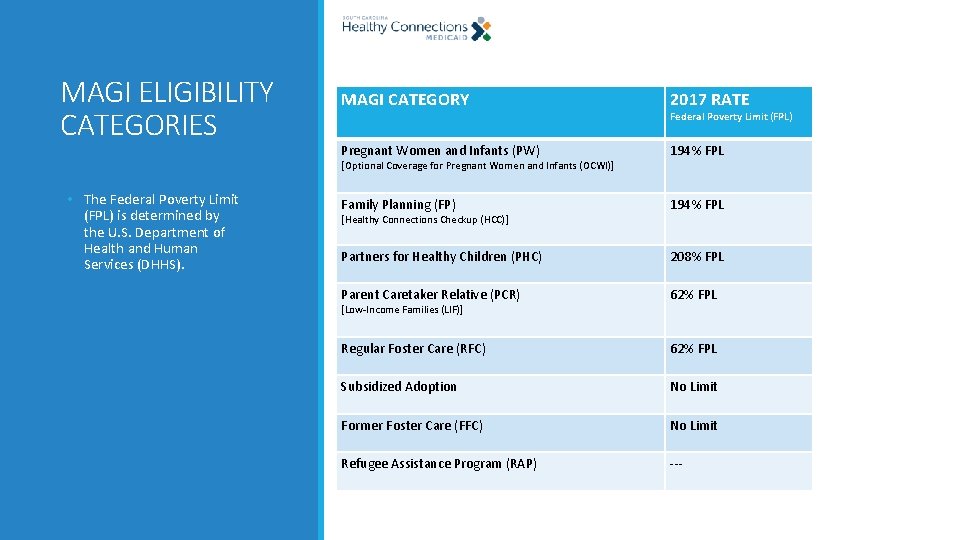
MAGI ELIGIBILITY CATEGORIES MAGI CATEGORY 2017 RATE Pregnant Women and Infants (PW) 194% FPL Family Planning (FP) 194% FPL Partners for Healthy Children (PHC) 208% FPL Parent Caretaker Relative (PCR) 62% FPL Regular Foster Care (RFC) 62% FPL Subsidized Adoption No Limit Former Foster Care (FFC) No Limit Refugee Assistance Program (RAP) --- [Optional Coverage for Pregnant Women and Infants (OCWI)] • The Federal Poverty Limit (FPL) is determined by the U. S. Department of Health and Human Services (DHHS). [Healthy Connections Checkup (HCC)] [Low-Income Families (LIF)] Federal Poverty Limit (FPL)
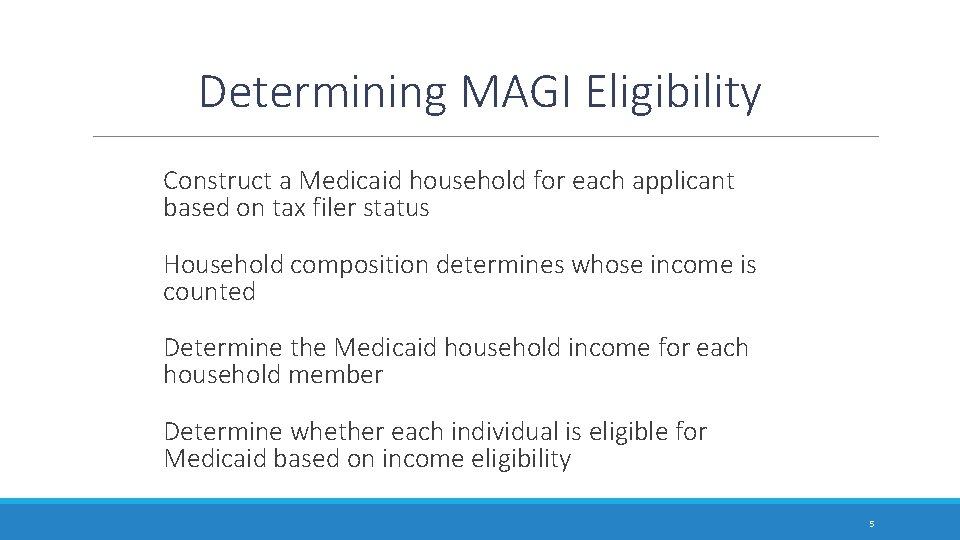
Determining MAGI Eligibility Construct a Medicaid household for each applicant based on tax filer status Household composition determines whose income is counted Determine the Medicaid household income for each household member Determine whether each individual is eligible for Medicaid based on income eligibility 5
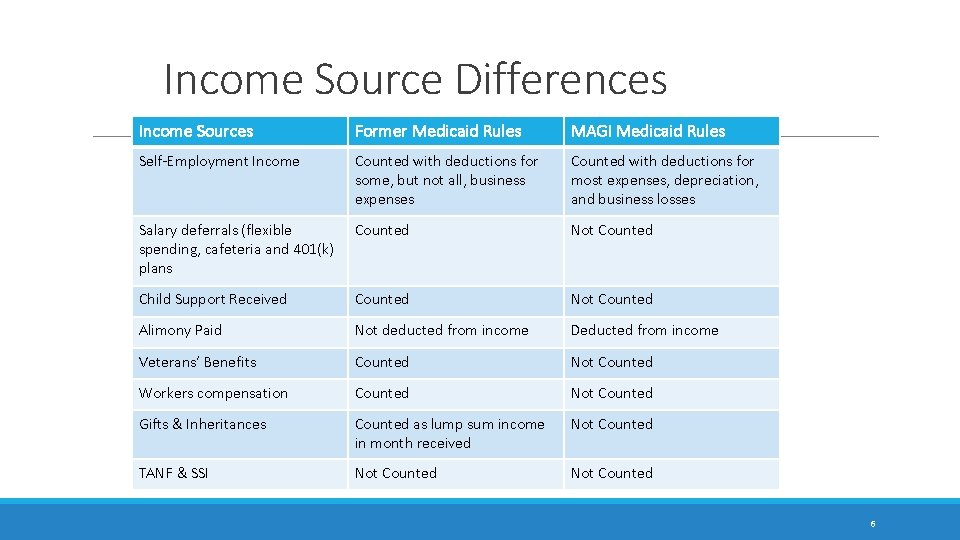
Income Source Differences Income Sources Former Medicaid Rules MAGI Medicaid Rules Self-Employment Income Counted with deductions for some, but not all, business expenses Counted with deductions for most expenses, depreciation, and business losses Salary deferrals (flexible spending, cafeteria and 401(k) plans Counted Not Counted Child Support Received Counted Not Counted Alimony Paid Not deducted from income Deducted from income Veterans’ Benefits Counted Not Counted Workers compensation Counted Not Counted Gifts & Inheritances Counted as lump sum income in month received Not Counted TANF & SSI Not Counted 6
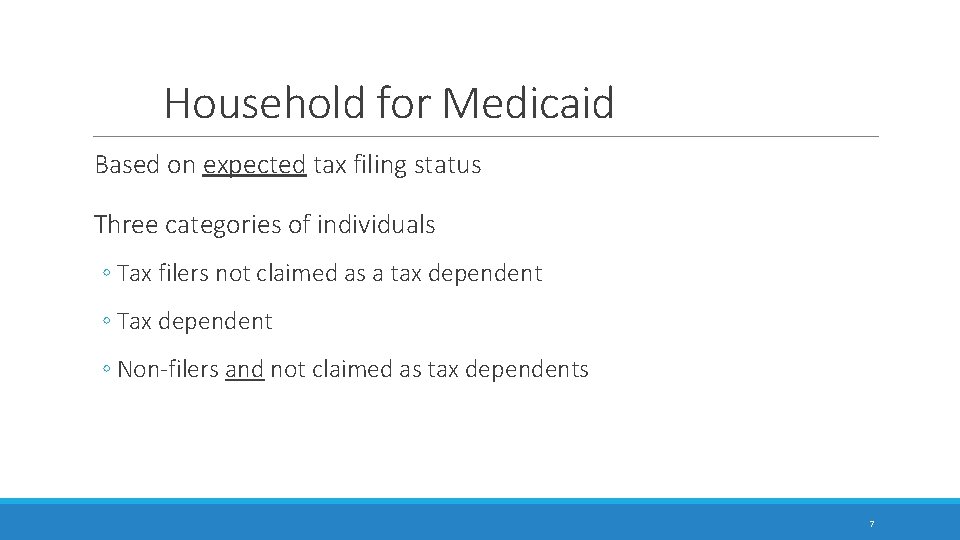
Household for Medicaid Based on expected tax filing status Three categories of individuals ◦ Tax filers not claimed as a tax dependent ◦ Tax dependent ◦ Non-filers and not claimed as tax dependents 7
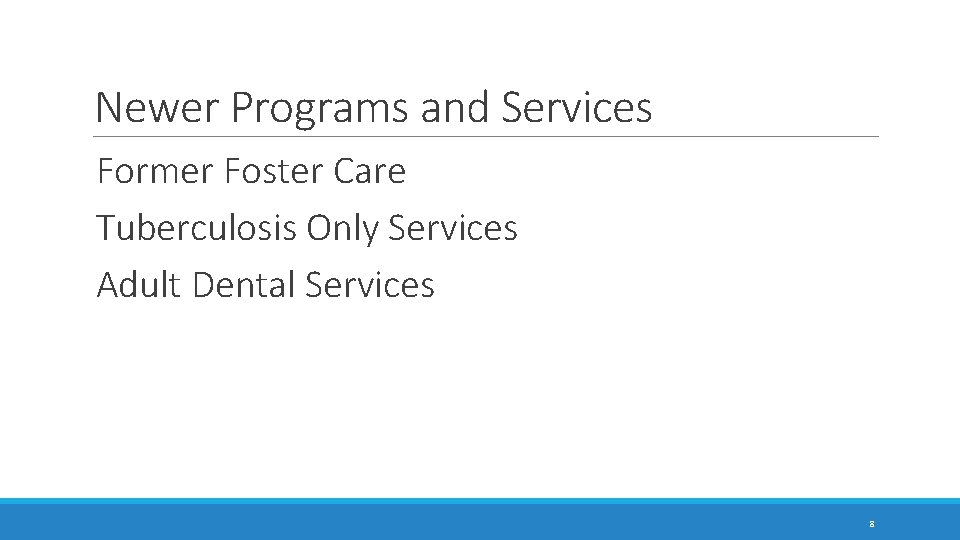
Newer Programs and Services Former Foster Care Tuberculosis Only Services Adult Dental Services 8
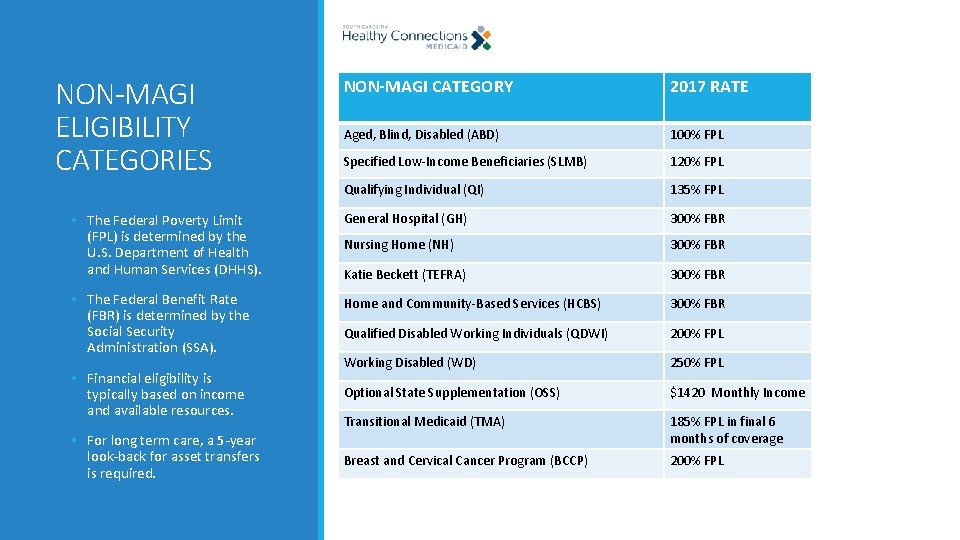
NON-MAGI ELIGIBILITY CATEGORIES NON-MAGI CATEGORY 2017 RATE Aged, Blind, Disabled (ABD) 100% FPL Specified Low-Income Beneficiaries (SLMB) 120% FPL Qualifying Individual (QI) 135% FPL • The Federal Poverty Limit (FPL) is determined by the U. S. Department of Health and Human Services (DHHS). General Hospital (GH) 300% FBR Nursing Home (NH) 300% FBR Katie Beckett (TEFRA) 300% FBR • The Federal Benefit Rate (FBR) is determined by the Social Security Administration (SSA). Home and Community-Based Services (HCBS) 300% FBR Qualified Disabled Working Individuals (QDWI) 200% FPL Working Disabled (WD) 250% FPL Optional State Supplementation (OSS) $1420 Monthly Income Transitional Medicaid (TMA) 185% FPL in final 6 months of coverage Breast and Cervical Cancer Program (BCCP) 200% FPL • Financial eligibility is typically based on income and available resources. • For long term care, a 5 -year look-back for asset transfers is required.
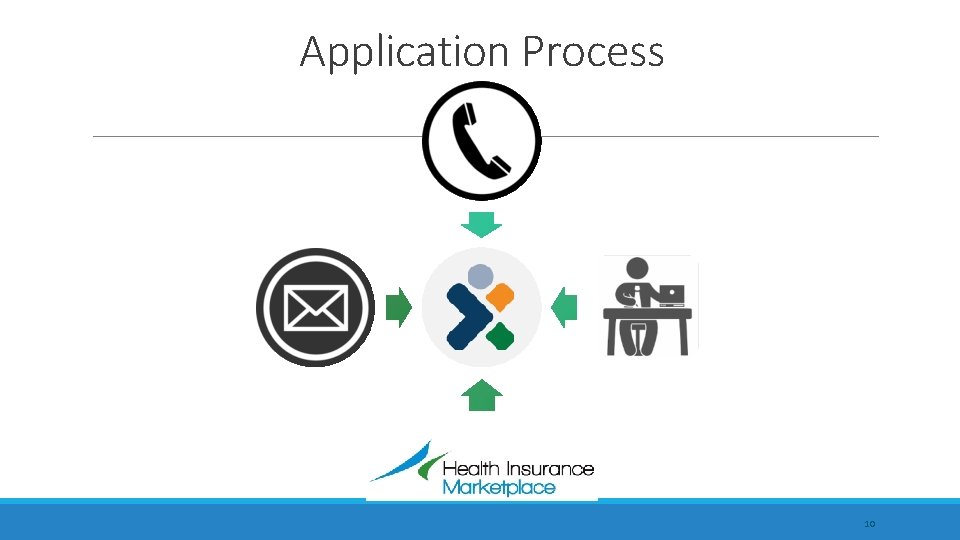
Application Process 10
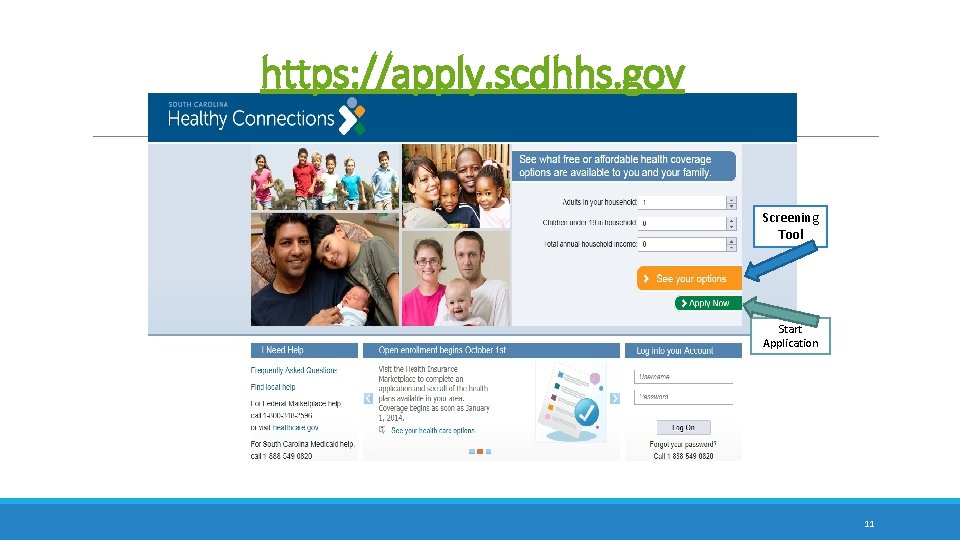
https: //apply. scdhhs. gov Screening Tool Start Application 11
How to Submit a Completed Paper Application or Review Form Mail to: SCDHHS – Central Mail PO Box 100101 Columbia, SC 29202 -3101 Fax to: 888 -820 -1204 In person at County office: https: //scdhhs. gov/site-page/where-go-help For questions or to request an application or review form in Spanish, call the Healthy Connections Member Services Center at: 888 -549 -0820
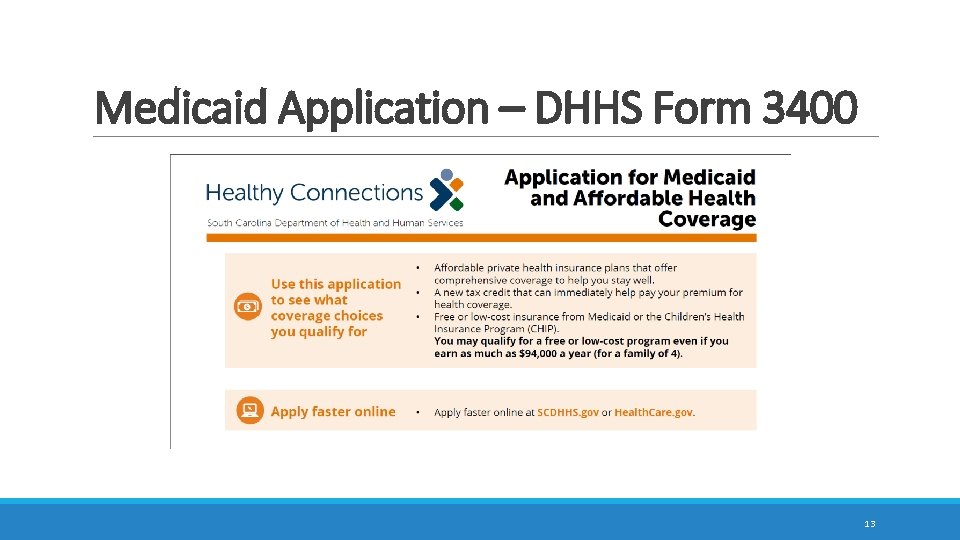
Medicaid Application – DHHS Form 3400 13
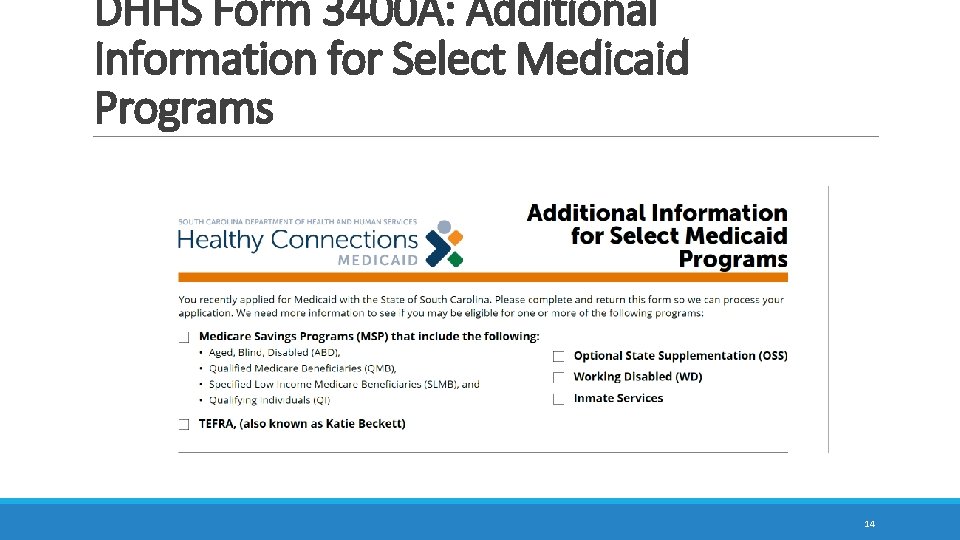
DHHS Form 3400 A: Additional Information for Select Medicaid Programs 14
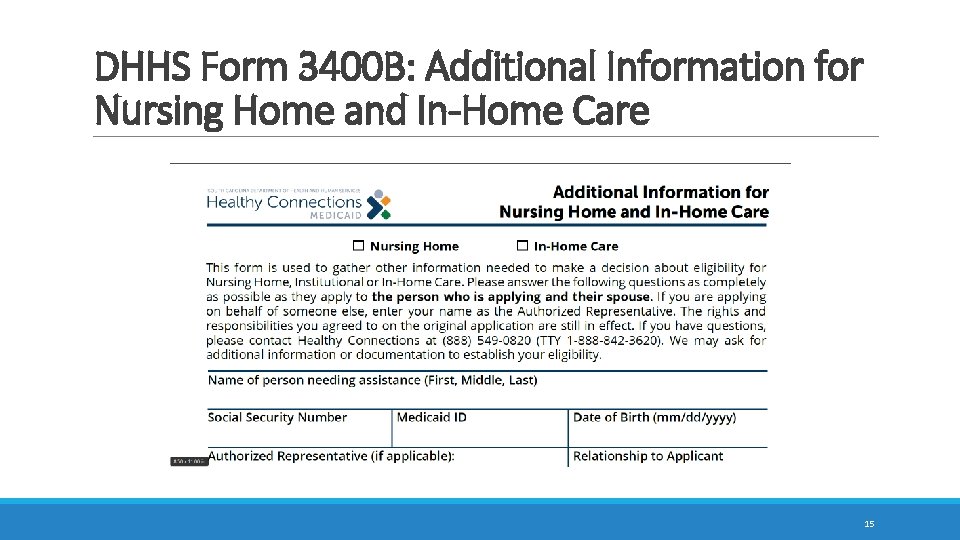
DHHS Form 3400 B: Additional Information for Nursing Home and In-Home Care 15
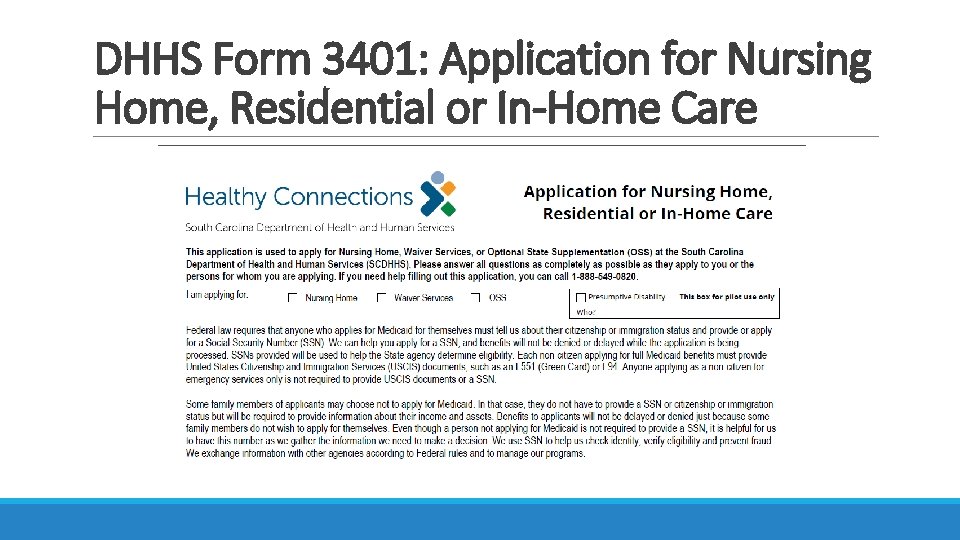
DHHS Form 3401: Application for Nursing Home, Residential or In-Home Care
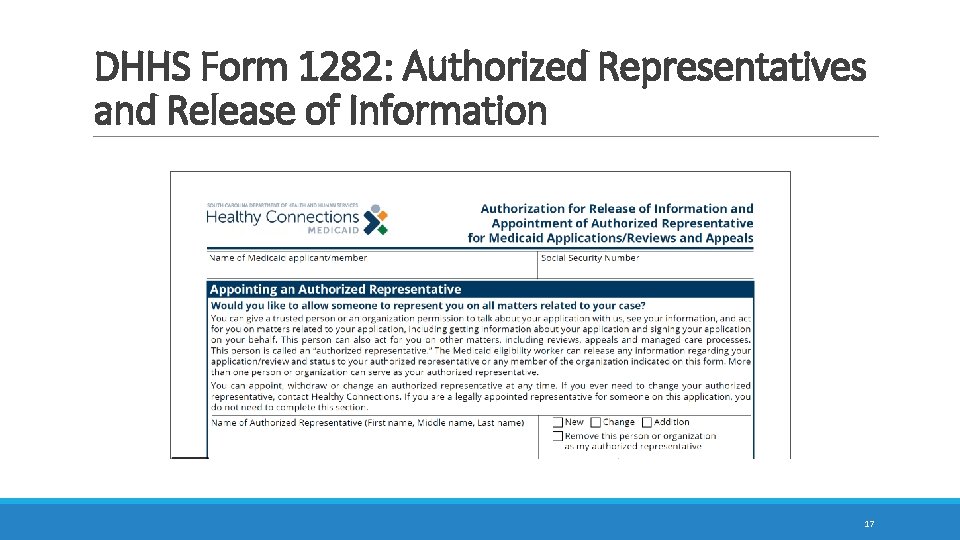
DHHS Form 1282: Authorized Representatives and Release of Information 17
Annual Review Process 1 x/year or when changes occur Different review forms for different programs Reassess eligibility based on changes in eligibility criteria Can be automated for MAGI categories ◦ Receive Continuation of Benefits Notice Always by paper for other eligibility groups 18
Long Term Care Programs – General Overview
Long Term Care Programs – General Overview Nursing Home Assistance Medicaid sponsors the payment of long-term care for individuals who: Reside in Licensed and certified nursing facilities Receive Long Term Care services through Home and Community Based Waivers and PACE Programs. Have long term hospital stays of 30 days or longer Medicaid may also assist individuals who reside in Community Residential Care Facilities.
Long Term Care Programs Nursing Home Assistance • Nursing Home Assistance • Skilled Nursing Facilities • Swing Beds • Intermediate Care Facilities for the Intellectually Disabled (ICF/ID)
Long Term Care Programs Home and Community Based Services Purpose of the Waivers • To provide and alternative to institutional care • Participants meet nursing home level of care but choose to remain in the community. Waivers are operated by: • Community Long Term Care • Department of Mental Health & SCDHHS • Department of Disabilities and Special Needs (DDSN)
Long Term Care Programs General Hospital The General Hospital Program covers long term hospital stays of 30 days or longer.
Long Term Care Programs Optional State Supplementation (OSS) Optional State Supplementation Assistance for residents of Community Residential Care Facilities
Long Term Care Programs – Categorical Criteria -- General Must be Aged 65 or Older, Blind or Disabled as defined by Supplemental Security Income (SSI) guidelines Notes: Disability – expected to be totally disabled for a period of one year or longer. If a person is under age 65 and has Medicare A & B, they have been determined disabled.
Long Term Care Programs – Categorical Criteria Nursing Home & Waiver Services Level Of Care – Must meet an Intermediate or Skilled level of care 30 Consecutive Days – The applicant must be in the hospital, nursing home, and/or participating in Waiver Services for 30 consecutive days or more before Medicaid can be approved. If all criteria are met, eligibility may begin the first date of the month of admission or enrollment. Exceptions: Already eligible in a full coverage Medicaid category. Passed away before the 30 days were met. Must not be subject to a Penalty for a transfer of assets.
Income Gross income from all sources must be considered and verified. Acceptable forms of verification include: ◦ ◦ ◦ Copies of award letters Copies of check stubs Copies of IRS Form 1099 Self employment – Copies of tax returns or ledgers Copies of Promissory Notes System matches Note: Bank statements reflecting direct deposits should not be used to verify income as it may not reflect the necessary gross amounts.
Income exclusions may include the value of: ◦ Veterans Benefits for the following if the amounts can be verified ◦ Aid & Attendance ◦ Dependent Indemnity Compensation (DIC)
Income – Nursing Home Two Steps When Medicaid sponsors an Individual’s nursing home stay, they receive two services: A Medicaid Card Vendor Payment – Payment toward the room and board cost at the facility. An Individual’s income Is subject to paying toward the cost of their nursing home care. Their cost of care is known as recurring income. Budgeting has two steps: Eligibility Determination Recurring Income Determination (Post Eligibility)
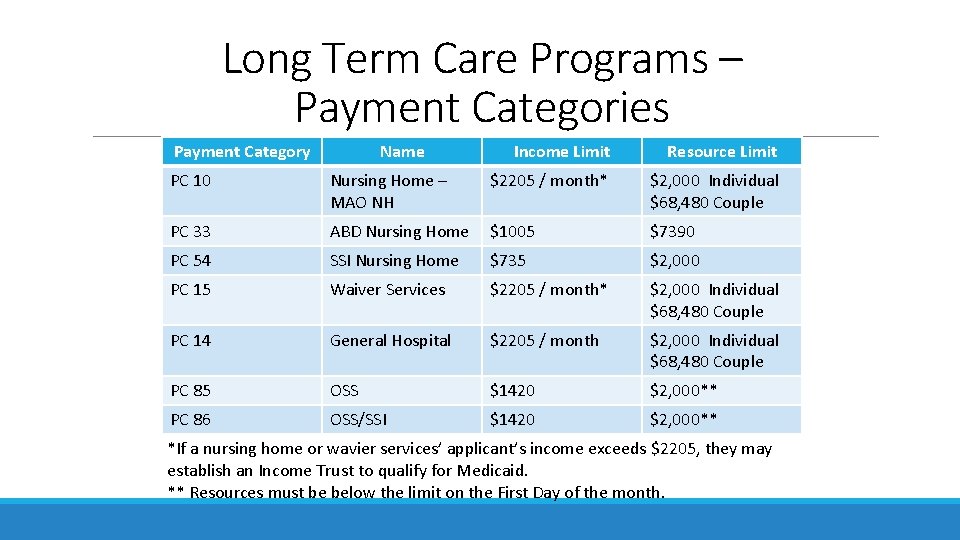
Income Trust Special Trust also known as a “Miller” trust Authorized by the Omnibus Budget Reconciliation Act of 1993 (OBRA 93) Intent – To enable individuals who need institutional care to qualify for Medicaid if they meet all eligibility criteria other than the Medicaid Cap (income limit). The Medicaid Cap is $2205 effective January 1, 2017 Provisions apply to the Nursing Home and Community Waivered Services programs but does not apply to the General Hospital or Optional State Supplementation programs. The earliest possible date of eligibility is the first day of the month the Income Trust document is signed.
Income Trust v. An individual may have an attorney assist them with an Income Trust, but it is not required. v. The DHHS Form 905 is a template which can be completed. v. Requirements: v. The applicant is the primary beneficiary. v. The Medicaid agency is the secondary beneficiary. v. Other beneficiaries may be named but may not receive any money until Medicaid has been repaid. v. If funds remain in the Income Trust account at the time of the individual’s death, it is required that the trust reimburse the Medicaid agency for expenses paid on the individual’s behalf.
Income Trust – Separately Identifiable Account The income assigned to the Income Trust must be placed in a separately identifiable account. May designate a current account or open a new account Only the applicant and trustee’s names may be on the account May be a regular checking account If the Facility is the Trustee, a separate ledger account may be used. It must be separate from the Patient Personal Fund account. Only the income assigned to the Income Trust on the Schedule A can be deposited Only allowable deductions such as cost of care may be withdrawn. Account must be funded prior to Medicaid approval
Establishing an Income Trust The beneficiary must appoint a trustee to manage the Income Trust An individual can not be their own trustee The Trustee may be anyone of their choosing, such as a: o Family member o Friend o Facility o Court appointee o Only the applicant or their legal representative (Power of Attorney, Conservator) can sign the Income Trust document
Income – Nursing Home Cost of Care Recurring income is calculating beginning with the applicant’s gross countable income. From there, certain deductions are allowed. These deductions may include: • • • $30 Personal Allowance Community Spouse’s allocation Dependent’s allocation Home Maintenance Allowance Beneficiary’s health insurance premiums Protected Income (Month of admission from / discharge to community) The amount remaining after deductions is the individual’s Monthly Cost of Care
Resources include assets an individual owns and can use to meet food, clothing, and shelter needs such as: Non-Home Property Bank Accounts CDs, Stocks, Bonds, Investment funds, Life Insurance Inheritances The value of the applicant’s resources cannot exceed $2, 000, following exclusions. If they are ABD eligible, resources cannot exceed $7, 280 The value of a married couple’s resources cannot exceed $68, 480, following exclusions. If all other criteria are met and the applicant is approved, they have 90 days from the date of approval to transfer resources from the applicant to the community spouse’s name.
Resources Resource exclusions may include the value of: ◦ ◦ ◦ The home, if the equity value is less than $543, 000, Up to two cars, A life estate interest, Household goods and personal effects, Up to $1, 500 for a burial fund (but more may be excluded if the applicant purchased a pre-need burial contract) and ◦ The cash value of life insurance policies with face values totaling more than $10, 000.
Resources • The following documentation may be requested: üCopies of the applicant and spouse’s financial account statements -Checking, savings, CD’s, Stocks, Investment funds NOTE: At minimum, DHHS must look at the month of application and the three months prior. üCopies of trust agreements üCopies of annuity contracts üTax verification of vehicles and property owned üCopies of burial contracts, burial fund accounts, or plot certificates üCopies of life insurance policies
Additional Requirements: Look-Back A look-back may be required to determine if the applicant or their spouse has transferred assets in the 60 months preceding the date of application. We are currently asking for bank information that reflects the month of application and the three months prior to the month of application. Additional months may be requested if a potential transfer is identified or if the applicant’s indicates a transfer has occurred.
Additional Requirements: Look-Back • The following documentation may be requested: üVerification of closed accounts üCopies of HUD statement from sale of home üVerification of amounts gifted
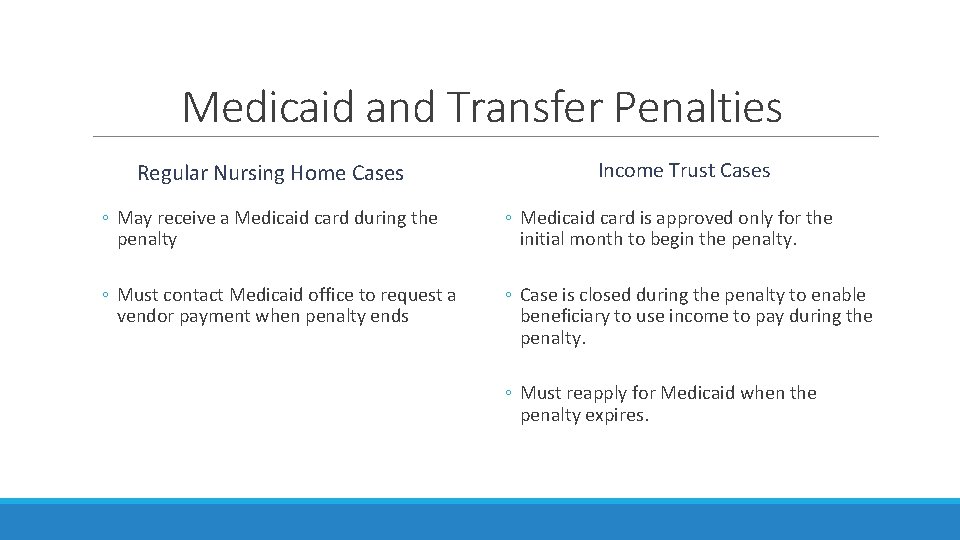
Transfer of Assets -- Nursing Home A penalty is applied to institutionalized individuals and their spouses if the individual transferred assets for less than Fair Market Value (FMV) within the 60 -month look-back period. Although an individual can receive services (Medicaid card) during the penalty period, Medicaid will not pay for the vendor payment services until the penalty period is over. ◦ EXCEPTION: Income Trust cases can not receive a Medicaid card during the penalty period. The penalty period is calculated by dividing the uncompensated value of the transferred assets by the average private pay nursing home rate (currently the rate is $6, 672. 80)
Transfer of Assets -- Nursing Home No penalty is imposed if: ◦ The assets were transferred to a spouse or a blind or disabled child, ◦ The home was transferred to a spouse, and in some cases, to a child or sibling, ◦ The individual can show the transfer was intended to be for FMV, ◦ The individual can show the assets were transferred for a reason other than to qualify for Medicaid, or ◦ It creates an undue hardship, which would place the individual in a lifethreatening situation.
Transfer of Assets – Home and Community Based Services A penalty is applied to individuals, who receive waiver services, and their spouses if the individual transferred assets for less than Fair Market Value (FMV) within the 60 -month lookback period. Waivered services cannot begin if there is a sanctionable transfer. Medicaid may be approved if the individual meets the eligibility criteria in a non-institutional payment category, such as ABD, PCR, etc.
Medicaid and Transfer Penalties Regular Nursing Home Cases Income Trust Cases ◦ May receive a Medicaid card during the penalty ◦ Medicaid card is approved only for the initial month to begin the penalty. ◦ Must contact Medicaid office to request a vendor payment when penalty ends ◦ Case is closed during the penalty to enable beneficiary to use income to pay during the penalty. ◦ Must reapply for Medicaid when the penalty expires.
Optional State Supplementation Assistance for residents of Community Residential Care Facilities
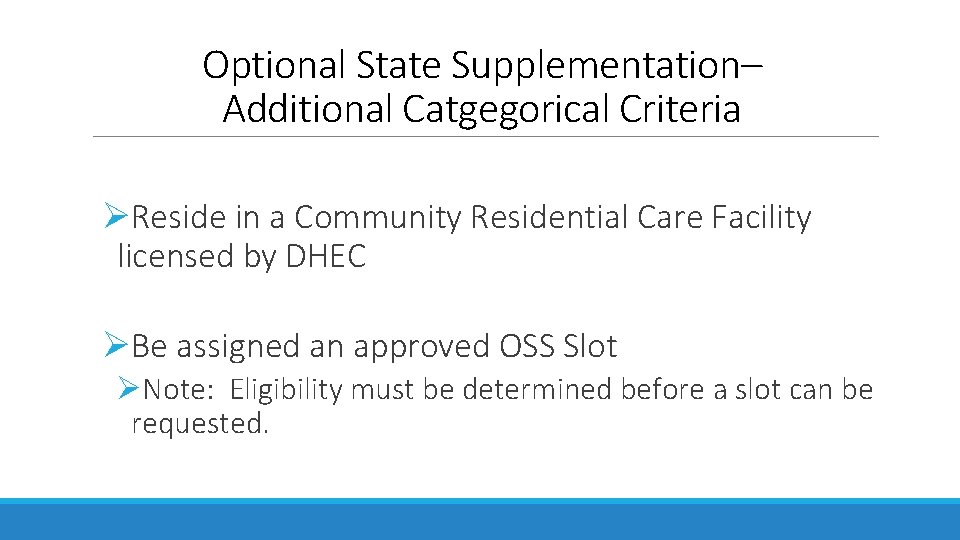
Optional State Supplementation– Additional Catgegorical Criteria Reside in a Community Residential Care Facility licensed by DHEC Be assigned an approved OSS Slot Note: Eligibility must be determined before a slot can be requested.
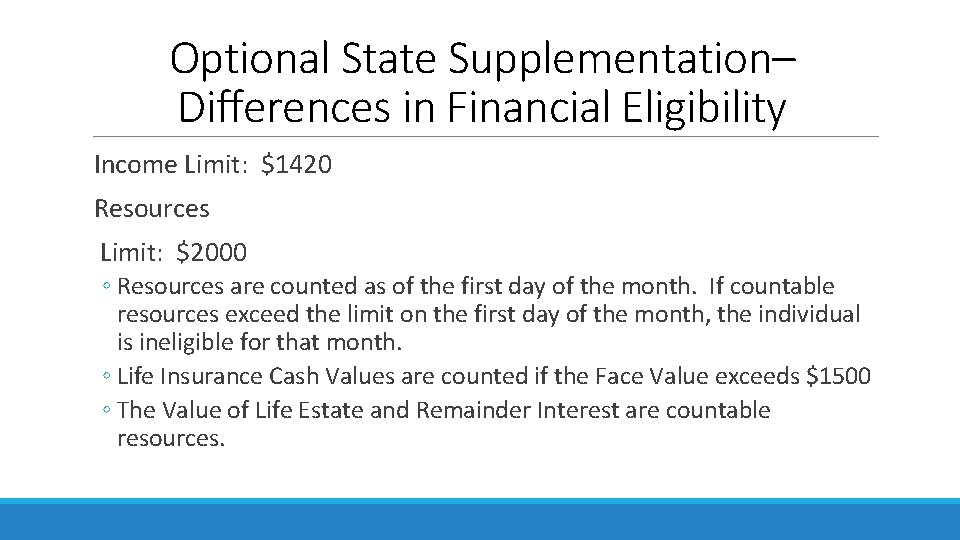
Optional State Supplementation– Differences in Financial Eligibility Income Limit: $1420 Resources Limit: $2000 ◦ Resources are counted as of the first day of the month. If countable resources exceed the limit on the first day of the month, the individual is ineligible for that month. ◦ Life Insurance Cash Values are counted if the Face Value exceeds $1500 ◦ The Value of Life Estate and Remainder Interest are countable resources.
Long Term Care Programs – Payment Categories Payment Category Income Limit Resource Limit Nursing Home – MAO NH $2205 / month* $2, 000 Individual $68, 480 Couple PC 33 ABD Nursing Home $1005 $7390 PC 54 SSI Nursing Home $735 $2, 000 PC 15 Waiver Services $2205 / month* $2, 000 Individual $68, 480 Couple PC 14 General Hospital $2205 / month $2, 000 Individual $68, 480 Couple PC 85 OSS $1420 $2, 000** PC 86 OSS/SSI $1420 $2, 000** PC 10 Name *If a nursing home or wavier services’ applicant’s income exceeds $2205, they may establish an Income Trust to qualify for Medicaid. ** Resources must be below the limit on the First Day of the month.
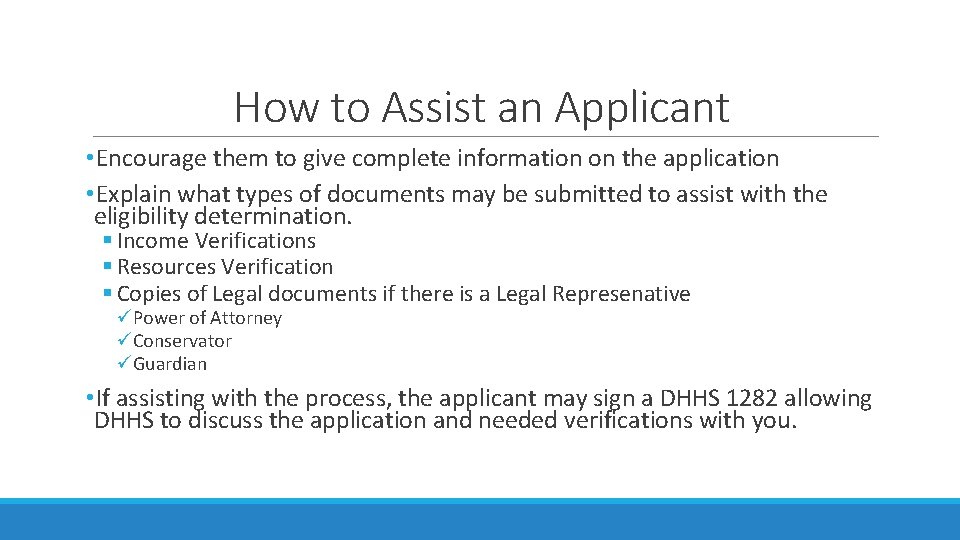
How to Assist an Applicant • Encourage them to give complete information on the application • Explain what types of documents may be submitted to assist with the eligibility determination. § Income Verifications § Resources Verification § Copies of Legal documents if there is a Legal Represenative üPower of Attorney üConservator üGuardian • If assisting with the process, the applicant may sign a DHHS 1282 allowing DHHS to discuss the application and needed verifications with you.
For More Information Donna Day Eligibility Policy and Process DAYDON@scdhhs. gov 803. 898. 2677 Lori Risk Eligibility Policy and Process Lori. Risk@scdhhs. gov 803. 898. 4562