
DIVISION OF DEVELOPMENTAL DISABILITIES 2008 MEDICAID WAIVERS HOMEBASED
DIVISION OF DEVELOPMENTAL DISABILITIES 2008 MEDICAID WAIVERS HOME-BASED SUPPORT SERVICES (HBS) SERVICE FACILITATOR TRAINING Move through this computer-based learning course at your own pace by clicking on the arrows at the bottom of the screen. There will be a test at the end of the course.
THE PURPOSE OF THIS TRAINING To prepare Qualified Mental Retardation Professionals to understand the Medicaid waiver Home-Based Support Services programs and fulfill the responsibilities of an HBS Service Facilitator within those programs. This training was first presented in August. September 2008 in a series of sessions across the state. It has been modified for Net. Learning. 2
Overview of Training The training is divided into the following general sections: n Waiver Overview and Amendments n HBS Overview n Covered Adult and Children’s HBS Services n Role of the Service Facilitator n Role of ACES$ n Other Important Information 3
An Overview of Medicaid Home and Community-Based Waivers Federal Statutory Requirements: n The waiver program must be a cost-effective alternative to Medicaid-funded services in an Intermediate Care Facility for Individuals with Developmental Disabilities (ICFDD), either a private facility or a State-Operated Developmental Center. n Total annual expenditures and numbers of people served are limited as approved by the State and the U. S. Centers for Medicare and Medicaid Services. n The rights, health, safety and welfare of waiver participants must be protected. 4
An Overview of Medicaid Home and Community -Based Waivers n n There is an intergovernmental agreement between the State and the federal Centers for Medicare and Medicaid Services (CMS) for each Medicaid waiver program. The agreement describes: n Waiver capacity n Individual eligibility criteria (tied to eligibility for ICFDD services) n Covered services n Provider standards n The State’s Quality Management Plan n Individual Service Plan requirements n Individual safeguards The Agreement allows federal reimbursement (called FFP) for ½ the cost of covered services for waiver participants. 5
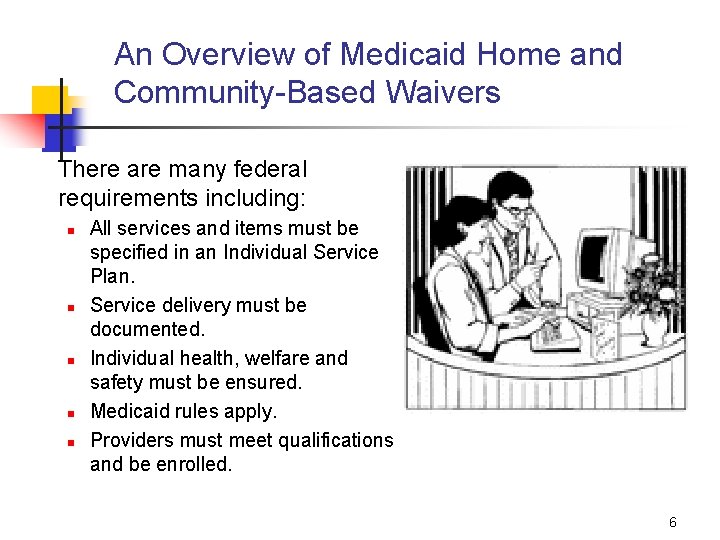
An Overview of Medicaid Home and Community-Based Waivers There are many federal requirements including: n n n All services and items must be specified in an Individual Service Plan. Service delivery must be documented. Individual health, welfare and safety must be ensured. Medicaid rules apply. Providers must meet qualifications and be enrolled. 6
An Overview of Medicaid Home and Community-Based Waivers The nine waivers in Illinois are: n DHS - Developmental Disabilities (Adult Waiver, Children’s Support Waiver, Children’s Residential Waiver) n DHS – Rehabilitation Home Services (Disabilities, Acquired Brain Injury, HIV/AIDS Waivers) n Aging - Community Care Program n U of I Division of Specialized Care for Children Technology Dependent/Medically Fragile Waiver n HFS - Supportive Living Facilities Waiver 7
Adult DD Waiver Amendment n n A recent amendment raised approved capacity to 15, 225 (from 14, 000). The amendment removed the requirement for a high school diploma or GED for domestic employees providing Personal Support. 8
DD Children’s Support Waiver Amendment n n n The amendment increased the approved capacity to 1, 100 (from 600). The amendment removed the requirement for a high school diploma or GED for domestic employees providing Personal Support. The amendment allows relatives to provide Personal Support (except legally responsible relatives). 9
Children’s Support Waiver Overview § The DD Children’s Support Waiver (CSW) is designed to be similar § § § to the adult HBS program. In CSW, also called Children’s HBS, only the child’s income and assets count in determining Medicaid eligibility. Covered services differ from the Adult DD Waiver. Please see the Provider Waiver Manual located on the DHS website at www. dhs. state. il. us. Click on About DHS, the Publications, then Manuals. 100% of the federal funds garnered by the Children’s Support Waiver is dedicated to program expansion. 10
Home-Based Support Services (HBS) Overview n n HBS continues as an Adult DD Waiver option and in the DD Children’s Support Waiver. The 2008 monthly HBS service cost maximums are: n $1, 274 for all children’s HBS participants and for adult HBS participants who are in special education. n $1, 911 for all other adult HBS participants. $$$$ 11
Self Direction is Basic to Home-Based Support Services Individuals and families choose: § How best to use the monthly budget to § § § meet the individual’s needs. What services they want and need. Which qualified providers to use. Whether to choose agency-based staff or domestic employees (or a combination) to provide services. 12
Home-Based Support Services (continued): Services available for children and adults that must be within the individual’s monthly budget include: § Service Facilitation, § Personal Support, § Behavior Intervention & Treatment, and § Training and Counseling for Unpaid Caregivers. 13
HBS Services: Out-of-Home Respite § Effective August 2008, HBS participants may § § receive Out-of-Home Respite (89 D). Out-of-Home Respite is in addition to the monthly budget. It is for both children and adults. 14
HBS One Time Funding$15, 000 over Five Years § The HBS one time funding is for both children and adults. § It is in addition to the monthly budget and covers the following items: § § Adaptive equipment (53 E) Assistive technology (53 T) Home modifications (53 H) Vehicle modifications (53 V) § The one time funding requires prior approval before the funding is authorized. See Section VIII of the Provider Waiver Manual for details. 15
Individual Service and Support Advocacy (ISSA) is for both children and adult waiver participants and is in addition to the monthly budget. It provides advocacy assistance and is the first level of quality assurance. Participation in Individual Service Plan development is required of ISSA, as well as quarterly visits in the home and day program (if attending a day program). 16
Individual Service and Support Advocacy (ISSA) – continued ISSA is provided by Independent Service Coordination (ISC) agencies, also known as Pre. Admission Screening (PAS) agencies. The maximum for ISSA is 25 hours per state fiscal year. Additional hours may be allowed with prior approval. 17
Additional HBS Services for Adults Adult HBS participants have additional service options within the monthly budget. Additional adult services are: Day Habilitation programs, which include: § § Developmental Training – DT Supported Employment – SEP * Regular Work/Sheltered Employment Adult Day Care * * These require prior approval. 18
Additional HBS Services for Adults (cont. ) Adult HBS participants have additional service options within the monthly budget, including: n n n Non-Medical Transportation, Professional Therapies (Physical, Occupational and Speech), * Skilled Nursing, Temporary Intensive DT Staffing, * Emergency Home Response. * These require prior approval. 19
Additional HBS Service for Adults (cont. ) Another adult service that is in addition to the monthly budget is Temporary Assistance (formerly called Crisis Services). Temporary Assistance requires prior approval. 20
HBS Service Descriptions n n Now that we have gone over which services are available for children and for adults in HBS, we will move on to descriptions of the HBS services. Complete descriptions of services are in Section III of the Provider Waiver Manual at www. dhs. state. il. us. Click on About DHS, then Publications, then Manuals. 21
HBS Services – Service Facilitation (55 A) Service Facilitation is required every HBS participant, both children and adults. It is within the monthly budget. The Facilitator helps create and coordinate the Individual Service Plan, as well as other responsibilities. More on those responsibilities later in this training. 22
HBS Services – Personal Support (55 D) n n Personal Support is available for both children and adults within the monthly budget. Personal Support provides assistance in performing activities of daily living. It can also provide short-term respite due to the absence or need for relief of primary caregiver. It does not include professional services. 23
HBS Personal Support (continued) Examples of professional services that are not included are: n Educational tutoring by certified teacher. n Music lessons, music therapy, or art therapy. n Speech, occupational or physical therapy. n Mental Health or Behavior Counseling. n Massage therapy. n Other professional services used by the general public. 24
HBS Personal Support (continued) n To provide Personal Support, participants may choose: n Domestic employees, n Agency staff, or n A combination of both. 25
HBS Personal Support (continued) If participants choose to hire domestic employees, the following applies: n Employer finds and hires the workers. n Employer trains and supervises the workers. n Employer cannot be either the domestic employee or a participant who has a legal guardian. n ACES$ (fiscal agent) enrolls the employer and employee and issues payroll. 26
HBS Personal Support – Domestic Employee Qualifications n n n The domestic employee must be 18 years of age or older. The employee must pass a background check, if hired on or after July 1, 2007. The initial, name-based checks are done by ACES$ at no charge. A high school diploma or GED is no longer required. Spouses of adult HBS participants may not be paid Personal Support providers. Parents, stepparents, spouses, or other “legally responsible relatives” of participants in children’s HBS may not be paid Personal Support providers. Except for the above, other family members are allowed to provide Personal Support. 27
HBS Personal Support (continued) n n If participants choose, they may hire a local agency to do the following: n Provide Direct Support Personnel. n Find and hire the workers. n Train and supervise the workers. n Pay the worker directly without the help of ACES$. Please remember that the hourly cost may be higher and that the local agency must meet contractual requirements. 28
HBS Personal Support - Qualifications for Agency Staff There are some requirements for agency staff who provide Personal Support. The Agency must have a DHS contract with the Division of DD. Staff must complete Direct Support Personnel (DSP) training. Also, staff must pass background checks that include a criminal record, Health Care Workers Registry, and CANTS (if serving children 17 years of age or younger). 29
HBS Personal Support - Qualifications for Agency Staff Agency staff providing HBS services must receive training on the Office of Inspector General (OIG) abuse/neglect rule (59 Ill. Adm. Code 50) requirements at the time of hire and every two years thereafter. 30
HBS Personal Support - Qualifications for Agency Staff Agency staff providing Waiver services to individuals ages 17 and younger must receive training in DCFS reporting requirements for allegations of abuse, neglect or exploitation at the time of hire and every two years thereafter. 31
HBS Personal Support – Some Guidance n n n All Personal Support rates are negotiated. Rates must be related to the worker’s skills and training. Actual rates paid may not exceed the rate approved on the Service Agreement/Service Authorization. 32
HBS Personal Support – Guidance (cont. ) n n n Personal Support may not be provided during normal school hours for children. Personal Support may not be provided in a day program for adults. If the service plan identifies that one-on-one staff are needed in DT, the Service Facilitator should request either Temporary Intensive Staffing (53 D) or a longer term DT rate add-on. 33
Behavior Intervention and Treatment (56 U) n n Behavior Intervention and Treatment is available for both children and adults and is within the monthly budget. For adults, the maximum is 66 hours per state fiscal year. For participants in children’s HBS, there is no maximum, except the monthly budget. There are two rate levels for Behavior Intervention and Treatment, depending on provider qualifications. 34
Behavior Intervention &Treatment (continued) n n The definition includes behavior assessments, service planning and monitoring. The definition includes services specific to autism. The definition does not include general psychological evaluations. Only the services delivered personally by the enrolled professional are billable. 35
Behavior Intervention &Treatment Provider Qualifications Rate Level 1 - $77. 86/hour - Provider must be: n A clinical psychologist licensed by the Illinois Department of Financial and Professional Regulation or n A Board-Certified Behavior Analyst (BCBA) (Please refer to www. bacb. com for more information). 36
Behavior Intervention &Treatment Provider Qualifications (cont. ) Level 2 - $62. 28/hour – Provider must be: n A Board-Certified Associate Behavior Analyst (BCABA), or n A professional with a bachelor’s degree in a human service field who has completed at least 1, 500 hours of training and/or supervised experience in the application of behaviorally-based therapy models consistent with best practice and research on individuals with autism spectrum disorder, or 37
Behavior Intervention &Treatment Provider Qualifications (cont. ) Level 2 - $62. 28/hour (cont. ) Provider must be: n A professional who is certified to provide relationship development assessment. More information is at rdiconnect. com or 38
Behavior Intervention &Treatment Provider Qualifications (cont. ) Level 2 - $62. 28/hour (cont. ) Provider must be: § An Early Intervention specialist with a developmental therapy credential (this is approved for children only). 39
Behavior Intervention &Treatment Provider Qualifications (cont. ) n n A new edit was implemented July 1, 2008 to ensure providers have the appropriate professional credentials. The new reject code for this edit is 72. If bills are rejected for this reason, please check the provider qualifications section of the Provider Waiver Manual. If the professional is qualified, please contact Provider Enrollment to update/correct credentials. 40
HBS Training for Unpaid Caregivers (55 B) § HBS Training for Unpaid Caregivers is available for both children § § § and adults within the monthly budget. It covers tuition and fees. It does not include transportation, food, or lodging. The provider must be enrolled in the participant’s waiver. Medicaid rules prohibit payment before the service is rendered. If the caregiver paid in advance, he/she may be designated as the payee to be reimbursed after attending. 41
HBS Counseling for Unpaid Caregivers (55 C) § HBS Counseling for Unpaid § § Caregivers is available for both children and adults within the monthly budget. The provider must be enrolled in the participant’s waiver. Provider qualifications are the same as for Counseling for adults (57 G, 57 U). 42
HBS Day Programs for Adults § HBS day programs are available for adults and must § § be within the monthly budget. Providers must have a DHS contract with the Division of DD. Some day programs require individual prior approval. They are Supported Employment (39 U, 39 G, 36 U, 36 G) and Adult Day Care (35 U). 43
HBS Day Programs for Adults - Guidance 92 hours per month is recommended for day services to individuals in Adult HBS services. n This recommended amount allows full state fiscal year reimbursement. (92 hours per month times 12 months equals 1, 104. This is just over the state fiscal year day program maximum of 1, 100 hours. ) n 44
HBS Non-Medical Transportation for Adults (55 T) n n HBS Non-Medical Transportation is available for adults within the monthly budget. Providers must have valid license and proof of insurance. It does not include transportation to and from medical appointments (funding for that is covered by the Medicaid State Plan) It does not include transportation to and from day programs. Family fees for day program transportation are not allowed. Transportation is the responsibility of the day program provider and is included in the day program rate. 45
Temporary Intensive Staffing – DT for Adults (53 D) n Temporary Intensive Staffing is available for adults who attend a DT program and need temporary one-on-one staffing in the DT program. It is within the monthly budget. n Written prior approval is required. n 46
HBS Therapies for Adults n n HBS Therapies are available for adults within the monthly budget These therapies require written prior approval and include: n Occupational Therapy (52 O), Physical Therapy (52 P), and n Speech Therapy (52 S). n n Fiscal year maximums apply for these services. Please see the Provider Waiver Manual for the specific fiscal year maximums. 47
HBS Nursing for Adults n n HBS Nursing is available for adults within the monthly budget. The services are: n n n Skilled Nursing – RN (55 N), and Skilled Nursing – LPN (55 P). The state fiscal year maximum is 365 hours for each service. 48
HBS Temporary Assistance (53 C) for Adults (formerly Crisis Services) § HBS Temporary Assistance is available for adults in § § § addition to the monthly budget. It is for emergencies due to the absence or incapacity of the primary unpaid caregiver. Written prior approval is required. It provides up to $2, 000 per month for up to two months for additional Personal Support. Temporary Assistance may not be extended. More than one approval per year is permitted if there additional emergency situations. 49
HBS Emergency Home Response for Adults (55 W) n n n HBS Emergency Home Response is available for adults within the monthly budget. It funds installation (rate level 1) and monthly monitoring (rate level 2) of an electronic device to call for help. Providers must by approved by the Department on Aging and accept the State rate. 50
An Overview of HBS Service Facilitation responsibilities include: n n n n Developing an Individual Service Plan (ISP). Balancing the needs and wants of the participant with program requirements. Locating potential providers. Coordinating all services. Ensuring participant health, welfare and safety. Documenting response to ISP in QMRP notes every two months. Ensuring that services are within the monthly budget. Ensuring compliance with program requirements. 51
HBS Service Facilitation (55 A) – Provider Qualifications To provide Service Facilitation, agencies must have a DHS contract with the Division of DD and must ensure that Service Facilitators meet all qualifications for a QMRP in Attachment A of the DHS community services agreement. (See www. dhs. state. il. us. Click on For Providers, then Contracts) 52
HBS Service Facilitation - Initial Activities When HBS services are first starting, the HBS Service Facilitator should discuss with the participant and family: n n Covered services, Monthly budget, Service delivery and provider options, including domestic employees. Service Facilitator’s role in advocacy, planning, monitoring, and administrative activities. 53
HBS Service Facilitation - Initial Activities – Waiver Rights When HBS services are first starting, the Service Facilitator must explain the participant’s rights to the participant and family. These include: n n n Rights under the MH & DD Code and the right to appeal. (document on forms IL 462 -1201 and IL 462 -1202) Right to Confidentiality (document release of information on form IL 462 -1214) All three of these forms are in the Provider Waiver Manual appendices. 54
Waiver Appeal Rights n Waiver participants have the right to appeal adverse decisions under Medicaid, including: n n n Determination of ineligibility, Denial of services, and Discharge/ suspension/reduction of waiver services. § Waiver rule (59 Ill. Adm. Code 120) describes § requirements and the appeal process. Please note the following address change for appeals: HFS Bureau of Administrative Hearings 401 South Clinton 6 th Floor Chicago IL 60607 55
Waiver Appeal Rights (cont. ) n n Waiver participants have the right to a written notice of any adverse action. Notices must include: n The action to be taken; n n The reason and policy basis for the action; A complete statement of the individual's right to appeal, including the provider's grievance process, Department informal review and Department of Healthcare and Family Services hearing. 56
HBS Service Facilitation - Initial Responsibilities (cont. ) When HBS services are first starting, the Service Facilitator should explain the participant’s responsibilities to the participant and family. These include: n The participant must obtain and maintain Medicaid enrollment. n The participant may not receive services from another waiver or additional respite while authorized for HBS. n Services in a conflicting waiver must be terminated when HBS services actually begin (not always the effective date of the HBS award letter). 57
HBS Service Facilitation - Initial Responsibilities (cont. ) n n Individuals who have a Medicaid spenddown obligation may use the costs of HBS services received to meet the obligation. To do this, the Service Facilitator must complete the HFS-2653 to document the costs of HBS services to the DHS Family Community Resource Center, aka local office. 58
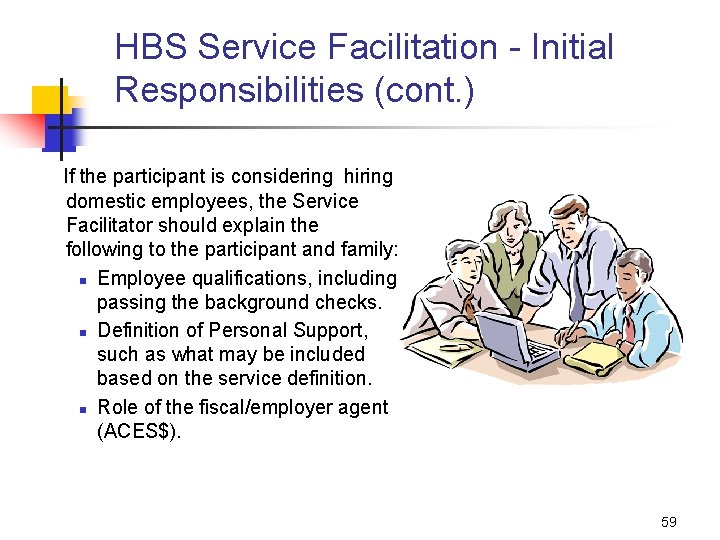
HBS Service Facilitation - Initial Responsibilities (cont. ) If the participant is considering hiring domestic employees, the Service Facilitator should explain the following to the participant and family: n Employee qualifications, including passing the background checks. n Definition of Personal Support, such as what may be included based on the service definition. n Role of the fiscal/employer agent (ACES$). 59
HBS Service Facilitation - Initial Responsibilities (cont. ) It is very important that if a family chooses to hire domestic employees, the Service Facilitator refer the employer and employees immediately to ACES$ for enrollment. The payroll for domestic employees cannot be issued before the date ACES$ obtains an Employer ID Number (EIN or FEIN). 60
HBS Service Facilitation – Individual Service Plan § § The Service Facilitator must develop an Individual Service Plan (ISP) before HBS services start. The Service Facilitator must complete Service Agreements/Authorizations with each service provider to implement the plan. The plan must be updated at least annually. For every service billed, the ISP must state the participant’s need for the service, how much the service is needed, who is to provide it, when and how often it is needed. 61
HBS Service Facilitation – Ongoing – Provider Enrollment § § Service Facilitators should verify service provider qualifications. Service Facilitators should ensure that every qualified provider submits a Medicaid Waiver provider enrollment. Domestic employee enrollments go through ACES$ as part of the employee packet. Other provider enrollments are sent directly to Provider Enrollment in the Division of DD. 62
HBS Service Facilitation – Ongoing – Prior Approval For services and items that require prior approval, the Service Facilitator must submit a prior approval request (forms are appendices to the Provider Waiver Manual) with required attachments to DDD Network staff after the planning team has identified and documented the need for the item/service. If approved, an official award letter or other written notice will be issued. 63
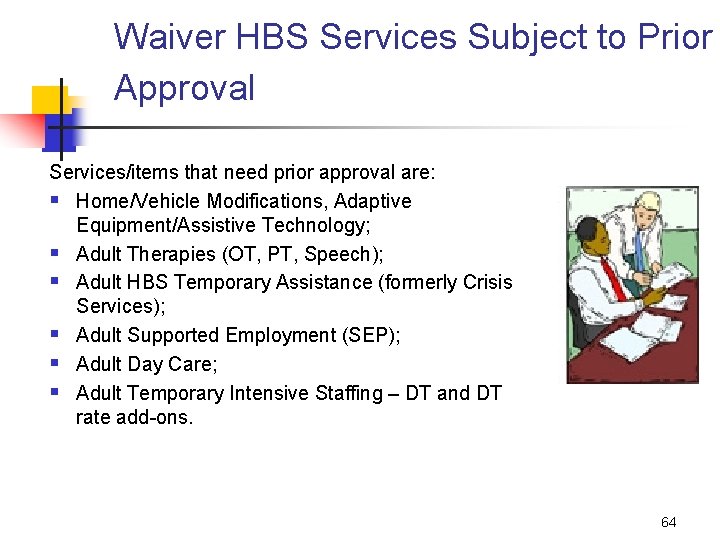
Waiver HBS Services Subject to Prior Approval Services/items that need prior approval are: § Home/Vehicle Modifications, Adaptive Equipment/Assistive Technology; § Adult Therapies (OT, PT, Speech); § Adult HBS Temporary Assistance (formerly Crisis Services); § Adult Supported Employment (SEP); § Adult Day Care; § Adult Temporary Intensive Staffing – DT and DT rate add-ons. 64
HBS Service Facilitation –Ongoing - Monitoring n n n Service Facilitators must visit the individual face-to-face at least six times per year (approximately once every two months). If the individual is a child, all six visits must be in the home. If the individual is an adult and attends a day program, two of the six required visits have to be in the day program. The other four are in the home. Additional visits may include supporting the child or young adult at the IEP meeting (to help coordinate waiver services with the IEP). Additional visits, such as the service planning meeting, may be in the home, day program (for adults), or other mutually agreed location. 65
HBS Service Facilitation –Ongoing - Budget n n n Service Agreements/Service Authorizations are important tools to manage the individual’s monthly budget. The total authorized may NOT exceed the individual’s HBS monthly budget. The Service Facilitator is responsible for making the services fit in the budget. 66
HBS Service Facilitation –Ongoing – Service Agreements n n n Service Agreements must be completed for all providers (including Service Facilitation), except domestic employees. The Service Facilitator is responsible for completing and updating Service Agreements for HBS services and items. HBS services provided to an individual without a Service Agreement may be recouped in postpayment reviews. 67
HBS Service Facilitation –Ongoing – Service Authorizations n n The Service Facilitator must complete Service Authorizations for domestic employees, sign and FAX them to ACES$. The Service Facilitator must update Service Authorizations as needed when the monthly budget changes, hours change, rates change or tax rates change. Please do not submit Service Authorization forms to ACES$ if provider is not qualified. Please do not submit Service Authorizations to ACES$ if the total authorized (when combined with the Service Agreements) exceeds the monthly budget. 68
HBS Service Facilitation – Ongoing – Service Authorizations n n n Service Authorizations may not be reduced retroactively after payroll has been issued. For flexibility, Service Authorizations may be temporarily adjusted upward as necessary to reflect needed changes. All changes must be done promptly (within a month of payroll) and documented in a supplemental or new Service Authorization. 69
HBS Service Facilitation – Ongoing - Timesheets § The Service Facilitator should help families FAX § § § domestic employee timesheets to ACES$, if needed (many participants and employers don’t have ready access to a FAX machine). For those with internet access, timesheets can be sent via the ACES$ website (www. acessfea. org) or e -mailed to timesheets@acessfea. org. If necessary to correct billing errors, the domestic employee may submit a corrected timesheet. If corrected after payroll has been issued, the domestic employee must also refund the payroll amount to ACES$. 70
HBS Service Facilitation – Ongoing - Correcting Billing Errors n n n To ensure that services are within the individual’s monthly budget, Service Facilitators should check the status of bills on a monthly basis by using the Mobius HBS exception report (CR 340091). If there are billing errors, they should check the Individual Service Plan, Service Agreements/Authorizations and rejected bills. Then work with providers and ACES$, as necessary, to adjust any bills that are incorrect. 71
HBS Service Facilitation – Ongoing - Correcting Billing Errors If the individual is over budget (Reject Code 71), please: n Compare all bills with the Service Agreements/ Authorizations to identify which provider is over. n If it is ACES$ and a domestic worker payroll needs to be corrected, contact ACES$ and the employer to revise the timesheet and repay ACES$ as necessary. n If it is another provider, contact that provider to reduce the bill as necessary. n Ask providers to resubmit changed and rejected bills. n Make it fit! 72
HBS Service Facilitation –Transition § Children’s Support Waiver participants may transition to adult § § § services on or after the child’s 18 th birthday. Transition from children’s HBS to adult HBS is not subject to the PUNS selection process. Please refer the participant to the Independent Service Coordination (aka: PAS) agency for determination of eligibility for adult services. The referral must be done after age 17½ and before age 21½. 73
HBS Service Facilitation –Transition (cont. ) n n The Children’s HBS services end on the day before the young adult’s 22 nd birthday. Children’s Support Waiver participants must transition to adult services on or before the 22 nd birthday to avoid interruption in services. 74
HBS Service Facilitation –Transition (cont. ) When a child transitions to adult services, the Service Facilitator coordinates the termination date on the Service Termination Approval Request (STAR) form for current Children’s HBS with the start date for the new services (adult HBS or CILA) with all providers. If any provider bills for CHBS services after the agreed termination date, the bill will reject or it could block the new adult service authorizations. 75
HBS Service Facilitation Guidance § Families must set aside a minimum of two hours per month for § § § Service Facilitation on the Service Agreement. Service Facilitators may negotiate additional hours if necessary. Additional hours might be especially needed when services are first starting. There is no service maximum for Service Facilitation, other than the monthly budget. Service Facilitators may bill only for actual services delivered and documented up to the agreed amount in the Service Agreement. 76
Fiscal Employer/Agent – Responsibilities of ACES$ For Personal Support workers hired by the participant/family (domestic employees), ACES$ does the following: n Conducts required initial name-based background checks. n Submits waiver enrollment for workers. n Handles employer and employee paperwork. $$$ 77
Fiscal Employer/Agent – Responsibilities of ACES$ (cont. ) Issues paychecks to domestic employees. n Calculates and files employee taxes (FICA and IRS). n Calculates and files employer FICA & unemployment taxes (SUTA & FUTA). The website for ACES$ is: www. acessfea. org. n 78
Fiscal Employer/Agent – ACES$ (cont. ) The most common problems that affect the ability of ACES$ to issue payroll in a timely manner are: § Missing or incorrect Service Authorization; § Timesheet exceeds the amount authorized on the Service Authorization; § Tardy employer or employee paperwork. These can all be corrected by the Service Facilitator working with the employer of record, the worker, and ACES$. 79
Waiver Provider Enrollment n n All providers must enroll as providers in the appropriate Medicaid Waiver(s) to be paid for services delivered. Provider Medicaid enrollments must be submitted directly to DDD, except domestic employees are submitted to ACES$ first. The enrollment forms are the HFS-1213 A and the HFS 2243. Both are appendices to the Provider Waiver Manual on the DHS website. To be paid directly by the State, providers must also submit an IRS-W 9 (also in the manual) 80
Provider Enrollment Provider Types The applicable provider type (based on which waiver the individual being served is in) must be written in the field in the upper right corner of the HFS-2243. n The Adult DD Waiver is Provider Type 91. n The Children’s Support Waiver is Provider Type 94. 81
Provider Enrollment Categories of Service List The applicable category/categories of service must be written in the correct field on the HFS-2243. n 47 - Service Facilitation n 95 - Habilitation - CILA, DT, SEP, Personal Support n 55 - Non-Medical Transportation (Adult HBS) n 94 - Adult Day Care (Adult Waiver) n 10 - Nursing (Adult HBS) n 97 - Other professional services & training for Unpaid Caregivers n 32 - Home/Vehicle Modifications n 41 - Adaptive Equipment/Assistive Technology n 98 - Emergency Home Response (Adult HBS) 82
Provider Enrollment - Non-Medical Transportation n § § § Domestic employees who also provide Transportation (55 T) must submit an IRS W-9 form to DDD Provider Enrollment with a note that they want to enroll as a transportation provider. 55 T bills are entered and transmitted by the Service Facilitation agency. The warrant (check) is issued by the State Comptroller. The amount paid for 55 T will be reported at the end of the calendar year to the provider and the IRS on an IRS- 1099 MISC form for tax purposes. 83
Provider Enrollment - National Provider ID # (NPI) n n n Providers of HIPAA-covered health care and behavior health services must have an NPI on file with DHS. HIPAA-covered Waiver services include: n Therapies (OT, PT, speech) n Nursing n Behavior Intervention and Treatment n Psychotherapy and Counseling A NPI is required on the waiver provider enrollment form (HFS-2243). Non-Waiver health care providers must send their NPI’s to Provider Enrollment in the Division of DD. 84
Payment Policy in Long Term Care or Hospital n n The Waivers are a community-based alternative to institutional services. Therefore, individuals may not receive Waiver services while admitted to a hospital or a long term care facility (LTC). LTC’s includes ICFDD’s, nursing facilities and State. Operated Facilities. 85
Payment policy in Long Term Care or Hospital (cont. ) There are Three Exceptions to this policy: Exception #1 is Service Facilitation (55 A). § May bill to notify other waiver providers of hospital or LTC admission. § May bill to assist with discharge and return home, if needed. Exception #2 is ISSA (50 D). § May bill to assist with discharge and return home, if needed. Exception #3 is Behavior Intervention & Treatment (56 U). § May bill to plan for behavioral interventions, if needed, so that the individual can return home. 86
Audit Trail/Documentation Requirements The following are documentation requirements for audit trail purposes: § Who was served; § Who provided service; § Type of service delivered; § Amount of service; § Date and time services began; § Date and time services ended; § For transportation, the destination must be identified. 87
Audit Trail/Documentation Requirements (cont. ) Service Facilitators must also document: § Results of visits, § Response to the Individual Service Plan, § Any concerns about individual health, welfare and safety and efforts to resolve those concerns. 88
Audit Trail/Documentation Requirements (cont. ) § DHS will continue to conduct desk audits § § and documentation reviews. The DDD may recoup payment when there is a lack of adequate documentation of service delivery. All services must be included in the Individual Service Plan (ISP). 89
DCFS CANTS Process § CANTS stands for the Department Of Children and § § Family Services (DCFS) background check of the Child Abuse and Neglect Tracking System (CANTS). Agencies must conduct a CANTS check on all employees providing Waiver services to children ages 17 and younger There is no charge to the provider. 90
DCFS CANTS Process (cont. ) n n Non-DCFS licensed providers can obtain the required form by downloading the background check form (CFS 689) from the DCFS website at: www. state. il. us/dcfs. A link to the form is also on the DHS website at www. dhs. state. il. us, as an appendix to the Provider Waiver Manual. 91
DCFS CANTS Process (cont. ) All CANTS forms should be mailed to: DCFS 406 E. Monroe, Station #30, Springfield, IL 62701 § Please allow approximately two weeks for a reply. § DCFS does not accept these forms as faxes. n 92
Resources n n For details on DHS contract requirements, please see the DHS website, www. dhs. state. il. us. Click on “For Providers”, then click on “Contracts”. The DHS website now includes links to forms and attachments. Click on “About DHS”, then click on “Publications”, then click on “Manuals”. Then click on the Provider Waiver Manual. 93
Resources Chicago Network: (312) 814 -2735 Greater IL Network: (217) 524 -2515 OR For network staff direct telephone numbers, go to the DHS website, www. dhs. state. il. us. Click on “About DHS”, then click on “Divisions”, then click on “Developmental Disabilities”, then click on “Contacts for Services”. 94
Resources Commonly needed numbers for the Division of Developmental Disabilities: 56 U provider qualifications (217) 557 -6260 Provider enrollment (217) 782 -3719 FAX # for enrollments and diplomas (217) 5582799 ACES$: (877) 223 -7781 95
THE END We hope you found this training module useful and applicable to your work as a Home-Based Support Service Facilitator. Please proceed to the test for this training module. 96
- Slides: 96