RSD the PACIFIC WAY Lingam Narsamma Sharma Lalita
- Slides: 14
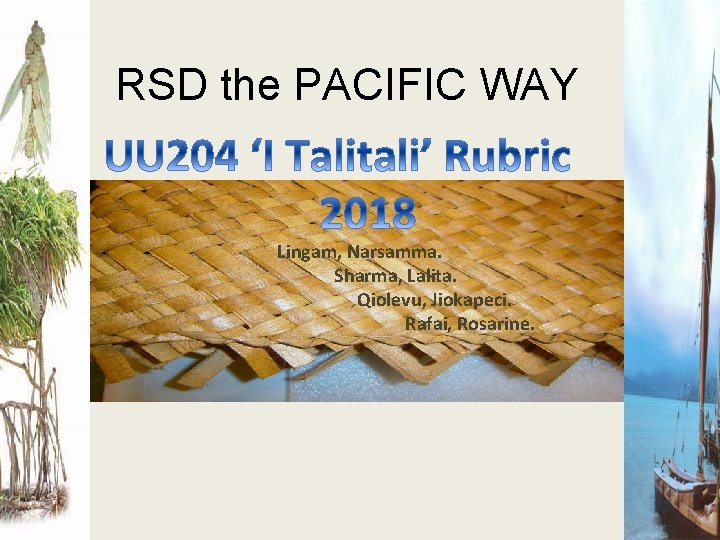
RSD the PACIFIC WAY Lingam, Narsamma. Sharma, Lalita. Qiolevu, Jiokapeci. Rafai, Rosarine.
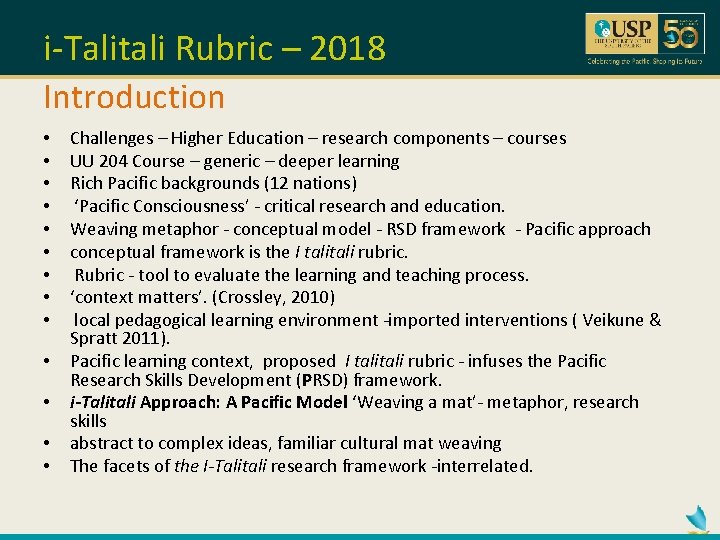
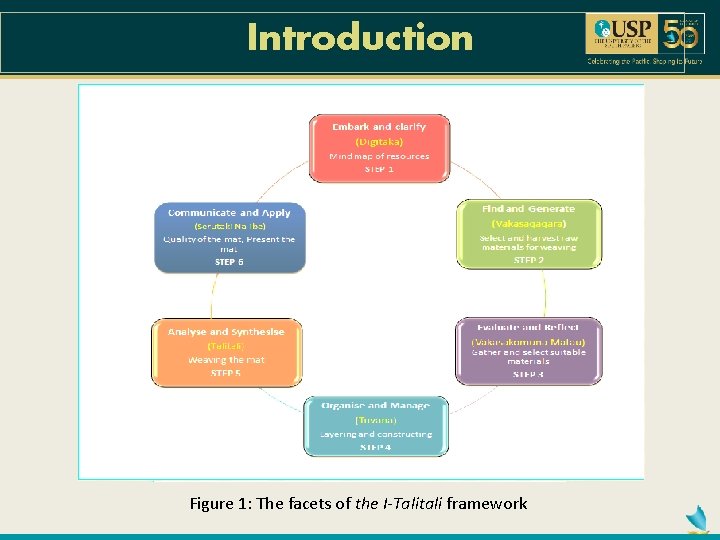
i-Talitali Rubric – 2018 Introduction • • • • Challenges – Higher Education – research components – courses UU 204 Course – generic – deeper learning Rich Pacific backgrounds (12 nations) ‘Pacific Consciousness’ - critical research and education. Weaving metaphor - conceptual model - RSD framework - Pacific approach conceptual framework is the I tali rubric. Rubric - tool to evaluate the learning and teaching process. ‘context matters’. (Crossley, 2010) local pedagogical learning environment -imported interventions ( Veikune & Spratt 2011). Pacific learning context, proposed I tali rubric - infuses the Pacific Research Skills Development (PRSD) framework. i-Talitali Approach: A Pacific Model ‘Weaving a mat’- metaphor, research skills abstract to complex ideas, familiar cultural mat weaving The facets of the I-Talitali research framework -interrelated.
Introduction Figure 1: The facets of the I-Talitali framework
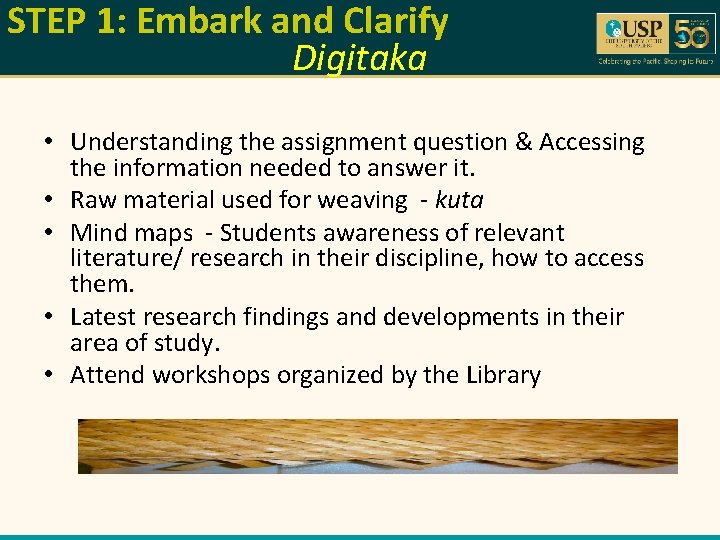
STEP 1: Embark and Clarify Digitaka • Understanding the assignment question & Accessing the information needed to answer it. • Raw material used for weaving - kuta • Mind maps - Students awareness of relevant literature/ research in their discipline, how to access them. • Latest research findings and developments in their area of study. • Attend workshops organized by the Library
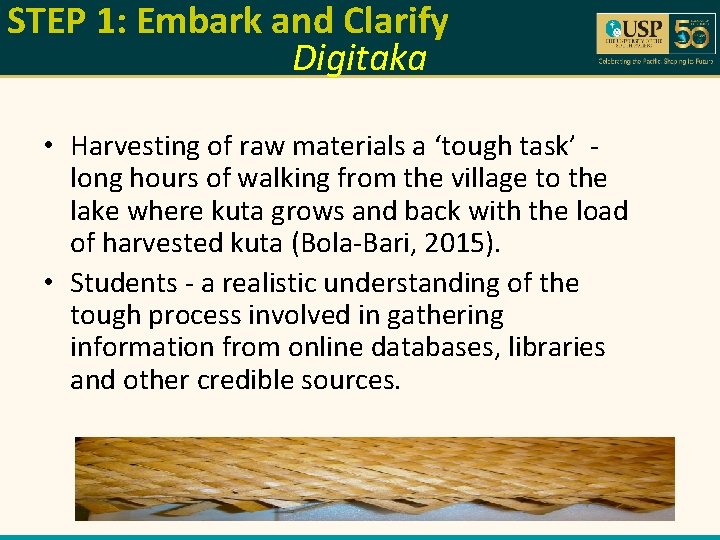
STEP 1: Embark and Clarify Digitaka • Harvesting of raw materials a ‘tough task’ long hours of walking from the village to the lake where kuta grows and back with the load of harvested kuta (Bola-Bari, 2015). • Students - a realistic understanding of the tough process involved in gathering information from online databases, libraries and other credible sources.
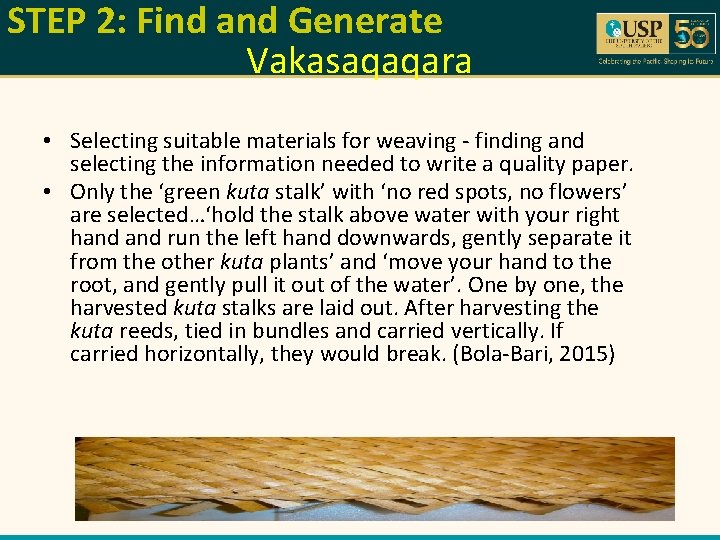
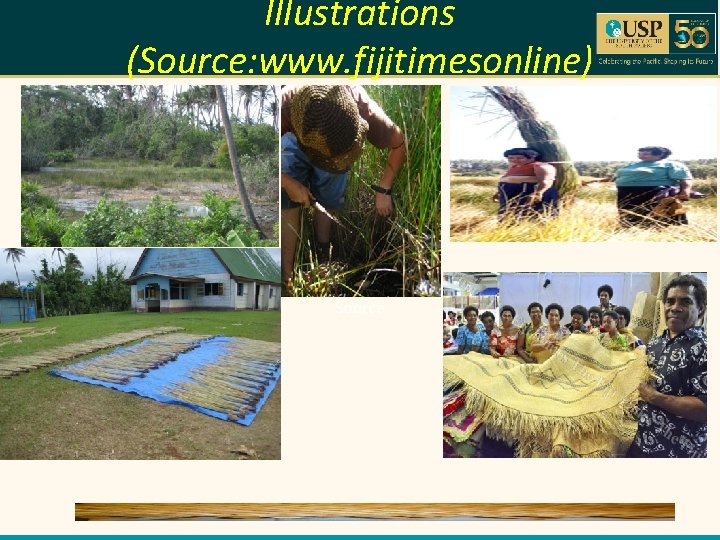
STEP 2: Find and Generate Vakasaqaqara • Selecting suitable materials for weaving - finding and selecting the information needed to write a quality paper. • Only the ‘green kuta stalk’ with ‘no red spots, no flowers’ are selected…‘hold the stalk above water with your right hand run the left hand downwards, gently separate it from the other kuta plants’ and ‘move your hand to the root, and gently pull it out of the water’. One by one, the harvested kuta stalks are laid out. After harvesting the kuta reeds, tied in bundles and carried vertically. If carried horizontally, they would break. (Bola-Bari, 2015)
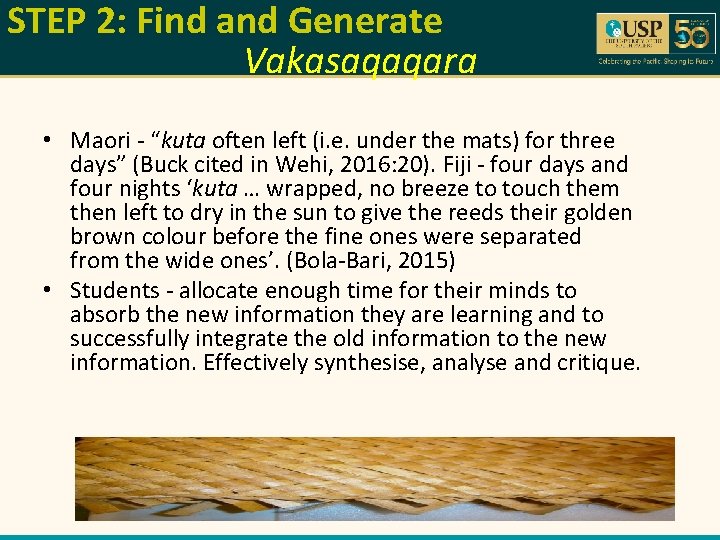
STEP 2: Find and Generate Vakasaqaqara • Maori - “kuta often left (i. e. under the mats) for three days” (Buck cited in Wehi, 2016: 20). Fiji - four days and four nights ‘kuta … wrapped, no breeze to touch them then left to dry in the sun to give the reeds their golden brown colour before the fine ones were separated from the wide ones’. (Bola-Bari, 2015) • Students - allocate enough time for their minds to absorb the new information they are learning and to successfully integrate the old information to the new information. Effectively synthesise, analyse and critique.
Illustrations (Source: www. fijitimesonline) com Source
STEP 3: Evaluate and Reflect (Vakasokomuna Vakamatau) i-Talitali Rubric • Gather and select suitable materials RSD • Cites credible sources • Paper includes personal reflection • Paper includes oral history
STEP 4: Organise and Manage (Tuvana) i-Talitali • Layering and constructing of raw materials RSD • Content is well structured overall, coherent / logical flow of text.
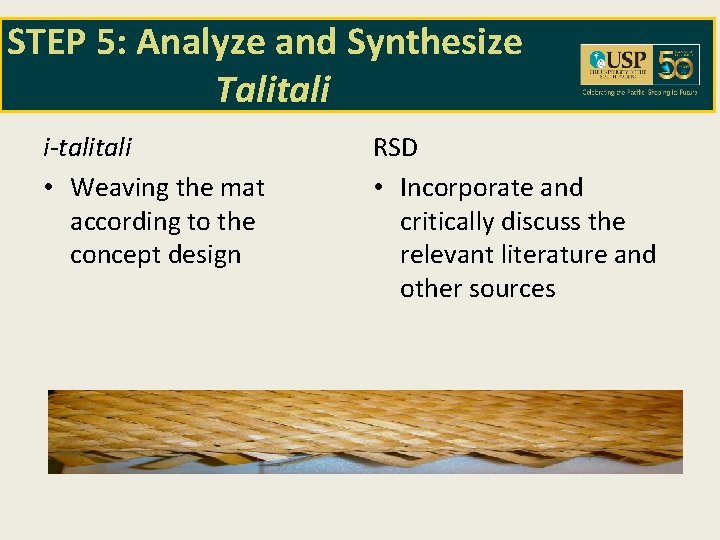
STEP 5: Analyze and Synthesize Talitali i-tali • Weaving the mat according to the concept design RSD • Incorporate and critically discuss the relevant literature and other sources
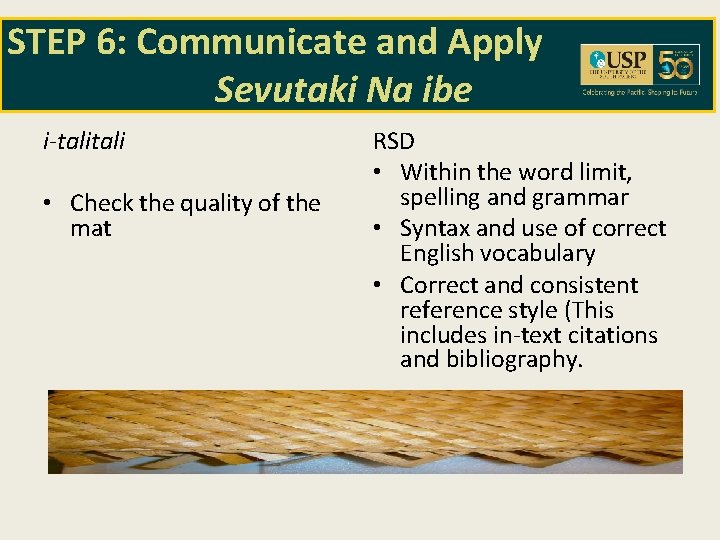
STEP 6: Communicate and Apply Sevutaki Na ibe i-tali • Check the quality of the mat RSD • Within the word limit, spelling and grammar • Syntax and use of correct English vocabulary • Correct and consistent reference style (This includes in-text citations and bibliography.
Conclusion • • • Propose the ‘I tali’ rubric Potential to enhance -learning and teaching UU 204 course Research-based learning in a Pacific context. Anticipated ‘I tali‘ rubric vigor in research encourages deeper learning contextualised RSD framework. ‘I tali’ rubric gifted to nurture Vinaka Vakalevu, Dhanevard & Fḁiäksia
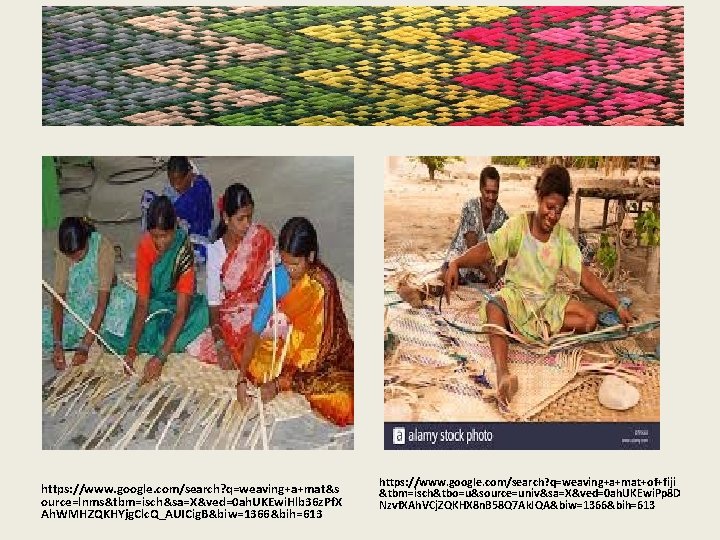
https: //www. google. com/search? q=weaving+a+mat&s ource=lnms&tbm=isch&sa=X&ved=0 ah. UKEwi. Hlb 36 z. Pf. X Ah. WMHZQKHYjg. Clc. Q_AUICig. B&biw=1366&bih=613 https: //www. google. com/search? q=weaving+a+mat+of+fiji &tbm=isch&tbo=u&source=univ&sa=X&ved=0 ah. UKEwi. Pp 8 D Nzvf. XAh. VCj. ZQKHX 8 n. B 58 Q 7 Ak. IQA&biw=1366&bih=613