Rotation curve kinematics Complications 1 inclination correction 2




- Slides: 28
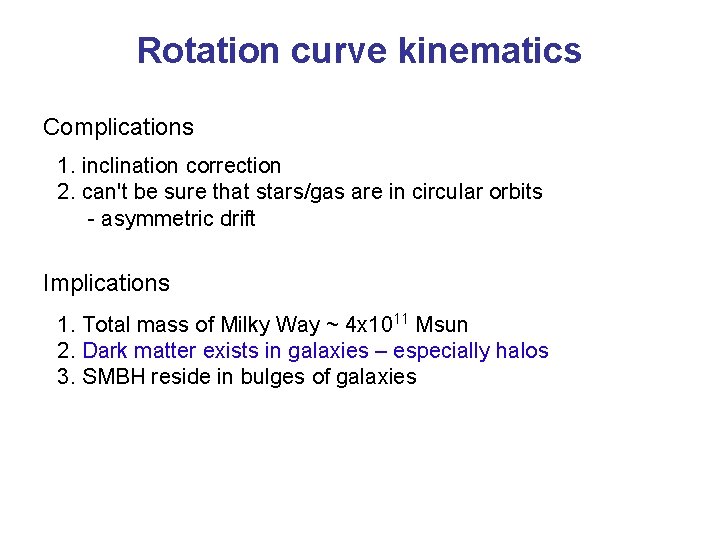
Rotation curve kinematics Complications 1. inclination correction 2. can't be sure that stars/gas are in circular orbits - asymmetric drift Implications 1. Total mass of Milky Way ~ 4 x 10¹¹ Msun 2. Dark matter exists in galaxies – especially halos 3. SMBH reside in bulges of galaxies 4. Distance estimator: Tully-Fisher relation
Rotation curve kinematics Complications 1. inclination correction 2. can't be sure that stars/gas are in circular orbits - asymmetric drift Early-type dwarf galaxy with disk (Lisker and Fuchs 2009)
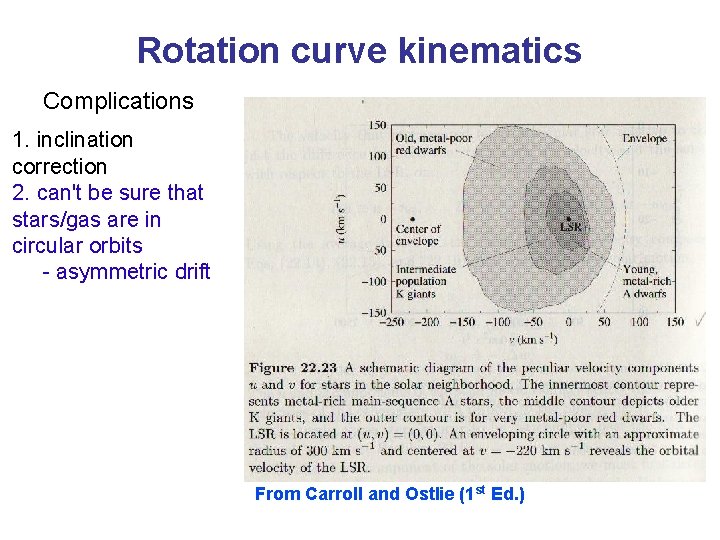
Rotation curve kinematics Complications 1. inclination correction 2. can't be sure that stars/gas are in circular orbits - asymmetric drift From Carroll and Ostlie (1 st Ed. )
Rotation curve kinematics Complications 1. inclination correction 2. can't be sure that stars/gas are in circular orbits - asymmetric drift Implications 1. Total mass of Milky Way ~ 4 x 10¹¹ Msun 2. Dark matter exists in galaxies – especially halos 3. SMBH reside in bulges of galaxies
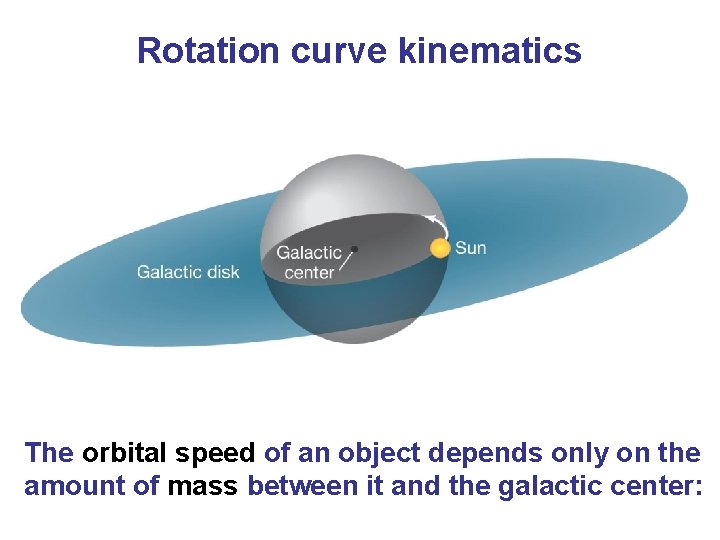
Rotation curve kinematics The orbital speed of an object depends only on the amount of mass between it and the galactic center:
Rotation curve kinematics Milky Way rotation More than twice the mass of the galaxy would have to be outside the visible part to reproduce the observed curve.
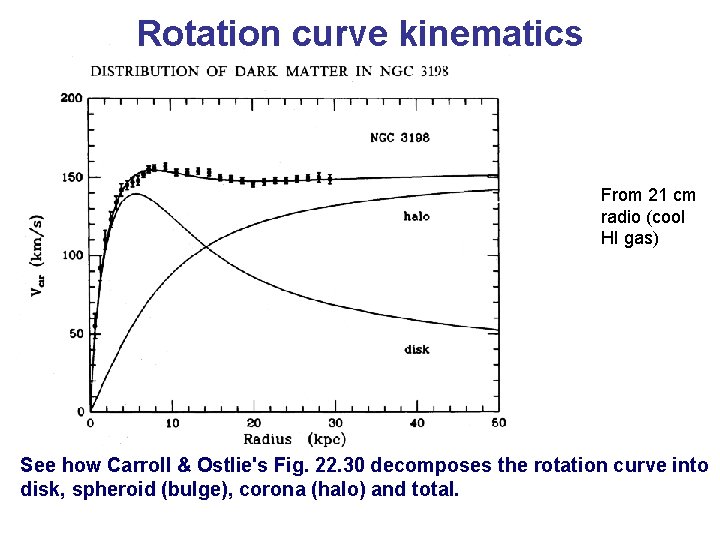
Rotation curve kinematics From 21 cm radio (cool HI gas) See how Carroll & Ostlie's Fig. 22. 30 decomposes the rotation curve into disk, spheroid (bulge), corona (halo) and total.
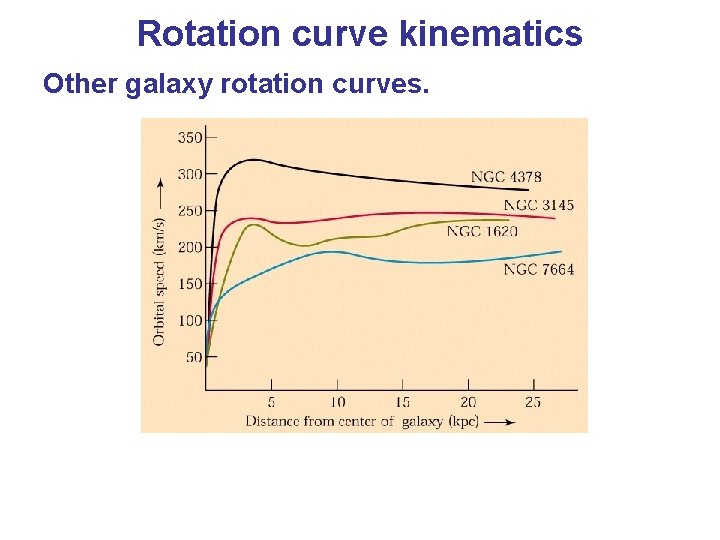
Rotation curve kinematics Other galaxy rotation curves.
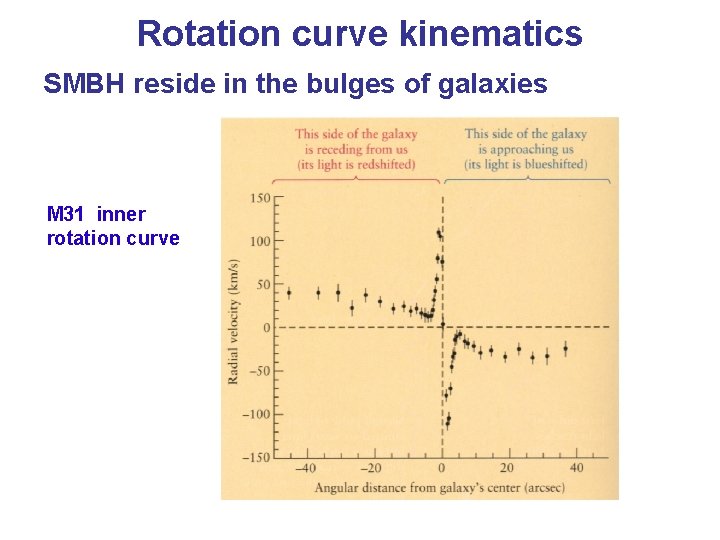
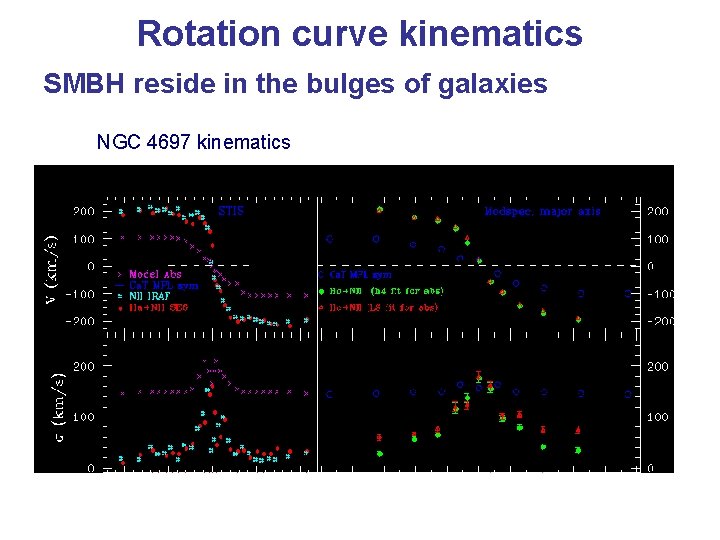
Rotation curve kinematics SMBH reside in the bulges of galaxies M 31 inner rotation curve
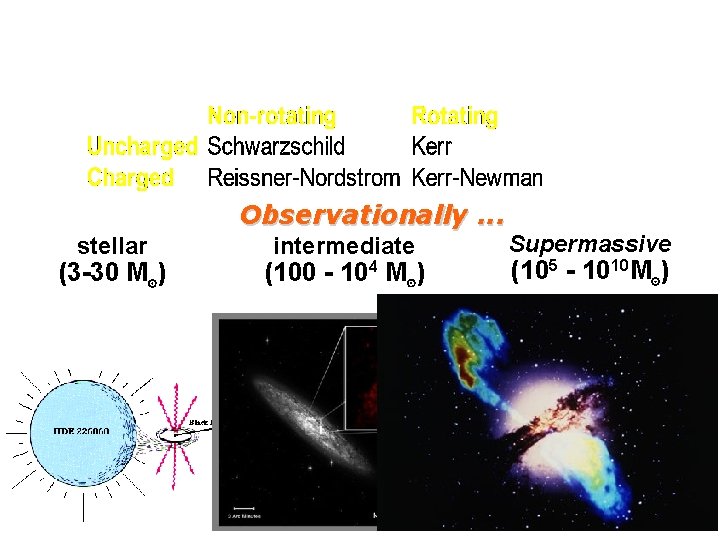
Observationally. . . stellar (3 -30 M⊙) intermediate (100 - 104 M⊙) Supermassive (105 - 1010 M⊙)
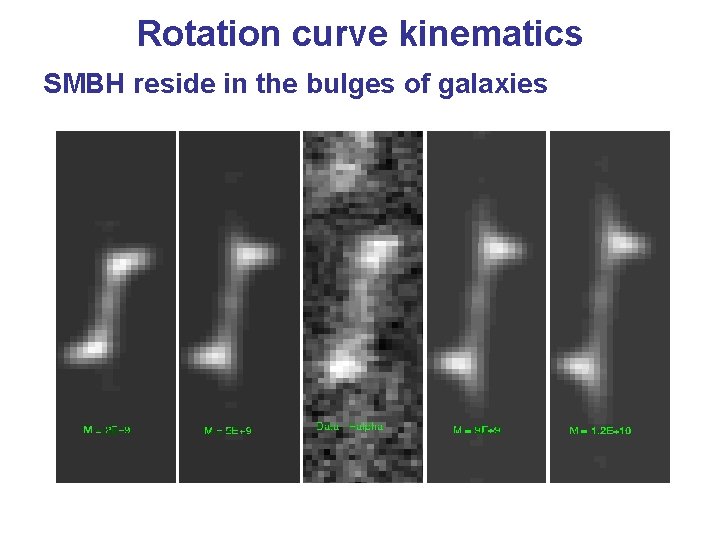
Rotation curve kinematics SMBH reside in the bulges of galaxies
Rotation curve kinematics SMBH reside in the bulges of galaxies NGC 4697 kinematics
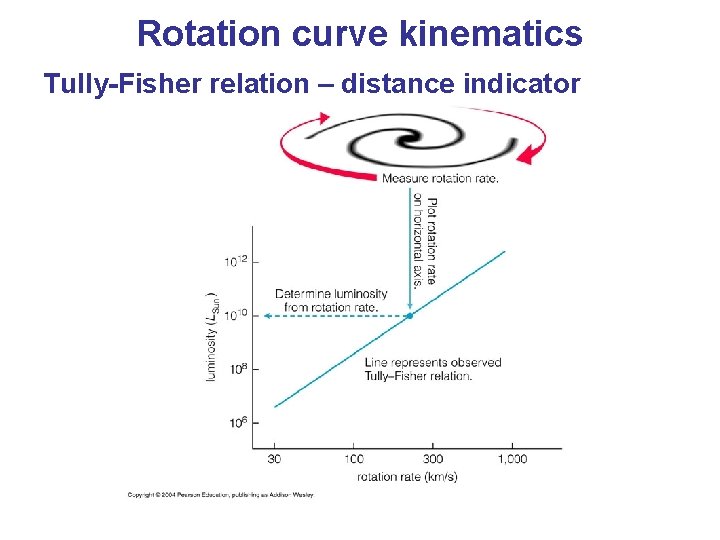
Rotation curve kinematics Tully-Fisher relation – distance indicator
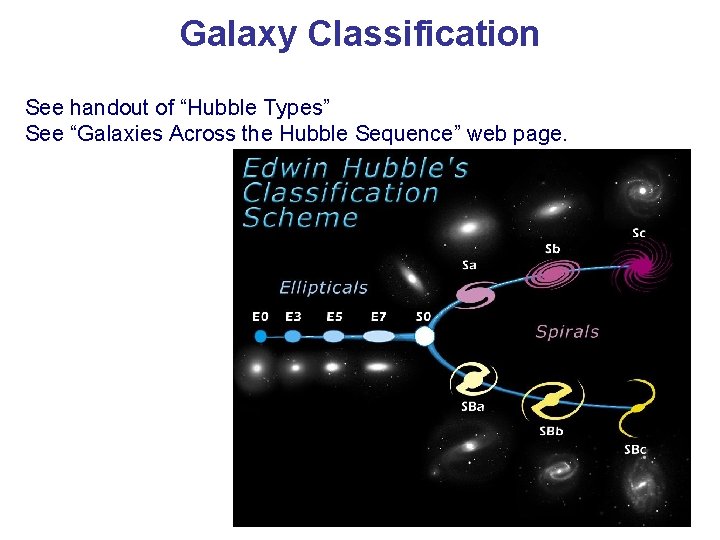
Galaxy Classification See handout of “Hubble Types” See “Galaxies Across the Hubble Sequence” web page.
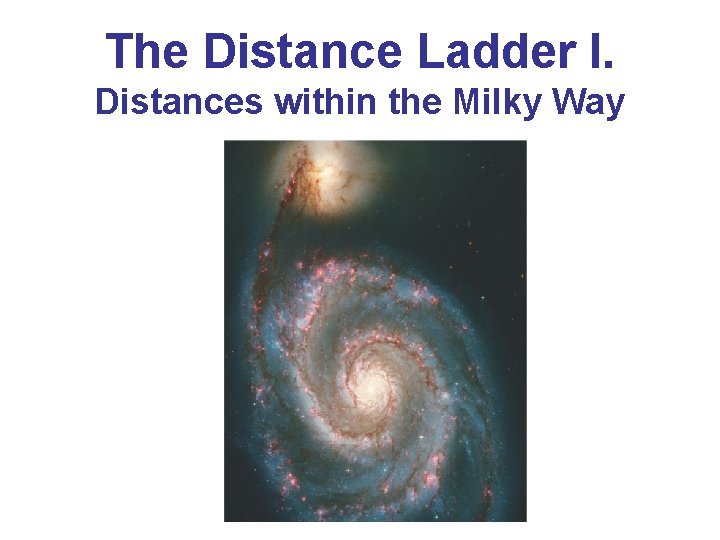
The Distance Ladder I. Distances within the Milky Way
Distance Scale 1. Distances within the Milky Way a) Stellar and spectroscopic parallax b) “Standard Candles” or “Beasts of a kind” concept c) Herschel's star counts d) “Intrinsic” Variable Stars e) Other Distance Indicators
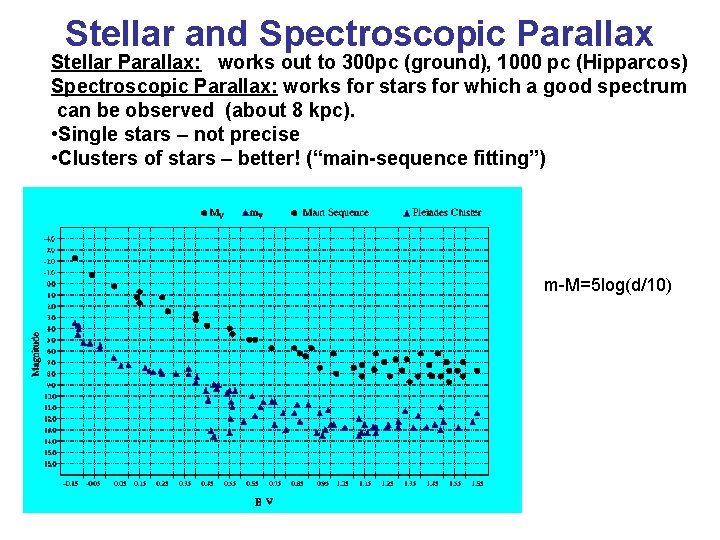
Stellar and Spectroscopic Parallax Stellar Parallax: works out to 300 pc (ground), 1000 pc (Hipparcos) Spectroscopic Parallax: works for stars for which a good spectrum can be observed (about 8 kpc). • Single stars – not precise • Clusters of stars – better! (“main-sequence fitting”) m-M=5 log(d/10)
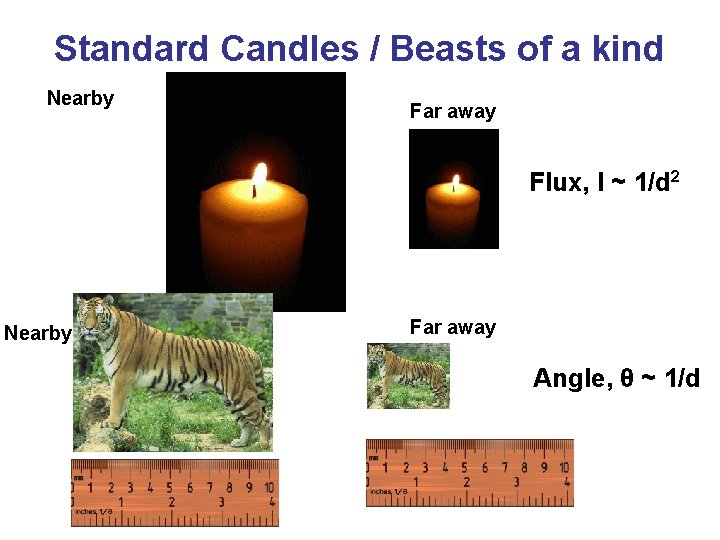
Standard Candles / Beasts of a kind Nearby Far away Flux, I ~ 1/d 2 Nearby Far away Angle, θ ~ 1/d
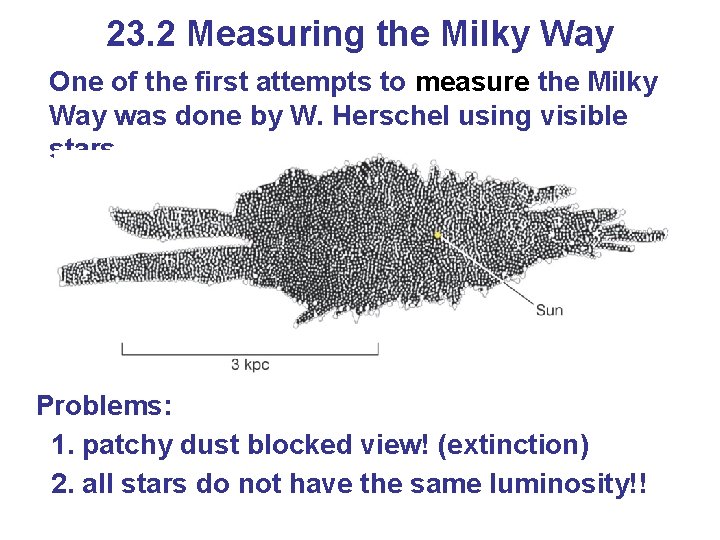
23. 2 Measuring the Milky Way One of the first attempts to measure the Milky Way was done by W. Herschel using visible stars. Problems: 1. patchy dust blocked view! (extinction) 2. all stars do not have the same luminosity!!
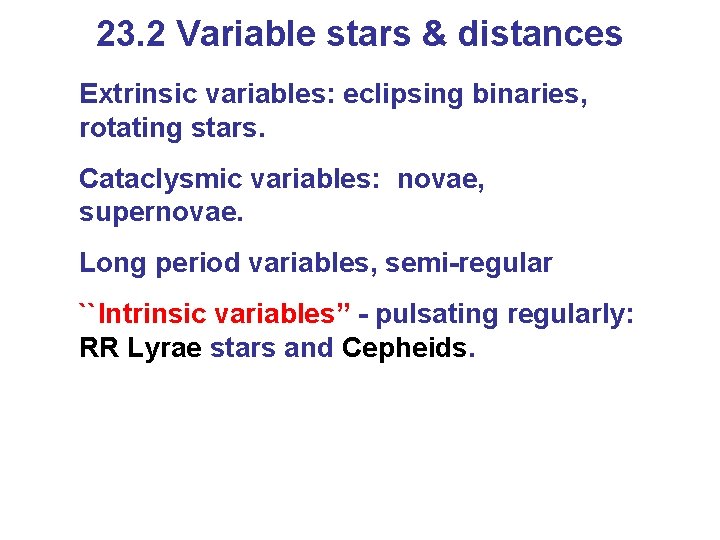
23. 2 Variable stars & distances Extrinsic variables: eclipsing binaries, rotating stars. Cataclysmic variables: novae, supernovae. Long period variables, semi-regular ``Intrinsic variables” - pulsating regularly: RR Lyrae stars and Cepheids.
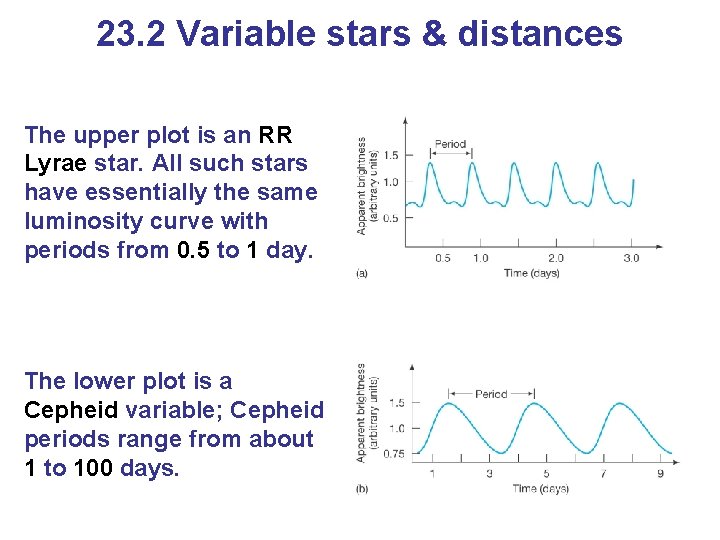
23. 2 Variable stars & distances The upper plot is an RR Lyrae star. All such stars have essentially the same luminosity curve with periods from 0. 5 to 1 day. The lower plot is a Cepheid variable; Cepheid periods range from about 1 to 100 days.
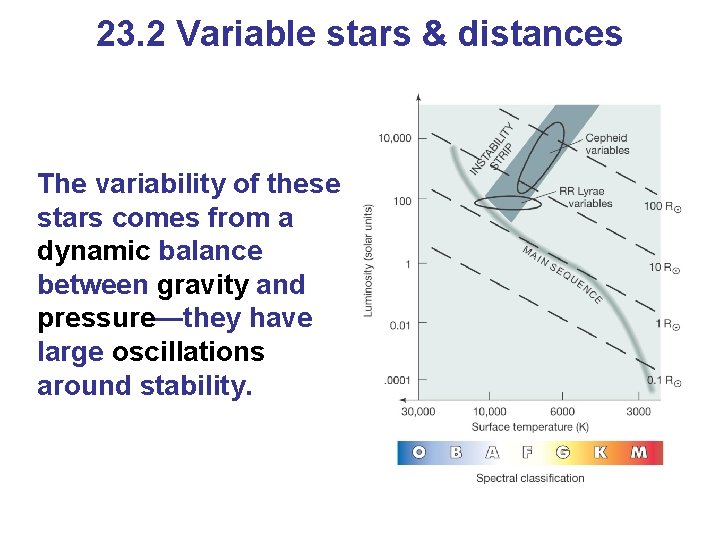
23. 2 Variable stars & distances The variability of these stars comes from a dynamic balance between gravity and pressure—they have large oscillations around stability.
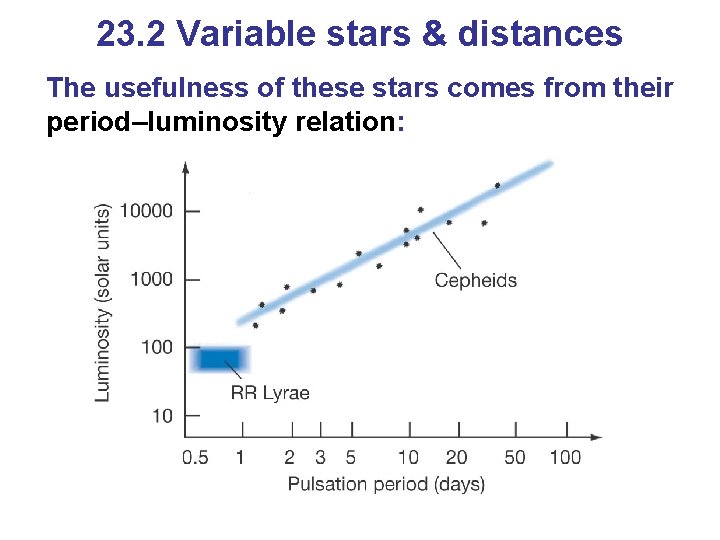
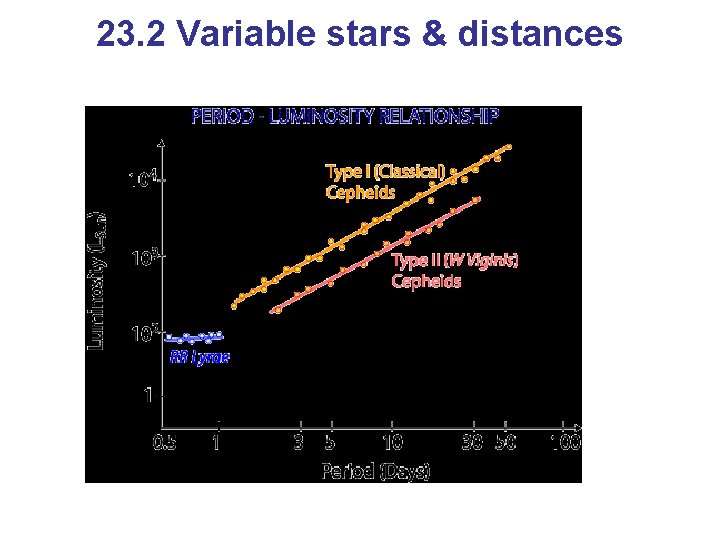
23. 2 Variable stars & distances The usefulness of these stars comes from their period–luminosity relation:
23. 2 Variable stars & distances
23. 2 Variable stars & distances This allows us to measure the distances to these stars: • RR Lyrae stars all have about the same luminosity; knowing their apparent magnitude allows us to calculate the distance. • Cepheids have a luminosity that is strongly correlated with the period of their oscillations; once the period is measured, the luminosity is known and we can proceed as above.
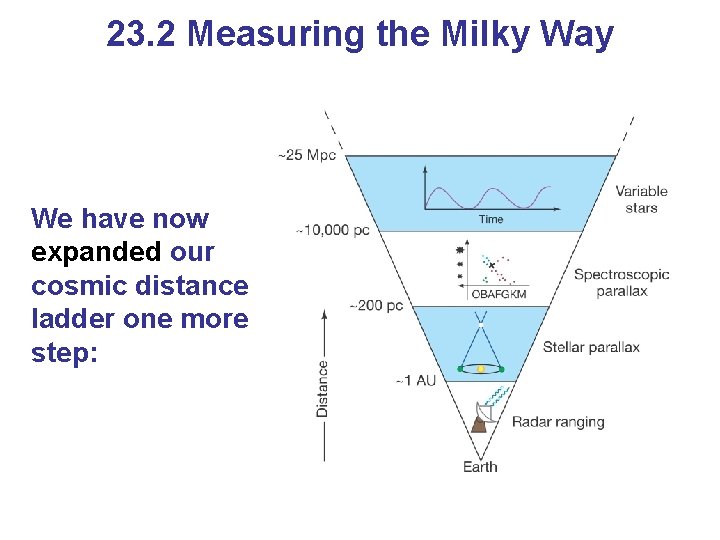
23. 2 Measuring the Milky Way We have now expanded our cosmic distance ladder one more step:
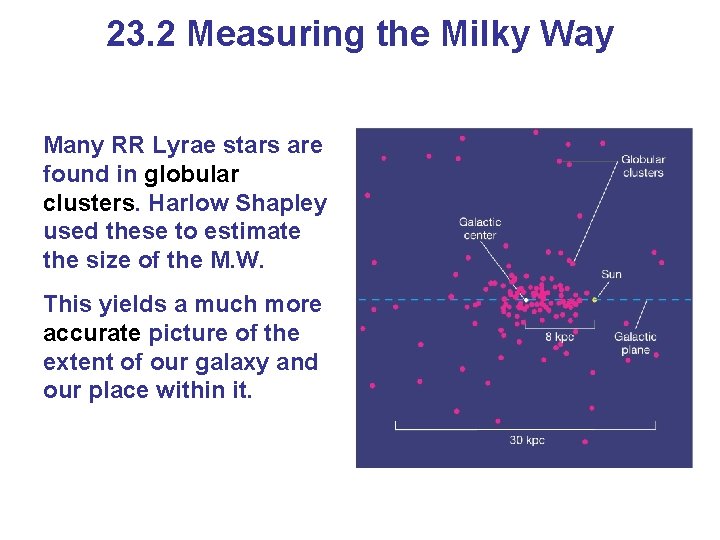
23. 2 Measuring the Milky Way Many RR Lyrae stars are found in globular clusters. Harlow Shapley used these to estimate the size of the M. W. This yields a much more accurate picture of the extent of our galaxy and our place within it.
23. 2 Other stellar distance indicators Brightest blue stars Brightest red stars Tip of the red giant branch (TRGB) Planetary nebula luminosity function (PNLF) globular cluster luminosity function (GCLF) Novae (see slide 41 of Stel. Evol. ) Supernovae