
Learning Objective Describe the global winds by reading
Learning Objective Describe the global winds by reading a science text and creating diagrams. Think-Pair-Share: What is wind? How is it created?
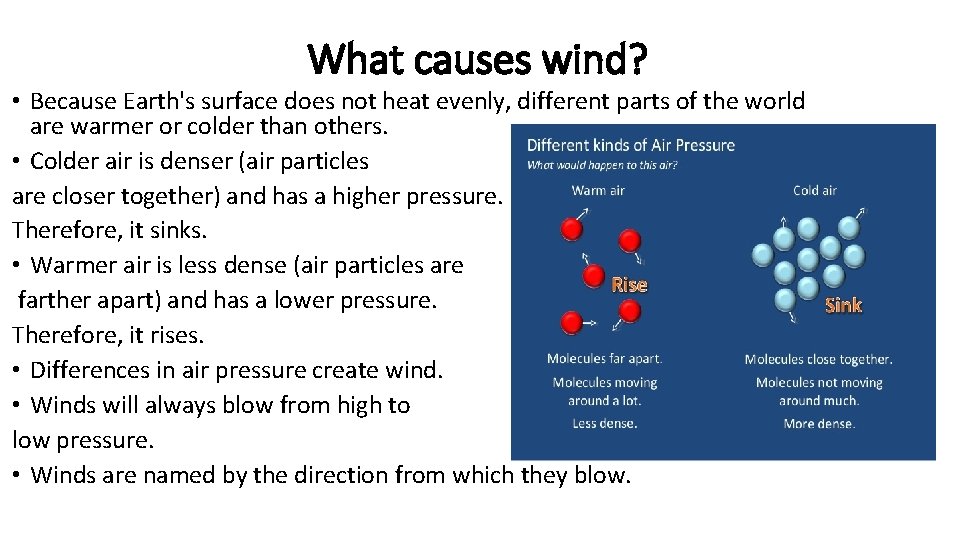
What causes wind? • Because Earth's surface does not heat evenly, different parts of the world are warmer or colder than others. • Colder air is denser (air particles are closer together) and has a higher pressure. Therefore, it sinks. • Warmer air is less dense (air particles are farther apart) and has a lower pressure. Therefore, it rises. • Differences in air pressure create wind. • Winds will always blow from high to low pressure. • Winds are named by the direction from which they blow.

The Coriolis Effect • The way Earth’s rotation makes winds curve is called the Coriolis effect. • In Northern hemisphere=objects deflected to the Right • In Southern hemisphere=objects deflected to the Left. • The effect is named after its discoverer, French mathematician Gaspard de Coriolis (1792– 1843)
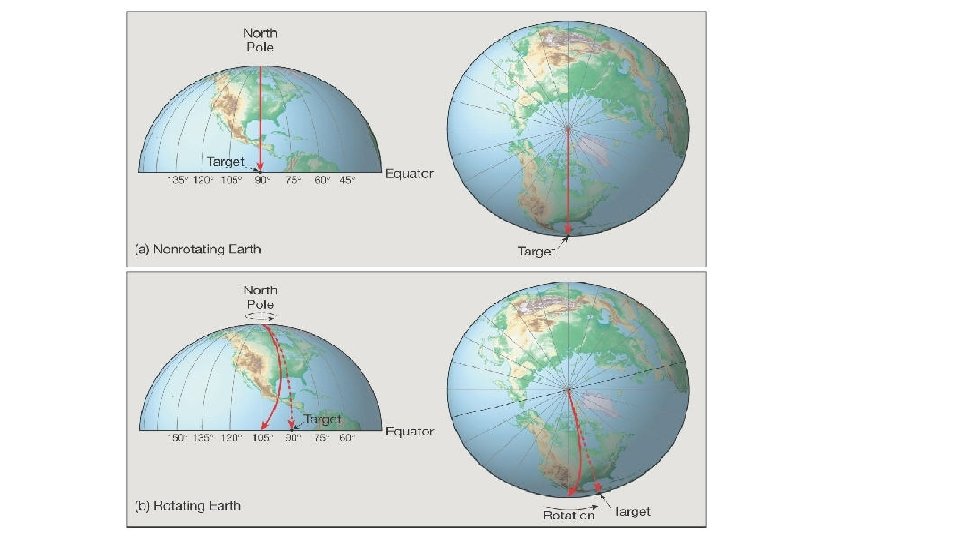

The Coriolis force is zero right at the equator. Amount of deflection is related to both an object’s speed and its latitude. Slowly blowing winds will be deflected by a smaller amount than strong winds. Like-wise, winds blowing closer to the poles will be deflected more than winds at the same speed closer to the equator.

• https: //earth. nullschool. net/#current/wind/isobaric/1000 h. Pa/orthog raphic=-93. 89, 30. 11, 441 • http: //www. phschool. com/atschool/phsciexp/active_art/global_wind s/
Think-Pair-Share • Draw a straight line on a piece of paper as your classmate turns the paper in a counter-clockwise direction. • What happens to your line? • Does it stay straight? Why not?

Global Convection Currents • Temperature and pressure differences between the equator and the poles produce giant convection currents in the atmosphere.
Global Wind Belts The major global wind belts are the: • Trade Winds • Prevailing westerlies • Polar easterlies

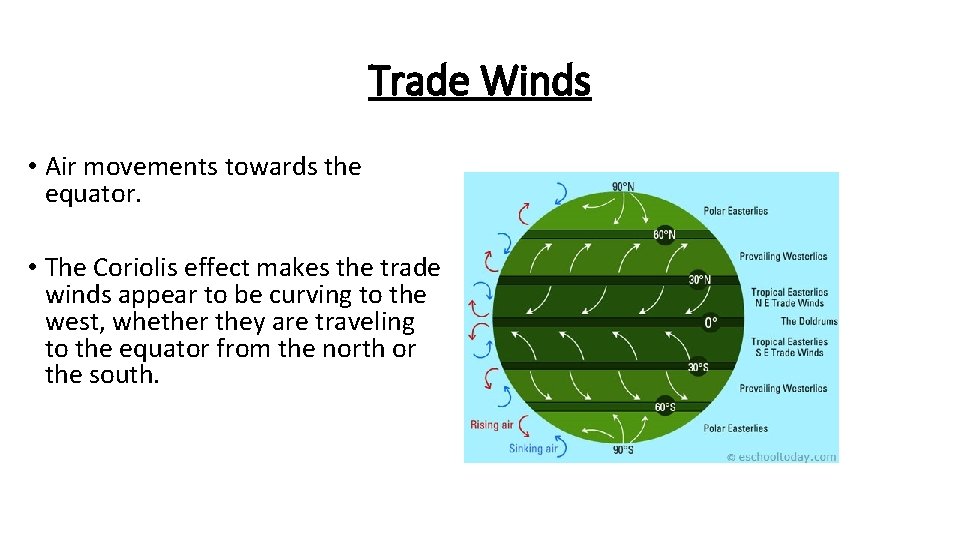
Trade Winds • Air movements towards the equator. • The Coriolis effect makes the trade winds appear to be curving to the west, whether they are traveling to the equator from the north or the south.
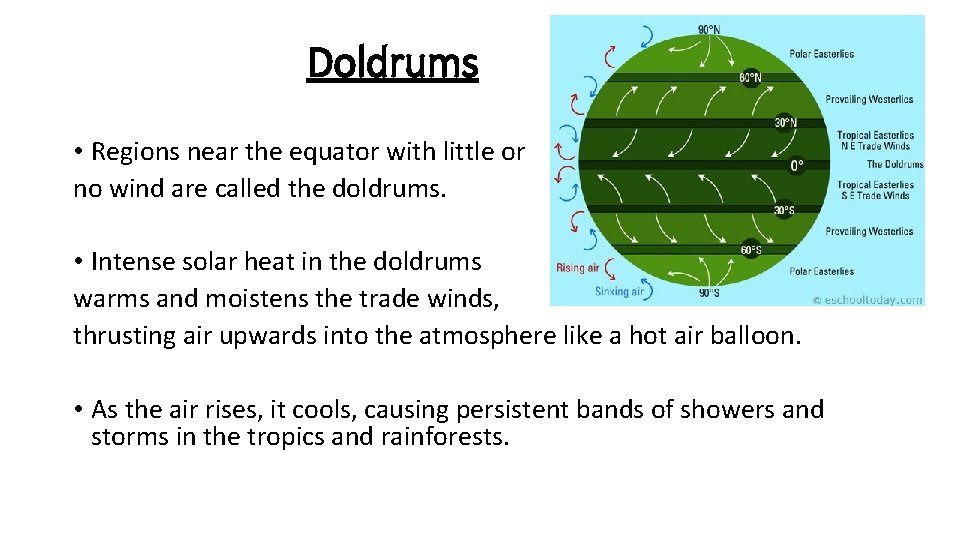
Doldrums • Regions near the equator with little or no wind are called the doldrums. • Intense solar heat in the doldrums warms and moistens the trade winds, thrusting air upwards into the atmosphere like a hot air balloon. • As the air rises, it cools, causing persistent bands of showers and storms in the tropics and rainforests.
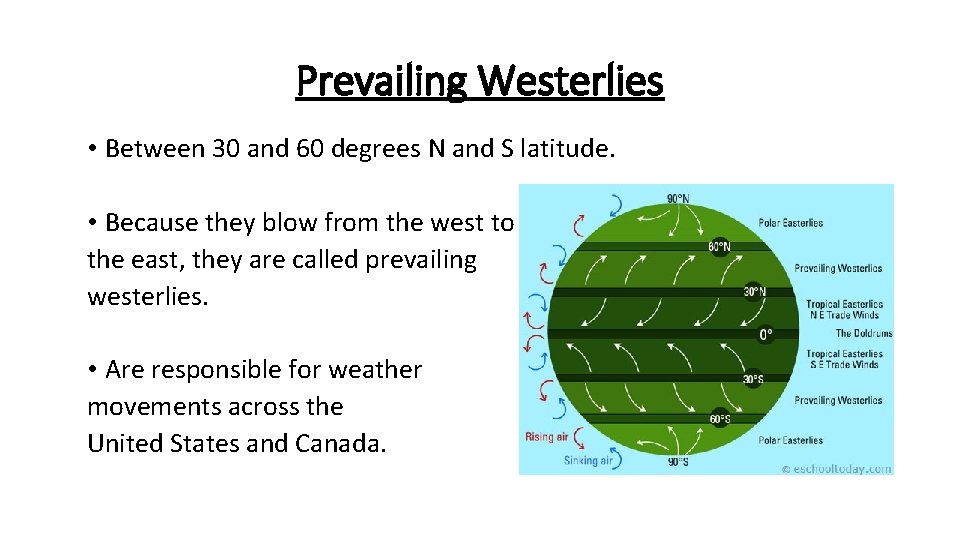
Prevailing Westerlies • Between 30 and 60 degrees N and S latitude. • Because they blow from the west to the east, they are called prevailing westerlies. • Are responsible for weather movements across the United States and Canada.
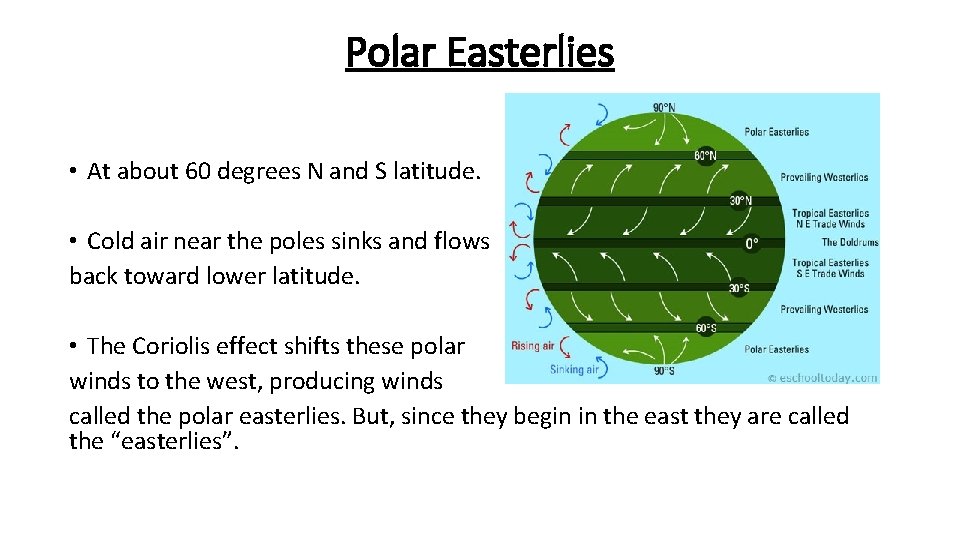
Polar Easterlies • At about 60 degrees N and S latitude. • Cold air near the poles sinks and flows back toward lower latitude. • The Coriolis effect shifts these polar winds to the west, producing winds called the polar easterlies. But, since they begin in the east they are called the “easterlies”.
- Slides: 14