Rochester Institute of Technology P 17487 Kon Tiki

- Slides: 16
Rochester Institute of Technology P 17487: Kon. Tiki Kiln Heat Recovery First Design Review September 8, 2016 RIT
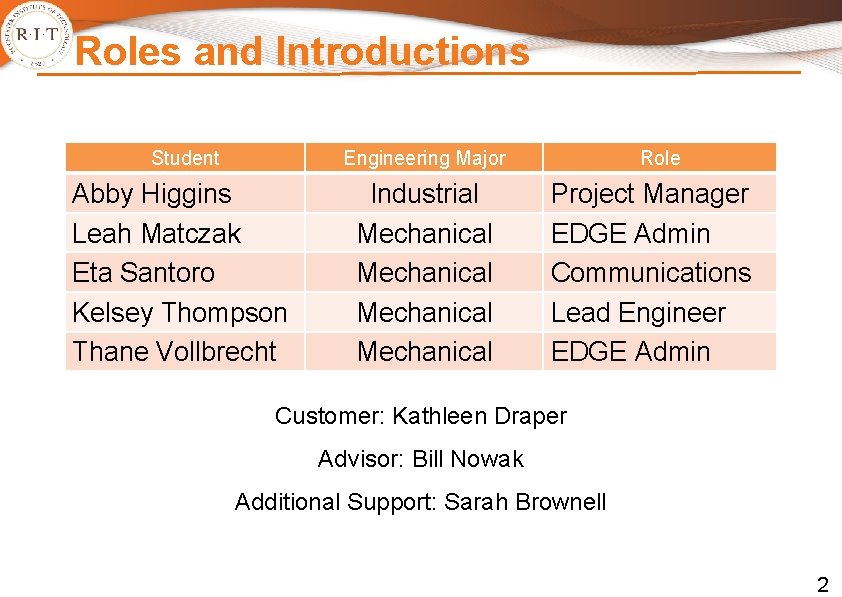
Roles and Introductions Student Engineering Major Abby Higgins Leah Matczak Eta Santoro Kelsey Thompson Thane Vollbrecht Industrial Mechanical Role Project Manager EDGE Admin Communications Lead Engineer EDGE Admin Customer: Kathleen Draper Advisor: Bill Nowak Additional Support: Sarah Brownell 2
Current Product Kon. Tiki v Low cost kiln for producing biochar v Various models and sizes v Runs hotter than necessary for biochar production Heat Recovery v No heat recovery devices on the market for Kon. Tiki Kilns v Independent user: heat recovery for studio Primary Purpose v Heat water for showers 3
Problem Statement Current State v Hood used to dry tea leaves v Coil used to heat water to pasteurization temperatures v Hood used to heat workshop Desired State v Heat water for showers Project Goals v Simple design and use v Safe to use Constraints v Use cheap and locally available materials 4
Additional Deliverables v A system that produce water hot enough for bathing v Functioning Prototype v Bill of Materials v User Guide 5
Constraints v Must attach to current Kon. Tiki models v Setup and operation must be simple tasks v Must not hinder biochar production v Materials must be readily available in developing nations v Must cost less than $250 6
Stakeholders v Kathleen Draper v Ithaka Institute v Kon. Tiki users in developing nations 7
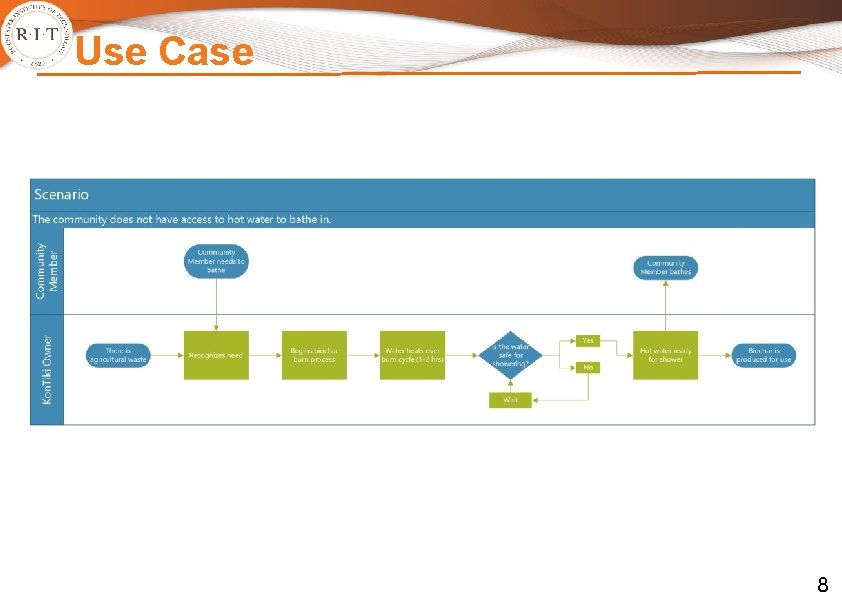
Use Case 8
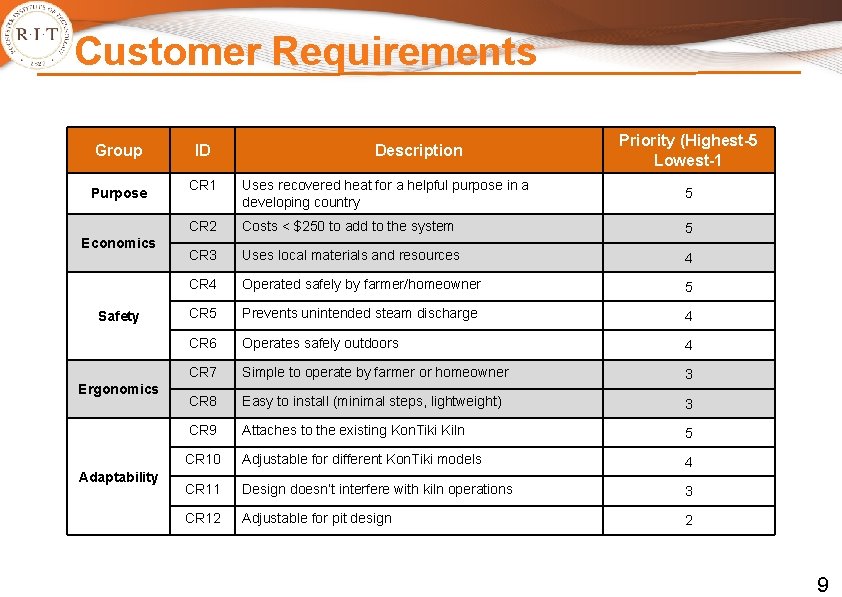
Customer Requirements Group Purpose Economics Safety Ergonomics Adaptability ID Description Priority (Highest-5 Lowest-1 CR 1 Uses recovered heat for a helpful purpose in a developing country 5 CR 2 Costs < $250 to add to the system 5 CR 3 Uses local materials and resources 4 CR 4 Operated safely by farmer/homeowner 5 CR 5 Prevents unintended steam discharge 4 CR 6 Operates safely outdoors 4 CR 7 Simple to operate by farmer or homeowner 3 CR 8 Easy to install (minimal steps, lightweight) 3 CR 9 Attaches to the existing Kon. Tiki Kiln 5 CR 10 Adjustable for different Kon. Tiki models 4 CR 11 Design doesn’t interfere with kiln operations 3 CR 12 Adjustable for pit design 2 9
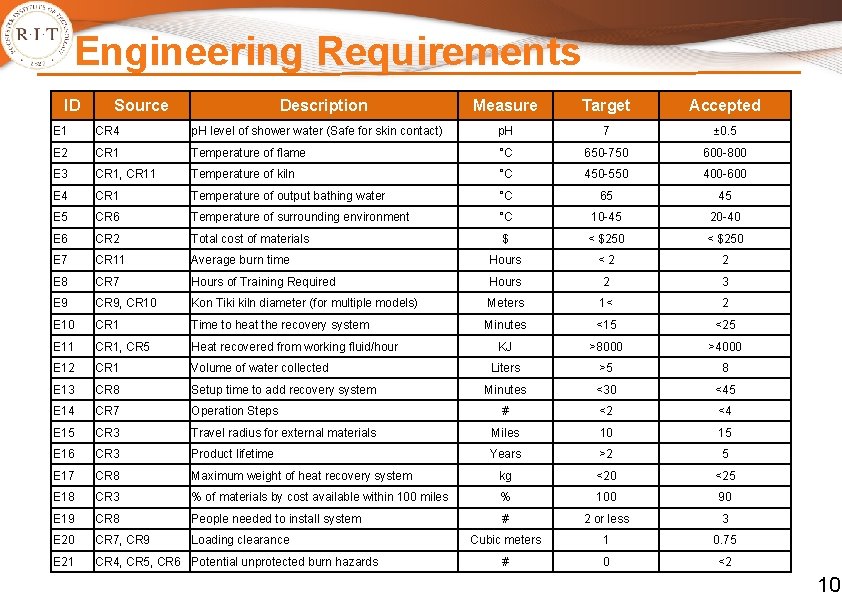
Engineering Requirements ID Source Description Measure Target Accepted E 1 CR 4 p. H level of shower water (Safe for skin contact) p. H 7 ± 0. 5 E 2 CR 1 Temperature of flame °C 650 -750 600 -800 E 3 CR 1, CR 11 Temperature of kiln °C 450 -550 400 -600 E 4 CR 1 Temperature of output bathing water °C 65 45 E 5 CR 6 Temperature of surrounding environment °C 10 -45 20 -40 E 6 CR 2 Total cost of materials $ < $250 E 7 CR 11 Average burn time Hours <2 2 E 8 CR 7 Hours of Training Required Hours 2 3 E 9 CR 9, CR 10 Kon Tiki kiln diameter (for multiple models) Meters 1< 2 E 10 CR 1 Time to heat the recovery system Minutes <15 <25 E 11 CR 1, CR 5 Heat recovered from working fluid/hour KJ >8000 >4000 E 12 CR 1 Volume of water collected Liters >5 8 E 13 CR 8 Setup time to add recovery system Minutes <30 <45 E 14 CR 7 Operation Steps # <2 <4 E 15 CR 3 Travel radius for external materials Miles 10 15 E 16 CR 3 Product lifetime Years >2 5 E 17 CR 8 Maximum weight of heat recovery system kg <20 <25 E 18 CR 3 % of materials by cost available within 100 miles % 100 90 E 19 CR 8 People needed to install system # 2 or less 3 E 20 CR 7, CR 9 Loading clearance Cubic meters 1 0. 75 E 21 CR 4, CR 5, CR 6 Potential unprotected burn hazards # 0 <2 10
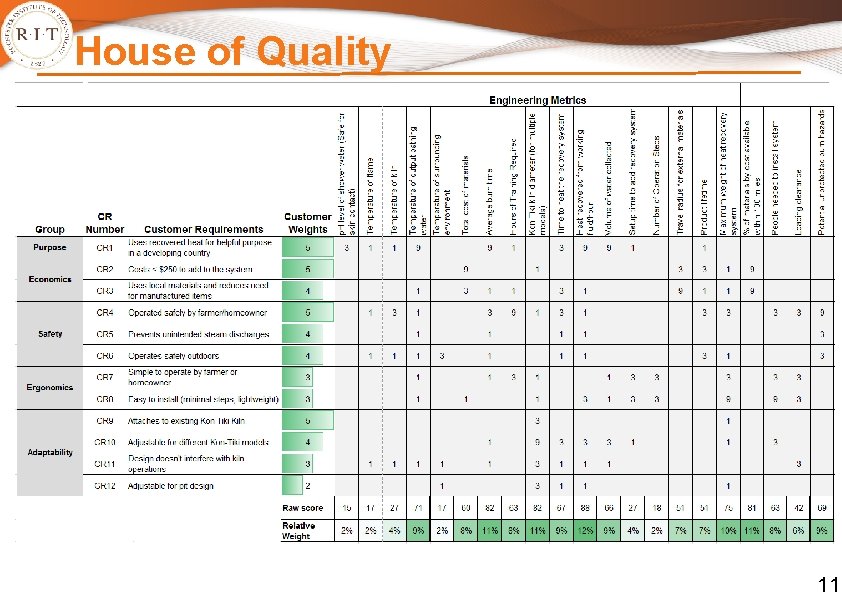
House of Quality 11
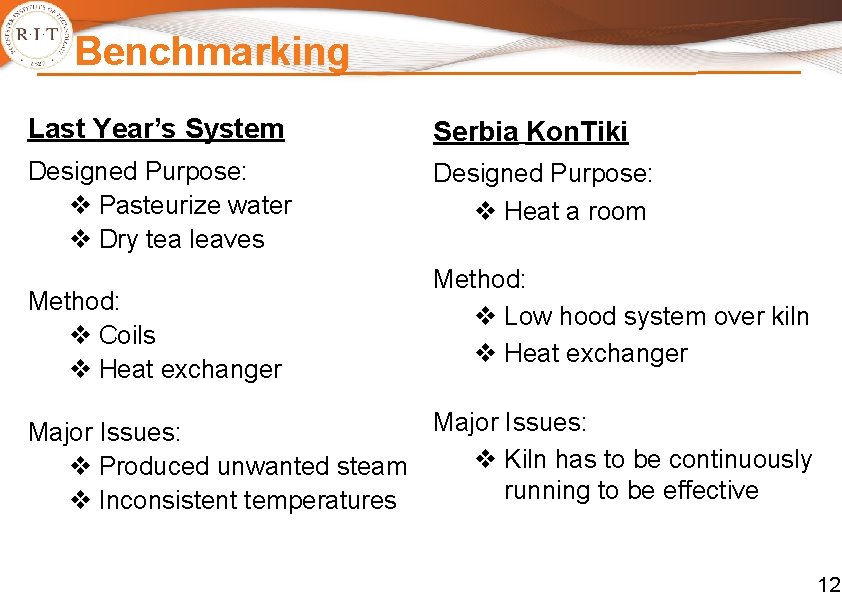
Benchmarking Last Year’s System Serbia Kon. Tiki Designed Purpose: v Pasteurize water v Dry tea leaves Designed Purpose: v Heat a room Method: v Coils v Heat exchanger Method: v Low hood system over kiln v Heat exchanger Major Issues: v Kiln has to be continuously v Produced unwanted steam running to be effective v Inconsistent temperatures 12
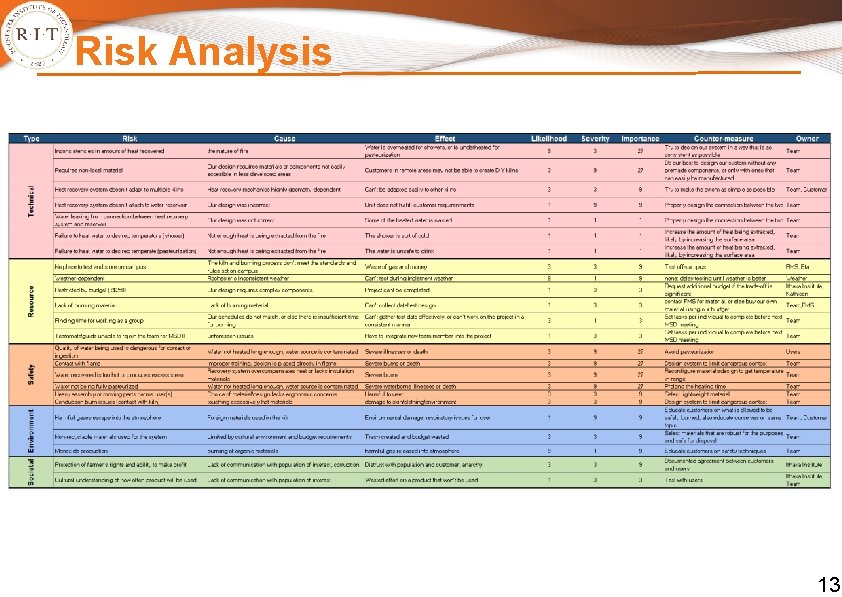
Risk Analysis 13
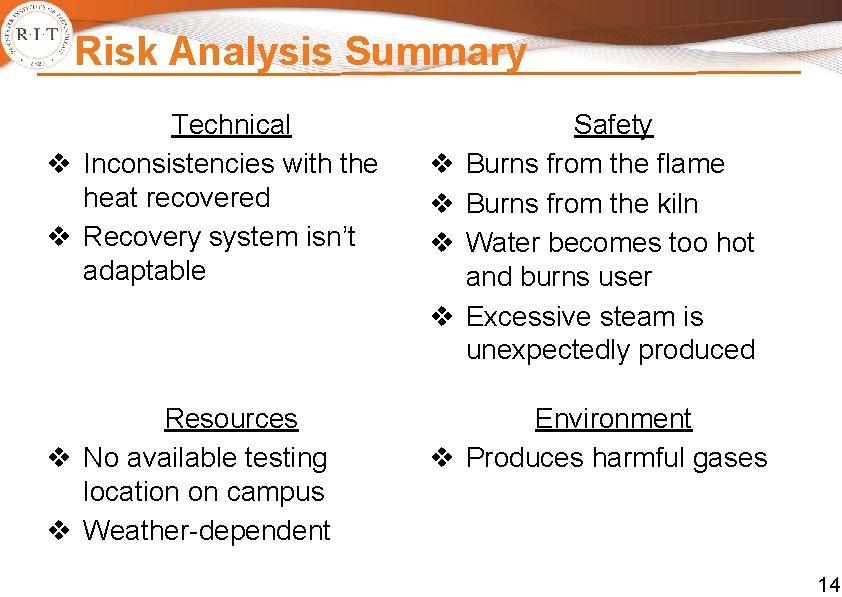
Risk Analysis Summary Technical v Inconsistencies with the heat recovered v Recovery system isn’t adaptable v v Resources v No available testing location on campus v Weather-dependent Safety Burns from the flame Burns from the kiln Water becomes too hot and burns user Excessive steam is unexpectedly produced Environment v Produces harmful gases 14
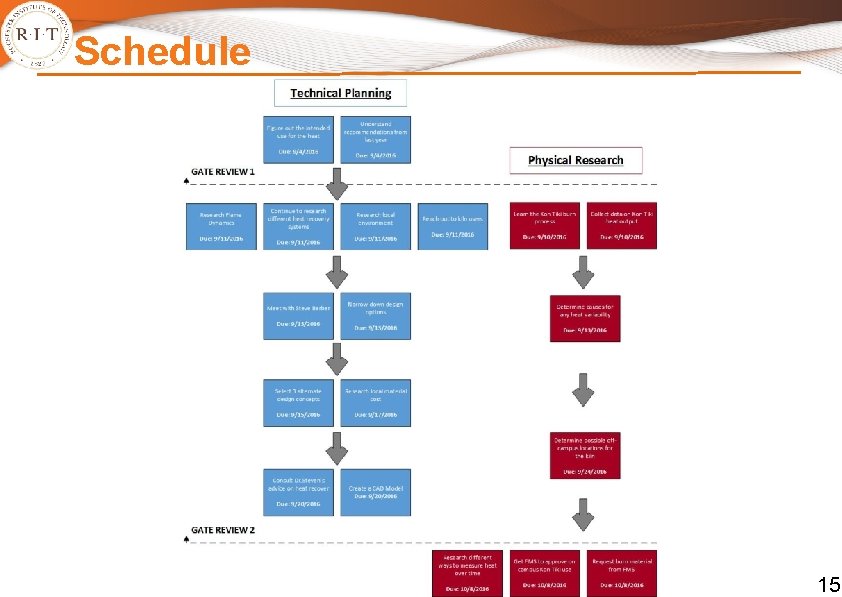
Schedule 15
Questions?