Risks and Rewards of International Expansion Anthony Zara























- Slides: 31
Risks and Rewards of International Expansion Anthony Zara, Ph. D. , Pearson VUE Promoting Regulatory Excellence
Risks and Rewards of International Expansion Unique challenges Security Cultural differences Construct differences Data protection issues; statutes In-country assets (personnel, hardware, software, data) Exam accessibility Cost Testing Standards Localization US vs. indigenous purposes Infrastructure Challenges
Kick-off Questions • Who has expanded internationally? – How did it go? • Who has attempted expanding to international markets? • Who is interested in international testing? – In the near term timeframe – In the farther term timeframe
Why are we interested? • • • Small world Organizational mandate Mobility of professionals CBT reduces barriers Traditional barriers are eroding (e. g. , instant communications, stable travel) • Raising professional standards • Improving public protection/confidence
Special Issues with Administering Tests Outside your Home Country • Must ensure validity of the testing process to provide the information for decisionmaking • Challenges exist for all test delivery modalities (e. g. , PP, CBT, oral) • Challenges include distance, culture, language, staffing, demand, value of exam, infrastructure, content
Special Issues with Administering Tests Outside your Home Country Security Challenges • Time zones, distance • Relationships with partners • Facilities • Legal rules (biometrics)
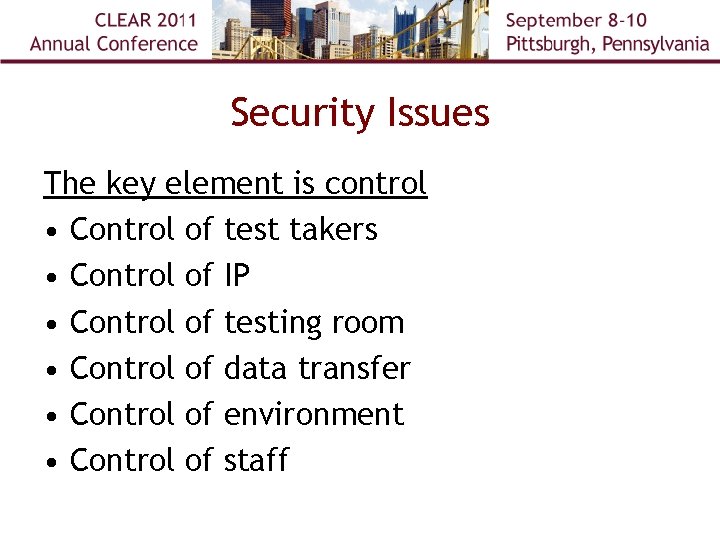
Security Issues The key element is control • Control of test takers • Control of IP • Control of testing room • Control of data transfer • Control of environment • Control of staff
Special Issues with Administering Tests Outside your Home Country Cultural Challenges • Standardized testing not a local concept • Accepted testing behavior • “Sharing” seen as cooperation not cheating • Individual exercise vs. group
Special Issues with Administering Tests Outside your Home Country Content Challenges • Defining purpose • Defining construct • Construct translation
Special Issues with Administering Tests Outside your Home Country Data Protection Issues • Data ownership • Data warehousing • Data transfer • Individual country rules
Special Issues with Administering Tests Outside your Home Country In-country assets • Personnel • Real estate • Hardware • Software • Data
Special Issues with Administering Tests Outside your Home Country Exam availability challenges • Delivery channel • Staffing issues • Overcoming potential cultural differences • Developing loyalty to the program • Education/training programs
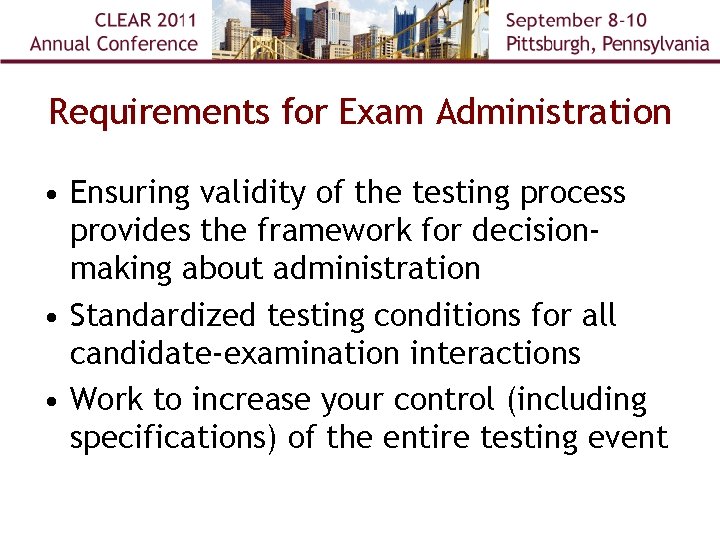
Requirements for Exam Administration • Ensuring validity of the testing process provides the framework for decisionmaking about administration • Standardized testing conditions for all candidate-examination interactions • Work to increase your control (including specifications) of the entire testing event
Special Issues with Administering Tests Outside your Home Country Cost Issues • US vs. local pricing • Demand challenges • Predicting administration volumes • Need for flexibility in dates and venues
Special Issues with Administering Tests Outside your Home Country Standards Issues • ISO 17024 • Guidelines for Adapting Educational and Psychological Instruments (International Test Commission and seven International Organizations EAPA, ETP, IACCP, IAAP, IEA, ILTA, IUPsy. S) • Cultural knowledge
Special Issues with Administering Tests Outside your Home Country Localization Challenges • Language • Need to translate test content? • Non-examination content (e. g. instructions)? • Construct generalization? • Communicating candidate expectations
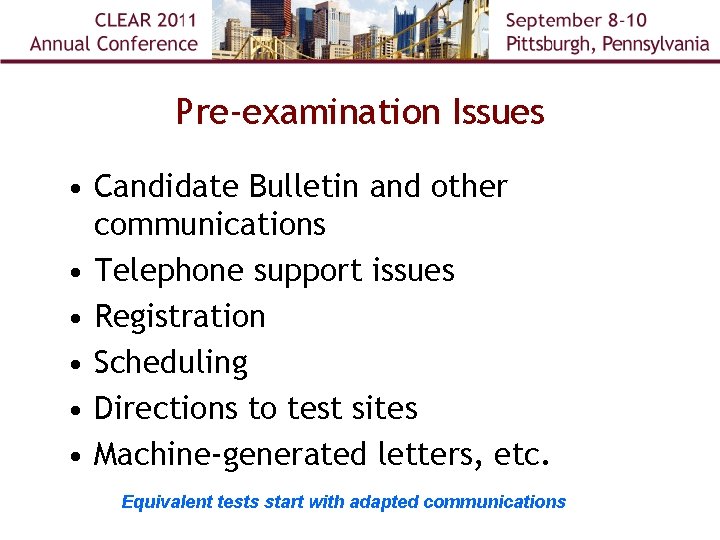
Pre-examination Issues • Candidate Bulletin and other communications • Telephone support issues • Registration • Scheduling • Directions to test sites • Machine-generated letters, etc. Equivalent tests start with adapted communications
Special Issues with Administering Tests Outside your Home Country Purpose Challenges • US vs. indigenous • Adapting standards (? ) • High-stakes vs. low-stakes
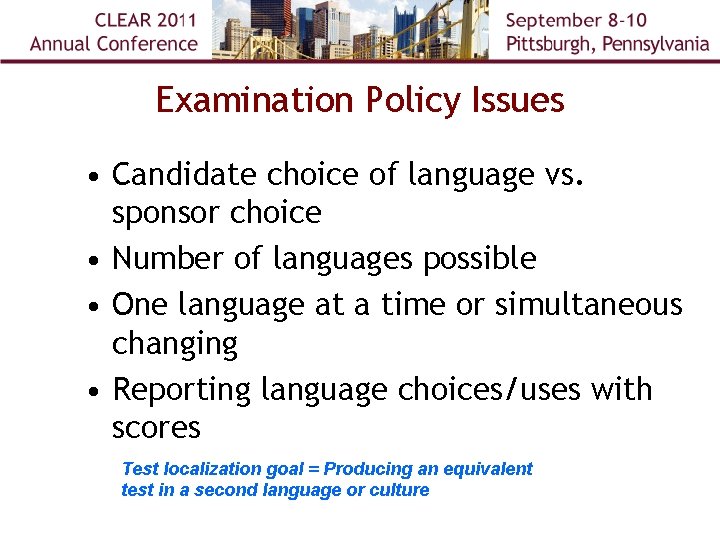
Examination Policy Issues • Candidate choice of language vs. sponsor choice • Number of languages possible • One language at a time or simultaneous changing • Reporting language choices/uses with scores Test localization goal = Producing an equivalent test in a second language or culture
8 Steps for Localizing Exams 1. Checking exam content and format equivalence 2. Deciding on the desirability of a translation/adaptation 3. Choosing translators 4. Translating and adapting the credentialing exam 5. Reviewing the adapted version of the exam 6. Conducting a small tryout of the adapted exam 7. Carrying out a more ambitious study of the adapted exam (checking for exam validity) 8. Documenting the process
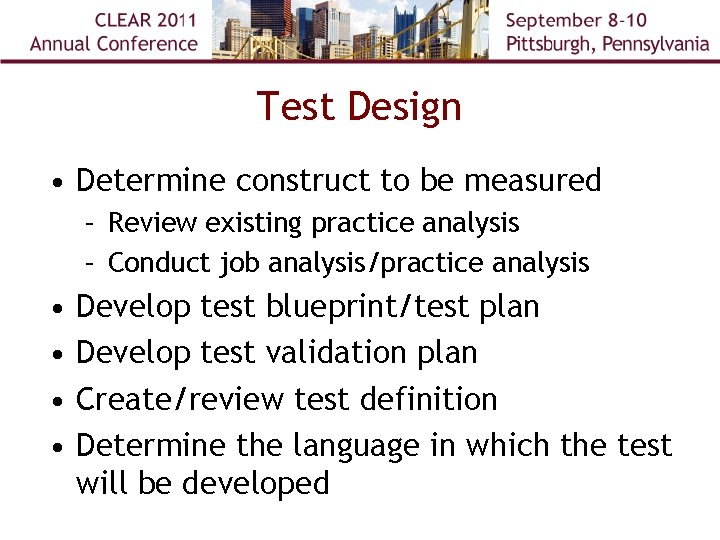
Test Design • Determine construct to be measured – Review existing practice analysis – Conduct job analysis/practice analysis • • Develop test blueprint/test plan Develop test validation plan Create/review test definition Determine the language in which the test will be developed
Special Issues with Administering Tests Outside your Home Country Infrastructure Challenges • Need standard conditions • Electricity, equipment, connectivity, etc. • Delivery platforms – Ipad – Smart phone – Etc.
Given all the issues outlined earlier, how can we assure success? 23
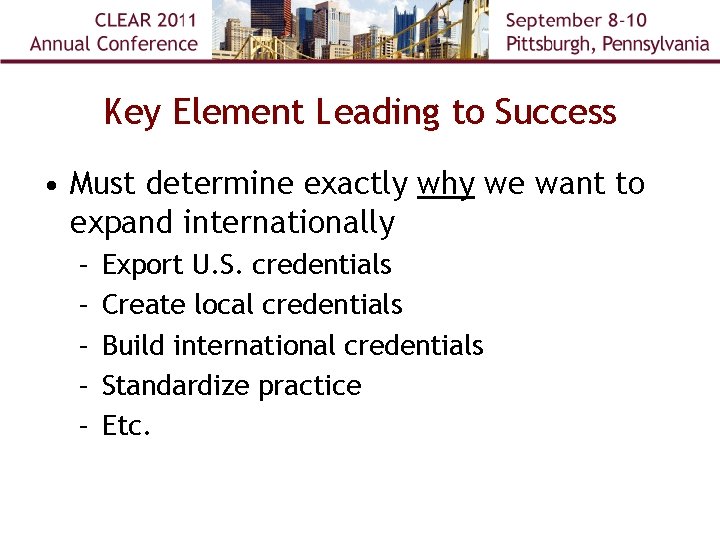
Key Element Leading to Success • Must determine exactly why we want to expand internationally – – – Export U. S. credentials Create local credentials Build international credentials Standardize practice Etc.
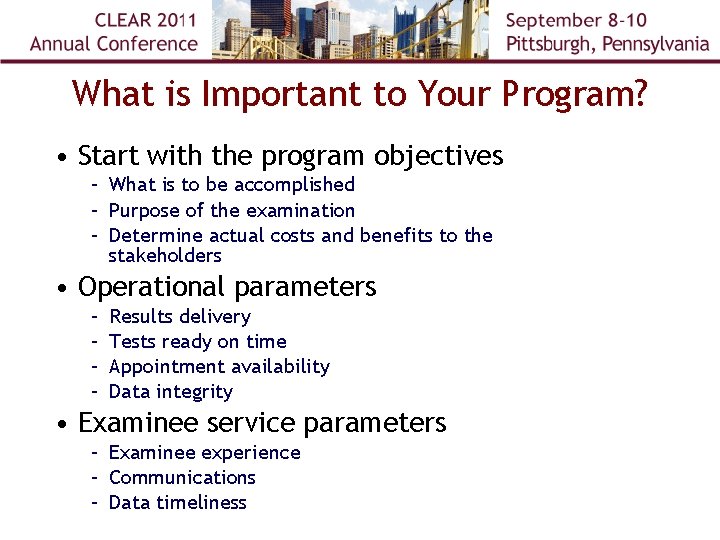
What is Important to Your Program? • Start with the program objectives – What is to be accomplished – Purpose of the examination – Determine actual costs and benefits to the stakeholders • Operational parameters – – Results delivery Tests ready on time Appointment availability Data integrity • Examinee service parameters – Examinee experience – Communications – Data timeliness
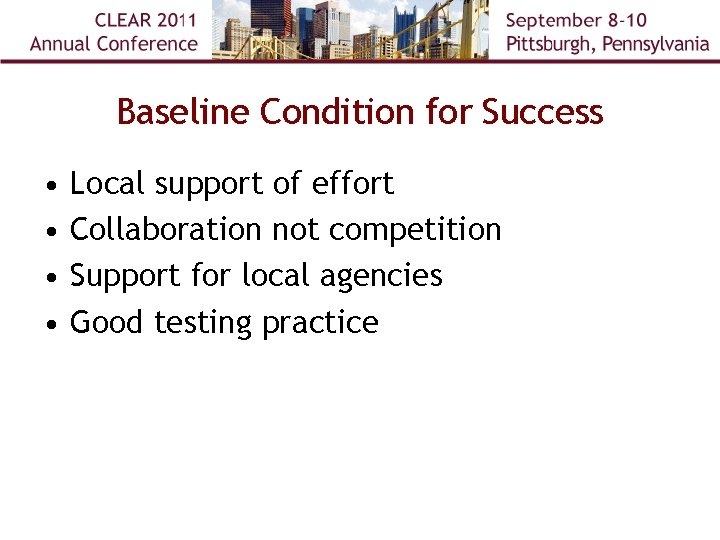
Baseline Condition for Success • • Local support of effort Collaboration not competition Support for local agencies Good testing practice
Best Electronic Testing Practices • Must utilize good testing practice and fundamental psychometric concepts • Test design must reflect the purpose of the test • Use technology for its best purposes
Lessons Learned • • Communications Planning is Key Define Stakeholders Carefully Know Your Audience (Culture) Use a Mix of Communications Tactics Monitor Stakeholder Attitudes & Behavior Be Flexible and Responsive Local Content Creation
Lessons Learned (con’d. ) • Stakeholder Messaging Critical (Internal and External) • New, Electronic Media is Cost Effective • Effective and Frequent Communications with Stakeholders is Vital to Success • Allow Adequate Time for Transitions or Major Program Changes
Conclusions • International testing is a considerable undertaking • Test localization is a huge task • Equivalent exams is the correct goal • Non-content issues need full consideration Content is important, but it is only one piece of the puzzle
Contact information Anthony Zara, Ph. D. tony. zara@pearson. com 31