
Connectionism By Carolyn Greig E Thorndike The Theory
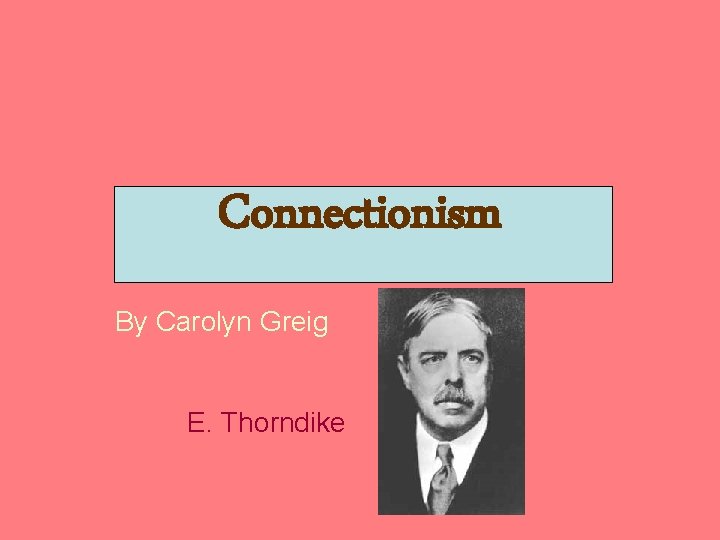
Connectionism By Carolyn Greig E. Thorndike
The Theory • Learning is the result of associations formed between stimuli and responses ( S-R framework) • These associations are strengthened/weakened by the nature and frequency of the S-R pairings. • Trial and error learning- certain responses come to dominate others due to rewards.
The 3 Primary Laws of Connectionism • Law of effect- responses to a situation which are followed by a rewarding state of affairs will be strengthened and become habitual responses to that situation • Law of readiness- a series of responses can e chained together to satisfy some goal which will result in annoyance if blocked • Law of exercise- connections become strengthened with practice and weakened when practice discontinues
Scope/Application Thorndike was especially interested in applying his theory of connectionism to areas of: • math • spelling and reading • measures of intelligences • adult learning
Principles • Learning requires both practice and rewards (laws of effect/exercise) • A series of S-R connections can be chained together if they belong to the same action sequence (law of readiness) • Transfer of learning occurs because of previously encountered situations • Intelligence is a function of the number of connections learned.

Resources http: //www. psychology. sbc. edu/Thorndike% 20 and%20 Watson. htm http: //tip. psychology. org/thorn. html
- Slides: 6