
Risk Analysis in Project Finance Modelling November 20
Risk Analysis in Project Finance Modelling November 20 1
Risk Analysis Contents • Introduction – Project Finance Analogies to Sub-prime Crisis • Risk Classification • Project Risk and Examples of Project Failures • Risk Allocation and Problems • Risk Analysis of Residual Exposure • Recovery and re-structure in the event of project failure Project Finance Risk Analysis November 20 2
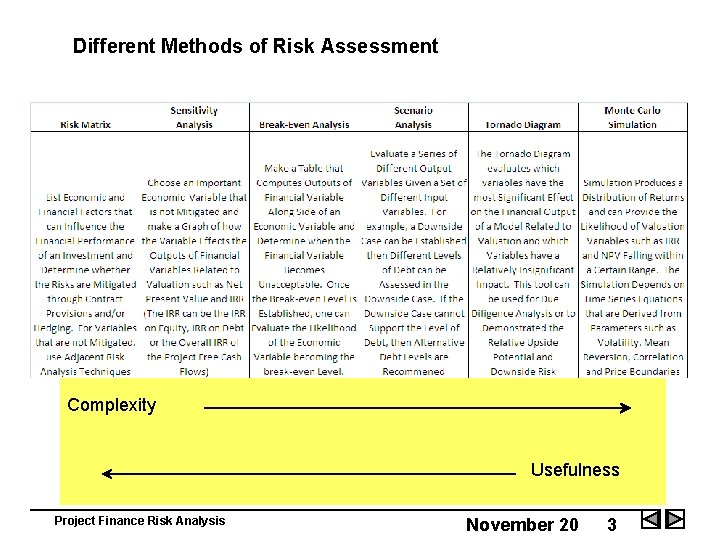
Different Methods of Risk Assessment Complexity Usefulness Project Finance Risk Analysis November 20 3
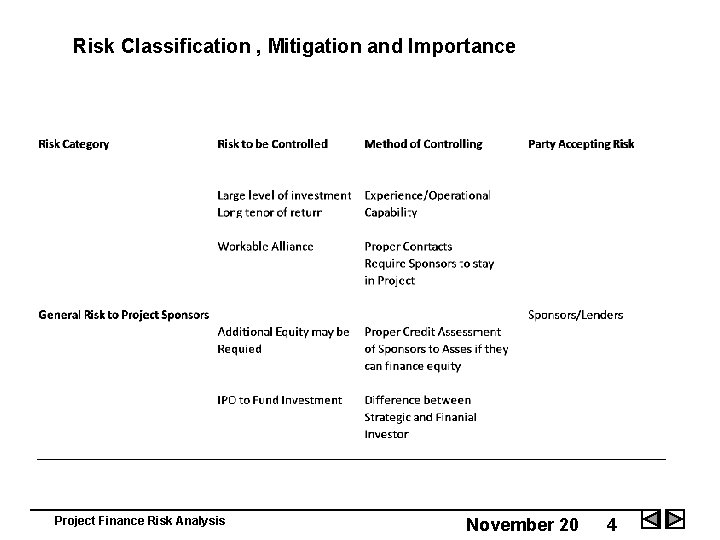
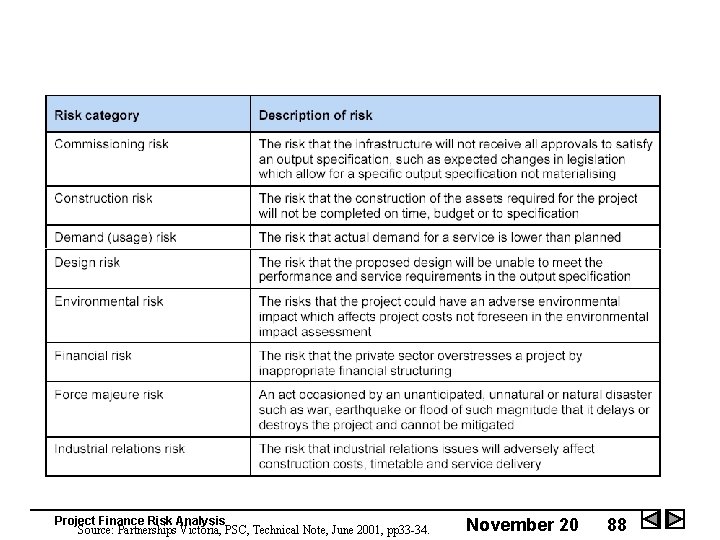
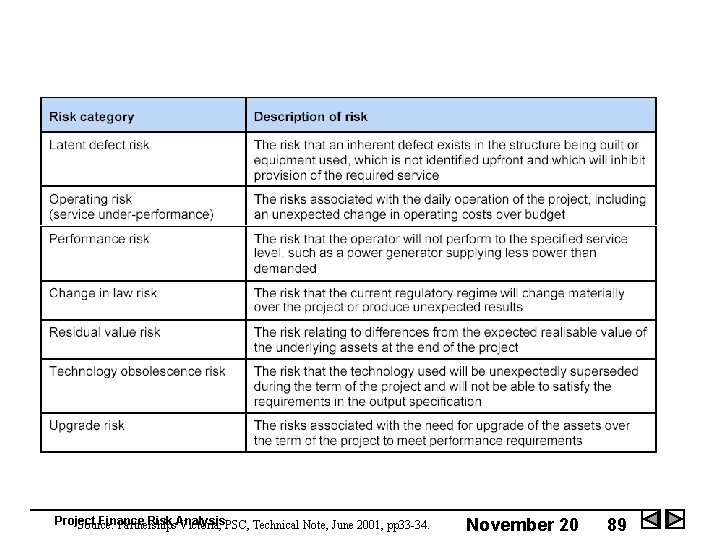
Risk Classification , Mitigation and Importance Project Finance Risk Analysis November 20 4
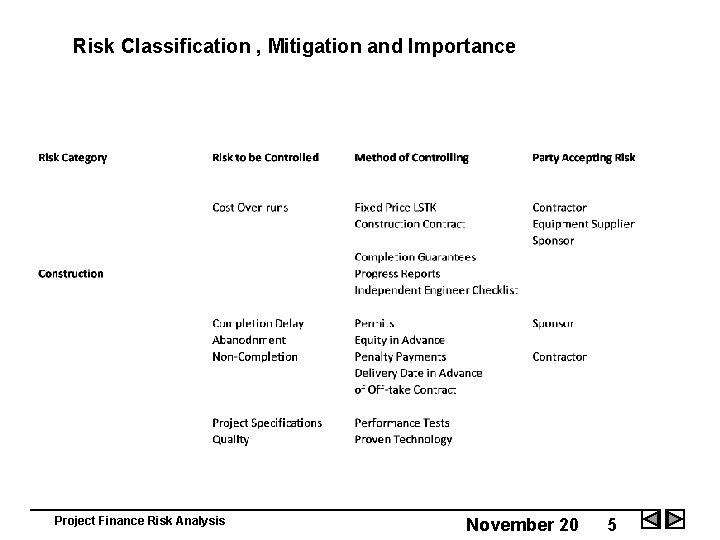
Risk Classification , Mitigation and Importance Project Finance Risk Analysis November 20 5
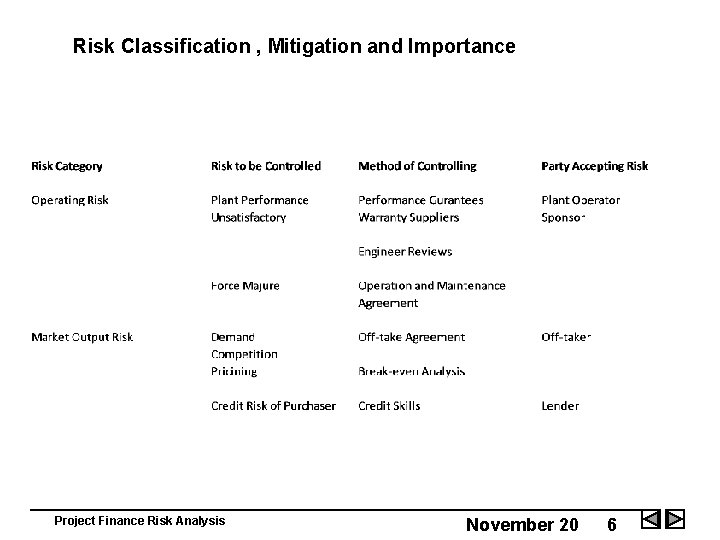
Risk Classification , Mitigation and Importance Project Finance Risk Analysis November 20 6
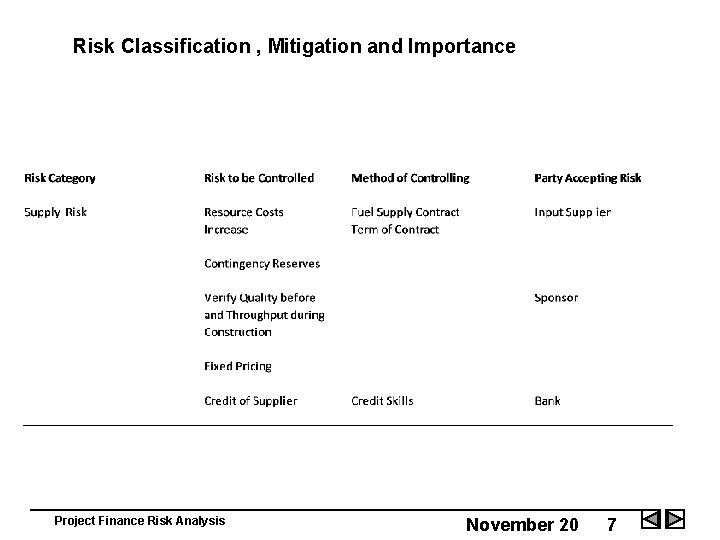
Risk Classification , Mitigation and Importance Project Finance Risk Analysis November 20 7
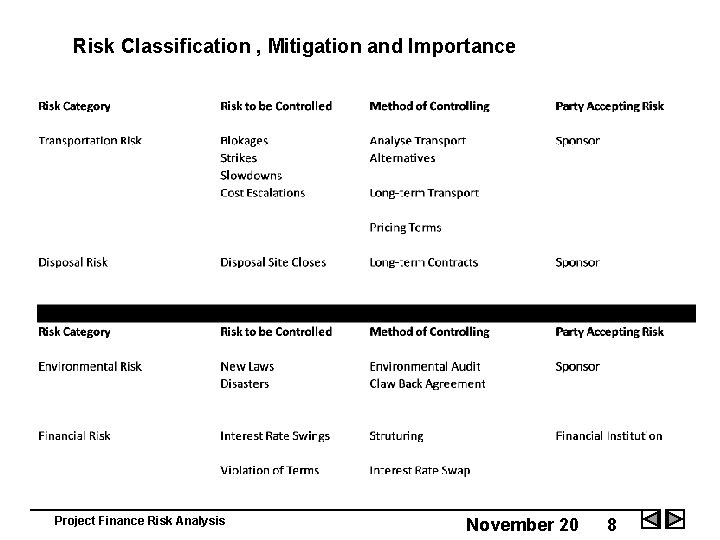
Risk Classification , Mitigation and Importance Project Finance Risk Analysis November 20 8
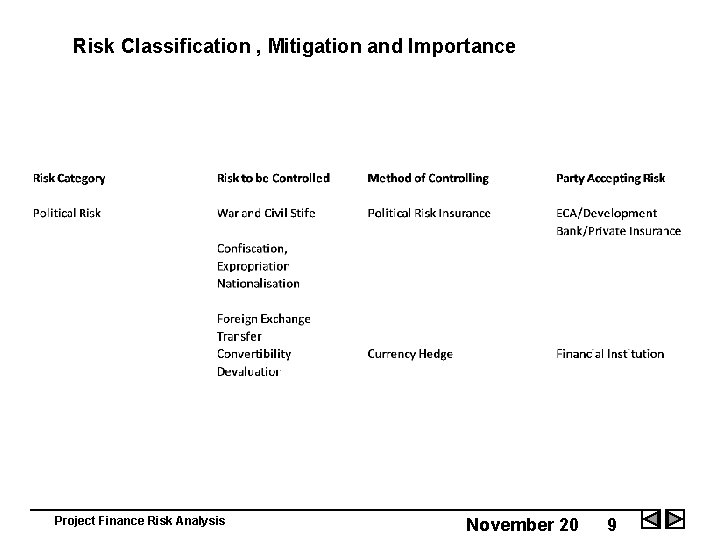
Risk Classification , Mitigation and Importance Project Finance Risk Analysis November 20 9
Risk Classification Project Finance Modelling November 20 10
Risk Analysis in Project Finance Models • Project finance analysis to a large degree involves identifying, allocating and mitigating risk. One must therefore be able first to identify risks and then to measure how effective the contracts and other mitigating factors (covenant, debt service reserve, liquidated damage) are in managing risk. • Project Finance Adage: § At the beginning of the project ü Lender has the money ü Developer has the experience § At the end of the project ü Developer has the money ü Lender has the experience Project Finance Risk Analysis November 20 11
Consulting Reports • Consultants cannot tell Shell to go to hell if they want to work in the oil industry • Engineers love their sector and dream that machines will work well • Pay depends on how favorable to project • Firms use their name without doing much work • Repackage work done for others • Consultants committed to get projects done in their country Project Finance Risk Analysis November 20 12
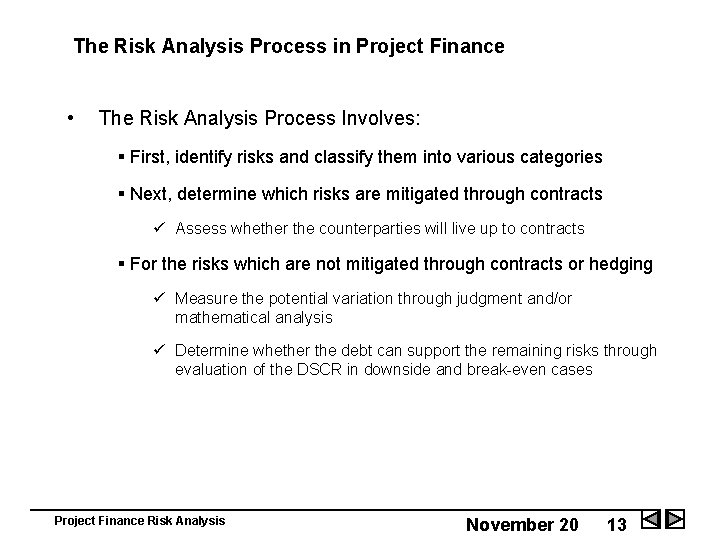
The Risk Analysis Process in Project Finance • The Risk Analysis Process Involves: § First, identify risks and classify them into various categories § Next, determine which risks are mitigated through contracts ü Assess whether the counterparties will live up to contracts § For the risks which are not mitigated through contracts or hedging ü Measure the potential variation through judgment and/or mathematical analysis ü Determine whether the debt can support the remaining risks through evaluation of the DSCR in downside and break-even cases Project Finance Risk Analysis November 20 13
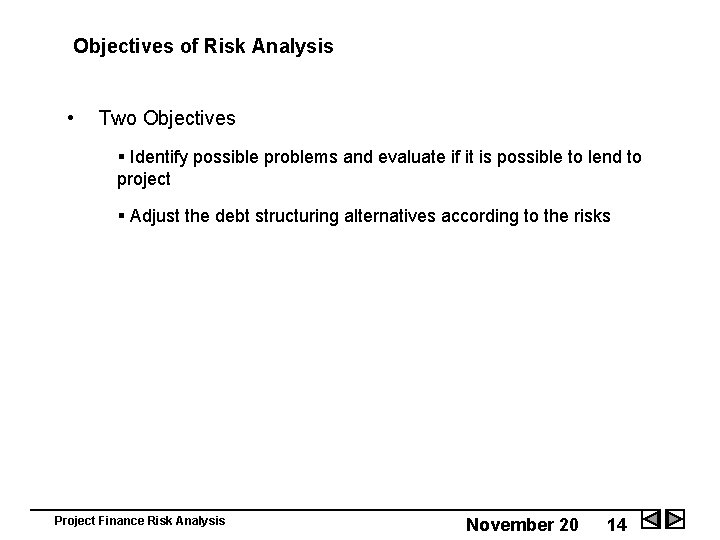
Objectives of Risk Analysis • Two Objectives § Identify possible problems and evaluate if it is possible to lend to project § Adjust the debt structuring alternatives according to the risks Project Finance Risk Analysis November 20 14
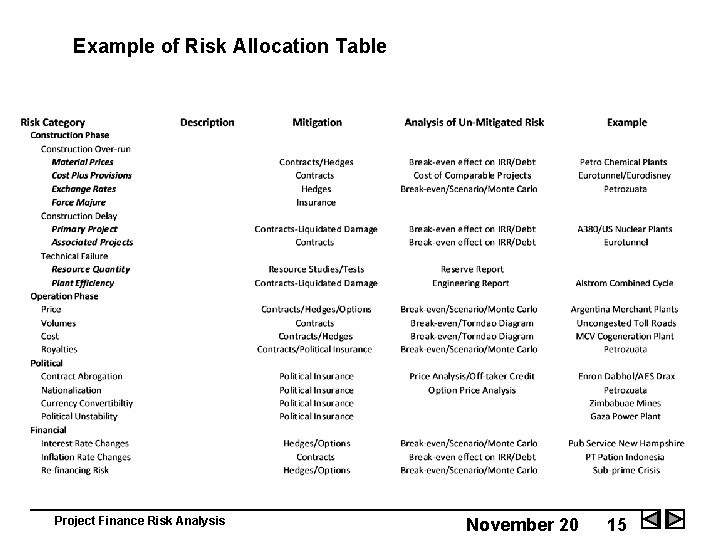
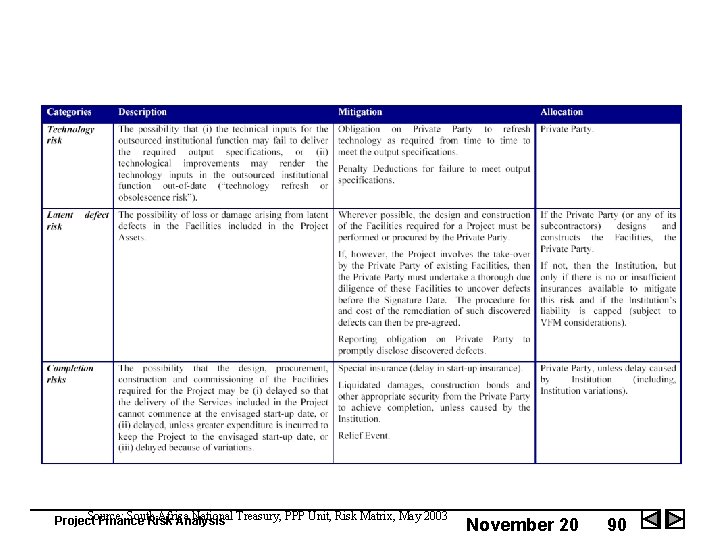
Example of Risk Allocation Table Project Finance Risk Analysis November 20 15

Format of Risk Allocation Table • The risk allocation table could include § Risk Heading § Nature of the event that can go wrong § Consequences and magnitude of problem § Mitigation and method of resolution § Desired outcome Project Finance Risk Analysis November 20 16
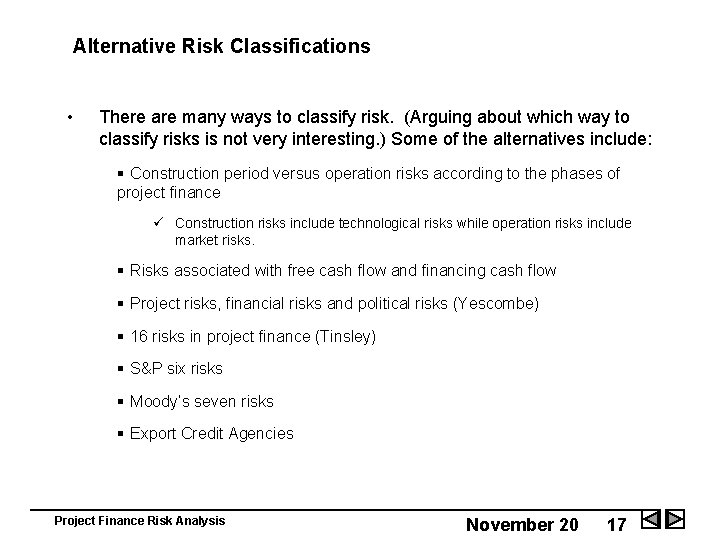
Alternative Risk Classifications • There are many ways to classify risk. (Arguing about which way to classify risks is not very interesting. ) Some of the alternatives include: § Construction period versus operation risks according to the phases of project finance ü Construction risks include technological risks while operation risks include market risks. § Risks associated with free cash flow and financing cash flow § Project risks, financial risks and political risks (Yescombe) § 16 risks in project finance (Tinsley) § S&P six risks § Moody’s seven risks § Export Credit Agencies Project Finance Risk Analysis November 20 17
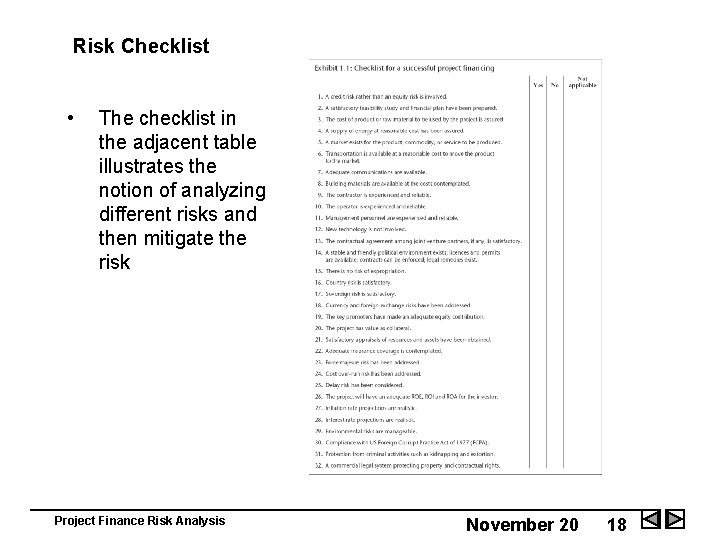
Risk Checklist • The checklist in the adjacent table illustrates the notion of analyzing different risks and then mitigate the risk Project Finance Risk Analysis November 20 18
Moody’s Comments on Risk Classification and Assessment • The analysis of project finance transactions is a complex procedure. § Risks analyzed include ü Economic risk, ü Construction, ü Operating ü Technology risk ü Legal ü Political ü Regulatory risk. § Frequently, the participants in each transaction analyze such risks in minute detail and put in place structural enhancements that seek to mitigate them. Project Finance Risk Analysis November 20 19
S&P Risk Checklist – General Comments 1. Evaluate project contracts that, along with the project's physical plant, serve as the basis of the project enterprise; 2. Assess the technology and performance of the project enterprise; 3. Analyze the competitive position of the project; 4. Determine the risk that counterparties present to the project enterprise; 5. Appraise the project's legal structure; and 6. Evaluate the financial risks that may affect forecast results. Project Finance Risk Analysis November 20 20
Revenue Risks Project Finance Modelling November 20 21
Price versus Output Risks • Market-risk project financing is where a level of either price or volume risk (but almost never both) exists. § These financings without contracts are typically for larger capital expenditure items have much higher equity funding, shorter terms (usually within 10 -12 years), and higher spreads relative to the contract-supported forms. § Lack of long term contracts does not necessarily mean unacceptable structure, but may call for different loan structures to assure faster prepayments in higher cash flow years and slower amortization in leaner years. Project Finance Risk Analysis November 20 22
Volume Risk • A good project should exhibit reliable revenue stream. Therefore volume and price risks need to be carefully assessed. The project needs to produce and sell its designed volume of output at certain minimum prices to account for downside or stress situations. • In most project financing, the volume risk is not assumed by lenders either because of § (1) committed purchase of the output, at some price by the sponsor or one or more users of the output, or § (2) the output is basically a commodity and the nature of the market negates the need for reliance on any one or more known purchasers. • Depending on the output's nature, the price risks could be covered through comfort with market price, minimum price guarantees, or cost plus pricing arrangements. Project Finance Risk Analysis November 20 23
Construction Phase Risks Project Finance Modelling November 20 24
Technology Risk • Project Financing is seldom applied to new technology. • Can take technology risk if: § Known and proven technology is used; § The facilities are projected to remain technologically competitive; and § Plant/project life is longer than the funding life; • Project financiers do not want to be ‘first’ to bank a project with new technology. § If an untried technology is incorporated into a new project, most financiers will require extra support. ü Liquidated damage provisions after the plant is complete ü Added insurance ü Sponsor guarantee § Covenants will be required to ensure that the borrower applies generally accepted operating practices and obeys the applicable laws including environmental regulations. (the "prudent operator" clause). Project Finance Risk Analysis November 20 25
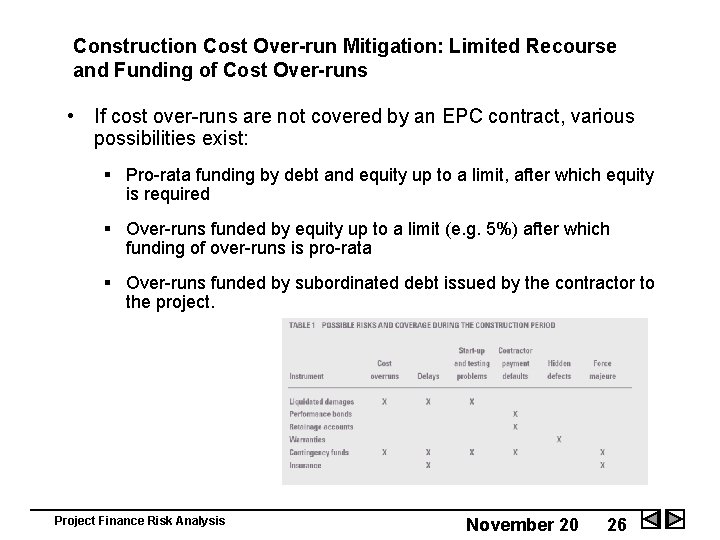
Construction Cost Over-run Mitigation: Limited Recourse and Funding of Cost Over-runs • If cost over-runs are not covered by an EPC contract, various possibilities exist: § Pro-rata funding by debt and equity up to a limit, after which equity is required § Over-runs funded by equity up to a limit (e. g. 5%) after which funding of over-runs is pro-rata § Over-runs funded by subordinated debt issued by the contractor to the project. Project Finance Risk Analysis November 20 26
Cost Over-runs • 2002 Study (Bent Flyvbjerg) § 86% of public projects had cost over-runs § Average cost over-run is 28% § Metrics do not change • Quantified in Optimism Bias • 2002 Study of Mining Projects § Average over-run is 22% § Problems with all consultants § No effect of size/location Project Finance Risk Analysis November 20 27
Risks with EPC • A Standard & Poor's study of the causes of credit deterioration in rated project finance transactions revealed that technology, construction, and operational problems have contributed to only 2 % of total project defaults over the last 10 years. • For example, a recently rated project had certain preconstruction site preparation activities excluded from the EPC contractor's scope of work. § When ground was broken at the project site, unexpected soil contamination and unforeseen remediation activities raised the risk that the project would be delayed and require sizeable early draws on the contingency budgets. § Because the additional labor and materials were excluded from the EPC contract, none of these costs or delays would be subject to the performance guarantees or delay damages included in the EPC contract. • This situation underscores how a comprehensive EPC contract can partially mitigate the impact of some construction risks. Project Finance Risk Analysis November 20 28
Mitigation of Construction - Reference • Delay In Service Insurance § This can cover completion risk either through contract work policies or start-up delay policies, which latter cover the capitalised interest bill caused by a delay. • Completion Guarantee § This requires the loan to be repaid by the Sponsor rather than the project’s cash flow either in full or on an agreed repayment schedule if the project is not completed by a certain date. It is seldom used in Project Financing today. • Overrun Undertaking § In this case the Sponsors agree to provide only the overrun amounts above the pre-agreed debt and equity financing total. • Stand-by Facility § These may be contingent underwriting facilities, or indeed money in an escrowed bank account, provided to cover cost overruns perhaps from a strong parent or related companies. For example, interest may only be permitted to be capitalised to a given cumulative dollar ceiling beyond which the Sponsors must pay interest when due. • Deficiency/Shortfall Agreement § Even though the project is producing cash flows and has met a performance Completion Test, an agreed amount of Sponsor support is available to meet cash flow on Debt Service shortfalls for an agreed amount, for an agreed period post-Completion, or for an agreed obligation e. g. interest up to a limit. Project Finance Risk Analysis November 20 29
Mitigation of Construction Risk - Reference • Completion Undertaking § The Sponsors put in however much money it takes to make the Project meet the Completion Test. If the test cannot be met, then there may be recourse to the Sponsors for the whole Project Financing. • Turnkey Contract § The turnkey construction contract may be formed in such a way as to provide the necessary financial support for the Completion aspect of Project Financing through healthy liquidated damages (“LDs”), Retentions, buy down payments, etc. As a rule of thumb, turnkey construction contracts add 20% to cost. • Equity and Debt Subscription § In the event of a cost overrun or a delay forcing capitalisation of interest, both the financiers and the company agree to contribute further funds, either pro-rata or in leap-frogging tranches, to meet the overrun with a ceiling on the bank’s exposure at some stage. • Default Agreement § This is a variation of Equity and Debt Subscription except for a “stand-still” period after all base financing has been provided, say 90 days, within which talks proceed between the financiers and the Sponsors to hopefully reach agreement on how to finance the increment to achieve project Completion. The commitment of both sides to proceed may be halted early if estimates show that the project will come in above the financed budget. Project Finance Risk Analysis November 20 30
Strong and Weak Technology/Construction Risk • Strong § Fixed-price, date-certain turnkey contract; § one-year-plus guarantees; § superior liquidated performance/delay damages; § highly rated EPC contractor, § credible sponsor completion guarantee or LOC-backed construction; § installed costs at/below market; § contracts executed. § IE oversight through completion, including completion certificate. § Commercially proven, currently used technology. § Rated O&M contract with performance damages. § Budget and schedule credible, not aggressive. § Thorough and credible IE report. Project Finance Risk Analysis November 20 31
Strong and Weak Technology/Construction Risk • Weak § Cost-plus contracts, ü no cap; ü weak guarantees, if any; minor liquidated performance/delay damages; ü questionable EPC contractor. § Costly project budget. § Permits lacking and siting issues. § Possible local political/regulatory problems. § No Independent Engineering oversight. § Technology issues exist. § Budget and schedule aggressive. § No Independent Engineering report. Project Finance Risk Analysis November 20 32
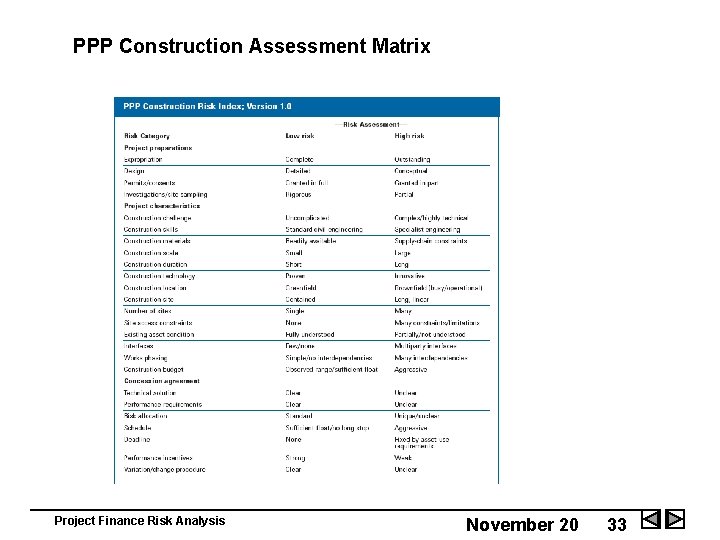
PPP Construction Assessment Matrix Project Finance Risk Analysis November 20 33
Risks Present Even with EPC Contract • Construction contracts cannot eliminate all risk to a project. Some residual level of risk generally remains § force majeure § change-of-law events § Change orders • By definition, the vendor and contractor cannot control such events. • Better projects, especially heavily leveraged, high fixed cost ones, will seek to minimize these risks through insurance or sovereign guarantees and provisions to renegotiate tariff costoffsetting provisions of power purchase agreements. Project Finance Risk Analysis November 20 34
Case Study of Bias in IE Report • In one example, an IE report noted a mismatch between the physical requirements of an offtake agreement and the operating requirements of a key piece of project machinery § nevertheless concluded that the sponsor's operating practices would be sufficient to avoid significant problems. § Despite the benign appearance of the issue, the project ultimately suffered years of poor operating and financial performance and issued a substantial amount of additional senior debt to finance the replacement of the affected equipment. Project Finance Risk Analysis November 20 35
Evaluation of Feasibility Study and Independent Engineer Report – Standard and Poor’s (Reference) • Independent engineer's evaluation about the adequacy of contingencies for schedule and budget, and related assumptions. § Evaluate performance requirements and incentives for the construction contractors along with the financial and technical capacity of the contractors to perform on these contracts. § For newer technologies, evaluate whether the contractor has significant experience working with that technology and whether the contractor has worked in the host country. § A project having a legal structure that includes construction monitoring by an expert third party, such as an independent engineer, enhances construction surveillance by providing systematic oversight. § Monitor surveillance of work in progress with the independent engineer to establish the predictability of the remaining construction schedule. Project Finance Risk Analysis November 20 36
Mitigation of Operation and Maintenance Risk Project Finance Modelling November 20 37
Productivity Risk • Another threat to a project may be the development and entry of new technologies that radically change the industry structure and the basis for competition and sustainability. While it has always been difficult to predict the next successful technology in any industry, the potential for new technologies to disrupt traditional industries may be greater in some sectors than others. § For instance, the development of wireless technology over the past 10 years has transformed the global telecommunications industry. Project Finance Risk Analysis November 20 38
Cost Risk – Standard and Poor’s (Reference) • Cost risks apply to labor and materials inputs, productivity, and operating expenses (“Opex”) • Cost risk includes the effect of inflation. • Typical cash flows will show 7 -10 key items of costs with the remaining cost categories usually amounting to only 5 -10% of Opex • An adequate O&M budget and major maintenance funding commensurate with the technology are mandatory. Standard & Poor's expects that O&M plans for new technologies or significantly scaled-up versions of proven technologies provide additional contingency for unexpected operating results. The budget estimates must be based on a detailed schedule of plant maintenance and planned overhauls. Project Finance Risk Analysis November 20 39
Cost of Production and Cost Curves • Whether a contract exists or not, the position of the project in terms of cost of production relative to all the other producers of the given product is important. • Generally, a project in the lower half or lower third of the cost curve (sorted costs of other producers) is adequate. A project's competitive position relative to its peer group is a principal credit determinant. Given that most projects produce a commodity, such as electricity, ore, oil or gas, or some form of transport, low-cost production relative to the market is essential for an investment-grade rating. High costs relative to an average market price, absent mitigating circumstances, will almost always place lenders at risk. To the extent that a project can "decommoditize" its product and obtain higher pricing, either through locational advantages, contractual agreements, or by differentiation in service and quality, it may achieve a higher rating, all else being equal. Project Finance Risk Analysis November 20 40
Raw Material Risk • Because projects are, by definition, generally single site, limited product businesses, they are potentially at greater risk than a less restricted corporation. • Most projects take a single raw material and convert it to a single, higher value-added product; hence, the supplier may be critical to a buyer's business. • The cost of the input usually drives the project's competitiveness. • If only a few firms dominate the supply of a critical factor of production relative to the number of potential customers, a project, absent mitigating factors, could be at higher risk because the supplier is in a better position to dictate terms of sale. • Projects that rely on fixed and dedicated transportation systems, such as pipelines or rail lines, to deliver necessary inputs, may have few substitutes available. Project Finance Risk Analysis November 20 41
Cost Risk Management • Sponsors projects mitigate supply risk through several strategies. § Some enter into commodity supply contracts (indexed to the product price) coterminous with the debt. § Second, transportation arrangements for the commodity should evidence a high level of dependability, with the transportation agreements again being coterminous with the debt. § Perhaps the best strategy uses a complete pass-through of supply costs to the purchaser. This strategy, however, places the buyer at risk of a price shock if the commodity's price should suddenly increase. Project Finance Risk Analysis November 20 42
Cost Risk Management • Projects can either hedge supply risk, or transfer it to an entity with the means and willingness to assume the project's output price risk. • The commodity supply markets in the U. S. and the U. K. , are sufficiently liquid to support credible risk management strategies. § A U. K. -based sponsor may partially hedge its natural gas fuel supply price risk through fixed price-volume contracts or derivative products § The sponsor will demonstrate the ability and experience to engage in these complex risk management strategies. Project Finance Risk Analysis November 20 43
Risks Remaining in Supply Contracts (S&P) • Although a project may contractually receive fixed payments that cover its debt obligations, project input or supply arrangements, such as for fuel, ash disposal and water, may expose the project (and bondholders) at risk as regards those contracts' price and volume arrangements. § If the buyer's obligation to pay a fixed price under the offtake contract is contingent on the project's availability and a disruption in fuel or other supply commodity occurs to make the project not available, if the disruption extends over a period of time with the result that the buyer is not contractually required to make fixed payments under the offtake agreement the project may not have sufficient revenues to pay debt service on the bonds. • Another risk to bondholders arises from the potential narrowing of the spread between supply prices and project product prices. Project Finance Risk Analysis November 20 44
Political Risk - Introduction • Projects are long-term and immobile § Long-term investments require sustained political support § Do not want to become a political football • Political viability is analogous to commercial viability § Must be beneficial to a country § High rate of return can increase risk • Standard Political Risks § Currency convertibility § Expropriation of the project by the state § Political violence Project Finance Risk Analysis November 20 45
Political and Country Risk The legal and political regime in which a project operates can have profound effects on its ability to repay investors. § Tax, environmental, labor, insolvency and secured lending laws (or lack thereof). § Contract enforceability. § Sovereign risk, primarily as currency transfer and convertibility risk, is also an issue because non-recourse projects have no call on their sponsors' balance sheets if host-country exchange control laws subsequently affect project cash flows across national boundaries. Legal systems in developing countries often fail to provide the rights and remedies that a project or its creditors typically require for the enforcement of their interests. Project Finance Risk Analysis November 20 46
Political Risks • Basis for political risk § Change of law risk ü Changes in law because of new legislation. These may be passed on to the off-taker in the PPA or concession contract § Quasi political risk ü Contract disputes ü Dividing line between commercial and political risk is blurred • Mitigate with: § Political risk insurance § Direct loan insurance Project Finance Risk Analysis November 20 47
Currency Convertibility • Often do not raise financing in the currency of the project (e. g. cannot raise Caribbean dollars from local banks). Then must convert revenues collected from the project to another currency. • If country runs into difficulties (such as Zimbabwe) , then cannot convert the currency and remove from the country. Here the local currency is forbidden to be converted into another currency. • Mitigate by: § Analysis of macroeconomic risks § Use of enclave projects with off-shore accounts to collect revenues from commodity. (Problem that may cause other actions from host country). Project Finance Risk Analysis November 20 48
Change in Law • General principle that party most able to affect the risk should take the risk means that government off-taker should take the risk. § In construction period, the EPC passes to project company who in turn passes on to PPA or Concession contract. § Problem with change in tax rates – argument that is general risk of doing business. § Mechanics of changing tariffs ü Direct change ü Interest cost Project Finance Risk Analysis November 20 49
Piercing the Sovereign Veil • In some rare instances where projects have foreign ownership that is key to the project's operations, the ability to earn a hard currency by exporting a commodity with minimal domestic demand, and other risk-mitigating structures, a project rating may exceed the sovereign rating. Project Finance Risk Analysis November 20 50
S&P on Sovereign Risk • As a general rule, project ratings are constrained by the foreign currency rating of the country in which the project is located. • A sovereign foreign currency rating indicates the sovereign government's willingness and ability to service its foreign currency denominated debt on time and in full. § The sovereign foreign currency rating acts as a constraint, because the project's ability to acquire the hard currency needed to service its foreign currency debt may be affected by acts or policies of the sovereign. For example, in times of economic or political stress, or both, the sovereign may intervene in the settlement process by impeding commercial conversion or transfer mechanisms, or by implementing exchange controls. In some rare instances where projects have foreign ownership that is key to the project's operations, the ability to earn a hard currency by exporting a commodity with minimal domestic demand, and other risk-mitigating structures, a project rating may exceed the sovereign rating. Project Finance Risk Analysis November 20 51
Foreign Exchange Rate Risk • Recent experiences in the power sector in emerging markets have dramatically illustrated how foreign exchange devaluations can undermine a project's competitive position. Many cross-border projects, particularly infrastructure projects, have revenues denominated in local currencies but have debt obligations in a different currency. The mismatch creates two potential risks. ü If the currency exposure is un-hedged, a project could likely experience a cash shortfall sufficient to cause a default if a sudden and severe devaluation occurs. ü The second risk occurs when project revenues are contractually indexed so as to pass on the exchange rate risk to off-takers. In this second instance, lenders run the risk that a massive devaluation will make the project's off-take so expensive in the local currency that off-takers cannot afford to purchase the output. Hence, the risk of contract abrogation may soar. Project Finance Risk Analysis November 20 52
Evaluating Foreign Exchange Rate Risk • The limitations of indexing, however, can do little to offset the threat posed by sudden and severe depreciation. • Standard & Poor's will look to severe scenarios to test a project's robustness in speculative-grade sovereigns or in any other sovereign where the exchange rate regime may be unsustainable. The question is how much devaluation be assumed in the scenarios. Project Finance Risk Analysis November 20 53
Use of Foreign Exchange Derivatives to Hedge Exposure • Mitigation strategies such as currency swaps and forward sales, while useful in theory, tend to have limited credit value. • As a practical matter, the maturity and availability of such instruments, particularly in emerging markets, fall short of the needs of long-term debt. Non-amortizing debt are particularly risky in emerging markets, because a sudden crisis could prevent a refinancing regardless of the pricing. Project Finance Risk Analysis November 20 54
Example of Political Risk – Robbins Incinerator in US • Law subsidized waste to energy • Subsidy was in the form of a zero interest loan • Budget issues at state caused the law to be over-turned • See the Robbins prospectus • Facility cost $438 million and is now in bankruptcy § All accumulated tax credits received by Com. Ed due to compensation for the additional payments caused by the difference in Rider 3 and Rider 4 rates must ultimately be reimbursed to the Illinois General Fund by the Project. Such reimbursement must commence no later than the 21 st' year following the commencement of Commercial Operations of the Project, and the total reimbursement payments must equal the sum of all tax credits accumulated by Com. Ed from the operation of the Project. The total reimbursement period must be such that all accumulated tax credits are fully reimbursed to the Illinois General Fund by the end of the actual useful life of the Project Finance Risk Analysis November 20 55
Multilateral Support • Mitigation of Political risk by: § Guarantees or insurance for political risks § Guarantees of insurance for all risks § Direct Loans • Sources of guarantees, insurance and direct loans § Export Credit Agencies § International Financing Institutions § Private Insurance Project Finance Risk Analysis November 20 56
Management of Political Risk • Some political risks may be covered by government-Sponsored export credit agencies (ECAs); • Alternatively, the risks can be absorbed through insurance from groups such as Lloyds of London or private insurance sources. • If the Project Financing parallels an MLA or ECA financing, then some (but not complete) comfort may be derived from the potential leverage from these government agencies. • ECAs can provide very effective insurance against currency inconvertibility, creeping expropriation, and unfair calling of performance bonds. • Usually a delay of six months is built in to the PRI defined events to ensure that the government action is not a temporary squeeze Project Finance Risk Analysis November 20 57
Currency Risk Project Finance Modelling November 20 58
Risk Mitigation and Purchasing Power Parity • Purchasing Power Parity § Change in exchange rate (versus USD) ü Current exchange rate x (1+local inflation)/(1+US$ inflation) § How purchasing power parity mitigates risk ü In theory people in the country are willing to pay higher nominal prices because of inflation and the net cash flow for the project should be the same ü For example, if the inflation rate increases to 20%, the exchange rate should reflect depreciation in the currency of 20%. § Problems with purchasing power parity assumption ü Large devaluations can occur without inflation rate changes ü For example, the East Asian Crisis of 1997 Project Finance Risk Analysis November 20 59
Other Risks – Environmental, Legal, Infrastructure Project Finance Modelling November 20 60
Interest Rate Risks • Exposure to increases in interest costs because of interest rate changes. Funding generally with variable rate debt. • Mitigation § Interest Rate Swaps § Interest Rate Caps § Forward Interest Rates Project Finance Risk Analysis November 20 61
Environmental Risk • This risk category can also arise due to location of the project e. g. near towns or highway or in proximity to wilderness, heritage, native reserve, or scenic areas. • Mitigation § Insurance firms are now specializing in assessing projects for environmental event, disaster, and clean-up policies. Project Finance Risk Analysis November 20 62
Infrastructure Risk • Risk Related to Costs of Delivering Equipment § Transportation costs required to deliver the equipment can sometimes equal or exceed the Project’s operating and capital costs. § Port capacity may be the limiting factor in remote projects. § Example: Wind power in Caribbean • May Require Independent Certification • Mitigation § Local governments may commit to develop the requisite roads and ports. Project Finance Risk Analysis November 20 63
Analysis of Residual Risks Project Finance Modelling November 20 64
Sensitivity Analysis • Stage 1 § Decide on plausible range of values. Some have higher ranges • Stage 2 § Consider whether sensitivities are related Project Finance Risk Analysis November 20 65
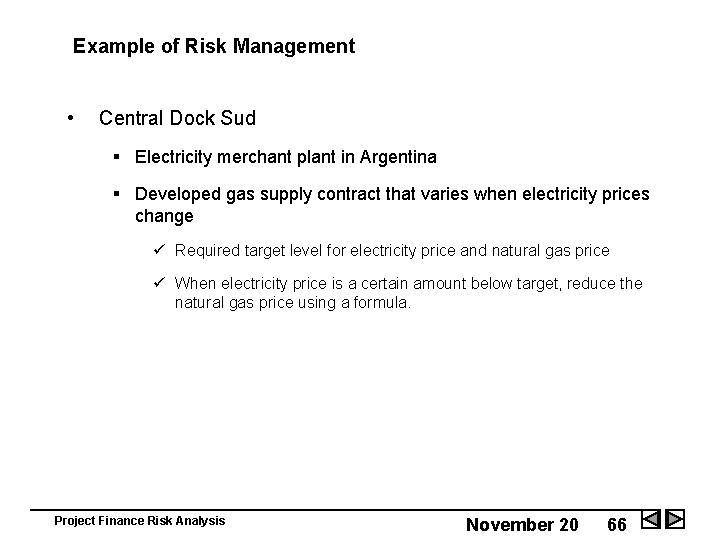
Example of Risk Management • Central Dock Sud § Electricity merchant plant in Argentina § Developed gas supply contract that varies when electricity prices change ü Required target level for electricity price and natural gas price ü When electricity price is a certain amount below target, reduce the natural gas price using a formula. Project Finance Risk Analysis November 20 66
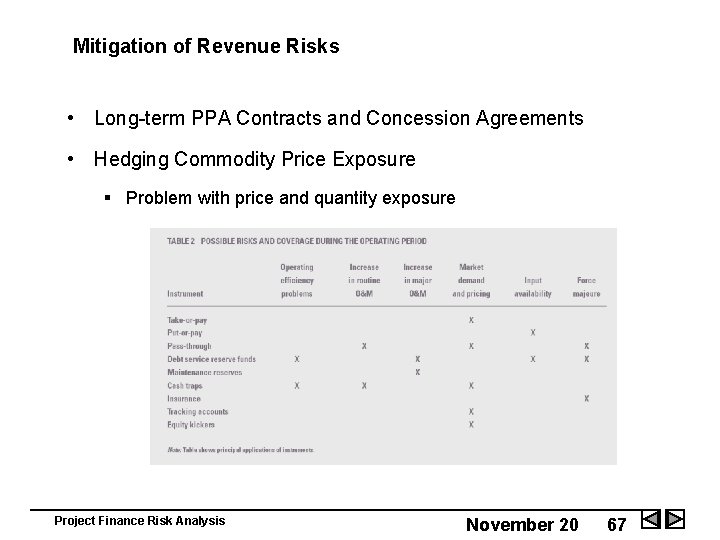
Mitigation of Revenue Risks • Long-term PPA Contracts and Concession Agreements • Hedging Commodity Price Exposure § Problem with price and quantity exposure Project Finance Risk Analysis November 20 67
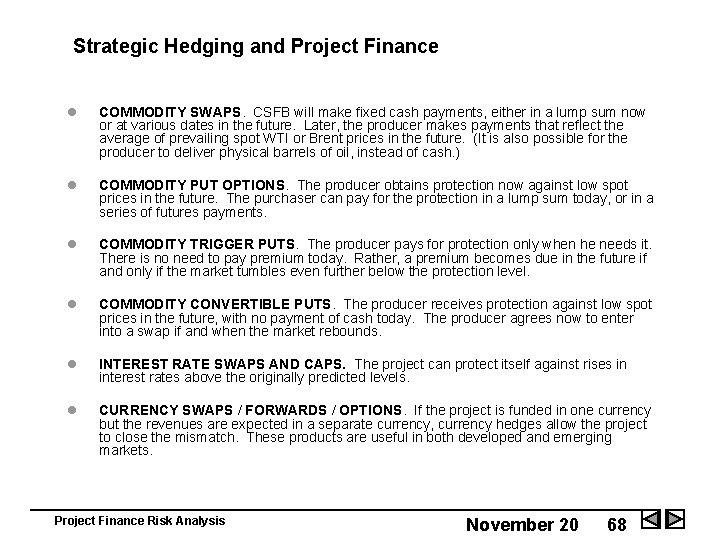
Strategic Hedging and Project Finance l COMMODITY SWAPS. CSFB will make fixed cash payments, either in a lump sum now or at various dates in the future. Later, the producer makes payments that reflect the average of prevailing spot WTI or Brent prices in the future. (It is also possible for the producer to deliver physical barrels of oil, instead of cash. ) l COMMODITY PUT OPTIONS. The producer obtains protection now against low spot prices in the future. The purchaser can pay for the protection in a lump sum today, or in a series of futures payments. l COMMODITY TRIGGER PUTS. The producer pays for protection only when he needs it. There is no need to pay premium today. Rather, a premium becomes due in the future if and only if the market tumbles even further below the protection level. l COMMODITY CONVERTIBLE PUTS. The producer receives protection against low spot prices in the future, with no payment of cash today. The producer agrees now to enter into a swap if and when the market rebounds. l INTEREST RATE SWAPS AND CAPS. The project can protect itself against rises in interest rates above the originally predicted levels. l CURRENCY SWAPS / FORWARDS / OPTIONS. If the project is funded in one currency but the revenues are expected in a separate currency, currency hedges allow the project to close the mismatch. These products are useful in both developed and emerging markets. Project Finance Risk Analysis November 20 68
General Discussion Risk Management (Reference) • The essence of risk management lies in maximizing the areas where we have some control over the outcome and minimizing the areas where we have absolutely no control over the outcome. • Risk managers must be thoroughly familiar with a variety of financial markets, with the intricacies of the trading process, and with financial and statistical modeling. • Risk management integrates fixed-income markets, currency markets, equity and commodity markets. In each of these, financial instruments must be decomposed into fundamental building blocks, then reassembled for risk measurement purposes. • Philippe Jorion, “Value at Risk” Project Finance Risk Analysis November 20 69
Management of Technological Risk – Liquidated Damages and Guarantees • Technology Guarantee § Either the Sponsor itself or the technology developer will guarantee that the technology will work for a given period ü For example, six months to two years after startup. ü Twelve months is common in the power generation sector. ü If the guarantee is not met, financial penalties could apply (although these are rarely sufficient to fully repay the loan. ) § Problem with Technology Guarantees: Many Technology companies are weak financially and may have little substance to back such a guarantee. Project Finance Risk Analysis November 20 70
Technology Risk Management Continued • Technology Insurance § Insurance cover may be raised from unconventional or conventional insurance markets. This can be expected to be difficult for brand-new technologies. • Quality Assurance § An equipment supplier or technology licenser may guarantee the resultant product’s specification which, to a large part, can cover the Technical component of Operating Risk. This is often seen in the industrial chemicals industry. • Fleet Assurance § An equipment supplier or lessor may guarantee to replace individual items found faulty from a fleet in the neighbourhood. This may be a little difficult for a dragline, in say, Thailand, although it may be easy for a toll-booth machine installed there. Duplicate facilities and standby/backups are varieties of this approach. Project Finance Risk Analysis November 20 71
Technology Risk Management • Alternative Sourcing § If the technology does not work out, then the technology company undertakes to provide equipment from elsewhere (if the supplier) or arrange to use the technology elsewhere (if the plant) with no impact on cash-flows. This is rarely seen. • Business Interruption Insurance § This takes effect upon project startup and can provide useful protection of the Assets or the Project Financing in the event of lost income arising from an accident. If a total loss, the banks will often want to be the loss payee under this type of insurance policy as well as the all-risks general insurance policy. This is indirect cover for the Technical Component of Operating Risk. Project Finance Risk Analysis November 20 72
Standard and Poor’s on Assumptions • The first analytical task is to identify the project's key drivers of success that could adversely affect cash flow for debt service if the original project assumptions prove wrong. • Financial projections of project finance power projects are probably inherently skewed toward successful results. . . hiding the true technical and operating risks inherent in many projects. . . " Project Finance Risk Analysis November 20 73
Standard & Poor’s on Assumptions According to S&P, three potential problems with assumptions include: § To what extent do predictions about the key drivers, made explicitly or implicitly, rely on overly optimistic plans and scenarios of success? § Are predictions made symmetrically, in that the downside performance is considered as well as the upside? § Have the forecasts neglected the statistics of the past, which, among other things, could indicate a different scenario than the one based only upon current trends or conditions? Project Finance Risk Analysis November 20 74

Risk Assessment Methods with Project Finance Models • Methods of Risk Assessment § Using judgmental assessments ü Sensitivity analysis ü Scenario analysis ü Stress test analysis ü Break-even analysis § Using mathematical analysis ü Volatility ü Monte Carlo simulation ü Value at Risk Project Finance Risk Analysis November 20 75
Three Risk Analysis Techniques with Project Finance Models • Traditional methods of using a project finance model with expert judgement to assess the risk include break-even analysis, scenario analysis and sensitivity analysis: § Sensitivity analysis ü Evaluates how the credit quality and value is affected by changing single variables. § Scenario analysis ü Measures the ability to service debt and generate cash flow under a comprehensive set of assumptions for market prices, fuel costs, plant availability and other variables. § Break-even analysis ü Tests how much worse a variable can become before a default or non-payment of debt occurs. Break-even analysis can be applied to the minimum debt service coverage ratio or the amount of debt outstanding at the end of the life of a project. Project Finance Risk Analysis November 20 76
Sensitivity Analysis and Scenario Analysis (Reference) • Sensitivity Analysis • Scenario Analysis • Simple sensitivities to potential changes in fuel prices, project availability, mechanical efficiency, inflation, and O&M costs usually sufficed to measure financial risk. Too simplistic and thus, may not capture a project's financial risk. Because sensitivity analysis only tests a projects' response to one variable, it ignores the multidimensional reality of business and, therefore, may ignore the full range of uncertainty. Still worse, sensitivity analysis may elevate pinhole risks, and their usual attendant dire consequences, to levels that needlessly dominate the credit analysis. • Scenario analysis collectively considers a number of variables and their potential values that a project could face through its debt maturity. A good collection of project scenarios, when placed into the project's financial model, will explore the various, and sometimes complex, linkages and correlations among variables, such as interest rates, inflation, foreign exchange, product price, or cost of production in some industries. Assess the long-term drivers of profitability in the project's industry, as well as the specific project, and identify the critical uncertainties. Develop several scenarios based on those uncertainties, asses their relative likelihood of occurrence, and then determine how robust or weak the project is under varying economic and market conditions. Project Finance Risk Analysis November 20 77
Stress Test Analysis • Stress scenarios test the pro forma results' sensitivity to changes in key assumptions and operational parameters that explore how a project will fare under different views of the market: § Changes in technical parameters and performance, such as efficiency, availability, output, etc. ; § Fuel, supplies, and other operating expenses; § Downside market price and demand scenarios; § Inflation rates, including de-inflation if appropriate; § Interest rate exposure for projects with floating rate debt; § Foreign exchange movements; § The effects of new technologies; and § Additional debt levels, as allowed by project documentation. Project Finance Risk Analysis November 20 78
Rating Agency Comments on Risk Analysis with Models • Fitch • The object is to determine if the project is likely to continue to cover operating expenses and debt interest and principal payments despite unexpected stress levels. The scenarios also reveal whethere are particular variables to which the project has a greater degree of sensitivity. The evaluation of the stress scenario results is focused on the minimum debt service coverage in any single year and the average debt service coverage over the entire life of the debt. If the cash flows are unable to cover payments on project debt under certain stress scenarios, the debt service reserve or other forms of credit enhancement available to the project are applied. Thus, [sensitivity analysis] can be used to size the appropriate debt service reserve or other credit enhancements needed to avoid default under adverse scenarios. Fitch performs sensitivity analyses that stress cash flows down to a break-even level to see how the project performs under extreme hardship conditions and at what minimum power price the project can perform while covering operating costs and debt service payments. Project Finance Risk Analysis November 20 79
Rating Agency Comments on Risk Analysis with Models • Moody’s believes that the appropriate analytical beginning is to determine a credible market forecast and to assess the projects break -even position relative to that market forecast. A break-even point substantially below the market forecast allows a project to absorb unexpected market fluctuations in prices and volumes which is essential to an investment grade debt security. From this analysis, one can derive the appropriate capital structure for each project individually. • Moody’s believes that a merchant plant will be subject to swings in prices as power markets develop. The better able a project is to absorb changes in prices (and changes in volumes) the higher its rating will be. Our belief is that an investment-grade-rated merchant power plant will have a break-even point, where it fully covers its debt service obligations, between 30% and 50% below a reasonable market forecast price. The amount of the discount is determined by the characteristics of the market and the reasonableness of the market forecast assumptions. Project Finance Risk Analysis November 20 80
Rating Agency Comments on Risk Analysis with Models • Standard & Poor's • Where projects elect to obtain key supply inputs from spot markets, the risk of cash flow erosion may raise project credit concerns, particularly in volatile markets, such as energy and other commodities. Stronger projects will be those that can demonstrate a resilience to worst case cost movement scenarios as indicated by historical trends. Historical price trends in such commodities as crude oil, petrochemical products, metals and pulp and paper can provide a basis for analysis of potential worst case price movements. Standard & Poor's will rely in part on financial scenario analysis to assess the effects of supply and cost disruptions on project economics. Project Finance Risk Analysis November 20 81
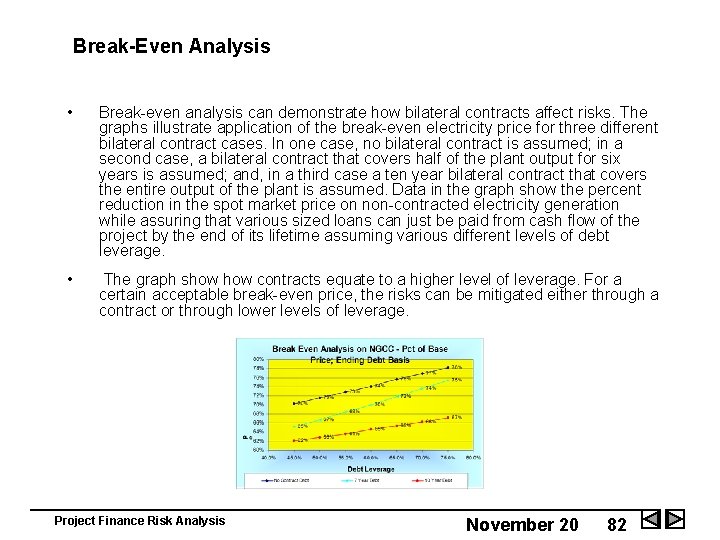
Break-Even Analysis • Break-even analysis can demonstrate how bilateral contracts affect risks. The graphs illustrate application of the break-even electricity price for three different bilateral contract cases. In one case, no bilateral contract is assumed; in a second case, a bilateral contract that covers half of the plant output for six years is assumed; and, in a third case a ten year bilateral contract that covers the entire output of the plant is assumed. Data in the graph show the percent reduction in the spot market price on non-contracted electricity generation while assuring that various sized loans can just be paid from cash flow of the project by the end of its lifetime assuming various different levels of debt leverage. • The graph show contracts equate to a higher level of leverage. For a certain acceptable break-even price, the risks can be mitigated either through a contract or through lower levels of leverage. Project Finance Risk Analysis November 20 82
Tornado Diagrams and Sensitivity Analysis • The tornado graph begins with a base case and measures how much prices move up or down from the base case because of the assumption change. • The tornado diagram demonstrates which aspects of risk are most important to IRR or DSCR. • Once the tornado diagram is complete for a case without contractual enhancements, the risk analysis can be re-done with contracts to evaluate how the enhancements affect risk. • Examples § Base case IRR is 14% ü Construction cost risk moves down by 2% or up by 3% ü Price risk moves IRR up from base case by 4% or down by 5% § Base case DSCR is 1. 4 ü O&M risk moves DSCR from 1. 4 down to 1. 2 or up to 1. 5 ü Volume risk moves DSCR down from 1. 4 to 1. 3 or up to 1. 6 Project Finance Risk Analysis November 20 83
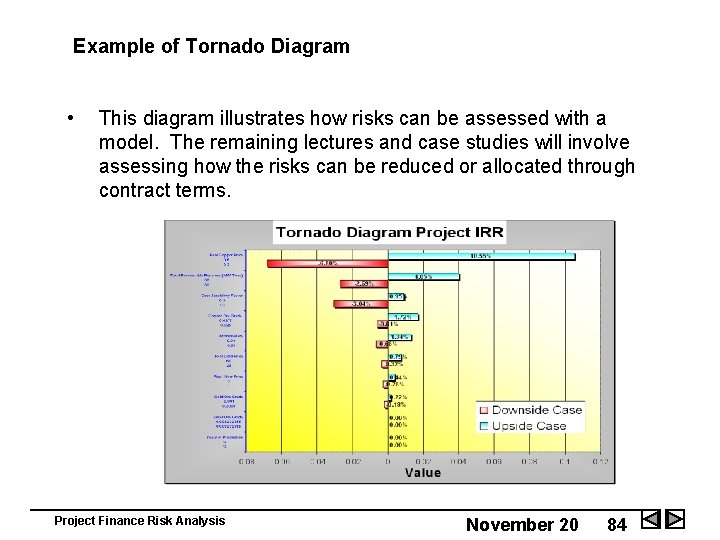
Example of Tornado Diagram • This diagram illustrates how risks can be assessed with a model. The remaining lectures and case studies will involve assessing how the risks can be reduced or allocated through contract terms. Project Finance Risk Analysis November 20 84
S&P on Volatility Analysis • Where historical price data exist, Standard & Poor's expects that sponsors will have assessed historical and prospective price volatility as part of their analyses. • Project participants have developed analytic techniques such as option pricing and probabilistic modeling as tools for understanding and managing financial and operational risk. • While such techniques can be useful for exploring market dynamics and assessing relationships among key variables, Standard & Poor's notes that the historical data needed to employ these techniques tend not to be sufficient at present to develop reliable predictions or statistically significant inferences for investment-grade transactions. Hence, given the limitations of statistical approaches, statistics will not drive the ratings methodology, but only support the analysis. Project Finance Risk Analysis November 20 85
Paul Ashley on Simulation • Given plausible assumptions for key risk drivers (for example, volatility of gas prices), the ratings are then built around simulating cash flows and debt coverage for individual projects. These simulations can then determine probability and loss distribution and directly observe the impact on cash flows and riskiness of a particular transaction structure under different market environments. • The parameterization of the rating simulations combines market data and expert judgment in a structured way that allows transparency and consistency in risk evaluation without losing the ability to capture the specifics of a transaction structure. Project Finance Risk Analysis November 20 86
Sensitivity and Scenario Analysis Project Finance Modelling November 20 87
Project Finance Risk Analysis Source: Partnerships Victoria, PSC, Technical Note, June 2001, pp 33 -34. November 20 88
Project Finance Risk Analysis Source: Partnerships Victoria, PSC, Technical Note, June 2001, pp 33 -34. November 20 89
Source: South Africa National Treasury, PPP Unit, Risk Matrix, May 2003 Project Finance Risk Analysis November 20 90
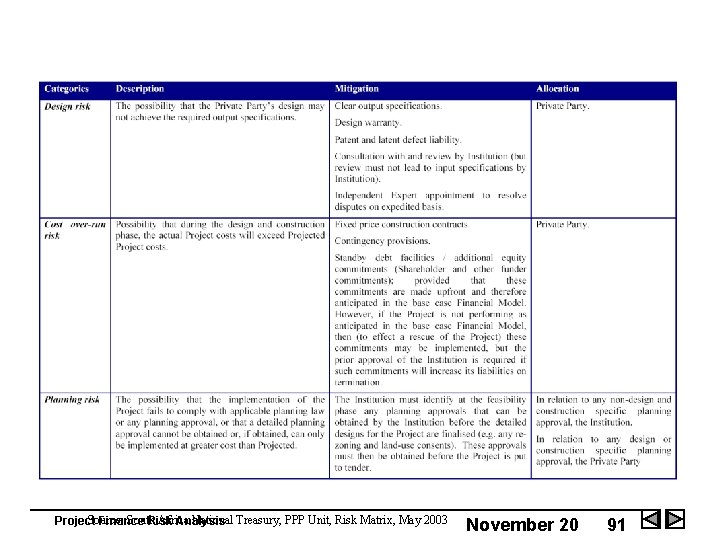
Source: South Africa National Treasury, PPP Unit, Risk Matrix, May 2003 Project Finance Risk Analysis November 20 91
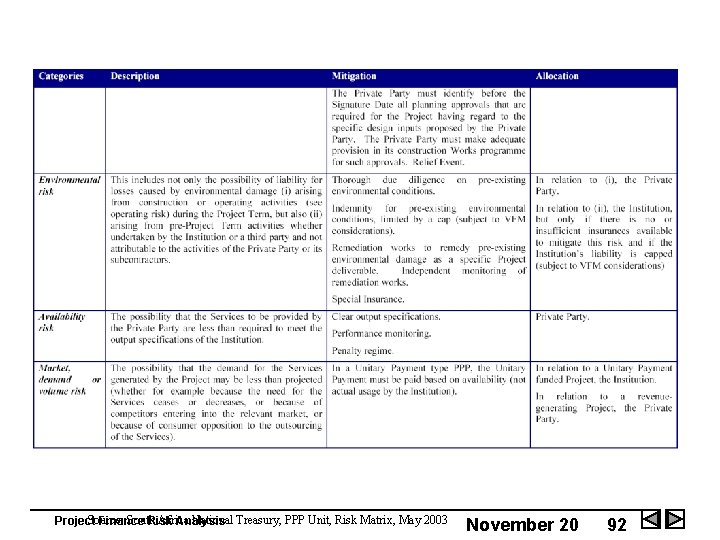
Source: South Africa National Treasury, PPP Unit, Risk Matrix, May 2003 Project Finance Risk Analysis November 20 92
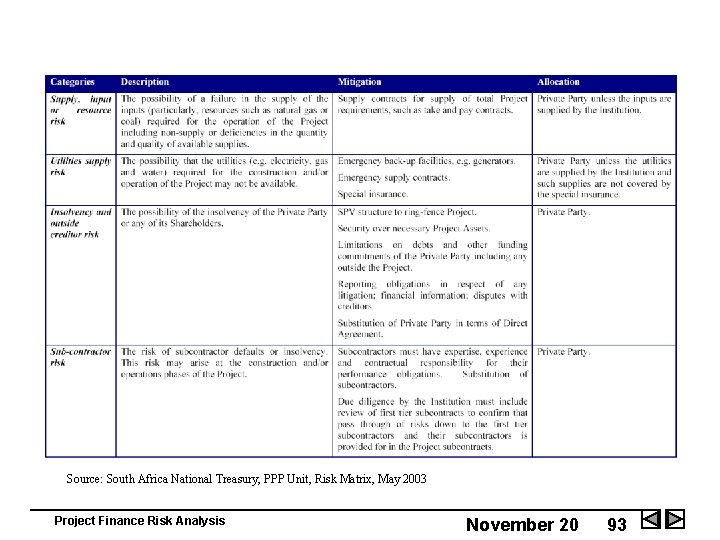
Source: South Africa National Treasury, PPP Unit, Risk Matrix, May 2003 Project Finance Risk Analysis November 20 93
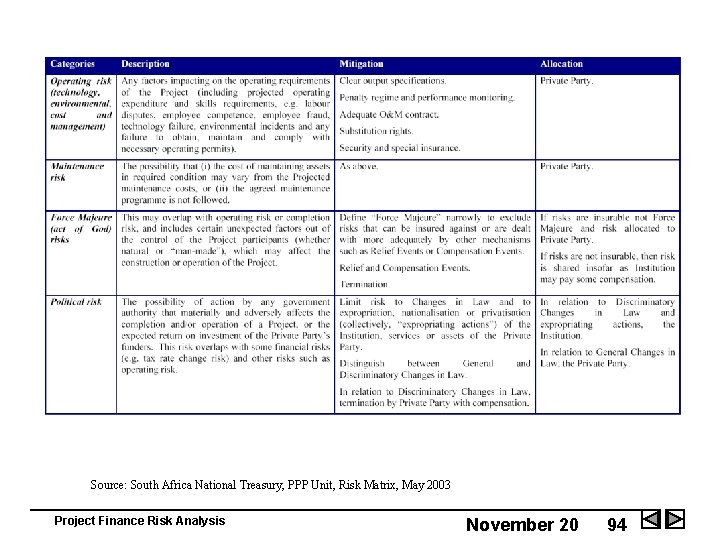
Source: South Africa National Treasury, PPP Unit, Risk Matrix, May 2003 Project Finance Risk Analysis November 20 94
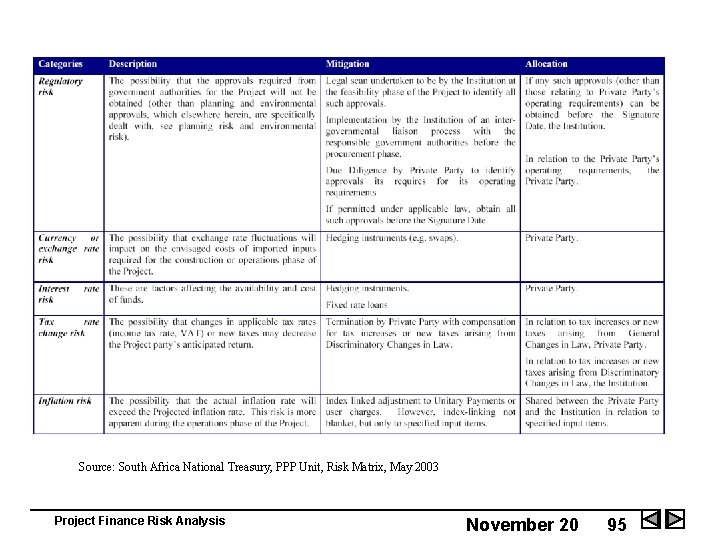
Source: South Africa National Treasury, PPP Unit, Risk Matrix, May 2003 Project Finance Risk Analysis November 20 95
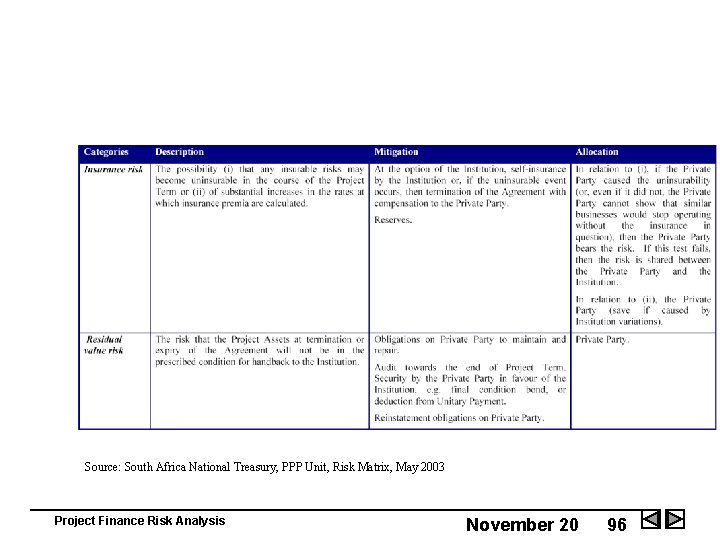
Source: South Africa National Treasury, PPP Unit, Risk Matrix, May 2003 Project Finance Risk Analysis November 20 96
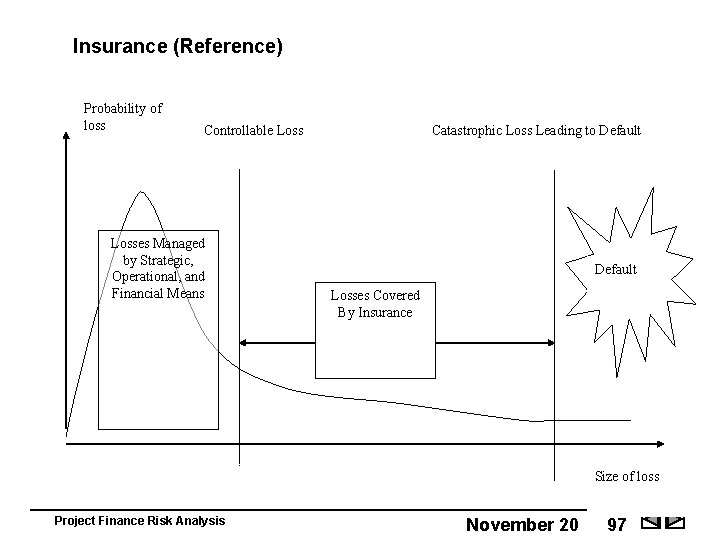
Insurance (Reference) Probability of loss Controllable Losses Managed by Strategic, Operational, and Financial Means Catastrophic Loss Leading to Default Losses Covered By Insurance Size of loss Project Finance Risk Analysis November 20 97
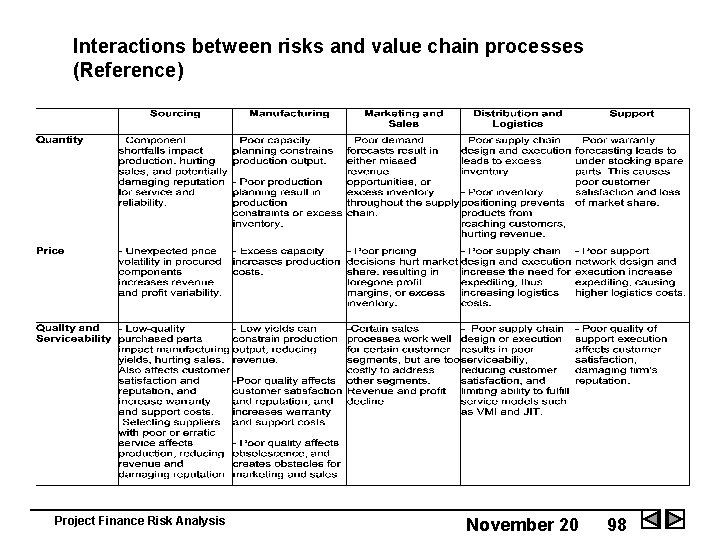
Interactions between risks and value chain processes (Reference) Project Finance Risk Analysis November 20 98
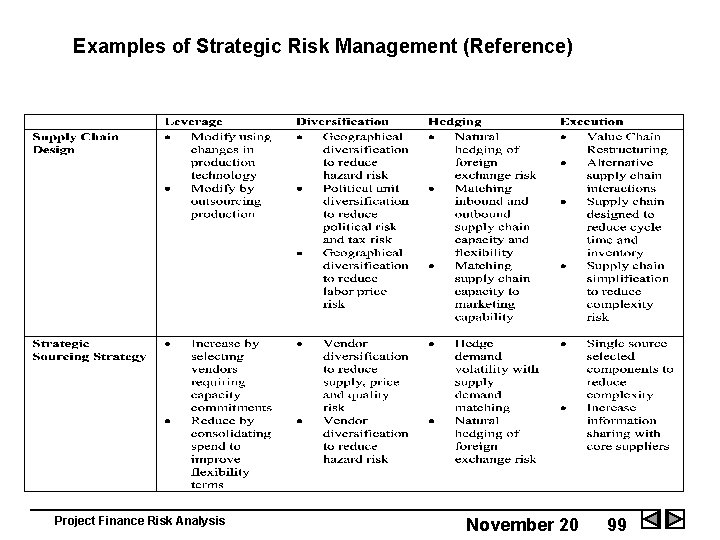
Examples of Strategic Risk Management (Reference) Project Finance Risk Analysis November 20 99
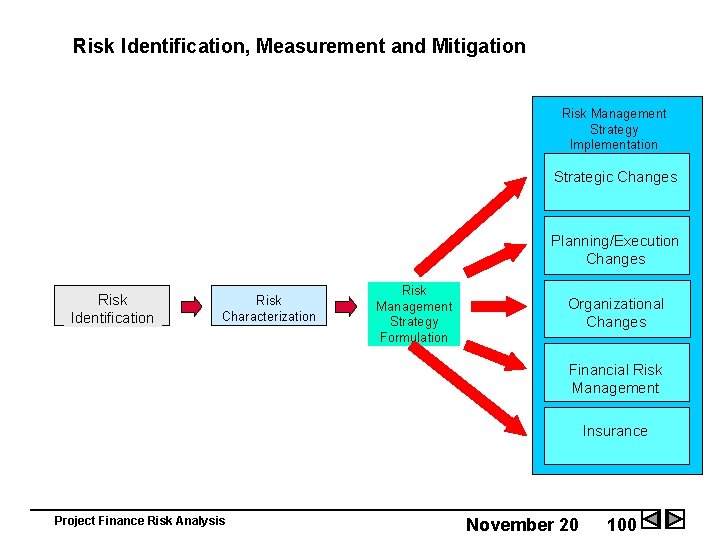
Risk Identification, Measurement and Mitigation Risk Management Strategy Implementation Strategic Changes Planning/Execution Changes Risk Identification Risk Characterization Risk Management Strategy Formulation Organizational Changes Financial Risk Management Insurance Project Finance Risk Analysis November 20 100
Appendix: Alternative Risk Classifications Project Finance Modelling November 20 101
Begin Risk Analysis with Free Cash Flow Value Drivers – Project Risks • Revenues § Forward prices and contract sustainability (Oil, electricity, tolls) § Volume and capacity utilization (Traffic, wind, market capacity factor) § Credit quality of off-taker (PPA, country risk) • Operating Expenses § Efficiency in converting inputs to outputs (Heat rate, input prices) § Operation and maintenance expense volatility (Availability) § On-going Capital Expenditures (Gearboxes) • Capital Expenditures § Completion and technology § Over-run § Delay § Credit and protection of construction company Project Finance Risk Analysis November 20 102
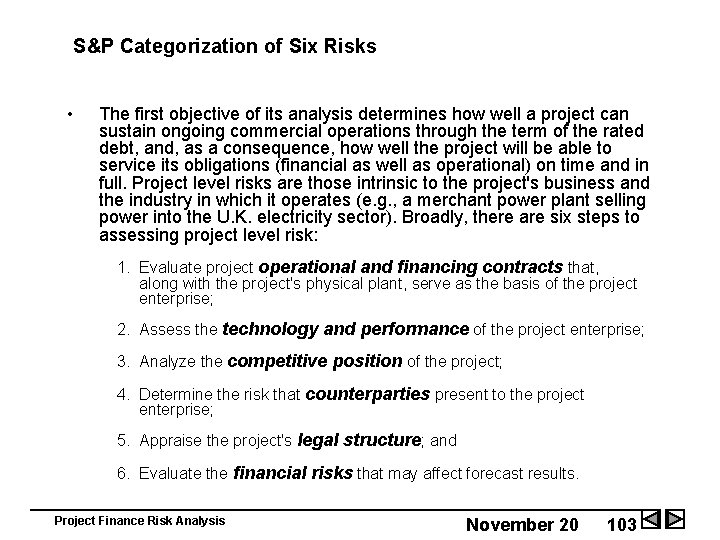
S&P Categorization of Six Risks • The first objective of its analysis determines how well a project can sustain ongoing commercial operations through the term of the rated debt, and, as a consequence, how well the project will be able to service its obligations (financial as well as operational) on time and in full. Project level risks are those intrinsic to the project's business and the industry in which it operates (e. g. , a merchant power plant selling power into the U. K. electricity sector). Broadly, there are six steps to assessing project level risk: 1. Evaluate project operational and financing contracts that, along with the project's physical plant, serve as the basis of the project enterprise; 2. Assess the technology and performance of the project enterprise; 3. Analyze the competitive position of the project; 4. Determine the risk that counterparties present to the project enterprise; 5. Appraise the project's legal structure; and 6. Evaluate the financial risks that may affect forecast results. Project Finance Risk Analysis November 20 103
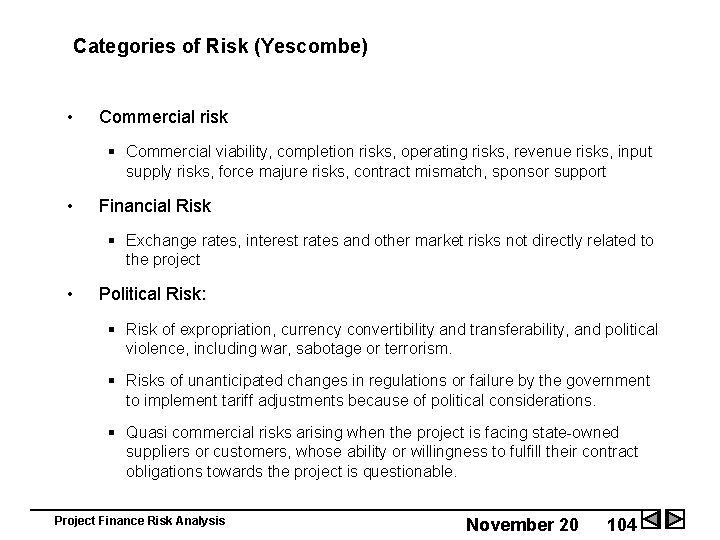
Categories of Risk (Yescombe) • Commercial risk § Commercial viability, completion risks, operating risks, revenue risks, input supply risks, force majure risks, contract mismatch, sponsor support • Financial Risk § Exchange rates, interest rates and other market risks not directly related to the project • Political Risk: § Risk of expropriation, currency convertibility and transferability, and political violence, including war, sabotage or terrorism. § Risks of unanticipated changes in regulations or failure by the government to implement tariff adjustments because of political considerations. § Quasi commercial risks arising when the project is facing state-owned suppliers or customers, whose ability or willingness to fulfill their contract obligations towards the project is questionable. Project Finance Risk Analysis November 20 104
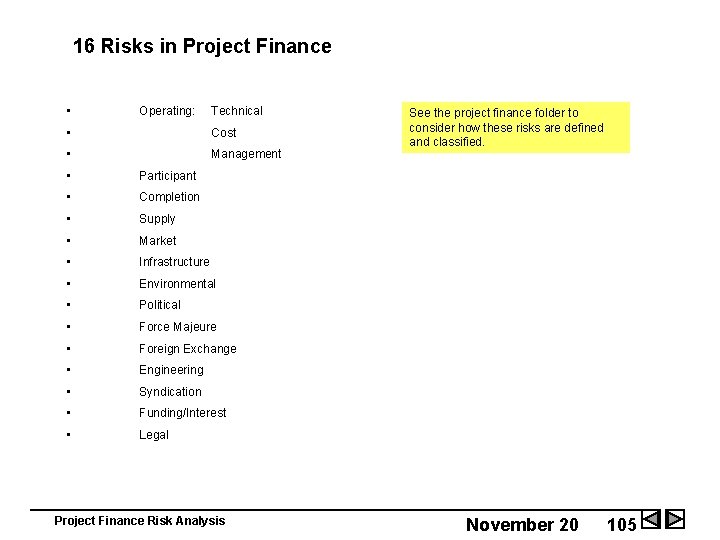
16 Risks in Project Finance • Operating: Technical • Cost • Management • Participant • Completion • Supply • Market • Infrastructure • Environmental • Political • Force Majeure • Foreign Exchange • Engineering • Syndication • Funding/Interest • Legal Project Finance Risk Analysis See the project finance folder to consider how these risks are defined and classified. November 20 105
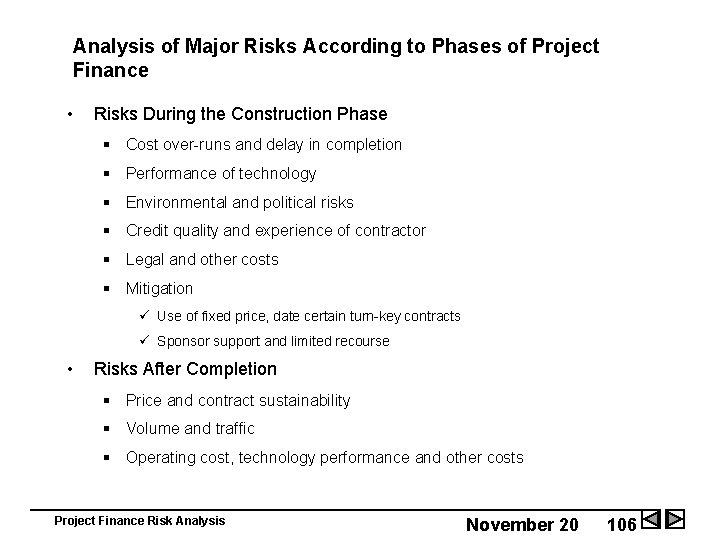
Analysis of Major Risks According to Phases of Project Finance • Risks During the Construction Phase § Cost over-runs and delay in completion § Performance of technology § Environmental and political risks § Credit quality and experience of contractor § Legal and other costs § Mitigation ü Use of fixed price, date certain turn-key contracts ü Sponsor support and limited recourse • Risks After Completion § Price and contract sustainability § Volume and traffic § Operating cost, technology performance and other costs Project Finance Risk Analysis November 20 106
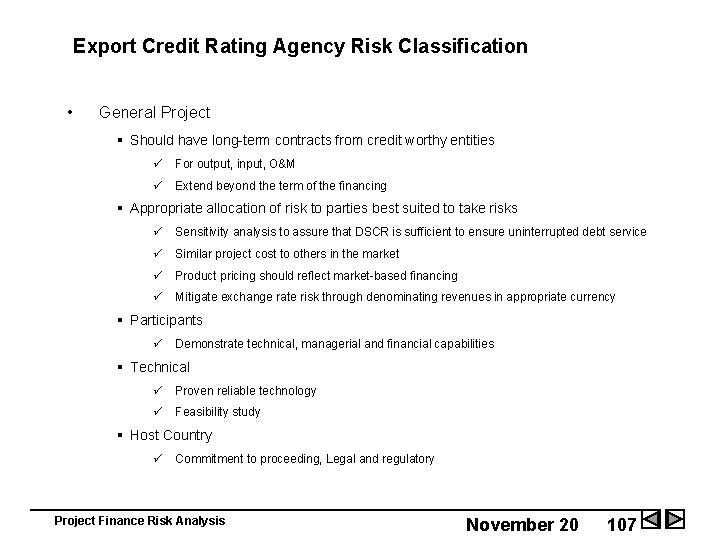
Export Credit Rating Agency Risk Classification • General Project § Should have long-term contracts from credit worthy entities ü For output, input, O&M ü Extend beyond the term of the financing § Appropriate allocation of risk to parties best suited to take risks ü Sensitivity analysis to assure that DSCR is sufficient to ensure uninterrupted debt service ü Similar project cost to others in the market ü Product pricing should reflect market-based financing ü Mitigate exchange rate risk through denominating revenues in appropriate currency § Participants ü Demonstrate technical, managerial and financial capabilities § Technical ü Proven reliable technology ü Feasibility study § Host Country ü Commitment to proceeding, Legal and regulatory Project Finance Risk Analysis November 20 107
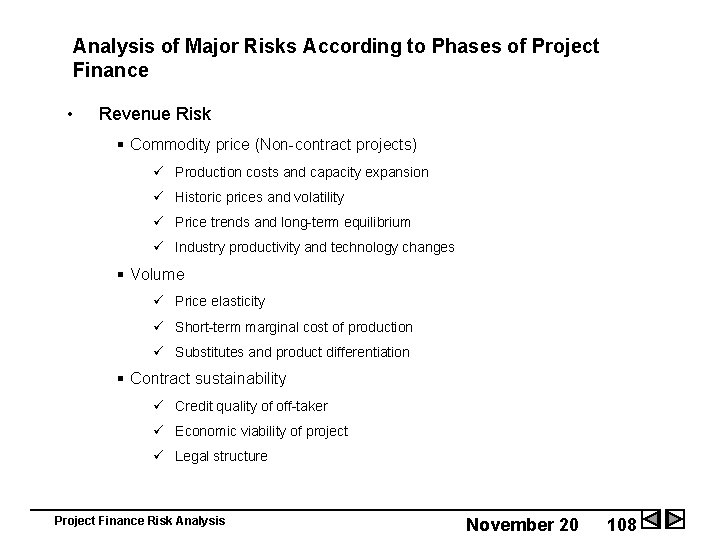
Analysis of Major Risks According to Phases of Project Finance • Revenue Risk § Commodity price (Non-contract projects) ü Production costs and capacity expansion ü Historic prices and volatility ü Price trends and long-term equilibrium ü Industry productivity and technology changes § Volume ü Price elasticity ü Short-term marginal cost of production ü Substitutes and product differentiation § Contract sustainability ü Credit quality of off-taker ü Economic viability of project ü Legal structure Project Finance Risk Analysis November 20 108
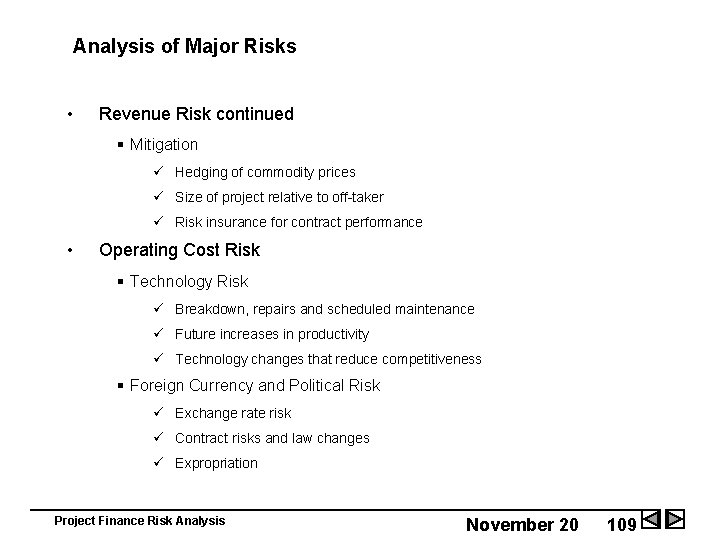
Analysis of Major Risks • Revenue Risk continued § Mitigation ü Hedging of commodity prices ü Size of project relative to off-taker ü Risk insurance for contract performance • Operating Cost Risk § Technology Risk ü Breakdown, repairs and scheduled maintenance ü Future increases in productivity ü Technology changes that reduce competitiveness § Foreign Currency and Political Risk ü Exchange rate risk ü Contract risks and law changes ü Expropriation Project Finance Risk Analysis November 20 109
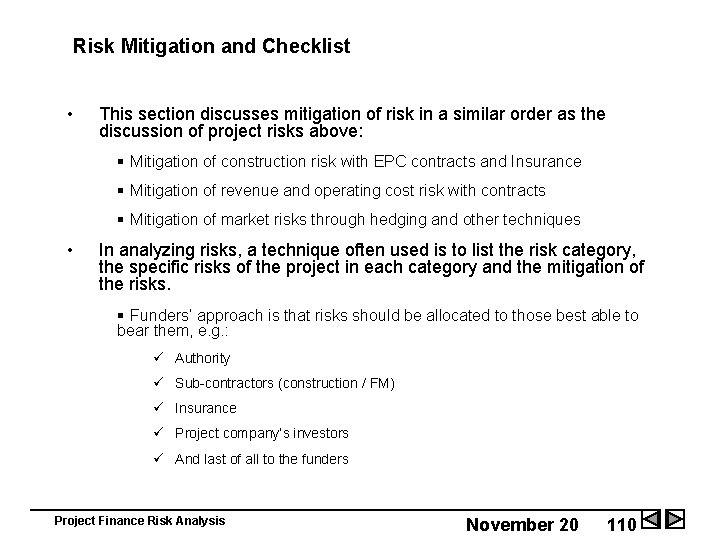
Risk Mitigation and Checklist • This section discusses mitigation of risk in a similar order as the discussion of project risks above: § Mitigation of construction risk with EPC contracts and Insurance § Mitigation of revenue and operating cost risk with contracts § Mitigation of market risks through hedging and other techniques • In analyzing risks, a technique often used is to list the risk category, the specific risks of the project in each category and the mitigation of the risks. § Funders’ approach is that risks should be allocated to those best able to bear them, e. g. : ü Authority ü Sub-contractors (construction / FM) ü Insurance ü Project company’s investors ü And last of all to the funders Project Finance Risk Analysis November 20 110
Resources and Contacts • My contacts § Ed Bodmer § Phone: +001 -630 -886 -2754 § E-mail: edbodmer@aol. com • Other Sources § Financial Library – project finance case studies including Eurotunnel and Dabhol § Financial Library – Monte Carlo simulation analysis Project Finance Risk Analysis November 20 111
- Slides: 111