RICE UNIVERSITY China Energy Environment Awareness Presentation Prepared


- Slides: 27
RICE UNIVERSITY China, Energy & Environment Awareness Presentation Prepared for China & Sustainable Development Environmental & Energy Systems Institute Shell Center for Sustainability Rice University September 27, 2004 Steven W. Lewis, Ph. D. James A. Baker III Institute for Public Policy RICE UNIVERSITY swlewis@rice. edu 1
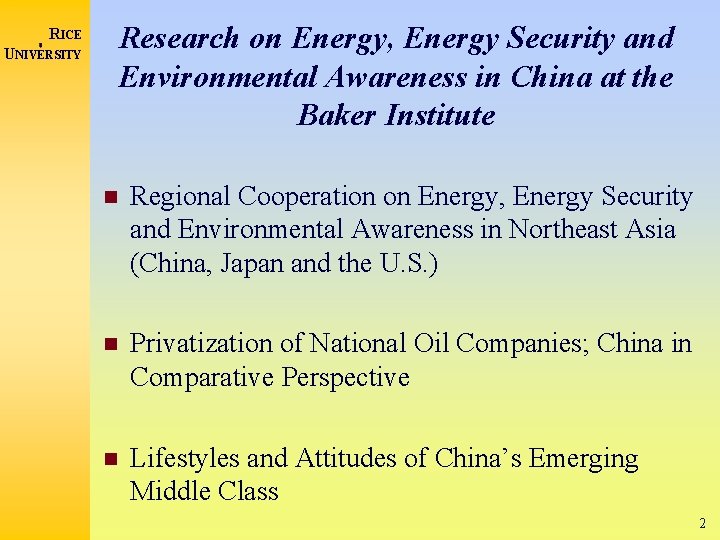
RICE UNIVERSITY Research on Energy, Energy Security and Environmental Awareness in China at the Baker Institute Regional Cooperation on Energy, Energy Security and Environmental Awareness in Northeast Asia (China, Japan and the U. S. ) Privatization of National Oil Companies; China in Comparative Perspective Lifestyles and Attitudes of China’s Emerging Middle Class 2
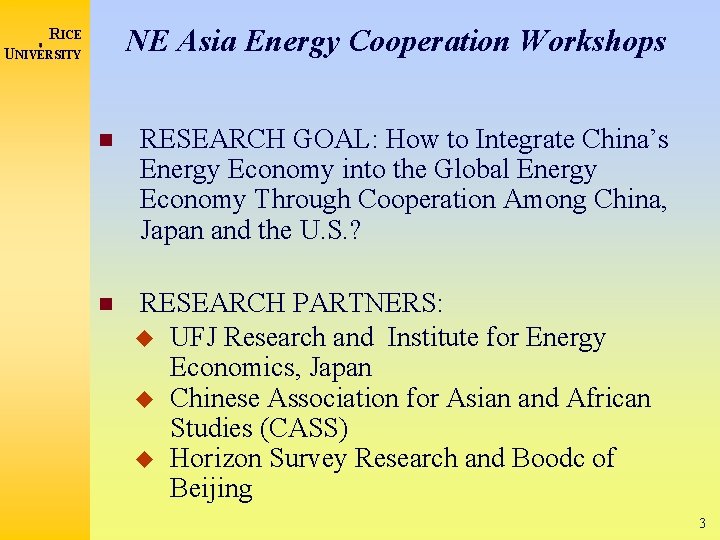
NE Asia Energy Cooperation Workshops RICE UNIVERSITY RESEARCH GOAL: How to Integrate China’s Energy Economy into the Global Energy Economy Through Cooperation Among China, Japan and the U. S. ? RESEARCH PARTNERS: UFJ Research and Institute for Energy Economics, Japan Chinese Association for Asian and African Studies (CASS) Horizon Survey Research and Boodc of Beijing 3
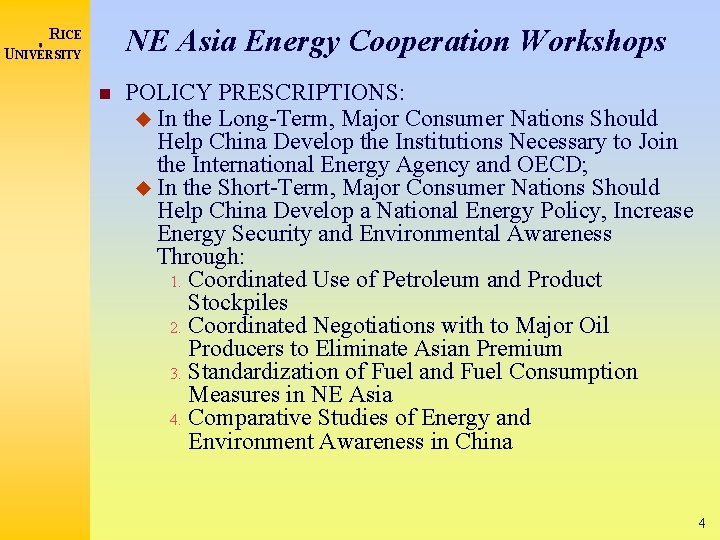
NE Asia Energy Cooperation Workshops RICE UNIVERSITY POLICY PRESCRIPTIONS: In the Long-Term, Major Consumer Nations Should Help China Develop the Institutions Necessary to Join the International Energy Agency and OECD; In the Short-Term, Major Consumer Nations Should Help China Develop a National Energy Policy, Increase Energy Security and Environmental Awareness Through: 1. Coordinated Use of Petroleum and Product Stockpiles 2. Coordinated Negotiations with to Major Oil Producers to Eliminate Asian Premium 3. Standardization of Fuel and Fuel Consumption Measures in NE Asia 4. Comparative Studies of Energy and Environment Awareness in China 4
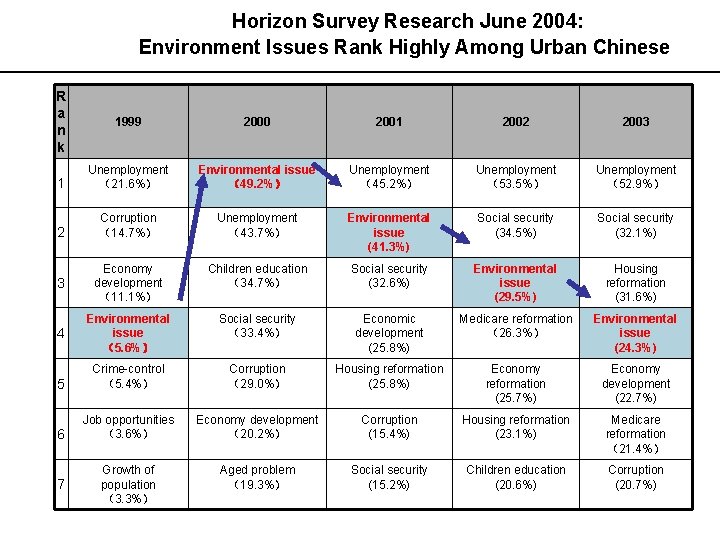
Horizon Survey Research June 2004: Environment Issues Rank Highly Among Urban Chinese R a n k 1999 2000 2001 2002 2003 1 Unemployment (21. 6%) Environmental issue (49. 2%) Unemployment (45. 2%) Unemployment (53. 5%) Unemployment (52. 9%) 2 Corruption (14. 7%) Unemployment (43. 7%) Environmental issue (41. 3%) Social security (34. 5%) Social security (32. 1%) 3 Economy development (11. 1%) Children education (34. 7%) Social security (32. 6%) Environmental issue (29. 5%) Housing reformation (31. 6%) 4 Environmental issue (5. 6%) Social security (33. 4%) Economic development (25. 8%) Medicare reformation (26. 3%) Environmental issue (24. 3%) 5 Crime-control (5. 4%) Corruption (29. 0%) Housing reformation (25. 8%) Economy reformation (25. 7%) Economy development (22. 7%) 6 Job opportunities (3. 6%) Economy development (20. 2%) Corruption (15. 4%) Housing reformation (23. 1%) Medicare reformation (21. 4%) Growth of population (3. 3%) Aged problem (19. 3%) Social security (15. 2%) Children education (20. 6%) Corruption (20. 7%) 7
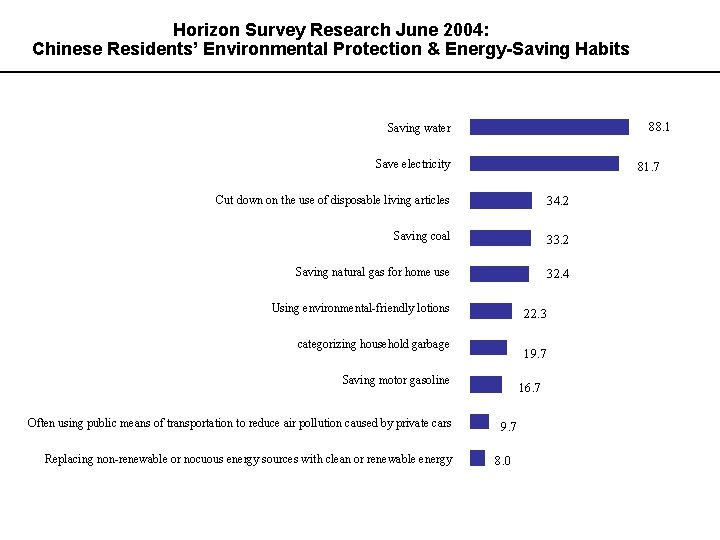
Horizon Survey Research June 2004: Chinese Residents’ Environmental Protection & Energy-Saving Habits 88. 1 Saving water Save electricity 81. 7 Cut down on the use of disposable living articles 34. 2 Saving coal 33. 2 Saving natural gas for home use 32. 4 Using environmental-friendly lotions 22. 3 categorizing household garbage 19. 7 Saving motor gasoline Often using public means of transportation to reduce air pollution caused by private cars Replacing non-renewable or nocuous energy sources with clean or renewable energy 16. 7 9. 7 8. 0
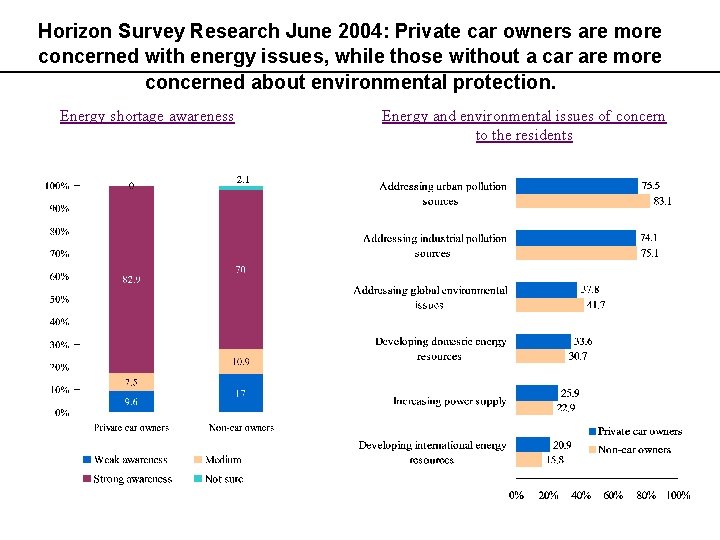
Horizon Survey Research June 2004: Private car owners are more concerned with energy issues, while those without a car are more concerned about environmental protection. Energy shortage awareness Energy and environmental issues of concern to the residents
Horizon Survey Research June 2004: Urban residents near factories or plants pay much attentions to air pollution and noise caused by manufacturing but less attention to the waste of water and land resources
Horizon Survey Research June 2004: Chinese residents expect a public hearing mechanism with high participation will be established for energy pricing
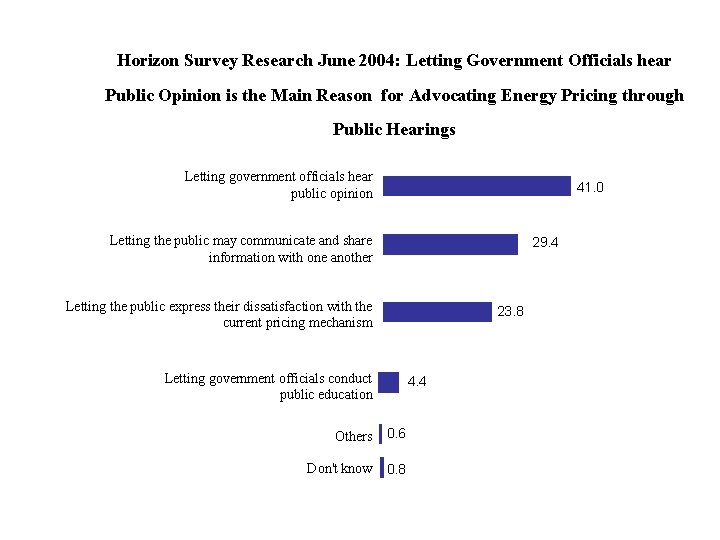
Horizon Survey Research June 2004: Letting Government Officials hear Public Opinion is the Main Reason for Advocating Energy Pricing through Public Hearings Letting government officials hear public opinion 41. 0 Letting the public may communicate and share information with one another 29. 4 Letting the public express their dissatisfaction with the current pricing mechanism 23. 8 Letting government officials conduct public education 4. 4 Others 0. 6 Don't know 0. 8
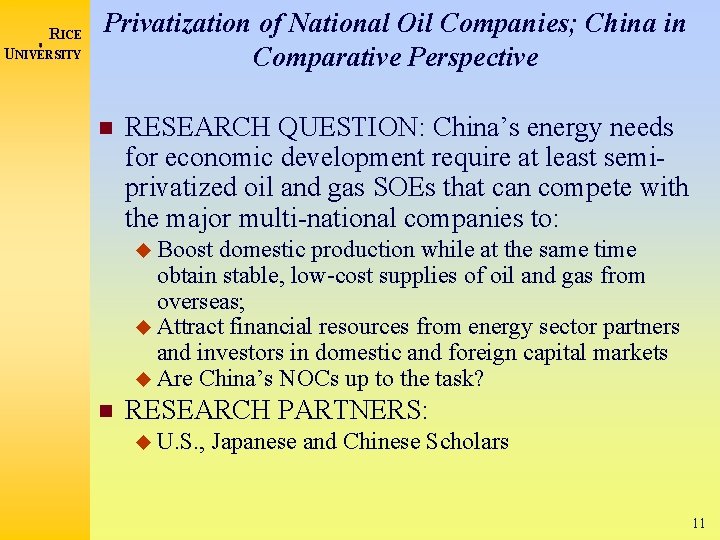
RICE UNIVERSITY Privatization of National Oil Companies; China in Comparative Perspective RESEARCH QUESTION: China’s energy needs for economic development require at least semiprivatized oil and gas SOEs that can compete with the major multi-national companies to: Boost domestic production while at the same time obtain stable, low-cost supplies of oil and gas from overseas; Attract financial resources from energy sector partners and investors in domestic and foreign capital markets Are China’s NOCs up to the task? RESEARCH PARTNERS: U. S. , Japanese and Chinese Scholars 11
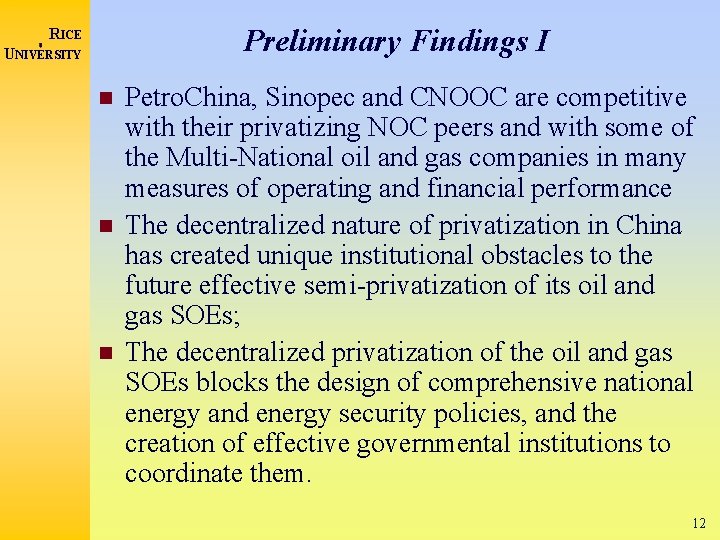
Preliminary Findings I RICE UNIVERSITY Petro. China, Sinopec and CNOOC are competitive with their privatizing NOC peers and with some of the Multi-National oil and gas companies in many measures of operating and financial performance The decentralized nature of privatization in China has created unique institutional obstacles to the future effective semi-privatization of its oil and gas SOEs; The decentralized privatization of the oil and gas SOEs blocks the design of comprehensive national energy and energy security policies, and the creation of effective governmental institutions to coordinate them. 12
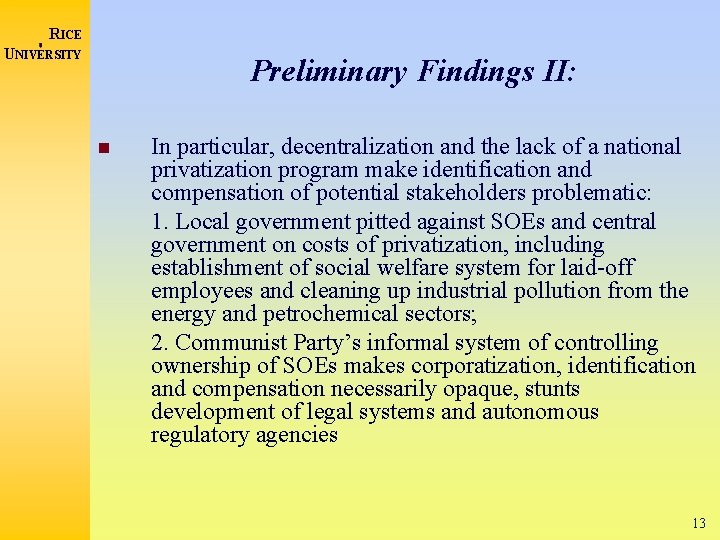
RICE UNIVERSITY Preliminary Findings II: In particular, decentralization and the lack of a national privatization program make identification and compensation of potential stakeholders problematic: 1. Local government pitted against SOEs and central government on costs of privatization, including establishment of social welfare system for laid-off employees and cleaning up industrial pollution from the energy and petrochemical sectors; 2. Communist Party’s informal system of controlling ownership of SOEs makes corporatization, identification and compensation necessarily opaque, stunts development of legal systems and autonomous regulatory agencies 13
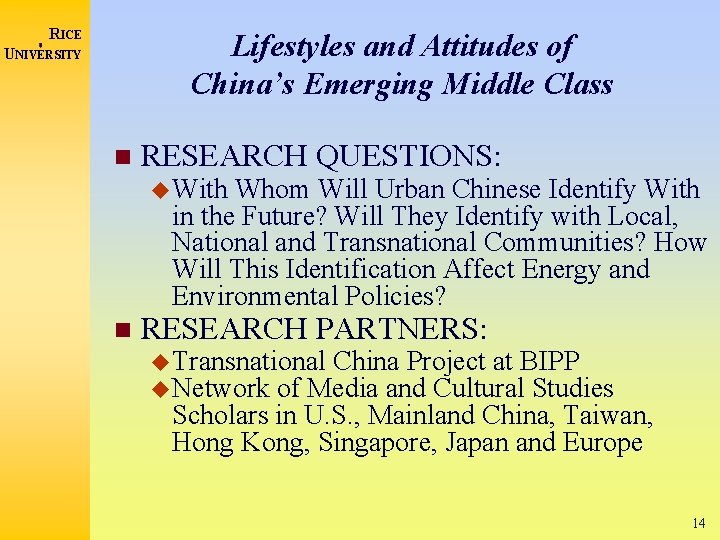
RICE Lifestyles and Attitudes of China’s Emerging Middle Class UNIVERSITY RESEARCH QUESTIONS: With Whom Will Urban Chinese Identify With in the Future? Will They Identify with Local, National and Transnational Communities? How Will This Identification Affect Energy and Environmental Policies? RESEARCH PARTNERS: Transnational China Project at BIPP Network of Media and Cultural Studies Scholars in U. S. , Mainland China, Taiwan, Hong Kong, Singapore, Japan and Europe 14
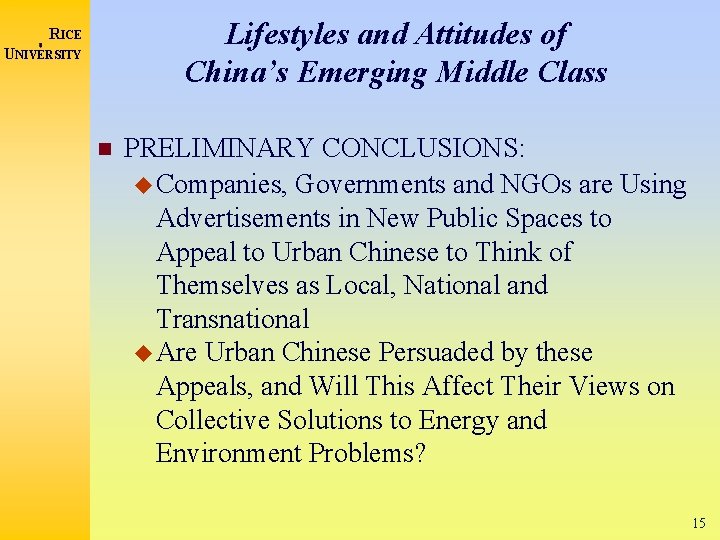
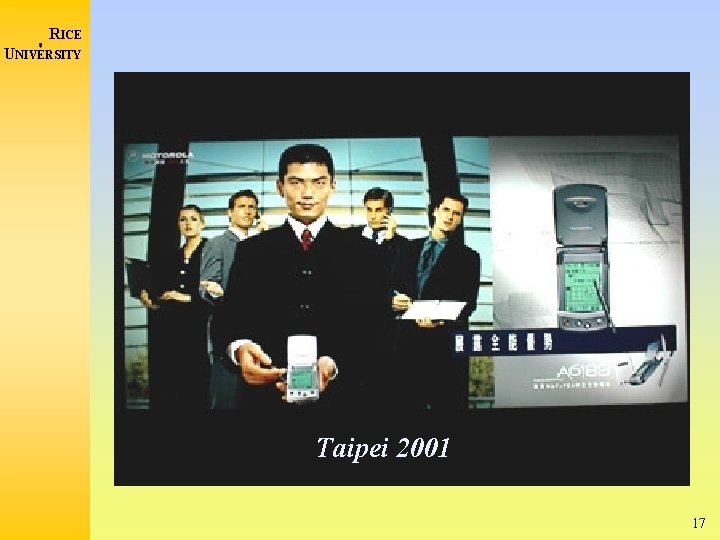
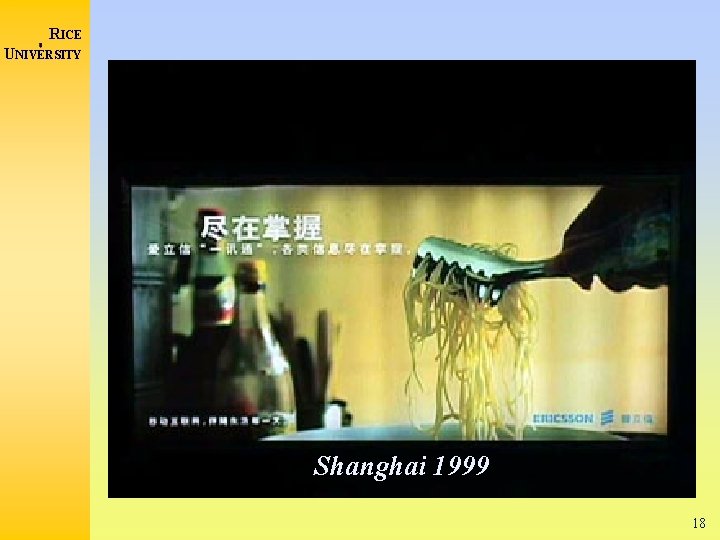
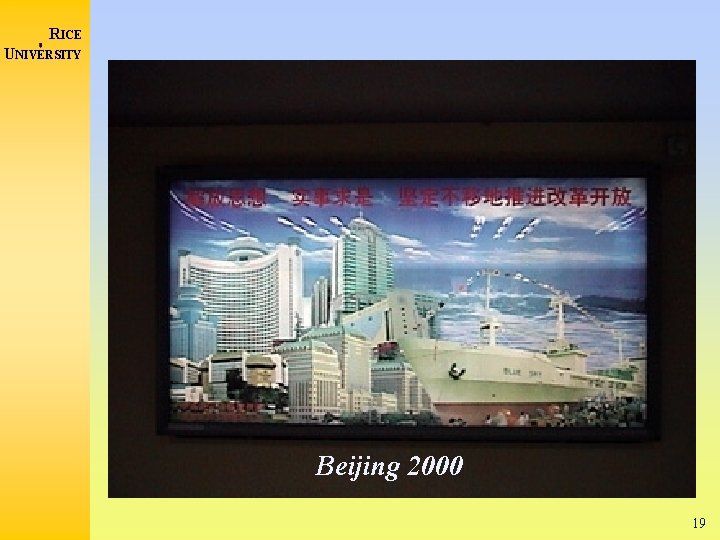
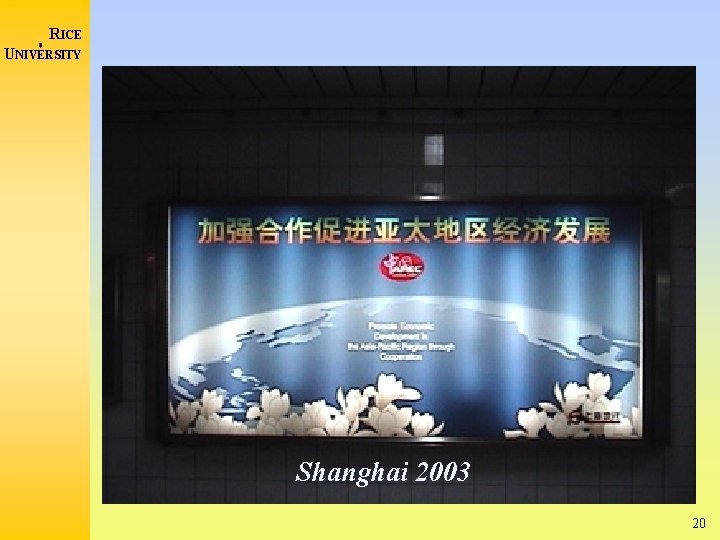
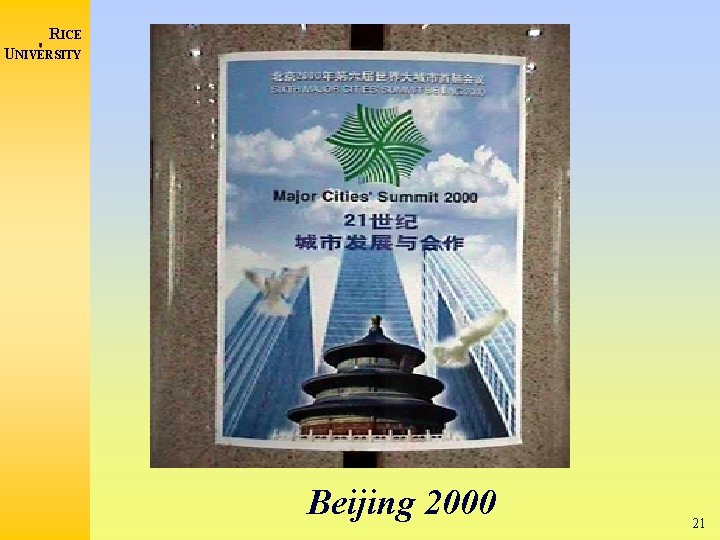
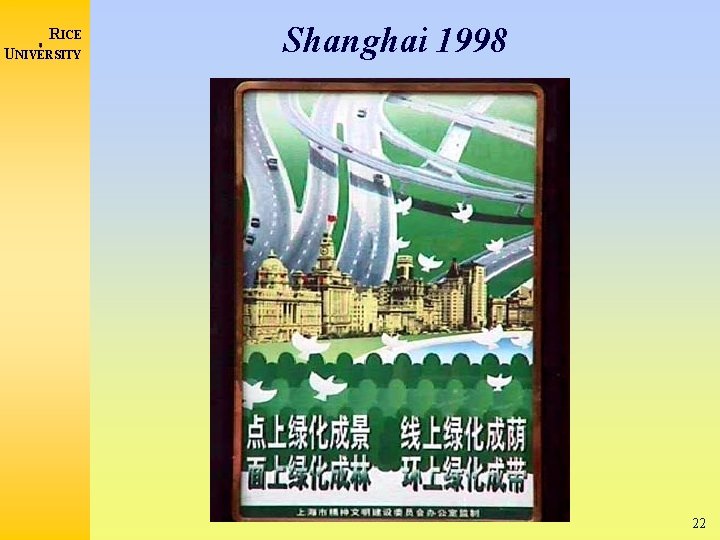
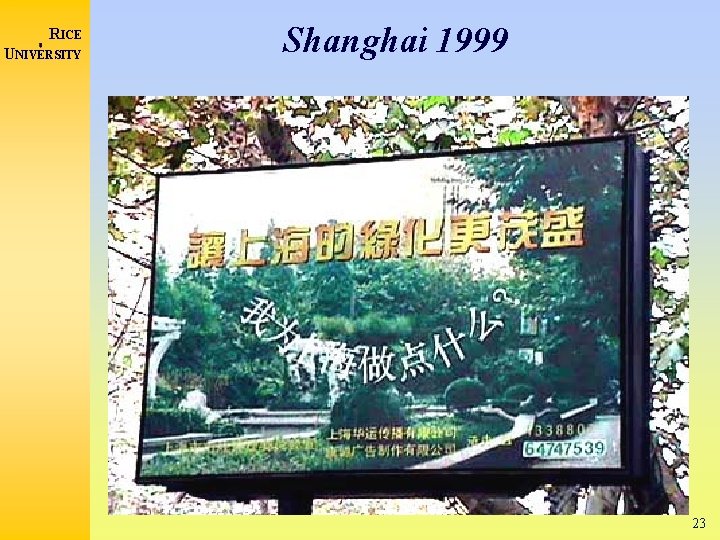
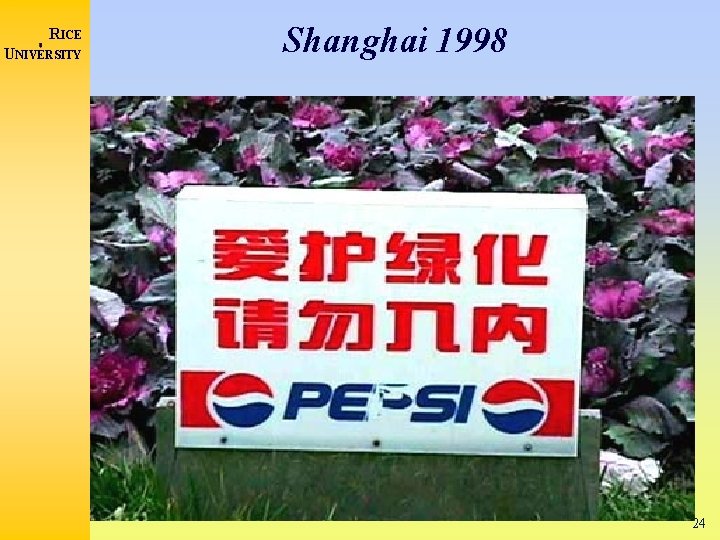
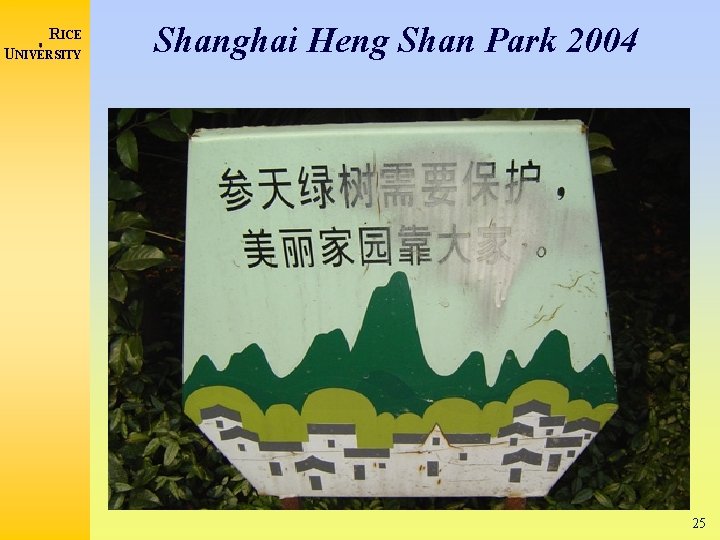
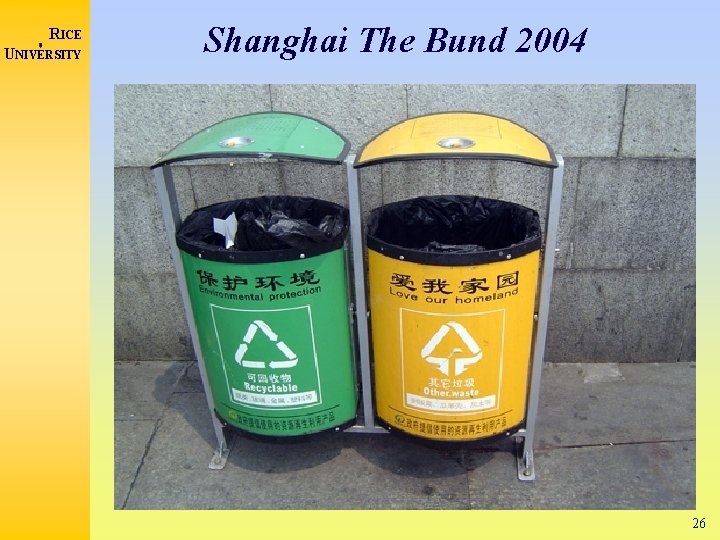
Lifestyles and Attitudes of China’s Emerging Middle Class RICE UNIVERSITY PRELIMINARY CONCLUSIONS: Companies, Governments and NGOs are Using Advertisements in New Public Spaces to Appeal to Urban Chinese to Think of Themselves as Local, National and Transnational Are Urban Chinese Persuaded by these Appeals, and Will This Affect Their Views on Collective Solutions to Energy and Environment Problems? 15
RICE UNIVERSITY Shanghai 2003 16
RICE UNIVERSITY Taipei 2001 17
RICE UNIVERSITY Shanghai 1999 18
RICE UNIVERSITY Beijing 2000 19
RICE UNIVERSITY Shanghai 2003 20
RICE UNIVERSITY Beijing 2000 21
RICE UNIVERSITY Shanghai 1998 22
RICE UNIVERSITY Shanghai 1999 23
RICE UNIVERSITY Shanghai 1998 24
RICE UNIVERSITY Shanghai Heng Shan Park 2004 25
RICE UNIVERSITY Shanghai The Bund 2004 26
RICE UNIVERSITY 谢谢 Thank You 27