Rhode Island Model Teacher Evaluation Support System Edition

















- Slides: 41
Rhode Island Model Teacher Evaluation & Support System Edition III
Objectives Participants will: Understand the architecture and key terms of the Professional Practice and Professional Responsibilities Rubrics Become familiar with the Support and Development Process Develop a common understanding of the purpose of setting SLOs Understand where SLOs fit into the big picture of Educator Evaluation Understand how a teacher’s final effectiveness rating is calculated
Agenda q Model Overview q Support & Development q Professional Practice q Professional Responsibilities q Student Learning Objectives q Calculating a Final Effectiveness Rating
Full Model at a Glance Element Minimum Requirements Evaluation Conferences 3 evaluation conferences between the teachers and the evaluator (Beginning, Middle and End-of-Year) Classroom Observations At least 3, including: 1 announced and 2 unannounced All observations must be at least 20 minutes each Each of the 8 Professional Practice components will be scored after each observation Written feedback is required after each observation At least 1 at the beginning of the year Professional Growth Goals Student Learning Objectives At least 2 per teacher (no more than 4) RI Growth Model Rating Not included as part of a teacher’s Student Learning Score in 2014 -2015
Edition III: Evaluation and Support System on i t a u Eval r ria Crite po Sup Professional Responsibilities Professional Practice Student Learning Final Effectiveness Rating ste y S t m • Professional Growth Plan • Evaluation Conferences • Ongoing reflection and planning
Support and Development The Rhode Island Model is designed to support teacher development by: Outlining high expectations that are clear and aligned to school, district, and state priorities; Establishing a common vocabulary for meeting expectations; Encouraging student-focused conversations to share best practices, and address common challenges; Grounding teacher professional development in data-driven collaboration, conferencing, observation, and feedback to meet shared goals for student achievement; and Providing a reliable process for educators to focus practice and drive student learning. p. 8
Support and Development Three Evaluation Conferences Beginning, Middle, and End-of Year Self assessment (optional) optional reflective process use prior evaluation data to analyze and identify priorities for professional growth plan
Support and Development Professional Growth Plan One professional growth goal required (minimum) Goal(s) within a plan can span more than one school year, however, the activities and benchmarks for the goal should be identified for each year • Clear action steps and benchmarks for meeting goal • Aligned to the components within the teacher professional practice or professional responsibilities rubric • Mid-Year Conference provides a formal opportunity for the teacher and evaluator to review the Professional Growth Plan and make adjustments, if necessary • • Performance Improvement Plan for teachers rated as Developing or Ineffective, or who are in need of targeted support anytime during the school year ü EPSS facilitates the conferencing and goal setting processes, and enables users to upload evidence related to professional growth plan Flexibility Factor: Schools and districts may determine that a school-wide approach for one professional growth goal is preferable. It is also important that teachers are able to set individual goals designed to meet their professional development goals. p. 9
Edition III: Professional Practice t ua Eval ria rite C n io Professional Responsibilities Professional Practice (8 Observable Classroom Components) ü Research based ü Improves transparency ü Observation rubric Student Learning Final Effectiveness Rating p. 10
Professional Practice Rubric at a Glance p. 39
Architecture of Edition III Rubrics Do m ain C en n po om itle T t n tio t en n o ip scr De mp Co Elements Indicators p. 41
Architecture of the Rubric (cont. ) Levels Of Performance Critical Attributes Possible Examples
Edition III: Professional Responsibilities ion E at u l a v ia r e t i Cr Professional Responsibilities (8 components) Professional Practice Student Learning Final Effectiveness Rating
Professional Responsibilities Architecture: At a Glance Appendix 4: Teacher Professional Responsibilities Rubric THE RUBRIC AT A GLANCE DOMAIN 1: SCHOOL RESPONSIBILITIES AND COMMUNICATION PR 1: Understands and participates in school/districtbased initiatives and activities Knowledge of school and district initiatives and activities Involvement in school and district initiatives and activities PR 2: Solicits, maintains records of, and communicates appropriate information about students’ behavior, learning needs, and academic progress Teacher interactions with parents Teacher interactions with colleagues Student or personnel records Grade books Specialist referrals DOMAIN 2: PROFESSIONALISM DOMAIN 3: PLANNING PR 3: Acts on the belief that all students can learn and advocates for students’ best interests Teacher interactions with students Teacher interactions with parents Course offerings Support services offerings Student advocacy meetings or call notes After school support logs PR 7: Plans effectively based on accurate knowledge of how children learn and develop Lesson and unit plans Classroom materials and learning activities Assessments PR 4: Works toward a safe, supportive, collaborative culture by demonstrating respect for everyone, including other educators, students, parents, and other community members in all actions and interactions Interactions with colleagues Interactions with parents or other community members PR 8: Uses data appropriately to plan instruction for a diverse group of learners Lesson and unit plans Classroom materials and learning activities Assessments PR 5: Acts ethically and with integrity while following all school, district, and state policies Required personnel file documentation of behavior Interactions with school leadership Interactions with colleagues PR 6: Engages meaningfully in the professional development process and enhances professional learning by giving and seeking assistance from other educators Professional Growth Plans Involvement in district or school-sponsored professional development p. 57
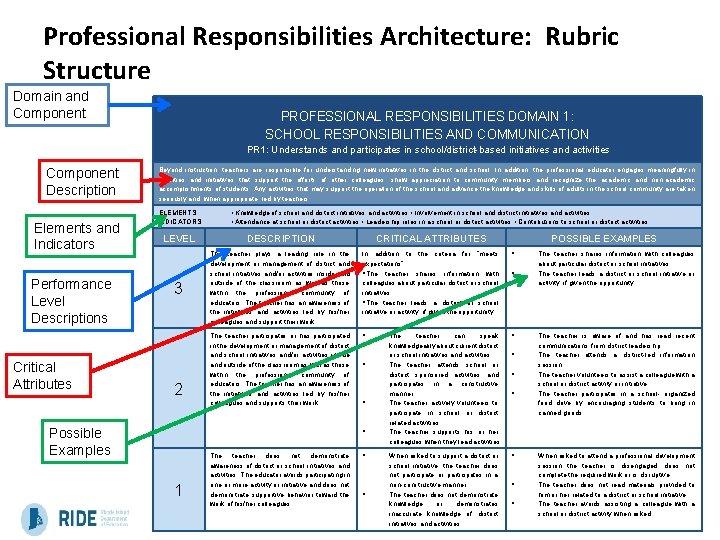
Professional Responsibilities Architecture: Rubric Structure Domain and Component PROFESSIONAL RESPONSIBILITIES DOMAIN 1: SCHOOL RESPONSIBILITIES AND COMMUNICATION PR 1: Understands and participates in school/district-based initiatives and activities Component Description Elements and Indicators Performance Level Descriptions Critical Attributes Beyond instruction, teachers are responsible for understanding new initiatives in the district and school. In addition, the professional educator engages meaningfully in activities and initiatives that support the efforts of other colleagues, show appreciation to community members and recognize the academic and non-academic accomplishments of students. Any activities that may support the operation of the school and advance the knowledge and skills of adults in the school community are taken seriously and, when appropriate, led by teachers. ELEMENTS: INDICATORS: • Knowledge of school and district initiatives and activities • Involvement in school and district initiatives and activities • Attendance at school or district activities • Leadership roles in a school or district activities • Contributions to school or district activities LEVEL DESCRIPTION CRITICAL ATTRIBUTES In addition to the criteria for “meets expectations”: The teacher shares information with colleagues about particular district or school initiatives. The teacher leads a district or school initiative or activity, if given the opportunity. 3 The teacher plays a leading role in the development or management of district and school initiatives and/or activities inside and outside of the classroom as well as those within the professional community of educators. The teacher has an awareness of the initiatives and activities led by his/her colleagues and support their work. The teacher participates or has participated in the development or management of district and school initiatives and/or activities inside and outside of the classroom as well as those within the professional community of educators. The teacher has an awareness of the initiatives and activities led by his/her colleagues and supports their work. The teacher can speak knowledgeably about current district or school initiatives and activities. The teacher attends school or district sponsored activities and participates in a constructive manner. The teacher actively volunteers to participate in school or district related activities. The teacher supports his or her colleagues when they lead activities. When asked to support a district or school initiative, the teacher does not participate or participates in a non-constructive manner. The teacher does not demonstrate knowledge or demonstrates inaccurate knowledge of district initiatives and activities. 2 Possible Examples 1 The teacher does not demonstrate awareness of district or school initiatives and activities. The educator avoids participating in one or more activity or initiative and does not demonstrate supportive behavior toward the work of his/her colleagues. POSSIBLE EXAMPLES The teacher shares information with colleagues about particular district or school initiatives. The teacher leads a district or school initiative or activity, if given the opportunity. The teacher is aware of and has read recent communications from district leadership. The teacher attends a district-led information session. The teacher volunteers to assist a colleague with a school or district activity or initiative. The teacher participates in a school- organized food drive by encouraging students to bring in canned goods. When asked to attend a professional development session the teacher is disengaged, does not complete the required work or is disruptive. The teacher does not read materials provided to him or her related to a district or school initiative. The teacher avoids assisting a colleague with a school or district activity when asked.
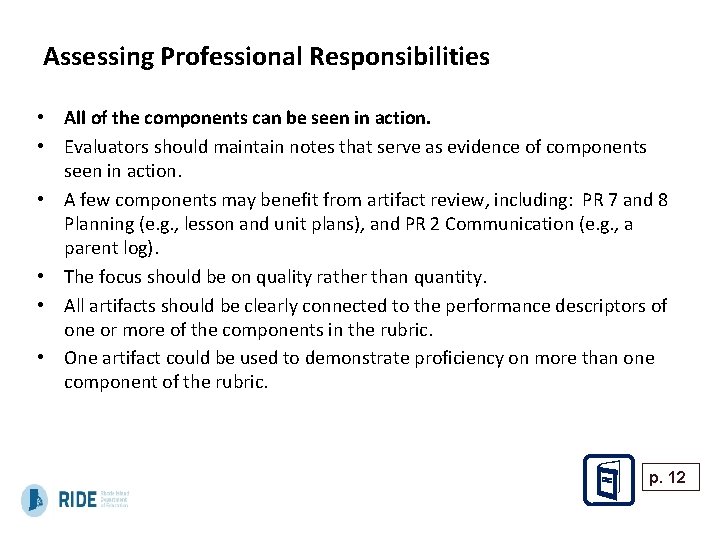
Assessing Professional Responsibilities • All of the components can be seen in action. • Evaluators should maintain notes that serve as evidence of components seen in action. • A few components may benefit from artifact review, including: PR 7 and 8 Planning (e. g. , lesson and unit plans), and PR 2 Communication (e. g. , a parent log). • The focus should be on quality rather than quantity. • All artifacts should be clearly connected to the performance descriptors of one or more of the components in the rubric. • One artifact could be used to demonstrate proficiency on more than one component of the rubric. p. 12
Edition II: Student Learning eria t i r n C Eva io luat Professional Responsibilities Student Learning (Student Learning Objectives and Rhode Island Growth Model) Professional Practice Final Effectiveness Rating
Student Learning Objectives Framing A Student Learning Objective is a long term, measureable, academic goal that educators set for students. The purpose of an SLO is to measure students’ growth over the course of an academic term. Student Learning Objectives consist of content standards, evidence, and targets: ü The content standards can be CCSS, GSEs/GLEs, or other national standards ü The evidence is the assessment(s) used to measure student progress/mastery ü The target is the numerical goal for student progress/mastery, based on available prior data p. 13
Student Learning Objective Framing Instructional Coherence Student Learning Objectives are not a disconnected initiative. Rather, they bring together all the essential aspects of instruction. Curriculum & Instruction Curriculum, standards, data, and the CAS inform high quality SLOs Student Learning Objectives Common Core Data Usage & Comprehensive Assessment System
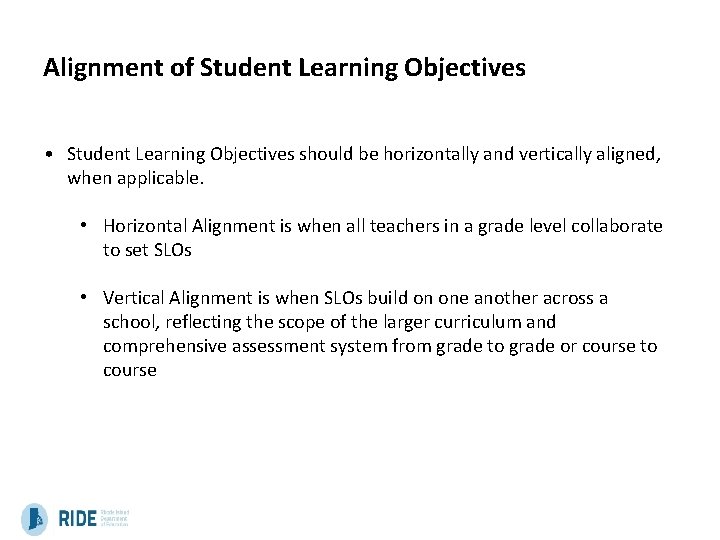
Alignment of Student Learning Objectives • Student Learning Objectives should be horizontally and vertically aligned, when applicable. • Horizontal Alignment is when all teachers in a grade level collaborate to set SLOs • Vertical Alignment is when SLOs build on one another across a school, reflecting the scope of the larger curriculum and comprehensive assessment system from grade to grade or course to course
3 Types of Alignment • Direct Alignment- the focus of the objective statement, targets, and evidence sources are shared. The teacher’s SLOs mirror the building administrator’s SLOs. • Supportive Alignment- the content or skills addressed in the teacher’s SLO relates to the content or skills of the building administrator’s SLO, but is not identical. • No Alignment- the teacher’s SLO authentically reflects the most important content or skills of his/her discipline and grade level, but do not align with the building administrator’s SLO. 21
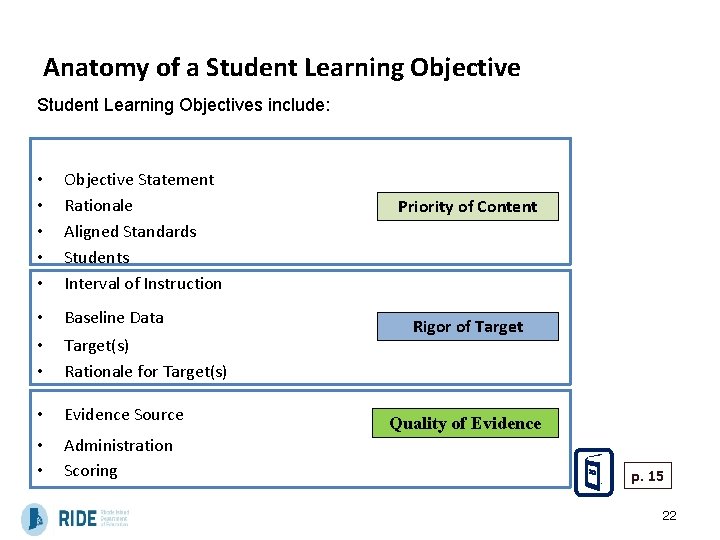
Anatomy of a Student Learning Objectives include: • • • Objective Statement Rationale Aligned Standards Students Interval of Instruction • Baseline Data • • Target(s) Rationale for Target(s) • Evidence Source • • Administration Scoring Priority of Content Rigor of Target Quality of Evidence p. 15 22
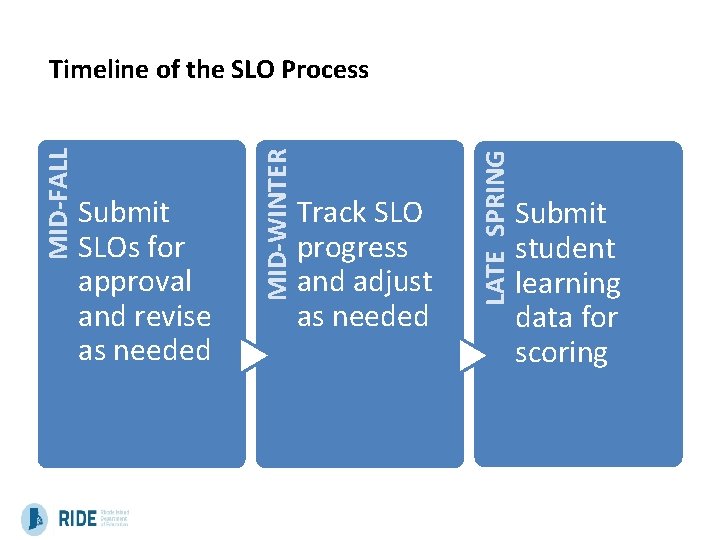
Track SLO progress and adjust as needed LATE SPRING Submit SLOs for approval and revise as needed MID-WINTER MID-FALL Timeline of the SLO Process Submit student learning data for scoring
Edition III: Final Effectiveness Rating Eval ia uatio iter r C n Professional Responsibilities Professional Practice Student Learning Final Effectiveness Rating
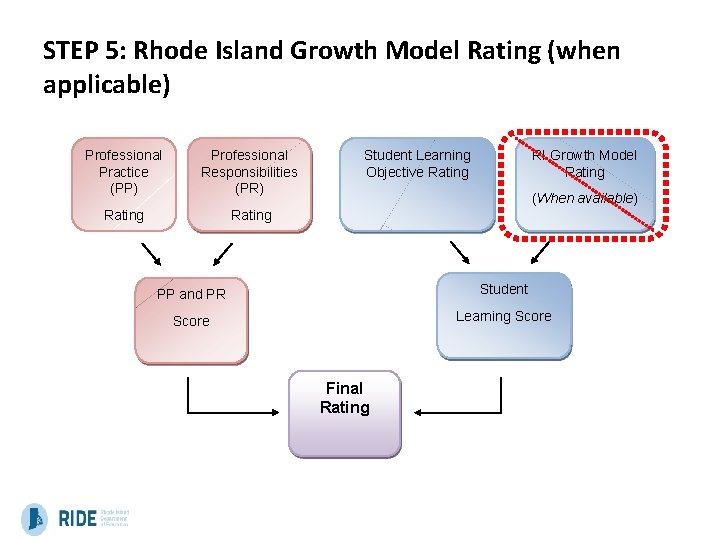
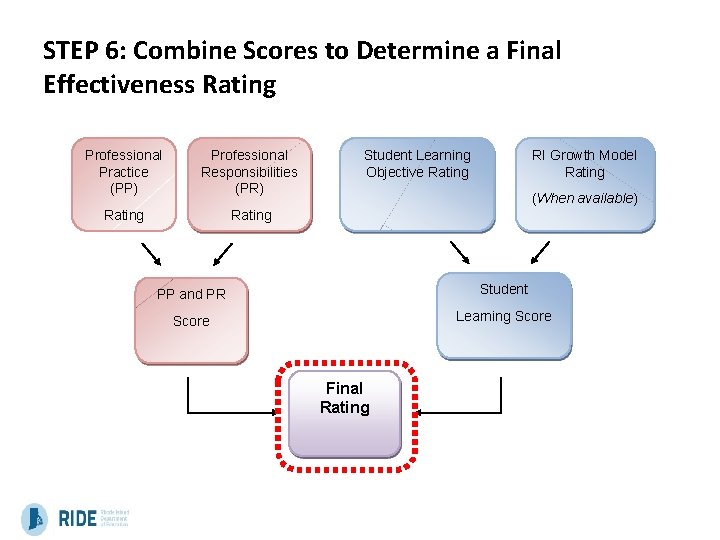
Calculating a Final Effectiveness Rating Professional Practice (PP) Professional Responsibilities (PR) Rating Student Learning Objective Rating RI Growth Model Rating (When available) PP and PF Student Score Learning Score Final Rating Educators will receive one of four final Effectiveness ratings Highly Effective, Developing, or Ineffective p. 31
Professional Practice Rating Example Component Observation 1 Observation 2 Observation 3 Average 2 a 2 3 3 2. 7 2 b 2 2. 0 2 c 2 3 3 2. 7 2 d 2 3 3 2. 7 3 a 3 2 2 2. 3 3 b 2 3 4 3. 0 3 c 2 2 3 2. 3 3 d 2 2. 0 TOTAL 20
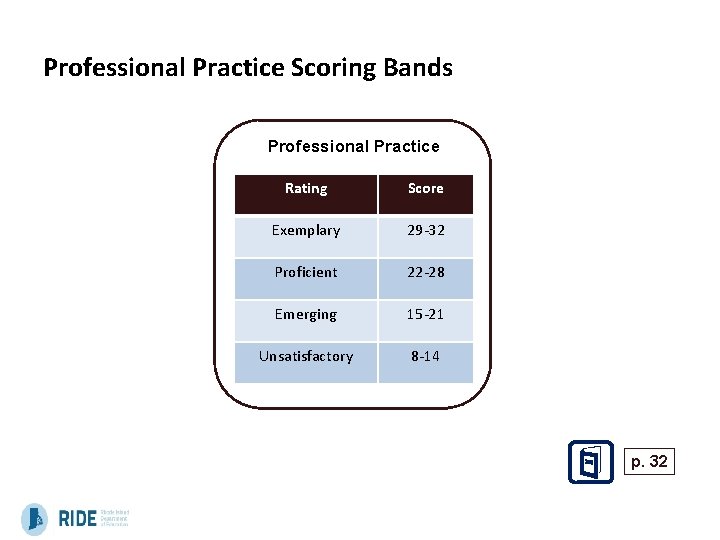
Professional Practice Scoring Bands Professional Practice Rating Score Exemplary 29 -32 Proficient 22 -28 Emerging 15 -21 Unsatisfactory 8 -14 p. 32
STEP 2: Calculate a Professional Foundations Rating Professional Practice (PP) Professional Responsibilities (PR) Rating Student Learning Objective Rating RI Growth Model Rating (When available) PP and PF Student Score Learning Score Final Rating
Professional Responsibilities Rating Example Component Score PR 1 2 PR 2 2 PR 3 2 PR 4 2 PR 5 2 PR 6 3 PR 7 2 PR 8 2 TOTAL 17
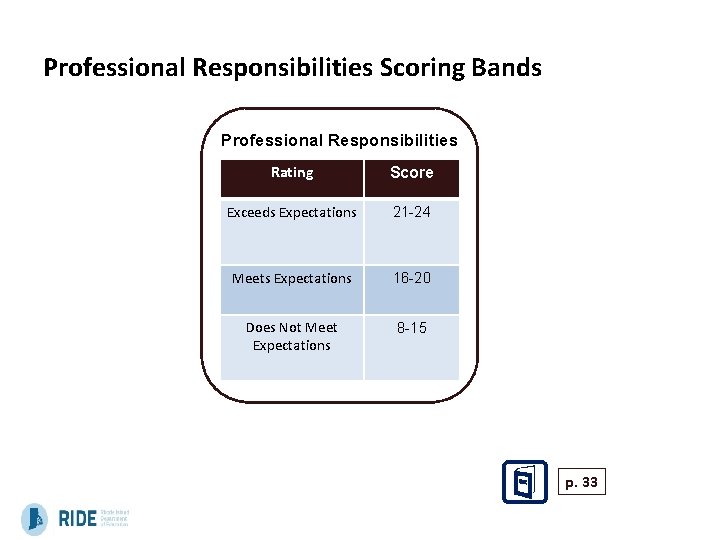
Professional Responsibilities Scoring Bands Professional Responsibilities Rating Score Exceeds Expectations 21 -24 Meets Expectations 16 -20 Does Not Meet Expectations 8 -15 p. 33
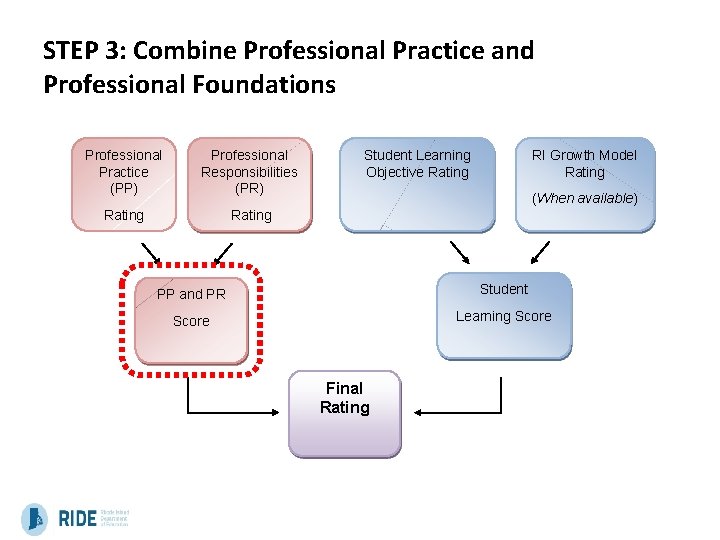
STEP 3: Combine Professional Practice and Professional Foundations Professional Practice (PP) Professional Responsibilities (PR) Rating Student Learning Objective Rating RI Growth Model Rating (When available) PP and PR Student Score Learning Score Final Rating
PP and PR Matrix Professional Responsibilities Matrix Used for All Educators Professional Practice Exemplary Proficient Emerging Unsatisfactory Exceeds Expectations 4 4 2 2 Meets Expectations 4 3 Does Not Meet Expectations 2 2 2 1 1 1 p. 33
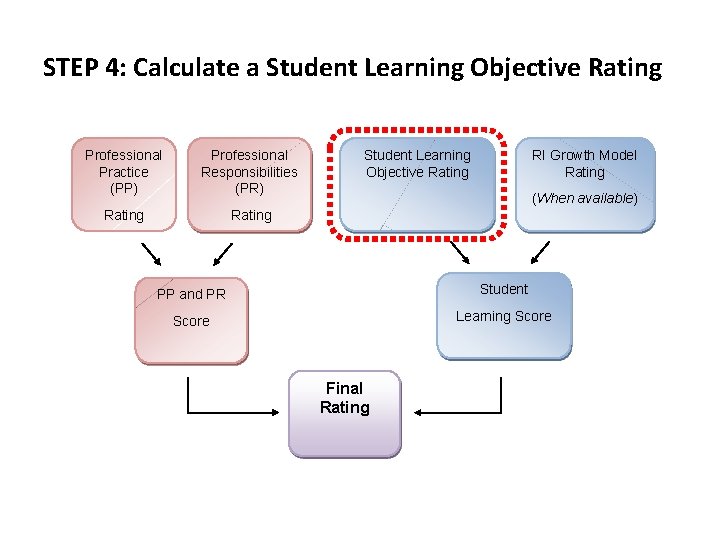
STEP 4: Calculate a Student Learning Objective Rating Professional Practice (PP) Professional Responsibilities (PR) Rating Student Learning Objective Rating RI Growth Model Rating (When available) PP and PR Student Score Learning Score Final Rating
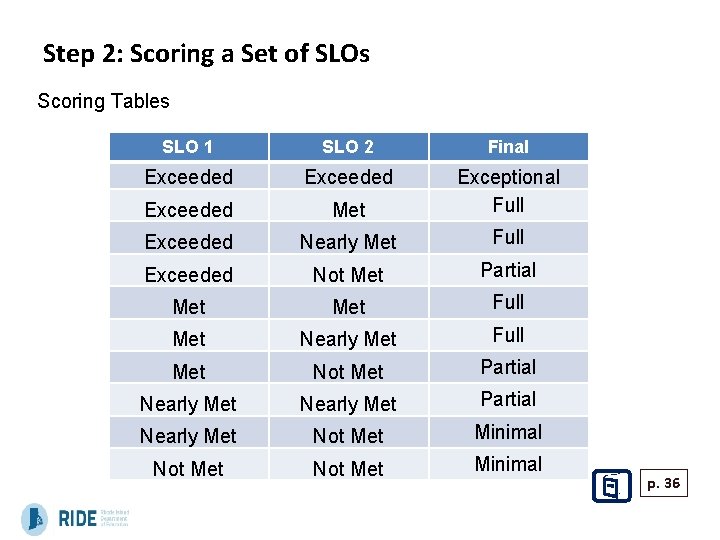
SLO Scoring Process Step 1 The evaluator rates each individual SLO Step 2 The set of SLOs is calculated within EPSS based upon individual scores
Individual SLO Scoring Guidance p. 27
Sets of Student Learning Objectives Ratings Exceptional Attainment (4) Full Attainment (3) Partial Attainment (2) Minimal Attainment (1) p. 29
Step 2: Scoring a Set of SLOs Scoring Tables SLO 1 SLO 2 Final Exceeded Met Exceptional Full Exceeded Nearly Met Full Exceeded Not Met Partial Met Full Met Nearly Met Full Met Not Met Partial Nearly Met Not Met Minimal p. 36
STEP 5: Rhode Island Growth Model Rating (when applicable) Professional Practice (PP) Professional Responsibilities (PR) Rating Student Learning Objective Rating RI Growth Model Rating (When available) PP and PR Student Score Learning Score Final Rating
STEP 6: Combine Scores to Determine a Final Effectiveness Rating Professional Practice (PP) Professional Responsibilities (PR) Rating Student Learning Objective Rating RI Growth Model Rating (When available) PP and PR Student Score Learning Score Final Rating
Final Effectiveness Rating Matrix p. 35
Questions? Comments? E-mail us at: Ed. Eval@ride. ri. gov