
Teacher Evaluation in BTSD Achieve NJ K5 Meeting
Teacher Evaluation in BTSD (Achieve. NJ) K-5 Meeting May 22 nd 2013 1
Keep everything in perspective • How does this impact me? 2
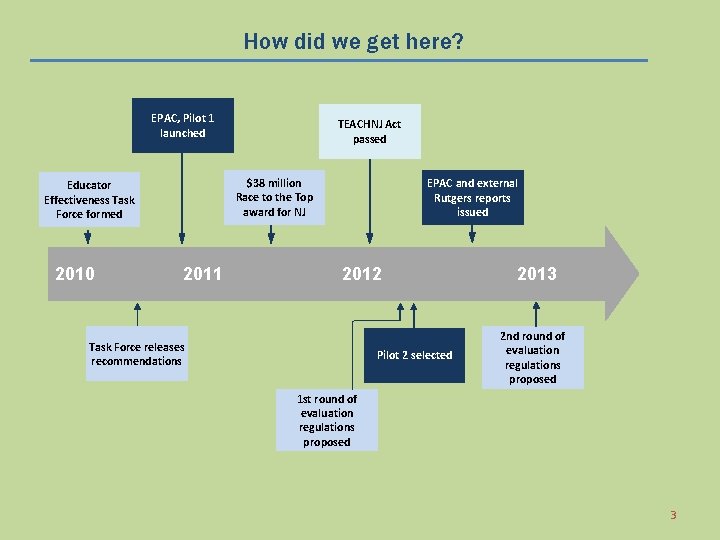
How did we get here? EPAC, Pilot 1 launched $38 million Race to the Top award for NJ Educator Effectiveness Task Force formed 2010 TEACHNJ Act passed 2011 EPAC and external Rutgers reports issued 2012 Task Force releases recommendations Pilot 2 selected 2013 2 nd round of evaluation regulations proposed 1 st round of evaluation regulations proposed 3
Context: What’s the same? • Annual evaluation of all teaching staff members • Annual summary conferences • Individualized professional development planning: • Three observations with post-observation conferences for all nontenured teaching staff members by April 30 of each year • Mentoring for novice teachers 4
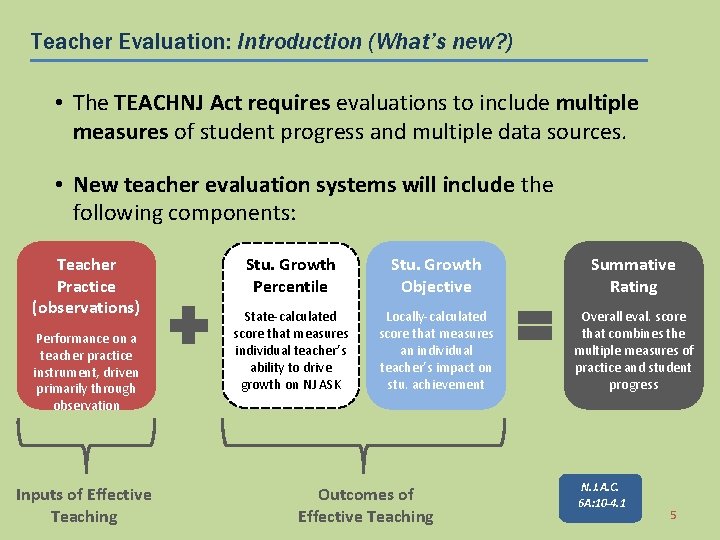
Teacher Evaluation: Introduction (What’s new? ) • The TEACHNJ Act requires evaluations to include multiple measures of student progress and multiple data sources. • New teacher evaluation systems will include the following components: Teacher Practice (observations) Performance on a teacher practice instrument, driven primarily through observation Inputs of Effective Teaching Stu. Growth Percentile Stu. Growth Objective Summative Rating State-calculated score that measures individual teacher’s ability to drive growth on NJ ASK NJASK Locally-calculated score that measures an individual teacher’s impact on stu. achievement Overall eval. score that combines the multiple measures of practice and student progress Outcomes of Effective Teaching N. J. A. C. 6 A: 10 -4. 1 5
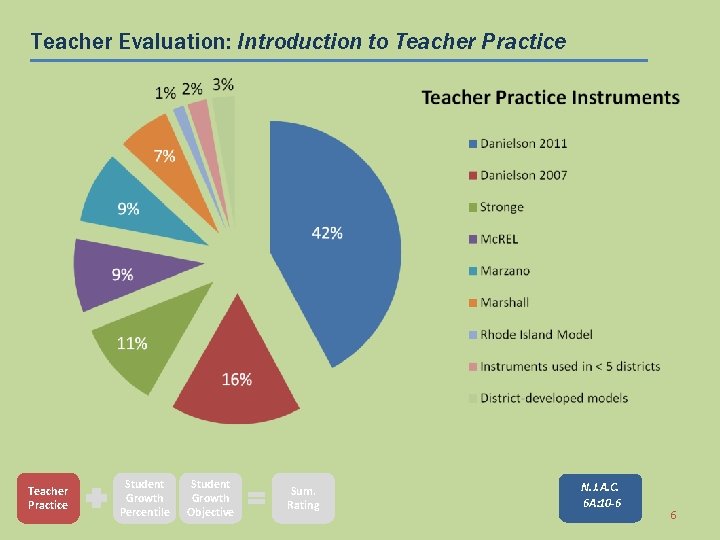
Teacher Evaluation: Introduction to Teacher Practice Student Growth Percentile Student Growth Objective Sum. Rating N. J. A. C. 6 A: 10 -6 6
Observation Process in ‘ 13 -’ 14 • Conducted using Teachscape • Rubric aligned with Danielson • 3 observations for ALL staff (non-tenured & tenured) • Conducted by at least two administrators • At least one will be unannounced • May be double-scored but not required • Observations combine for a weighted score on summative evaluation. • 4 Tiered rating system ( INE, PE, E, HE) 7
Teacher Evaluation: Training and reliability provisions • All teaching staff members being evaluated must be trained on evaluation rubric. We piloted during the ‘ 12 -’ 13 school year. • Before observing for the purpose of evaluation, all observers must be trained on the instrument. • All evaluators must participate in yearly “refresher” training. • CSA/Superintendent will certify every year that observers for the purpose of evaluation have been trained. Teacher Practice Student Growth Percentile Student Growth Objective Sum. Rating N. J. A. C. 6 A: 10 -2. 2 8
What is a Student Growth Percentile or SGP? STUDENT GROWTH PERCENTILES 9
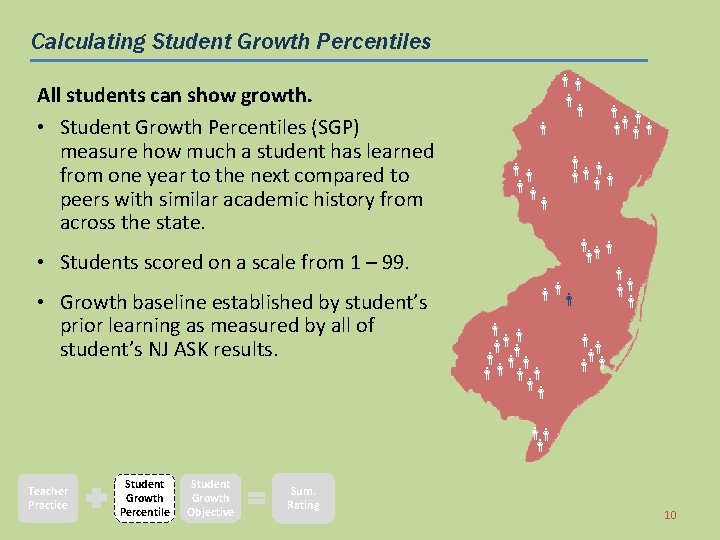
Calculating Student Growth Percentiles All students can show growth. • Student Growth Percentiles (SGP) measure how much a student has learned from one year to the next compared to peers with similar academic history from across the state. • Students scored on a scale from 1 – 99. • Growth baseline established by student’s prior learning as measured by all of student’s NJ ASK results. Teacher Practice Student Growth Percentile Student Growth Objective Sum. Rating 10
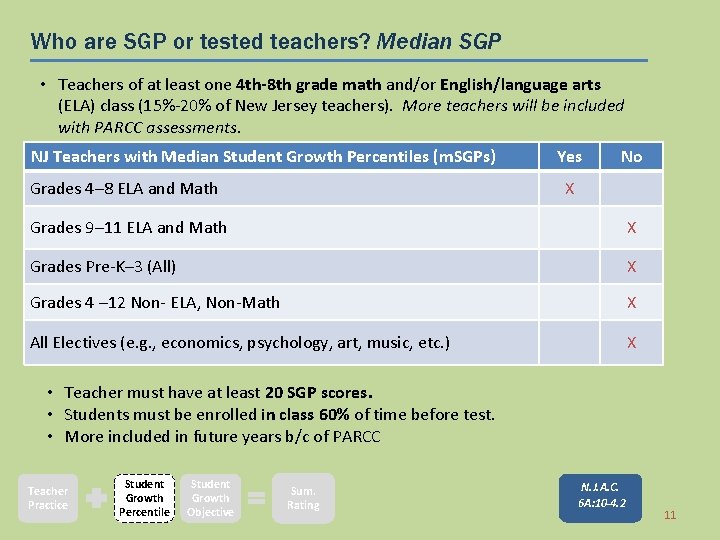
Who are SGP or tested teachers? Median SGP • Teachers of at least one 4 th-8 th grade math and/or English/language arts (ELA) class (15%-20% of New Jersey teachers). More teachers will be included with PARCC assessments. NJ Teachers with Median Student Growth Percentiles (m. SGPs) Grades 4– 8 ELA and Math Yes No X Grades 9– 11 ELA and Math X Grades Pre-K– 3 (All) X Grades 4 – 12 Non- ELA, Non-Math X All Electives (e. g. , economics, psychology, art, music, etc. ) X • Teacher must have at least 20 SGP scores. • Students must be enrolled in class 60% of time before test. • More included in future years b/c of PARCC Teacher Practice Student Growth Percentile Student Growth Objective Sum. Rating N. J. A. C. 6 A: 10 -4. 2 11
Other SGPs • • Speedway Grand Prix ( SGP) Suzuki Genuine Parts ( SGP) Strain Gradiant Plasticity Sheep and Goat Pox ( SGP) 12
What is a Student Growth Objective or SGO? STUDENT GROWTH OBJECTIVES 13
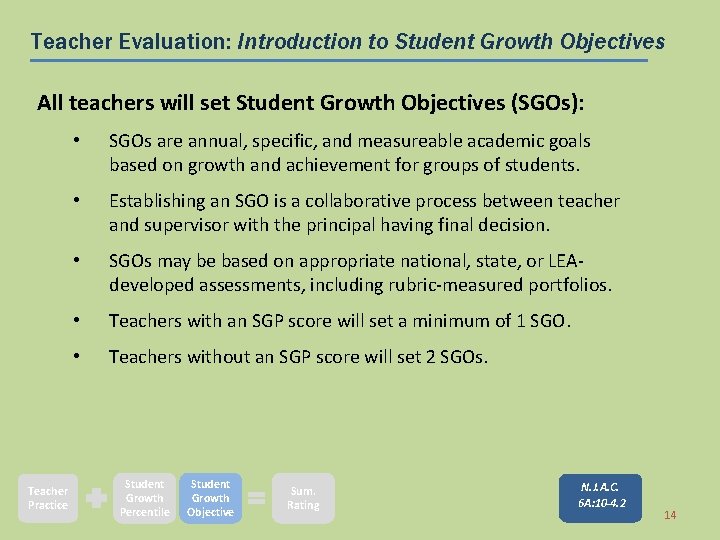
Teacher Evaluation: Introduction to Student Growth Objectives All teachers will set Student Growth Objectives (SGOs): Teacher Practice • SGOs are annual, specific, and measureable academic goals based on growth and achievement for groups of students. • Establishing an SGO is a collaborative process between teacher and supervisor with the principal having final decision. • SGOs may be based on appropriate national, state, or LEAdeveloped assessments, including rubric-measured portfolios. • Teachers with an SGP score will set a minimum of 1 SGO. • Teachers without an SGP score will set 2 SGOs. Student Growth Percentile Student Growth Objective Sum. Rating N. J. A. C. 6 A: 10 -4. 2 14
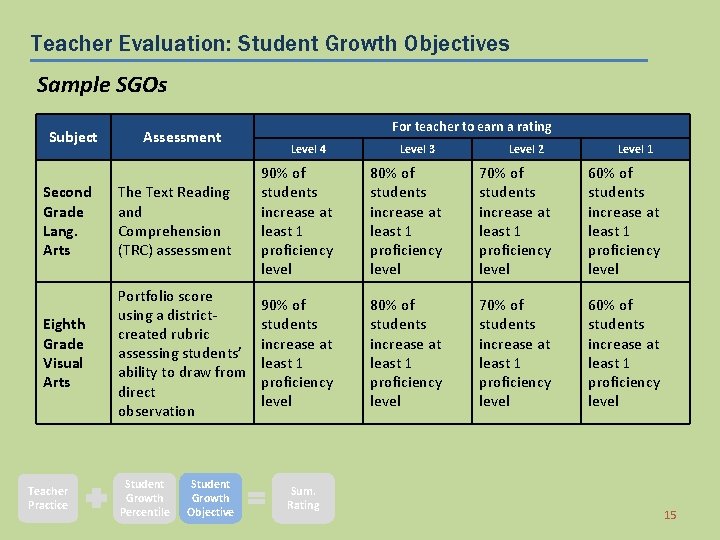
Teacher Evaluation: Student Growth Objectives Sample SGOs Subject Assessment For teacher to earn a rating Level 4 Second Grade Lang. Arts The Text Reading and Comprehension (TRC) assessment 90% of students increase at least 1 proficiency level Eighth Grade Visual Arts Portfolio score using a districtcreated rubric assessing students’ ability to draw from direct observation 90% of students increase at least 1 proficiency level Teacher Practice Student Growth Percentile Student Growth Objective Sum. Rating Level 3 Level 2 Level 1 80% of students increase at least 1 proficiency level 70% of students increase at least 1 proficiency level 60% of students increase at least 1 proficiency level 15

What’s next? • SGO Lunch Q&A – CH-Tuesday May 28 th – OS-Wednesday May 29 th – LC-Thursday May 30 th – MP-Friday May 31 st • June Faculty Meetings: SGO Breakout Session 16
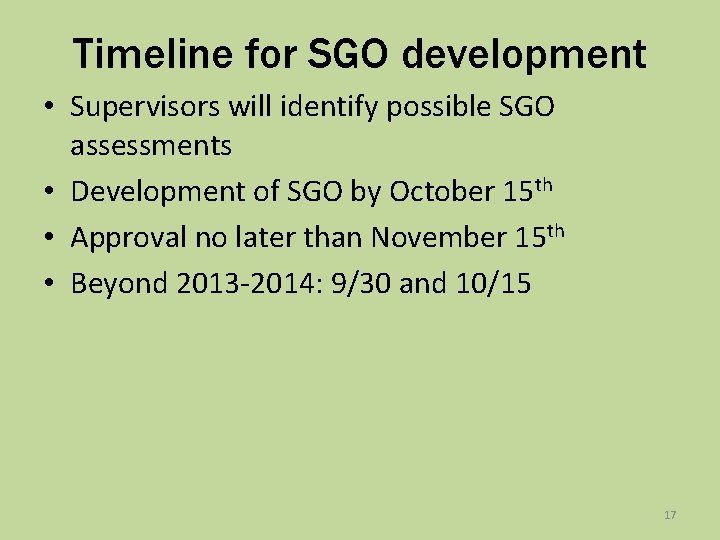
Timeline for SGO development • Supervisors will identify possible SGO assessments • Development of SGO by October 15 th • Approval no later than November 15 th • Beyond 2013 -2014: 9/30 and 10/15 17
Other SGOs • • Surgeon General’s Office ( SGO) Office of Secretary General Sweat Output per Gland (SGO) Stuff Going On ( SGO) 18

How does it all come together? 19
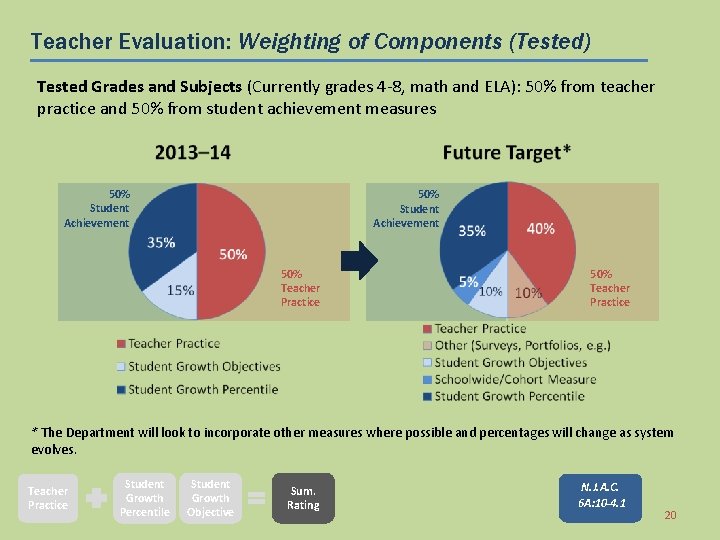
Teacher Evaluation: Weighting of Components (Tested) Tested Grades and Subjects (Currently grades 4 -8, math and ELA): 50% from teacher practice and 50% from student achievement measures 50% Student Achievement 50% Teacher Practice * The Department will look to incorporate other measures where possible and percentages will change as system evolves. Teacher Practice Student Growth Percentile Student Growth Objective Sum. Rating N. J. A. C. 6 A: 10 -4. 1 20
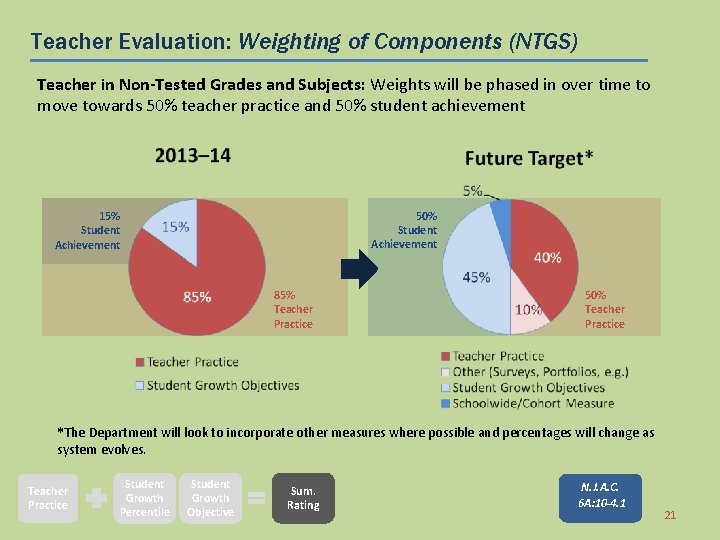
Teacher Evaluation: Weighting of Components (NTGS) Teacher in Non-Tested Grades and Subjects: Weights will be phased in over time to move towards 50% teacher practice and 50% student achievement 50% Student Achievement 15% Student Achievement 85% Teacher Practice 50% Teacher Practice *The Department will look to incorporate other measures where possible and percentages will change as system evolves. Teacher Practice Student Growth Percentile Student Growth Objective Sum. Rating N. J. A. C. 6 A: 10 -4. 1 21
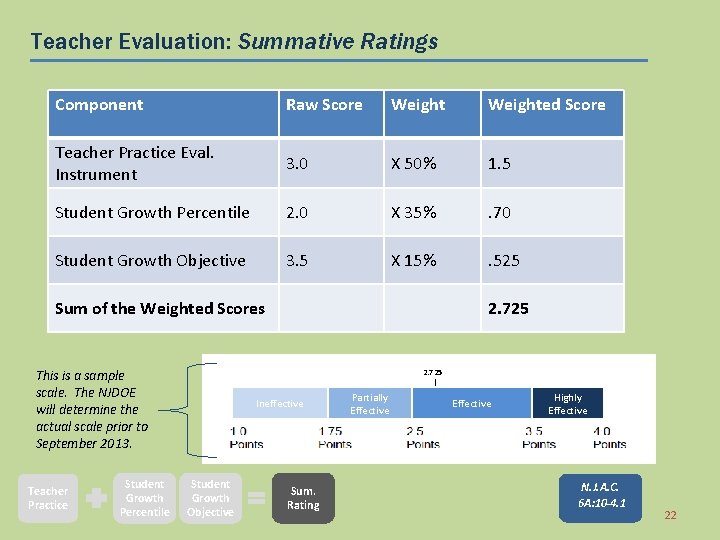
Teacher Evaluation: Summative Ratings Component Raw Score Weighted Score Teacher Practice Eval. Instrument 3. 0 X 50% 1. 5 Student Growth Percentile 2. 0 X 35% . 70 Student Growth Objective 3. 5 X 15% . 525 Sum of the Weighted Scores 2. 725 This is a sample scale. The NJDOE will determine the actual scale prior to September 2013. Teacher Practice Student Growth Percentile 2. 725 Ineffective Student Growth Objective Sum. Rating Partially Effective Highly Effective N. J. A. C. 6 A: 10 -4. 1 22
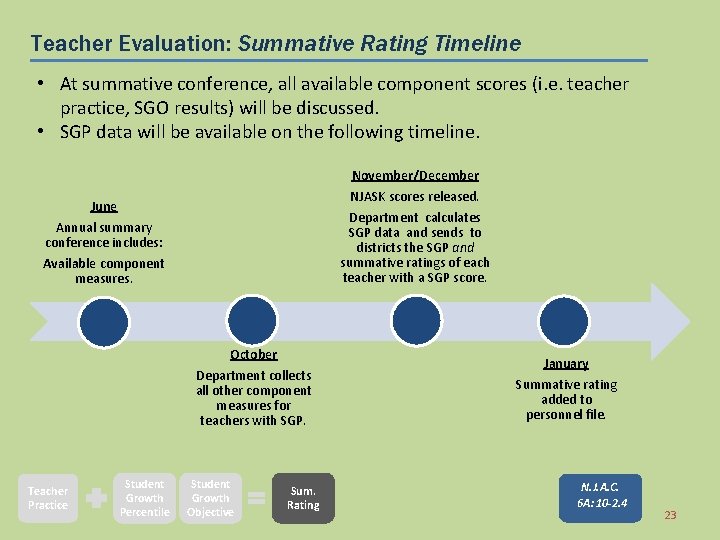
Teacher Evaluation: Summative Rating Timeline • At summative conference, all available component scores (i. e. teacher practice, SGO results) will be discussed. • SGP data will be available on the following timeline. November/December NJASK scores released. Department calculates SGP data and sends to districts the SGP and summative ratings of each teacher with a SGP score. June Annual summary conference includes: Available component measures. October Department collects all other component measures for teachers with SGP. Teacher Practice Student Growth Percentile Student Growth Objective Sum. Rating January Summative rating added to personnel file. N. J. A. C. 6 A: 10 -2. 4 23
School Improvement Panel • Monitors and recommends Professional Development to support evaluation process • Reviews SGO progress • Liaisons with DEAC 24
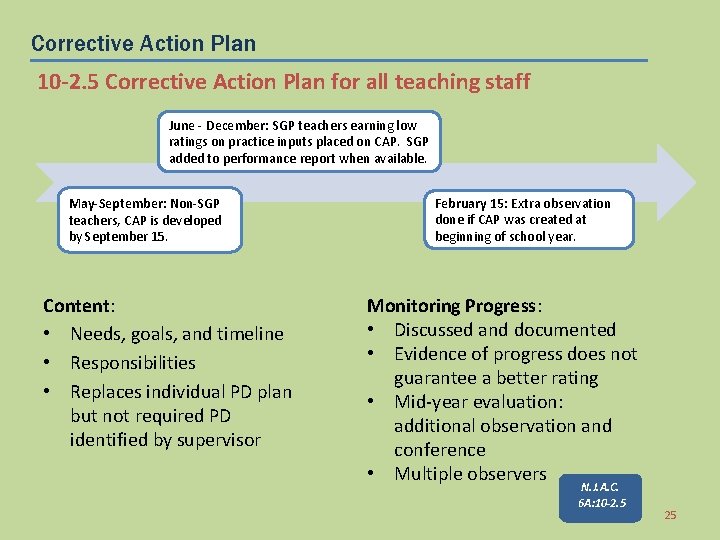
Corrective Action Plan 10 -2. 5 Corrective Action Plan for all teaching staff June - December: SGP teachers earning low ratings on practice inputs placed on CAP. SGP added to performance report when available. May-September: Non-SGP teachers, CAP is developed by September 15. Content: • Needs, goals, and timeline • Responsibilities • Replaces individual PD plan but not required PD identified by supervisor February 15: Extra observation done if CAP was created at beginning of school year. Monitoring Progress: • Discussed and documented • Evidence of progress does not guarantee a better rating • Mid-year evaluation: additional observation and conference • Multiple observers N. J. A. C. 6 A: 10 -2. 5 25
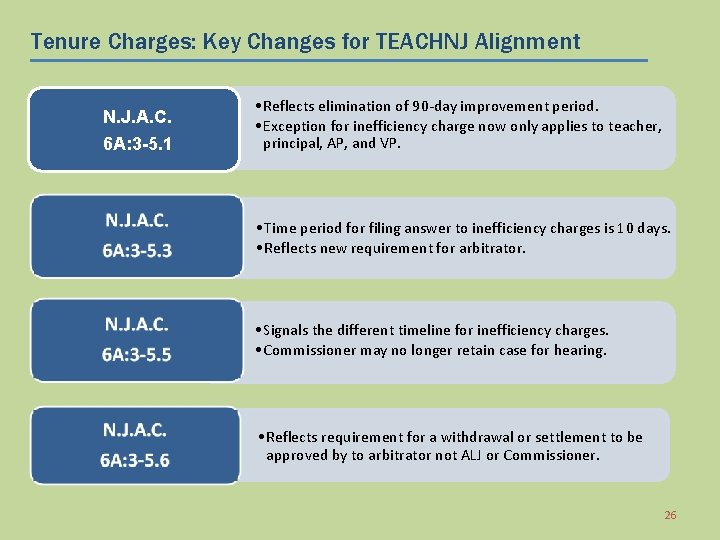
Tenure Charges: Key Changes for TEACHNJ Alignment N. J. A. C. 6 A: 3 -5. 1 • Reflects elimination of 90 -day improvement period. • Exception for inefficiency charge now only applies to teacher, principal, AP, and VP. • Time period for filing answer to inefficiency charges is 10 days. • Reflects new requirement for arbitrator. • Signals the different timeline for inefficiency charges. • Commissioner may no longer retain case for hearing. • Reflects requirement for a withdrawal or settlement to be approved by to arbitrator not ALJ or Commissioner. 26
- Slides: 26