Recall of the 2015 Service Delivery Project in



- Slides: 45
Recall of the 2015 Service Delivery Project in Albania Andreas Schaffhauser, Georg Pistotnik, ZAMG
Content • Project Description • Service Delivery • Assessment according the Service Delivery Progress Model (SDPM) • Stakeholder Workshop and Gap Analysis • Action plan including capacity development and investment plan • Summary and recommendations Content 03. 12. 2020 Folie 2
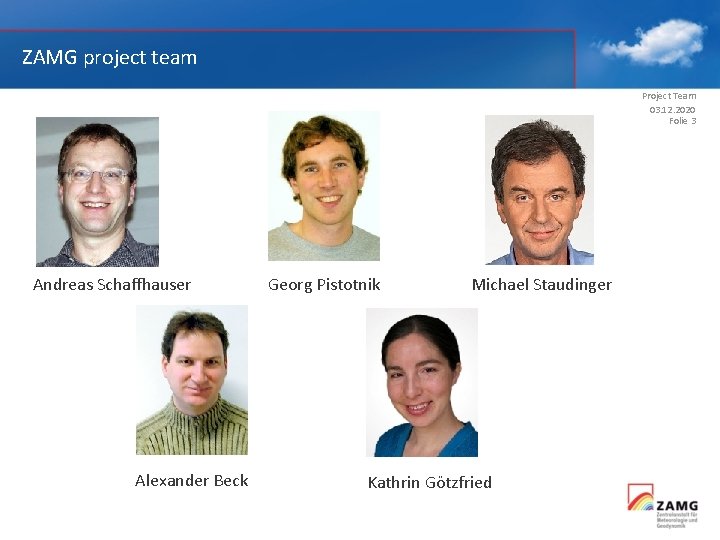
ZAMG project team Project Team 03. 12. 2020 Folie 3 Andreas Schaffhauser Alexander Beck Georg Pistotnik Michael Staudinger Kathrin Götzfried
Project Objectives Project Presentation 03. 12. 2020 Folie 4 Ø Support development of a service delivery strategy and investment plan for the Albania Institute of Geosciences, Energy, Water and Environment (IGEWE) under the Technical Assistance on Reducing Risk and Building Resilience (World Bank) Ø To support development of a service delivery strategy and investment plan for IGEWE Ø Support development of the IGEWE service delivery strategy and investment plan through close coordination with the Director of the IGEWE. Ø Service delivery strategy includes capacity development and investment plan to achieve modernization to a service‐focused national meteorological and hydrological service. Ø Hydro‐meteorological services in Albania are shared between IGEWE, the Military Meteorological Service (MMS) and Albcontrol (National Air Traffic Agency, NAT) Met Service.
Work Packages Ø WP 1: Inception Report: Preparation of the detailed working plan including milestones and deliverables. The definitions of aims, objectives and methodology of the contract are refined. Identification of the local personnel required any possible commitments required from the beneficiary Deliverable: Inception report Ø WP 2: Assessment of the current level of service delivery of IGEWE using the SDPM. Deliverable: Report on the IGEWE’s current level in the SDPM. Ø WP 3: Definition of the user requirements together with IGEWE and key users. Project Description 03. 12. 2020 Folie 5
Work Packages Project Description 03. 12. 2020 Folie 6 Ø WP 4: Gap Analysis: Identification of gaps between the current service delivery level of IGEWE and the user needs and requirements. Deliverable: Identification of gaps between the current service delivery level of IGEWE and the user needs and requirements (technical note) Ø WP 5: Development of the action plan for improved service delivery and required investments. Deliverable: Action plan with short‐, medium‐ and long‐term goals and investments (Draft) Ø WP 6: Completion report Deliverable: Completion report
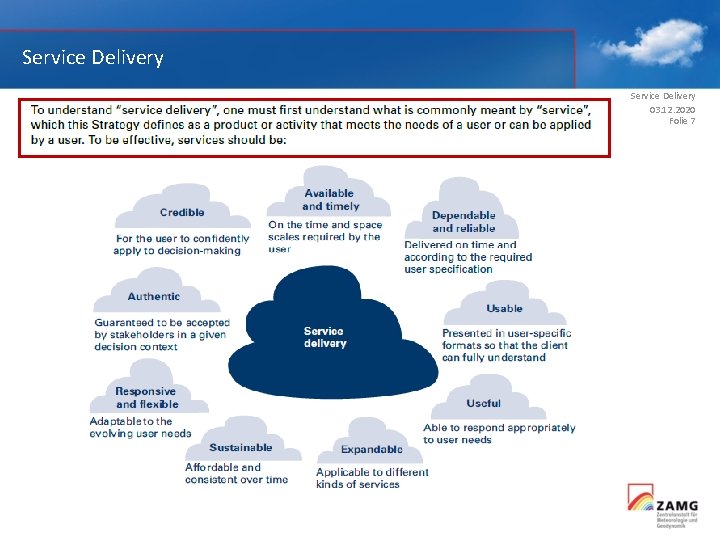
Service Delivery 03. 12. 2020 Folie 7
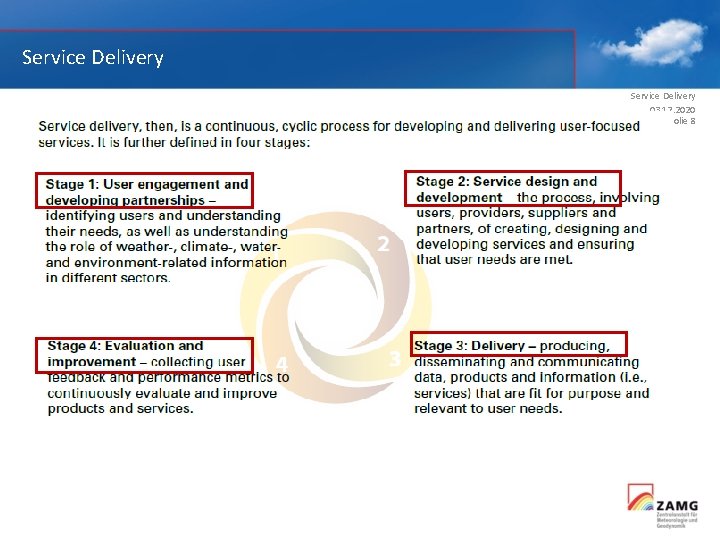
Service Delivery 03. 12. 2020 Folie 8
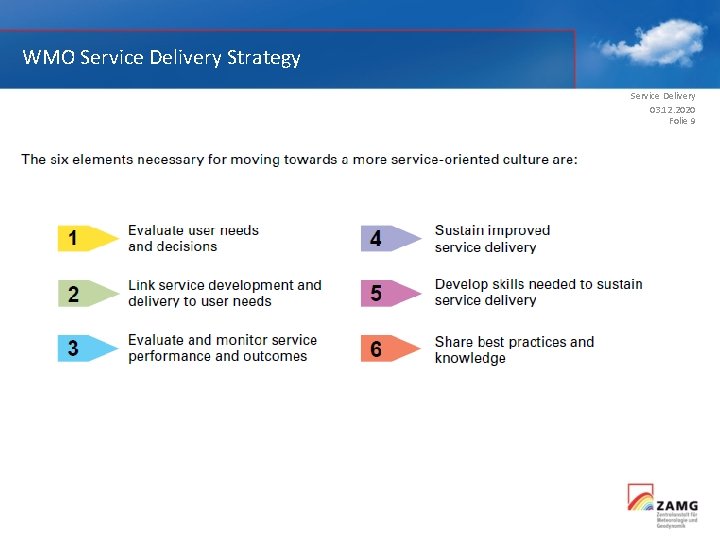
WMO Service Delivery Strategy Service Delivery 03. 12. 2020 Folie 9
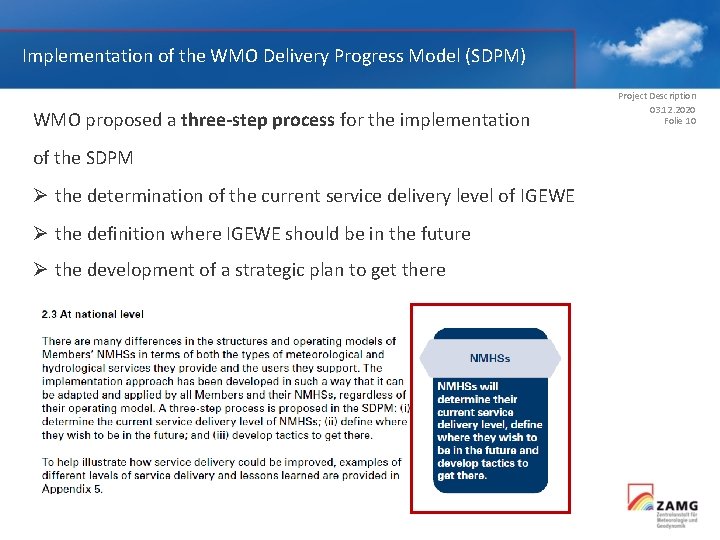
Implementation of the WMO Delivery Progress Model (SDPM) WMO proposed a three‐step process for the implementation of the SDPM Ø the determination of the current service delivery level of IGEWE Ø the definition where IGEWE should be in the future Ø the development of a strategic plan to get there Project Description 03. 12. 2020 Folie 10
Assessment of the current level in the SDPM Ø The SDPM model serves as a tool for the assessment of the current development level. The assessment can carried out in two subsequent steps, namely by a self assessment followed by the discussion and revision of the results together with the management of NHMS and the responsible staff members. Ø All current practices are systematically reviewed against the definitions provided in the SDPM. The answers to the questions of each of the six strategic elements justify the current status of the service delivery processes in an objective way. Ø The assessment was documented in a report that describes the state of development of the Met Services for each element, including a detailed answer to each question posed in the SDPM, with specific evidence provided wherever possible. Assessment 03. 12. 2020 Folie 11
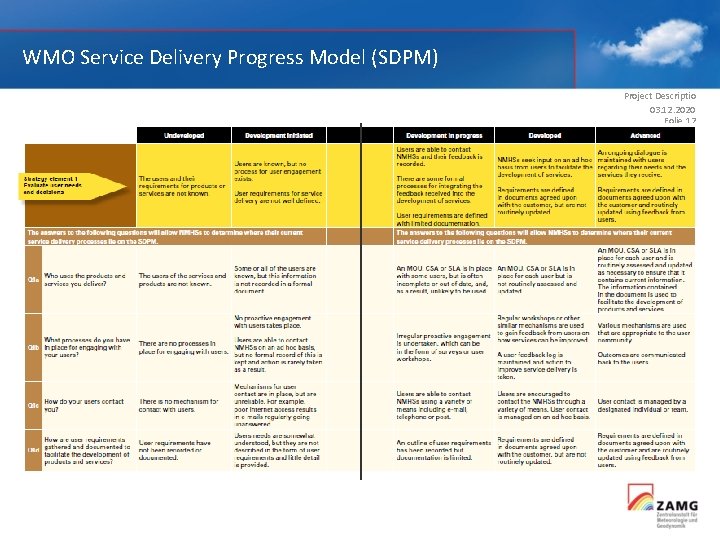
WMO Service Delivery Progress Model (SDPM) Project Descriptio 03. 12. 2020 Folie 12
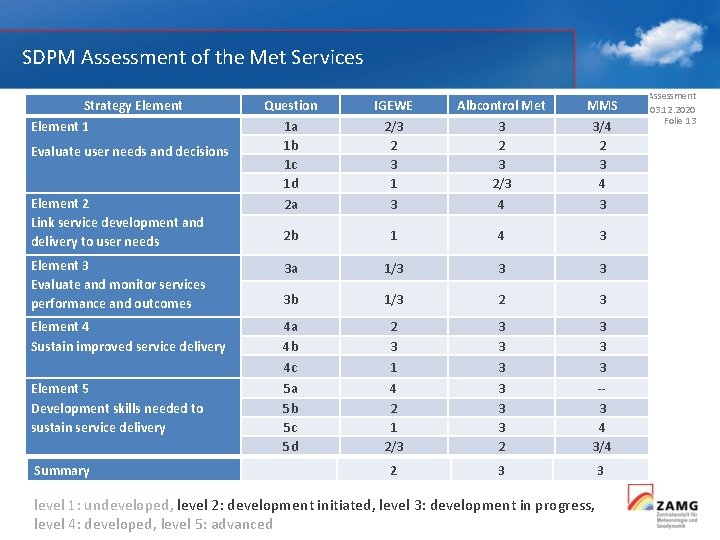
SDPM Assessment of the Met Services Strategy Element 1 Evaluate user needs and decisions Element 2 Link service development and delivery to user needs Question 1 a 1 b 1 c 1 d 2 a IGEWE 2/3 2 3 1 3 Albcontrol Met 3 2/3 4 MMS 3/4 2 3 4 3 2 b 1 4 3 Element 3 Evaluate and monitor services performance and outcomes 3 a 1/3 3 3 3 b 1/3 2 3 Element 4 Sustain improved service delivery 4 a 4 b 2 3 3 3 4 c 1 3 3 5 a 5 b 5 c 5 d 4 2 1 2/3 3 2 ‐‐ 3 4 3/4 2 3 3 Element 5 Development skills needed to sustain service delivery Summary level 1: undeveloped, level 2: development initiated, level 3: development in progress, level 4: developed, level 5: advanced SDPM Assessment 03. 12. 2020 Folie 13
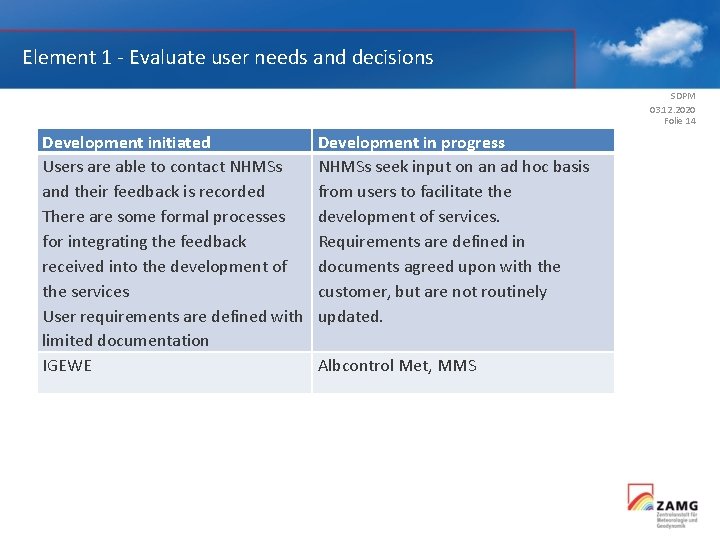
Element 1 ‐ Evaluate user needs and decisions SDPM 03. 12. 2020 Folie 14 Development initiated Users are able to contact NHMSs and their feedback is recorded There are some formal processes for integrating the feedback received into the development of the services User requirements are defined with limited documentation IGEWE Development in progress NHMSs seek input on an ad hoc basis from users to facilitate the development of services. Requirements are defined in documents agreed upon with the customer, but are not routinely updated. Albcontrol Met, MMS
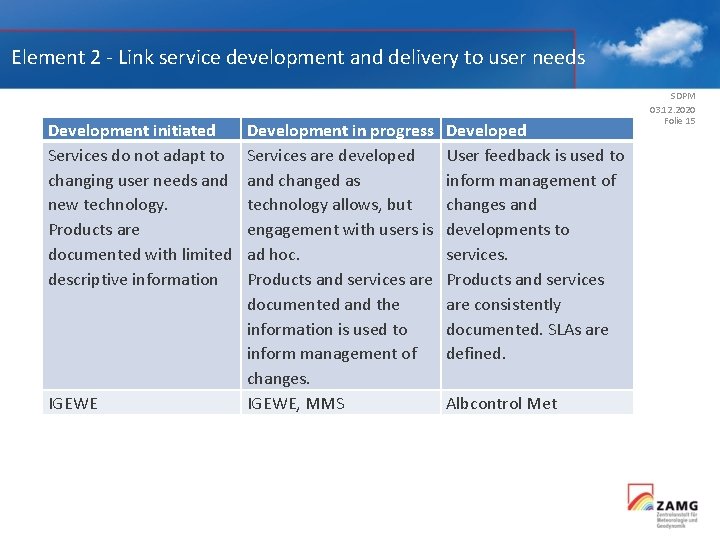
Element 2 ‐ Link service development and delivery to user needs Development initiated Services do not adapt to changing user needs and Development initiated new technology. Services do not adapt to Products are changing user needs and new technology. documented with limited Products are documented with limited descriptive information IGEWE Development in progress Developed Services are developed User feedback is used to and changed as inform management of Development in progress Developed technology allows, but changes and Services are developed and User feedback is used to inform engagement with users is developments to changed as technology allows, management of changes and but engagement with users is ad developments to services. ad hoc. services. hoc. Products and services are consistently documented. SLAs Products and services are Products and services documented and the are defined. documented and the are consistently information is used to inform management of changes. information is used to documented. SLAs are IGEWE, MMS Albcontrol Met inform management of defined. changes. IGEWE, MMS Albcontrol Met SDPM 03. 12. 2020 Folie 15
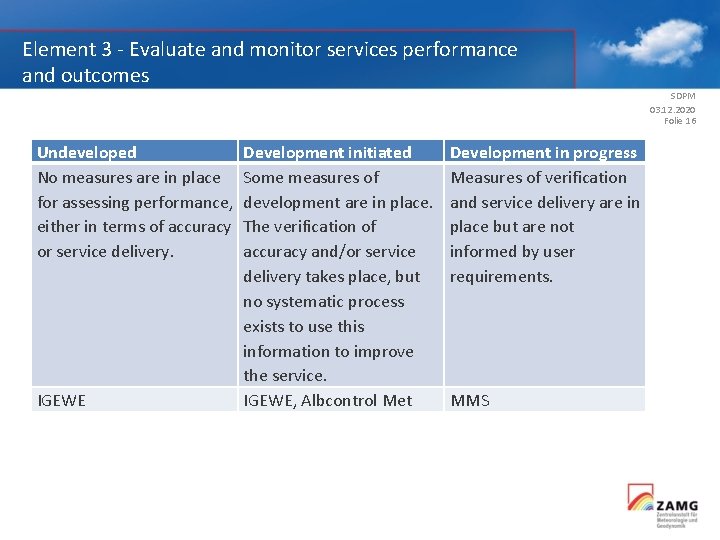
Element 3 ‐ Evaluate and monitor services performance and outcomes SDPM 03. 12. 2020 Folie 16 Undeveloped No measures are in place for assessing performance, either in terms of accuracy or service delivery. IGEWE Development initiated Some measures of development are in place. The verification of accuracy and/or service delivery takes place, but no systematic process exists to use this information to improve the service. IGEWE, Albcontrol Met Development in progress Measures of verification and service delivery are in place but are not informed by user requirements. MMS
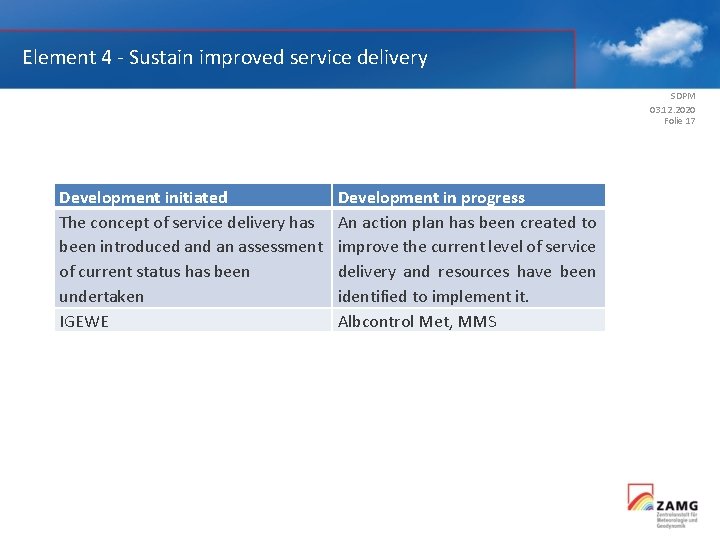
Element 4 ‐ Sustain improved service delivery SDPM 03. 12. 2020 Folie 17 Development initiated The concept of service delivery has been introduced an assessment of current status has been undertaken IGEWE Development in progress An action plan has been created to improve the current level of service delivery and resources have been identified to implement it. Albcontrol Met, MMS
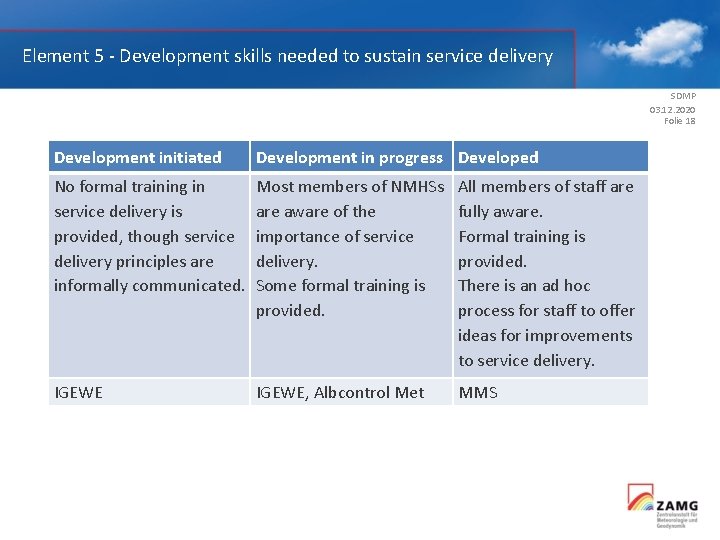
Element 5 ‐ Development skills needed to sustain service delivery SDMP 03. 12. 2020 Folie 18 Development initiated Development in progress Developed No formal training in service delivery is provided, though service delivery principles are informally communicated. Most members of NMHSs are aware of the importance of service delivery. Some formal training is provided. All members of staff are fully aware. Formal training is provided. There is an ad hoc process for staff to offer ideas for improvements to service delivery. IGEWE, Albcontrol Met MMS
Action Plan Ø Step 1: Definition of the user needs and requirements together with IGEWE and key users (e. g. civil protection). Discussion in thematic focus groups (e. g. observations, data management and exchange, operational forecasting, warning systems, product development, sales). Interaction with users is achieved through user workshops/meetings. Action Plan 03. 12. 2020 Folie 19 Ø Step 2: Gap Analysis: Identification of the gaps between the current service delivery level of IGEWE and the user needs and requirements in coordination with IGEWE. Ø Step 3: Development of the action plan for improved service delivery together with IGEWE. For each of the six elements of the SDPM actions to improve the level of service delivery are deduced based on the gap analysis. These actions enable IGEWE to advance through the levels of the SDPM. The action plan comprises IGEWE in coordination with the Military Meteorological Service as well as Albcontrol.
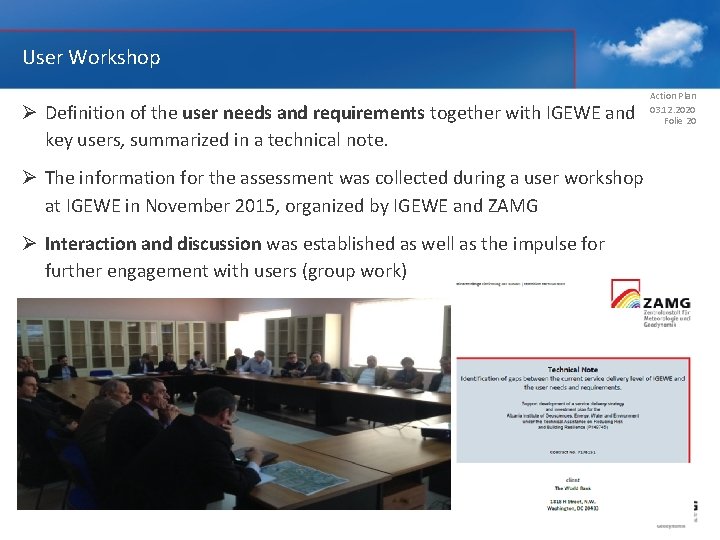
User Workshop Ø Definition of the user needs and requirements together with IGEWE and key users, summarized in a technical note. Ø The information for the assessment was collected during a user workshop at IGEWE in November 2015, organized by IGEWE and ZAMG Ø Interaction and discussion was established as well as the impulse for further engagement with users (group work) Action Plan 03. 12. 2020 Folie 20
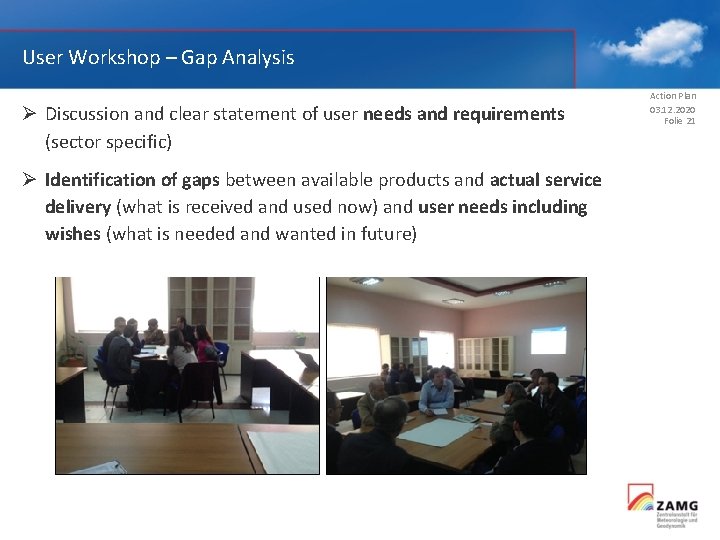
User Workshop – Gap Analysis Ø Discussion and clear statement of user needs and requirements (sector specific) Ø Identification of gaps between available products and actual service delivery (what is received and used now) and user needs including wishes (what is needed and wanted in future) Action Plan 03. 12. 2020 Folie 21
Development of the Action Plan Ø The identification of the gaps between the current level of service delivery and the user needs and requirements one serves as the basis for the development of the action plan. Ø The plan comprises actions required for the improvement of service delivery and moreover essential actions for the enhancement of the capabilities of the Met services Ø The plan contains well defined objectives, milestones, estimates of the resources, cost estimates for the related investments and measures for capacity building in order to achieve higher levels of service delivery. Ø Proposed actions and activities are separated into projects and programs. The expected impact on the internal processes, products, services and users will be described in detail in the action plan. Action Plan 03. 12. 2020 Folie 22
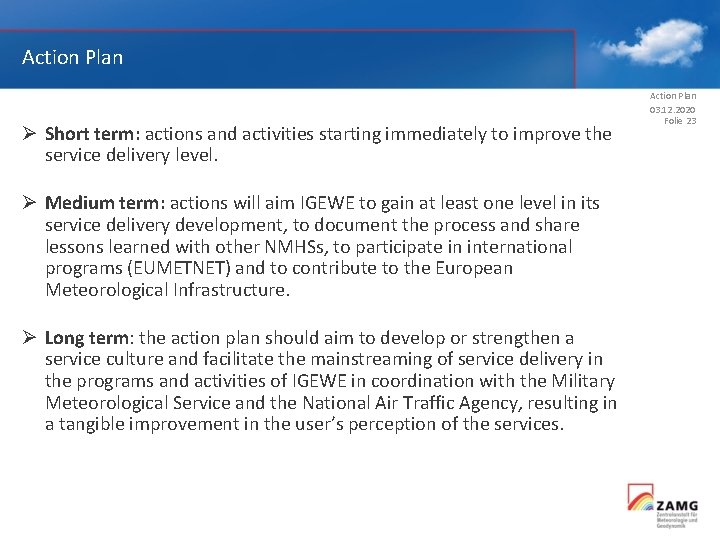
Action Plan Ø Short term: actions and activities starting immediately to improve the service delivery level. Ø Medium term: actions will aim IGEWE to gain at least one level in its service delivery development, to document the process and share lessons learned with other NMHSs, to participate in international programs (EUMETNET) and to contribute to the European Meteorological Infrastructure. Ø Long term: the action plan should aim to develop or strengthen a service culture and facilitate the mainstreaming of service delivery in the programs and activities of IGEWE in coordination with the Military Meteorological Service and the National Air Traffic Agency, resulting in a tangible improvement in the user’s perception of the services. Action Plan 03. 12. 2020 Folie 23
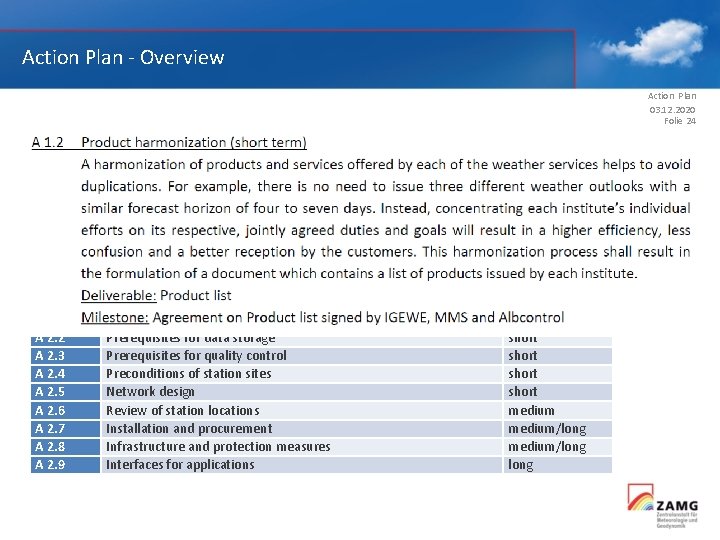
Action Plan ‐ Overview Action Plan 03. 12. 2020 Folie 24 Actions Number A 1. 1 A 1. 2 A 1. 3 A 1. 4 A 2. 1 A 2. 2 A 2. 3 A 2. 4 A 2. 5 A 2. 6 A 2. 7 A 2. 8 A 2. 9 Time frame Title Coordination between IGEWE, MMS and Albcontrol MET Responsibilities and resources short Product harmonization short Data exchange short Regular update of the Mo. U, product list and agreement on data medium/long exchange Optimization of the meteorological and hydrological network Assessment of available resources for network maintenance short Prerequisites for data storage short Prerequisites for quality control short Preconditions of station sites short Network design short Review of station locations medium Installation and procurement medium/long Infrastructure and protection measures medium/long Interfaces for applications long
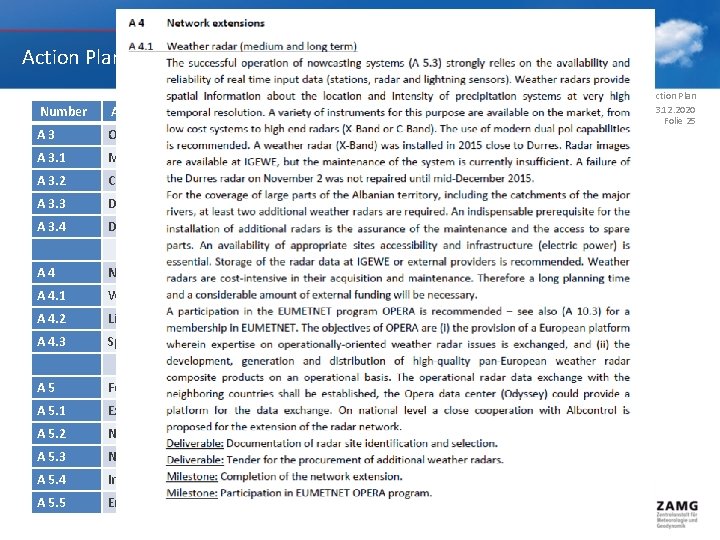
Action Plan ‐ Overview Number Action title Time frame A 3 Operational service A 3. 1 Maintenance All A 3. 2 Calibration of rating curves medium/long A 3. 3 Data quality control medium/long A 3. 4 Data services medium/long A 4 Network extension A 4. 1 Weather radar medium/long A 4. 2 Lightning detection medium/long A 4. 3 Special instrumentation for Rinas International Airport All A 5 Forecasting tools A 5. 1 Exploitation of DEWETRA platform short/medium A 5. 2 Numerical modeling medium/long A 5. 3 Nowcasting medium/long A 5. 4 Implementation of a meteorological visualization platform long A 5. 5 Enhanced flood forecasting system for the major rivers medium/long Action Plan 03. 12. 2020 Folie 25
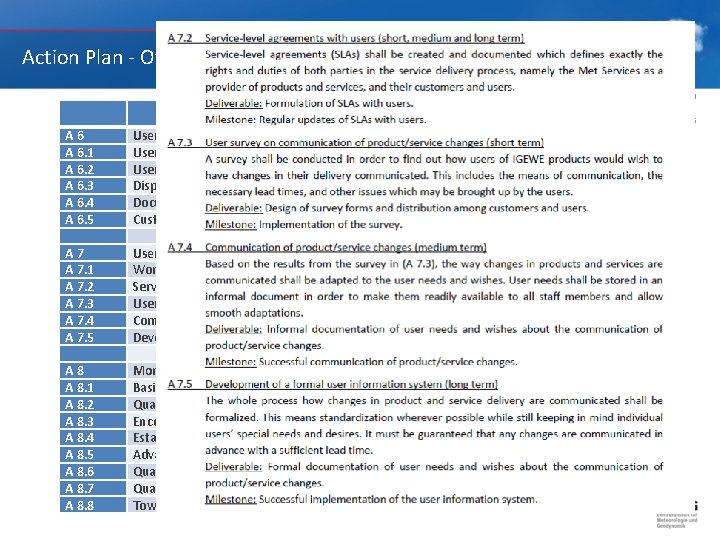
Action Plan ‐ Overview A 6. 1 A 6. 2 A 6. 3 A 6. 4 A 6. 5 A 7. 1 A 7. 2 A 7. 3 A 7. 4 A 7. 5 A 8. 1 A 8. 2 A 8. 3 A 8. 4 A 8. 5 A 8. 6 A 8. 7 A 8. 8 User engagement User surveys User workshops Disposition of a service point Documentation of user needs and requirements Customer relationship management User‐oriented service development Work instructions documents Service‐level agreements with users User survey on communication of product/service changes Communication of product/service changes Development of a formal user information system Monitoring of service performance Basic training on verification methods Qualitative evaluation of products Encouragement of user feedback Establishment of a framework for quantitative verification Advanced training on verification methods Quantitative verification Quarterly verification reports Towards impact‐based verification All medium long All short medium long short medium/long Action Plan 03. 12. 2020 Folie 26
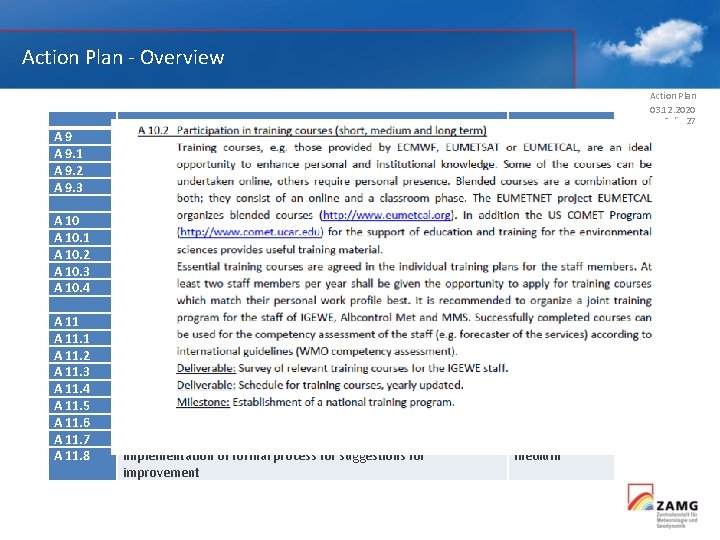
Action Plan ‐ Overview A 9. 1 A 9. 2 A 9. 3 A 10. 1 A 10. 2 A 10. 3 A 10. 4 A 11. 1 A 11. 2 A 11. 3 A 11. 4 A 11. 5 A 11. 6 A 11. 7 A 11. 8 Quality management Documentation of service delivery process Design of a quality management system (QMS) Implementation of the QMS Training and networking Visits to other National Hydro‐meteorological Services (NHMS) Participation in training courses EUMETNET membership ECMWF membership Strategy and capacity building Strategy for the development of the National Hazard Center Funding acquisition Update of the IGEWE Web Site Structured development of commercial products Individual training plans Job descriptions Appraisal interviews and regular team meetings Implementation of formal process for suggestions for improvement short medium long All short medium short All short/medium/long short All medium Action Plan 03. 12. 2020 Folie 27
Summary and Recomendations Recommenations 03. 12. 2020 Folie 28 Ø Hydro‐meteorological services in Albania are traditionally shared between IGEWE, MMS and Albcontrol Met. IGEWE is officially recognized as the national lead, represents Albania in the WMO and has Mo. Us with the other agencies. Ø Rather unusual for a European NMHSs, IGEWE is organized as a research unit of a university, namely the Polytechnic University of Tirana. Ø It is caught in a cycle common to many NMHSs in developing countries: lack of awareness of service delivery leads to a lack of recognition by the government and the public, inadequate basic funding, an insufficient accomplishment of the official duties, and consequently an inability to improve service delivery. Ø Academic staff is only about 70 percent of their work time available for the institution (operational work, project work, proposals), about 30 percent of the working time is reserved for activities prescribed by the university (teaching, etc. )
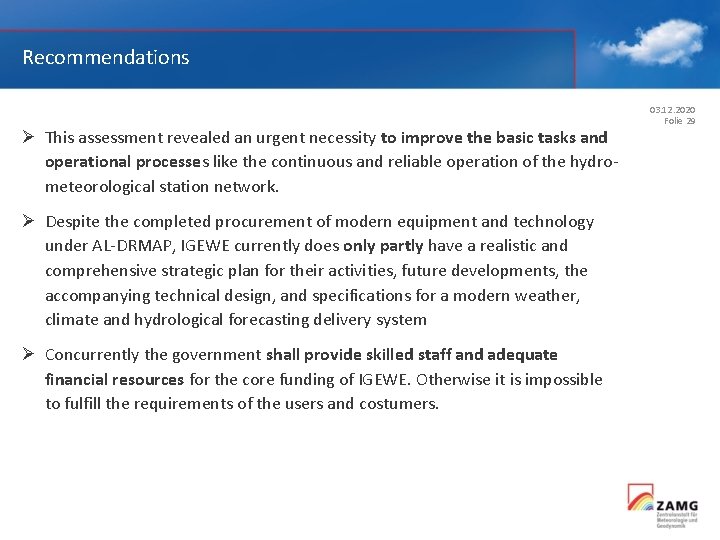
Recommendations Ø This assessment revealed an urgent necessity to improve the basic tasks and operational processes like the continuous and reliable operation of the hydro‐ meteorological station network. Ø Despite the completed procurement of modern equipment and technology under AL‐DRMAP, IGEWE currently does only partly have a realistic and comprehensive strategic plan for their activities, future developments, the accompanying technical design, and specifications for a modern weather, climate and hydrological forecasting delivery system Ø Concurrently the government shall provide skilled staff and adequate financial resources for the core funding of IGEWE. Otherwise it is impossible to fulfill the requirements of the users and costumers. 03. 12. 2020 Folie 29
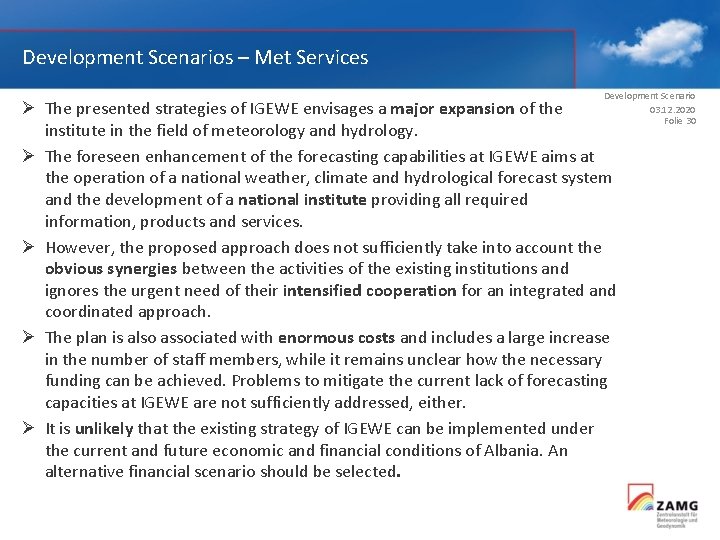
Development Scenarios – Met Services Development Scenario 03. 12. 2020 Folie 30 Ø The presented strategies of IGEWE envisages a major expansion of the institute in the field of meteorology and hydrology. Ø The foreseen enhancement of the forecasting capabilities at IGEWE aims at the operation of a national weather, climate and hydrological forecast system and the development of a national institute providing all required information, products and services. Ø However, the proposed approach does not sufficiently take into account the obvious synergies between the activities of the existing institutions and ignores the urgent need of their intensified cooperation for an integrated and coordinated approach. Ø The plan is also associated with enormous costs and includes a large increase in the number of staff members, while it remains unclear how the necessary funding can be achieved. Problems to mitigate the current lack of forecasting capacities at IGEWE are not sufficiently addressed, either. Ø It is unlikely that the existing strategy of IGEWE can be implemented under the current and future economic and financial conditions of Albania. An alternative financial scenario should be selected.
Development Scenario – IGEWE Development Scenariio 03. 12. 2020 Folie 31 The alternative scenario includes the recruitment of new staff members listed below over the short and medium term. Additionally there is an urgent need for the replacement of the retirements. 2 skilled technicians (also on disposal for hydrological measurements) 1 meteorologist and climatologist 2 hydrologists 1 IT specialist (Data Management and Exchange, Data Services) 1 or 2 specialists (financed by commercial activities, depending on commercial success) Ø 5 staff members, replacement of the retirement Ø Ø Ø The recruitment for the new staff members is gradually foreseen for the period between 2016 to 2018. All staff members must be principally involved in the realization and implementation of the action plan and have to be mostly available for operational duties.
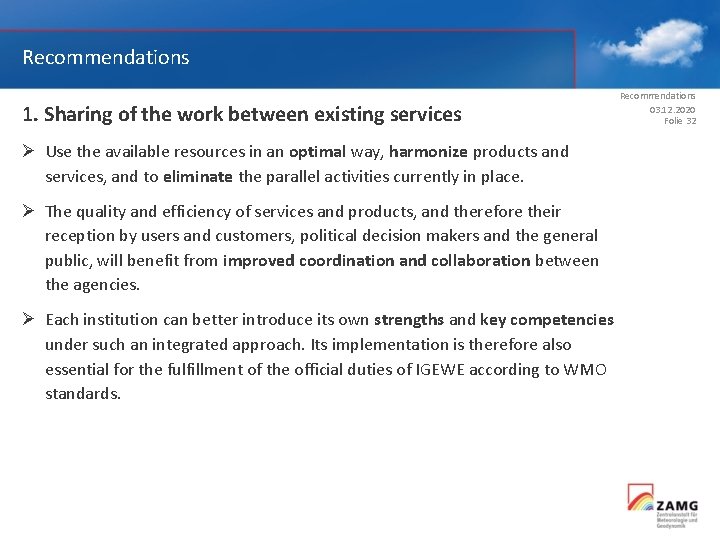
Recommendations 1. Sharing of the work between existing services Ø Use the available resources in an optimal way, harmonize products and services, and to eliminate the parallel activities currently in place. Ø The quality and efficiency of services and products, and therefore their reception by users and customers, political decision makers and the general public, will benefit from improved coordination and collaboration between the agencies. Ø Each institution can better introduce its own strengths and key competencies under such an integrated approach. Its implementation is therefore also essential for the fulfillment of the official duties of IGEWE according to WMO standards. Recommendations 03. 12. 2020 Folie 32
Recommendations 2. Increase of the annual budget of IGEWE Recommendations 03. 12. 2020 Folie 33 Ø An increase of the annual budget is required for a sustainable fulfillment of the official duties. The annual budget is provided by the Polytechnic University of Tirana. Ø Budget comprises staff salary, operational duties, maintenance of the manual station network, infrastructure and telecommunication, and the WMO fee and administration. Ø No funds are assigned yet to the maintenance of the automatic station network, investments in additional equipment and technology, and the membership to international organizations like EUMETNET or ECMWF. Ø Efforts shall be undertaken to reel in funding bodies who agree to cover parts of the operational costs, for example special budgets from the university, civil protection or other ministries, or international development programs, at least for some years during the adaptation phase of the network.
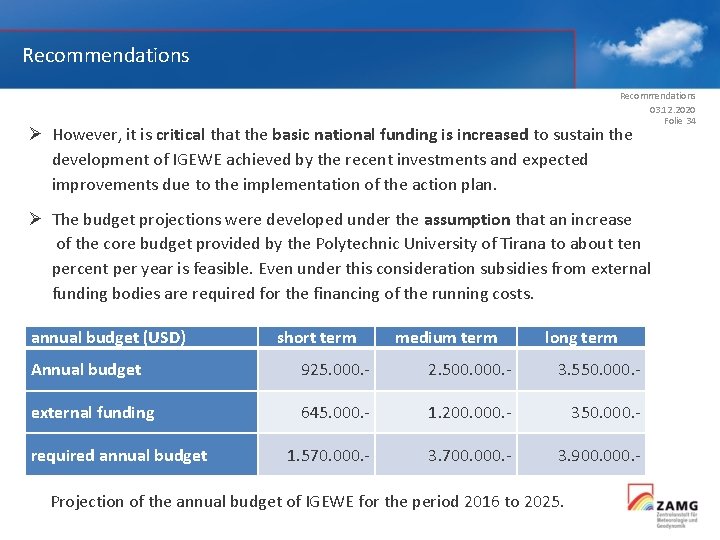
Recommendations 03. 12. 2020 Folie 34 Ø However, it is critical that the basic national funding is increased to sustain the development of IGEWE achieved by the recent investments and expected improvements due to the implementation of the action plan. Ø The budget projections were developed under the assumption that an increase of the core budget provided by the Polytechnic University of Tirana to about ten percent per year is feasible. Even under this consideration subsidies from external funding bodies are required for the financing of the running costs. annual budget (USD) short term medium term long term Annual budget 925. 000. ‐ 2. 500. 000. ‐ 3. 550. 000. ‐ external funding 645. 000. ‐ 1. 200. 000. ‐ 350. 000. ‐ 1. 570. 000. ‐ 3. 700. 000. ‐ 3. 900. 000. ‐ required annual budget Projection of the annual budget of IGEWE for the period 2016 to 2025.
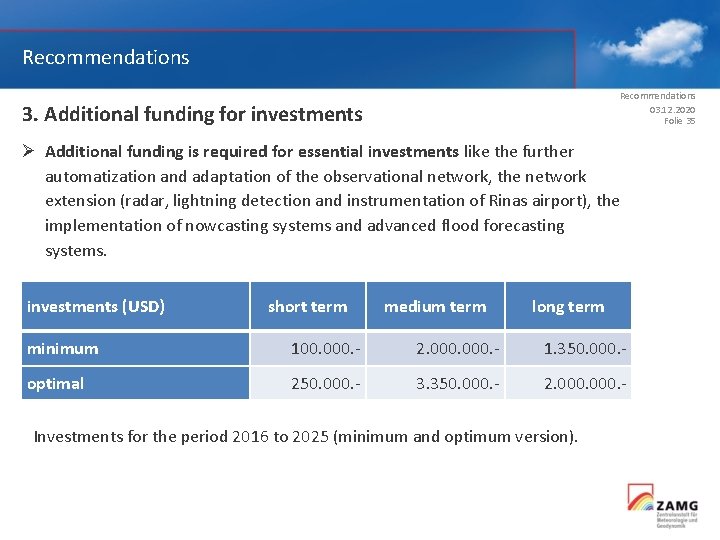
Recommendations 03. 12. 2020 Folie 35 3. Additional funding for investments Ø Additional funding is required for essential investments like the further automatization and adaptation of the observational network, the network extension (radar, lightning detection and instrumentation of Rinas airport), the implementation of nowcasting systems and advanced flood forecasting systems. investments (USD) short term medium term long term minimum 100. 000. ‐ 2. 000. ‐ 1. 350. 000. ‐ optimal 250. 000. ‐ 3. 350. 000. ‐ 2. 000. ‐ Investments for the period 2016 to 2025 (minimum and optimum version).
Recommendations 4. Network design and operation Recommendations 03. 12. 2020 Folie 36 Ø The design and operation of the observational network according to user needs and requirements are of great importance. Ø Central point is a further automatization of the hydrological and meteorological stations, which makes data available in real‐time and allows reducing the number and costs of observers. This budget position can then be shifted to the maintenance of the automatic station network, which shall be shared with the technicians of MMS and Albcontrol Met. Ø Outsourcing of parts of the maintenance work to private companies is proposed in addition, but skilled technicians are still needed at IGEWE for the preparation of tenders, support and the acceptance of the maintenance work. Ø It is essential for the quality of the observations that the functionality of the existing automatic network is ensured before the observers are reduced. The preservation of long time series, which are important for the documentation of climate chance, must be given top priority.
Reccomendations 5. Extension of the National Hazard Center (1/2) Ø A joint extension of the National Hazard Center together with civil protection, other contributors and key users is recommended. Ø Responsibilities for different risks need to be clarified between the contributing partners. Ø The center shall cover meteorological and geophysical hazards like floods, landslides, drought, forest fires, heat waves or cold waves, thunderstorms, hail, windstorms, snow, ice, high waves, and earthquakes by collecting, displaying and distributing the warnings from different official sources of information. Ø The center shall be responsible for the communication of warnings and alerts to civil protection and via different channels to the general public Reccomendations 03. 12. 2020 Folie 37
Reccomendations 5. Extension of the National Hazard Center (2/2) Recommendations 03. 12. 2020 Folie 38 Ø A national multi‐hazard early warning system shall emerge from these activities in the future. Ø Its implementation shall use existing structures in Europe, benefit from “best practices”, and follow the recommendations of WMO and UN‐ISDR. Ø A close cooperation and coordination with neighboring countries and a development of partnerships at a national level are recommended. Ø The membership to EUMETNET will eventually integrate the warnings into the pan‐European METEOALARM platform.
Recommendations 6. Update of the IGEWE Website Reccomendations 03. 12. 2020 Folie 39 Ø The update of the IGEWE website aims at strengthening the capacities for the development of IGEWE. Ø A modernization of the website based on responsive design will improve the quality and availability of station data for the general public and specific groups of users. Ø Additional observational data like satellite, radar and lightning images shall be included. Ø Existing data services and climate services would become more user‐friendly.
Recommendations 7. Capacity building Recommendations 03. 12. 2020 Folie 40 Ø A gap analysis based on existing competencies shall identify areas requiring training and allow the compilation of individual training plans. Ø The development of national training modules ensures that all staff members have the opportunity to learn and develop their skills. It is proposed that the individual training plans follow the recommendations for competence development provided by the WMO Technical Commissions. The learning success shall be evaluated according to the WMO competency assessment. Ø Attend training courses, e. g. those provided by ECMWF, EUMETSAT or EUMETCAL, are an ideal opportunity to enhance personal and institutional knowledge. Some of the courses can be undertaken online, others require personal presence. Blended courses are a combination of both; they consist of an online and a classroom phase Ø The great practical experiences of senior forecasters and observers have to be taken into account for the assessment of the competencies.
Recommendations 8. Numerical Weather Prediction, enhance regional cooperation Ø A stronger collaboration within the South‐East European Consortium for Operational weather Prediction (SEECOP) is encouraged. Ø Jointly run and develop a numerical weather prediction model together with neighboring states, an effort which would otherwise exceed the possibilities for a small weather service with limited resources like IGEWE. Ø Furthermore, a full exploitation of the WMO access to ECMWF products and application to a regular membership at ECMWF with access to further data including ensemble information are strongly recommended. Recommendations 03. 12. 2020 Folie 41
Recommendations 9. Implementation of Nowcasting systems (1/2) Recommendations 03. 12. 2020 Folie 42 Ø Nowcasting techniques are superior to NWP output for very short lead times of minutes to a few hours, and are crucial for severe weather warnings. Ø They critically depend on a real‐time availability of observational data, which is therefore of immense importance for the forecasters on duty. Ø In addition, these observational data may also be merged into an integrated automatic nowcasting system with a high spatial and temporal resolution and a very high update rate. Ø Such a system is very important for warnings and interesting for various customers to optimize their activities (e. g. hail and thunderstorm warnings, extreme rainfall, flash floods).
Recommendations 9. Implementation of Nowcasting systems (2/2) Recommendations 03. 12. 2020 Folie 43 Ø Flash floods and river flooding are the primary weather‐related hazards in Albania. Ø In particular coupled rainfall‐runoff models for major rivers would be greatly helpful for civil protection, operators of hydropower plants, urban and infrastructure planners, risk managers and disaster response or emergency services. Ø It is very likely that the development of such an automatic nowcasting system will attract new customers whose funding will multiply reward the investment. Ø Various NMHSs in Europe have substantial expertise in the development of automatic nowcasting tools and, in particular, coupled rainfall‐runoff models. It is strongly recommended to benefit from their expertise and sound the possibilities for collaborations.
Recommendations 10. Commercial activities Ø Start with the structured development of commercial products. Ø Prerequisites are the successful enhancement of the forecasting capacities, identification of user needs, and training of staff regarding development of new products and services, sales and marketing. Ø A thorough market analysis, economic and non‐economic viability analysis, an accurate preparation of business plans, and appropriate marketing activities are a key to commercial success. Ø The revenues can then be used for the recruitment of new staff members. Recommendations 03. 12. 2020 Folie 44
Thank you for your attention !! 03. 12. 2020 Folie 45 We are happy to accompany the change process and hope that many other NHSMs can benefit from our common work and our experiences !