
Chapter 12 Customers Roles in Service Delivery The


- Slides: 14
Chapter 12 Customers’ Roles in Service Delivery • The Importance of Customers in Service Delivery • Customers’ Roles • Self-Service Technologies—The Ultimate in Customer Participation • Strategies for Enhancing Customer Participation Mc. Graw-Hill/Irwin © 2003. The Mc. Graw-Hill Companies. All Rights Reserved
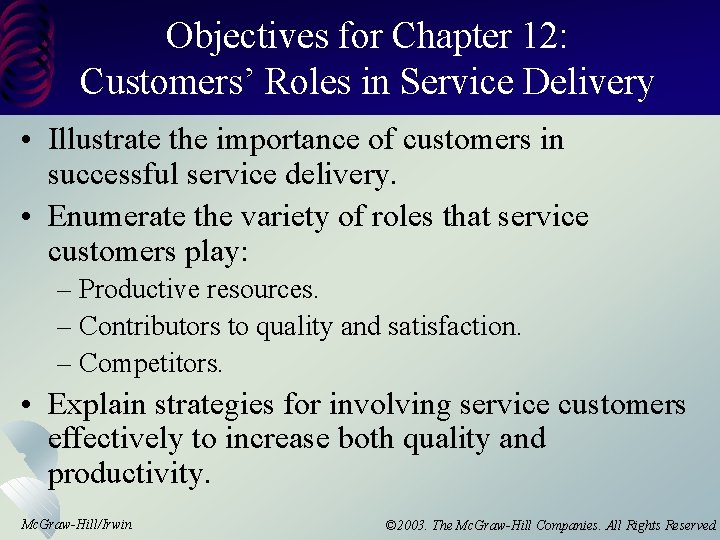
Objectives for Chapter 12: Customers’ Roles in Service Delivery • Illustrate the importance of customers in successful service delivery. • Enumerate the variety of roles that service customers play: – Productive resources. – Contributors to quality and satisfaction. – Competitors. • Explain strategies for involving service customers effectively to increase both quality and productivity. Mc. Graw-Hill/Irwin © 2003. The Mc. Graw-Hill Companies. All Rights Reserved
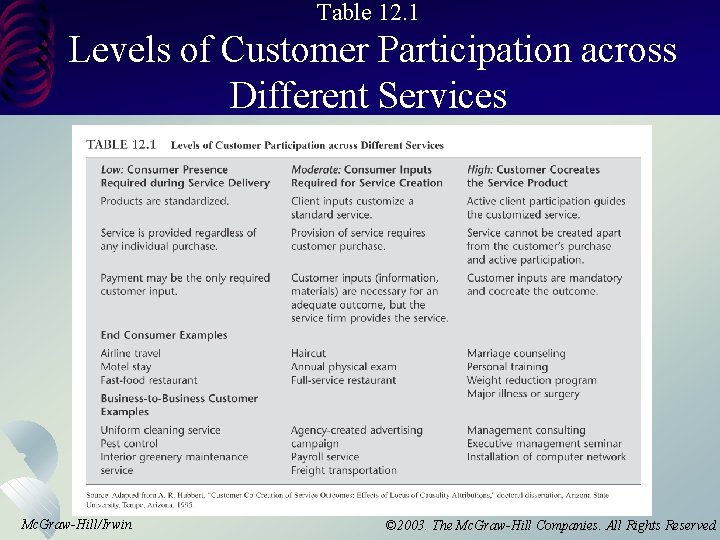
Table 12. 1 Levels of Customer Participation across Different Services Mc. Graw-Hill/Irwin © 2003. The Mc. Graw-Hill Companies. All Rights Reserved
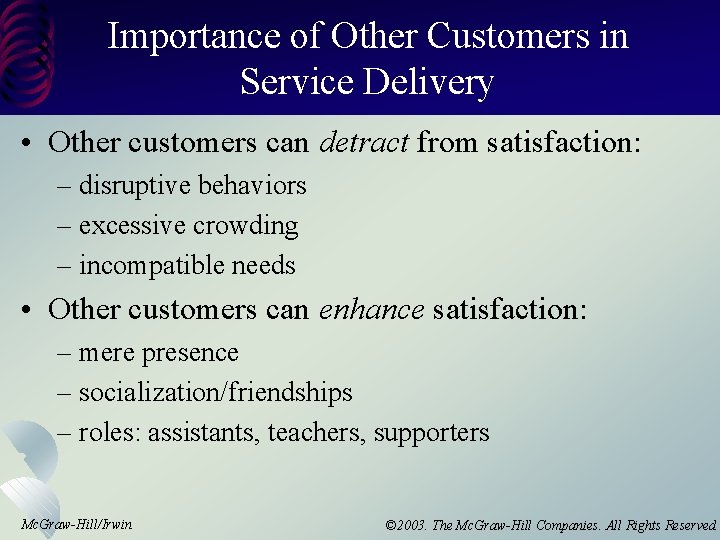
Importance of Other Customers in Service Delivery • Other customers can detract from satisfaction: – disruptive behaviors – excessive crowding – incompatible needs • Other customers can enhance satisfaction: – mere presence – socialization/friendships – roles: assistants, teachers, supporters Mc. Graw-Hill/Irwin © 2003. The Mc. Graw-Hill Companies. All Rights Reserved
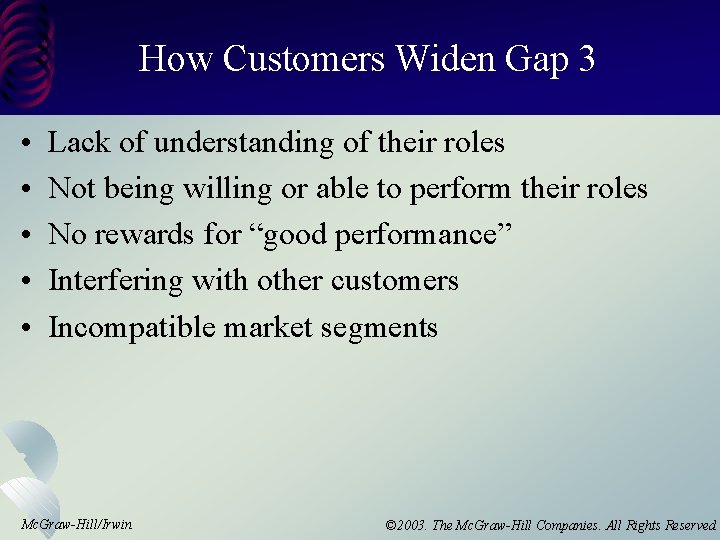
How Customers Widen Gap 3 • • • Lack of understanding of their roles Not being willing or able to perform their roles No rewards for “good performance” Interfering with other customers Incompatible market segments Mc. Graw-Hill/Irwin © 2003. The Mc. Graw-Hill Companies. All Rights Reserved
Figure 12. 2 Customer Roles in Service Delivery Productive Resources Contributors to Quality and Satisfaction Competitors Mc. Graw-Hill/Irwin © 2003. The Mc. Graw-Hill Companies. All Rights Reserved
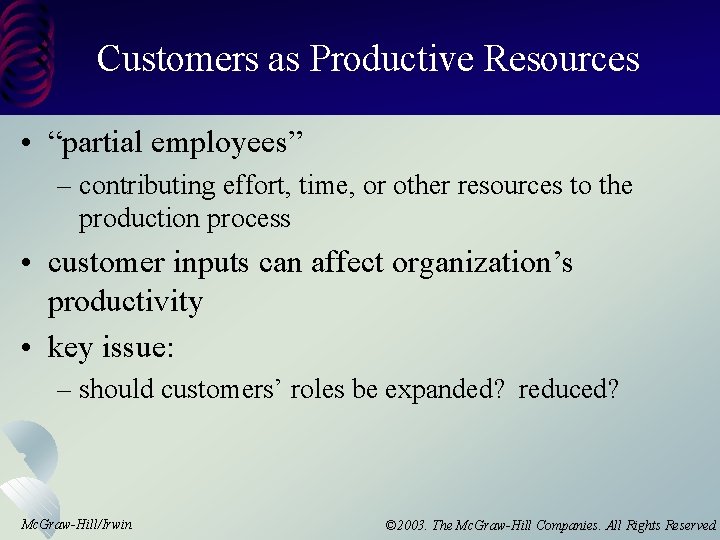
Customers as Productive Resources • “partial employees” – contributing effort, time, or other resources to the production process • customer inputs can affect organization’s productivity • key issue: – should customers’ roles be expanded? reduced? Mc. Graw-Hill/Irwin © 2003. The Mc. Graw-Hill Companies. All Rights Reserved
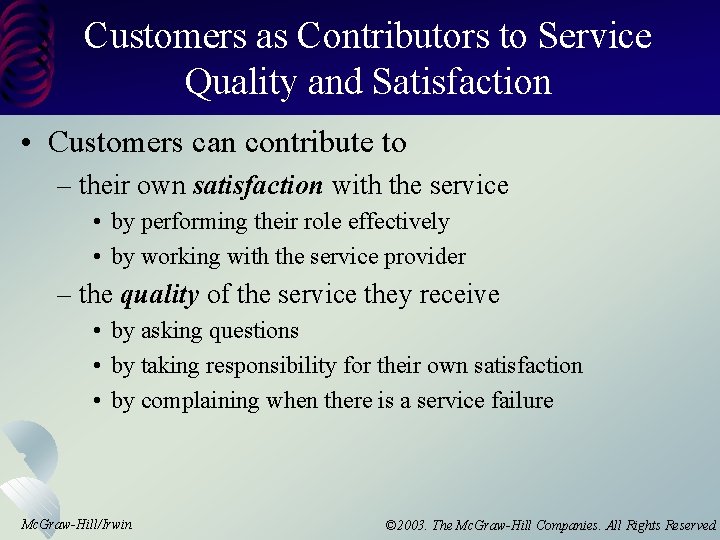
Customers as Contributors to Service Quality and Satisfaction • Customers can contribute to – their own satisfaction with the service • by performing their role effectively • by working with the service provider – the quality of the service they receive • by asking questions • by taking responsibility for their own satisfaction • by complaining when there is a service failure Mc. Graw-Hill/Irwin © 2003. The Mc. Graw-Hill Companies. All Rights Reserved
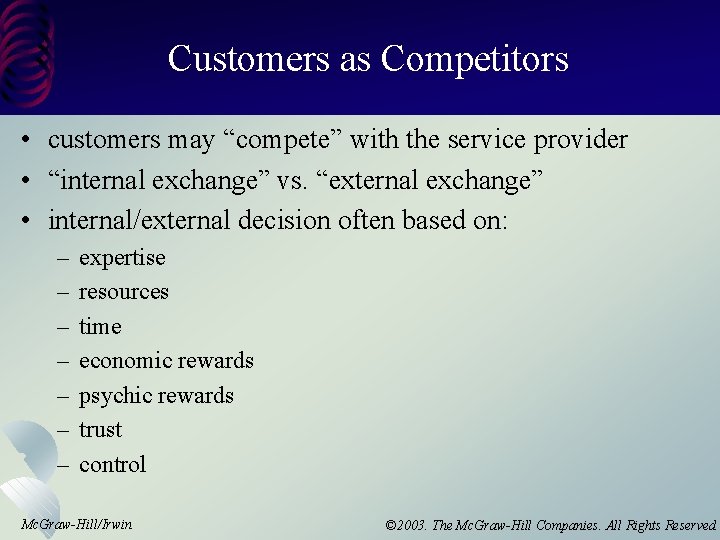
Customers as Competitors • customers may “compete” with the service provider • “internal exchange” vs. “external exchange” • internal/external decision often based on: – – – – expertise resources time economic rewards psychic rewards trust control Mc. Graw-Hill/Irwin © 2003. The Mc. Graw-Hill Companies. All Rights Reserved
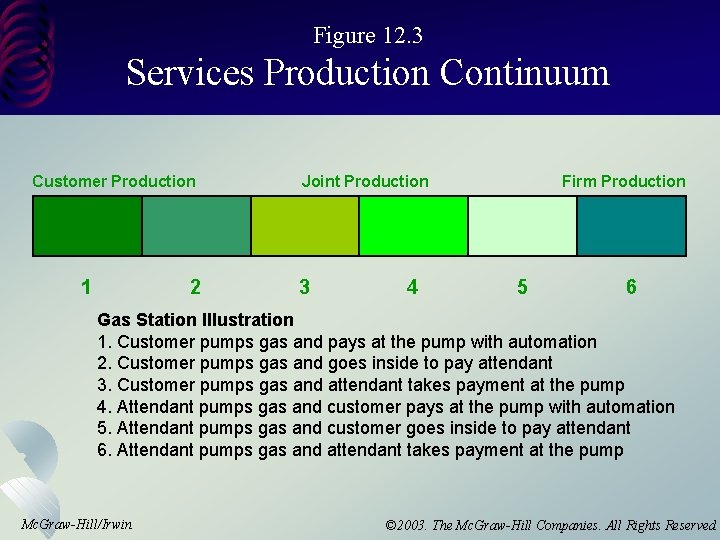
Figure 12. 3 Services Production Continuum Customer Production 1 2 Joint Production 3 4 Firm Production 5 6 Gas Station Illustration 1. Customer pumps gas and pays at the pump with automation 2. Customer pumps gas and goes inside to pay attendant 3. Customer pumps gas and attendant takes payment at the pump 4. Attendant pumps gas and customer pays at the pump with automation 5. Attendant pumps gas and customer goes inside to pay attendant 6. Attendant pumps gas and attendant takes payment at the pump Mc. Graw-Hill/Irwin © 2003. The Mc. Graw-Hill Companies. All Rights Reserved
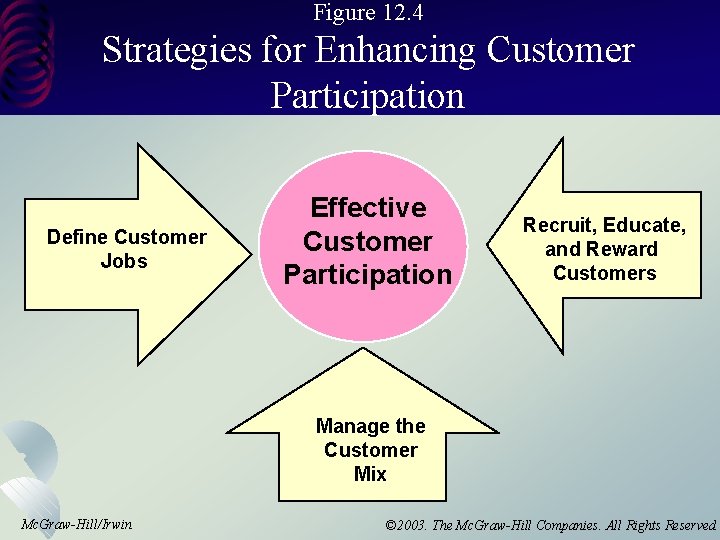
Figure 12. 4 Strategies for Enhancing Customer Participation Define Customer Jobs Effective Customer Participation Recruit, Educate, and Reward Customers Manage the Customer Mix Mc. Graw-Hill/Irwin © 2003. The Mc. Graw-Hill Companies. All Rights Reserved
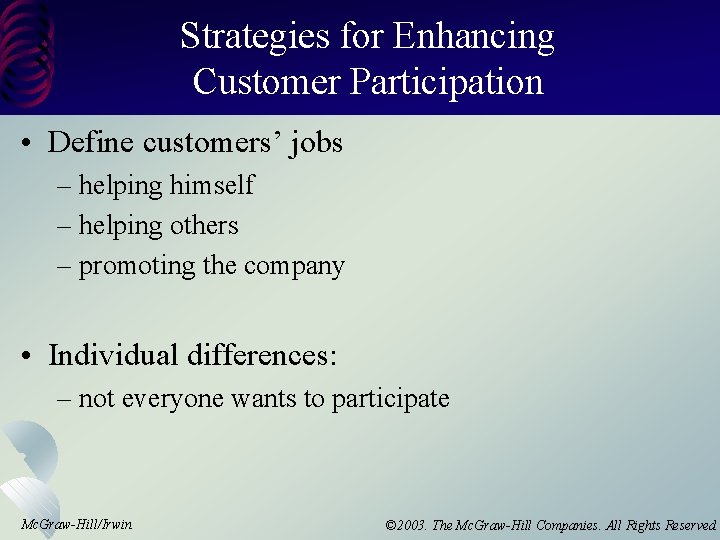
Strategies for Enhancing Customer Participation • Define customers’ jobs – helping himself – helping others – promoting the company • Individual differences: – not everyone wants to participate Mc. Graw-Hill/Irwin © 2003. The Mc. Graw-Hill Companies. All Rights Reserved
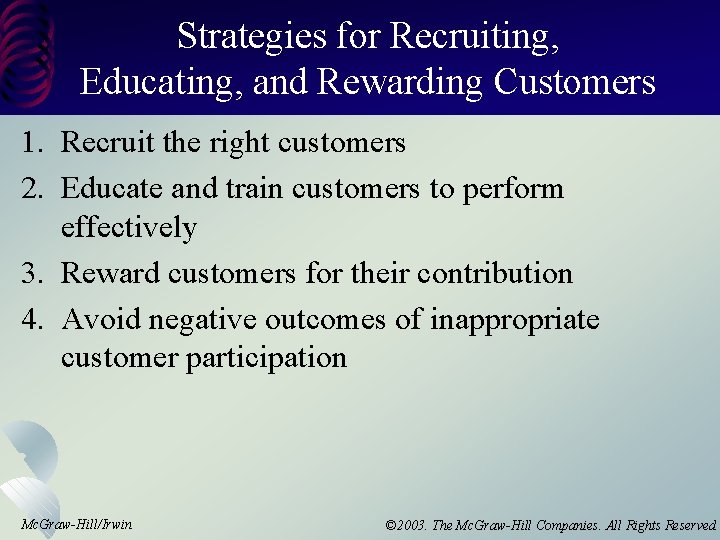
Strategies for Recruiting, Educating, and Rewarding Customers 1. Recruit the right customers 2. Educate and train customers to perform effectively 3. Reward customers for their contribution 4. Avoid negative outcomes of inappropriate customer participation Mc. Graw-Hill/Irwin © 2003. The Mc. Graw-Hill Companies. All Rights Reserved
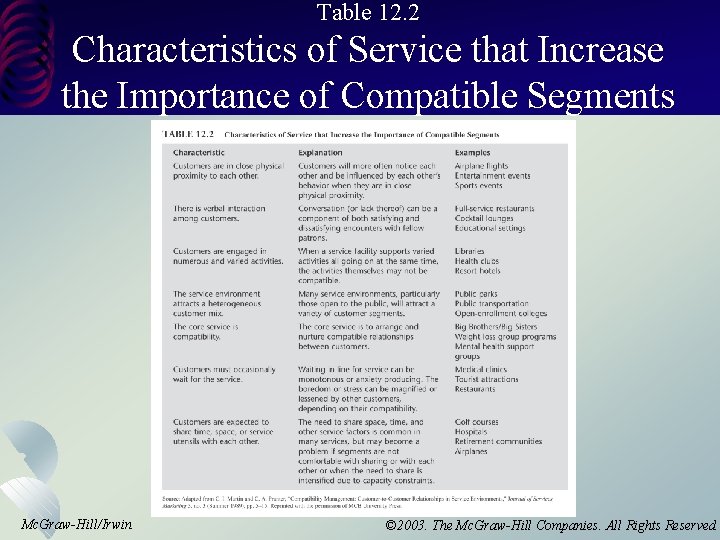
Table 12. 2 Characteristics of Service that Increase the Importance of Compatible Segments Mc. Graw-Hill/Irwin © 2003. The Mc. Graw-Hill Companies. All Rights Reserved