
SERVICE DELIVERY MECHANISMS OF LOCAL GOVERNMENT INCA 2004

- Slides: 33
SERVICE DELIVERY MECHANISMS OF LOCAL GOVERNMENT INCA 2004 SUMMER SCHOOL
THIS PRESENTATION: Distinguishing the service authority and the service provider roles The process for determining an appropriate service delivery mechanism Internal mechanisms External mechanisms
SERVICE AUTHORITY FUNCTIONS AND SERVICE PROVIDER FUNCTIONS
SERVICE AUTHORITY FUNCTIONS Service Authority A service authority is responsible for “administering” a function. This responsibility should be distinguished from regulation and service provision. For example, municipalities are service authorities for water. The Department of Water Affairs and Forestry functions as a regulator. The service provider could be the municipality but it need not be – as in the case of Mbombela Municipality or the City of Johannesburg. Hence: “A municipality has … the right to administer—the local government matters listed in Part B of Schedule 4 and Part B of Schedule 5” (Section 156 of the Constitution).
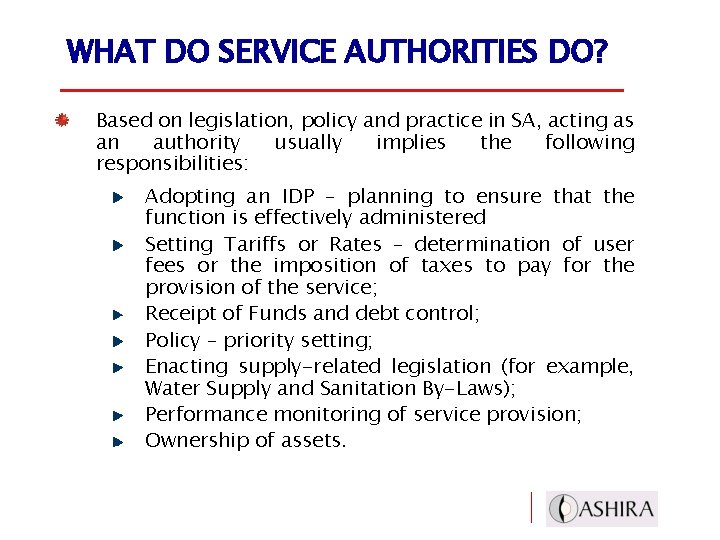
WHAT DO SERVICE AUTHORITIES DO? Based on legislation, policy and practice in SA, acting as an authority usually implies the following responsibilities: Adopting an IDP – planning to ensure that the function is effectively administered Setting Tariffs or Rates – determination of user fees or the imposition of taxes to pay for the provision of the service; Receipt of Funds and debt control; Policy – priority setting; Enacting supply-related legislation (for example, Water Supply and Sanitation By-Laws); Performance monitoring of service provision; Ownership of assets.
SERVICE PROVIDER FUNCTIONS Service Provider A service provider is responsible for providing “municipal services” – a term that has recently been defined in the Systems Act and broadly correlates to municipal functions that involve service provision. The service provider can be the municipality itself (if the provision is internal) or another entity (if the provision is external). The basis for the service provision is established by the Service Authority who remains ultimately responsible for the provision of the service. Chapter 8 of the Systems Act deals with service provision in detail.
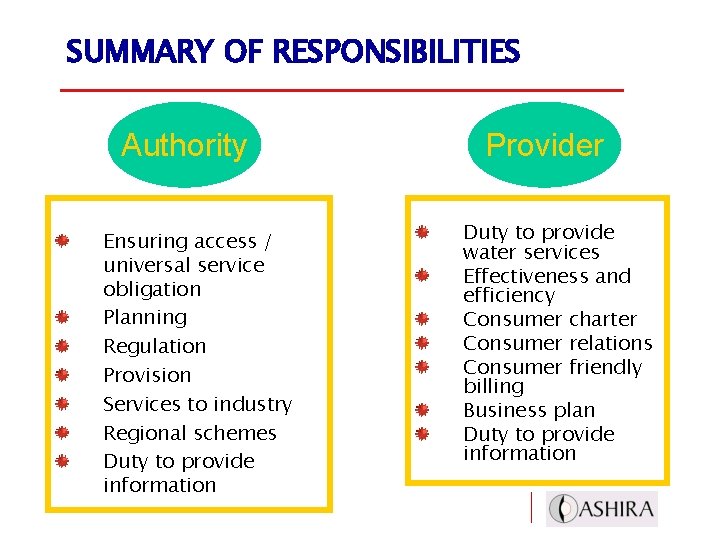
SUMMARY OF RESPONSIBILITIES Authority Ensuring access / universal service obligation Planning Regulation Provision Services to industry Regional schemes Duty to provide information Provider Duty to provide water services Effectiveness and efficiency Consumer charter Consumer relations Consumer friendly billing Business plan Duty to provide information
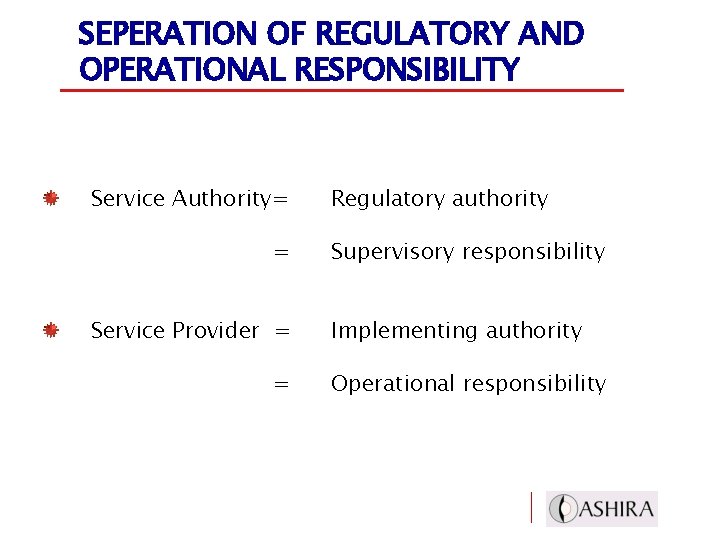
SEPERATION OF REGULATORY AND OPERATIONAL RESPONSIBILITY Service Authority= = Service Provider = = Regulatory authority Supervisory responsibility Implementing authority Operational responsibility
THE PROCESS FOR DETERMINING AN APPROPRIATE SERVICE DELIVERY MECHANISM
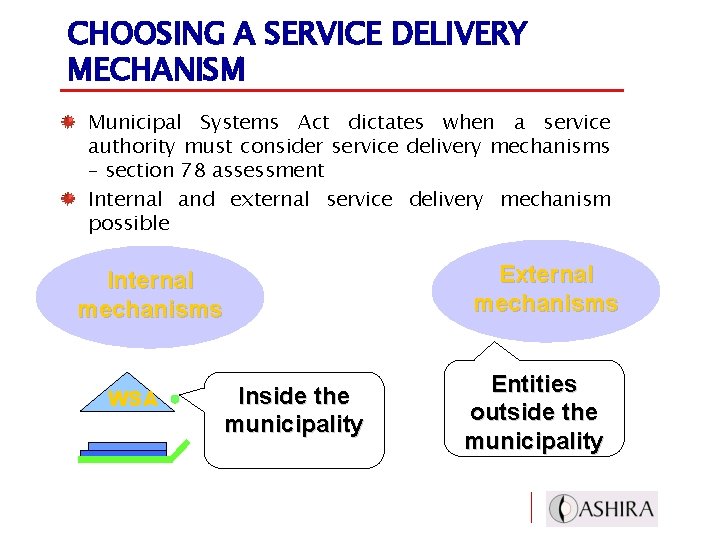
CHOOSING A SERVICE DELIVERY MECHANISM Municipal Systems Act dictates when a service authority must consider service delivery mechanisms – section 78 assessment Internal and external service delivery mechanism possible External mechanisms Internal mechanisms WSA Inside the municipality Entities outside the municipality
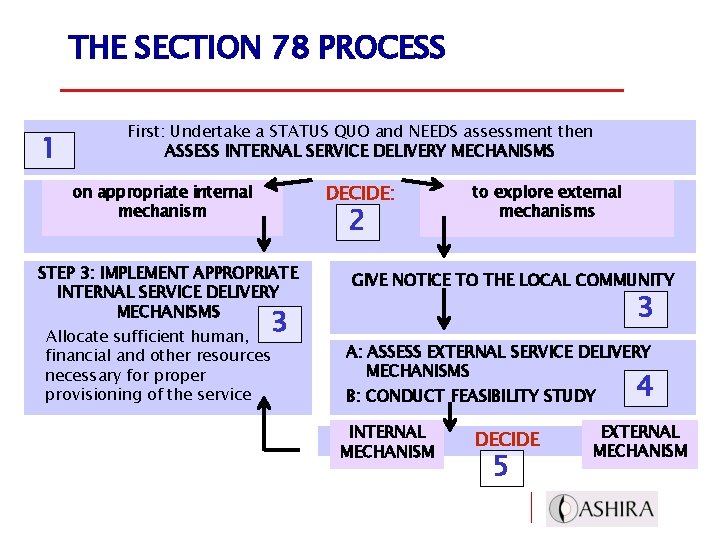
THE SECTION 78 PROCESS 1 First: Undertake a STATUS QUO and NEEDS assessment then ASSESS INTERNAL SERVICE DELIVERY MECHANISMS DECIDE: on appropriate internal mechanism 2 STEP 3: IMPLEMENT APPROPRIATE INTERNAL SERVICE DELIVERY MECHANISMS 3 Allocate sufficient human, financial and other resources necessary for proper provisioning of the service to explore external mechanisms GIVE NOTICE TO THE LOCAL COMMUNITY 3 A: ASSESS EXTERNAL SERVICE DELIVERY MECHANISMS B: CONDUCT FEASIBILITY STUDY INTERNAL MECHANISM DECIDE 5 4 EXTERNAL MECHANISM
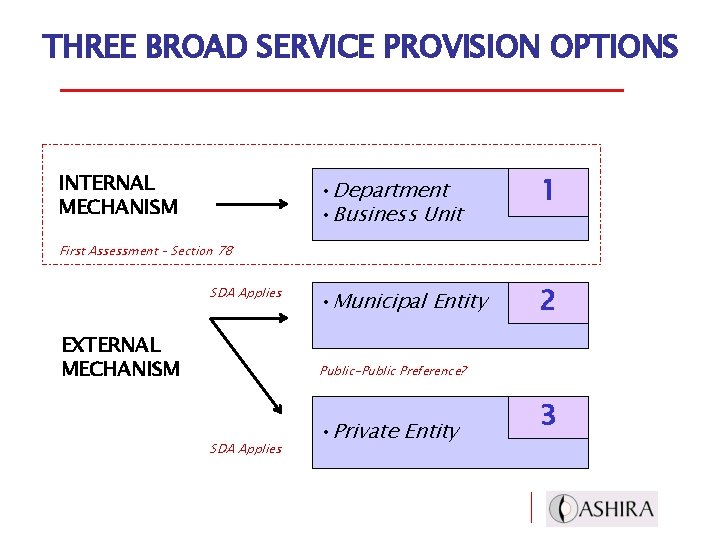
THREE BROAD SERVICE PROVISION OPTIONS INTERNAL MECHANISM • Department • Business Unit 1 • Municipal Entity 2 First Assessment – Section 78 SDA Applies EXTERNAL MECHANISM Public-Public Preference? SDA Applies • Private Entity 3
INTERNAL MECHANISMS
THINGS TO THINK ABOUT WHEN CONSIDERING INTERNAL MECHANISMS Internal delivery mechanisms are more about appropriate organisational design and performance improvement than financial considerations Effective and efficient administration will, however, improve financial performance A department can reflect many of the characteristics of a business unit and vice versa depending on the way it is governed and structured
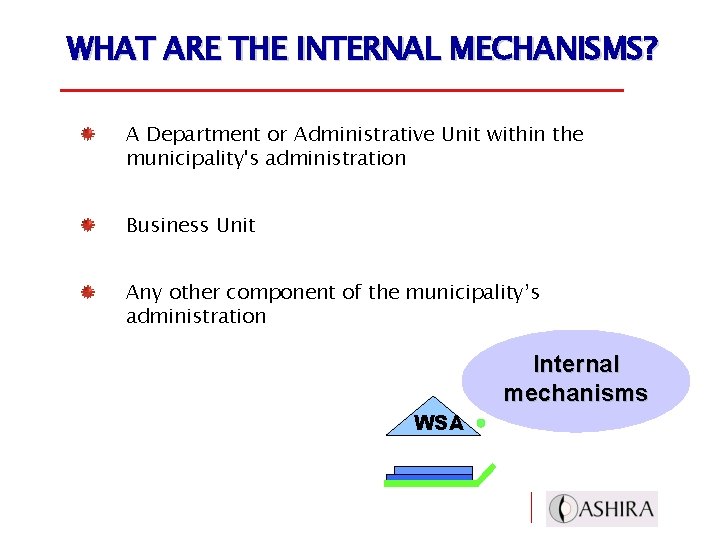
WHAT ARE THE INTERNAL MECHANISMS? A Department or Administrative Unit within the municipality's administration Business Unit Any other component of the municipality’s administration Internal mechanisms WSA
WHAT IS A DEPARTMENT OR ADMINISTRATIVE UNIT? The Systems Act doesn’t provide definitions Can be defined as “an institutional arrangement where the responsibility for the delivery of a particular service is carried by more than one unit within the administration of a municipality” Currently it’s the most common option The department or administrative unit usually takes responsibility for the technical aspects of the service, while other departments or administrative units take responsibility for other aspects of the service such as financial, legal, social, human resources and the like
WHAT IS A BUSINESS UNIT? A business unit - q operates within the municipality’s administration q under council’s control, and q in accordance with operational and performance criteria of Council The Act does not define a ‘business unit’ There is no clear legal or academic definition Can be defined as “a ring-fenced unit within the municipal structure operating within a defined framework and fully accountable for all aspects of service delivery”
WHAT IS A BUSINESS UNIT? Similar to a department or administrative unit as it is an integral part of a municipality and does not have a separate legal personality Functions as if it is separate from the municipality Usually is responsible for all aspects of a service, including the technical, financial and legal aspects All income and expenditure is ring-fenced and all functions (including meter reading, billing and credit control) related to the provision of water services may be performed by the business unit Transactions with other departments ‘at arms length’ The business unit focuses on water services provision and constitutes a holistic approach to rendering the service
EXTERNAL MECHANISMS
EXTERNAL MECHANISMS IN THE CONTEXT OF S 78 Challenges / needs have been identified (although not a legislative requirement, a status quo assessment should have been completed and needs going forward determined) Internal mechanism assessment completed, and decision to first assess feasibility of external mechanisms Notice to the community of intention explore external mechanisms has been given
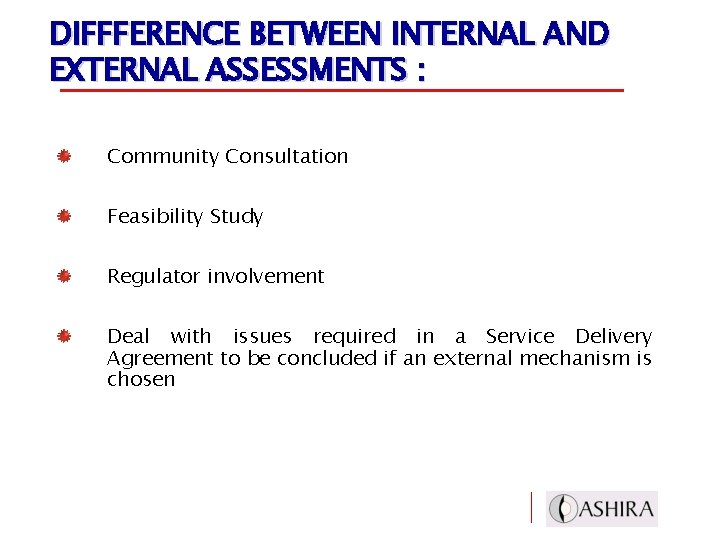
DIFFFERENCE BETWEEN INTERNAL AND EXTERNAL ASSESSMENTS : Community Consultation Feasibility Study Regulator involvement Deal with issues required in a Service Delivery Agreement to be concluded if an external mechanism is chosen
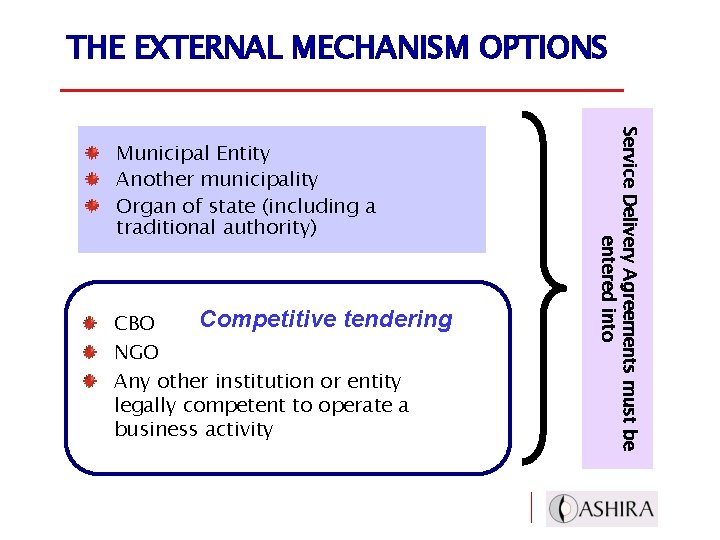
THE EXTERNAL MECHANISM OPTIONS Competitive tendering CBO NGO Any other institution or entity legally competent to operate a business activity Service Delivery Agreements must be entered into Municipal Entity Another municipality Organ of state (including a traditional authority)
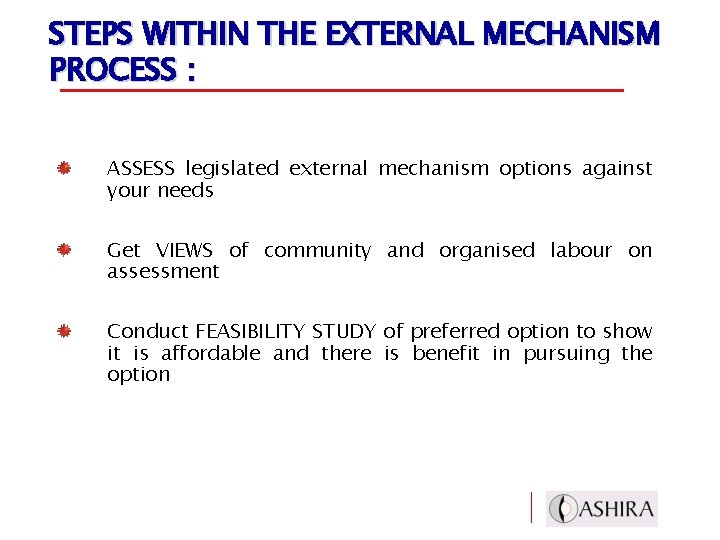
STEPS WITHIN THE EXTERNAL MECHANISM PROCESS : ASSESS legislated external mechanism options against your needs Get VIEWS of community and organised labour on assessment Conduct FEASIBILITY STUDY of preferred option to show it is affordable and there is benefit in pursuing the option
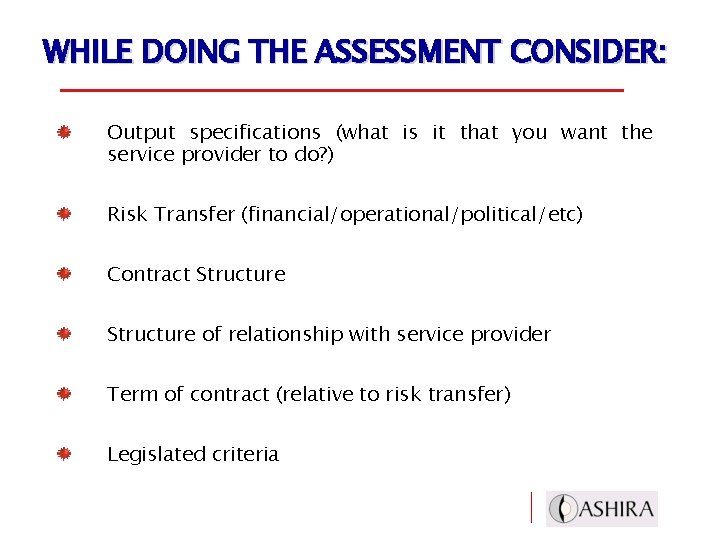
WHILE DOING THE ASSESSMENT CONSIDER: Output specifications (what is it that you want the service provider to do? ) Risk Transfer (financial/operational/political/etc) Contract Structure of relationship with service provider Term of contract (relative to risk transfer) Legislated criteria
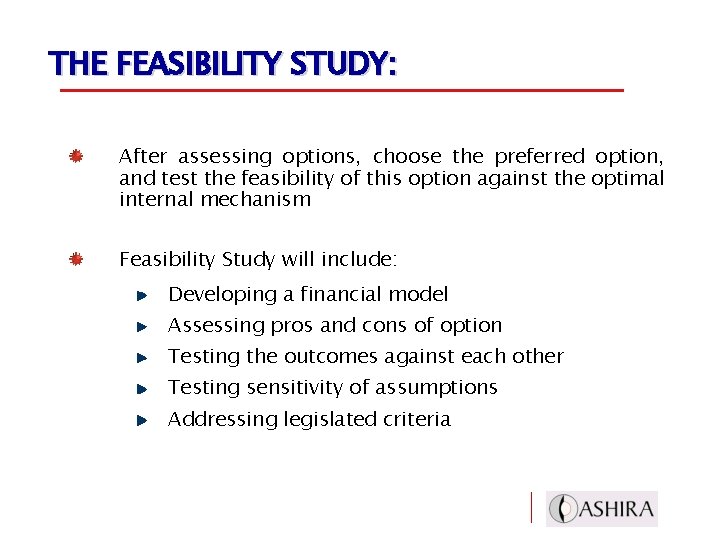
THE FEASIBILITY STUDY: After assessing options, choose the preferred option, and test the feasibility of this option against the optimal internal mechanism Feasibility Study will include: Developing a financial model Assessing pros and cons of option Testing the outcomes against each other Testing sensitivity of assumptions Addressing legislated criteria
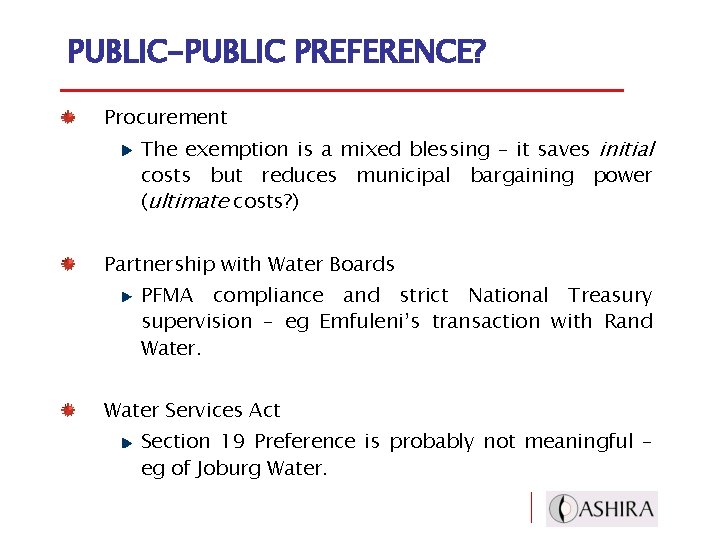
PUBLIC-PUBLIC PREFERENCE? Procurement The exemption is a mixed blessing – it saves initial costs but reduces municipal bargaining power (ultimate costs? ) Partnership with Water Boards PFMA compliance and strict National Treasury supervision – eg Emfuleni’s transaction with Rand Water Services Act Section 19 Preference is probably not meaningful – eg of Joburg Water.
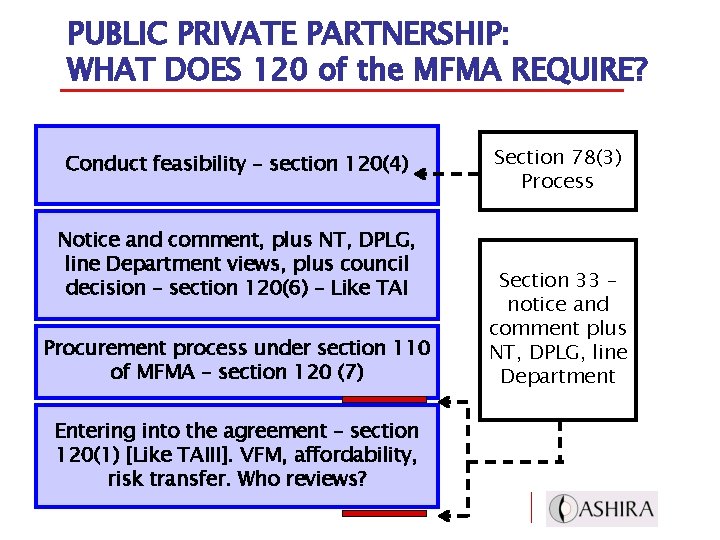
PUBLIC PRIVATE PARTNERSHIP: WHAT DOES 120 of the MFMA REQUIRE? Conduct feasibility – section 120(4) Notice and comment, plus NT, DPLG, line Department views, plus council decision – section 120(6) – Like TAI Procurement process under section 110 of MFMA – section 120 (7) Entering into the agreement – section 120(1) [Like TAIII]. VFM, affordability, risk transfer. Who reviews? Section 78(3) Process Section 33 – notice and comment plus NT, DPLG, line Department
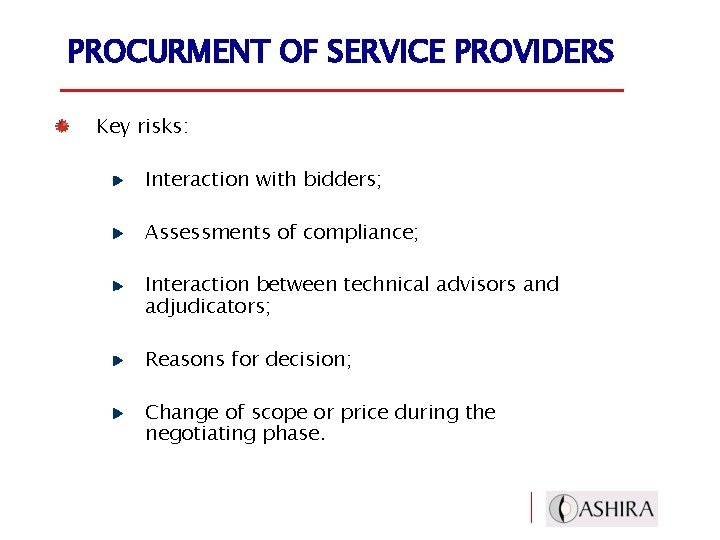
PROCURMENT OF SERVICE PROVIDERS Key risks: Interaction with bidders; Assessments of compliance; Interaction between technical advisors and adjudicators; Reasons for decision; Change of scope or price during the negotiating phase.
THE SERVICE DELIVERY AGREEMENT (“SDA”) Key difference between the internal and external mechanism is the SDA. An SDA is the agreement which regulates the relationship between the WSA and the WSP. It sets out who has to what and when. There are “generic types” of SDAs, but each WSA should make sure its contract is appropriate for its specific needs, allocates risks and adequately allows the WSA to “ensure service deliver”
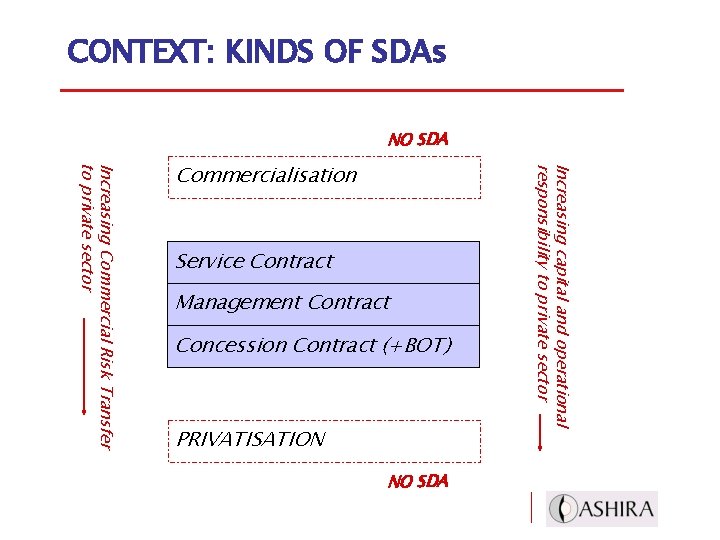
CONTEXT: KINDS OF SDAs NO SDA Service Contract Management Contract Concession Contract (+BOT) PRIVATISATION NO SDA Increasing capital and operational responsibility to private sector Increasing Commercial Risk Transfer to private sector Commercialisation
WHICH SDA FOR YOU? The type of output specification (what it is the WSA wants to achieve through the service delivery mechanism) and the risk transfer will influence WHO (which external mechanism) is appropriate to respond to your needs Let the communities needs drive the assessment of external mechanisms, rather than the other way around! Review s 81 of the Systems Act and s 19 of the Water Services Act
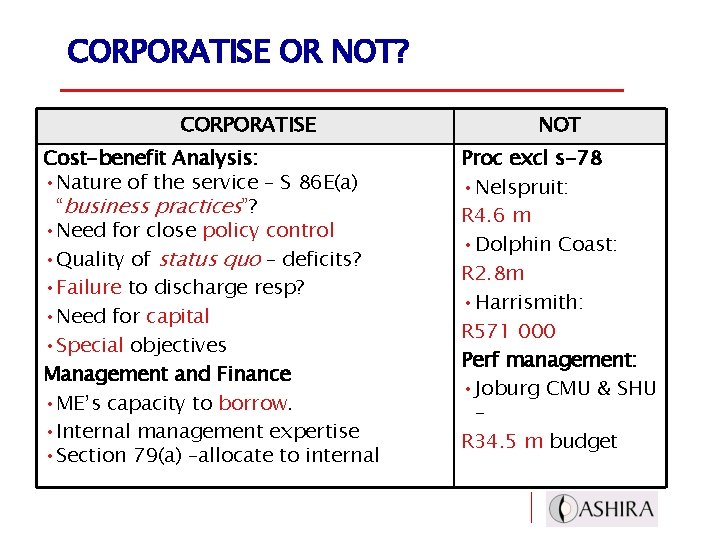
CORPORATISE OR NOT? CORPORATISE Cost-benefit Analysis: • Nature of the service – S 86 E(a) “business practices”? • Need for close policy control • Quality of status quo – deficits? • Failure to discharge resp? • Need for capital • Special objectives Management and Finance • ME’s capacity to borrow. • Internal management expertise • Section 79(a) –allocate to internal NOT Proc excl s-78 • Nelspruit: R 4. 6 m • Dolphin Coast: R 2. 8 m • Harrismith: R 571 000 Perf management: • Joburg CMU & SHU – R 34. 5 m budget
THANK YOU QUESTIONS PLEASE