Questionnaire Design EPIET Introductory Course 2010 Lazareto Menorca

- Slides: 59
Questionnaire Design EPIET Introductory Course 2010 Lazareto, Menorca K Alpers, C Campese, P Mc. Keown, V Bremer, V Prikazsky 1 1
What is a questionnaire? • A tool to – collect answers to questions – collect factual data • A series of written questions in a fixed, rational order 2 2
A well designed questionnaire • Gives accurate and relevant information to your research question • Minimises potential sources of bias As simple and focused as possible 3 3
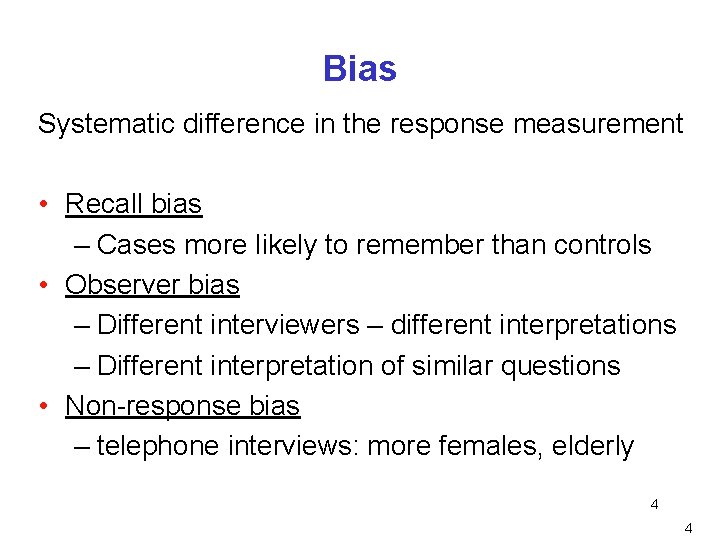
Bias Systematic difference in the response measurement • Recall bias – Cases more likely to remember than controls • Observer bias – Different interviewers – different interpretations – Different interpretation of similar questions • Non-response bias – telephone interviews: more females, elderly 4 4
How to reduce bias • Structured questionnaire • Ensure high response rate • Random choice of interview partners (next birthday) • Training of interviewers 5 5
Advantages of questionnaires • Can reach a large number of people • Relatively easy and economic • Relate directly to study question • Provide quantifiable answers • Relatively easy to analyse 6 6
Disadvantages of questionnaires • Provide only limited insight into a problem – the range of possible responses is limited – the question maybe misleading • Varying response – Unclear question can lead to • misunderstanding • misinterpretation • Do not allow for mistakes – must be right from the beginning – missing data hard to chase 7 7
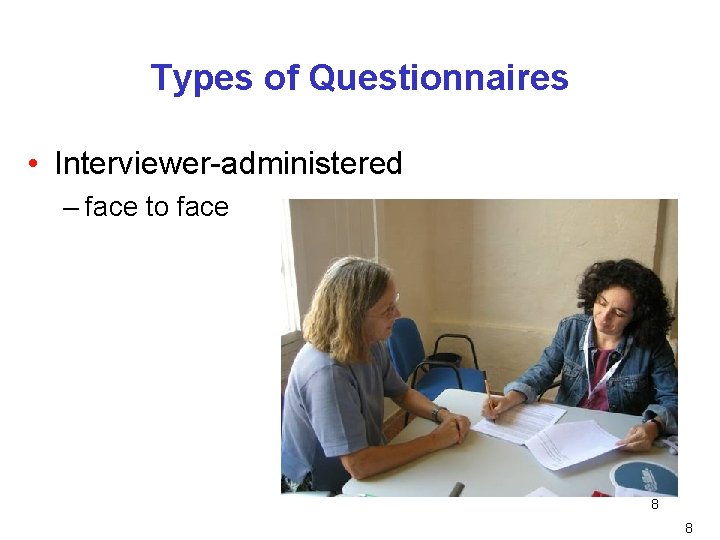
Types of Questionnaires • Interviewer-administered – face to face 8 8
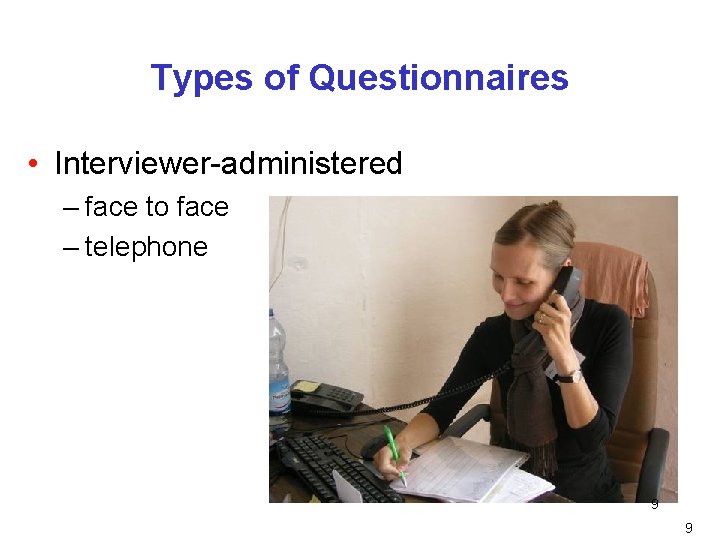
Types of Questionnaires • Interviewer-administered – face to face – telephone 9 9
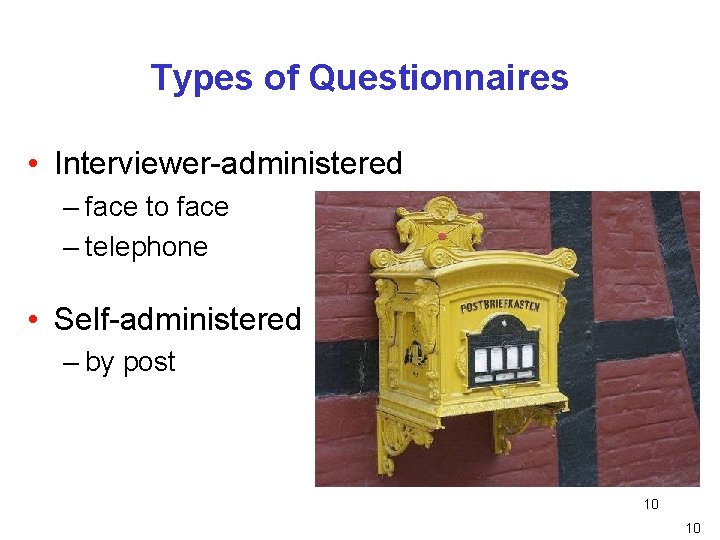
Types of Questionnaires • Interviewer-administered – face to face – telephone • Self-administered – by post 10 10
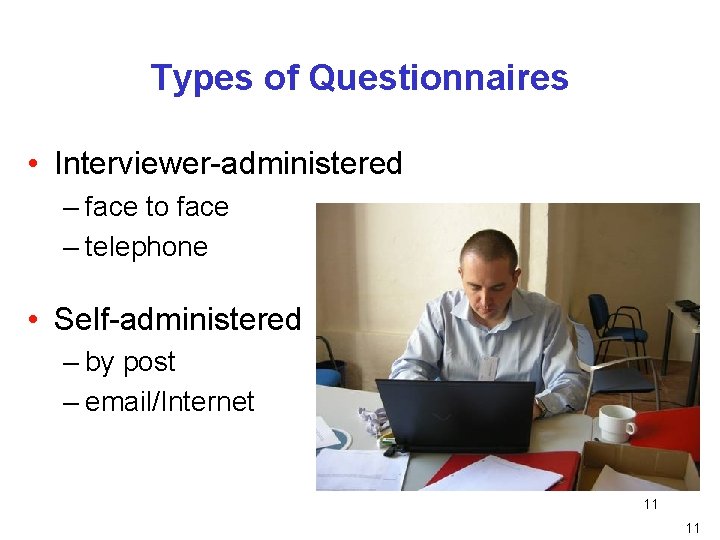
Types of Questionnaires • Interviewer-administered – face to face – telephone • Self-administered – by post – email/Internet 11 11
Self-administered questionnaire • Advantages – cheap and easy to administer – preserves confidentiality – completed at respondent's convenience – not influenced by interviewer 12 12
Self-administered questionnaire • Advantages – – cheap and easy to administer preserves confidentiality completed at respondent's convenience not influenced by interviewer • Disadvantages – – – low response questions can be misunderstood no control by interviewer only literate persons time delay (post) e-mail/internet: need computer access/software 13 13
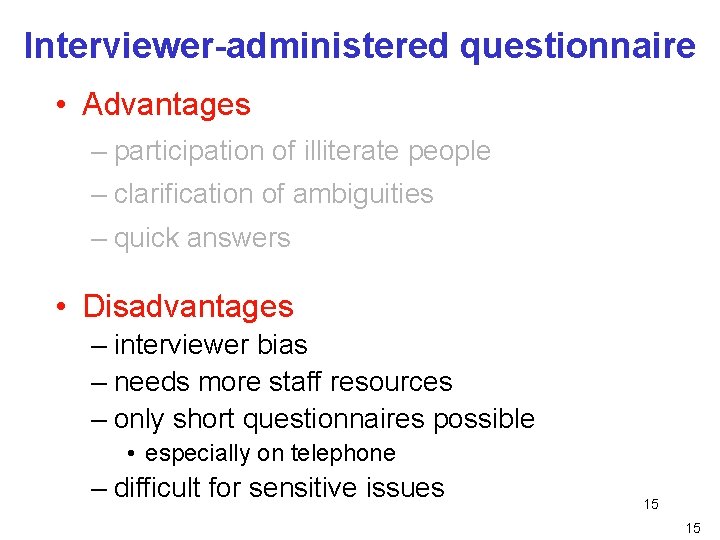
Interviewer-administered questionnaire • Advantages – participation of illiterate people – clarification of ambiguities – quick answers 14 14
Interviewer-administered questionnaire • Advantages – participation of illiterate people – clarification of ambiguities – quick answers • Disadvantages – interviewer bias – needs more staff resources – only short questionnaires possible • especially on telephone – difficult for sensitive issues 15 15
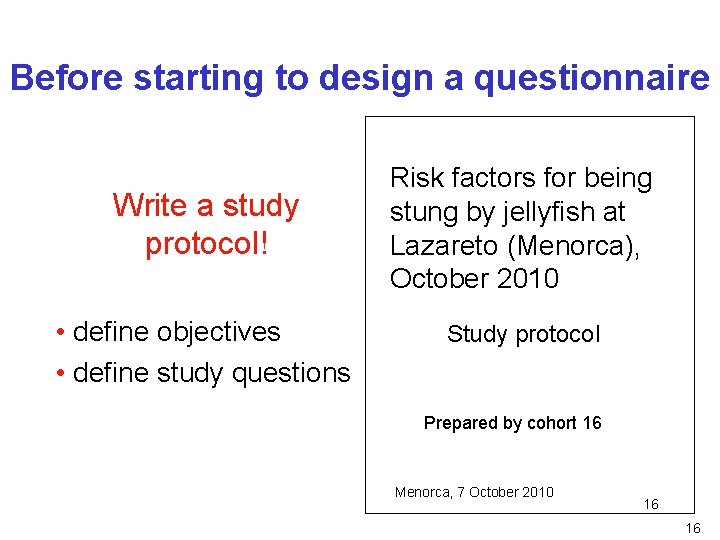
Before starting to design a questionnaire Write a study protocol! • define objectives • define study questions Risk factors for being stung by jellyfish at Lazareto (Menorca), October 2010 Study protocol Prepared by cohort 16 Menorca, 7 October 2010 16 16
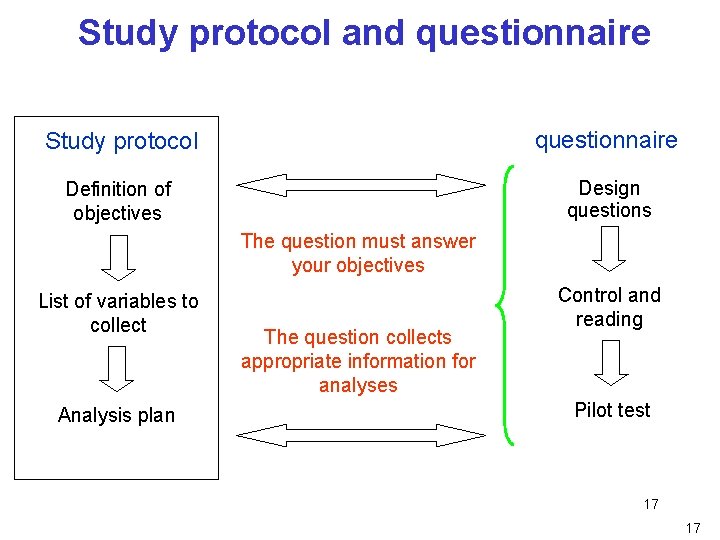
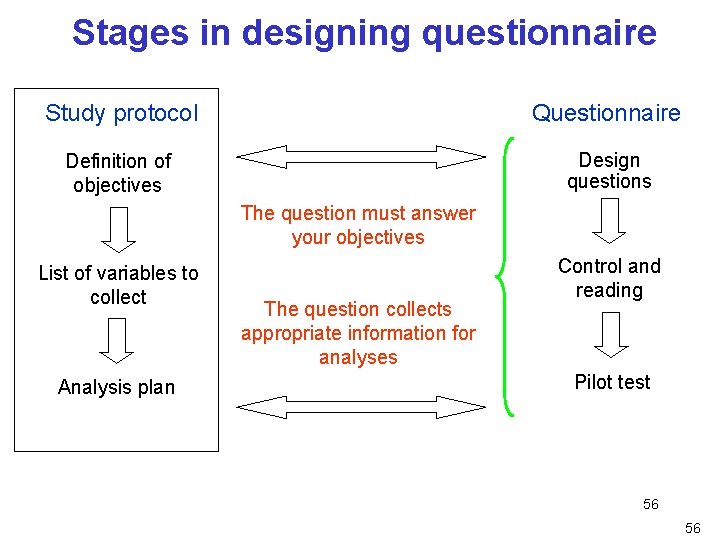
Study protocol and questionnaire Study protocol questionnaire Definition of objectives Design questions The question must answer your objectives List of variables to collect Analysis plan The question collects appropriate information for analyses Control and reading Pilot test 17 17
Use existing questionnaires • As an inspiration • Don´t need to re-invent the wheel • Have been tested • BUT: adapt to present situation! 18 18
Questionnaire needs to be adapted to study population • Know the respondents – occupation – sensitive issues – education – ethnic group – language 19 19
What makes a well designed questionnaire? • Good appearance (easy for the eye) • Short and simple • Relevant and logical ⇒ High response ⇒ Easier to collect to summarize to analyse 20 20
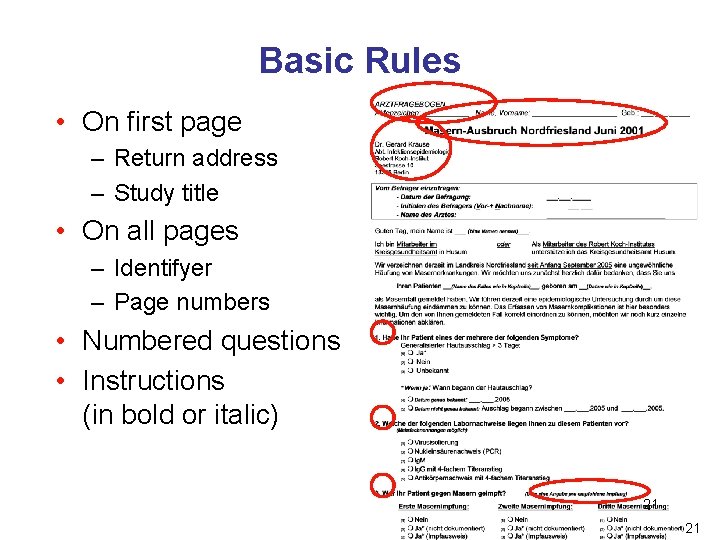
Basic Rules • On first page – Return address – Study title • On all pages – Identifyer – Page numbers • Numbered questions • Instructions (in bold or italic) 21 21
Structure of a questionnaire 1 Interview introduction 2 Identification 3 Instructions on how to answer 4 Questions 5 Conclusion 22 22
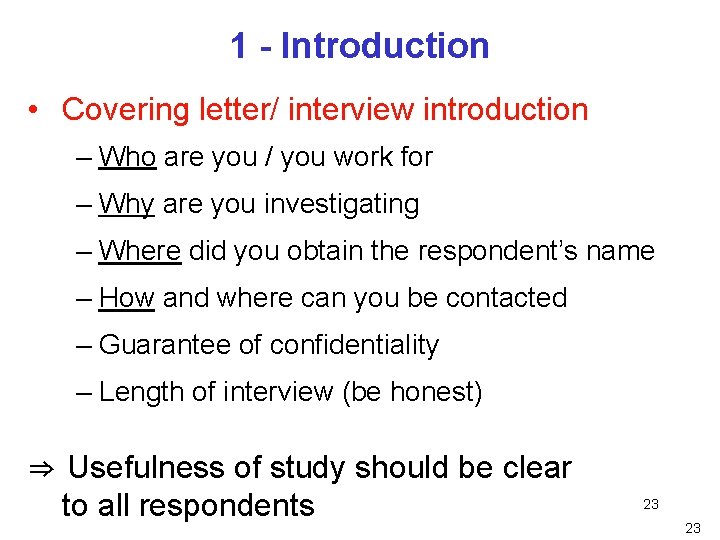
1 - Introduction • Covering letter/ interview introduction – Who are you / you work for – Why are you investigating – Where did you obtain the respondent’s name – How and where can you be contacted – Guarantee of confidentiality – Length of interview (be honest) ⇒ Usefulness of study should be clear to all respondents 23 23
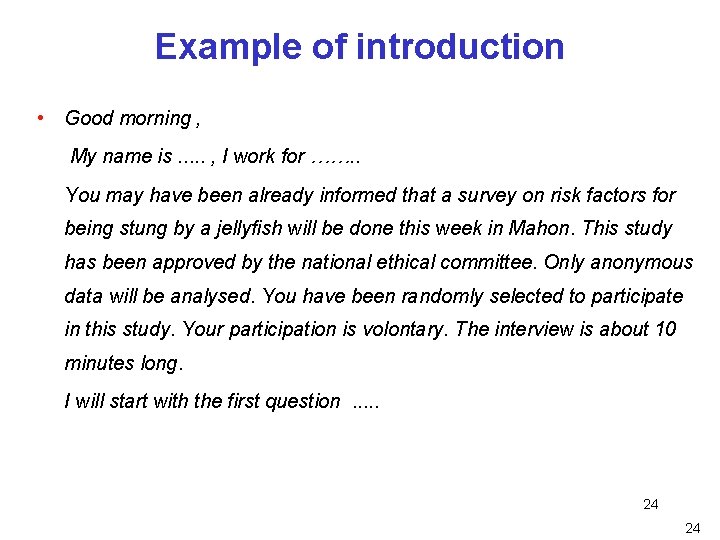
Example of introduction • Good morning , My name is. . . , I work for ……. . You may have been already informed that a survey on risk factors for being stung by a jellyfish will be done this week in Mahon. This study has been approved by the national ethical committee. Only anonymous data will be analysed. You have been randomly selected to participate in this study. Your participation is volontary. The interview is about 10 minutes long. I will start with the first question. . . 24 24
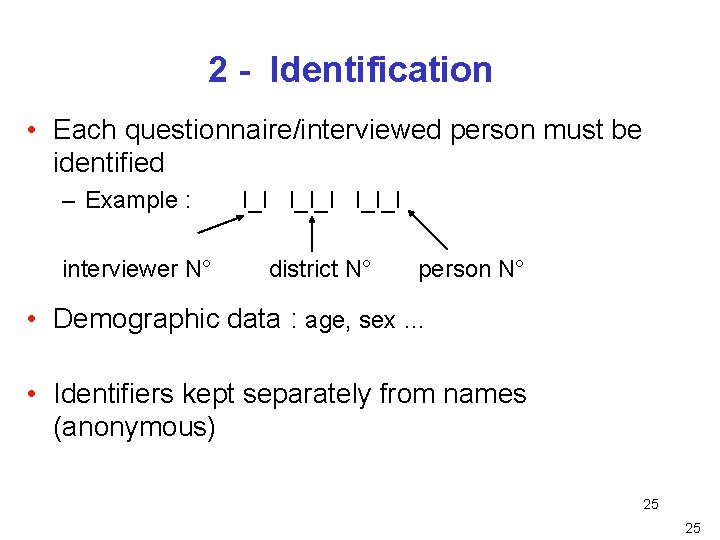
2 - Identification • Each questionnaire/interviewed person must be identified – Example : interviewer N° I_I_I district N° person N° • Demographic data : age, sex … • Identifiers kept separately from names (anonymous) 25 25
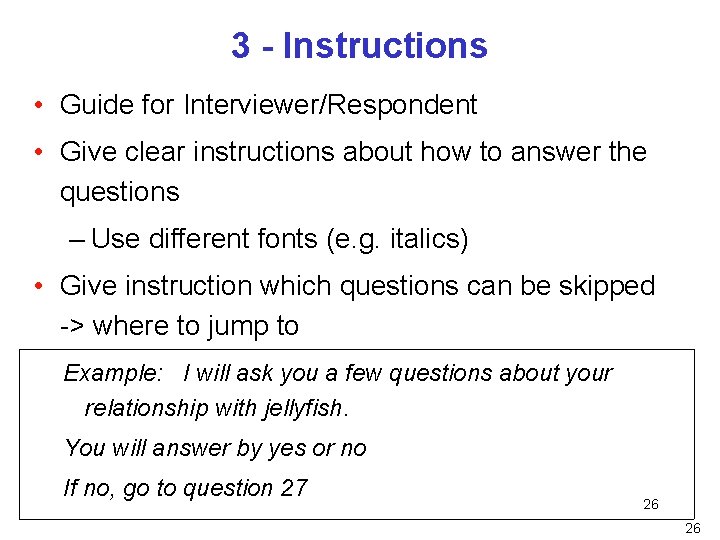
3 - Instructions • Guide for Interviewer/Respondent • Give clear instructions about how to answer the questions – Use different fonts (e. g. italics) • Give instruction which questions can be skipped -> where to jump to Example: I will ask you a few questions about your relationship with jellyfish. You will answer by yes or no If no, go to question 27 26 26
4 - Questions • Content • Order • Format • Problems and pitfalls • Coding 27 27
Content of questions • Clear focus on research question – avoid sidetracking – avoid unnecessary information 28 28
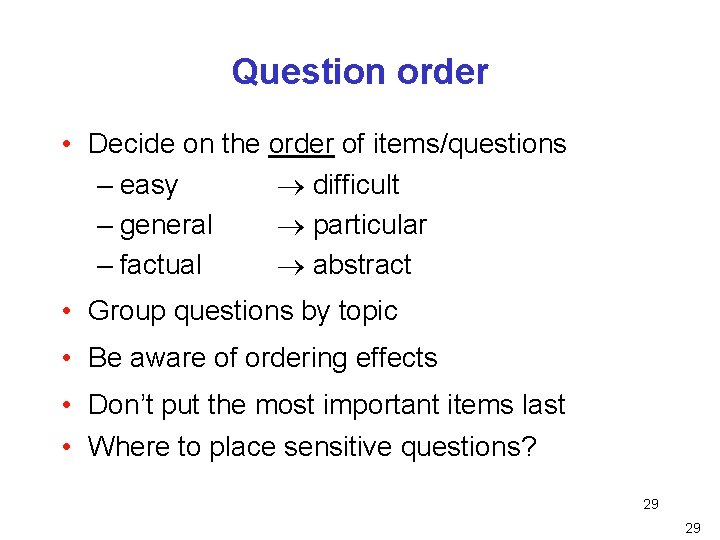
Question order • Decide on the order of items/questions – easy difficult – general particular – factual abstract • Group questions by topic • Be aware of ordering effects • Don’t put the most important items last • Where to place sensitive questions? 29 29
Starting questions – “Door-opener” – Simple – Closed format – Relevant to main subject – Non-offending – Neither demographic nor personal questions 30 30
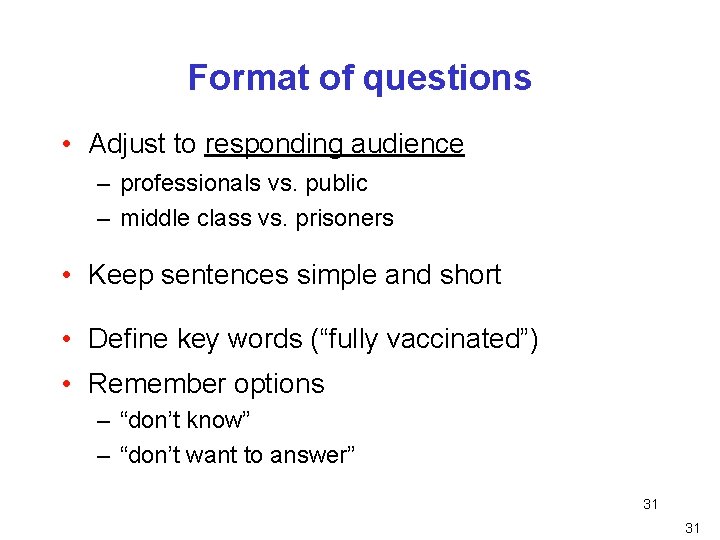
Format of questions • Adjust to responding audience – professionals vs. public – middle class vs. prisoners • Keep sentences simple and short • Define key words (“fully vaccinated”) • Remember options – “don’t know” – “don’t want to answer” 31 31
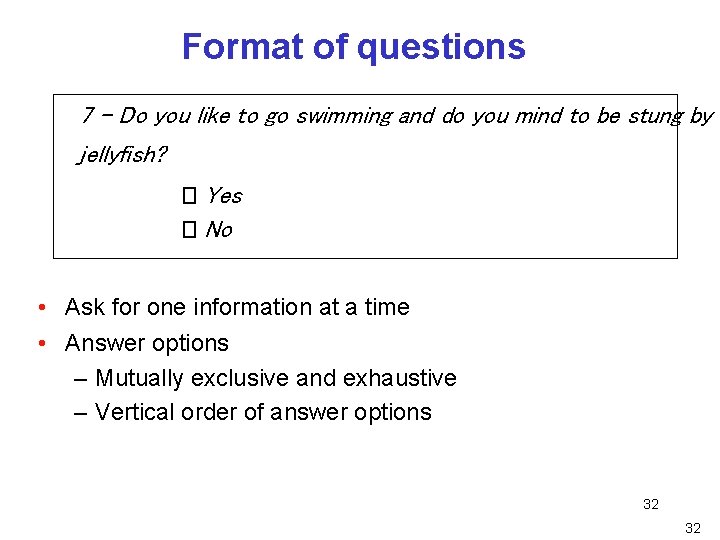
Format of questions 7 - Do you like to go swimming and do you mind to be stung by jellyfish? � Yes � No • Ask for one information at a time • Answer options – Mutually exclusive and exhaustive – Vertical order of answer options 32 32
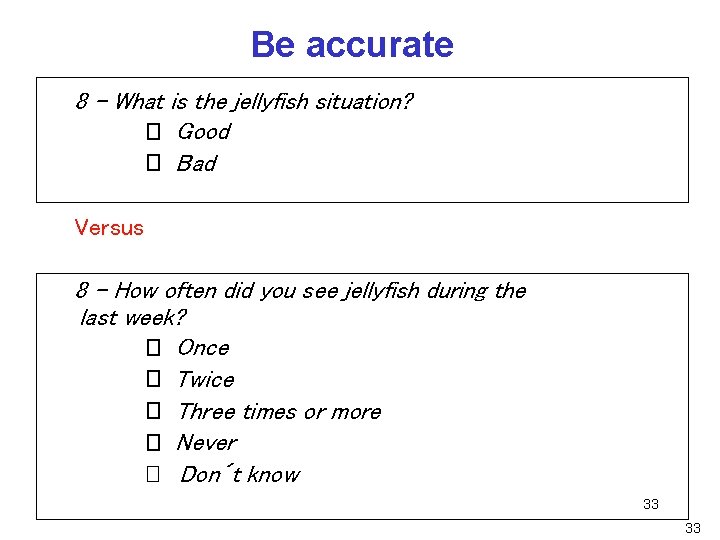
Be accurate 8 – What is the jellyfish situation? � Good � Bad Versus 8 - How often did you see jellyfish during the last week? � Once � Twice � Three times or more � Never � Don´t know 33 33
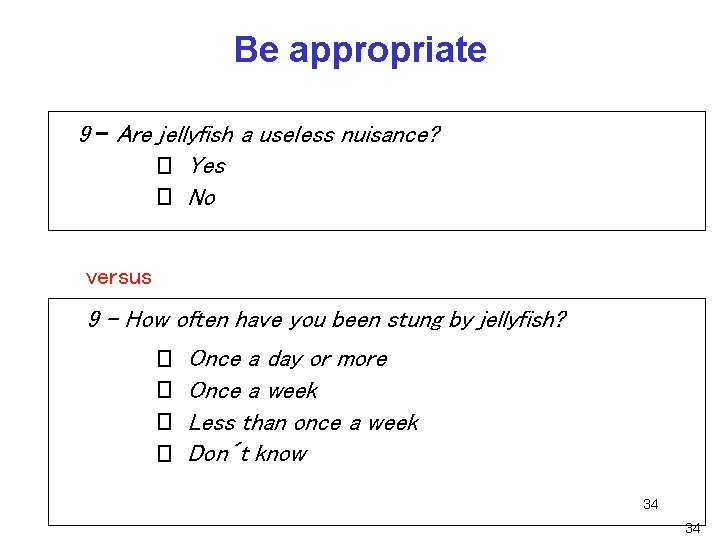
Be appropriate 9 – Are jellyfish a useless nuisance? � Yes � No versus 9 - How often have you been stung by jellyfish? � � Once a day or more Once a week Less than once a week Don´t know 34 34
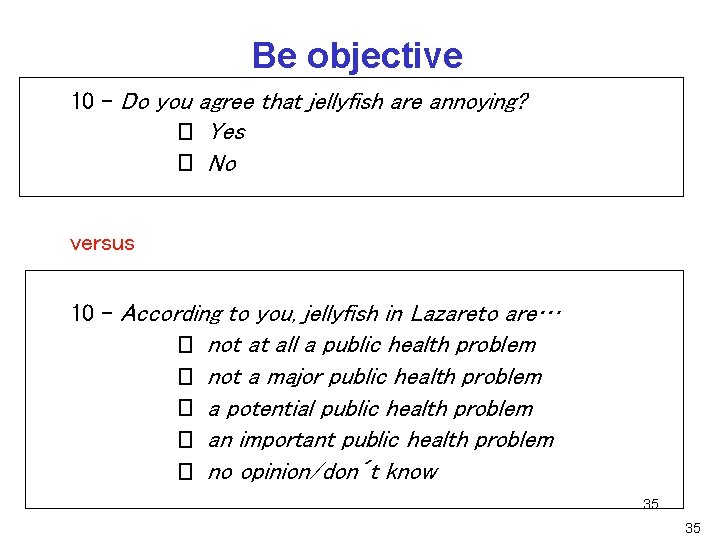
Be objective 10 - Do you agree that jellyfish are annoying? � Yes � No versus 10 - According to you, jellyfish in Lazareto are… � not at all a public health problem � not a major public health problem � a potential public health problem � an important public health problem � no opinion/don´t know 35 35
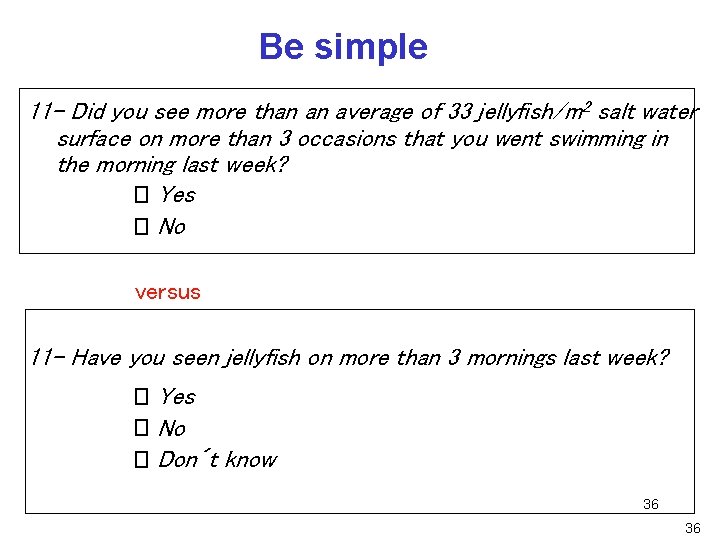
Be simple 11 - Did you see more than an average of 33 jellyfish/m 2 salt water surface on more than 3 occasions that you went swimming in the morning last week? � Yes � No versus 11 - Have you seen jellyfish on more than 3 mornings last week? � Yes � No � Don´t know 36 36
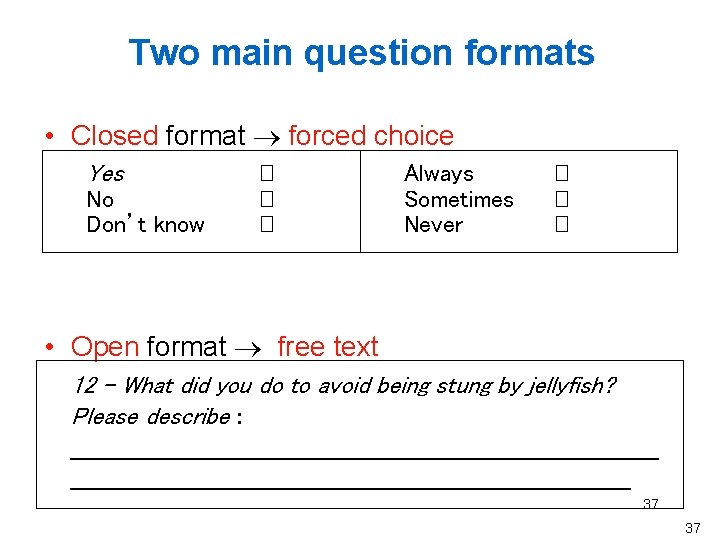
Two main question formats • Closed format forced choice Yes No Don’t know � � � Always Sometimes Never � � � • Open format free text 12 – What did you do to avoid being stung by jellyfish? Please describe : _____________________ 37 37
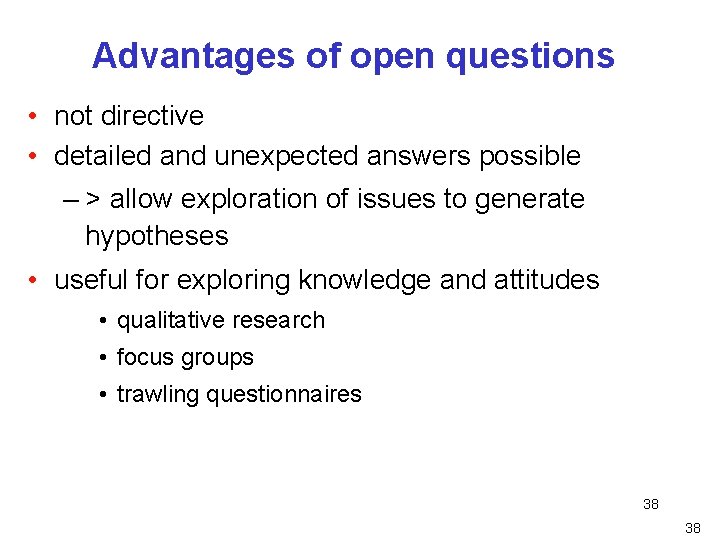
Advantages of open questions • not directive • detailed and unexpected answers possible – > allow exploration of issues to generate hypotheses • useful for exploring knowledge and attitudes • qualitative research • focus groups • trawling questionnaires 38 38
Disadvantages of open questions • interviewer bias • time-consuming • coding problems • difficult to analyse • difficult to compare groups 39 39
Advantages of closed questions • • Straightforward response Simple Quick Less discrimination against less verbally expressive people • Easy to code, record, analyse • Easy to compare • Easy to report 40 40
Disadvantages of closed questions • restricted number of possible answers • Possible loss of additional information Compromise – insert field “others, if yes specify : _____” 41 41
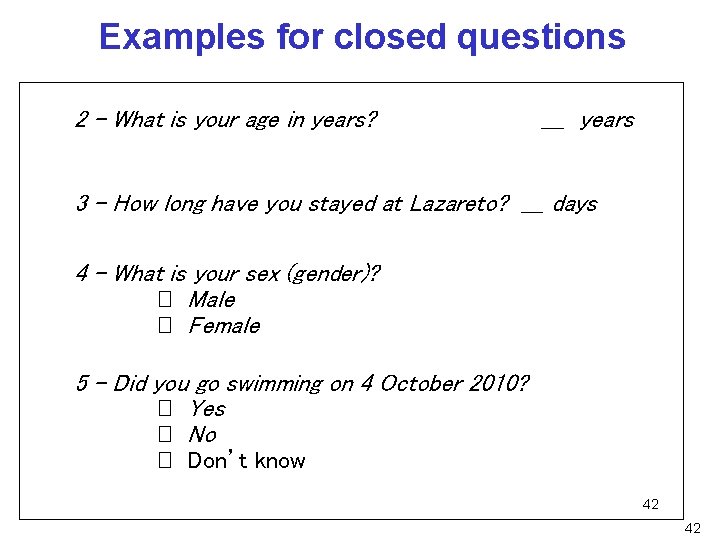
Examples for closed questions 2 - What is your age in years? ___ years 3 - How long have you stayed at Lazareto? ___ days 4 - What is your sex (gender)? � Male � Female 5 - Did you go swimming on 4 October 2010? � Yes � No � Don’t know 42 42
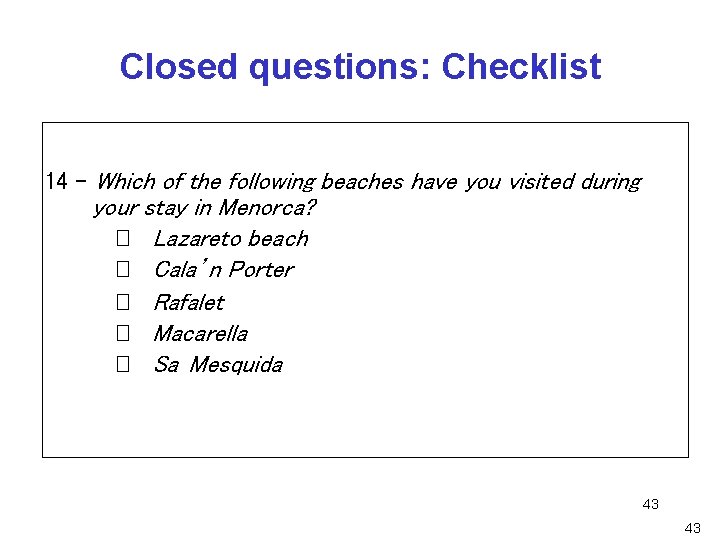
Closed questions: Checklist 14 - Which of the following beaches have you visited during your stay in Menorca? � Lazareto beach � Cala’n Porter � Rafalet � Macarella � Sa Mesquida 43 43
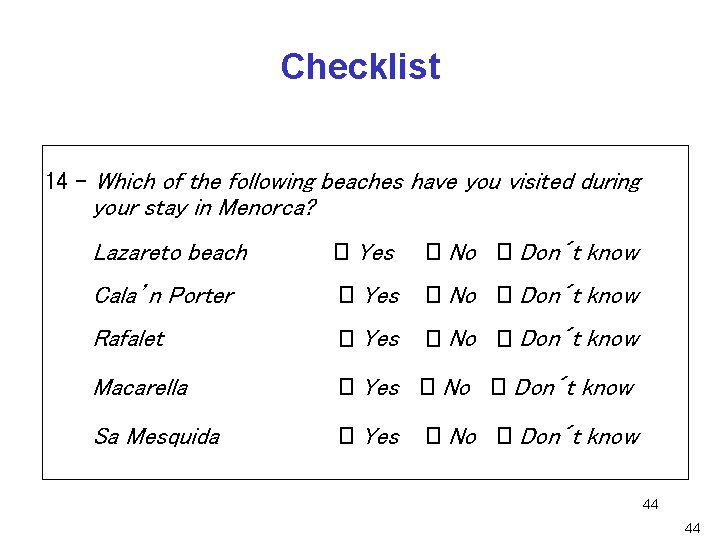
Checklist 14 - Which of the following beaches have you visited during your stay in Menorca? Lazareto beach � Yes � No � Don´t know Cala’n Porter � Yes � No � Don´t know Rafalet � Yes � No � Don´t know Macarella � Yes � No � Don´t know Sa Mesquida � Yes � No � Don´t know 44 44
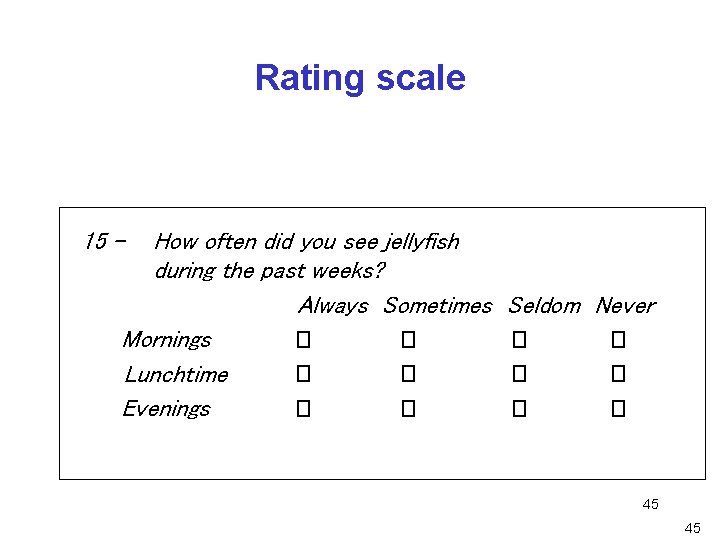
Rating scale 15 – How often did you see jellyfish during the past weeks? Always Sometimes Mornings � � Lunchtime � � Evenings � � Seldom Never � � � 45 45
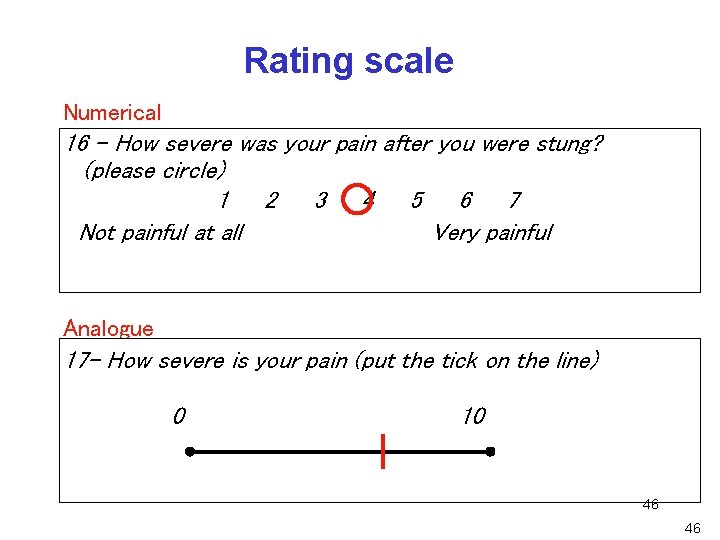
Rating scale Numerical 16 - How severe was your pain after you were stung? (please circle) 1 2 3 4 5 6 7 Not painful at all Very painful Analogue 17 - How severe is your pain (put the tick on the line) 0 10 46 46
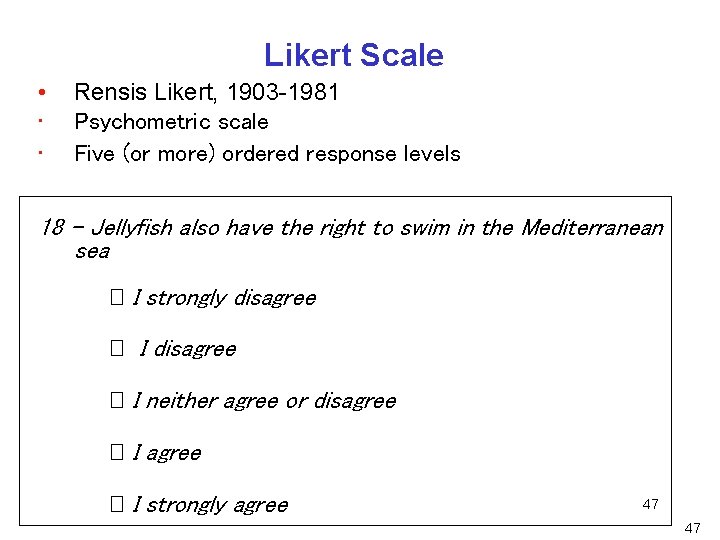
Likert Scale • • • Rensis Likert, 1903 -1981 Psychometric scale Five (or more) ordered response levels 18 – Jellyfish also have the right to swim in the Mediterranean sea � I strongly disagree � I neither agree or disagree � I strongly agree 47 47
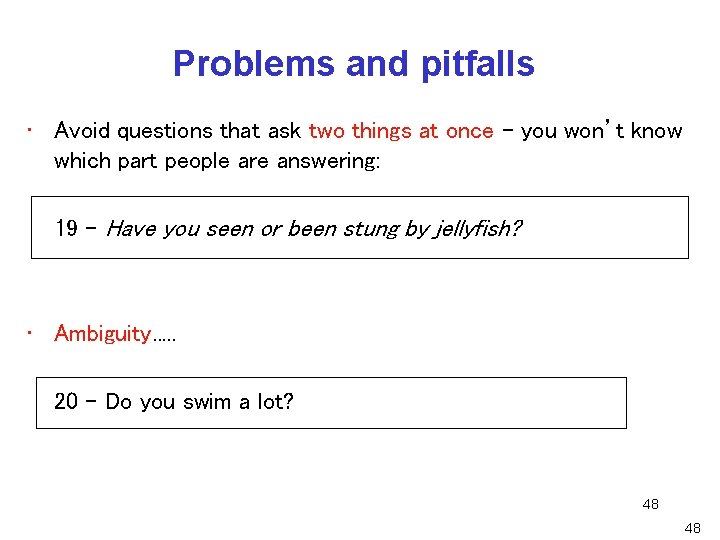
Problems and pitfalls • Avoid questions that ask two things at once - you won’t know which part people are answering: 19 - Have you seen or been stung by jellyfish? • Ambiguity. . . 20 - Do you swim a lot? 48 48
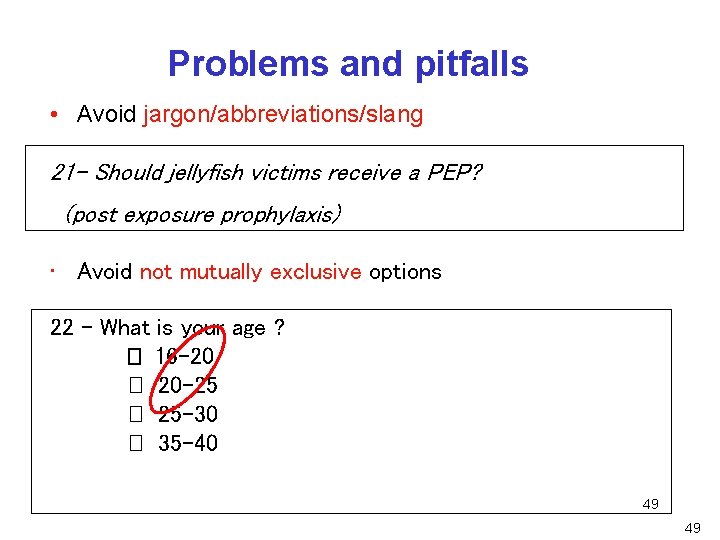
Problems and pitfalls • Avoid jargon/abbreviations/slang 21 - Should jellyfish victims receive a PEP? (post exposure prophylaxis) • Avoid not mutually exclusive options 22 - What is your age ? � 16 -20 � 20 -25 � 25 -30 � 35 -40 49 49
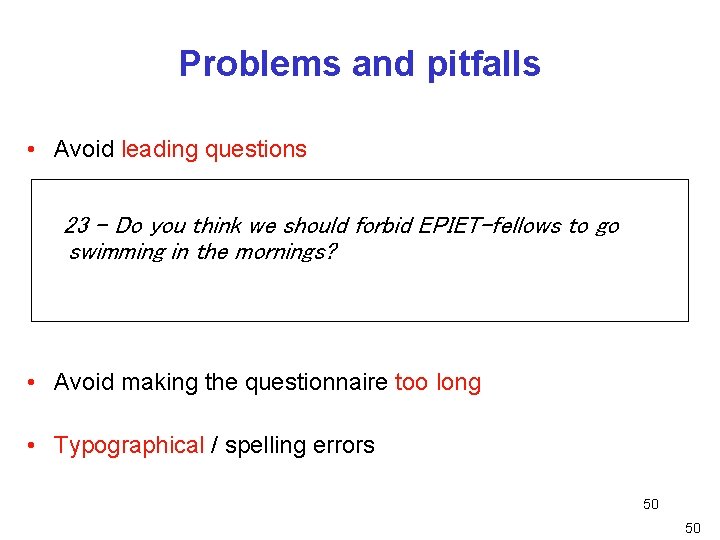
Problems and pitfalls • Avoid leading questions 23 - Do you think we should forbid EPIET-fellows to go swimming in the mornings? • Avoid making the questionnaire too long • Typographical / spelling errors 50 50
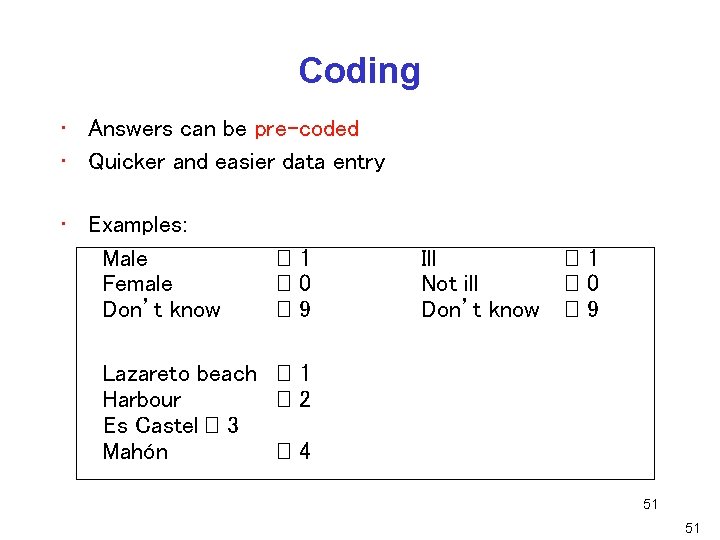
Coding • Answers can be pre-coded • Quicker and easier data entry • Examples: Male Female Don’t know � 1 � 0 � 9 Ill Not ill Don’t know � 1 � 0 � 9 Lazareto beach � 1 Harbour � 2 Es Castel � 3 Mahón � 4 51 51
5 - Conclusion • Don’t forget to thank the interviewed persons • Tell them when the results will be available and where 52 52
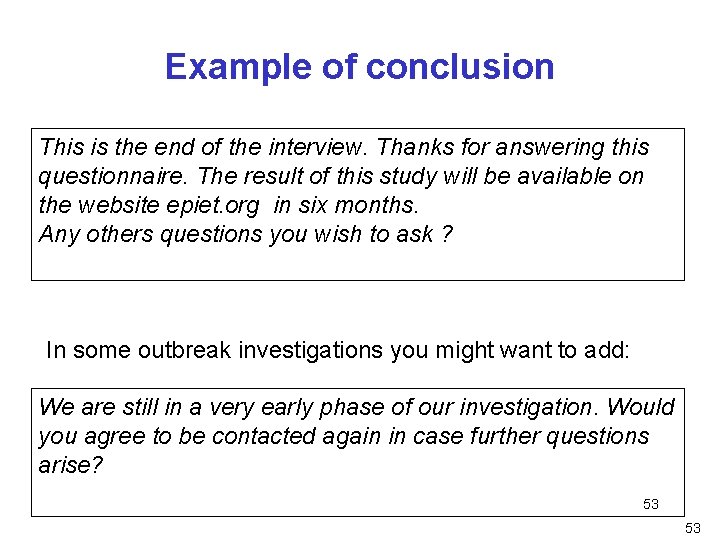
Example of conclusion This is the end of the interview. Thanks for answering this questionnaire. The result of this study will be available on the website epiet. org in six months. Any others questions you wish to ask ? In some outbreak investigations you might want to add: We are still in a very early phase of our investigation. Would you agree to be contacted again in case further questions arise? 53 53
Questionnaire validation • Use or adapt existing questionnaires – validated (and possibly harmonised) • New questionnaires – not validated – need to be tested (pilot) 54 54
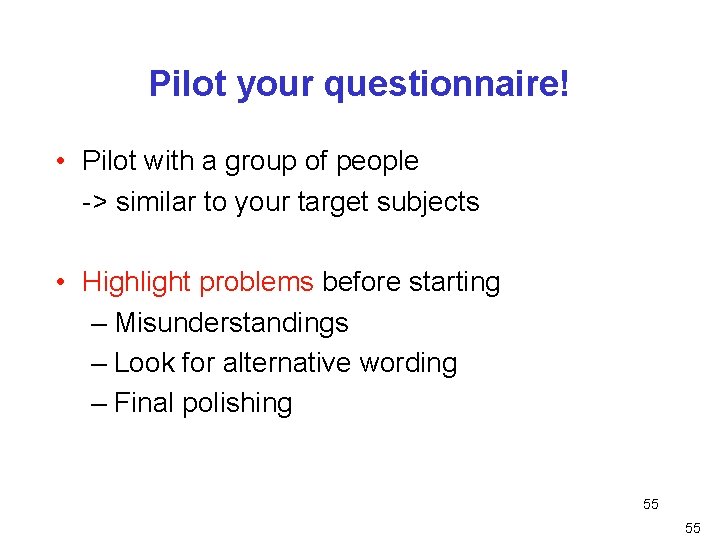
Pilot your questionnaire! • Pilot with a group of people -> similar to your target subjects • Highlight problems before starting – Misunderstandings – Look for alternative wording – Final polishing 55 55
Stages in designing questionnaire Study protocol Questionnaire Definition of objectives Design questions The question must answer your objectives List of variables to collect Analysis plan The question collects appropriate information for analyses Control and reading Pilot test 56 56
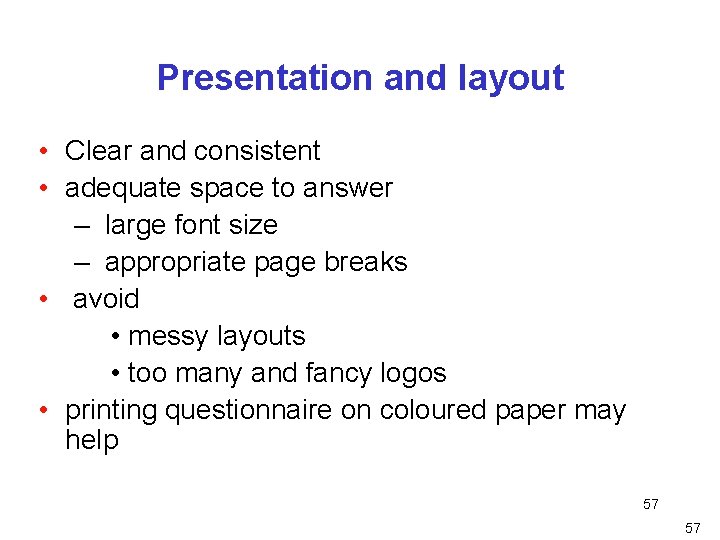
Presentation and layout • Clear and consistent • adequate space to answer – large font size – appropriate page breaks • avoid • messy layouts • too many and fancy logos • printing questionnaire on coloured paper may help 57 57
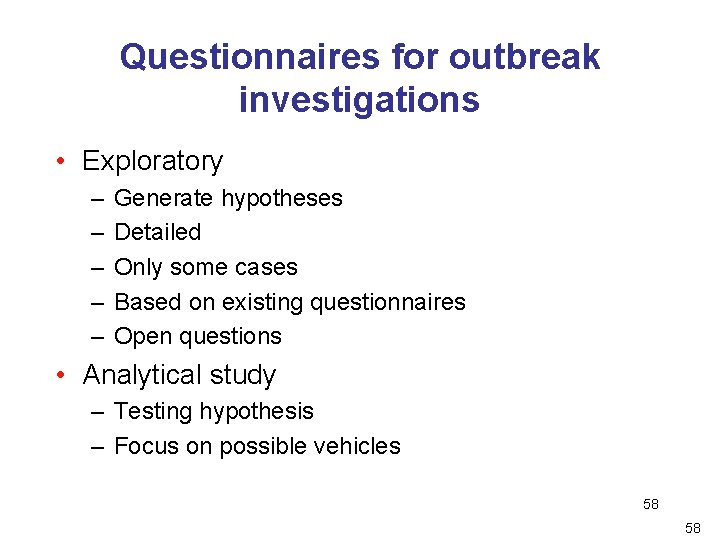
Questionnaires for outbreak investigations • Exploratory – – – Generate hypotheses Detailed Only some cases Based on existing questionnaires Open questions • Analytical study – Testing hypothesis – Focus on possible vehicles 58 58
Summary A well designed questionnaire: • collects appropriate data -> to answer your research question • minimises potential sources of bias -> increases the validity of the replies • Will much more likely be completed 59 59