
2010 Alabama Course of Study Mathematics College and
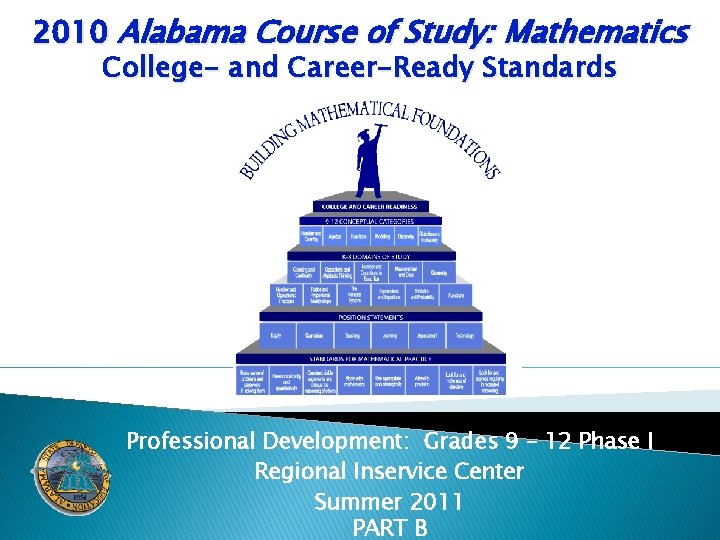
2010 Alabama Course of Study: Mathematics College- and Career-Ready Standards Professional Development: Grades 9 – 12 Phase I Regional Inservice Center Summer 2011 PART B
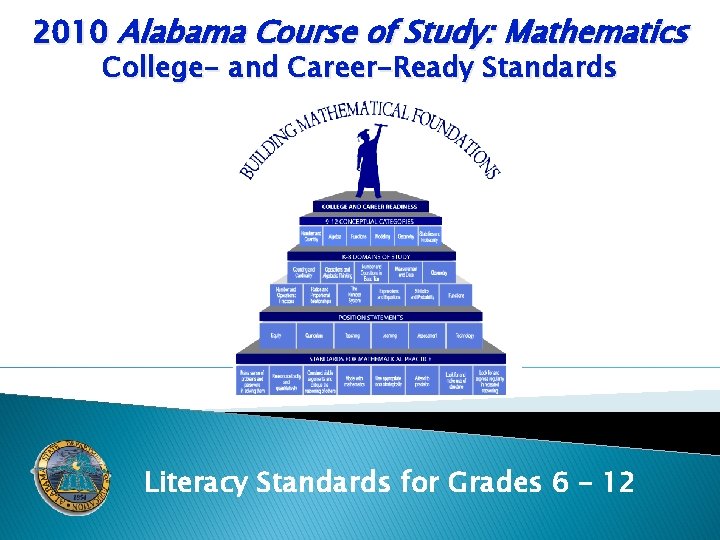
2010 Alabama Course of Study: Mathematics College- and Career-Ready Standards Literacy Standards for Grades 6 – 12
APPENDIX C Literacy Standards for Grades 6 – 12 History/Social Studies, Science and Technical Subjects “These standards are designed to supplement students’ learning of the mathematical standards by helping them meet the challenges of reading, writing, speaking, listening, and language in the field of mathematics. ”
It is essential for educators to: • select and develop resources that ensure students can connect their curriculum with the real world. • help students recognize and apply math concepts in areas outside of the mathematics classroom. • provide students with opportunities to participate in mathematical investigations. • help students develop problem-solving techniques and skills which enable them to interconnect ideas and build on existing content.
Basis of Literacy Standards The Literacy Standards for Reading and Writing are based on the College and Career Readiness (CCR) anchor standards as outlined in the English Language Arts (ELA) common core. Both of which are outlined in Appendix C.
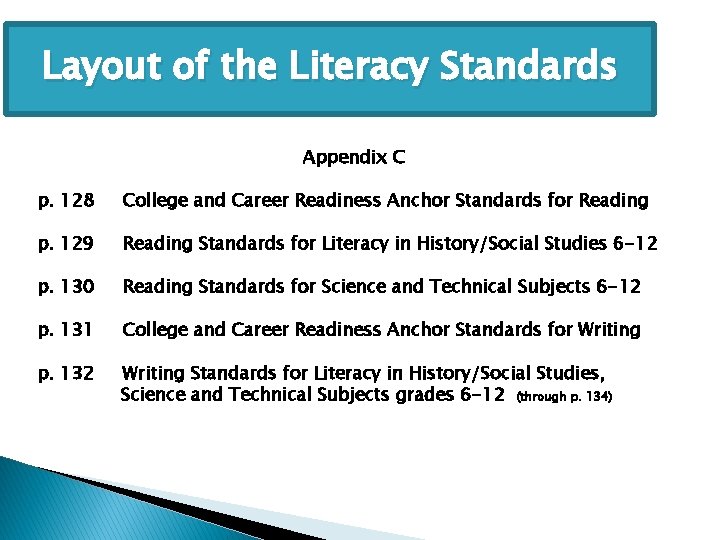
Layout of the Literacy Standards Appendix C p. 128 College and Career Readiness Anchor Standards for Reading p. 129 Reading Standards for Literacy in History/Social Studies 6 -12 p. 130 Reading Standards for Science and Technical Subjects 6 -12 p. 131 College and Career Readiness Anchor Standards for Writing p. 132 Writing Standards for Literacy in History/Social Studies, Science and Technical Subjects grades 6 -12 (through p. 134)
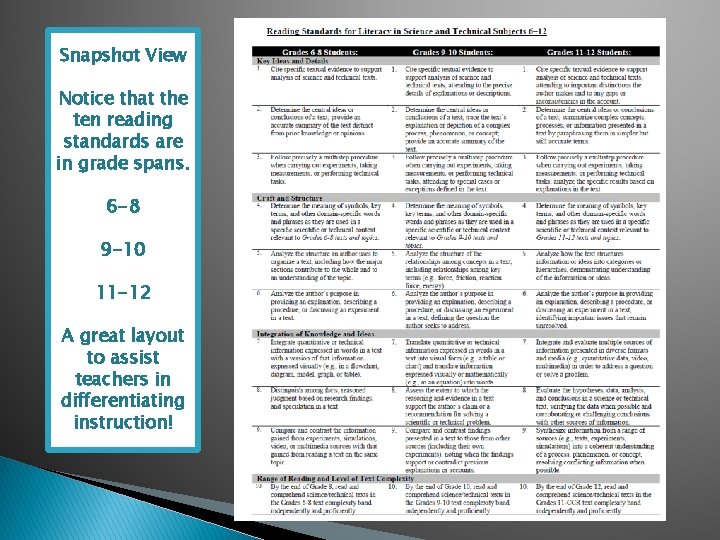
Snapshot View Notice that the ten reading standards are in grade spans. 6 -8 9 -10 11 -12 A great layout to assist teachers in differentiating instruction!
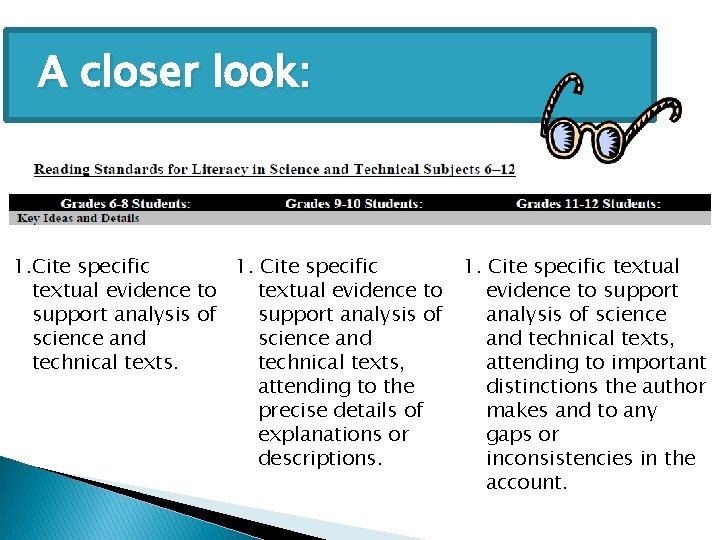
A closer look: 1. Cite specific textual evidence to support analysis of science and technical texts, attending to the precise details of explanations or descriptions. 1. Cite specific textual evidence to support analysis of science and technical texts, attending to important distinctions the author makes and to any gaps or inconsistencies in the account.
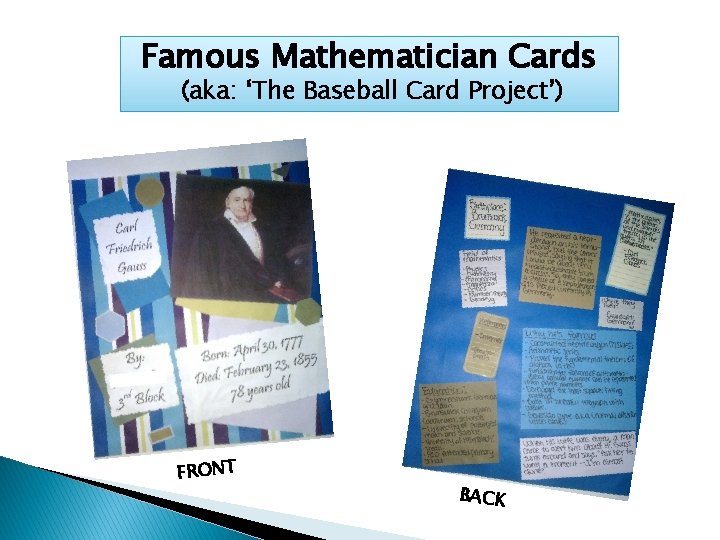
Famous Mathematician Cards (aka: ‘The Baseball Card Project’) FRONT BACK
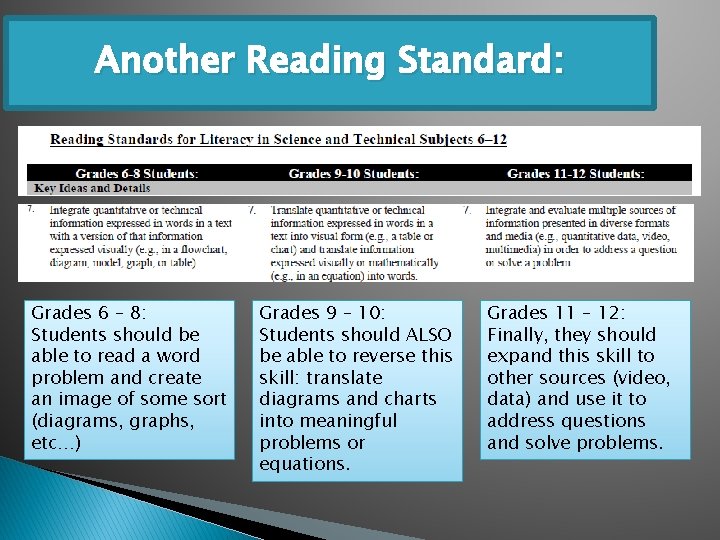
Another Reading Standard: Grades 6 – 8: Students should be able to read a word problem and create an image of some sort (diagrams, graphs, etc…) Grades 9 – 10: Students should ALSO be able to reverse this skill: translate diagrams and charts into meaningful problems or equations. Grades 11 – 12: Finally, they should expand this skill to other sources (video, data) and use it to address questions and solve problems.
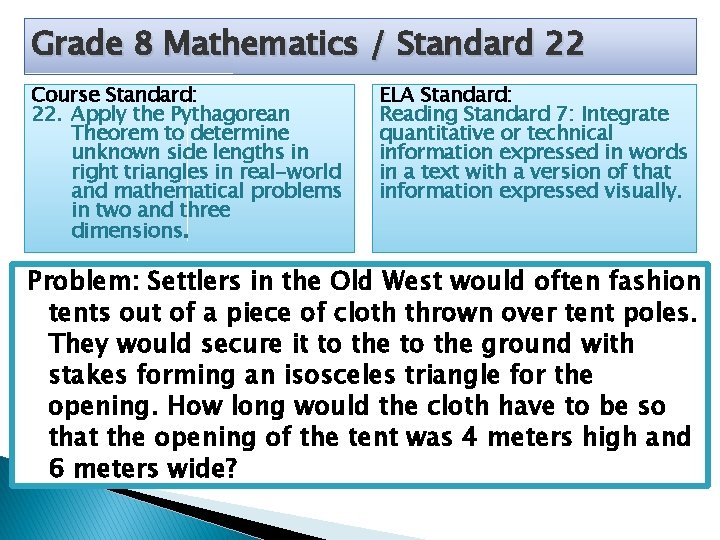
Grade 8 Mathematics / Standard 22 Course Standard: 22. Apply the Pythagorean Theorem to determine unknown side lengths in right triangles in real-world and mathematical problems in two and three dimensions. ELA Standard: Reading Standard 7: Integrate quantitative or technical information expressed in words in a text with a version of that information expressed visually. Problem: Settlers in the Old West would often fashion tents out of a piece of cloth thrown over tent poles. They would secure it to the ground with stakes forming an isosceles triangle for the opening. How long would the cloth have to be so that the opening of the tent was 4 meters high and 6 meters wide?
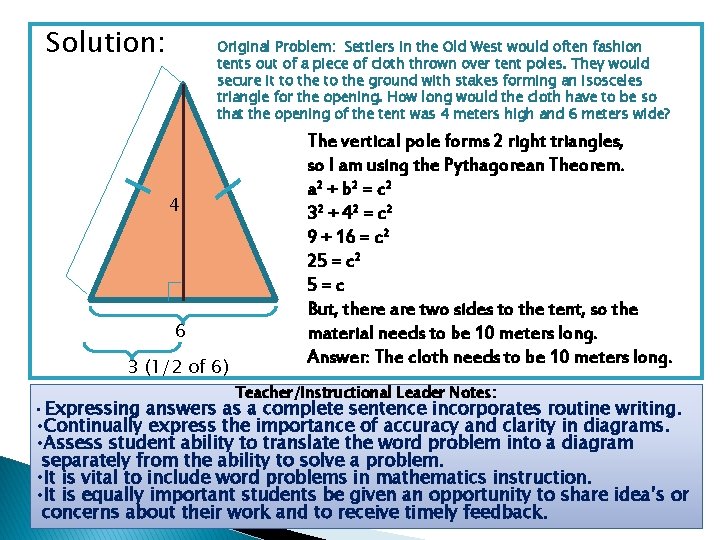
Solution: Original Problem: Settlers in the Old West would often fashion tents out of a piece of cloth thrown over tent poles. They would secure it to the ground with stakes forming an isosceles triangle for the opening. How long would the cloth have to be so that the opening of the tent was 4 meters high and 6 meters wide? 4 6 3 (1/2 of 6) The vertical pole forms 2 right triangles, so I am using the Pythagorean Theorem. a 2 + b 2 = c 2 32 + 4 2 = c 2 9 + 16 = c 2 25 = c 2 5=c But, there are two sides to the tent, so the material needs to be 10 meters long. Answer: The cloth needs to be 10 meters long. Teacher/Instructional Leader Notes: Expressing answers as a complete sentence incorporates routine writing. • Continually express the importance of accuracy and clarity in diagrams. • Assess student ability to translate the word problem into a diagram separately from the ability to solve a problem. • It is vital to include word problems in mathematics instruction. • It is equally important students be given an opportunity to share idea’s or concerns about their work and to receive timely feedback. •
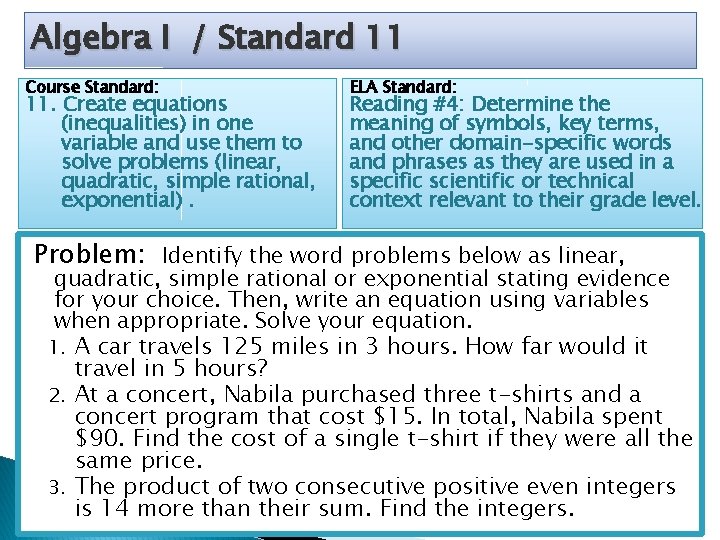
Algebra I / Standard 11 Course Standard: 11. Create equations (inequalities) in one variable and use them to solve problems (linear, quadratic, simple rational, exponential). ELA Standard: Reading #4: Determine the meaning of symbols, key terms, and other domain-specific words and phrases as they are used in a specific scientific or technical context relevant to their grade level. Problem: Identify the word problems below as linear, quadratic, simple rational or exponential stating evidence for your choice. Then, write an equation using variables when appropriate. Solve your equation. 1. A car travels 125 miles in 3 hours. How far would it travel in 5 hours? 2. At a concert, Nabila purchased three t-shirts and a concert program that cost $15. In total, Nabila spent $90. Find the cost of a single t-shirt if they were all the same price. 3. The product of two consecutive positive even integers is 14 more than their sum. Find the integers.
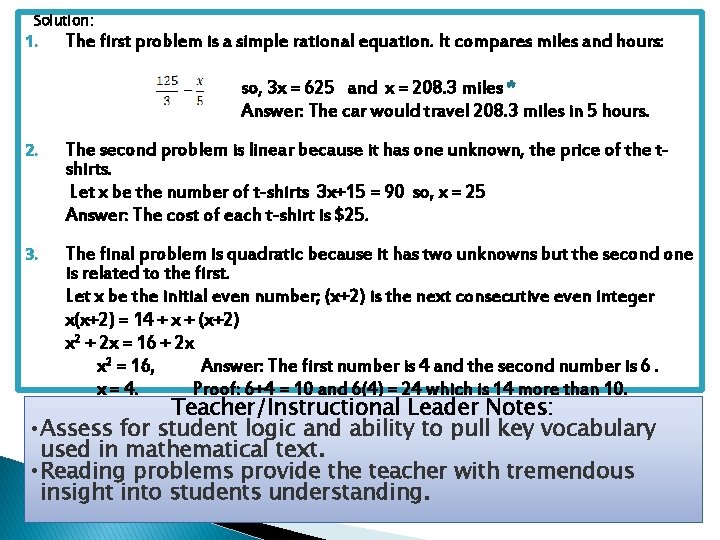
Solution: 1. The first problem is a simple rational equation. It compares miles and hours: so, 3 x = 625 and x = 208. 3 miles * Answer: The car would travel 208. 3 miles in 5 hours. 2. The second problem is linear because it has one unknown, the price of the tshirts. Let x be the number of t-shirts 3 x+15 = 90 so, x = 25 Answer: The cost of each t-shirt is $25. 3. The final problem is quadratic because it has two unknowns but the second one is related to the first. Let x be the initial even number; (x+2) is the next consecutive even integer x(x+2) = 14 + x + (x+2) x 2 + 2 x = 16 + 2 x x 2 = 16, Answer: The first number is 4 and the second number is 6. x = 4. Proof: 6+4 = 10 and 6(4) = 24 which is 14 more than 10. Teacher/Instructional Leader Notes: • Assess for student logic and ability to pull key vocabulary used in mathematical text. • Reading problems provide the teacher with tremendous insight into students understanding.
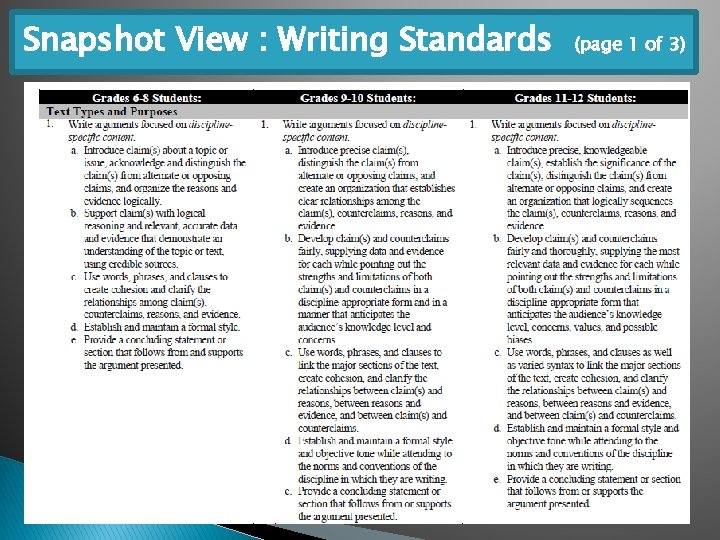
Snapshot View : Writing Standards (page 1 of 3)
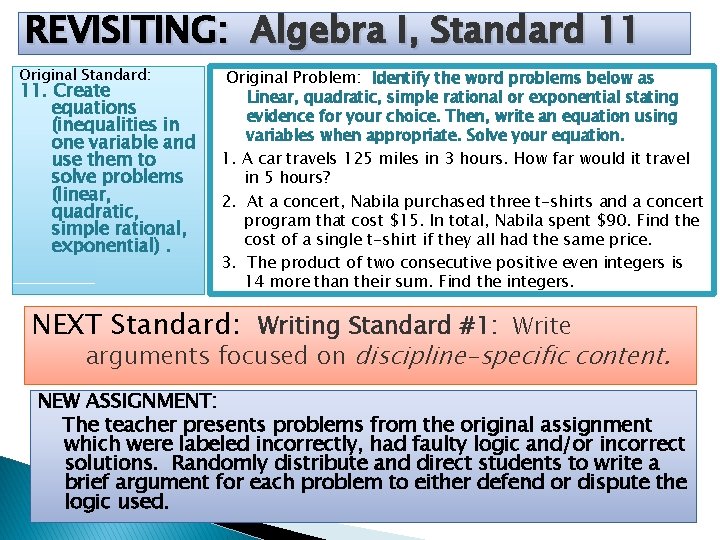
REVISITING: Algebra I, Standard 11 Original Standard: 11. Create equations (inequalities in one variable and use them to solve problems (linear, quadratic, simple rational, exponential). Original Problem: Identify the word problems below as Linear, quadratic, simple rational or exponential stating evidence for your choice. Then, write an equation using variables when appropriate. Solve your equation. 1. A car travels 125 miles in 3 hours. How far would it travel in 5 hours? 2. At a concert, Nabila purchased three t-shirts and a concert program that cost $15. In total, Nabila spent $90. Find the cost of a single t-shirt if they all had the same price. 3. The product of two consecutive positive even integers is 14 more than their sum. Find the integers. NEXT Standard: Writing Standard #1: Write arguments focused on discipline-specific content. NEW ASSIGNMENT: The teacher presents problems from the original assignment which were labeled incorrectly, had faulty logic and/or incorrect solutions. Randomly distribute and direct students to write a brief argument for each problem to either defend or dispute the logic used.
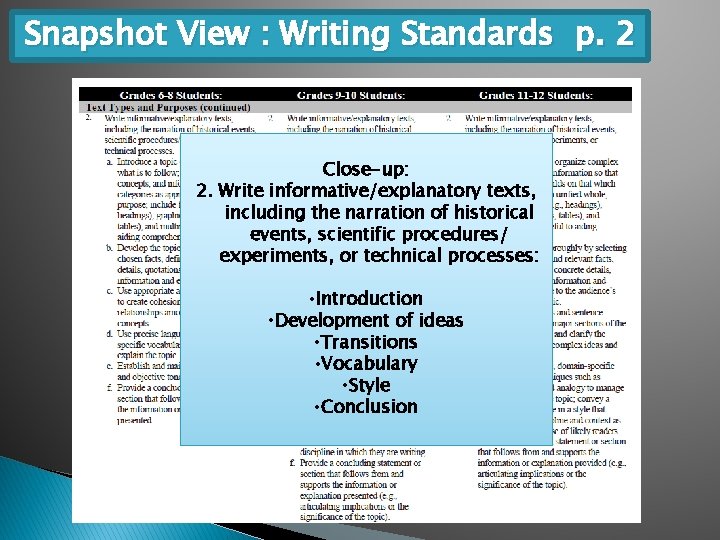
Snapshot View : Writing Standards p. 2 Close-up: 2. Write informative/explanatory texts, including the narration of historical events, scientific procedures/ experiments, or technical processes: • Introduction • Development of ideas • Transitions • Vocabulary • Style • Conclusion
Writing Standard #3 In science and technical subjects, students must be able to write precise enough descriptions of the step-by-step procedures they use in their investigations or technical work so others can replicate them and (possibly) reach the same results.
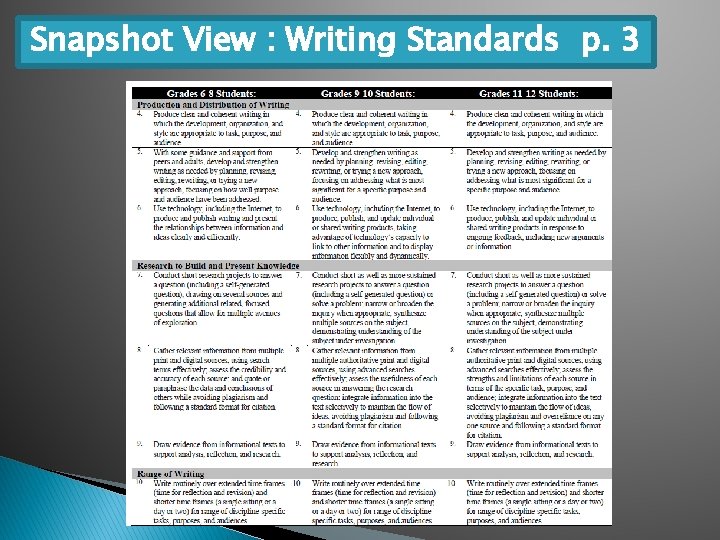
Snapshot View : Writing Standards p. 3
A closer look: *The same for all three levels 10. Write routinely over extended time frames (time for reflection and revision) and shorter time frames (a single sitting or a day or two) for range of disciplinespecific tasks, purposes, and audiences.
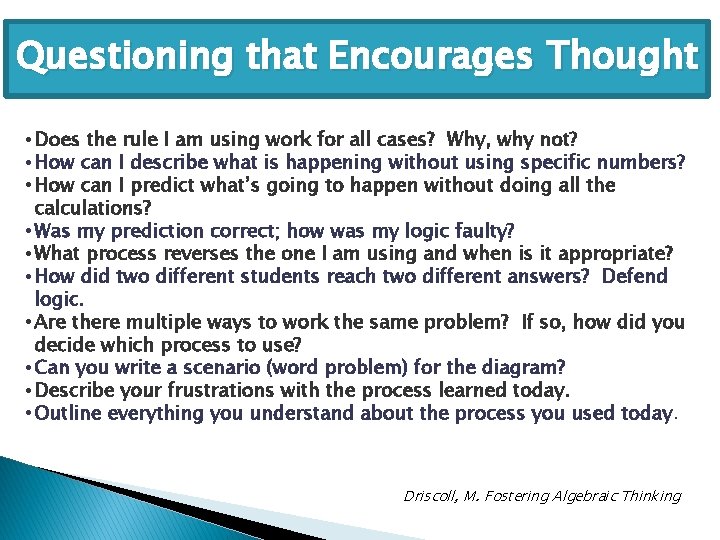
Questioning that Encourages Thought • Does the rule I am using work for all cases? Why, why not? • How can I describe what is happening without using specific numbers? • How can I predict what’s going to happen without doing all the calculations? • Was my prediction correct; how was my logic faulty? • What process reverses the one I am using and when is it appropriate? • How did two different students reach two different answers? Defend logic. • Are there multiple ways to work the same problem? If so, how did you decide which process to use? • Can you write a scenario (word problem) for the diagram? • Describe your frustrations with the process learned today. • Outline everything you understand about the process you used today. Driscoll, M. Fostering Algebraic Thinking
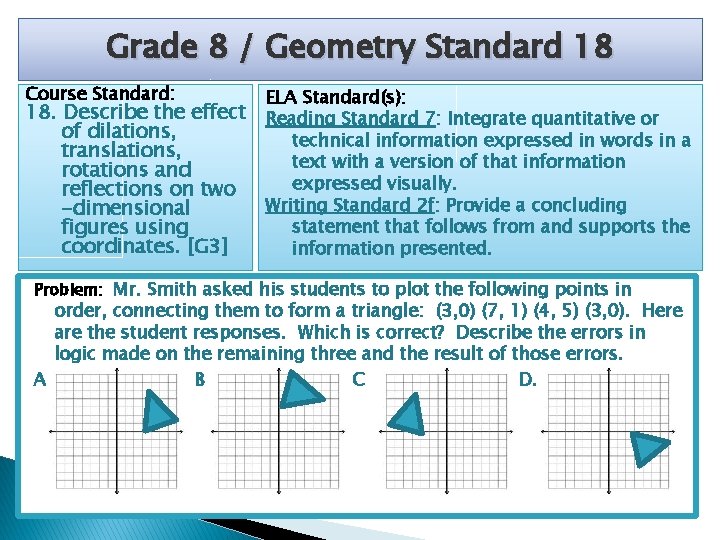
Grade 8 / Geometry Standard 18 Course Standard: 18. Describe the effect of dilations, translations, rotations and reflections on two -dimensional figures using coordinates. [G 3] ELA Standard(s): Reading Standard 7: Integrate quantitative or technical information expressed in words in a text with a version of that information expressed visually. Writing Standard 2 f: Provide a concluding statement that follows from and supports the information presented. Problem: Mr. Smith asked his students to plot the following points in order, connecting them to form a triangle: (3, 0) (7, 1) (4, 5) (3, 0). Here are the student responses. Which is correct? Describe the errors in logic made on the remaining three and the result of those errors. A B C D.

Possible Solution: A B C D a) Triangle A is plotted correctly b) In triangle B, the student switched the (x, y) coordinates. Instead of plotting (3, 0) they plotted (0, 3). The student might be confused about which axis is the x and which axis is the y. c) In Triangle C, the student went in the negative direction for the x coordinate but plotted the y correctly, this caused a reflection around the y-axis. d) In triangle D the student plotted the x coordinate correctly but went in the negative direction for the y, this caused a rotation and a shift in the graph.

Teacher/Teacher Leader Notes • Is the student’s mathematical logic correct? • Can they describe errors found in others’ mathematical thinking? • Activities like this may be used as a bell ringer (sparking discussion prior to a lesson) or as an exit slip to assess understanding. • It is important that the responses are assessed by the teacher through grading or discussion.
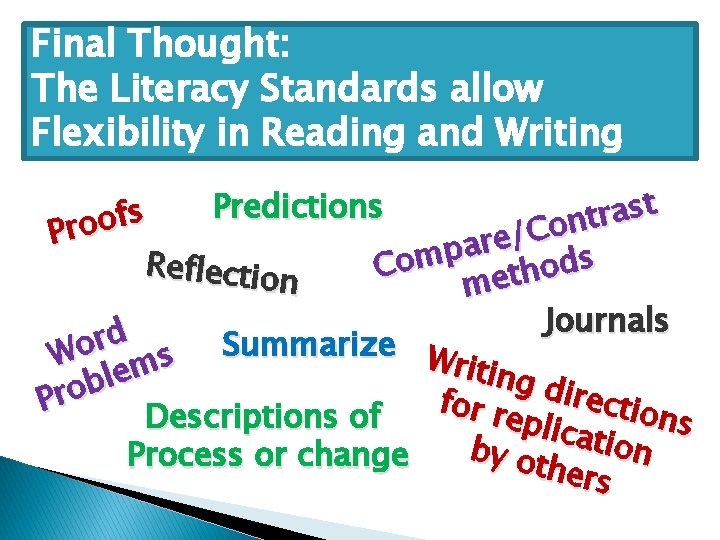
Final Thought: The Literacy Standards allow Flexibility in Reading and Writing t Predictions s a s r f t n o C Proo / e r a p m s o Reflectio d C o h n met Journals rd Summarize W o W s riting m e l b o r for r directio P Descriptions of ns eplic ation b y oth Process or change ers
? ? Questions ? ?
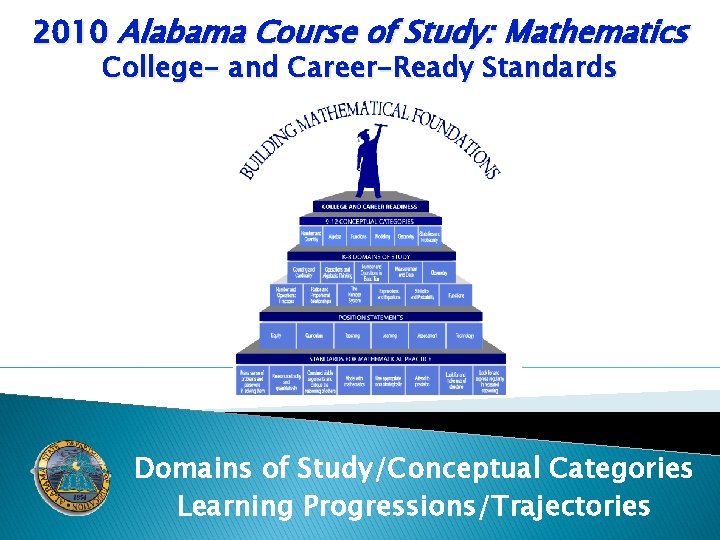
2010 Alabama Course of Study: Mathematics College- and Career-Ready Standards Domains of Study/Conceptual Categories Learning Progressions/Trajectories
CHARACTERISTICS � Aligned with college and work expectations � Written in a clear, understandable, and consistent format � Designed to include rigorous content and application of knowledge through high-order skills � Formulated upon strengths and lessons of current state standards � Informed by high-performing mathematics curricula in other countries to ensure all students are prepared to succeed in our global economy and society � Grounded on sound evidence-based research
2010 Alabama Course of Study: Mathematics �Coherent �Rigorous �Well-Articulated �Enables Students to Make Connections
Coherence �Articulated progressions of topics and performances that are developmental and connected to other progressions. �Conceptual understanding and procedural skills stressed equally. �Real-world/Situational expected. application
FOCUS �Key ideas, understandings, and skills are identified. �Deep learning stressed.
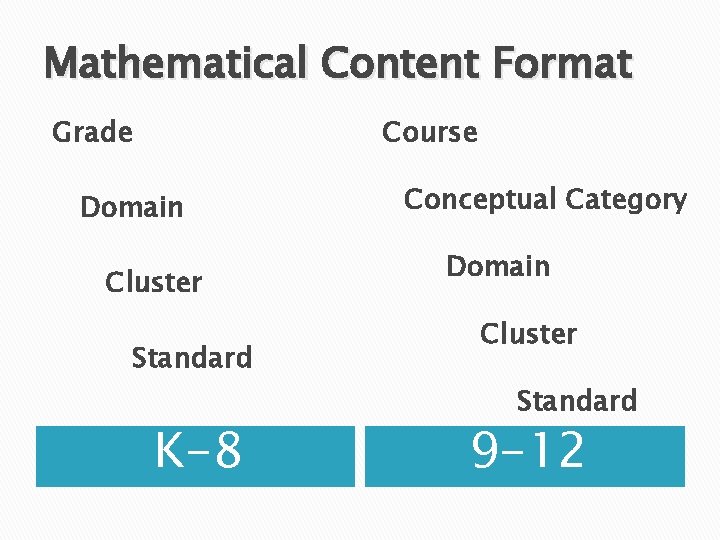
Mathematical Content Format Grade Course Domain Cluster Standard K-8 Conceptual Category Domain Cluster Standard 9 -12
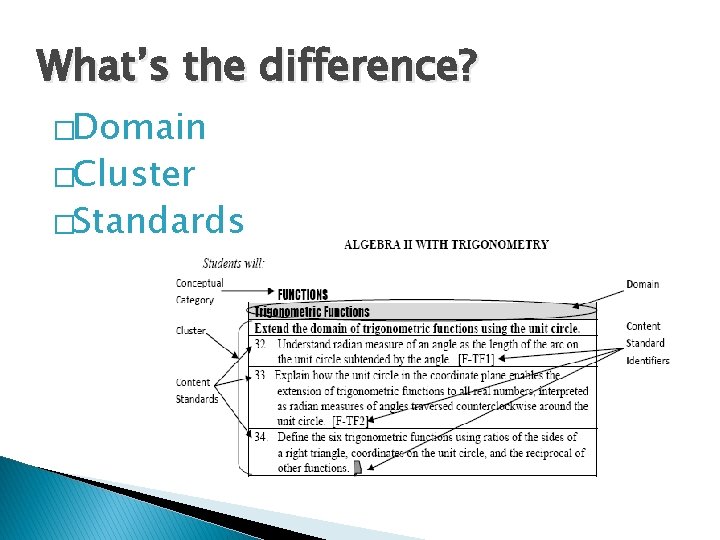
What’s the difference? �Domain �Cluster �Standards
What’s the difference? Domain: Overarching “big ideas” that connect content across the grade levels. Cluster: Group of related standards below a domain. Standards: Define what a student should know (understand) and do at the conclusion of a course or grade.
High School Conceptual Categories � Overarching big ideas that connect mathematics across high school � Illustrate progression of increasing complexity � May appear in all courses � Organize high school standards
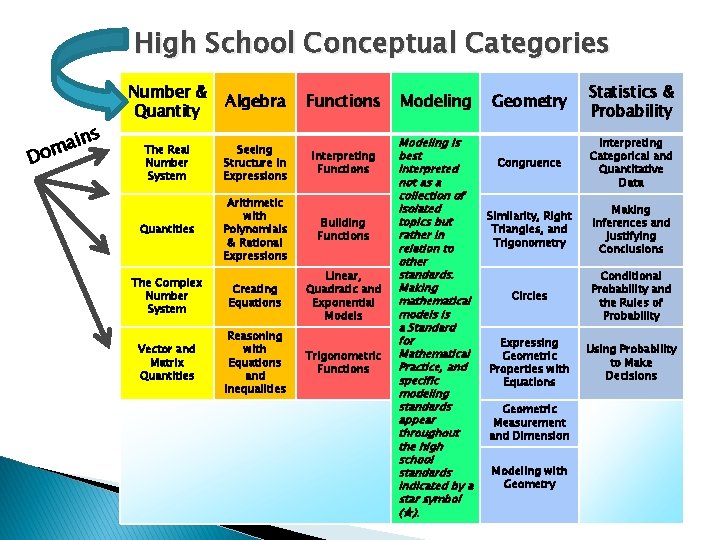
High School Conceptual Categories ins a m o D Number & Quantity Algebra Functions The Real Number System Seeing Structure in Expressions Interpreting Functions Quantities Arithmetic with Polynomials & Rational Expressions Building Functions The Complex Number System Creating Equations Linear, Quadratic and Exponential Models Vector and Matrix Quantities Reasoning with Equations and Inequalities Trigonometric Functions Modeling is best interpreted not as a collection of isolated topics but rather in relation to other standards. Making mathematical models is a Standard for Mathematical Practice, and specific modeling standards appear throughout the high school standards indicated by a star symbol (★). Geometry Statistics & Probability Congruence Interpreting Categorical and Quantitative Data Similarity, Right Triangles, and Trigonometry Making Inferences and Justifying Conclusions Circles Conditional Probability and the Rules of Probability Expressing Geometric Properties with Equations Using Probability to Make Decisions Geometric Measurement and Dimension Modeling with Geometry
High School Clusters �Multiple Courses �Illustrate Progression of Increasing Complexity from Grade to Grade
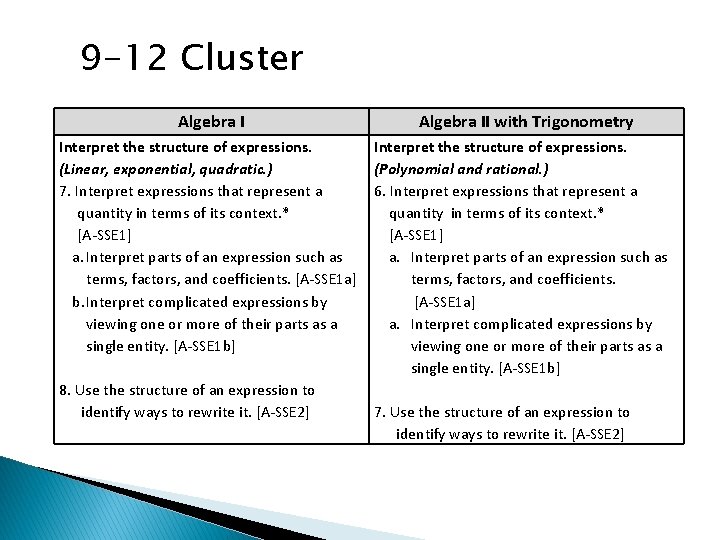
9 -12 Cluster Algebra I Interpret the structure of expressions. (Linear, exponential, quadratic. ) 7. Interpret expressions that represent a quantity in terms of its context. * [A-SSE 1] a. Interpret parts of an expression such as terms, factors, and coefficients. [A-SSE 1 a] b. Interpret complicated expressions by viewing one or more of their parts as a single entity. [A-SSE 1 b] 8. Use the structure of an expression to identify ways to rewrite it. [A-SSE 2] Algebra II with Trigonometry Interpret the structure of expressions. (Polynomial and rational. ) 6. Interpret expressions that represent a quantity in terms of its context. * [A-SSE 1] a. Interpret parts of an expression such as terms, factors, and coefficients. [A-SSE 1 a] a. Interpret complicated expressions by viewing one or more of their parts as a single entity. [A-SSE 1 b] 7. Use the structure of an expression to identify ways to rewrite it. [A-SSE 2]
Content Standards � Content standards in this document contain minimum required content. � Each content standard completes the phrase “Students will. ” � Reflect both mathematical understandings and skills, which are equally important.
High School Standards � Conceptual Categories • Cross course boundaries • Span high school years � Standards – “Core” for common mathematics curriculum for all students to be college and career ready – “College and Career Ready” for entry-level, creditbearing academic college courses and work-force training programs. – “STEM” (+) Additional mathematics that students should learn in order to take courses such as calculus, discrete mathematics, or advanced statistics.
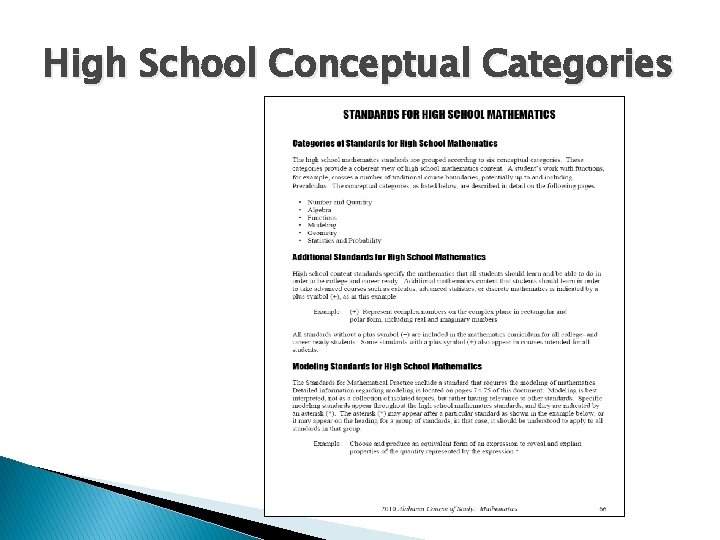
High School Conceptual Categories
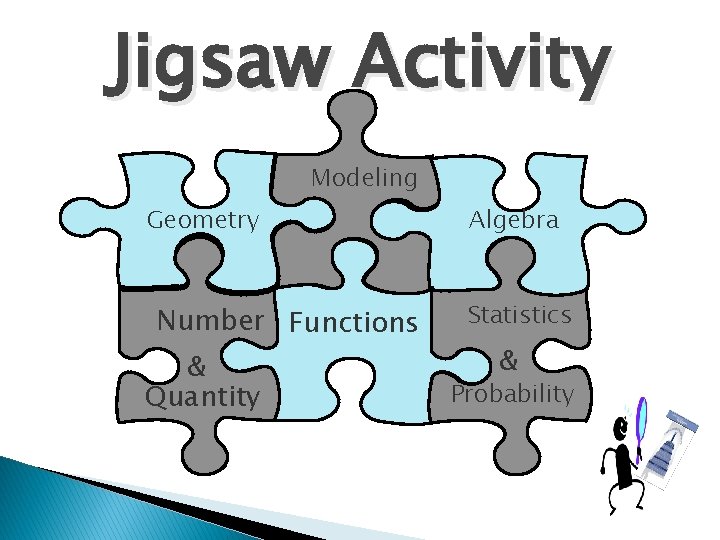
Jigsaw Activity Modeling Geometry Number Functions & Quantity Algebra Statistics & Probability

How many skills? 3. Explain why the sum or product of two rational numbers is rational; that the sum of a rational number and an irrational number is irrational; and that the product of a nonzero rational number and an irrational number is irrational. [N-RN 3] AI. 3. 1. Explain why the sum of two rational numbers is rational. AI. 3. 2. Explain why the product of two rational numbers is rational. AI. 3. 3. Explain that the sum of a rational number and an irrational number is irrational. AI. 3. 4. Explain that the product of a nonzero rational number and an irrational number is irrational.
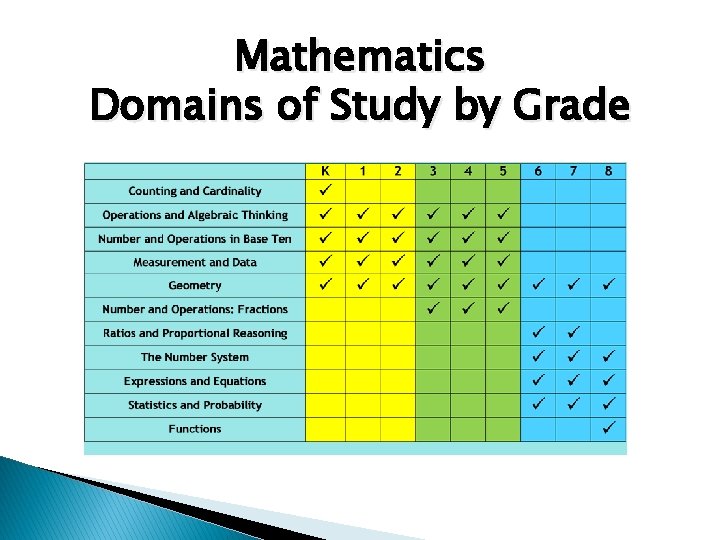
Mathematics Domains of Study by Grade
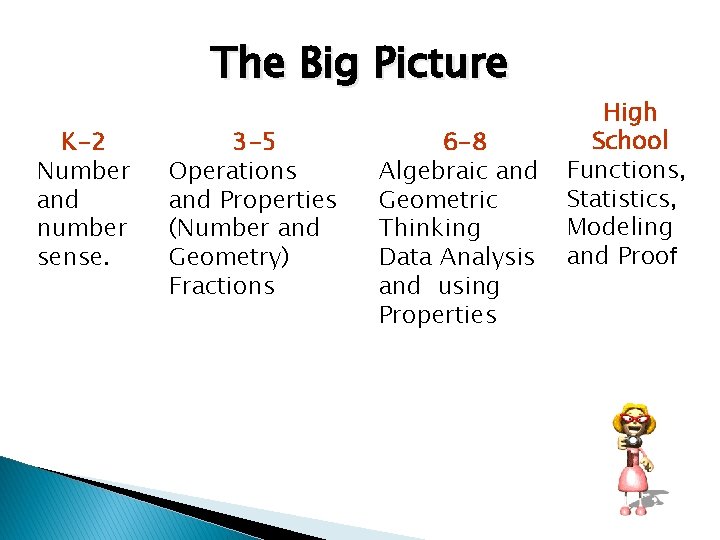
The Big Picture K-2 Number and number sense. 3 -5 Operations and Properties (Number and Geometry) Fractions 6 -8 Algebraic and Geometric Thinking Data Analysis and using Properties High School Functions, Statistics, Modeling and Proof
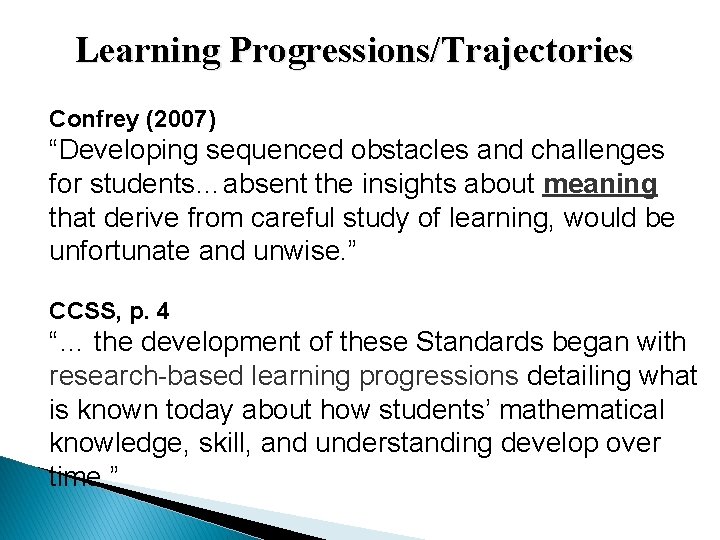
Learning Progressions/Trajectories Confrey (2007) “Developing sequenced obstacles and challenges for students…absent the insights about meaning that derive from careful study of learning, would be unfortunate and unwise. ” CCSS, p. 4 “… the development of these Standards began with research-based learning progressions detailing what is known today about how students’ mathematical knowledge, skill, and understanding develop over time. ”
What Are Learning Trajectories? And What Are They Good For? —Save the Last Word for Me!!! Read the excerpt from Learning Trajectories in Mathematics: A Foundation for Standards, Curriculum, Assessment, and Instruction � Identify 3 ideas that you are willing to talk about with colleagues. � Highlight the location in the text where these ideas appear.
Directions for Save the Last Word for Me � Designate a facilitator and timekeeper. � A volunteer begins by reading the sentence(s) from the text that embody one of his/her selected ideas. The speaker does not comment on the text at this point. � The individual to right of first speaker takes up to one minute to comment on the selected text. � The next two individuals also take up to one minute to comment on the initial speaker’s idea. � The individual selecting the idea has up to 1 minutes to react to colleagues’ ideas and to talk about why she or he thought this was important. � Another group member introduces one idea, and the group follows the same protocol. Continue until all members have shared or until time is called.
Learning Trajectories – sometimes called learning progressions – are sequences of learning experiences hypothesized and designed to build a deep and increasingly sophisticated understanding of core concepts and practices within various disciplines. The trajectories are based on empirical evidence of how students’ understanding actually develops in response to instruction and where it might break down. Daro, Mosher, & Corcoran, 2011
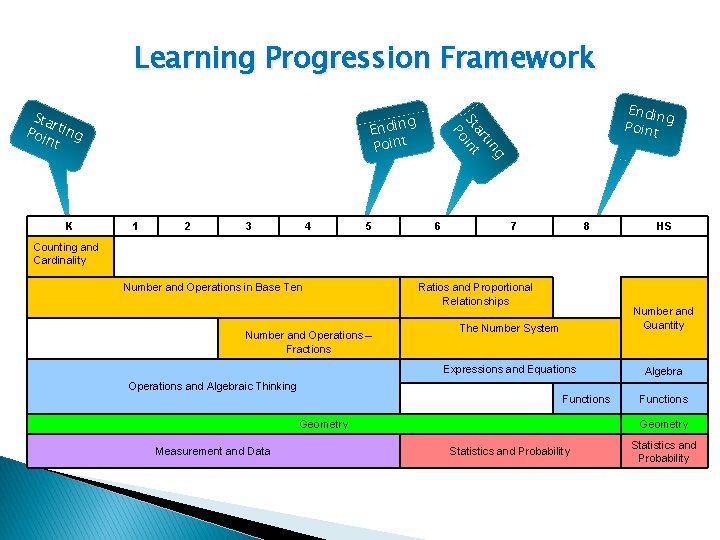
Learning Progression Framework Sta r Poi ting nt 1 2 3 4 5 Endin g Point g tin ar St int Po K g Endin Point 6 7 8 HS Counting and Cardinality Number and Operations in Base Ten Number and Operations – Fractions Operations and Algebraic Thinking Ratios and Proportional Relationships The Number System Number and Quantity Expressions and Equations Algebra Functions Geometry Measurement and Data Functions Geometry Statistics and Probability
Investigating the Domains/Conceptual Categories � � Domains provide common learning progressions. Curriculum and teaching methods are not dictated. Standards are not presented in a specific instructional order. Standards should be presented in a manner that is consistent with local collaboration.
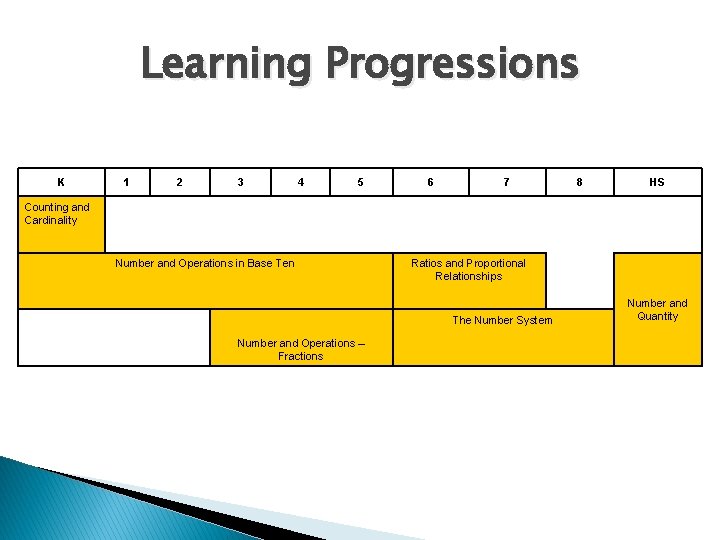
Learning Progressions K 1 2 3 4 5 6 7 8 HS Counting and Cardinality Number and Operations in Base Ten Ratios and Proportional Relationships The Number System Number and Operations – Fractions Number and Quantity
What Goes On The Chart Paper? � Summary and/or representation of how the concept of the use of numbers grows throughout your grade band. � Easy for others to interpret or understand. � Visual large enough for all to see. � More than just the letters and numbers of the standards – include key words or phrases.
Banding Together for a Common Message �Display posters side-by-side and in order on the wall. �Begin at the grade band you studied. Read the posters for your grade band. �Discuss similarities and differences between the posters. �Establish a clear vision for your grade band.
Let’s Talk About It! �As a table group, consider your journey through the 2010 ACOS as you studied the concept of the use of numbers K-12. �What did you learn? �What surprised you? �What questions do you still have?
Value of Learning Progressions/Trajectories to Teachers � Know what to expect about students’ preparation. � More readily manage the range of preparation of students in your class. � Know what teachers in the next grade expect of your students. � Identify clusters of related concepts at grade level. � Clarity about the student thinking and discourse to focus on conceptual development. � Engage in rich uses of classroom assessment.
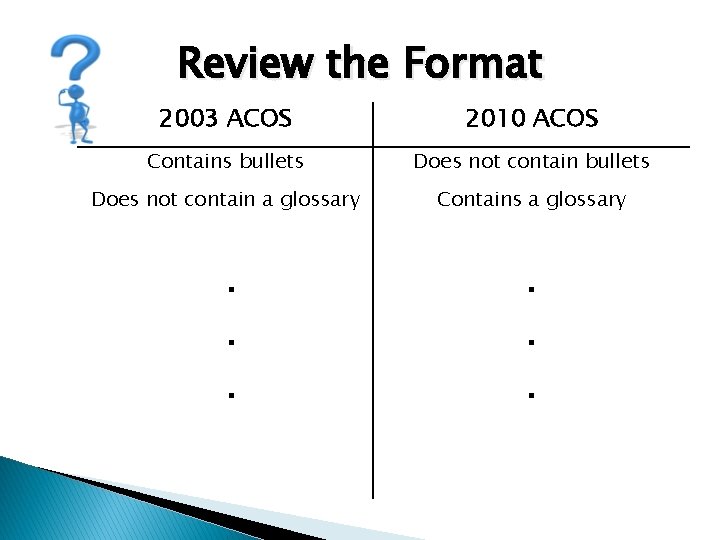
Review the Format 2003 ACOS 2010 ACOS Contains bullets Does not contain a glossary Contains a glossary . . .
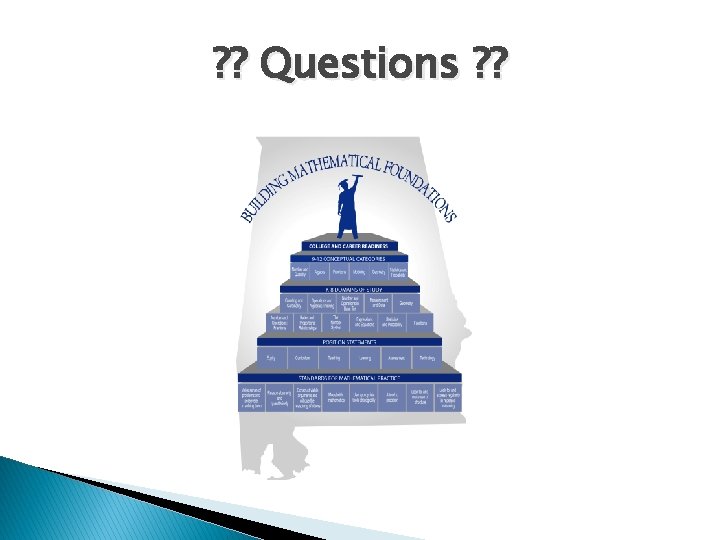
? ? Questions ? ?
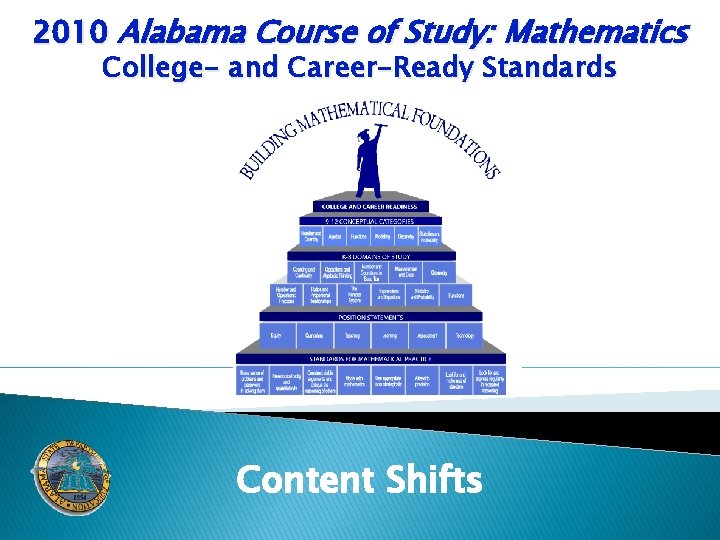
2010 Alabama Course of Study: Mathematics College- and Career-Ready Standards Content Shifts
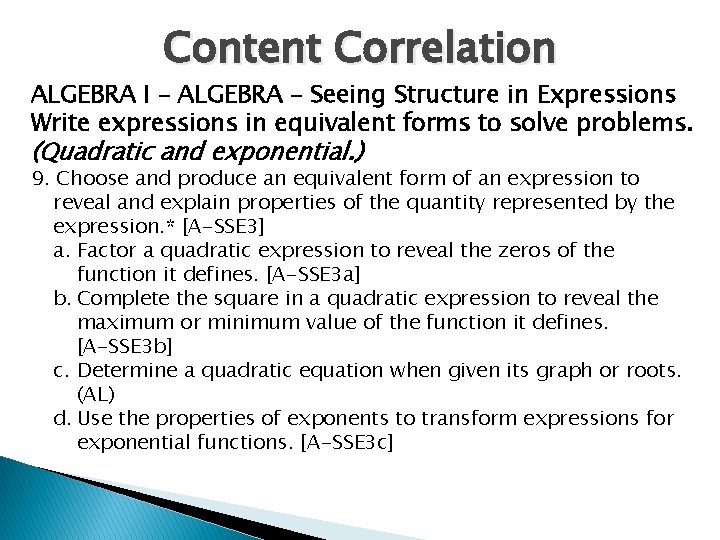
Content Correlation ALGEBRA I – ALGEBRA – Seeing Structure in Expressions Write expressions in equivalent forms to solve problems. (Quadratic and exponential. ) 9. Choose and produce an equivalent form of an expression to reveal and explain properties of the quantity represented by the expression. * [A-SSE 3] a. Factor a quadratic expression to reveal the zeros of the function it defines. [A-SSE 3 a] b. Complete the square in a quadratic expression to reveal the maximum or minimum value of the function it defines. [A-SSE 3 b] c. Determine a quadratic equation when given its graph or roots. (AL) d. Use the properties of exponents to transform expressions for exponential functions. [A-SSE 3 c]

2010 ACOS – ALGEBRA I 9. Choose and produce an equivalent form of an expression to reveal and explain properties of the quantity represented by the expression. * [A-SSE 3] a. Factor a quadratic expression to reveal the zeros of the function it defines. [A-SSE 3 a] d. Use the properties of exponents to transform expressions for exponential functions. [A-SSE 3 c] Correlates with 2003 ACOS – ALGEBRA I 6. Factor binomials, trinomials, and other polynomials using GCF, difference of squares, perfect square trinomials, and grouping. 9. Solve quadratic equations using the zero product property. 1. 1 Applying laws of exponents to simplify expressions, including those containing zero and negative integral exponents.
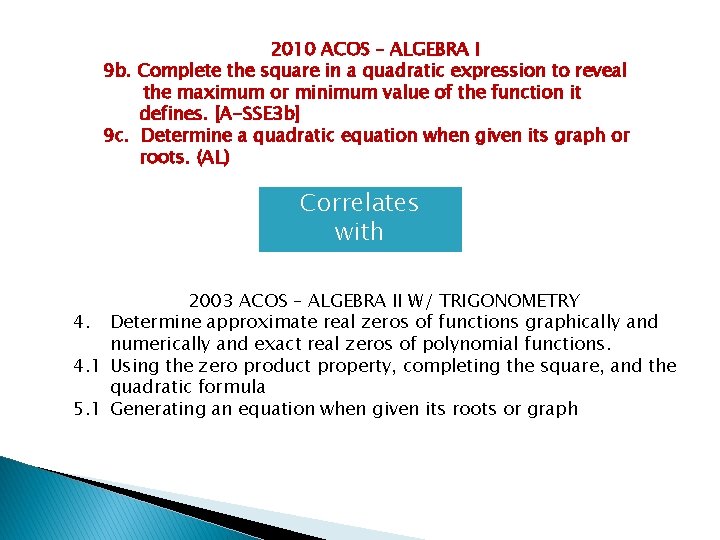
2010 ACOS – ALGEBRA I 9 b. Complete the square in a quadratic expression to reveal the maximum or minimum value of the function it defines. [A-SSE 3 b] 9 c. Determine a quadratic equation when given its graph or roots. (AL) Correlates with 2003 ACOS – ALGEBRA II W/ TRIGONOMETRY 4. Determine approximate real zeros of functions graphically and numerically and exact real zeros of polynomial functions. 4. 1 Using the zero product property, completing the square, and the quadratic formula 5. 1 Generating an equation when given its roots or graph
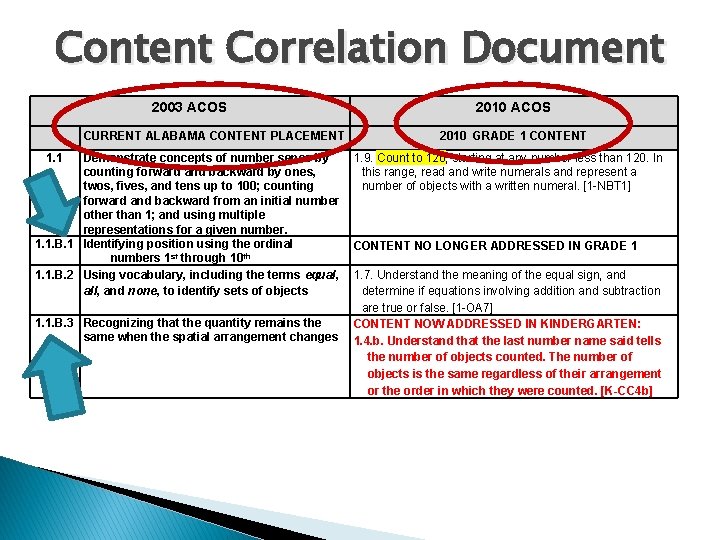
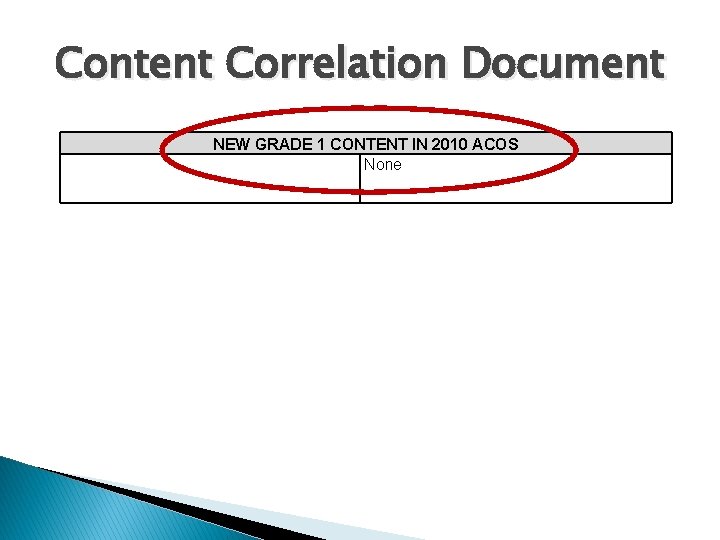
Content Correlation Document 2003 ACOS CURRENT ALABAMA CONTENT PLACEMENT 1. 1 Demonstrate concepts of number sense by counting forward and backward by ones, twos, fives, and tens up to 100; counting forward and backward from an initial number other than 1; and using multiple representations for a given number. 1. 1. B. 1 Identifying position using the ordinal numbers 1 st through 10 th 1. 1. B. 2 Using vocabulary, including the terms equal, all, and none, to identify sets of objects 1. 1. B. 3 Recognizing that the quantity remains the same when the spatial arrangement changes 2010 ACOS 2010 GRADE 1 CONTENT 1. 9. Count to 120, starting at any number less than 120. In this range, read and write numerals and represent a number of objects with a written numeral. [1 -NBT 1] CONTENT NO LONGER ADDRESSED IN GRADE 1 1. 7. Understand the meaning of the equal sign, and determine if equations involving addition and subtraction are true or false. [1 -OA 7] CONTENT NOW ADDRESSED IN KINDERGARTEN: 1. 4. b. Understand that the last number name said tells the number of objects counted. The number of objects is the same regardless of their arrangement or the order in which they were counted. [K-CC 4 b]
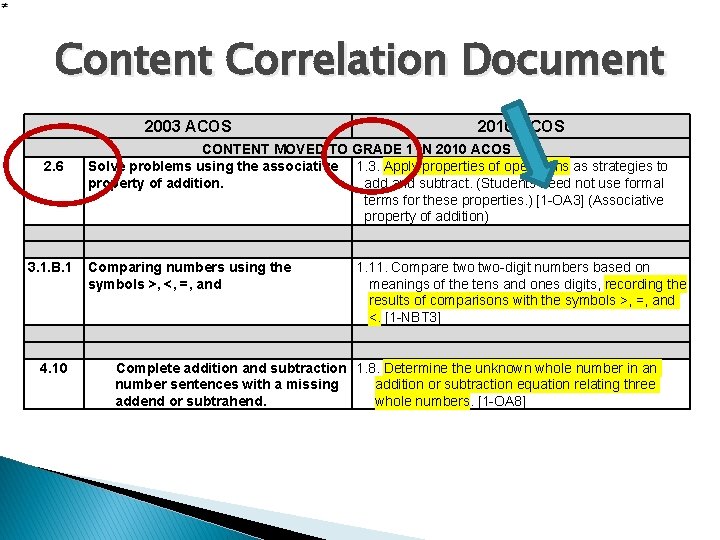
Content Correlation Document 2003 ACOS 2. 6 3. 1. B. 1 4. 10 2010 ACOS CONTENT MOVED TO GRADE 1 IN 2010 ACOS Solve problems using the associative 1. 3. Apply properties of operations as strategies to property of addition. add and subtract. (Students need not use formal terms for these properties. ) [1 -OA 3] (Associative property of addition) Comparing numbers using the symbols >, <, =, and 1. 11. Compare two-digit numbers based on meanings of the tens and ones digits, recording the results of comparisons with the symbols >, =, and <. [1 -NBT 3] Complete addition and subtraction 1. 8. Determine the unknown whole number in an number sentences with a missing addition or subtraction equation relating three addend or subtrahend. whole numbers. [1 -OA 8]
Content Correlation Document NEW GRADE 1 CONTENT IN 2010 ACOS None
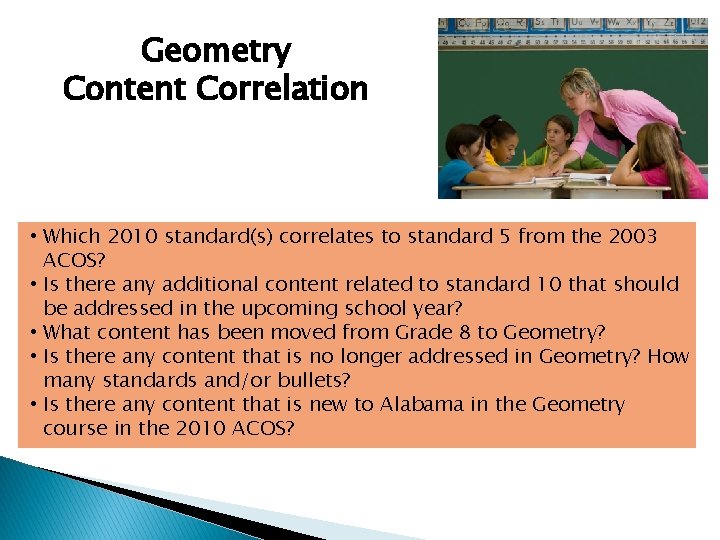
Geometry Content Correlation • Which 2010 standard(s) correlates to standard 5 from the 2003 ACOS? • Is there any additional content related to standard 10 that should be addressed in the upcoming school year? • What content has been moved from Grade 8 to Geometry? • Is there any content that is no longer addressed in Geometry? How many standards and/or bullets? • Is there any content that is new to Alabama in the Geometry course in the 2010 ACOS?
How can I be sure my students are prepared for the implementation of the 2010 ACOS in the 2012 -2013 school year?
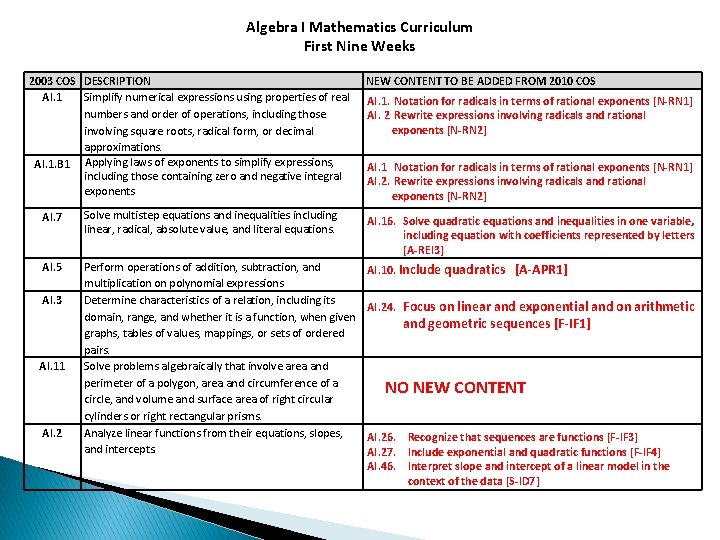
Algebra I Mathematics Curriculum First Nine Weeks 2003 COS DESCRIPTION AI. 1 Simplify numerical expressions using properties of real numbers and order of operations, including those involving square roots, radical form, or decimal approximations. AI. 1. B 1 Applying laws of exponents to simplify expressions, including those containing zero and negative integral exponents NEW CONTENT TO BE ADDED FROM 2010 COS AI. 1. Notation for radicals in terms of rational exponents [N-RN 1] AI. 2 Rewrite expressions involving radicals and rational exponents [N-RN 2] AI. 1 Notation for radicals in terms of rational exponents [N-RN 1] AI. 2. Rewrite expressions involving radicals and rational exponents [N-RN 2] AI. 7 Solve multistep equations and inequalities including linear, radical, absolute value, and literal equations. AI. 16. Solve quadratic equations and inequalities in one variable, including equation with coefficients represented by letters [A-REI 3] AI. 5 Perform operations of addition, subtraction, and multiplication on polynomial expressions Determine characteristics of a relation, including its domain, range, and whether it is a function, when given graphs, tables of values, mappings, or sets of ordered pairs. Solve problems algebraically that involve area and perimeter of a polygon, area and circumference of a circle, and volume and surface area of right circular cylinders or right rectangular prisms. Analyze linear functions from their equations, slopes, and intercepts. AI. 10. Include quadratics [A-APR 1] AI. 3 AI. 11 AI. 24. Focus on linear and exponential and on arithmetic and geometric sequences [F-IF 1] NO NEW CONTENT AI. 26. Recognize that sequences are functions [F-IF 3] AI. 27. Include exponential and quadratic functions [F-IF 4] AI. 46. Interpret slope and intercept of a linear model in the context of the data [S-ID 7]
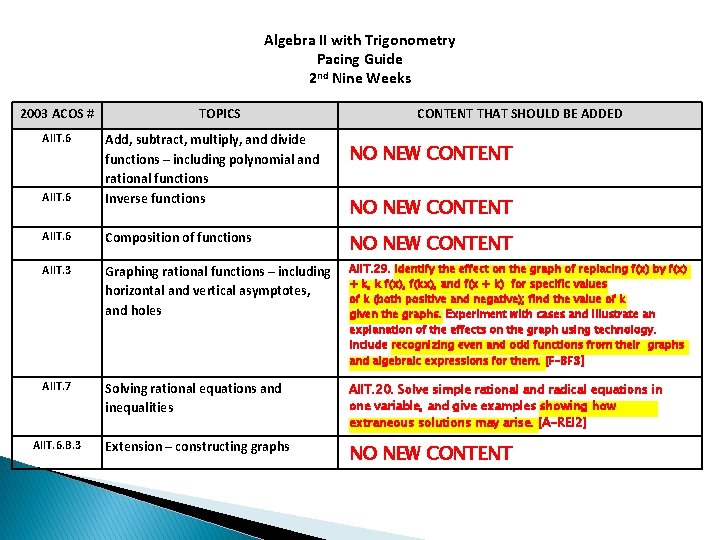
Algebra II with Trigonometry Pacing Guide 2 nd Nine Weeks 2003 ACOS # AIIT. 6 TOPICS CONTENT THAT SHOULD BE ADDED AIIT. 6 Add, subtract, multiply, and divide functions – including polynomial and rational functions Inverse functions AIIT. 6 Composition of functions NO NEW CONTENT AIIT. 3 Graphing rational functions – including horizontal and vertical asymptotes, and holes AIIT. 29. Identify the effect on the graph of replacing f(x) by f(x) + k, k f(x), f(kx), and f(x + k) for specific values of k (both positive and negative); find the value of k given the graphs. Experiment with cases and illustrate an explanation of the effects on the graph using technology. Include recognizing even and odd functions from their graphs and algebraic expressions for them. [F-BF 3] AIIT. 7 Solving rational equations and inequalities AIIT. 20. Solve simple rational and radical equations in one variable, and give examples showing how extraneous solutions may arise. [A-REI 2] Extension – constructing graphs NO NEW CONTENT AIIT. 6. B. 3 NO NEW CONTENT
What about the assessments?
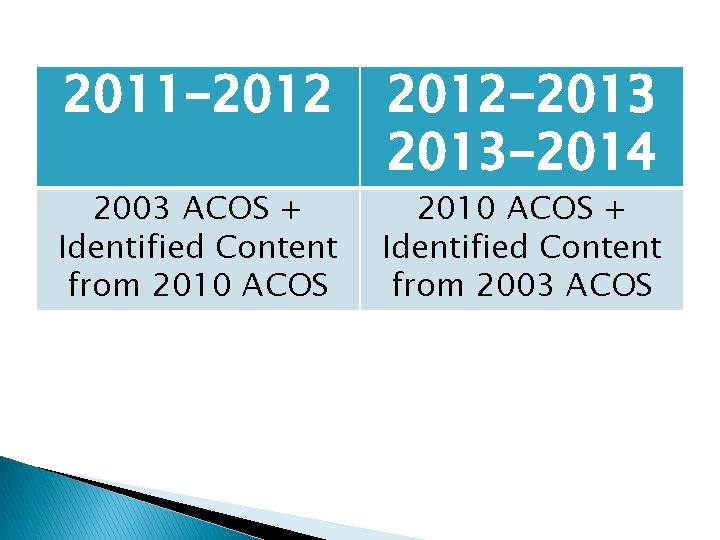
2011 -2012 2003 ACOS + Identified Content from 2010 ACOS 2012 -2013 -2014 2010 ACOS + Identified Content from 2003 ACOS
? ? Questions ? ?
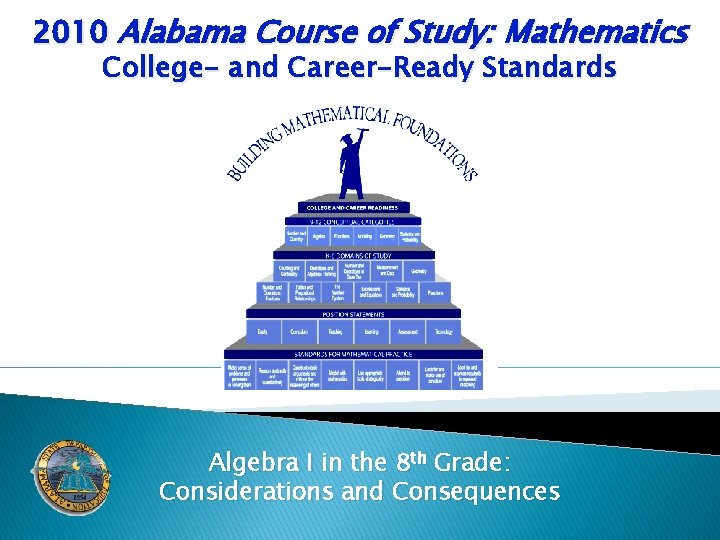
2010 Alabama Course of Study: Mathematics College- and Career-Ready Standards Algebra I in the 8 th Grade: Considerations and Consequences
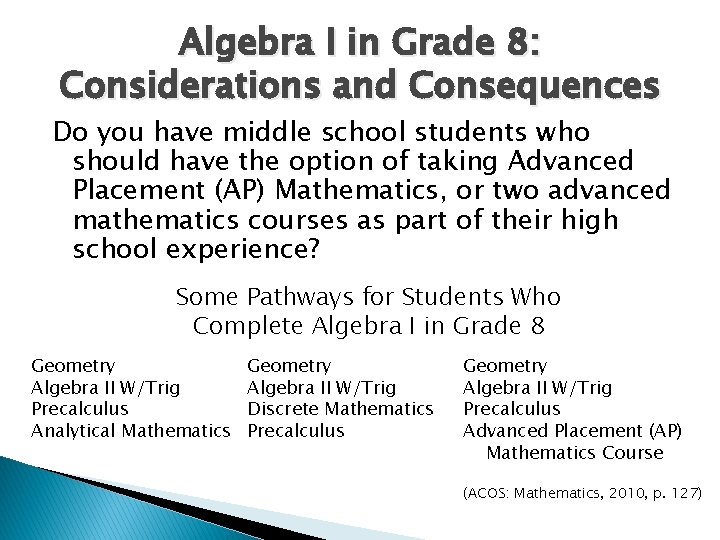
Algebra I in Grade 8: Considerations and Consequences Do you have middle school students who should have the option of taking Advanced Placement (AP) Mathematics, or two advanced mathematics courses as part of their high school experience? Some Pathways for Students Who Complete Algebra I in Grade 8 Geometry Algebra II W/Trig Precalculus Analytical Mathematics Geometry Algebra II W/Trig Discrete Mathematics Precalculus Geometry Algebra II W/Trig Precalculus Advanced Placement (AP) Mathematics Course (ACOS: Mathematics, 2010, p. 127)
Algebra I in Grade 8: Considerations and Consequences � “Systems offering Algebra I in the eighth grade have the responsibility of ensuring that all Algebra I course content standards and Grade 8 course content standards be included in instruction. ” (ACOS: Mathematics, 2010, p. 81) � The State Department of Education will provide further guidance and training (Phase II) in the fall of 2011 relative to issues local education agencies may encounter in providing an Algebra I course in Grade 8.
Algebra I in Grade 8: Considerations and Consequences Decisions to accelerate students into a high school Algebra I course before Grade 9 should not be rushed. Placing students into an Algebra I course too early should be avoided at all costs. Local education agency’s decision should: Be Advertised Be Equitable Provide Written Policy Decisions to accelerate students into a high school Algebra I course before Grade 9 should be based on solid evidence of student learning.
Algebra I in Grade 8: Considerations and Consequences Ø Ø Not all students are ready for Algebra I in Grade 8. The 2010 COS Algebra I content is not the same as the Algebra I content in earlier Alabama Courses of Study. Much of what was previously included in Algebra I will now be taught in Grades 6 -8 in the 2010 COS. A Southern Regional Education Board (SREB) study found a difference in readiness for higher-level mathematics between students scoring in the bottom quartile and those scoring in the top 3 quartiles. Graduates who completed Geometry or Algebra II as ninth graders earned an average Grade 12 NAEP mathematics at the Proficient level.
Algebra I in Grade 8: Considerations and Consequences � “Mathematics leaders need to ensure equitable access to courses by carefully monitoring barriers to participation. ” (A Guide to Mathematics Leadership, 2010, p. 4) � There are valid reasons for placing students in certain courses, but mathematics leaders are expected to ensure that there are no systematic barriers that discriminate against specific populations. (A Guide to Mathematics Leadership, 2010, pp. 31 -32) � An accelerated Grade 7 course and a Grade 8 Algebra I course differ from the Grade 7, Grade 8, and Algebra I courses found in the 2010 COS in that they contain additional content by comparison and demand a faster pace for instruction and learning.
Algebra I in Grade 8: Considerations and Consequences � � � Ensure that the Grade 8 Algebra I course is not watered down. Ensure that there is equity in support materials for all courses, that is, that more and better materials and supports are not just in place for the accelerated and advanced courses. Ensure that interventions are in place so that all students are prepared for high school Algebra I coursework.
Ways to Provide Greater Access to Mathematics � � Allow students to take two math electives simultaneously, provided the course progression chart is followed. Use block scheduling to take a math course both semesters. � Offer Credit Advancement. � Offer Dual Enrollment. � Offer summer courses that are designed to provide an equivalent experience of a full course.
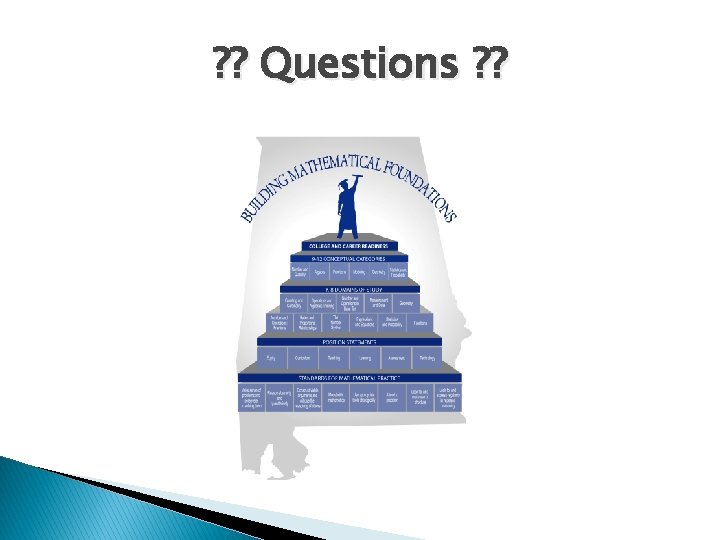
? ? Questions ? ?
http: //alex. state. al. us/ccrs
Contact Information ALSDE Office of Student Learning Curriculum and Instruction Cindy Freeman, Mathematics Specialist �Phone: 334. 353. 5321 E-mail: cfreeman@alsde. edu
- Slides: 83