
2010 Alabama Course of Study Mathematics College and
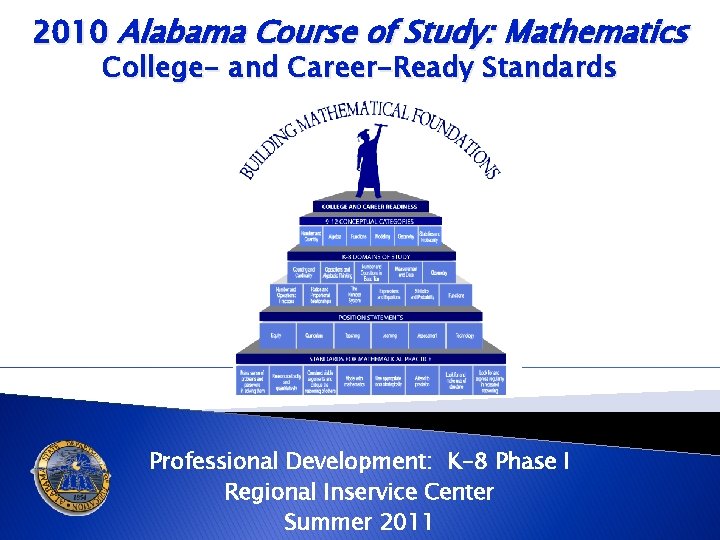
2010 Alabama Course of Study: Mathematics College- and Career-Ready Standards Professional Development: K-8 Phase I Regional Inservice Center Summer 2011
Topics for Today � Components of the Course of Study � High School Course Progressions/Pathways � Standards for Mathematical Practice � Literacy Standards for Grades 6 -12 ◦ History/Social Studies, Science, and Technical Subjects � The Big Picture ◦ Domains of Study and Conceptual Categories � Learning Progressions/Trajectories ◦ Vertical Alignment of Content � Addressing Content Shifts � Early Entry Algebra I ◦ Considerations/Consequences
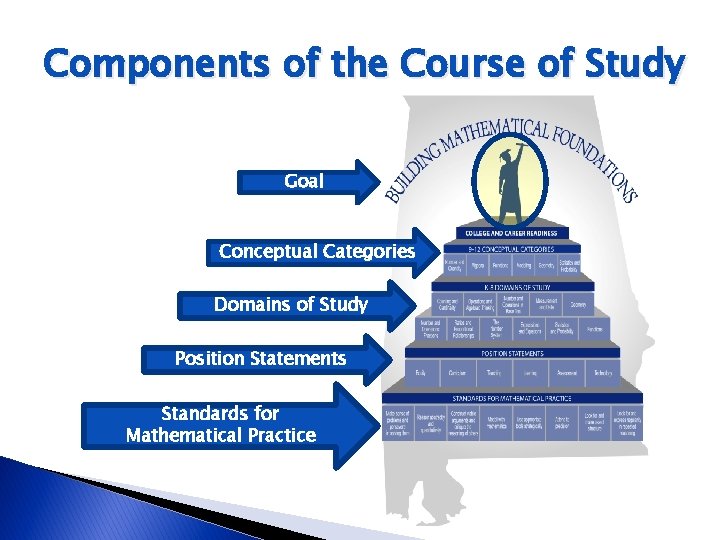
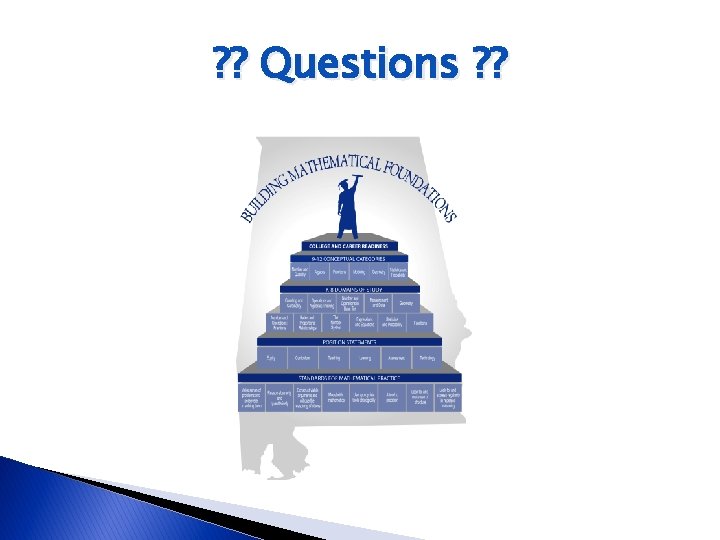
Components of the Course of Study Goal Conceptual Categories Domains of Study Position Statements Standards for Mathematical Practice
Components of the Course of Study � Preface � Acknowledgments � General Introduction � Conceptual Framework � Position Statements ◦ ◦ ◦ Equity Curriculum Teaching Learning Assessment Technology � Standards for Mathematical Practice
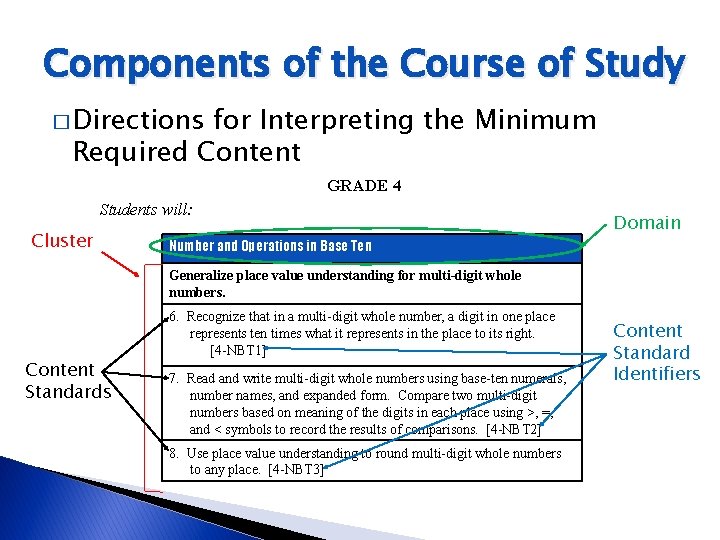
Components of the Course of Study � Directions for Interpreting the Minimum Required Content GRADE 4 Students will: Cluster Domain Number and Operations in Base Ten Generalize place value understanding for multi-digit whole numbers. Content Standards 6. Recognize that in a multi-digit whole number, a digit in one place represents ten times what it represents in the place to its right. [4 -NBT 1] 7. Read and write multi-digit whole numbers using base-ten numerals, number names, and expanded form. Compare two multi-digit numbers based on meaning of the digits in each place using >, =, and < symbols to record the results of comparisons. [4 -NBT 2] 8. Use place value understanding to round multi-digit whole numbers to any place. [4 -NBT 3] Content Standard Identifiers
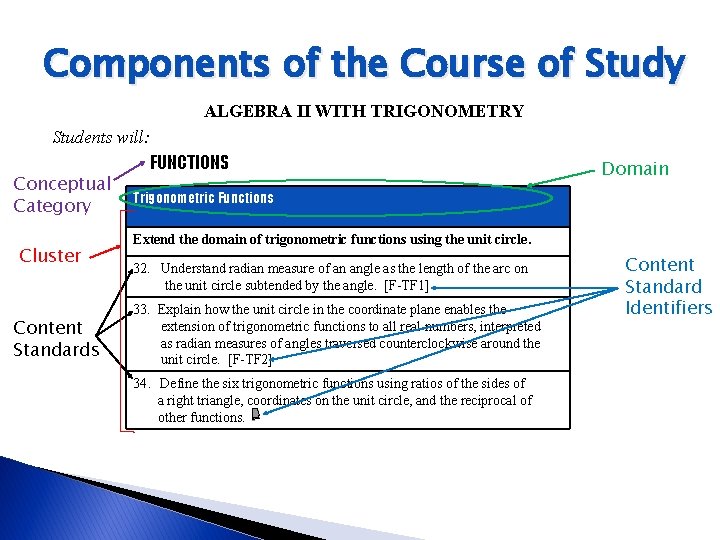
Components of the Course of Study ALGEBRA II WITH TRIGONOMETRY Students will: FUNCTIONS Conceptual Trigonometric Functions Category Cluster Content Standards Domain Extend the domain of trigonometric functions using the unit circle. 32. Understand radian measure of an angle as the length of the arc on the unit circle subtended by the angle. [F-TF 1] 33. Explain how the unit circle in the coordinate plane enables the extension of trigonometric functions to all real numbers, interpreted as radian measures of angles traversed counterclockwise around the unit circle. [F-TF 2] 34. Define the six trigonometric functions using ratios of the sides of a right triangle, coordinates on the unit circle, and the reciprocal of other functions. Content Standard Identifiers
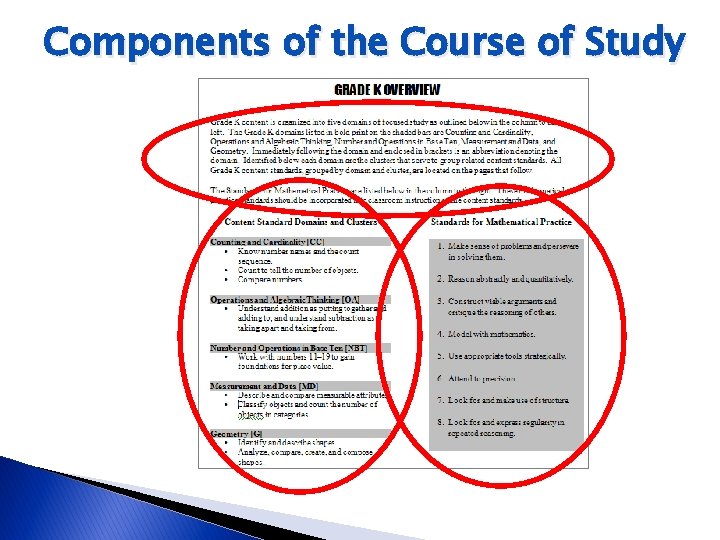
Components of the Course of Study
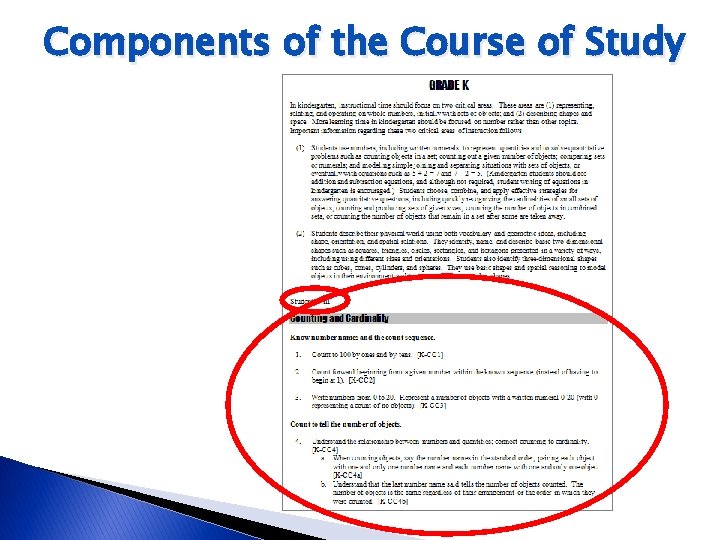
Components of the Course of Study
Components of the Course of Study � Standards for High School Mathematics ◦ Conceptual Categories for High School Mathematics �Number and Quantity �Algebra �Functions �Modeling �Geometry �Statistics and Probability ◦ Additional Coding �(+) STEM Standards �(*) Modeling Standards �( ) Alabama Added Content
Components of the Course of Study � (+) STEM Standards Geometry 22. (+) Derive the formula A = (1/2)ab sin(C) for the area of a triangle by drawing an auxiliary line from a vertex perpendicular to the opposite side. [G-SRT 9]
Components of the Course of Study � (*) Modeling Standards Algebra I 28. Relate the domain of a function to its graph and, where applicable, to the quantitative relationship it describes. * [F-IF 5]
Components of the Course of Study � Added Content Specific to Alabama Geometry 35. Determine areas and perimeters of regular polygons, including inscribed or circumscribed polygons, given the coordinates of vertices or other characteristics.
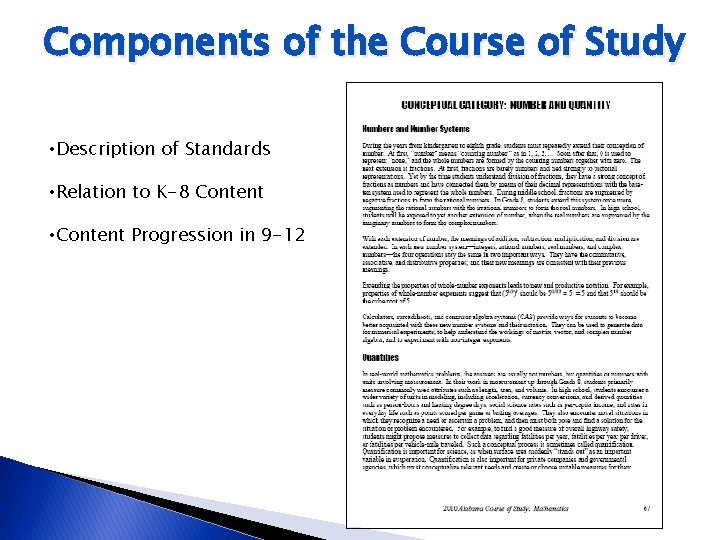
Components of the Course of Study • Description of Standards • Relation to K-8 Content • Content Progression in 9 -12
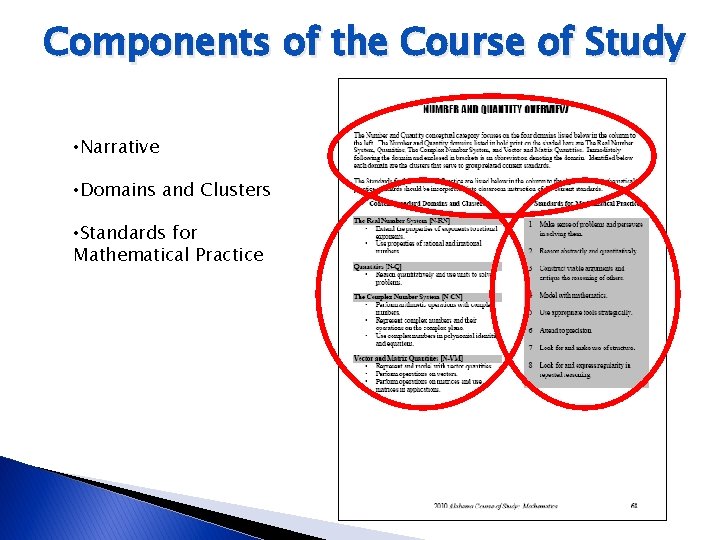
Components of the Course of Study • Narrative • Domains and Clusters • Standards for Mathematical Practice
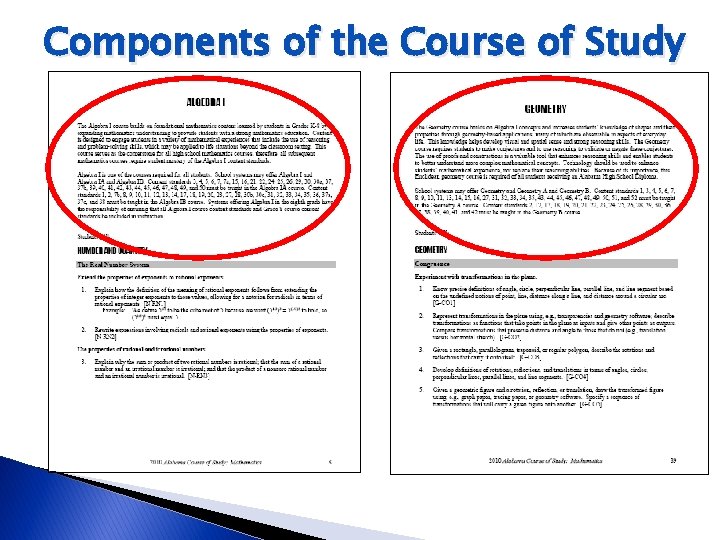
Components of the Course of Study
Components of the Course of Study � Appendices ◦ Appendix A � Table � Table 1: 2: 3: 4: 5: A-E Common Addition and Subtraction Situations Common Multiplication and Division Situations Properties of Operations Properties of Equality Properties of Inequality ◦ Appendix B � Possible Course Progressions in Grades 9 -12 � Possible Course Pathways ◦ Appendix C � Literacy Standards For Grades 6 -12 History/Social Studies, Science, and Technical Subjects ◦ Appendix D � Alabama High School Graduation Requirements ◦ Appendix E � Guidelines and Suggestions for Local Time Requirements and Homework � Bibliography � Glossary
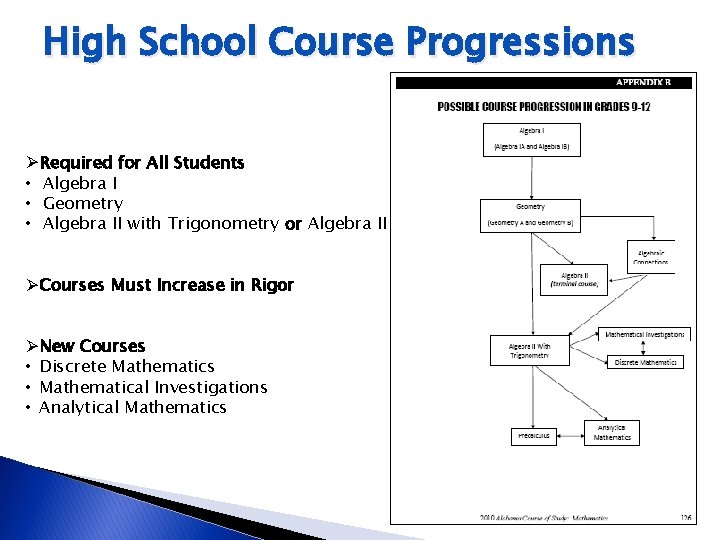
High School Course Progressions ØRequired for All Students • Algebra I • Geometry • Algebra II with Trigonometry or Algebra II ØCourses Must Increase in Rigor ØNew Courses • Discrete Mathematics • Mathematical Investigations • Analytical Mathematics
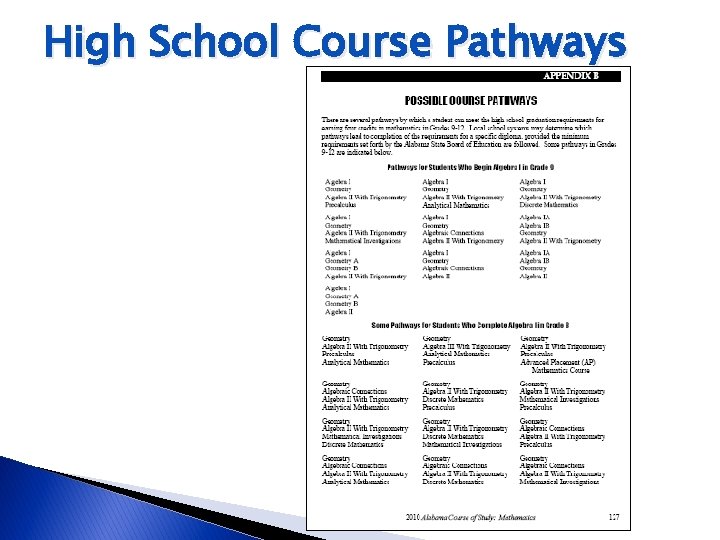
High School Course Pathways
? ? Questions ? ?
2010 Alabama Course of Study: Mathematics College- and Career-Ready Standards The Standards for Mathematical Practice
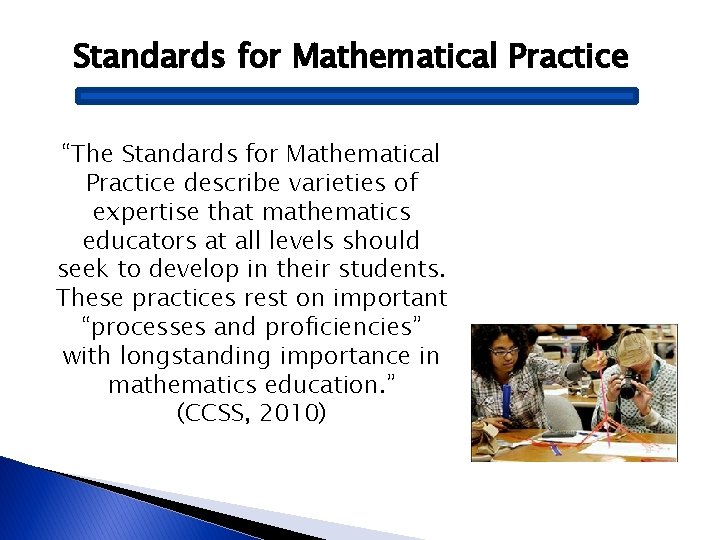
Standards for Mathematical Practice “The Standards for Mathematical Practice describe varieties of expertise that mathematics educators at all levels should seek to develop in their students. These practices rest on important “processes and proficiencies” with longstanding importance in mathematics education. ” (CCSS, 2010)
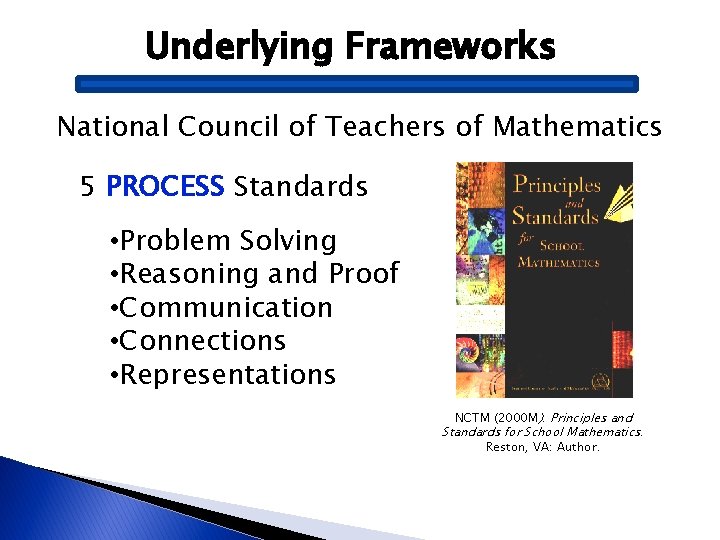
Underlying Frameworks National Council of Teachers of Mathematics 5 PROCESS Standards • Problem Solving • Reasoning and Proof • Communication • Connections • Representations NCTM (2000 M). Principles and Standards for School Mathematics. Reston, VA: Author.
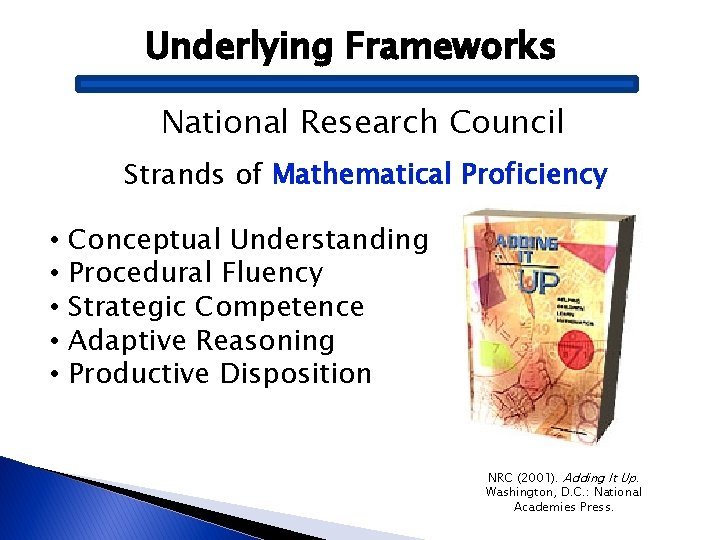
Underlying Frameworks National Research Council Strands of Mathematical Proficiency • • • Conceptual Understanding Procedural Fluency Strategic Competence Adaptive Reasoning Productive Disposition NRC (2001). Adding It Up. Washington, D. C. : National Academies Press.
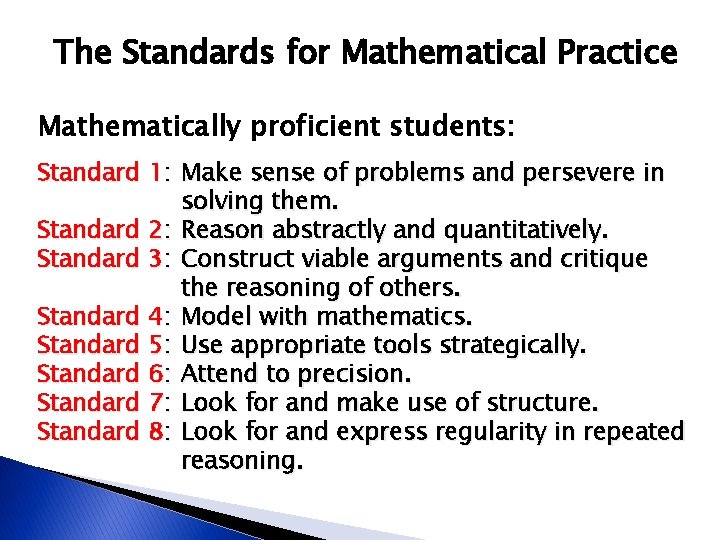
The Standards for Mathematical Practice Mathematically proficient students: Standard 1: Make sense of problems and persevere in solving them. Standard 2: Reason abstractly and quantitatively. Standard 3: Construct viable arguments and critique the reasoning of others. Standard 4: Model with mathematics. Standard 5: Use appropriate tools strategically. Standard 6: Attend to precision. Standard 7: Look for and make use of structure. Standard 8: Look for and express regularity in repeated reasoning.
Standard 1: Make sense of problems and persevere in solving them. What do mathematically proficient students do? � Analyze givens, constraints, relationships � Make conjectures � Plan solution pathways � Make meaning of the solution � Monitor and evaluate their progress � Change course if necessary � Ask themselves if what they are doing makes sense
Standard 2: Reason abstractly and quantitatively. What do mathematically proficient students do? � Make sense of quantities and relationships � Able to decontextualize ◦ Abstract a given situation ◦ Represent it symbolically ◦ Manipulate the representing symbols � Able to contextualize ◦ Pause during manipulation process ◦ Probe the referents for symbols involved
Standard 3: Construct viable arguments and critique the reasoning of others. What do mathematically proficient students do? � Construct arguments � Analyze situations � Justify conclusions � Communicate conclusions � Reason inductively � Distinguish correct logic from flawed logic � Listen to/Read/Respond to other’s arguments and ask useful questions to clarify/improve arguments
Standard 4: Model with mathematics. What do mathematically proficient students do? � Apply mathematics to solve problems from everyday life situations � Apply what they know � Simplify a complicated situation � Identify important quantities � Map math relationships using tools � Analyze mathematical relationships to draw conclusions � Reflect on improving the model
Standard 5: Use appropriate tools strategically. What do mathematically proficient students do? � Consider and use available tools � Make sound decisions about when different tools might be helpful � Identify relevant external mathematical resources � Use technological tools to explore and deepen conceptual understandings
Standard 6: Attend to precision. What do mathematically proficient students do? � Communicate precisely to others � Use clear definitions in discussions � State meaning of symbols consistently and appropriately � Specify units of measurements � Calculate accurately & efficiently
Standard 7: Look for and make use of structure. What do mathematically proficient students do? � Discern patterns and structures � Use strategies to solve problems � Step back for an overview and can shift perspective
Standard 8: Look for and express regularity in repeated reasoning. What do mathematically proficient students do? � Notice if calculations are repeated � Look for general methods and shortcuts � Maintain oversight of the processes � Attend to details � Continually evaluates the reasonableness of their results
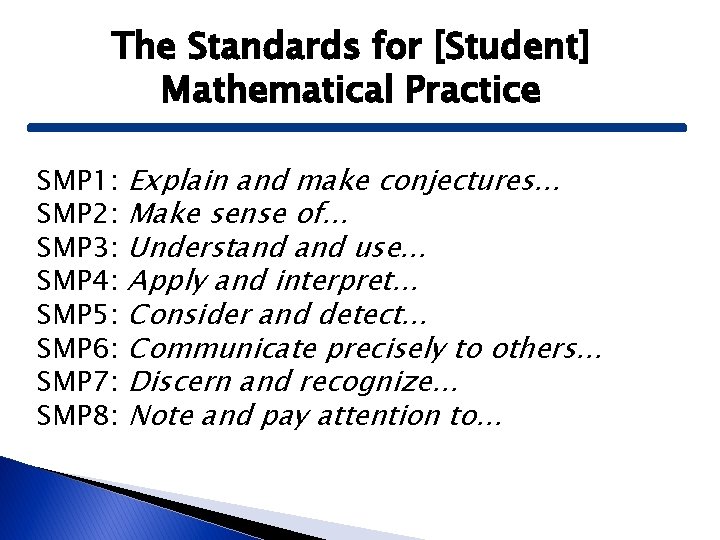
The Standards for [Student] Mathematical Practice SMP 1: SMP 2: SMP 3: SMP 4: SMP 5: SMP 6: SMP 7: SMP 8: Explain and make conjectures… Make sense of… Understand use… Apply and interpret… Consider and detect… Communicate precisely to others… Discern and recognize… Note and pay attention to…
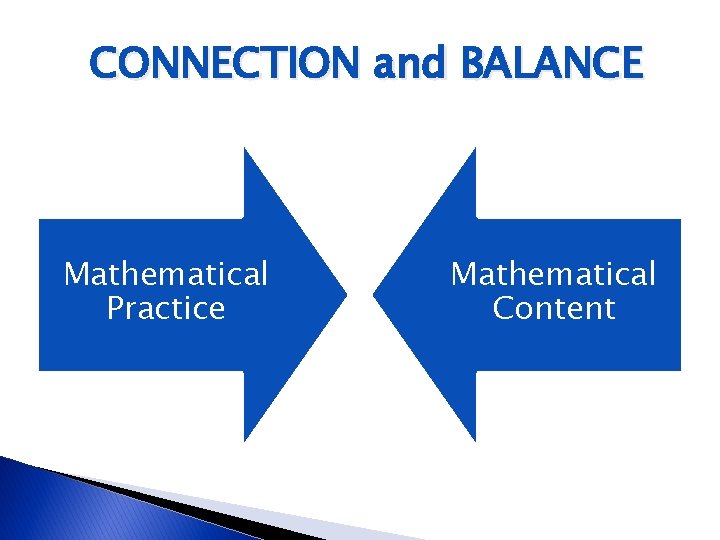
CONNECTION and BALANCE Mathematical Practice Mathematical Content
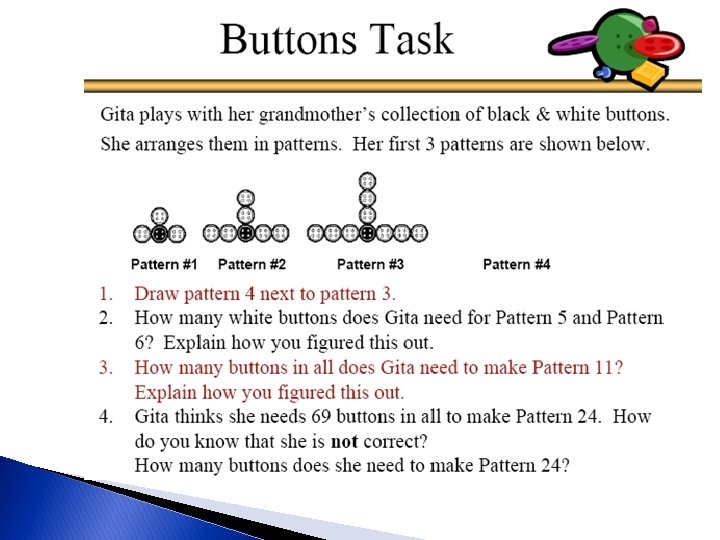
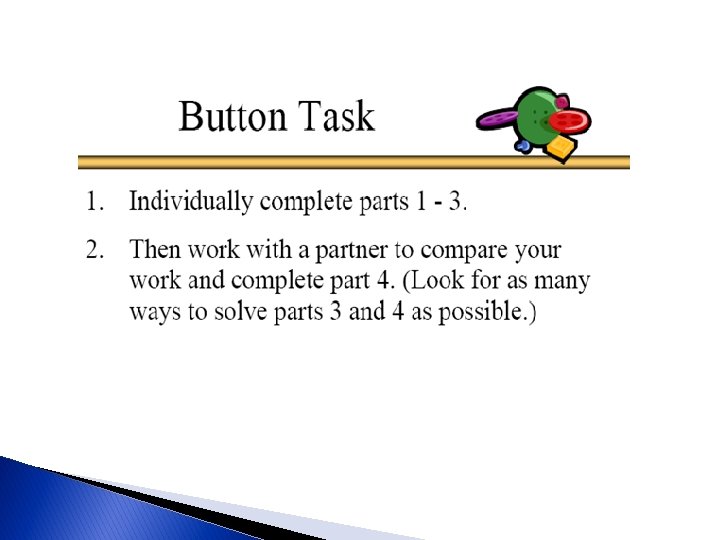

1. Draw Pattern 4 next to Pattern 3. See answer above. 2. How many white buttons does Gita need for Pattern 5 and Pattern 6? Explain how you figured this out. 15 buttons and 18 buttons 3. How many buttons in all does Gita need to make Pattern 11? Explain how you figured this out. 34 buttons 4. Gita thinks she needs 69 buttons in all to make Pattern 24. How do you know that she is NOT correct? How many buttons does she need to make Pattern 24? 73 buttons
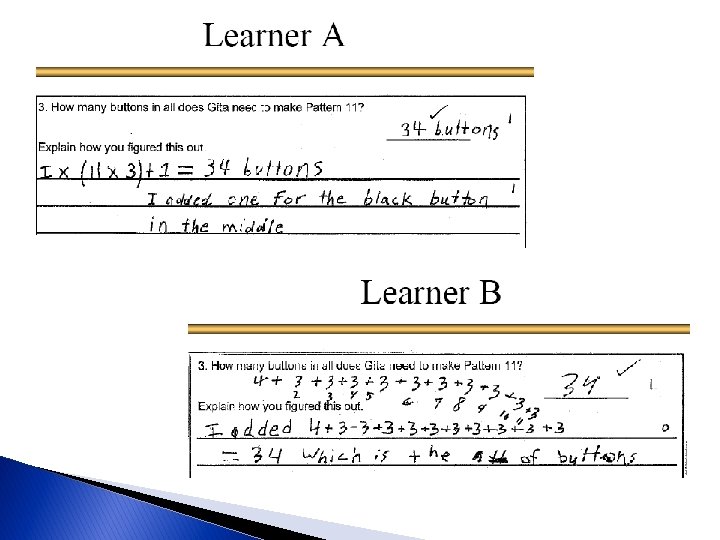
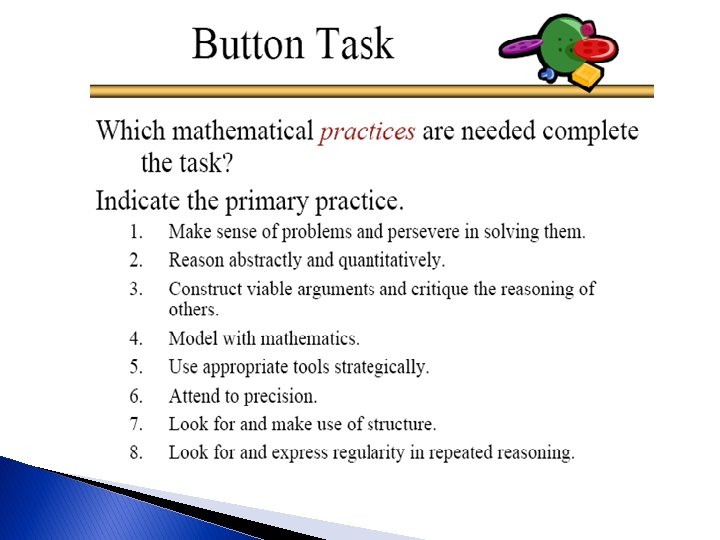
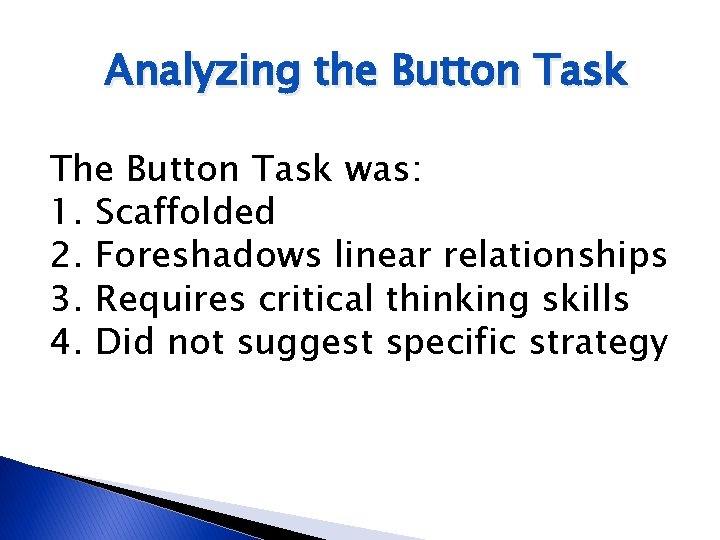
Analyzing the Button Task The Button Task was: 1. Scaffolded 2. Foreshadows linear relationships 3. Requires critical thinking skills 4. Did not suggest specific strategy
www. insidemathematics. org
The Standards for [Student] Mathematical Practice “Not all tasks are created equal, and different tasks will provoke different levels and kinds of student thinking. ” Stein, Smith, Henningtsen & Silver, 2000 “The level and kind of thinking in which students engage determines what they will learn. ” Herbert, Carpenter, Fennema, Fuson, Wearne, Murray, Oliver, & Human, 1997
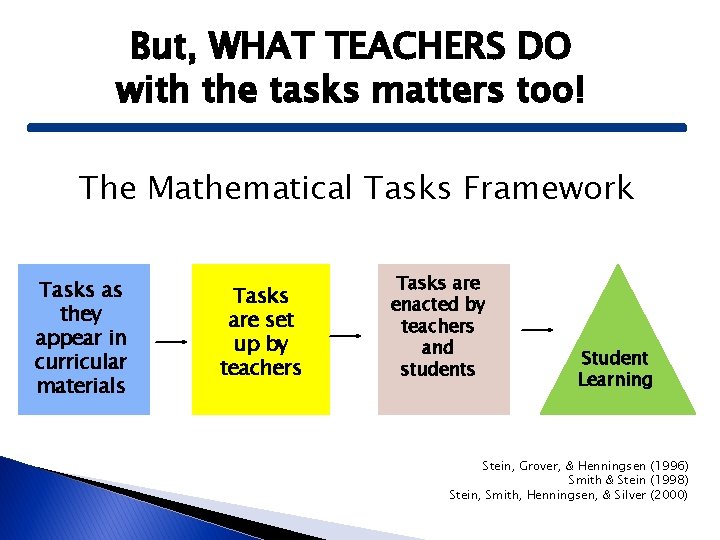
But, WHAT TEACHERS DO with the tasks matters too! The Mathematical Tasks Framework Tasks as they appear in curricular materials Tasks are set up by teachers Tasks are enacted by teachers and students Student Learning Stein, Grover, & Henningsen (1996) Smith & Stein (1998) Stein, Smith, Henningsen, & Silver (2000)
Standards for [Student] Mathematical Practice The Standards for Mathematical Practice place an emphasis on student demonstrations of learning… Equity begins with an understanding of how the selection of tasks, the assessment of tasks, and how the student learning environment create inequity in our schools…
Leading with the Mathematical Practice Standards § You can begin by implementing the 8 Standards for Mathematical Practice now § Think about the relationships among the practices and how you can move forward to implement BEST PRACTICES § Analyze instructional tasks so students engage in these practices repeatedly
? ? Questions ? ?
2010 Alabama Course of Study: Mathematics College- and Career-Ready Standards Literacy Standards for Grades 6 – 12
APPENDIX C Literacy Standards for Grades 6 – 12 History/Social Studies, Science and Technical Subjects “These standards are designed to supplement students’ learning of the mathematical standards by helping them meet the challenges of reading, writing, speaking, listening, and language in the field of mathematics. ”
It is essential for educators to: • select and develop resources that ensure students can connect their curriculum with the real world. • help students recognize and apply math concepts in areas outside of the mathematics classroom. • provide students with opportunities to participate in mathematical investigations. • help students develop problem-solving techniques and skills which enable them to interconnect ideas and build on existing content.
Basis of Literacy Standards The Literacy Standards for Reading and Writing are based on the College and Career Readiness (CCR) anchor standards as outlined in the English Language Arts (ELA) common core. Both of which are outlined in Appendix C.
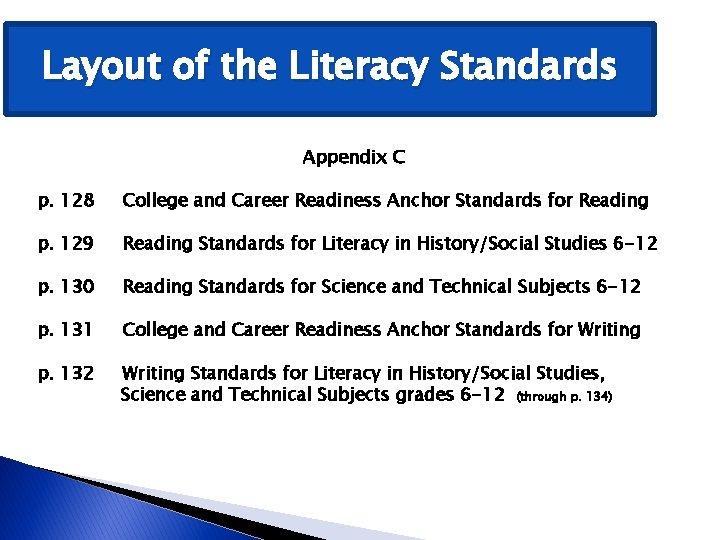
Layout of the Literacy Standards Appendix C p. 128 College and Career Readiness Anchor Standards for Reading p. 129 Reading Standards for Literacy in History/Social Studies 6 -12 p. 130 Reading Standards for Science and Technical Subjects 6 -12 p. 131 College and Career Readiness Anchor Standards for Writing p. 132 Writing Standards for Literacy in History/Social Studies, Science and Technical Subjects grades 6 -12 (through p. 134)
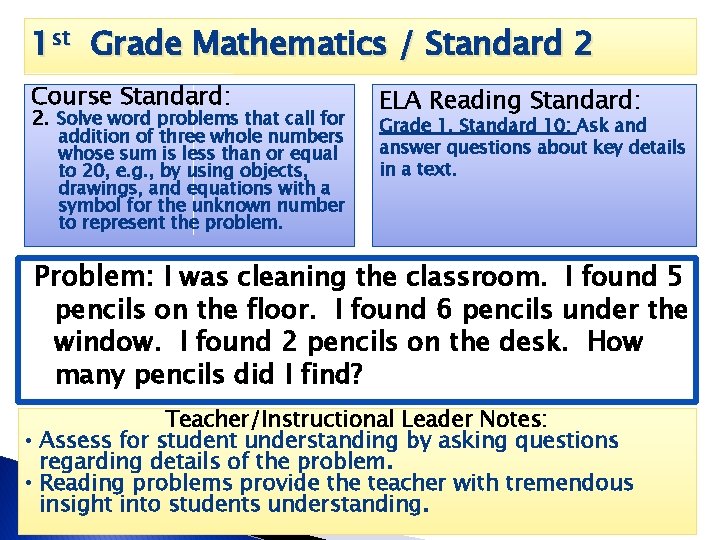
1 st Grade Mathematics / Standard 2 Course Standard: 2. Solve word problems that call for addition of three whole numbers whose sum is less than or equal to 20, e. g. , by using objects, drawings, and equations with a symbol for the unknown number to represent the problem. ELA Reading Standard: Grade 1, Standard 10: Ask and answer questions about key details in a text. Problem: I was cleaning the classroom. I found 5 pencils on the floor. I found 6 pencils under the window. I found 2 pencils on the desk. How many pencils did I find? Teacher/Instructional Leader Notes: • Assess for student understanding by asking questions regarding details of the problem. • Reading problems provide the teacher with tremendous insight into students understanding.
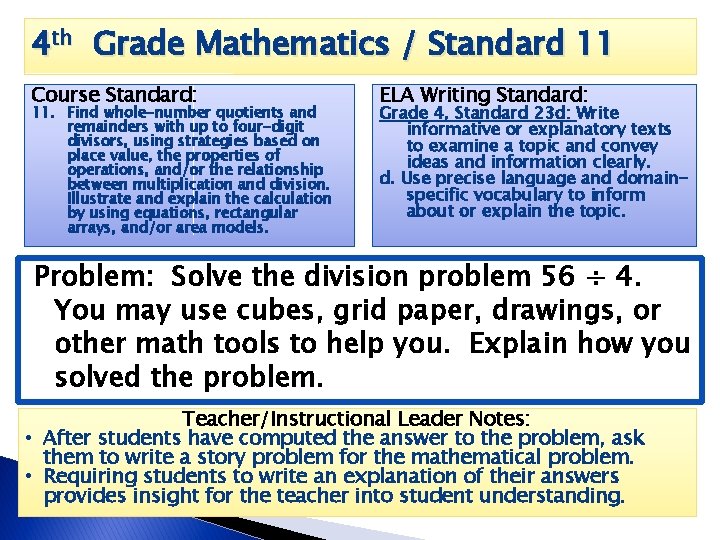
4 th Grade Mathematics / Standard 11 Course Standard: 11. Find whole-number quotients and remainders with up to four-digit divisors, using strategies based on place value, the properties of operations, and/or the relationship between multiplication and division. Illustrate and explain the calculation by using equations, rectangular arrays, and/or area models. ELA Writing Standard: Grade 4, Standard 23 d: Write informative or explanatory texts to examine a topic and convey ideas and information clearly. d. Use precise language and domainspecific vocabulary to inform about or explain the topic. Problem: Solve the division problem 56 ÷ 4. You may use cubes, grid paper, drawings, or other math tools to help you. Explain how you solved the problem. Teacher/Instructional Leader Notes: • After students have computed the answer to the problem, ask them to write a story problem for the mathematical problem. • Requiring students to write an explanation of their answers provides insight for the teacher into student understanding.
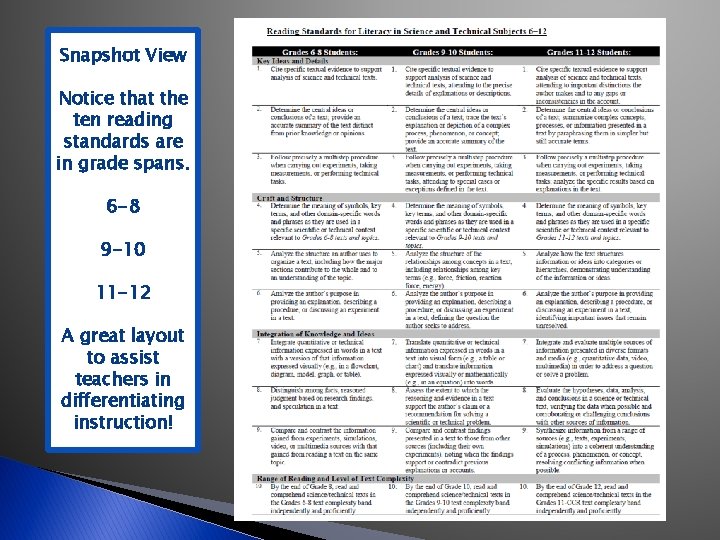
Snapshot View Notice that the ten reading standards are in grade spans. 6 -8 9 -10 11 -12 A great layout to assist teachers in differentiating instruction!

A closer look: 1. Cite specific textual evidence to support analysis of science and technical texts, attending to the precise details of explanations or descriptions. 1. Cite specific textual evidence to support analysis of science and technical texts, attending to important distinctions the author makes and to any gaps or inconsistencies in the account.
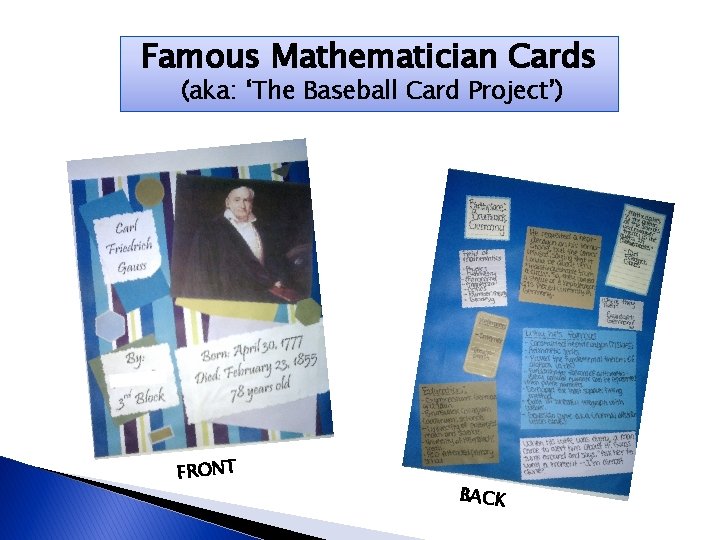
Famous Mathematician Cards (aka: ‘The Baseball Card Project’) FRONT BACK
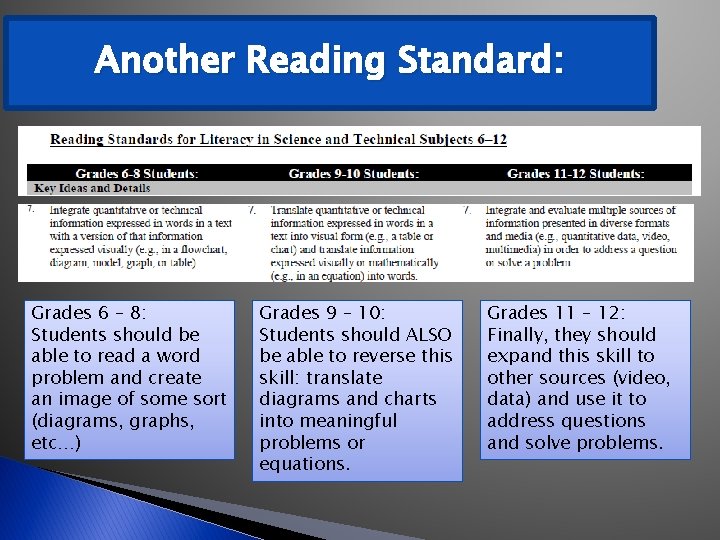
Another Reading Standard: Grades 6 – 8: Students should be able to read a word problem and create an image of some sort (diagrams, graphs, etc…) Grades 9 – 10: Students should ALSO be able to reverse this skill: translate diagrams and charts into meaningful problems or equations. Grades 11 – 12: Finally, they should expand this skill to other sources (video, data) and use it to address questions and solve problems.
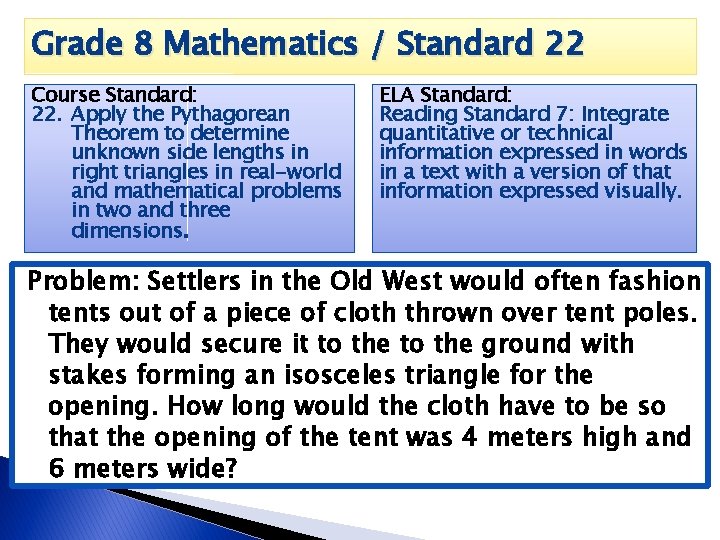
Grade 8 Mathematics / Standard 22 Course Standard: 22. Apply the Pythagorean Theorem to determine unknown side lengths in right triangles in real-world and mathematical problems in two and three dimensions. ELA Standard: Reading Standard 7: Integrate quantitative or technical information expressed in words in a text with a version of that information expressed visually. Problem: Settlers in the Old West would often fashion tents out of a piece of cloth thrown over tent poles. They would secure it to the ground with stakes forming an isosceles triangle for the opening. How long would the cloth have to be so that the opening of the tent was 4 meters high and 6 meters wide?
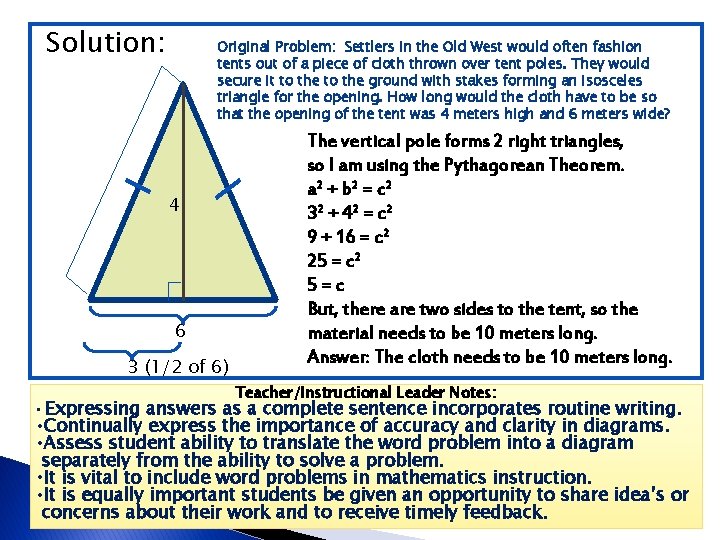
Solution: Original Problem: Settlers in the Old West would often fashion tents out of a piece of cloth thrown over tent poles. They would secure it to the ground with stakes forming an isosceles triangle for the opening. How long would the cloth have to be so that the opening of the tent was 4 meters high and 6 meters wide? 4 6 3 (1/2 of 6) The vertical pole forms 2 right triangles, so I am using the Pythagorean Theorem. a 2 + b 2 = c 2 32 + 4 2 = c 2 9 + 16 = c 2 25 = c 2 5=c But, there are two sides to the tent, so the material needs to be 10 meters long. Answer: The cloth needs to be 10 meters long. Teacher/Instructional Leader Notes: Expressing answers as a complete sentence incorporates routine writing. • Continually express the importance of accuracy and clarity in diagrams. • Assess student ability to translate the word problem into a diagram separately from the ability to solve a problem. • It is vital to include word problems in mathematics instruction. • It is equally important students be given an opportunity to share idea’s or concerns about their work and to receive timely feedback. •
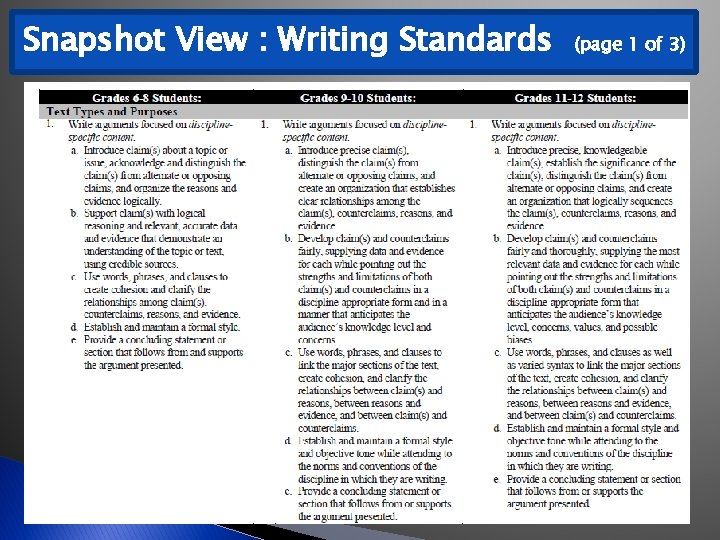
Snapshot View : Writing Standards (page 1 of 3)
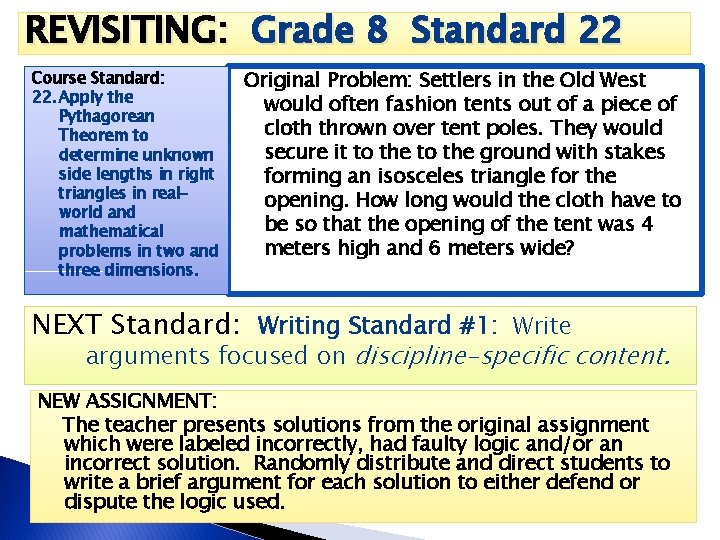
REVISITING: Grade 8 Standard 22 Course Standard: 22. Apply the Pythagorean Theorem to determine unknown side lengths in right triangles in realworld and mathematical problems in two and three dimensions. Original Problem: Settlers in the Old West would often fashion tents out of a piece of cloth thrown over tent poles. They would secure it to the ground with stakes forming an isosceles triangle for the opening. How long would the cloth have to be so that the opening of the tent was 4 meters high and 6 meters wide? NEXT Standard: Writing Standard #1: Write arguments focused on discipline-specific content. NEW ASSIGNMENT: The teacher presents solutions from the original assignment which were labeled incorrectly, had faulty logic and/or an incorrect solution. Randomly distribute and direct students to write a brief argument for each solution to either defend or dispute the logic used.
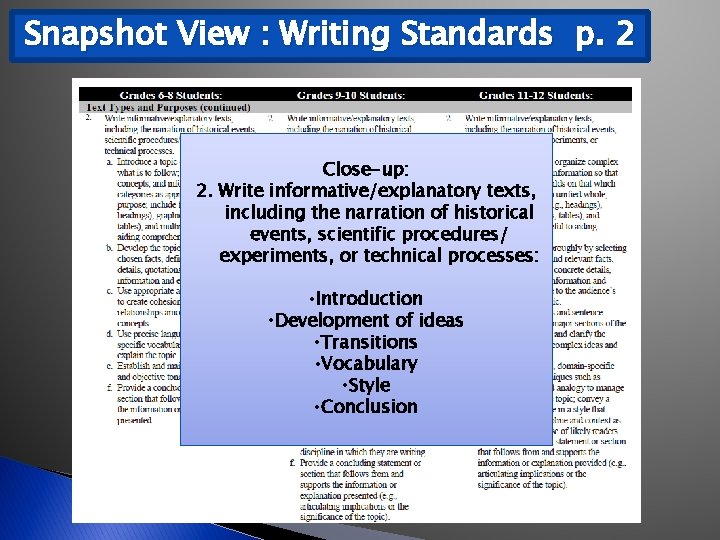
Snapshot View : Writing Standards p. 2 Close-up: 2. Write informative/explanatory texts, including the narration of historical events, scientific procedures/ experiments, or technical processes: • Introduction • Development of ideas • Transitions • Vocabulary • Style • Conclusion
Writing Standard #3 In science and technical subjects, students must be able to write precise enough descriptions of the step-by-step procedures they use in their investigations or technical work so others can replicate them and (possibly) reach the same results.

Snapshot View : Writing Standards p. 3

A closer look: *The same for all three levels 10. Write routinely over extended time frames (time for reflection and revision) and shorter time frames (a single sitting or a day or two) for range of disciplinespecific tasks, purposes, and audiences.
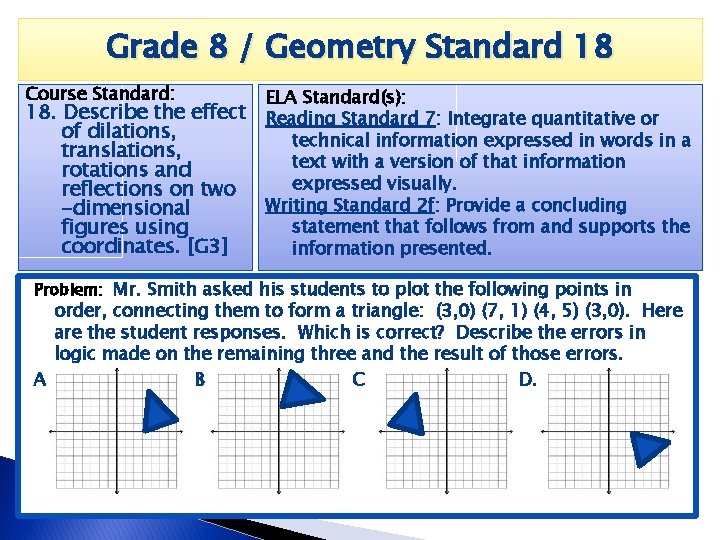
Grade 8 / Geometry Standard 18 Course Standard: 18. Describe the effect of dilations, translations, rotations and reflections on two -dimensional figures using coordinates. [G 3] ELA Standard(s): Reading Standard 7: Integrate quantitative or technical information expressed in words in a text with a version of that information expressed visually. Writing Standard 2 f: Provide a concluding statement that follows from and supports the information presented. Problem: Mr. Smith asked his students to plot the following points in order, connecting them to form a triangle: (3, 0) (7, 1) (4, 5) (3, 0). Here are the student responses. Which is correct? Describe the errors in logic made on the remaining three and the result of those errors. A B C D.
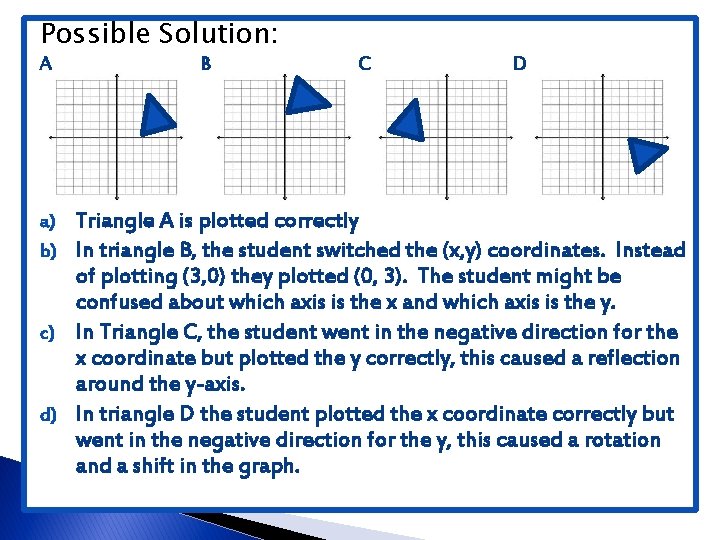
Possible Solution: A B C D a) Triangle A is plotted correctly b) In triangle B, the student switched the (x, y) coordinates. Instead of plotting (3, 0) they plotted (0, 3). The student might be confused about which axis is the x and which axis is the y. c) In Triangle C, the student went in the negative direction for the x coordinate but plotted the y correctly, this caused a reflection around the y-axis. d) In triangle D the student plotted the x coordinate correctly but went in the negative direction for the y, this caused a rotation and a shift in the graph.
Teacher/Teacher Leader Notes • Is the student’s mathematical logic correct? • Can they describe errors found in others’ mathematical thinking? • Activities like this may be used as a bell ringer (sparking discussion prior to a lesson) or as an exit slip to assess understanding. • It is important that the responses are assessed by the teacher through grading or discussion.
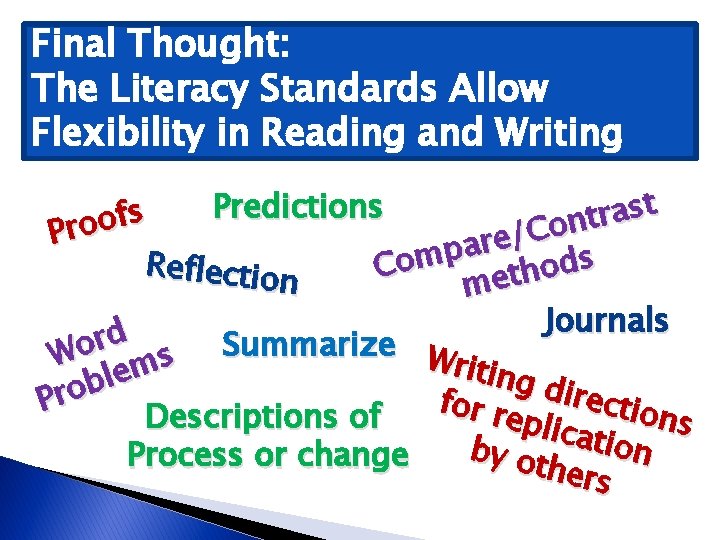
Final Thought: The Literacy Standards Allow Flexibility in Reading and Writing t Predictions s a s r f t n o C Proo / e r a p m s o Reflectio d C o h n met Journals rd Summarize W o W s riting m e l b o r for r directio P Descriptions of ns eplic ation b y oth Process or change ers
? ? Questions ? ?
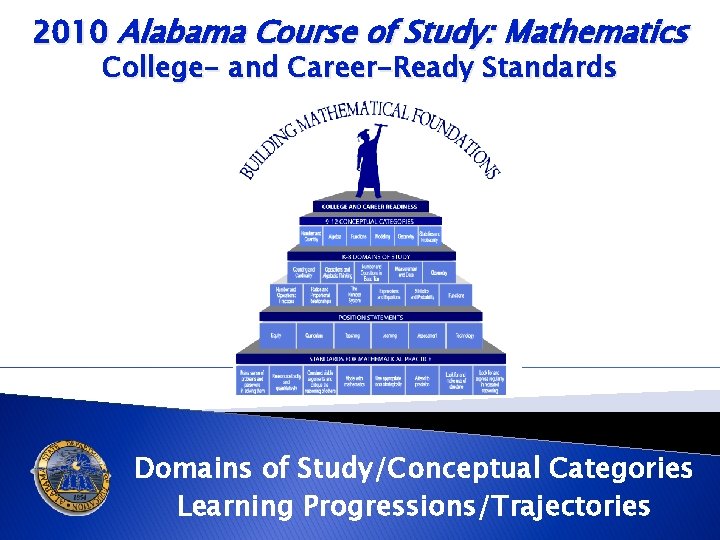
2010 Alabama Course of Study: Mathematics College- and Career-Ready Standards Domains of Study/Conceptual Categories Learning Progressions/Trajectories
CHARACTERISTICS � Aligned with college and work expectations � Written in a clear, understandable, and consistent format � Designed to include rigorous content and application of knowledge through high-order skills � Formulated upon strengths and lessons of current state standards � Informed by high-performing mathematics curricula in other countries to ensure all students are prepared to succeed in our global economy and society � Grounded on sound evidence-based research
2010 Alabama Course of Study: Mathematics �Coherent �Rigorous �Well-Articulated �Enables Students to Make Connections
Coherence �Articulated progressions of topics and performances that are developmental and connected to other progressions. �Conceptual understanding and procedural skills stressed equally. �Real-world/Situational expected. application
FOCUS �Key ideas, understandings, and skills are identified. �Deep learning stressed.
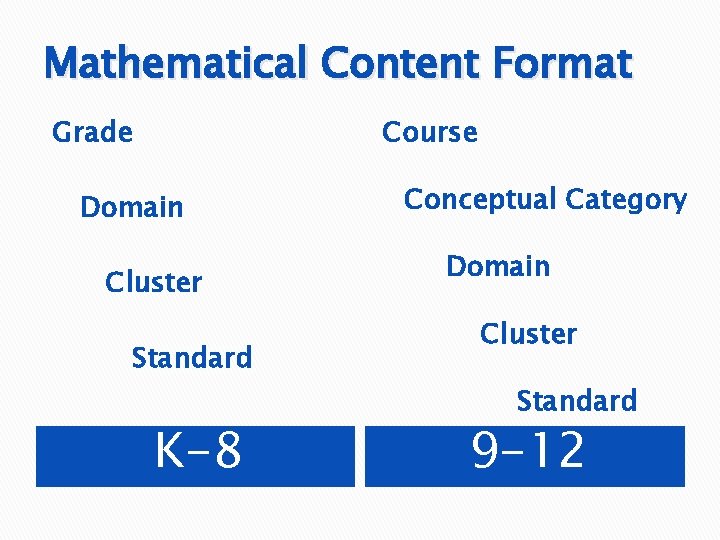
Mathematical Content Format Grade Course Domain Cluster Standard K-8 Conceptual Category Domain Cluster Standard 9 -12
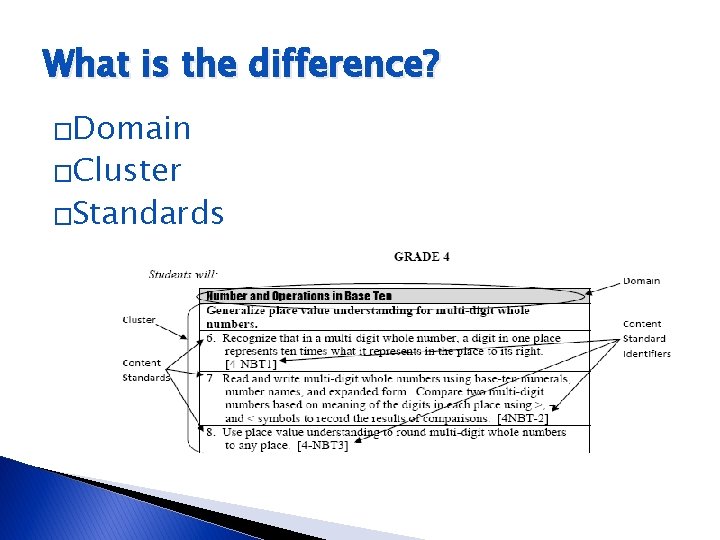
What is the difference? �Domain �Cluster �Standards
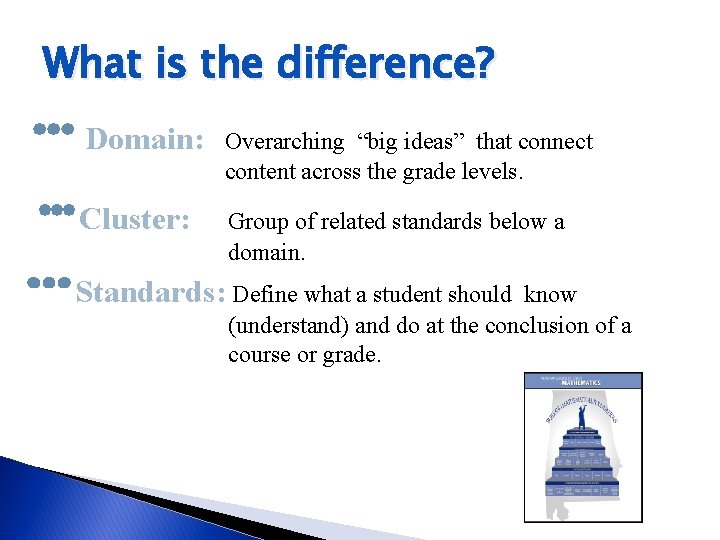
What is the difference? Domain: Overarching “big ideas” that connect content across the grade levels. Cluster: Group of related standards below a domain. Standards: Define what a student should know (understand) and do at the conclusion of a course or grade.
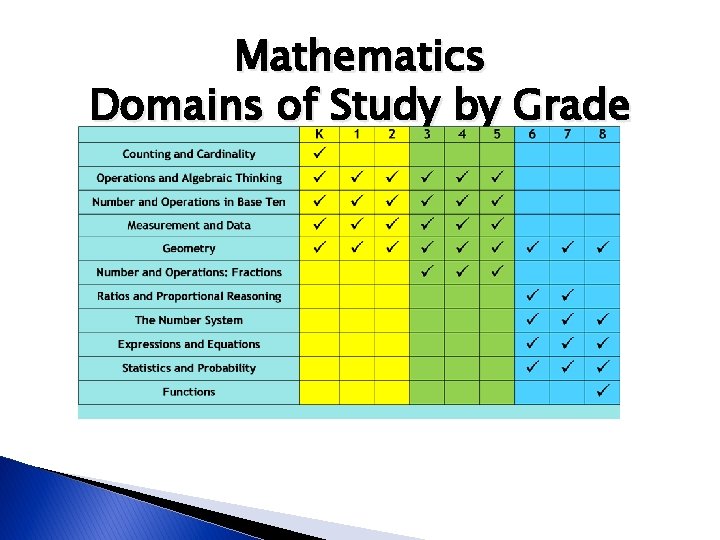
K-8 Domains �Illustrate progression of increasing complexity from grade to grade. �Organize standards within each grade. Note: Domains typically span a few grades.
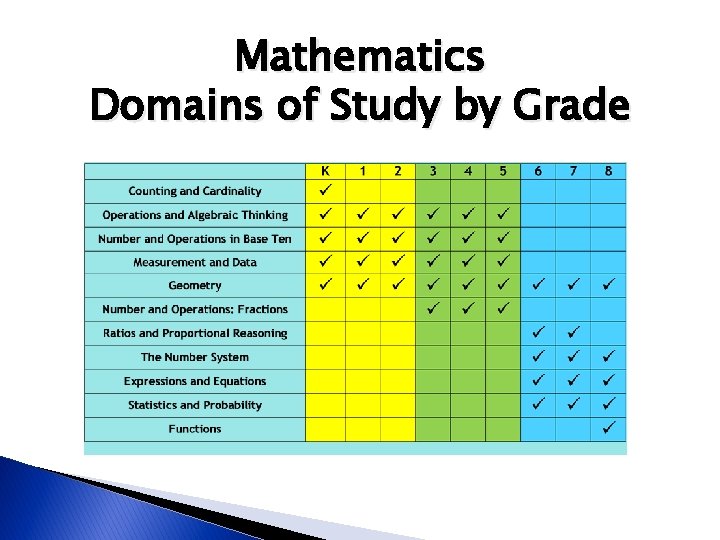
Mathematics Domains of Study by Grade
K-8 Clusters �May appear in multiple grades. �Illustrate progression of increasing complexity from grade to grade.
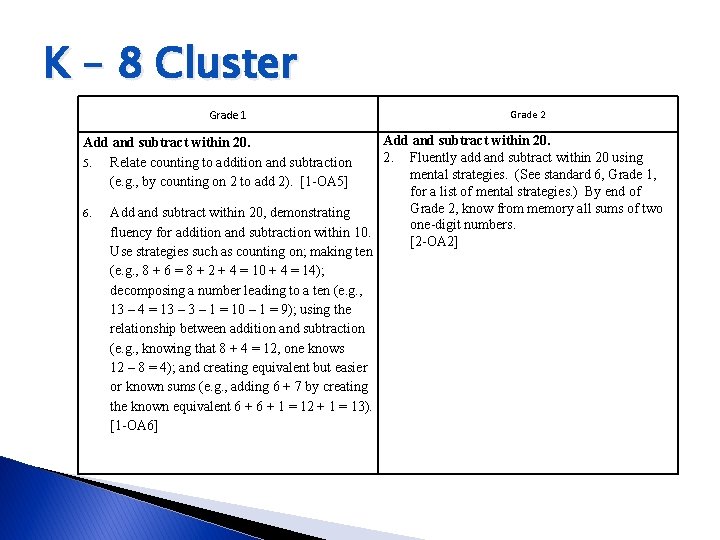
K – 8 Cluster Grade 1 Add and subtract within 20. 2. Fluently add and subtract within 20 using mental strategies. (See standard 6, Grade 1, for a list of mental strategies. ) By end of Grade 2, know from memory all sums of two Add and subtract within 20, demonstrating one-digit numbers. fluency for addition and subtraction within 10. [2 -OA 2] Use strategies such as counting on; making ten (e. g. , 8 + 6 = 8 + 2 + 4 = 10 + 4 = 14); decomposing a number leading to a ten (e. g. , 13 – 4 = 13 – 1 = 10 – 1 = 9); using the relationship between addition and subtraction (e. g. , knowing that 8 + 4 = 12, one knows 12 – 8 = 4); and creating equivalent but easier or known sums (e. g. , adding 6 + 7 by creating the known equivalent 6 + 1 = 12 + 1 = 13). [1 -OA 6] Add and subtract within 20. 5. Relate counting to addition and subtraction (e. g. , by counting on 2 to add 2). [1 -OA 5] 6. Grade 2
Content Standards � Content standards in this document contain minimum required content. � Each content standard completes the phrase “Students will. ” � Reflect both mathematical understandings and skills, which are equally important.

How Many Skills? 7. Read and write multi-digit whole numbers using base-ten numerals, number names, and expanded form. Compare two multi-digit numbers based on meanings of the digits in each place, using >, =, and < symbols to record the results of comparisons. [4 -NBT 2] 4. 7. 1. Read multi-digit whole numbers using base-ten numerals. 4. 7. 2. Read multi-digit whole numbers using number names. 4. 7. 3. Read multi-digit whole numbers using expanded form. 4. 7. 4. Write multi-digit whole numbers using base-ten numerals. 4. 7. 5. Write multi-digit whole numbers using number names. 4. 7. 6. Write multi-digit whole numbers using expanded form 4. 7. 7. Compare two multi-digit numbers based on meanings of the digits in each place, using >, =, and < symbols to record the results of comparisons.
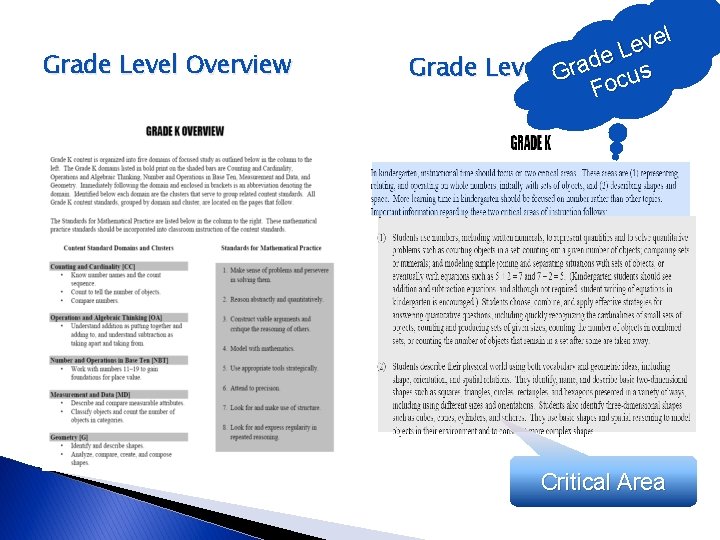
Grade Level Overview el v e L e d Grade Level Narrative Gra ocus F Critical Area
CRITICAL AREAS BRING FOCUS TO THE NEW STANDARDS
CRITICAL AREAS �Identify Two to Four Areas of Concentrated Study. �Bring Focus to the Standards. �Provide the Big Ideas for Building Curriculum and Guiding Instruction.
INVESTIGATING CRITICAL AREAS � In grade-level groups, analyze the critical areas for your grade. � Underline the key words and phrases that help summarize this area. � Design a poster that describes the focus of your grade level.
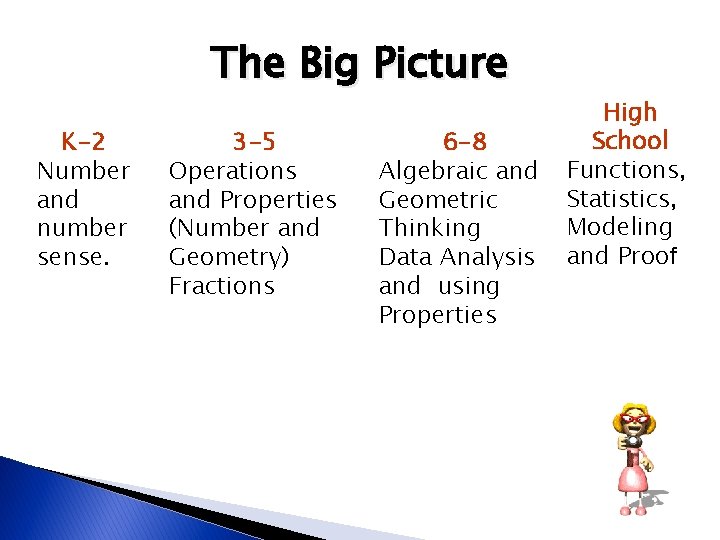
The Big Picture K-2 Number and number sense. 3 -5 Operations and Properties (Number and Geometry) Fractions 6 -8 Algebraic and Geometric Thinking Data Analysis and using Properties High School Functions, Statistics, Modeling and Proof
Mathematics Domains of Study by Grade
What Are Learning Trajectories? And What Are They Good For? —Save the Last Word for Me!!! Read the excerpt from Learning Trajectories in Mathematics: A Foundation for Standards, Curriculum, Assessment, and Instruction � Identify 3 ideas that you are willing to talk about with colleagues. � Highlight the location in the text where these ideas appear.
Learning Progressions/Trajectories Confrey (2007) “Developing sequenced obstacles and challenges for students…absent the insights about meaning that derive from careful study of learning, would be unfortunate and unwise. ” CCSS, p. 4 “… the development of these Standards began with research-based learning progressions detailing what is known today about how students’ mathematical knowledge, skill, and understanding develop over time. ”
Directions for Save the Last Word for Me � Designate a facilitator and timekeeper. � A volunteer begins by reading the sentence(s) from the text that embody one of his/her selected ideas. The speaker does not comment on the text at this point. � The individual to right of first speaker takes up to one minute to comment on the selected text. � The next two individuals also take up to one minute to comment on the initial speaker’s idea. � The individual selecting the idea has up to 1 minutes to react to colleagues’ ideas and to talk about why she or he thought this was important. � Another group member introduces one idea, and the group follows the same protocol. Continue until all members have shared or until time is called.
Learning Trajectories – sometimes called learning progressions – are sequences of learning experiences hypothesized and designed to build a deep and increasingly sophisticated understanding of core concepts and practices within various disciplines. The trajectories are based on empirical evidence of how students’ understanding actually develops in response to instruction and where it might break down. Daro, Mosher, & Corcoran, 2011
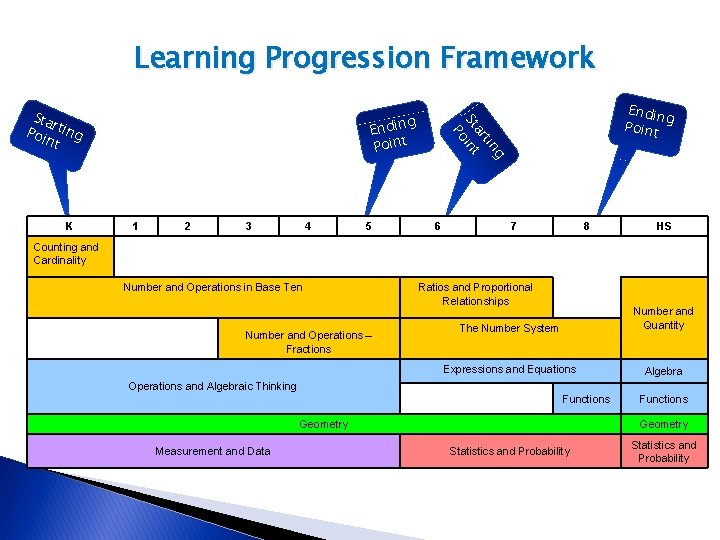
Learning Progression Framework Sta r Poi ting nt 1 2 3 4 5 Endin g Point g tin ar St int Po K g Endin Point 6 7 8 HS Counting and Cardinality Number and Operations in Base Ten Number and Operations – Fractions Operations and Algebraic Thinking Ratios and Proportional Relationships The Number System Number and Quantity Expressions and Equations Algebra Functions Geometry Measurement and Data Functions Geometry Statistics and Probability

Investigating the Domains/Conceptual Categories � � Domains provide common learning progressions. Curriculum and teaching methods are not dictated. Standards are not presented in a specific instructional order. Standards should be presented in a manner that is consistent with local collaboration.
What Goes On The Chart Paper? � Summary and/or representation of how the concept of the use of numbers grows throughout your grade band. � Easy for others to interpret or understand. � Visual large enough for all to see. � More than just the letters and numbers of the standards – include key words or phrases.
Let’s Talk About It! �As a table group, consider your journey through the 2010 ACOS as you studied the concept of the use of numbers K-12. �What did you learn? �What surprised you? �What questions do you still have?
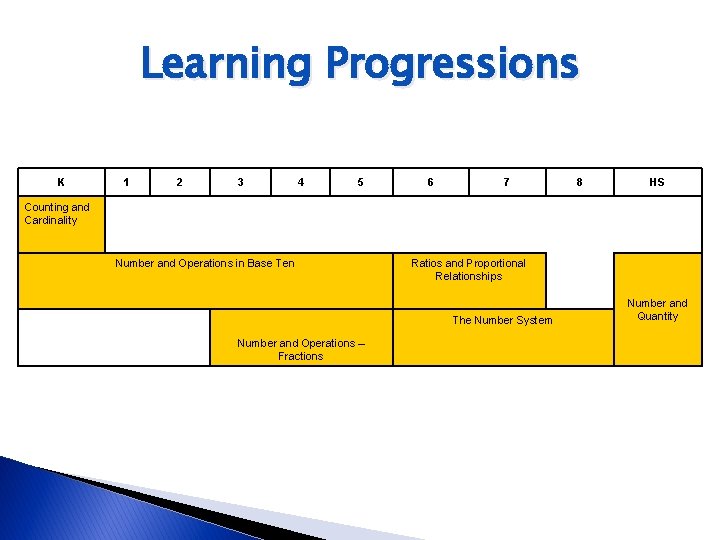
Learning Progressions K 1 2 3 4 5 6 7 8 HS Counting and Cardinality Number and Operations in Base Ten Ratios and Proportional Relationships The Number System Number and Operations – Fractions Number and Quantity
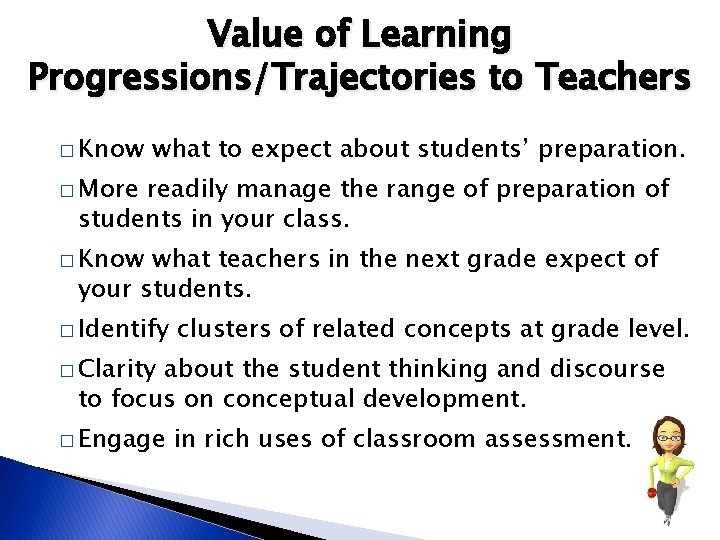
Value of Learning Progressions/Trajectories to Teachers � Know what to expect about students’ preparation. � More readily manage the range of preparation of students in your class. � Know what teachers in the next grade expect of your students. � Identify clusters of related concepts at grade level. � Clarity about the student thinking and discourse to focus on conceptual development. � Engage in rich uses of classroom assessment.
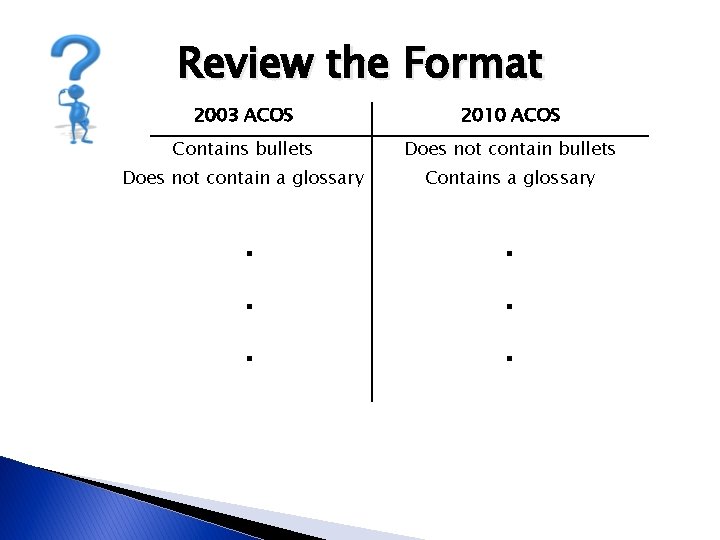
Review the Format 2003 ACOS 2010 ACOS Contains bullets Does not contain a glossary Contains a glossary . . .
? ? Questions ? ?
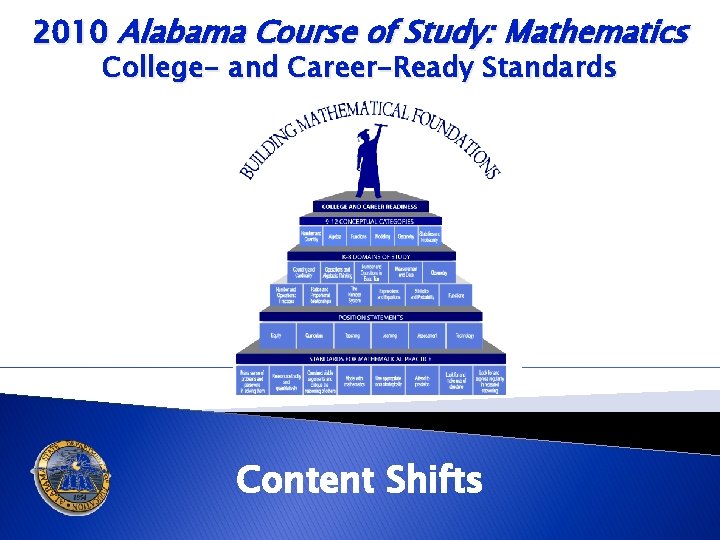
2010 Alabama Course of Study: Mathematics College- and Career-Ready Standards Content Shifts
Content Correlation… KINDERGARTEN - GEOMETRY Analyze, compare, create, and compose shapes. 20. Analyze and compare two- and three-dimensional shapes, in different sizes and orientations, using informal language to describe their similarities, differences, parts (e. g. , number of sides and vertices/’corners’) and other attributes (e. g. , having sides of equal length. ) [K-G 4] 21. Model shapes in the world by building shapes from components (e. g. , sticks and clay balls) and drawing shapes. [K-G 5] 22. Compose simple shapes to form larger shapes. [K-G 6]
2010 ACOS Kindergarten 21. Model shapes in the world by building shapes from components (e. g. , sticks and clay balls) and drawing shapes. [K-G 5] 22. Compose simple shapes to form larger shapes. [K-G 6] CORRELATES WITH 2003 ACOS Kindergarten 6. Create combinations of rectangles, squares, circles, and triangles using shapes or drawings.
KINDERGARTEN - GEOMETRY Analyze, compare, create, and compose shapes. 20. Analyze and compare two- and three-dimensional shapes, in different sizes and orientations, using informal language to describe their similarities, differences, parts (e. g. , number of sides and vertices/’corners’) and other attributes (e. g. , having sides of equal length. ) [K-G 4] 21. Model shapes in the world by building shapes from components (e. g. , sticks and clay balls) and drawing shapes. [K-G 5] 22. Compose simple shapes to form larger shapes. [K-G 6]
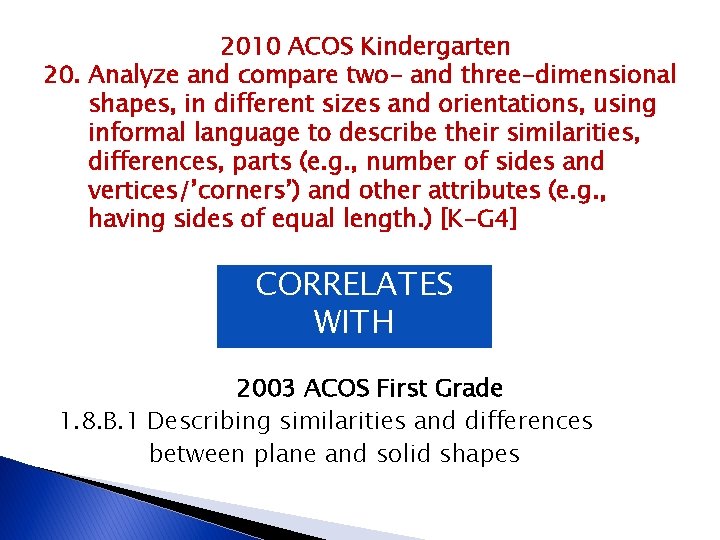
2010 ACOS Kindergarten 20. Analyze and compare two- and three-dimensional shapes, in different sizes and orientations, using informal language to describe their similarities, differences, parts (e. g. , number of sides and vertices/’corners’) and other attributes (e. g. , having sides of equal length. ) [K-G 4] CORRELATES WITH 2003 ACOS First Grade 1. 8. B. 1 Describing similarities and differences between plane and solid shapes
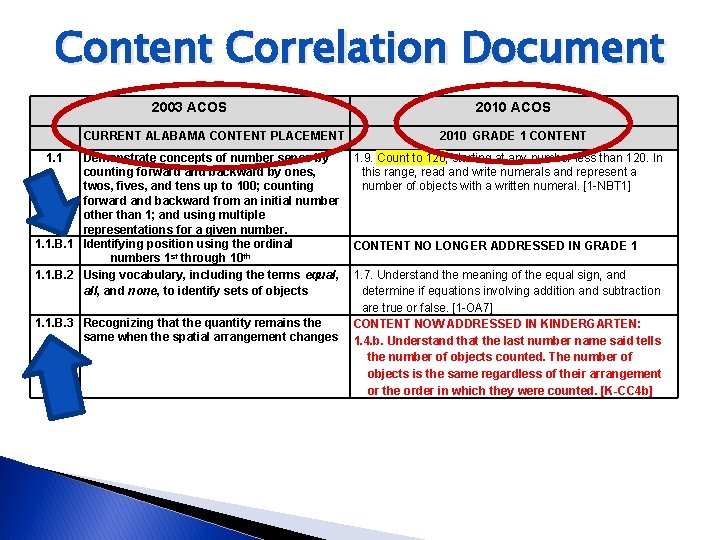
Content Correlation Document 2003 ACOS CURRENT ALABAMA CONTENT PLACEMENT 1. 1 Demonstrate concepts of number sense by counting forward and backward by ones, twos, fives, and tens up to 100; counting forward and backward from an initial number other than 1; and using multiple representations for a given number. 1. 1. B. 1 Identifying position using the ordinal numbers 1 st through 10 th 1. 1. B. 2 Using vocabulary, including the terms equal, all, and none, to identify sets of objects 1. 1. B. 3 Recognizing that the quantity remains the same when the spatial arrangement changes 2010 ACOS 2010 GRADE 1 CONTENT 1. 9. Count to 120, starting at any number less than 120. In this range, read and write numerals and represent a number of objects with a written numeral. [1 -NBT 1] CONTENT NO LONGER ADDRESSED IN GRADE 1 1. 7. Understand the meaning of the equal sign, and determine if equations involving addition and subtraction are true or false. [1 -OA 7] CONTENT NOW ADDRESSED IN KINDERGARTEN: 1. 4. b. Understand that the last number name said tells the number of objects counted. The number of objects is the same regardless of their arrangement or the order in which they were counted. [K-CC 4 b]
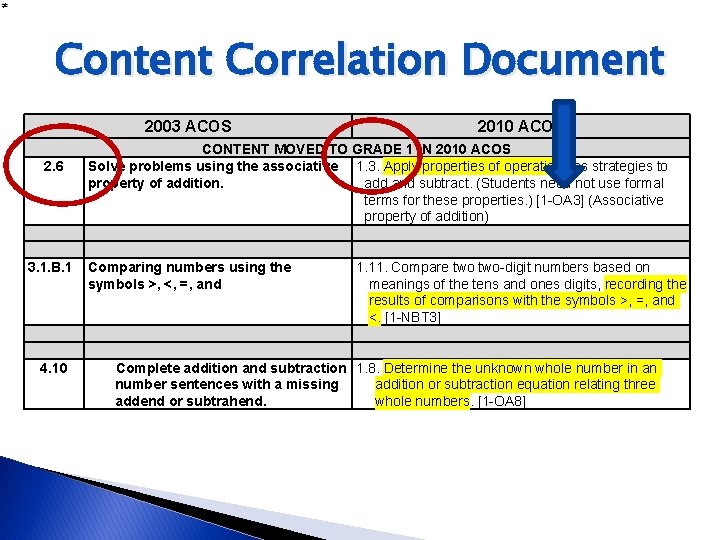
Content Correlation Document 2003 ACOS 2. 6 3. 1. B. 1 4. 10 2010 ACOS CONTENT MOVED TO GRADE 1 IN 2010 ACOS Solve problems using the associative 1. 3. Apply properties of operations as strategies to property of addition. add and subtract. (Students need not use formal terms for these properties. ) [1 -OA 3] (Associative property of addition) Comparing numbers using the symbols >, <, =, and 1. 11. Compare two-digit numbers based on meanings of the tens and ones digits, recording the results of comparisons with the symbols >, =, and <. [1 -NBT 3] Complete addition and subtraction 1. 8. Determine the unknown whole number in an number sentences with a missing addition or subtraction equation relating three addend or subtrahend. whole numbers. [1 -OA 8]
Content Correlation Document NEW GRADE 1 CONTENT IN 2010 ACOS None
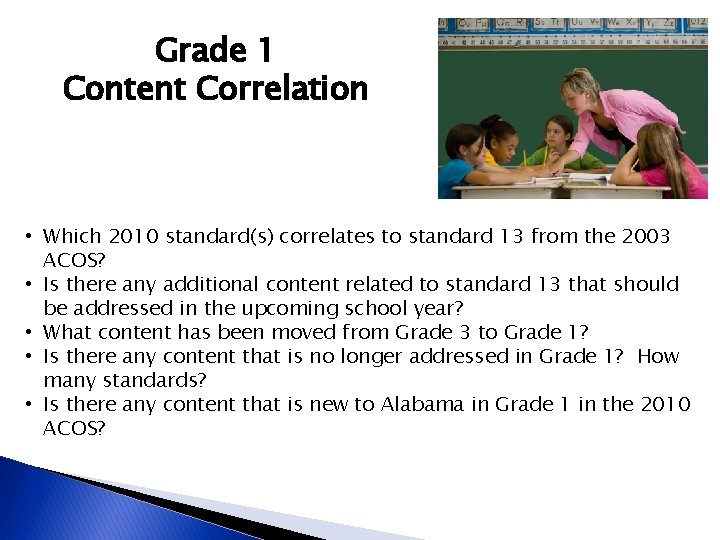
Grade 1 Content Correlation • Which 2010 standard(s) correlates to standard 13 from the 2003 ACOS? • Is there any additional content related to standard 13 that should be addressed in the upcoming school year? • What content has been moved from Grade 3 to Grade 1? • Is there any content that is no longer addressed in Grade 1? How many standards? • Is there any content that is new to Alabama in Grade 1 in the 2010 ACOS?
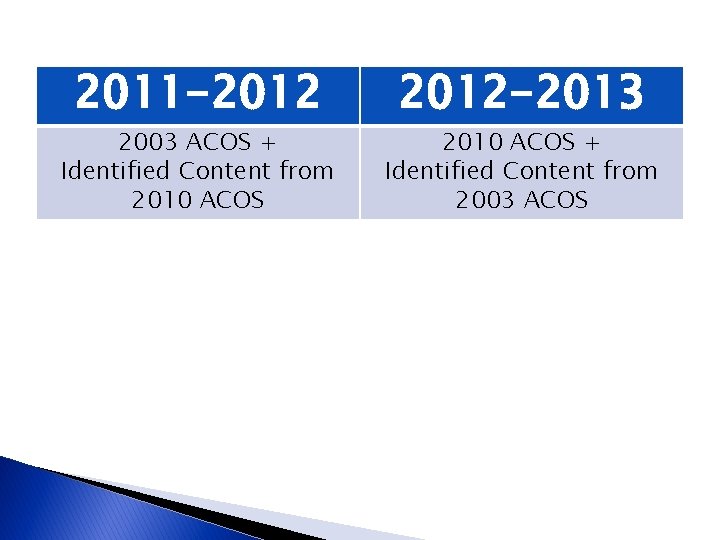
How can I be sure my students are prepared for the implementation of the 2010 ACOS in the 2012 -2013 school year?
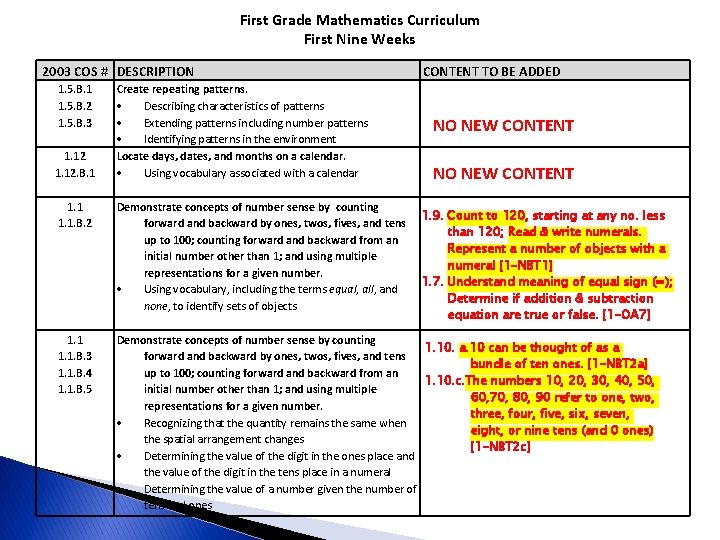
First Grade Mathematics Curriculum First Nine Weeks 2003 COS # DESCRIPTION 1. 5. B. 1 1. 5. B. 2 1. 5. B. 3 1. 12. B. 1 Create repeating patterns. Describing characteristics of patterns Extending patterns including number patterns Identifying patterns in the environment Locate days, dates, and months on a calendar. Using vocabulary associated with a calendar CONTENT TO BE ADDED NO NEW CONTENT 1. 1. B. 2 Demonstrate concepts of number sense by counting forward and backward by ones, twos, fives, and tens up to 100; counting forward and backward from an initial number other than 1; and using multiple representations for a given number. Using vocabulary, including the terms equal, all, and none, to identify sets of objects 1. 1. B. 3 1. 1. B. 4 1. 1. B. 5 Demonstrate concepts of number sense by counting 1. 10. a. 10 can be thought of as a forward and backward by ones, twos, fives, and tens bundle of ten ones. [1 -NBT 2 a] up to 100; counting forward and backward from an 1. 10. c. The numbers 10, 20, 30, 40, 50, initial number other than 1; and using multiple 60, 70, 80, 90 refer to one, two, representations for a given number. three, four, five, six, seven, Recognizing that the quantity remains the same when eight, or nine tens (and 0 ones) the spatial arrangement changes [1 -NBT 2 c] Determining the value of the digit in the ones place and the value of the digit in the tens place in a numeral Determining the value of a number given the number of tens and ones 1. 9. Count to 120, starting at any no. less than 120; Read & write numerals. Represent a number of objects with a numeral [1 -NBT 1] 1. 7. Understand meaning of equal sign (=); Determine if addition & subtraction equation are true or false. [1 -OA 7]
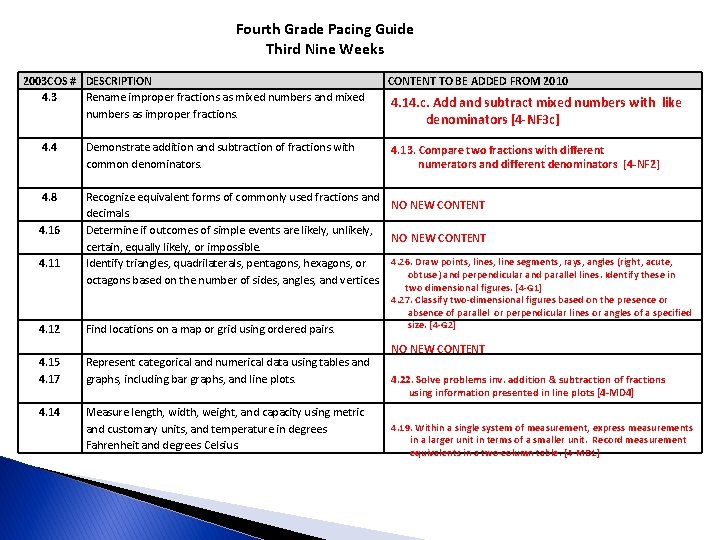
Fourth Grade Pacing Guide Third Nine Weeks 2003 COS # DESCRIPTION 4. 3 Rename improper fractions as mixed numbers and mixed numbers as improper fractions. CONTENT TO BE ADDED FROM 2010 4. 14. c. Add and subtract mixed numbers with like denominators [4 -NF 3 c] 4. 4 Demonstrate addition and subtraction of fractions with common denominators. 4. 8 Recognize equivalent forms of commonly used fractions and NO NEW CONTENT decimals. Determine if outcomes of simple events are likely, unlikely, NO NEW CONTENT certain, equally likely, or impossible. 4. 26. Draw points, line segments, rays, angles (right, acute, Identify triangles, quadrilaterals, pentagons, hexagons, or obtuse) and perpendicular and parallel lines. Identify these in octagons based on the number of sides, angles, and vertices. 4. 16 4. 11 4. 12 Find locations on a map or grid using ordered pairs. 4. 15 4. 17 Represent categorical and numerical data using tables and graphs, including bar graphs, and line plots. 4. 14 Measure length, width, weight, and capacity using metric and customary units, and temperature in degrees Fahrenheit and degrees Celsius. 4. 13. Compare two fractions with different numerators and different denominators [4 -NF 2] two dimensional figures. [4 -G 1] 4. 27. Classify two-dimensional figures based on the presence or absence of parallel or perpendicular lines or angles of a specified size. [4 -G 2] NO NEW CONTENT 4. 22. Solve problems inv. addition & subtraction of fractions using information presented in line plots [4 -MD 4] 4. 19. Within a single system of measurement, express measurements in a larger unit in terms of a smaller unit. Record measurement equivalents in a two-column table. [4 -MD 1]
What about the assessments?
2011 -2012 2003 ACOS + Identified Content from 2010 ACOS 2012 -2013 2010 ACOS + Identified Content from 2003 ACOS
? ? Questions ? ?
2010 Alabama Course of Study: Mathematics College- and Career-Ready Standards Algebra I in the 8 th Grade: Considerations and Consequences
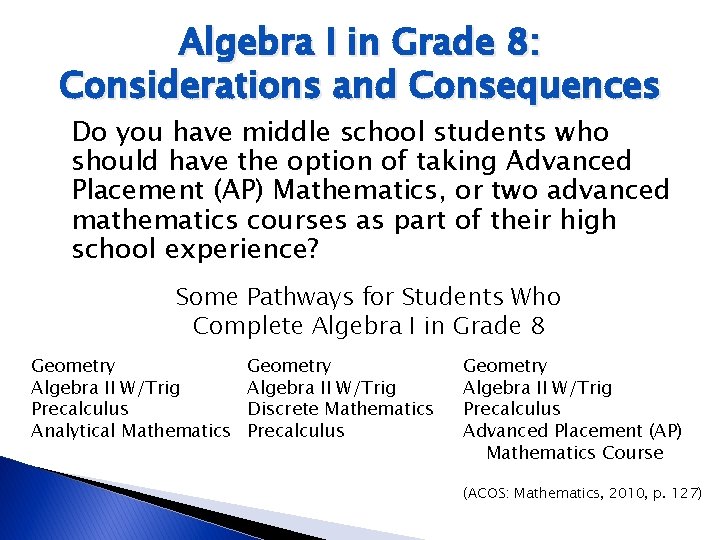
Algebra I in Grade 8: Considerations and Consequences Do you have middle school students who should have the option of taking Advanced Placement (AP) Mathematics, or two advanced mathematics courses as part of their high school experience? Some Pathways for Students Who Complete Algebra I in Grade 8 Geometry Algebra II W/Trig Precalculus Analytical Mathematics Geometry Algebra II W/Trig Discrete Mathematics Precalculus Geometry Algebra II W/Trig Precalculus Advanced Placement (AP) Mathematics Course (ACOS: Mathematics, 2010, p. 127)
Algebra I in Grade 8: Considerations and Consequences � “Systems offering Algebra I in the eighth grade have the responsibility of ensuring that all Algebra I course content standards and Grade 8 course content standards be included in instruction. ” (ACOS: Mathematics, 2010, p. 81) � The State Department of Education will provide further guidance and training (Phase II) in the fall of 2011 relative to issues local education agencies may encounter in providing an Algebra I course in Grade 8.
Algebra I in Grade 8: Considerations and Consequences Decisions to accelerate students into a high school Algebra I course before Grade 9 should not be rushed. Placing students into an Algebra I course too early should be avoided at all costs. Local education agency’s decision should: Be Advertised Be Equitable Provide Written Policy Decisions to accelerate students into a high school Algebra I course before Grade 9 should be based on solid evidence of student learning.
Algebra I in Grade 8: Considerations and Consequences Ø Ø Not all students are ready for Algebra I in Grade 8. The 2010 COS Algebra I content is not the same as the Algebra I content in earlier Alabama Courses of Study. Much of what was previously included in Algebra I will now be taught in Grades 6 -8 in the 2010 COS.
? ? Questions ? ?
http: //alex. state. al. us/ccrs
Contact Information ALSDE Office of Student Learning Curriculum and Instruction Section Cindy Freeman, Mathematics Specialist Phone: 334. 353. 5321 E-mail: cfreeman@alsde. edu
- Slides: 125