
Quality Factors Hvad er Kvalitet Conformance to specification

- Slides: 21
Quality Factors
Hvad er Kvalitet? • Conformance to specification: Quality that is defined as a matter of products and services • Meeting customer needs: Quality that is identified independent of any measurable characteristics.
Hvad er Kvalitet? Del 2 Walter A. Shewhart defines quality 1. The consideration of the quality of a thing as an objective reality independent of the existence of man. (Kvantitative – tit tæt på kvalitets faktorer) 2. What we think, feel or sense as a result of the objective reality. In other word, there is a subjective side of quality. (Kvalitative – sværere at beskrive)
Kvalitet faktorer • Et redskab til • Et bedre system udvikling forløb • Et fokuseret system udvikling forløb • Afklare bruger krav • Bør indgå i krav specifikationen • NB! Det er nemmere at specificere ‘objektive’ krav end subjektive
Kvalitet faktorer DEL 2 • En række Kvalitets Modeller • Mc. Call (conform to specification) • Boehm (You can conform in diff. degree) • FURPS (Same but fewer categories – Described in Larman) • ISO – international Standardisation Organisation • 900 x – focus on process • 9126 – a la Mc. Call, Boehm, FURPS • 25010 – Newest version of SW Product Quality
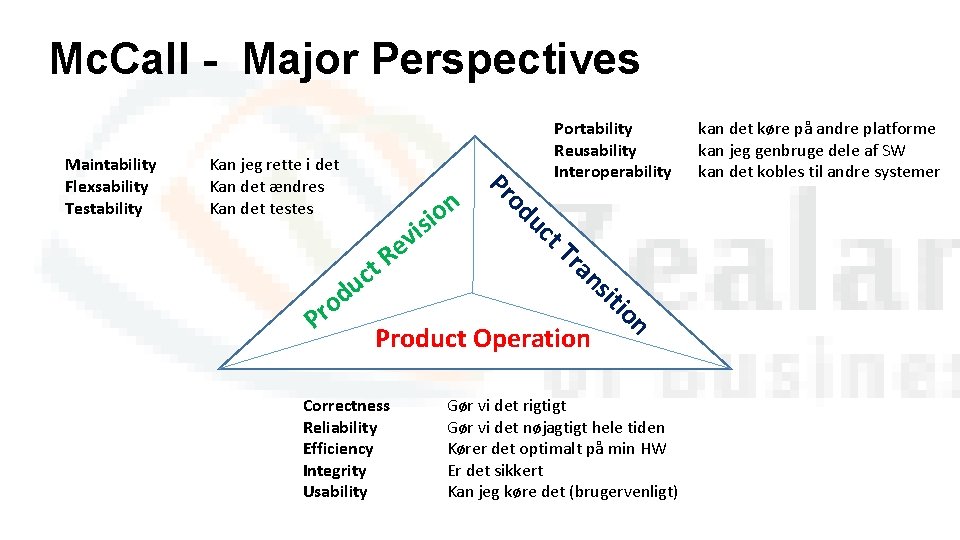
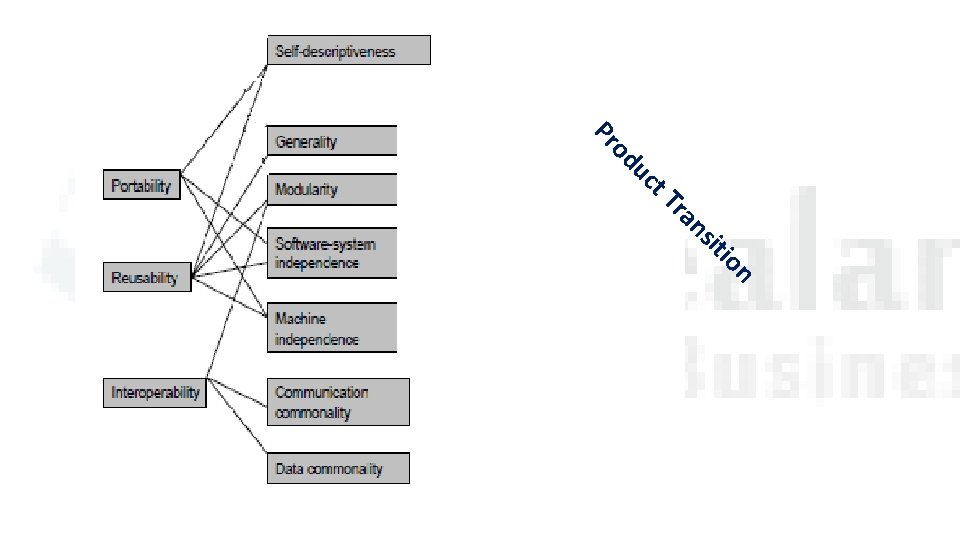
Mc. Call - Major Perspectives Kan jeg rette i det Kan det ændres Kan det testes n Product Operation Correctness Reliability Efficiency Integrity Usability on iti ns P ra d o r t. T t c u v e R uc si io od Pr Maintability Flexsability Testability Portability Reusability Interoperability Gør vi det rigtigt Gør vi det nøjagtigt hele tiden Kører det optimalt på min HW Er det sikkert Kan jeg køre det (brugervenligt) kan det køre på andre platforme kan jeg genbruge dele af SW kan det kobles til andre systemer
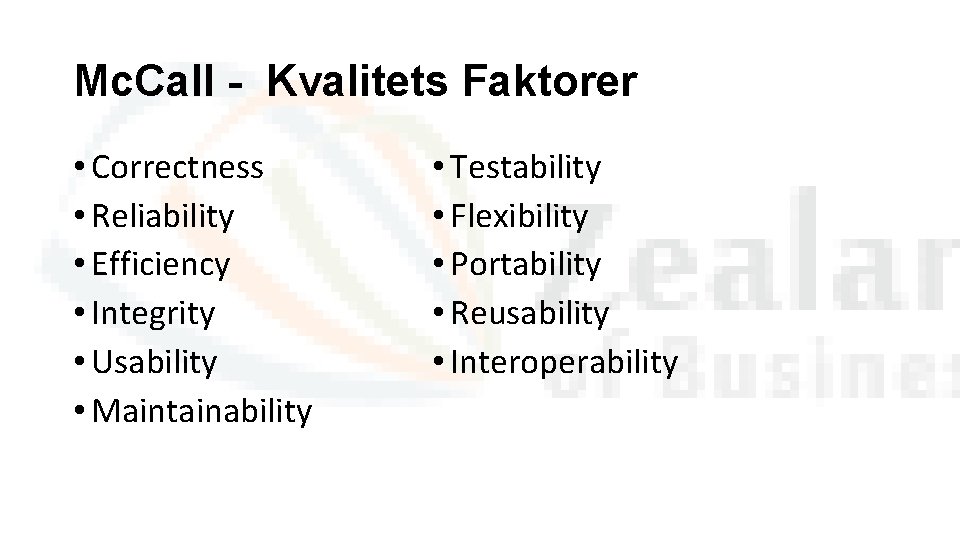
Mc. Call - Kvalitets Faktorer • Correctness • Reliability • Efficiency • Integrity • Usability • Maintainability • Testability • Flexibility • Portability • Reusability • Interoperability
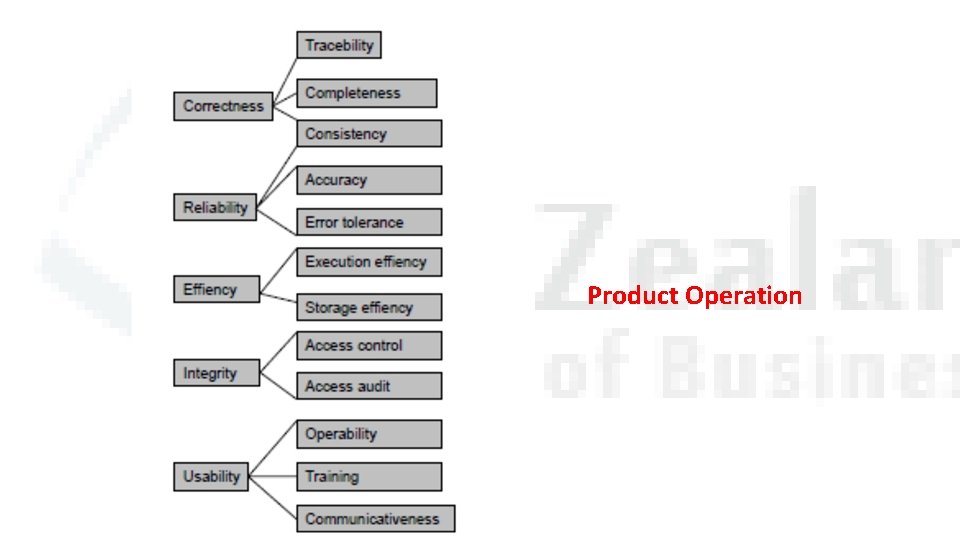
Product Operation
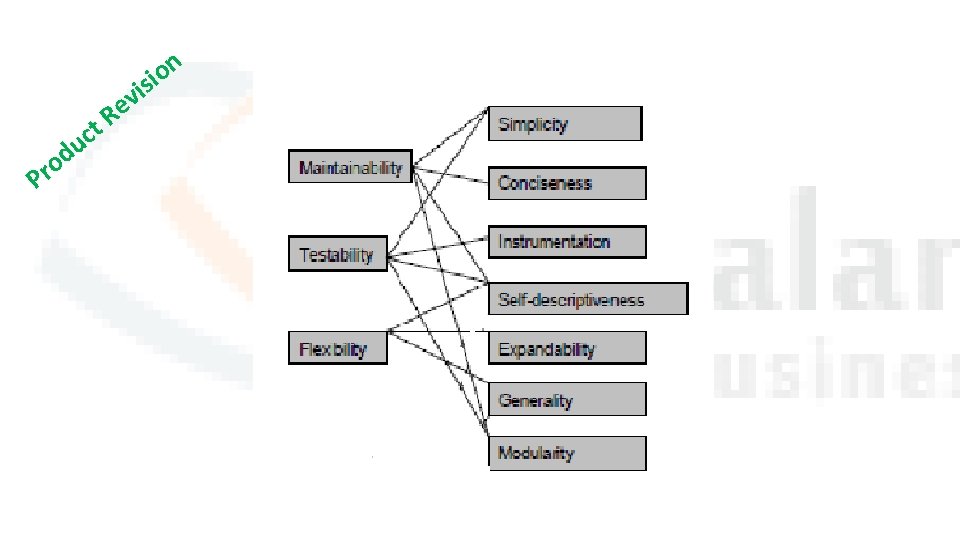
n o i vis e R t o r P c u d
ct u od Pr io sit an Tr n
FURPS • Functional features, capabilities, security. • Usability human factors, help, documentation. • Reliability frequency of failure, recoverability, predictability. • Performance response times, throughput, accuracy, availability, resource usage. • Supportability adaptability, maintainability, internationalization, configurability.
FURPS+ • Implementation resource limitations, languages and tools, hardware, . . . • Interface constraints imposed by interfacing with external systems. • Operations system management in its operational setting. • Packaging for example, a physical box. • Legal licensing and so forth.
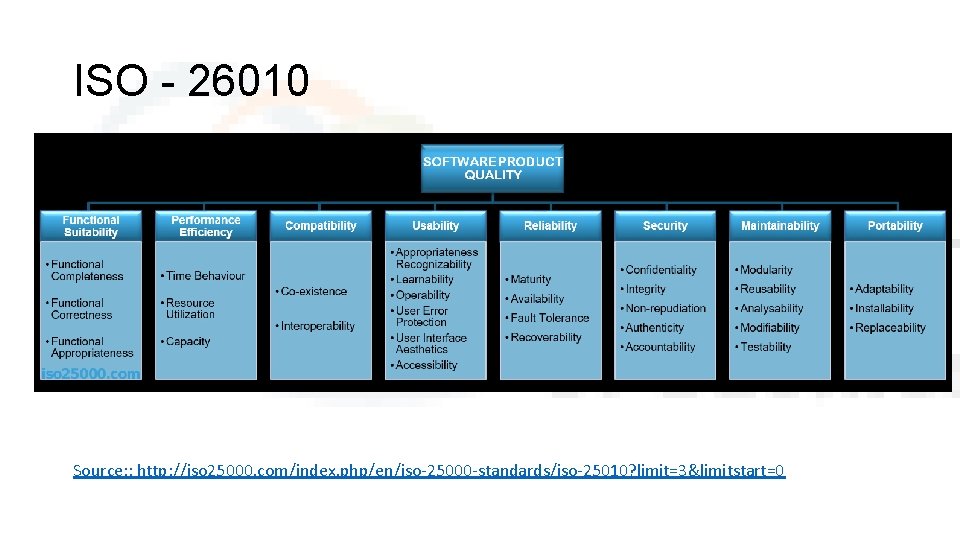
ISO - 26010 Source: : http: //iso 25000. com/index. php/en/iso-25000 -standards/iso-25010? limit=3&limitstart=0
ISO – 26010 – Functional Suitability • Functional completeness. • Degree to which the set of functions covers all the specified tasks and user objectives. • Functional correctness. • Degree to which a product or system provides the correct results with the needed degree of precision. • Functional appropriateness. • Degree to which the functions facilitate the accomplishment of specified tasks and objectives. Source: : http: //iso 25000. com/index. php/en/iso-25000 -standards/iso-25010? limit=3&limitstart=0
ISO – 26010 – Performance efficiency • Time behaviour. Degree to which the response and processing times and throughput rates of a product or system, when performing its functions, meet requirements. • Resource utilization. Degree to which the amounts and types of resources used by a product or system, when performing its functions, meet requirements. • Capacity. Degree to which the maximum limits of a product or system parameter meet requirements. Source: : http: //iso 25000. com/index. php/en/iso-25000 -standards/iso-25010? limit=3&limitstart=0
ISO – 26010 – Compatibility • Co-existence. Degree to which a product can perform its required functions efficiently while sharing a common environment and resources with other products, without detrimental impact on any other product. • Interoperability. Degree to which two or more systems, products or components can exchange information and use the information that has been exchanged. Source: : http: //iso 25000. com/index. php/en/iso-25000 -standards/iso-25010? limit=3&limitstart=0
ISO – 26010 – Usability • Appropriateness recognisability. Degree to which users can recognize whether a product or system is appropriate for their needs. • Learnability. Degree to which a product or system can be used by specified users to achieve specified goals of learning to use the product or system with effectiveness, efficiency, freedom from risk and satisfaction in a specified context of use. • Operability. Degree to which a product or system has attributes that make it easy to operate and control. • User error protection. Degree to which a system protects users against making errors. • User interface aesthetics. Degree to which a user interface enables pleasing and satisfying interaction for the user. • Accessibility. Degree to which a product or system can be used by people with the widest range of characteristics and capabilities to achieve a specified goal in a specified context of use. Source: : http: //iso 25000. com/index. php/en/iso-25000 -standards/iso-25010? limit=3&limitstart=0
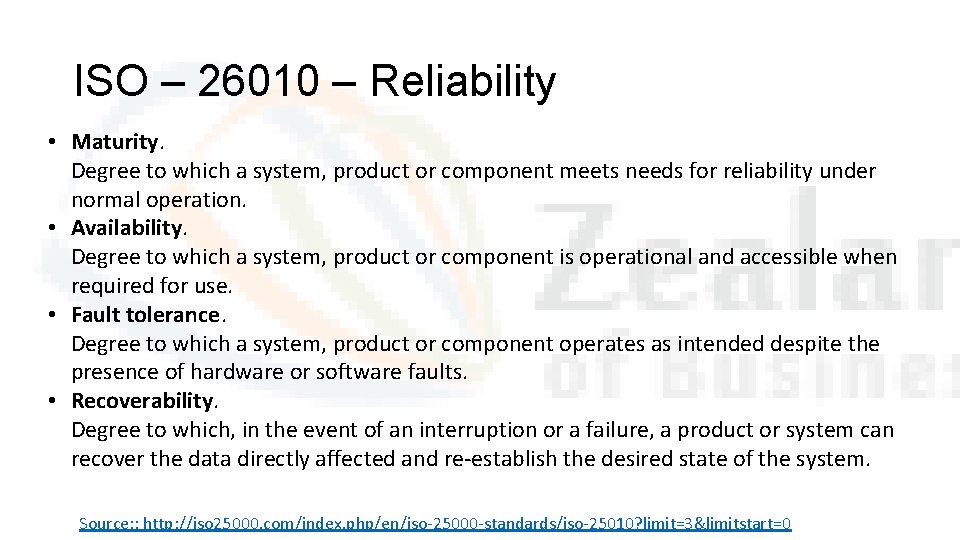
ISO – 26010 – Reliability • Maturity. Degree to which a system, product or component meets needs for reliability under normal operation. • Availability. Degree to which a system, product or component is operational and accessible when required for use. • Fault tolerance. Degree to which a system, product or component operates as intended despite the presence of hardware or software faults. • Recoverability. Degree to which, in the event of an interruption or a failure, a product or system can recover the data directly affected and re-establish the desired state of the system. Source: : http: //iso 25000. com/index. php/en/iso-25000 -standards/iso-25010? limit=3&limitstart=0
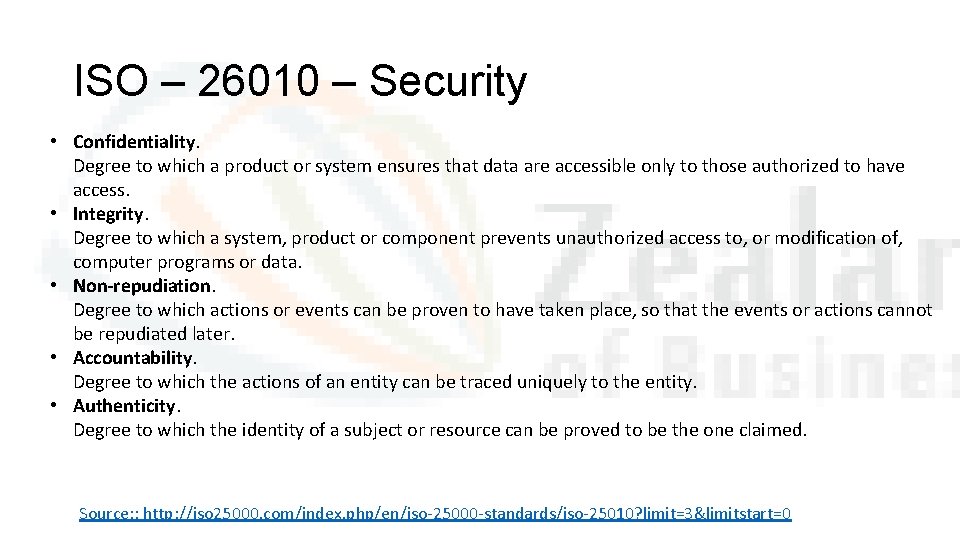
ISO – 26010 – Security • Confidentiality. Degree to which a product or system ensures that data are accessible only to those authorized to have access. • Integrity. Degree to which a system, product or component prevents unauthorized access to, or modification of, computer programs or data. • Non-repudiation. Degree to which actions or events can be proven to have taken place, so that the events or actions cannot be repudiated later. • Accountability. Degree to which the actions of an entity can be traced uniquely to the entity. • Authenticity. Degree to which the identity of a subject or resource can be proved to be the one claimed. Source: : http: //iso 25000. com/index. php/en/iso-25000 -standards/iso-25010? limit=3&limitstart=0
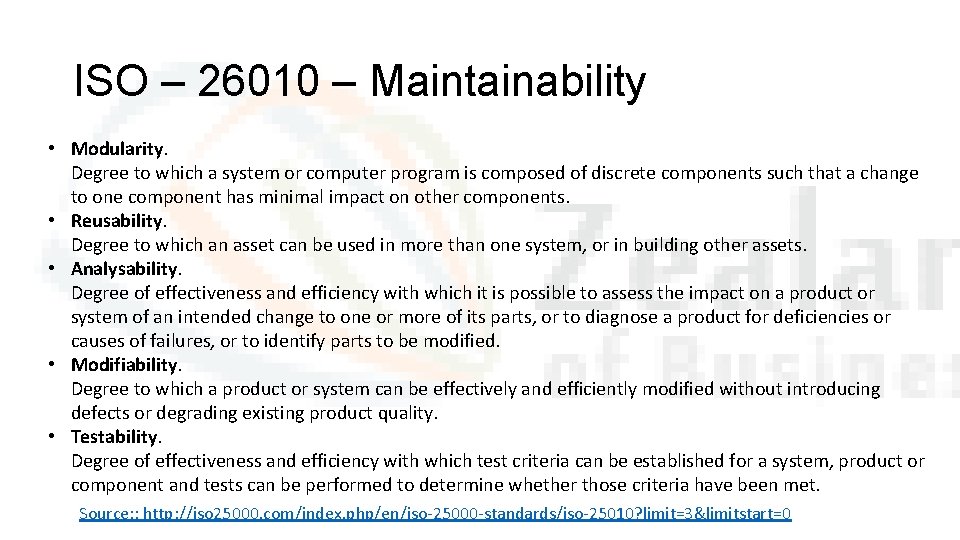
ISO – 26010 – Maintainability • Modularity. Degree to which a system or computer program is composed of discrete components such that a change to one component has minimal impact on other components. • Reusability. Degree to which an asset can be used in more than one system, or in building other assets. • Analysability. Degree of effectiveness and efficiency with which it is possible to assess the impact on a product or system of an intended change to one or more of its parts, or to diagnose a product for deficiencies or causes of failures, or to identify parts to be modified. • Modifiability. Degree to which a product or system can be effectively and efficiently modified without introducing defects or degrading existing product quality. • Testability. Degree of effectiveness and efficiency with which test criteria can be established for a system, product or component and tests can be performed to determine whether those criteria have been met. Source: : http: //iso 25000. com/index. php/en/iso-25000 -standards/iso-25010? limit=3&limitstart=0
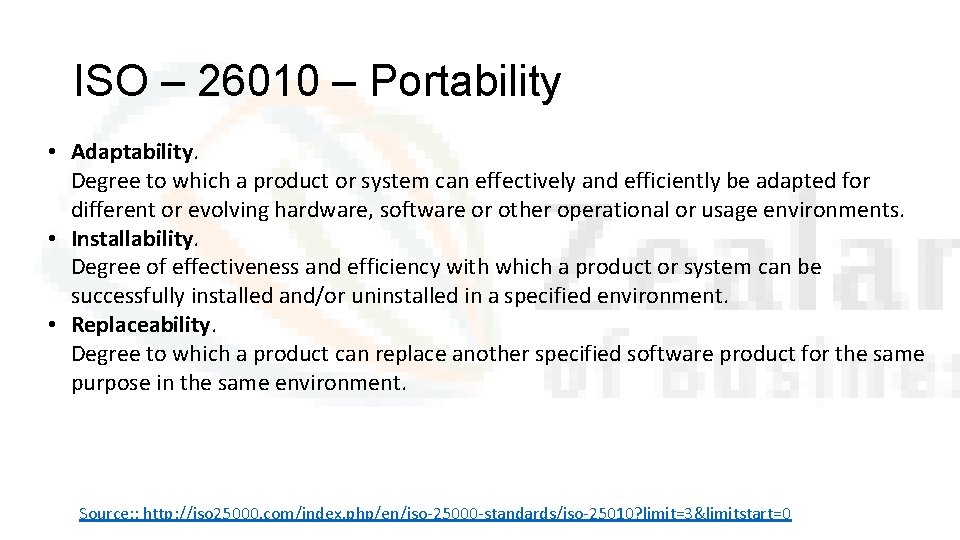
ISO – 26010 – Portability • Adaptability. Degree to which a product or system can effectively and efficiently be adapted for different or evolving hardware, software or other operational or usage environments. • Installability. Degree of effectiveness and efficiency with which a product or system can be successfully installed and/or uninstalled in a specified environment. • Replaceability. Degree to which a product can replace another specified software product for the same purpose in the same environment. Source: : http: //iso 25000. com/index. php/en/iso-25000 -standards/iso-25010? limit=3&limitstart=0