Price Leadership Revisited Joint work with Daisuke Hirata

- Slides: 39
Price Leadership Revisited Joint work with Daisuke Hirata Oligopoly Theory 1
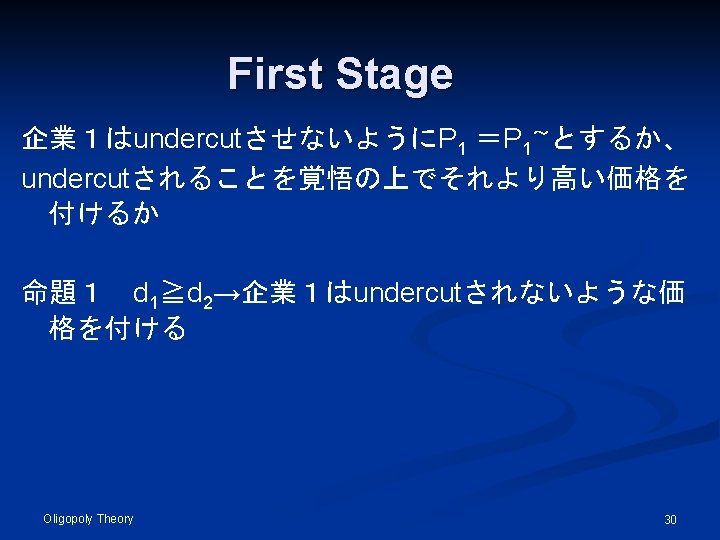
Plan of the presentation (1) Rough Sketch of Our Model and Our Results (2) Explanation of Ono (1978) and Other Existing Works (3) Mutual Beneficial Leadership and Endogenous Timing (4) Price Leadership Revisited (5) Results and Implications Oligopoly Theory 2
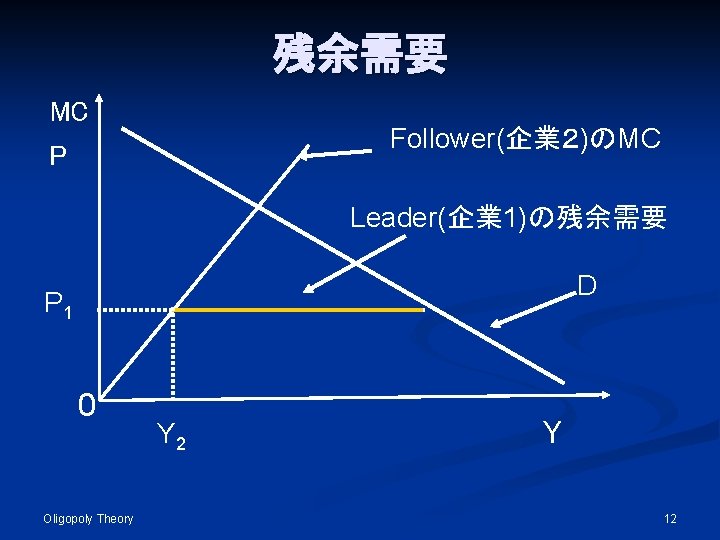
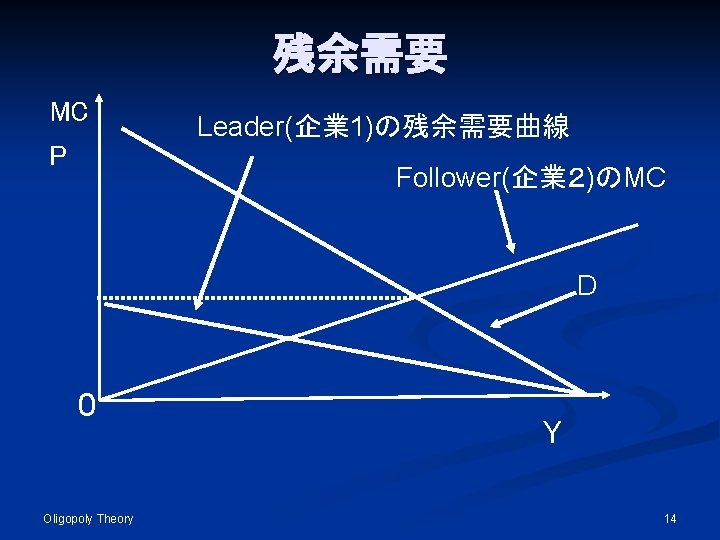
残余需要 MC Follower(企業2)のMC P Leader(企業 1)の残余需要 D P 1 0 Oligopoly Theory Y 2 Y 12
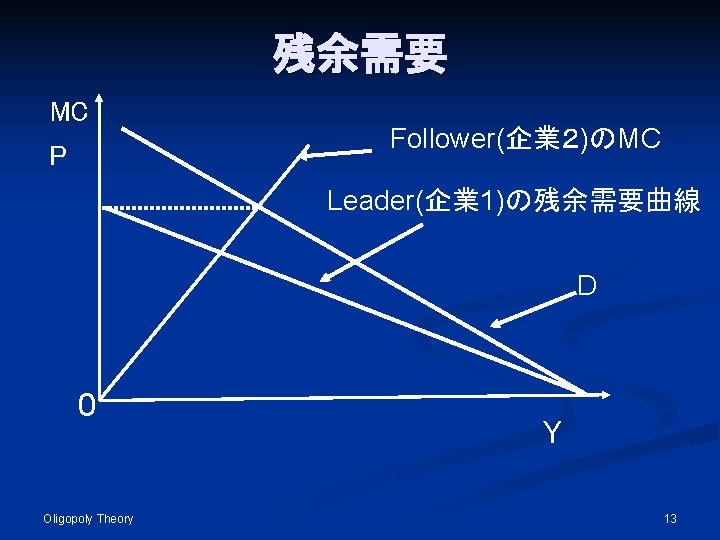
残余需要 MC P Follower(企業2)のMC Leader(企業 1)の残余需要曲線 D 0 Oligopoly Theory Y 13
残余需要 MC P Leader(企業 1)の残余需要曲線 Follower(企業2)のMC D 0 Oligopoly Theory Y 14
Contribution of Ono (1978) (1)Timing Game に関する先駆的業績 (2)Price Leadershipに関する先駆的な業績 ~低費用企業がLeaderになる (3)Mutual Beneficial Price Leadershipが現れる 条件を明らかにする ~両企業の費用格差が十分に大きいとき低費用企 業のLeadershipはMutual Beneficial (Pareto Dominant Oligopoly Theory 16
Subsequent Works ・Ono (1982) Oligopoly Version ・Denekere and Kovenock (1992) ~Capacity Constraint →より多くのcapacityを持つ企業がLeaderに ・ Amir and Stepanova (2006)~差別化された財 →低費用企業がleaderになり、費用格差が十分大 きければこれがmutual beneficial ・Ishibashi (2007) ~Capacity Constraint+repeated game →より多くのcapacityを持つ企業がLeaderに Oligopoly Theory 17
Risk Dominance vs Pareto Dominance 一般論としてrisk dominance とPareto dominance の乖離を議論してもしょうがない。Timing Game の文脈で考える。 Observable Delayを使う。 Oligopoly Theory 20
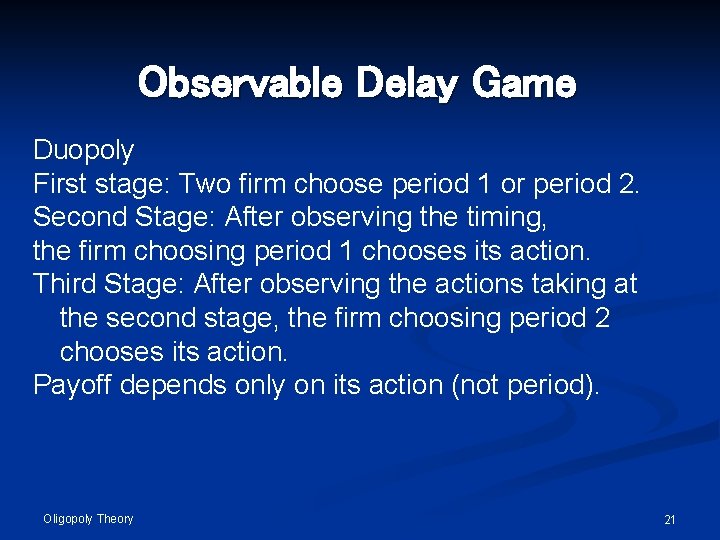
Observable Delay Game Duopoly First stage: Two firm choose period 1 or period 2. Second Stage: After observing the timing, the firm choosing period 1 chooses its action. Third Stage: After observing the actions taking at the second stage, the firm choosing period 2 chooses its action. Payoff depends only on its action (not period). Oligopoly Theory 21
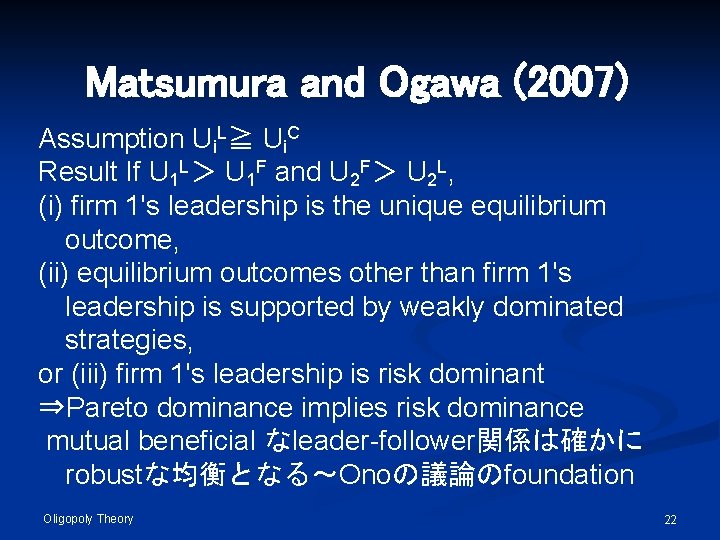
Matsumura and Ogawa (2007) Assumption Ui. L≧ Ui. C Result If U 1 L> U 1 F and U 2 F> U 2 L, (i) firm 1's leadership is the unique equilibrium outcome, (ii) equilibrium outcomes other than firm 1's leadership is supported by weakly dominated strategies, or (iii) firm 1's leadership is risk dominant ⇒Pareto dominance implies risk dominance mutual beneficial なleader-follower関係は確かに robustな均衡となる~Onoの議論のfoundation Oligopoly Theory 22
Ono(1978)の問題点2 (2)followerのprice-cutting strategyは本当に均衡 戦略になるのか? Oligopoly Theory 23
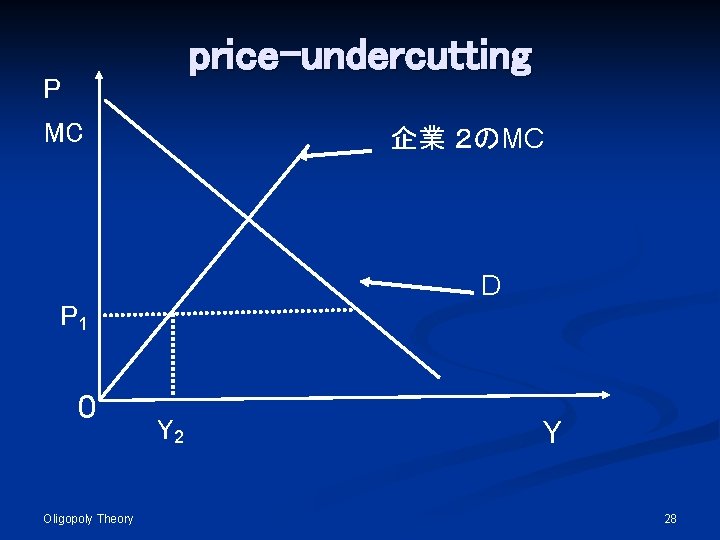
price-undercutting P MC 企業 2のMC D P 1 0 Oligopoly Theory Y 28
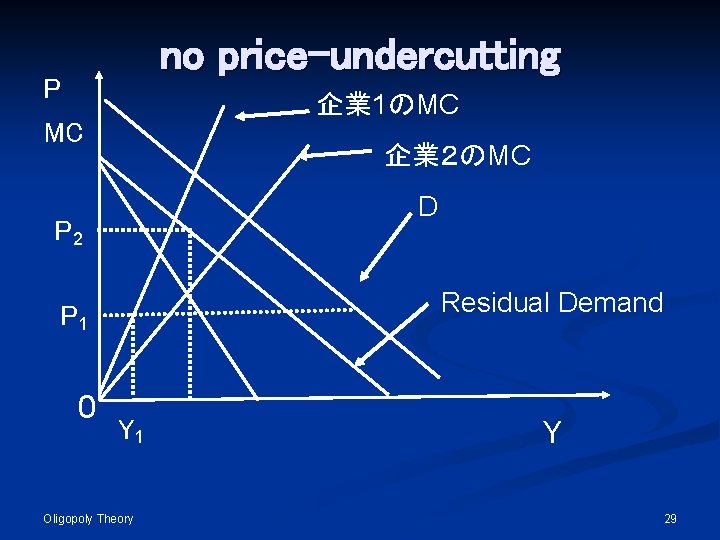
no price-undercutting P 企業 1のMC MC 企業2のMC D P 2 Residual Demand P 1 0 Y 1 Oligopoly Theory Y 29
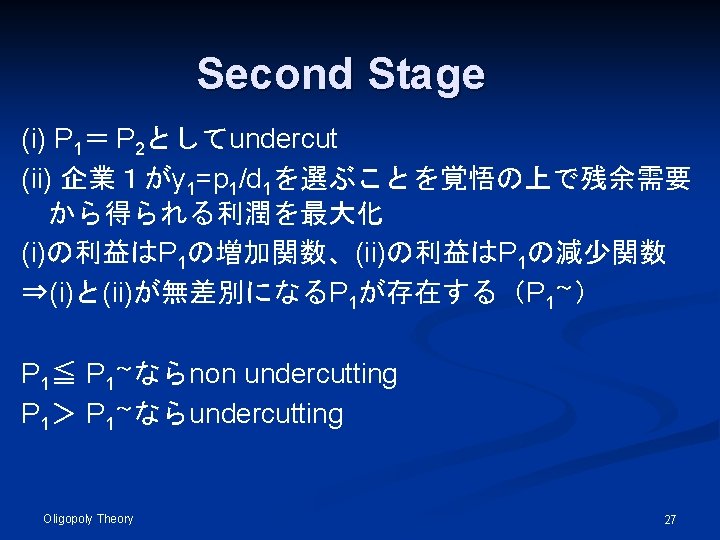
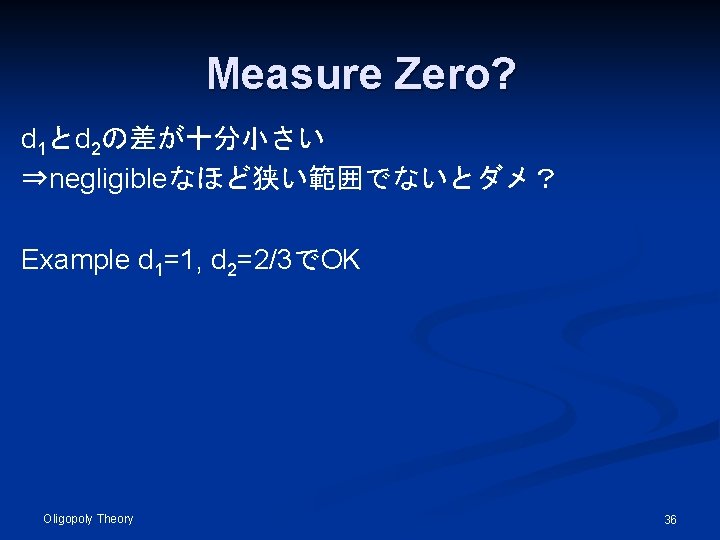
Measure Zero? d 1とd 2の差が十分小さい ⇒negligibleなほど狭い範囲でないとダメ? Example d 1=1, d 2=2/3でOK Oligopoly Theory 36