
Tidal Alignments Large Scale Structure Christopher Hirata Edinburgh
Tidal Alignments & Large Scale Structure Christopher Hirata Edinburgh, 22 Jul 2010 C. H. , MNRAS 399: 1074 (2009) – Redshift space distortions Elisabeth Krause & C. H. , 1004. 3611 – Bispectrum

Outline 1. 2. 3. 4. 5. Growth of Structure Tidal Alignments & Effects on LSS Formalism & Models Redshift Space Distortions Bispectrum
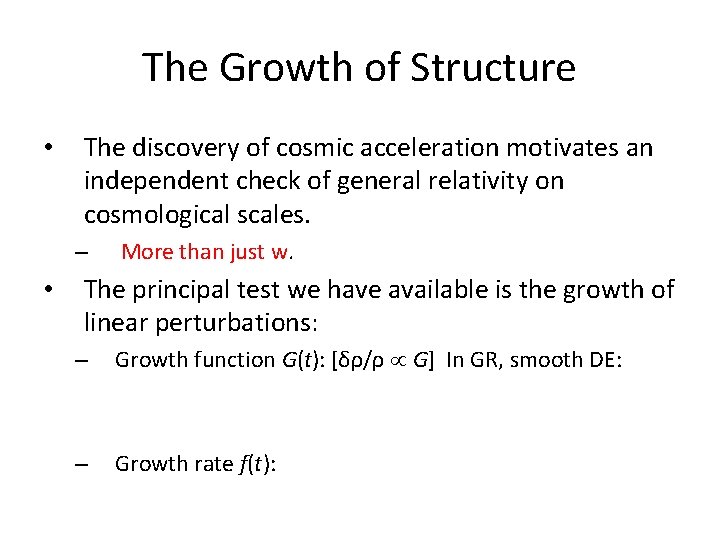
The Growth of Structure • The discovery of cosmic acceleration motivates an independent check of general relativity on cosmological scales. – • More than just w. The principal test we have available is the growth of linear perturbations: – Growth function G(t): [δρ/ρ G] In GR, smooth DE: – Growth rate f(t):
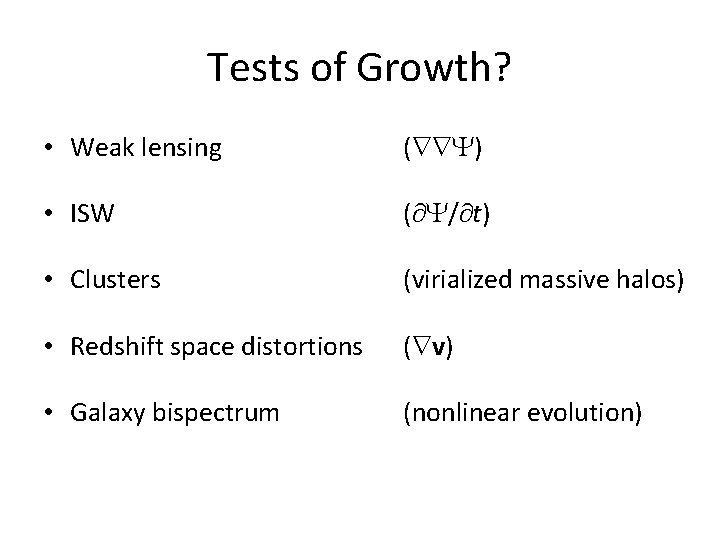
Tests of Growth? • Weak lensing ( ) • ISW ( / t) • Clusters (virialized massive halos) • Redshift space distortions ( v) • Galaxy bispectrum (nonlinear evolution)
Tidal Alignments • Galaxy orientation determined by: – Triaxiality (ellipticals) – Disk angular momentum (spirals) • Both affected by large-scale tidal fields – somehow: – Affects principal axes of collapse of halo – Tidal torquing of infalling baryons • Clearly an issue for weak lensing. Much effort by community on this. • BUT when combined with orientation-dependent selection biases: Also an issue for large scale structure!

Example: Redshift Space Distortions Hirata 2009
Formalism • A galaxy’s orientation is described by a matrix Q SO(3), or equivalently the 3 Euler angles (θ, ϕ, ψ). • The observer looks at the galaxy along the line-of-sight unit vector n S 2. • The probability of observing the galaxy is modulated by a function Υ of the line of sight in the galaxy frame:
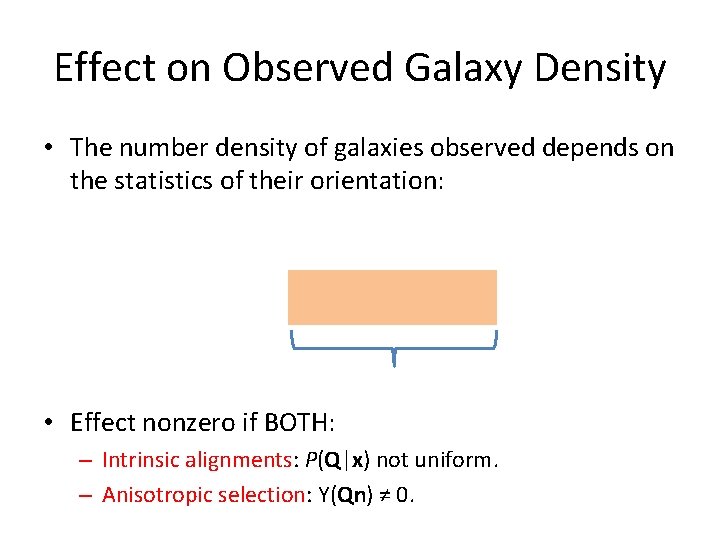
Effect on Observed Galaxy Density • The number density of galaxies observed depends on the statistics of their orientation: • Effect nonzero if BOTH: – Intrinsic alignments: P(Q|x) not uniform. – Anisotropic selection: Υ(Qn) ≠ 0.
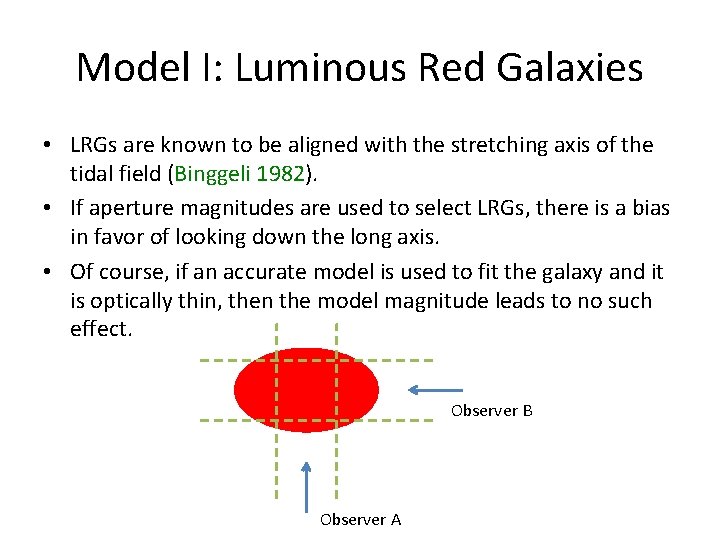
Model I: Luminous Red Galaxies • LRGs are known to be aligned with the stretching axis of the tidal field (Binggeli 1982). • If aperture magnitudes are used to select LRGs, there is a bias in favor of looking down the long axis. • Of course, if an accurate model is used to fit the galaxy and it is optically thin, then the model magnitude leads to no such effect. Observer B Observer A
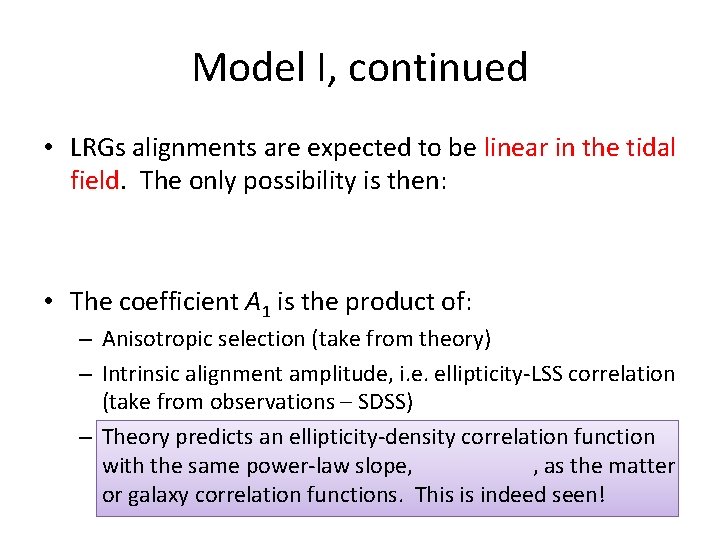
Model I, continued • LRGs alignments are expected to be linear in the tidal field. The only possibility is then: • The coefficient A 1 is the product of: – Anisotropic selection (take from theory) – Intrinsic alignment amplitude, i. e. ellipticity-LSS correlation (take from observations – SDSS) – Theory predicts an ellipticity-density correlation function with the same power-law slope, , as the matter or galaxy correlation functions. This is indeed seen!
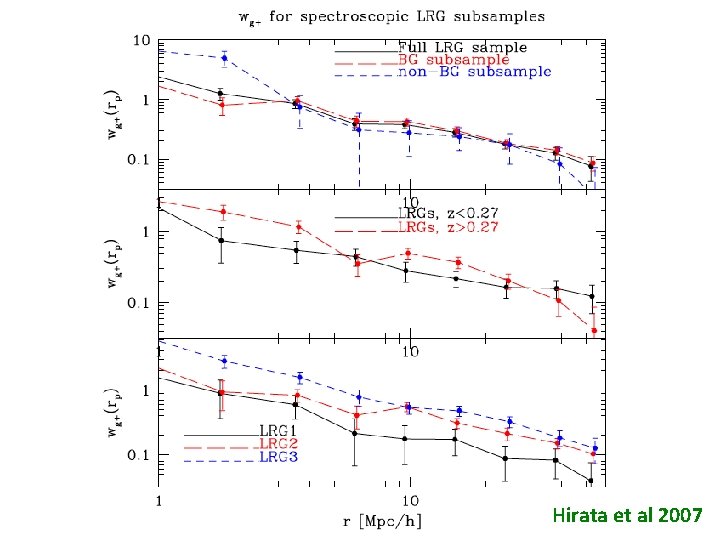
Hirata et al 2007
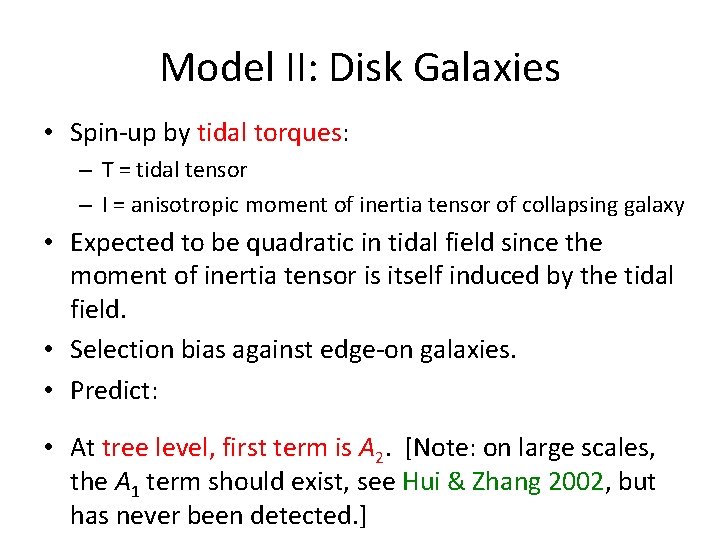
Model II: Disk Galaxies • Spin-up by tidal torques: – T = tidal tensor – I = anisotropic moment of inertia tensor of collapsing galaxy • Expected to be quadratic in tidal field since the moment of inertia tensor is itself induced by the tidal field. • Selection bias against edge-on galaxies. • Predict: • At tree level, first term is A 2. [Note: on large scales, the A 1 term should exist, see Hui & Zhang 2002, but has never been detected. ]
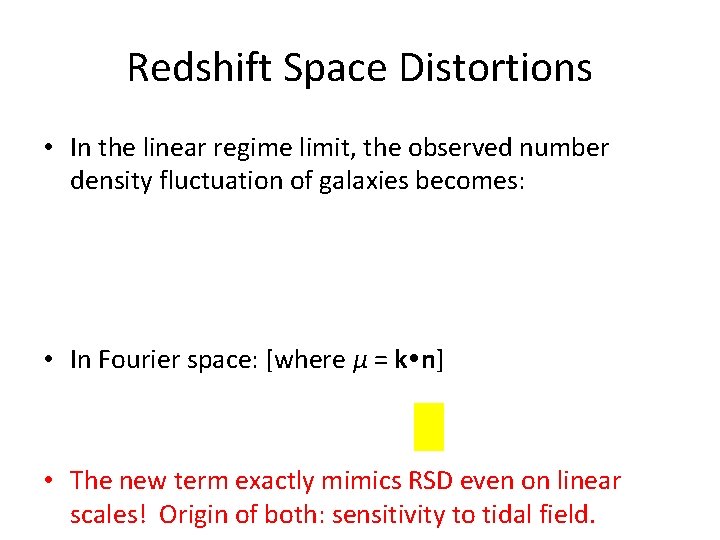
Redshift Space Distortions • In the linear regime limit, the observed number density fluctuation of galaxies becomes: • In Fourier space: [where μ = k n] • The new term exactly mimics RSD even on linear scales! Origin of both: sensitivity to tidal field.
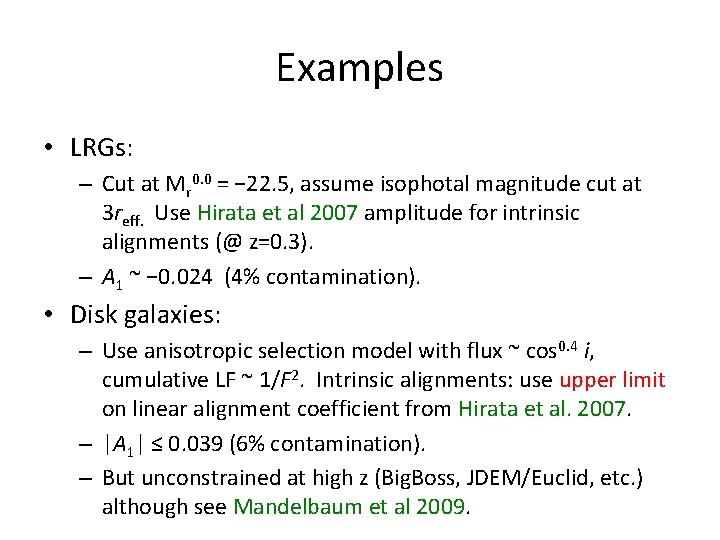
Examples • LRGs: – Cut at Mr 0. 0 = − 22. 5, assume isophotal magnitude cut at 3 reff. Use Hirata et al 2007 amplitude for intrinsic alignments (@ z=0. 3). – A 1 ~ − 0. 024 (4% contamination). • Disk galaxies: – Use anisotropic selection model with flux ~ cos 0. 4 i, cumulative LF ~ 1/F 2. Intrinsic alignments: use upper limit on linear alignment coefficient from Hirata et al. 2007. – |A 1| ≤ 0. 039 (6% contamination). – But unconstrained at high z (Big. Boss, JDEM/Euclid, etc. ) although see Mandelbaum et al 2009.
A Note on Lyman-α Emitters • Zheng et al 2010 find a strongly anisotropic clustering pattern for z=5. 7 LAEs opposite to linear RSD. – Same macrophysical effect: an anisotropic selection effect determined by the tidal forces on a galaxy. – This is exactly degenerate with β in the linear regime since the tidal field is the lowest-order feature of large scale structure to which a galaxy can be sensitive. (All others have additional powers of k. ) – Very different microphysics: Escape of Lyman-α radiation along directions of high velocity gradient. Zheng et al 2010 aligns the surrounding IGM whereas Hirata 2009 aligns the galaxy itself.
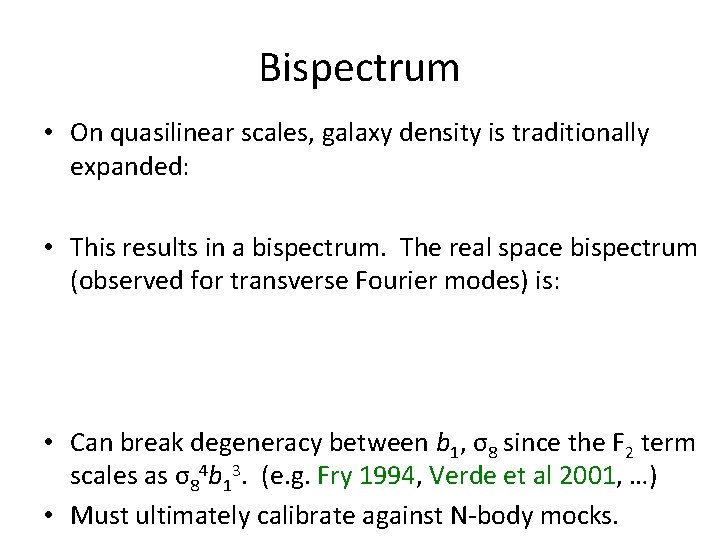
Bispectrum • On quasilinear scales, galaxy density is traditionally expanded: • This results in a bispectrum. The real space bispectrum (observed for transverse Fourier modes) is: • Can break degeneracy between b 1, σ8 since the F 2 term scales as σ84 b 13. (e. g. Fry 1994, Verde et al 2001, …) • Must ultimately calibrate against N-body mocks.
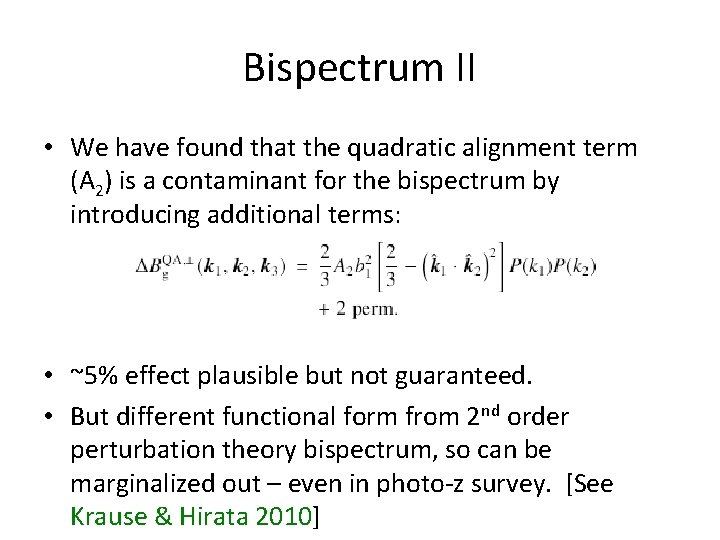
Bispectrum II • We have found that the quadratic alignment term (A 2) is a contaminant for the bispectrum by introducing additional terms: • ~5% effect plausible but not guaranteed. • But different functional form from 2 nd order perturbation theory bispectrum, so can be marginalized out – even in photo-z survey. [See Krause & Hirata 2010]
Conclusions • Tidal galaxy alignments, when combined with anisotropic selection effects, can affect LSS observables. • In particular, has implications for measuring the growth of structure: – Redshift space distortions: exactly degenerate in linear regime. – Bispectrum: not exactly degenerate in quasilinear regime, can simultaneously fit out albeit with some increase in error bars. • Cures: Judicious galaxy selection to reduce orientation dependent biases? Modeling?
- Slides: 18