Presentation Pro Magruders American Government C H A
- Slides: 26
Presentation Pro Magruder’s American Government C H A P T E R 20 Civil Liberties: Protecting Individual Rights © 2001 by Prentice Hall, Inc.
C H A P T E R 20 Civil Liberties: Protecting Individual Rights SECTION 1 Due Process of Law SECTION 2 Freedom and Security of the Person SECTION 3 Rights of the Accused SECTION 4 Punishment Go To Section: 1 2 3 4 Chapter 20
SECTION 1 Due Process of Law • How is the meaning of due process of law set out in the 5 th and 14 th amendments? • What is police power and how does it relate to civil rights? • What is the right of privacy and where are its origins in constitutional law? Go To Section: 1 2 3 4 Chapter 20, Section 1
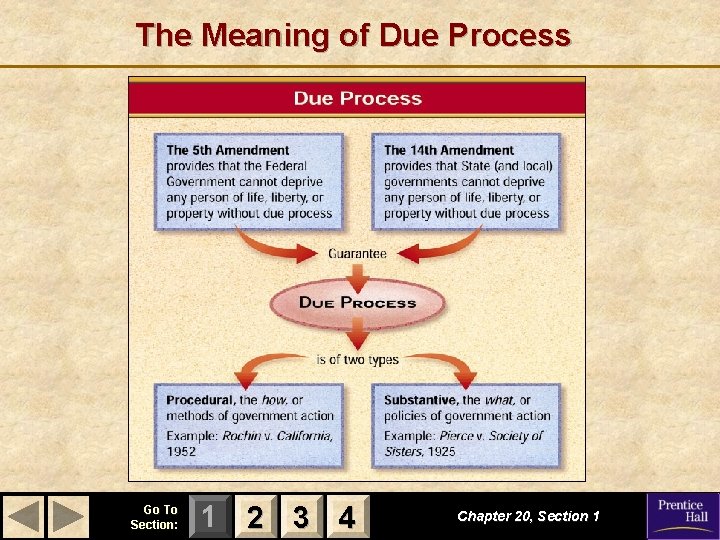
The Meaning of Due Process Go To Section: 1 2 3 4 Chapter 20, Section 1
The 5 th and 14 th Amendments • • The 5 th Amendment provides that “no person … shall be deprived of life, liberty, or property without due process of law…”. The 14 th Amendment extends that restriction to State and local governments. Go To Section: 1 2 3 4 • Due process means that the government must act fairly and in accord with established rules at all times. • Due process is broken down into two branches: Substantive due process—the fairness of the laws themselves Procedural due process—the fairness of the procedures used to enforce the laws Chapter 20, Section 1
The Police Power Go To Section: 1 2 3 4 Chapter 20, Section 1
The Right to Privacy The constitutional guarantees of due process create a right of privacy. • Established in Griswold v. Connecticut, 1965, which held that a law outlawing birth-control was unconstitutional. • In Stanley v. Georgia, 1969, the right of privacy was defined as “the right to be free, except in very limited circumstances, from unwanted governmental intrusion into one’s privacy. ” The right of privacy provoked controversy when it was applied to a woman’s right to an abortion, beginning with Roe v. Wade in 1973. Go To Section: 1 2 3 4 Chapter 20, Section 1
Equal Protection Clause The 14 th Amendment’s Equal Protection Clause declares that citizens are protected equally under the law. Reasonable Classification • The government may reasonably classify, or draw distinctions, between groups of individuals. Government may not discriminate unreasonably, however. The Supreme Court often uses two measures to determine the constitutionality of an action: The Rational Basis Test • The rational basis test asks: Does the classification in question bear a reasonable relationship to the achievement of some proper governmental purpose? The Strict Scrutiny Test • Sometimes more imposing standards are used, especially when a case deals with “fundamental rights” or “suspect classifications. ” Go To Section: 1 2 3 4 Chapter 21, Section 2
SECTION 2 Freedom and Security of the Person • Which Supreme Court cases have dealt with slavery and involuntary servitude? • What is the intent of the 2 nd Amendment’s protection of the right to keep and bear arms, and how is it applied? • What constitutional provisions are designed to guarantee the security of home and person? Go To Section: 1 2 3 4 Chapter 20, Section 2
Slavery and Involuntary Servitude • The 13 th Amendment, ratified in 1865, ended slavery in this country. It also protects against involuntary servitude, or forced labor. – Neither the draft nor imprisonment can be classified as involuntary servitude. • Unlike any other part of the Constitution, the 13 th Amendment covers the actions of private individuals as well as that of the government. Go To Section: 1 2 3 4 Chapter 20, Section 2
The 13 th Amendment in Action • For a long time after it was passed, both citizens and members of the Supreme Court thought that the 13 th Amendment did not apply to acts of racial discrimination committed by private citizens. After all, the discriminatory acts were social choices and did not reinstitute slavery. According to this theory, Congress did not have the power to act against private parties who practiced discrimination. Go To Section: 1 2 3 4 • Starting in 1968, the Supreme Court breathed new life into the 13 th Amendment by upholding provisions in the Civil Rights Act of 1866, a little-known law that had escaped repeal in the late 1800 s. In a series of landmark cases, the Supreme Court found that private citizens could not practice racial discrimination to exclude people on the basis of their color. They also expanded the law to include any group subject to discrimination based on their ethnicity. Chapter 20, Section 2
The Right to Keep and Bear Arms • The 2 nd Amendment protects the right of each State to form and keep a militia. • Many believe that the 2 nd Amendment also sets out an individual right to keep and bear arms. • The Supreme Court has only tried one important 2 nd Amendment Case, United States v. Miller, 1939. The case involved a section of the National Firearms Act of 1934 that forbid shipping sawed-off shotguns, silencers, and machine guns across State lines without informing the Treasury Department and paying a tax. The Court upheld the provision. • The 2 nd Amendment has as yet not been extended to each State under the 14 th Amendment. Therefore, the individual States have the right to regulate arms in their own ways. Go To Section: 1 2 3 4 Chapter 20, Section 2
Security of Home and Person The 3 rd and 4 th Amendments protect the security of home and person. The 4 th Amendment protects against writs of assistance (blanket search warrants) and “unreasonable searches and seizures. ” It is extended to the States through the 14 th Amendment. Go To Section: 1 2 3 4 Chapter 20, Section 2
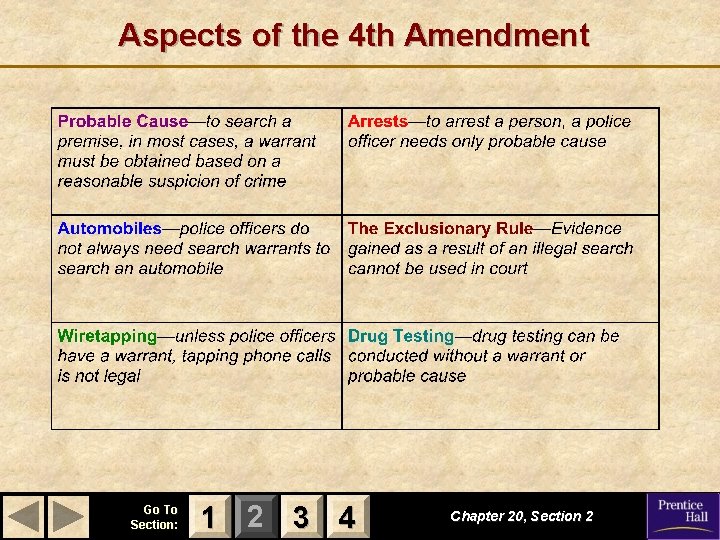
Aspects of the 4 th Amendment Go To Section: 1 2 3 4 Chapter 20, Section 2
SECTION 3 Rights of the Accused • What are the writ of habeas corpus, bills of attainder, and ex post facto laws? • What issues arise from the guarantee of a speedy and public trial? • What constitutes a fair trial by jury? Go To Section: 1 2 3 4 Chapter 20, Section 3
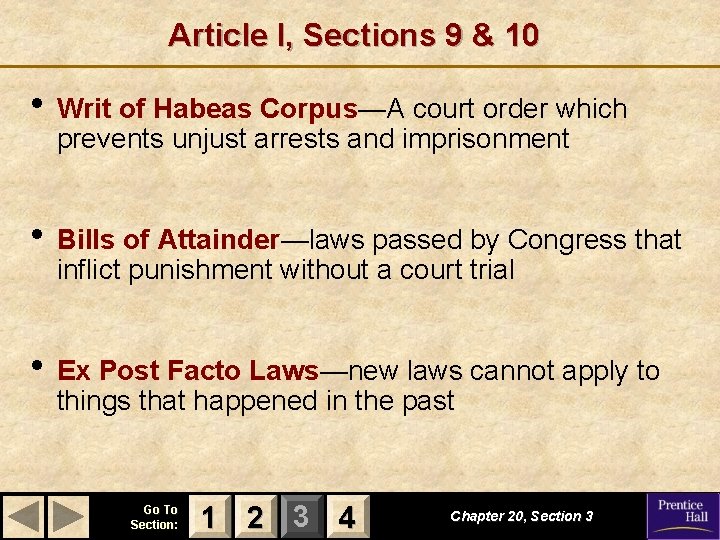
Article I, Sections 9 & 10 • Writ of Habeas Corpus—A court order which prevents unjust arrests and imprisonment • Bills of Attainder—laws passed by Congress that inflict punishment without a court trial • Ex Post Facto Laws—new laws cannot apply to things that happened in the past Go To Section: 1 2 3 4 Chapter 20, Section 3
Grand Jury A grand jury is the formal device by which a person can be accused of a serious crime. • • It is required for federal courts under the 5 th Amendment. • • Only the prosecution presents evidence. The grand jury deliberates on whether the prosecution’s indictment, a formal complaint, presents enough evidence against the accused to justify a trial. The right to a grand jury is not covered by the 14 th Amendment’s Due Process Clause. Most States have legislated to skip the grand jury stage. Go To Section: 1 2 3 4 Chapter 20, Section 3
Speedy and Public Trial The right to a speedy and public trial was extended as part of the 14 th Amendment’s Due Process Clause by Klopfer v. North Carolina, 1967. The Speedy Trial Act of 1974 requires that the beginning of a person’s federal criminal trial must take place no more than 100 days after the arrest. Go To Section: 1 2 3 4 A judge can limit who can watch a trial if the defendant’s rights are in jeopardy. Chapter 20, Section 3
Trial by Jury • Americans in criminal trials are guaranteed an impartial jury chosen from the district where the crime was committed. • If a defendant waives the right to a jury trial, a bench trial is held where the judge alone hears the case. • Most juries have to be unanimous to convict. Go To Section: 1 2 3 4 Chapter 20, Section 3
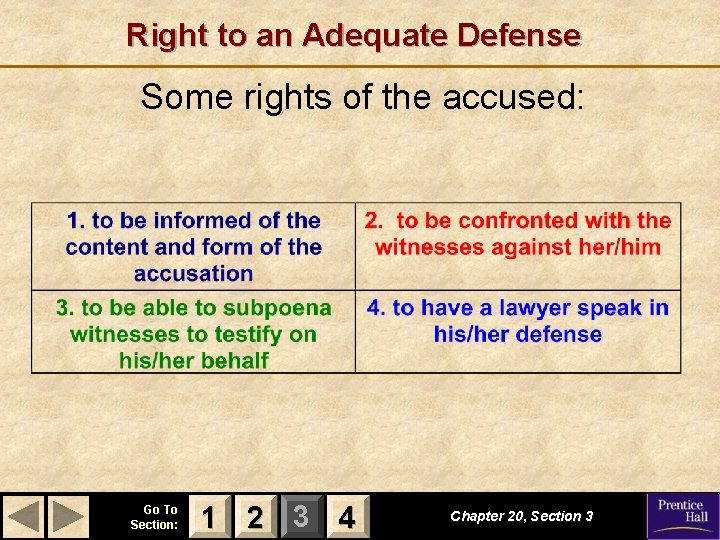
Right to an Adequate Defense Some rights of the accused: Go To Section: 1 2 3 4 Chapter 20, Section 3
Self-Incrimination The Fifth Amendment declares that no person can be “compelled in any criminal case to be a witness against himself. ” This protection extends to the States, and sometimes to civil trials if the selfincrimination could lead to a criminal charge. • • A person cannot be forced to confess to a crime under extreme circumstances. A husband or wife cannot be forced to testify against their spouse, although they can testify voluntarily. In Miranda v. Arizona, 1966, the Supreme Court set an historic precedent when it would no longer uphold convictions in cases in which the defendant had not been informed of his or her rights before questioning. This requirement is known as the Miranda Rule. Go To Section: 1 2 3 4 Chapter 20, Section 3
SECTION 4 Punishment • What is the purpose of bail and preventive detention? • What is the Court’s interpretation of cruel and unusual punishment? • What is the history of the Court’s decisions of capital punishment? • What is treason? Go To Section: 1 2 3 4 Chapter 20, Section 4
Bail and Preventative Detention • Bail is a sum of money that the accused may be required to deposit with the court as a guarantee that he or she will appear in court. • The Constitution does not guarantee that all accused persons are entitled to bail, just that the amount of the bail cannot be excessive. Go To Section: 1 2 3 4 • Preventive detention is a law that allows federal judges to order that accused felons be held without bail if there is a danger that the person will commit another crime if released. • Critics think preventive detention amounts to presuming the accused guilty. The Court upheld the law in United States v. Salerno, 1987. Chapter 20, Section 4
Cruel and Unusual Punishment The 8 th Amendment also forbids “cruel and unusual punishment. ” The Supreme Court extended the provision to the States in Robinson v. California, 1962. • The 8 th Amendment is intended to prevent, in the Court’s opinion, barbaric tortures such as drawing and quartering and other excessively cruel punishments. • The Supreme Court held that defining narcotics addiction as a crime, rather than an illness, was cruel and unusual in Robinson v. California, 1962. In Estelle v. Gamble, 1976, it ruled that a prison inmate could not be denied medical care. • However, generally the Court has not found many punishments to be cruel and unusual. Go To Section: 1 2 3 4 Chapter 20, Section 4
Capital Punishment Capital punishment, or the death penalty, is hotly debated under the 8 th Amendment. • The Supreme Court voided capital punishment laws in the early 1970 s because it felt that the punishment was applied “capriciously” to only a few convicts, often African American or poor or both. • However, in 1976, the Court held for the first time that a new law which instituted the death penalty was NOT unconstitutional. The new law provided for a two-stage trial process. One trial would determine guilt or innocence, and a second hearing would decide whether the death penalty was warranted. The Court later restricted the use of the death penalty to cases where the victim died. Despite these decisions, debate still surrounds the issue. Go To Section: 1 2 3 4 Chapter 20, Section 4
Treason is the only crime defined in the Constitution. Treason is: 1. Levying war against the United States or 2. Giving aid and comfort to the enemies of the United States. Go To Section: 1 2 3 4 • A person can only commit treason in times of war, and it is punishable by the death penalty. • Other related acts, such as sabotage or espionage, can be committed in peacetime. • John Brown, who was hanged as a traitor to Virginia because of his raid on Harper’s Ferry, is the only person ever to be executed for treason against a State. Chapter 20, Section 4