PREDICTOR CORRECTOR METHODS FOR SOLVING FIRST ORDER AND

















- Slides: 38
PREDICTOR CORRECTOR METHODS FOR SOLVING FIRST ORDER AND FIRST DEGREE ORDINARY DIFFERENTIAL EQUATION Student Name : ROVENA ALIA BINTI ROHAIZAD (2017613622) Supervisor Name : PN. NOOR KHAIRIAH BINTI RAZALI
Table Of Content ABSTRACT INTRODUCTION PROBLEM STATEMENT OBJECTIVE SIGNIFICANCE LITERATURE REVIEW METHODOLOGY EXPECTED RESULT GANTT CHART REFERENCES
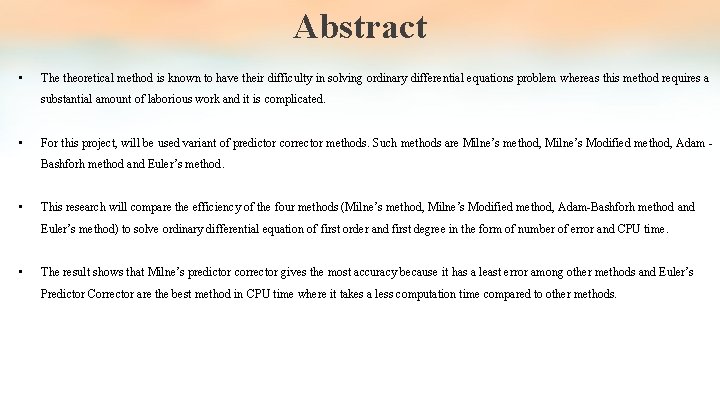
Abstract • The theoretical method is known to have their difficulty in solving ordinary differential equations problem whereas this method requires a substantial amount of laborious work and it is complicated. • For this project, will be used variant of predictor corrector methods. Such methods are Milne’s method, Milne’s Modified method, Adam Bashforh method and Euler’s method. • This research will compare the efficiency of the four methods (Milne’s method, Milne’s Modified method, Adam-Bashforh method and Euler’s method) to solve ordinary differential equation of first order and first degree in the form of number of error and CPU time. • The result shows that Milne’s predictor corrector gives the most accuracy because it has a least error among other methods and Euler’s Predictor Corrector are the best method in CPU time where it takes a less computation time compared to other methods.
Introduction • numerical method for solving ordinary differential equation is one of the best approached for solving ordinary differential equation. • Numerical method somehow has limitation on solving the ordinary differential equation over the analytic method. • Therefore for the analytic method, it is used to know absolutely how the model will behave under any circumstances, but it works only for simple models. • This research will be a limited to a simple model that can be solved both numerically and analytically. • This study will compare the accuracy of the numerical methods among these four methods which is Milne’s method, Modified Milne’s method, Adam-Bashforh method and the Euler method. In addition the central processing unit CPU time will be compared to determine the most efficiency and accurate to the exact solution. Refer to report page 1
Problem Statement • Most ODE is difficult to solved using theoretical solution • Numerical method will be applied • Finding the best method of predictor corrector method which is close to the number of exact solution. • Evaluating CPU time and Error to get the best method. Refer to report page 3
Objectives • To solve the first order and first degree ODE numerically using predictor corrector method. • To analyze the efficiency of numerical method based on Error and CPU time. • To determine the best method with closer to exact solution based on number of Error and CPU time. Refer to report page 4
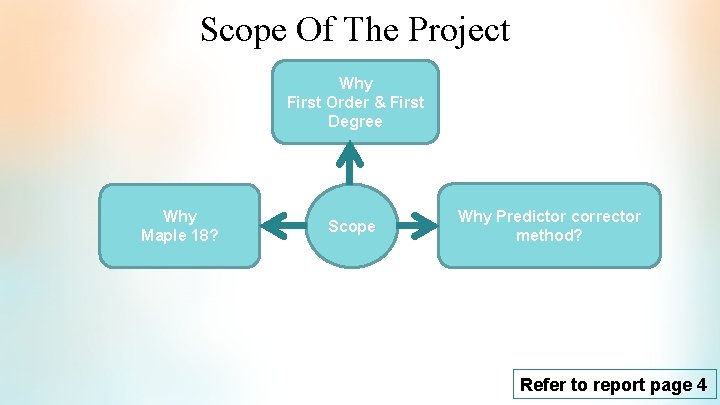
Scope Of The Project Why First Order & First Degree Why Maple 18? Scope Why Predictor corrector method? Refer to report page 4
Methodology
Refer to report page 18
Significance • This project is focused on finding which method is the best method for solving ODE of first order and first degree based on CPU times and error analysis. • Ordinary differential equation have important application and a powerful tool in the study of many problems in the natural sciences and technology such as in employed mechanics areas, astronomy, physics, and in many problem of chemistry and biology. • This research hopefully manages to give benefit to many people. Therefore, the result of comparing the methods can be used for further and future research. Refer to Report Page 4
Project Benefits • The best method can be finding by their performances (Milne’s method, Milne’s Modified method, Adam-Bashforh method and Euler method). • Through this experiment it can be decided which method is better to be used for future research. • Based on the result its will helps to give a conclusion on which method is good to apply in the order area of research. • This also will be useful since the solution used less computation time and will get the result immediately. Refer to report page 5
Literature Review • Approximation to the solution of ordinary differential equation is achieved by using numerical for ordinary differential equation method. • Since many practical problems in engineering involves in differential equation, Stroud (2001) point out that we need to find a function which the equation is true for solving a differential equation. • The solution of any differential equation will be one of the two forms (i) A series of y in terms of powers of x, from which the value of y can be obtained by substitution. (ii) A set of tabulated values of x and y. • Taylor methods and Picard method are belong to the class ( i ) while Euler, Modified Euler, Runge Kutta and Milne Method are belong to the class ( ii ), Sastry (2010). • Sastry (2010) also explained that the interval length h should be kept small and these methods can be applied for tabulating y over a limited range only for the method of Euler and Runge Kutta • Scheid & francis (1968) said that the predictor being Euler’s formula and the corrector being known as the modified Euler formula. Refer to report page 8
Numerical Result and Discussion
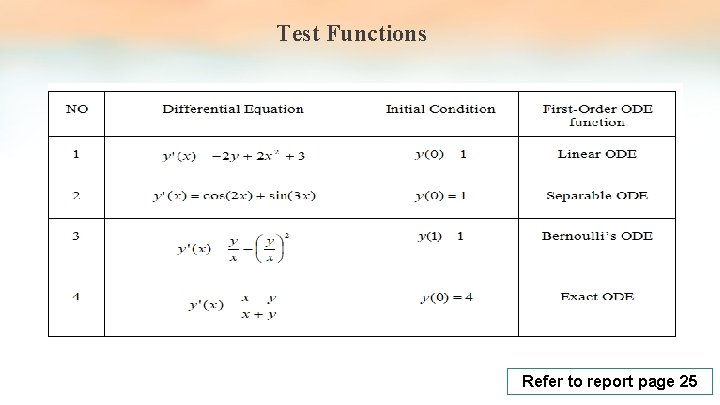
Test Functions Refer to report page 25
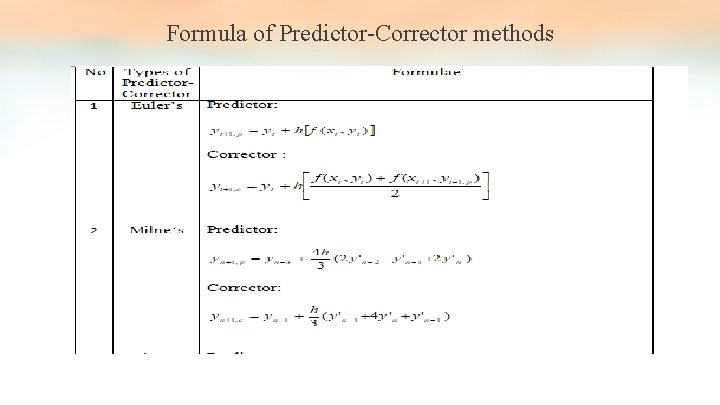
Formula of Predictor-Corrector methods
Analysis For Problem 1 Linear ODE
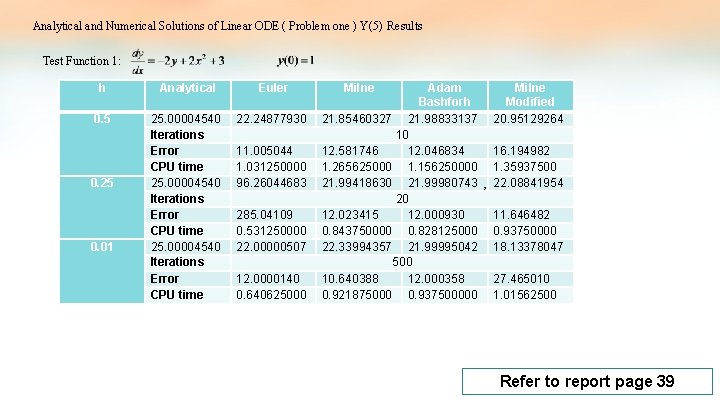
Analytical and Numerical Solutions of Linear ODE ( Problem one ) Y(5) Results Test Function 1: h Analytical Euler 0. 5 25. 00004540 Iterations Error CPU time 22. 24877930 0. 25 0. 01 11. 005044 1. 031250000 96. 26044683 285. 04109 0. 531250000 22. 00000507 12. 0000140 0. 640625000 Milne Adam Milne Bashforh Modified 21. 85460327 21. 98833137 20. 95129264 10 12. 581746 12. 046834 16. 194982 1. 265625000 1. 156250000 1. 35937500 21. 99418630 21. 99980743 , 22. 08841954 20 12. 023415 12. 000930 11. 646482 0. 843750000 0. 828125000 0. 93750000 22. 33994357 21. 99995042 18. 13378047 500 10. 640388 12. 000358 27. 465010 0. 921875000 0. 937500000 1. 01562500 Refer to report page 39
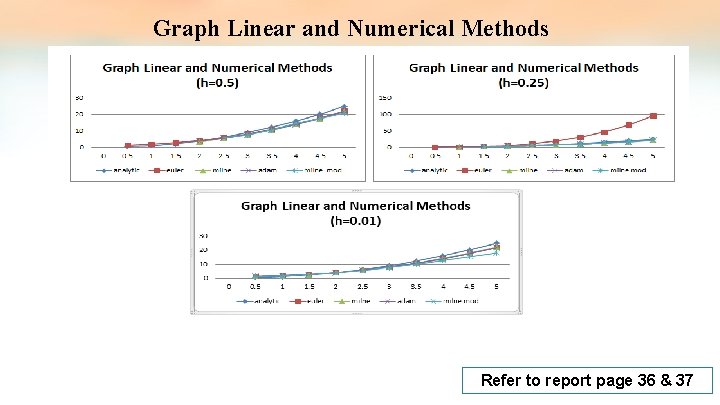
Graph Linear and Numerical Methods Refer to report page 36 & 37
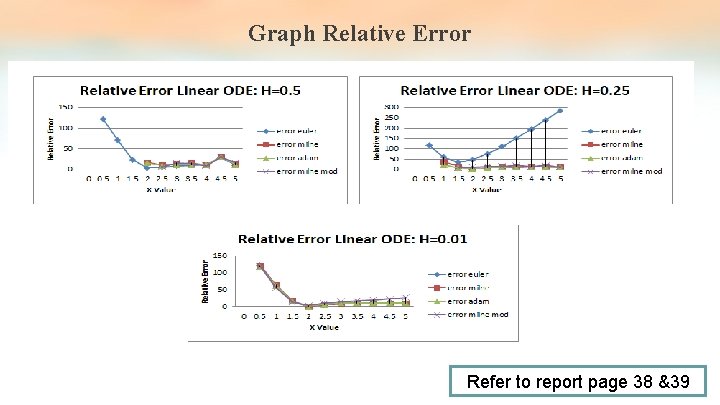
Graph Relative Error Refer to report page 38 &39
Analysis For Problem 2 Separable ODE
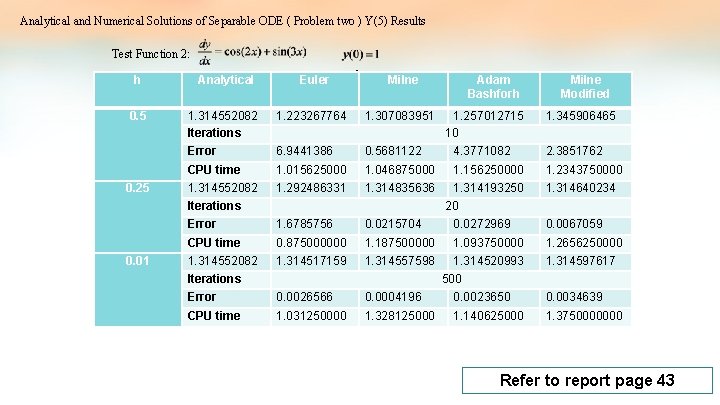
Analytical and Numerical Solutions of Separable ODE ( Problem two ) Y(5) Results Test Function 2: h 0. 5 0. 25 0. 01 Analytical Euler , Milne Adam Bashforh 1. 257012715 10 Milne Modified 1. 314552082 Iterations 1. 223267764 1. 307083951 1. 345906465 Error 6. 9441386 0. 5681122 4. 3771082 2. 3851762 CPU time 1. 015625000 1. 046875000 1. 156250000 1. 2343750000 1. 314552082 Iterations 1. 292486331 1. 314835636 1. 314193250 20 Error 1. 6785756 0. 0215704 0. 0272969 0. 0067059 CPU time 0. 875000000 1. 187500000 1. 093750000 1. 2656250000 1. 314552082 Iterations 1. 314517159 1. 314557598 1. 314520993 500 Error 0. 0026566 0. 0004196 0. 0023650 0. 0034639 CPU time 1. 031250000 1. 328125000 1. 140625000 1. 3750000000 1. 314640234 1. 314597617 Refer to report page 43
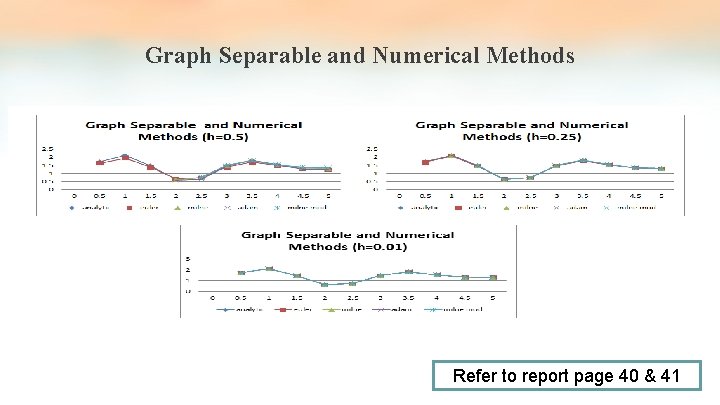
Graph Separable and Numerical Methods Refer to report page 40 & 41
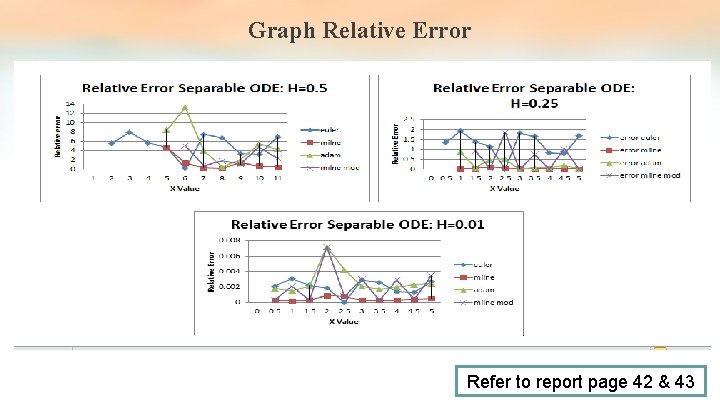
Graph Relative Error Refer to report page 42 & 43
Analysis For Problem 3 Bernoulli’s ODE
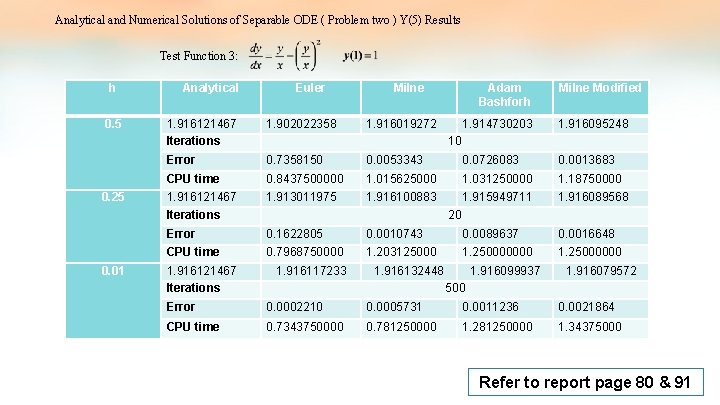
Analytical and Numerical Solutions of Separable ODE ( Problem two ) Y(5) Results Test Function 3: h 0. 5 0. 25 0. 01 Analytical Euler 1. 916121467 Iterations 1. 902022358 Error 0. 7358150 CPU time Milne Adam Bashforh 1. 914730203 1. 916095248 0. 0053343 0. 0726083 0. 0013683 0. 8437500000 1. 015625000 1. 031250000 1. 18750000 1. 916121467 Iterations 1. 913011975 1. 916100883 1. 915949711 1. 916089568 Error 0. 1622805 0. 0010743 0. 0089637 0. 0016648 CPU time 0. 7968750000 1. 203125000 1. 25000000 1. 916121467 Iterations 1. 916019272 Milne Modified 10 20 1. 916117233 1. 916132448 1. 916099937 1. 916079572 500 Error 0. 0002210 0. 0005731 0. 0011236 0. 0021864 CPU time 0. 7343750000 0. 781250000 1. 281250000 1. 34375000 Refer to report page 80 & 91
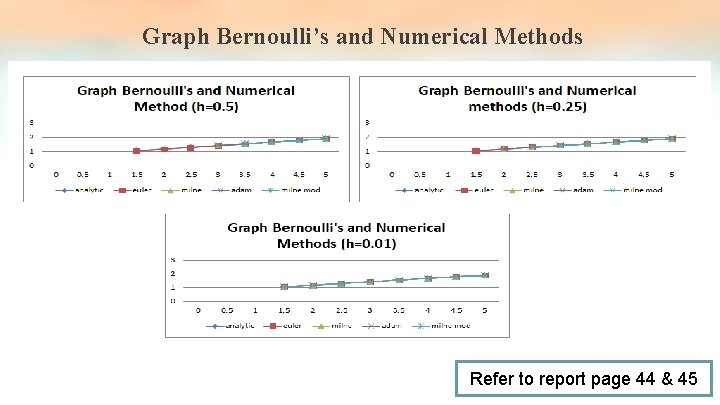
Graph Bernoulli’s and Numerical Methods Refer to report page 44 & 45
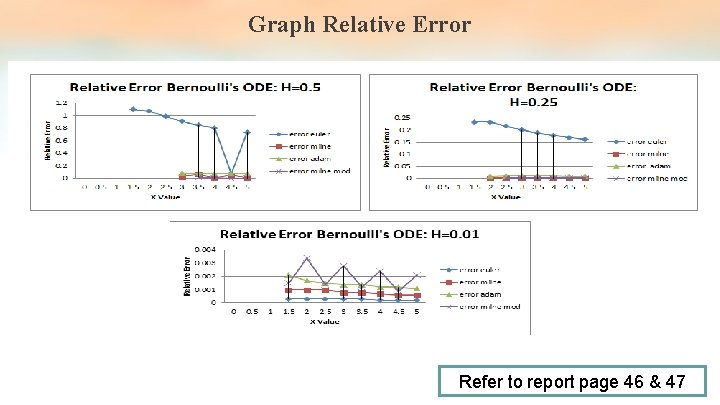
Graph Relative Error Refer to report page 46 & 47
Analysis For Problem 4 Exact ODE
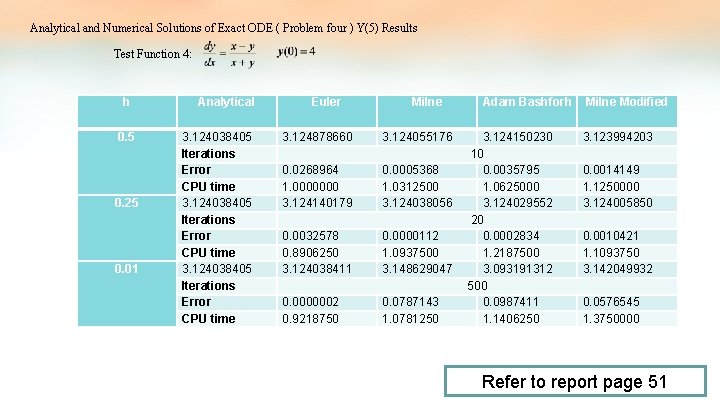
Analytical and Numerical Solutions of Exact ODE ( Problem four ) Y(5) Results Test Function 4: h 0. 5 0. 25 0. 01 Analytical 3. 124038405 Iterations Error CPU time Euler Milne 3. 124878660 , 3. 124055176 0. 0268964 1. 0000000 3. 124140179 0. 0005368 1. 0312500 3. 124038056 0. 0032578 0. 8906250 3. 124038411 0. 0000112 1. 0937500 3. 148629047 0. 0000002 0. 9218750 0. 0787143 1. 0781250 Adam Bashforh 3. 124150230 10 0. 0035795 1. 0625000 3. 124029552 20 0. 0002834 1. 2187500 3. 093191312 500 0. 0987411 1. 1406250 Milne Modified 3. 123994203 0. 0014149 1. 1250000 3. 124005850 0. 0010421 1. 1093750 3. 142049932 0. 0576545 1. 3750000 Refer to report page 51
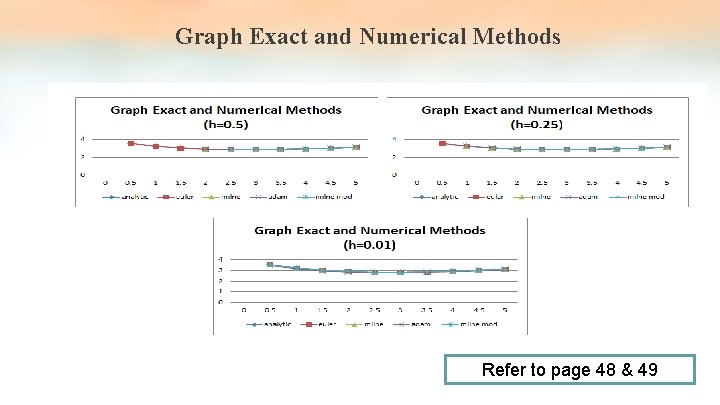
Graph Exact and Numerical Methods Refer to page 48 & 49
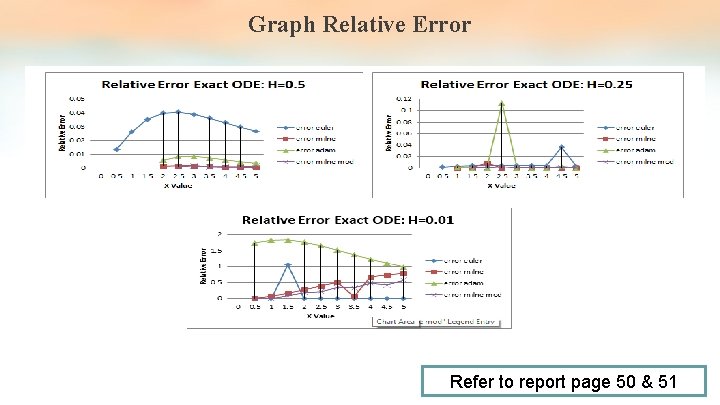
Graph Relative Error Refer to report page 50 & 51
Conclusion and Recommendation
Conclusion For overall conclusion for this report the best Method in terms of least Error is Milne’s method while the best method in terms of CPU time is Euler method. The Milne’s Modified gives the biggest Error among other methods and also the Biggest number of CPU time. Recommendations In this research, all methods are tested using only in first degree and first order of ordinary differential equation. In the future research, researchers may extend the field of research in finding using higher order and two or third degree of ordinary differential equation or in partial differential equation. Other than that, researcher may also find other Predictor Corrector method to be discussed. This is good for future research.
Gantt Chart
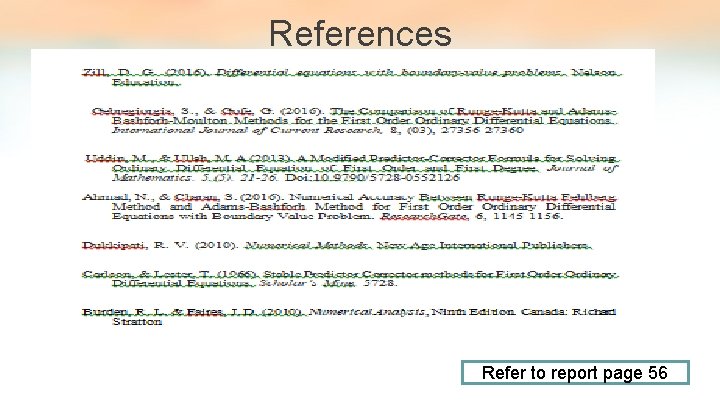
References Refer to report page 56
Thank you