Preciptimetric titration Lecture 1 Definition It is a




- Slides: 17
Preciptimetric titration Lecture 1
Definition: It is a type of volumetric analysis that used in determination of some compounds or ions through formation of sparingly (slightly) soluble precipitates. Example: Ag+ + Cl. Ag+ + I- Ag. Cl (White ppt) Ag. I (Yellow ppt) The reaction must satisfy these conditions: 1 - Precipitation must be rapid. 2 - The precipitate must be sparingly soluble. Ag. Cl (ppt) ⇄ Ag. Cl (soluble) ⇄ Ag+ + Cl 3 - The end point must be easily detected.
Solubility product: If a solid sparingly soluble precipitate (AB) is shaken in water or other solvent, very small amount of the ppt is converted to soluble molecules which ionize spontaneously. AB (Solid) ⇄ AB (Soluble) ⇄ A- + B+ (ions) AB (Solid) ⇄ A- + B+ (ions) Since in the forward reaction (f) the solid is found in excess, the velocity of the reaction is constant and depends only on temperature Vf = Kf [AB] = Kf & Vb = Kb [A-][B+]
On saturation: at equilibrium The rate of forward reaction will be equal to backward one till vf = v b Kf = Kb[A-][B+] KSP = Kf/Kb = [A-][B+] Where KSP is a constant known by the solubility product, it is constant at constant temperature and pressure. For a sparingly soluble salt having the general formula An. Bm the solubility product will be: KSP = [n. A-]n[m. B+]m In a saturated solution of sparingly soluble salt AB, the molar solubility, S = [A-] = [B+] Note: A sparingly soluble salt will precipitate when the product of multiplication of the molar concentration of its ions each raised to the power of number of ions produced exceeds its solubility product.
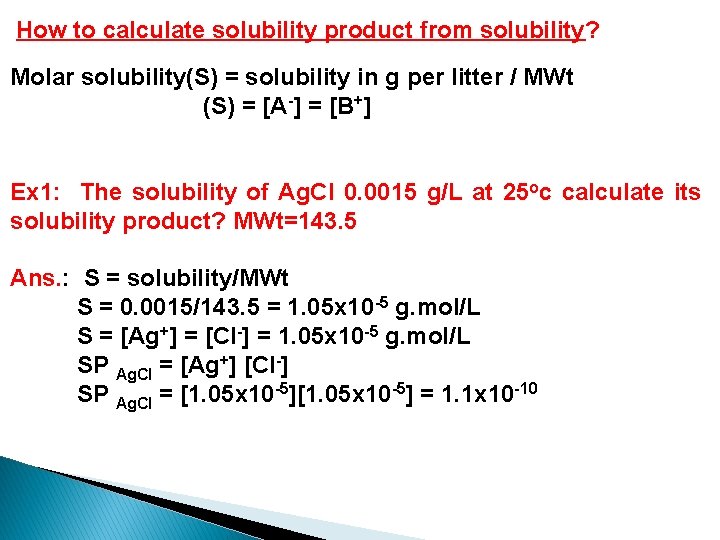
How to calculate solubility product from solubility? Molar solubility(S) = solubility in g per litter / MWt (S) = [A-] = [B+] Ex 1: The solubility of Ag. Cl 0. 0015 g/L at 25 oc calculate its solubility product? MWt=143. 5 Ans. : S = solubility/MWt S = 0. 0015/143. 5 = 1. 05 x 10 -5 g. mol/L S = [Ag+] = [Cl-] = 1. 05 x 10 -5 g. mol/L SP Ag. Cl = [Ag+] [Cl-] SP Ag. Cl = [1. 05 x 10 -5] = 1. 1 x 10 -10
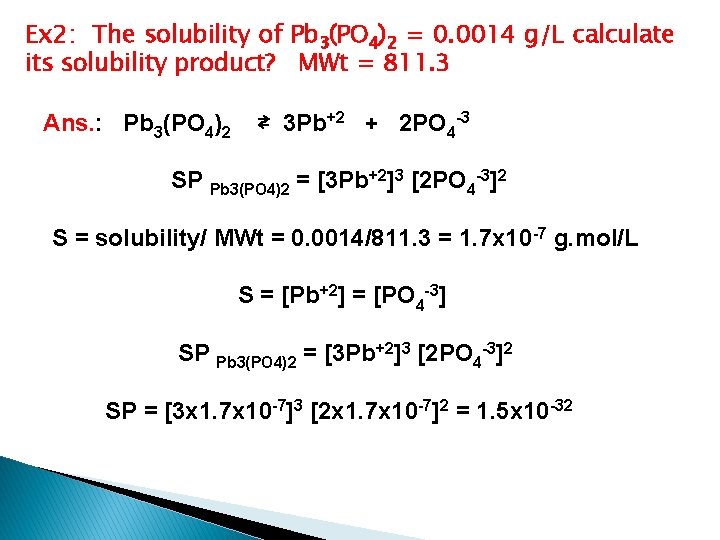
Ex 2: The solubility of Pb 3(PO 4)2 = 0. 0014 g/L calculate its solubility product? MWt = 811. 3 Ans. : Pb 3(PO 4)2 ⇄ 3 Pb+2 + 2 PO 4 -3 SP Pb 3(PO 4)2 = [3 Pb+2]3 [2 PO 4 -3]2 S = solubility/ MWt = 0. 0014/811. 3 = 1. 7 x 10 -7 g. mol/L S = [Pb+2] = [PO 4 -3] SP Pb 3(PO 4)2 = [3 Pb+2]3 [2 PO 4 -3]2 SP = [3 x 1. 7 x 10 -7]3 [2 x 1. 7 x 10 -7]2 = 1. 5 x 10 -32
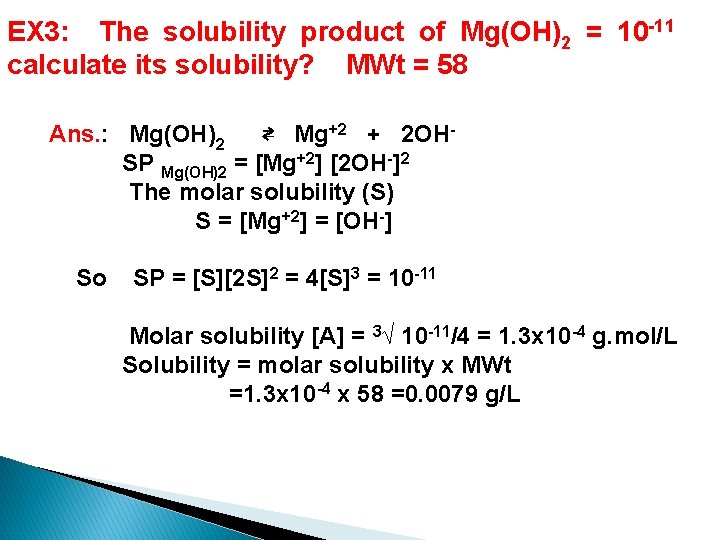
EX 3: The solubility product of Mg(OH)2 = 10 -11 calculate its solubility? MWt = 58 Ans. : Mg(OH)2 ⇄ Mg+2 + 2 OHSP Mg(OH)2 = [Mg+2] [2 OH-]2 The molar solubility (S) S = [Mg+2] = [OH-] So SP = [S][2 S]2 = 4[S]3 = 10 -11 Molar solubility [A] = 3√ 10 -11/4 = 1. 3 x 10 -4 g. mol/L Solubility = molar solubility x MWt =1. 3 x 10 -4 x 58 =0. 0079 g/L
Factors affecting the solubility 1234 - Common ion effect. Temperature. Complexing agent. Salt effect.
1 -Common ion effect Definition: A common is one of the components of sparingly soluble salt but found in solution from ionization of other salts. � If silver chloride is dissolved , in sodium or potassium chloride solution the chloride obtained from ionization of these salts form a common ion with the chloride ion produced from ionization of silver chloride. � Ag. Cl (White ppt) � KCl Ag+ + Cl. K+ + Cl-
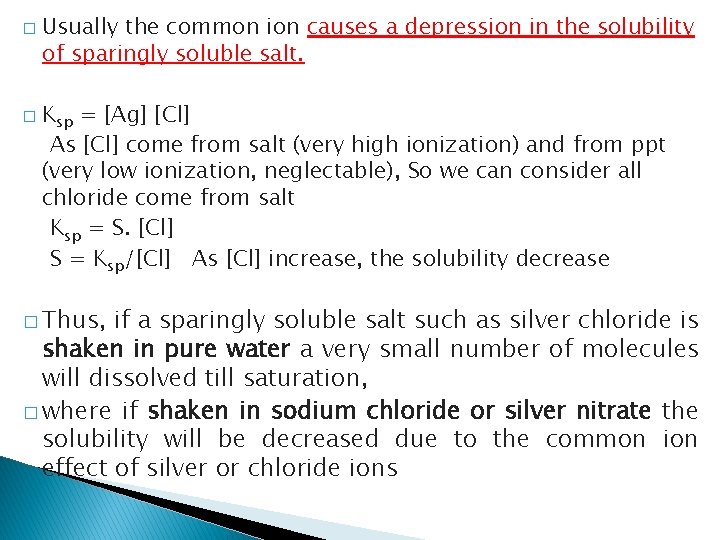
� � Usually the common ion causes a depression in the solubility of sparingly soluble salt. Ksp = [Ag] [Cl] As [Cl] come from salt (very high ionization) and from ppt (very low ionization, neglectable), So we can consider all chloride come from salt Ksp = S. [Cl] S = Ksp/[Cl] As [Cl] increase, the solubility decrease � Thus, if a sparingly soluble salt such as silver chloride is shaken in pure water a very small number of molecules will dissolved till saturation, � where if shaken in sodium chloride or silver nitrate the solubility will be decreased due to the common ion effect of silver or chloride ions
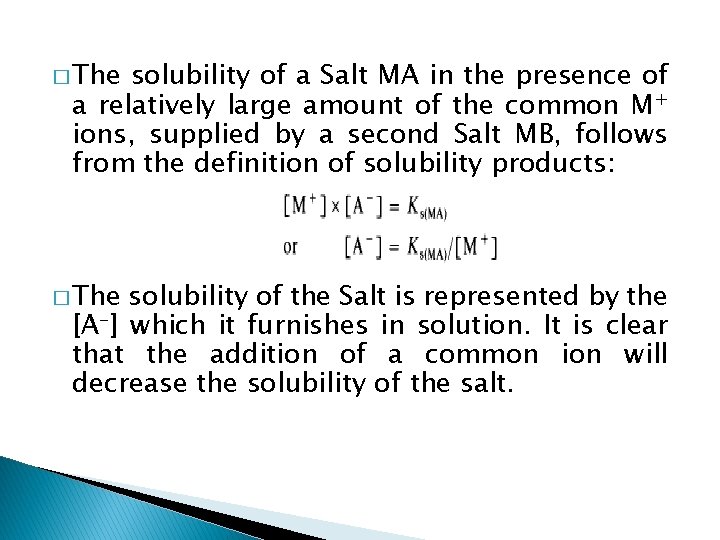
� The solubility of a Salt MA in the presence of a relatively large amount of the common M+ ions, supplied by a second Salt MB, follows from the definition of solubility products: � The solubility of the Salt is represented by the [A-] which it furnishes in solution. It is clear that the addition of a common ion will decrease the solubility of the salt.
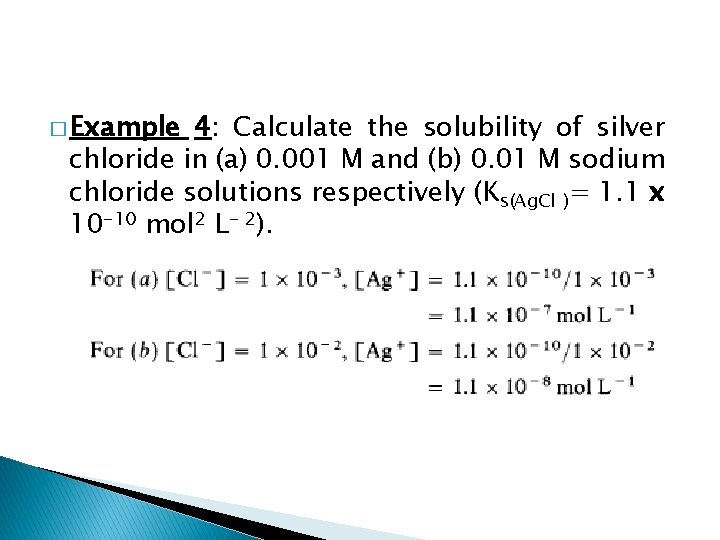
� Example 4: Calculate the solubility of silver chloride in (a) 0. 001 M and (b) 0. 01 M sodium chloride solutions respectively (Ks(Ag. Cl )= 1. 1 x 10 -10 mol 2 L- 2).
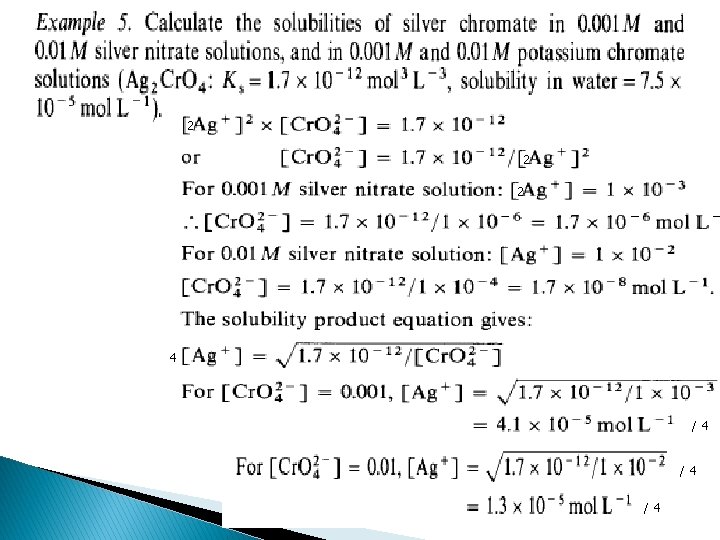
2 2 2 4 /4 /4 /4
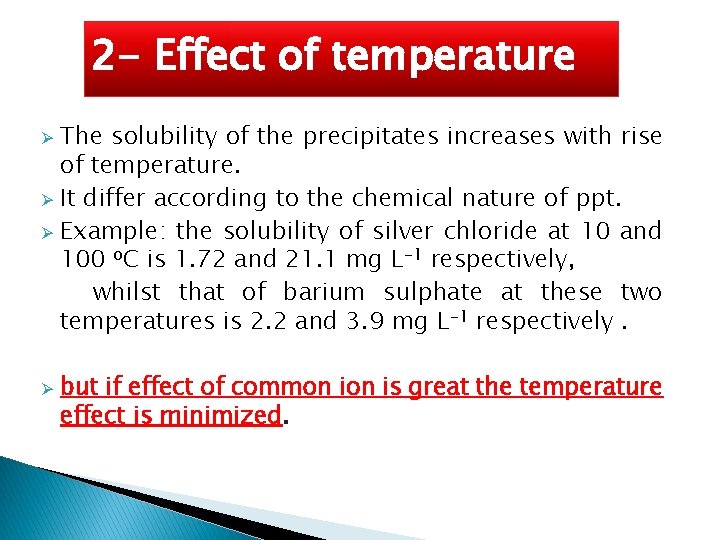
2 - Effect of temperature The solubility of the precipitates increases with rise of temperature. Ø It differ according to the chemical nature of ppt. Ø Example: the solubility of silver chloride at 10 and 100 o. C is 1. 72 and 21. 1 mg L-1 respectively, whilst that of barium sulphate at these two temperatures is 2. 2 and 3. 9 mg L-1 respectively. Ø Ø but if effect of common is great the temperature effect is minimized.
3 - Complexing agent Ø The solubility can be including an ion which forms a complex with one of ion components of the precipitate. For example; ØAmmonia influence the solubility of Ag. Cl ppt. Ag. Cl Ag+ + Cl. Ag+ + 2 NH 3 [Ag(NH 3)2] + Soluble Complex As [Ag]+ conc. decrease, the solubility of ppt increase as it force forward reaction.
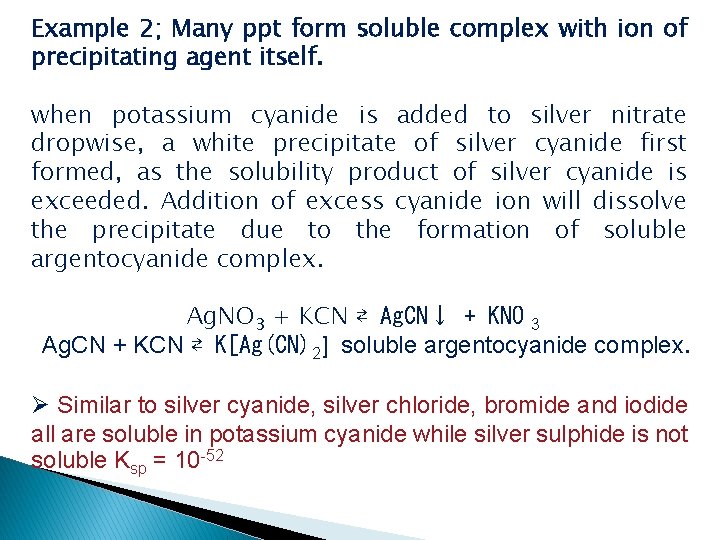
Example 2; Many ppt form soluble complex with ion of precipitating agent itself. when potassium cyanide is added to silver nitrate dropwise, a white precipitate of silver cyanide first formed, as the solubility product of silver cyanide is exceeded. Addition of excess cyanide ion will dissolve the precipitate due to the formation of soluble argentocyanide complex. Ag. NO 3 + KCN ⇄ Ag. CN↓ + KNO 3 Ag. CN + KCN ⇄ K[Ag(CN) 2] soluble argentocyanide complex. Ø Similar to silver cyanide, silver chloride, bromide and iodide all are soluble in potassium cyanide while silver sulphide is not soluble Ksp = 10 -52
4 - Salt Effect � In the presence of moderate concentrations of salts (does not possess an ion in common with the sparingly soluble salt), the ionic strength of the solution, will increase. This will, in general, increase the solubility of ppt. � Example: solubility of barium sulphate in pure water is 1. 3 X 10 -5 � Solubility of barium sulphate in 0. 05 M Hg. Cl 2 is 1. 9 X 10 -5.