Complexometric titration sometimes chelatometry is a form of

- Slides: 7
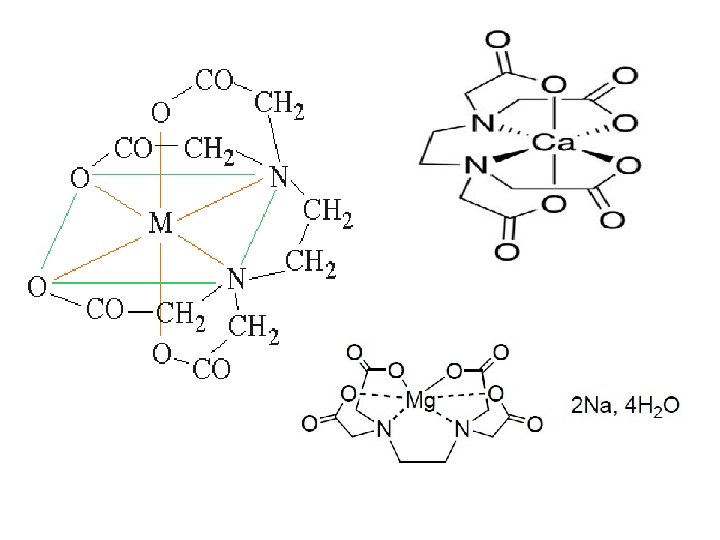
Complexometric titration (sometimes chelatometry) is a form of volumetric analysis in which the formation of a colored complex is used to indicate the end point of a titration. Complex titration with EDTA, ethylenediaminetetraacetic acid, has four carboxyl groups and two amine groups that can act as electron pair donors, or Lewis bases. The ability of EDTA to potentially donate its six lone pairs of electrons for the formation of coordinate covalent bonds to metal cations makes EDTA a hexadentate ligand. However, in practice EDTA is usually only partially ionized, and thus forms fewer than six coordinate covalent bonds with metal cations. Disodium EDTA is commonly used to standardize aqueous solutions of transition metal cations. Disodium EDTA (often written as Na 2 H 2 Y). EDTA forms an octahedral complex with most 2+ metal cations, M 2+, in aqueous solution. The main reason that EDTA is used so extensively in the standardization of metal cation solutions is that the formation constant for most metal cation-EDTA complexes is very high, meaning that the equilibrium for the reaction: M 2+ + H 4 Y → MH 2 Y + 2 H+
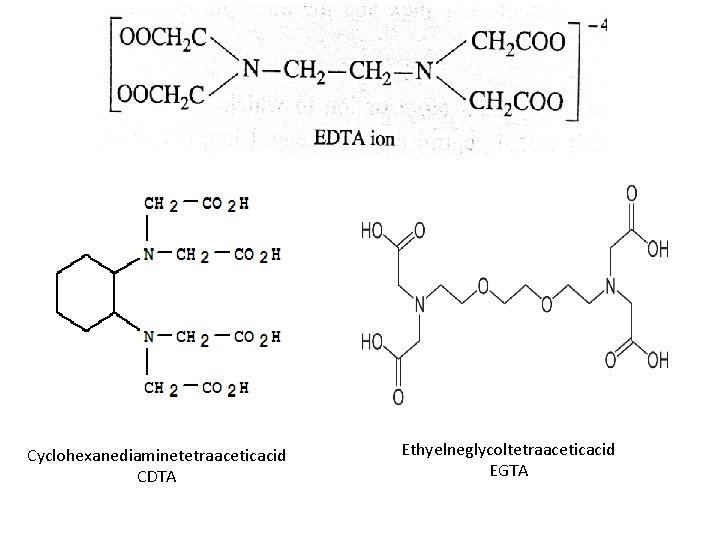
Ligands A ligand is an ion or molecule, which donates a pair of electrons to the central metal atom or ion to form a coordination complex. Ligands act as Lewis bases (donate electron pairs) and central metal atoms viewed as Lewis acid (electron pair acceptor). The nature of bonding between metal to ligand varies from covalent bond to ionic bond and called coordination bond. Types Of Ligands: Mono dentate Ligands: that attached to central metal atom at one point. Such as: anionic ligands are F–, Cl–, Br–, I–, S 2–, CN–, NCS–, OH–, NH 2– and neutral ligands are NH 3, H 2 O, NO, CO. Bidentate Ligands: that attached to central metal atom at two points. Such as: Ethylenediammine (en) and Oxalate ion (ox). multidentate Ligands: that attached to central metal atom at more than two points. Such as: EDTA, CDTA and EGTA
Cyclohexanediaminetetraaceticacid CDTA Ethyelneglycoltetraaceticacid EGTA
Indicators Its ligands can form colored complex with metal ion which is less stable than metal EDTA complex. To carry out metal cation titrations using EDTA, it is almost always necessary to use a complexometric indicator to determine when the end point has been reached. Common indicators are organic dyes such as Fast Sulphon Black, Eriochrome Black T. Color change shows that the indicator has been displaced (usually by EDTA) from the metal cations in solution when the endpoint has been reached. Thus, the free indicator (rather than the metal complex) serves as the endpoint indicator.
Conditions of p. M indicators 1. The indicator must be very sensitive to metal ions (i. e. to p. M) so that the colour change occurs as near to equivalence point as possible. 2. The colour contrast between the free indicator and the metal-indicator complex should be readily observed. 3. The metal-indicator complex must possess sufficient stability, however, be less stable than the metal-EDTA complex. 4. The colour reaction should be specific or selective. 5. All above conditions must be satisfactorily with p. H value.
Advantages of EDTA 1. 2. 3. 4. 5. 6. 7. 8. EDTA has two donor nitrogen atom and four donor oxygen atom, so it can form six coordination bond. It has four carboxylic groups, so it can form four covalent bonds. It can form complex with di, tri and tetra valent metals. This is the reason of unselectively of EDTA. It can form complex with alkali metals and alkaline earth metals, where other ligands can not do that. It is colorless, cheap and available. It is sodium salt easy soluble in water. It form considerably stable complex due to five member ring chelating. It can form labile complex. Note that: Labile complex: easy to form and has a short half life time while Inert complex: difficult to form and has a long half life time.