Practical outcomes of the pilot project Aleksandra Pavlovska
- Slides: 19
Practical outcomes of the pilot project Aleksandra Pavlovska, MSW, support person, RC ZELDA
Role of the support person From the experience of the support person, it became obvious that the role is not limited only to provision of support during the decision making process. It was also connected to: - Advocacy - Active listening - Finding resources and people around - Motivating and accompanying people etc.
Multiple support persons In RC Zelda lawyer, social worker, psychologist, plus there might be natural support system Advantages: - Have a network to choose from, gather multiple points of view - Have professional advice in certain spheres - Possibility to choose: for example, avoid talking about private matters, only legal issues
Agreement in supported decision making Proved to be a positive instrument for: - Empowerment and agency - Reducing hierarchy - Taking responsibility - Communicating with other organizations, institutions, state service providers etc. There was no agreement between the individual and the natural supporter!
Trustful Relationships Building trustful relationships takes time - We cannot expect that the SDM process will launch smoothly at the moment of appointing of the professional support worker - In the process of building trustful relationships individuals can change their aims or spheres where they want to make decisions - While supporting natural supporters and individuals, it is important to have trustful relationships with both of them, though individual is always a priority
Person centered planning in Supported decision makingas basis, and as a way of thinking with or about the Served individual, although: - Not all instruments, documentation could be used in each case (for ex. , people with psychosocial disability) - The language and the forms might not be acceptable for other specialists, who are used to traditional documentation - it takes time and effort explaining it Conclusion: PCP usage should be flexible
Supported decision making: major and minor decisions Minor decisions: - To start to wash hands after cooking - To decide to clean the floor in the apartment weekly Major decisions: - To search for a job - To change a place where to live - Not to take a credit - To explore possibilities for professional education Every decision matters!
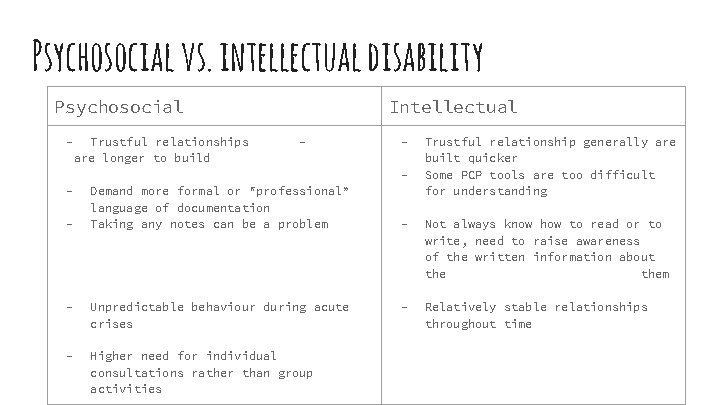
Psychosocial vs. intellectual disability Psychosocial - Trustful relationships are longer to build Intellectual - - - Demand more formal or “professional” language of documentation Taking any notes can be a problem - Unpredictable behaviour during acute crises - Higher need for individual consultations rather than group activities Trustful relationship generally are built quicker Some PCP tools are too difficult for understanding - Not always know how to read or to write, need to raise awareness of the written information about them - Relatively stable relationships throughout time
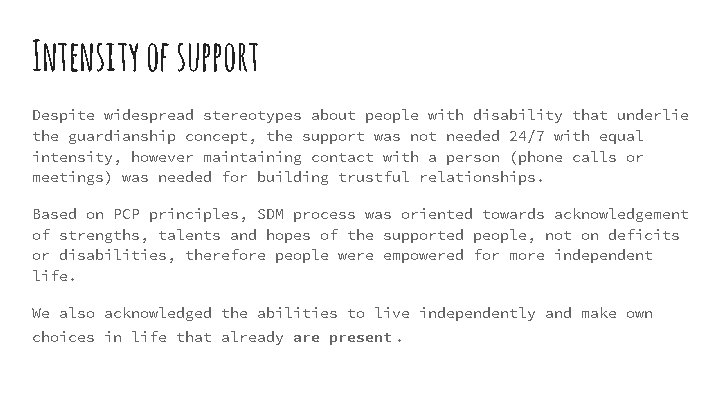
Intensity of support Despite widespread stereotypes about people with disability that underlie the guardianship concept, the support was not needed 24/7 with equal intensity, however maintaining contact with a person (phone calls or meetings) was needed for building trustful relationships. Based on PCP principles, SDM process was oriented towards acknowledgement of strengths, talents and hopes of the supported people, not on deficits or disabilities, therefore people were empowered for more independent life. We also acknowledged the abilities to live independently and make own choices in life that already are present.
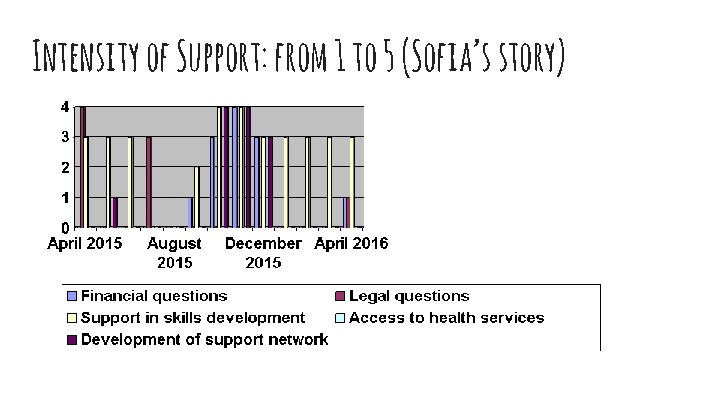
Intensity of Support: from 1 to 5 (Sofia’s story)
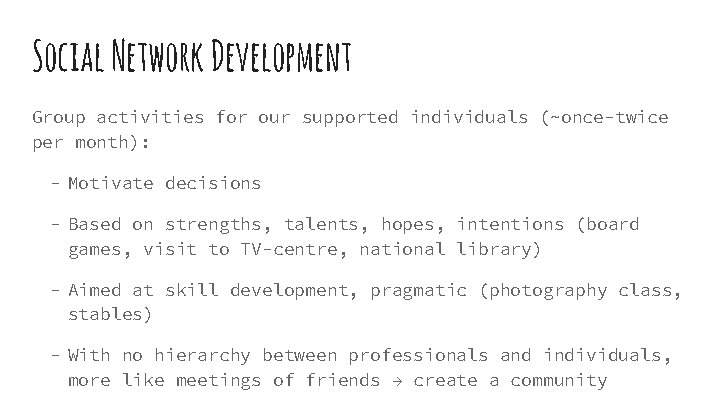
Social Network Development Group activities for our supported individuals (~once-twice per month): - Motivate decisions - Based on strengths, talents, hopes, intentions (board games, visit to TV-centre, national library) - Aimed at skill development, pragmatic (photography class, stables) - With no hierarchy between professionals and individuals, more like meetings of friends → create a community
Stories: Victoria During the project Victoria (a woman with psychosocial disability) made an important decision to give birth to a baby and to have a family. Moving towards this aim she had also to make minor decisions with the help of the support workers - psychologist and lawyer: ending violent relationships, changing her living place, developing parenting skills, managing finances, dealing with acute crises. Victoria is now living in a safe place with her small child and keeps contact with her support workers.
Stories: Kaspars, a young man with intellectual disability, was firstly included in the project as an individual supported in decision making by his mother. However later on it turned out that in certain situations there was a conflict of interests between Kaspars and his supporter, especially in cases concerning Kaspars’s desire to work and earn money. Being provided by us with the information about his rights, about possible employment options etc, Kaspars has made a decision to visit the unemployment agency, where he was offered a subsidised working place. Later on his mother said that this was a good choice.
“Wrong” decisions A right to make risks - To ask to move back to institution - To decide not to pay credits - To decide not to keep promises made to their family - To lie rather than tell the truth about plans or intentions Who has a right to say that these are “wrong” decisions?
Problems to face Facilitation of supported decision making, when the support person is a natural supporter - Insist on contacting and meeting with the individual - give voice to him/her - Be in constant contact, initiate a contact (distance might be a problem) - Support the supporter as much as the individual - Challenge the way of thinking vs. keep trustful relationships
Problems to face When the supporter is professional : - Retraining in accordance with SDM way of thinking is often needed - Ensuring a degree of non-formal attitude - Supervision and facilitation. Especially at the beginning, or when there are conflicts or misundestandings
Problems to face To take into account the person’s life story (level of education, communication and decision-making style, disability type etc. ) when proposing to work in SDM Demands: - Creativity - Flexibility - Empathy Qualities and skills to be developed, not only learning tools
Problems to face Non-professional volunteers are needed to establish the life in the community and to break the barriers between the “healthy” society and isolated individuals Lack of volunteers: - Especially, in small towns, rural areas - Must invest a lot in challenging stereotypes to attract volunteers - Need to support volunteers throughout the whole process
Thank you for your attention!