
Privacy at Scale Local Differential Privacy in Practice

- Slides: 106
Privacy at Scale: Local Differential Privacy in Practice Graham Cormode Based on a tutorial with Somesh Jha, Tejas Kulkarni, Ninghui Li, Divesh Srivastava, and Tianhao Wang
Schedule • Part 1 (yesterday): Centralized privacy models • The Privacy Problem • Syntactic Approaches to Privacy (1998 onwards) • (Centralized) Differential Privacy (2006 onwards) • Part 2 (today): Local privacy models (2014 onwards) • Local Differential Privacy technical foundations • Current directions and open problems • Note: This material can be quite technical and mathematical! • Slides available from http: //cormode. org/ghent 2
Aims of today’s material • To introduce the privacy model of local differential privacy (LDP) • Provide technical understanding, scaling of basic LDP algorithms • Show these have been used in practice • To connect with the privacy research literature • Give a deep understanding of the frequency estimation problem • Describe new work on LDP data mining and data modeling • To suggest directions for future research • Identify topics that have just recently been considered • Suggest open problems and grand challenges for the area Privacy at Scale: Local Differential Privacy in Practice 3
Outline • Module 1 • Introduction and Preliminaries (20 min) • State of the Art Deployments (25 min) • Theoretical Foundations (20 min) • Frequency Oracles and Mean Oracles (30 min) • Module 2 • Heavy Hitters (20 min) • Current Research Directions part 2 (20 min) • Marginals, graphs, location data, language modeling • Open Problems (20 min) Privacy at Scale: Local Differential Privacy in Practice 4
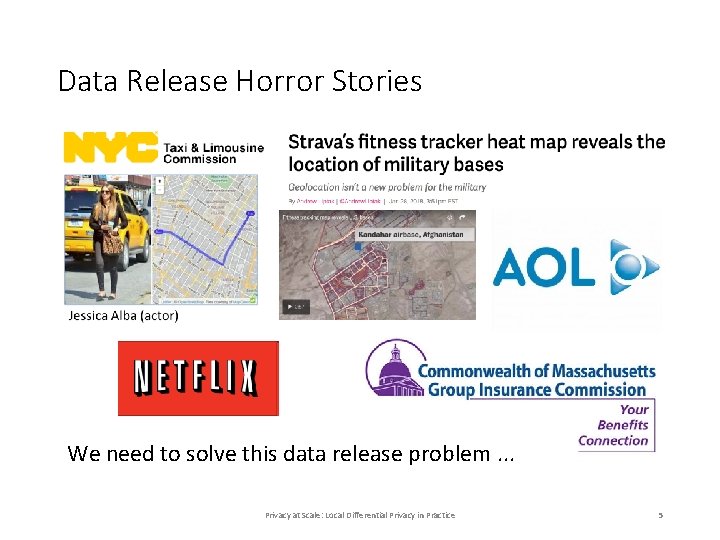
Data Release Horror Stories We need to solve this data release problem. . . Privacy at Scale: Local Differential Privacy in Practice 5
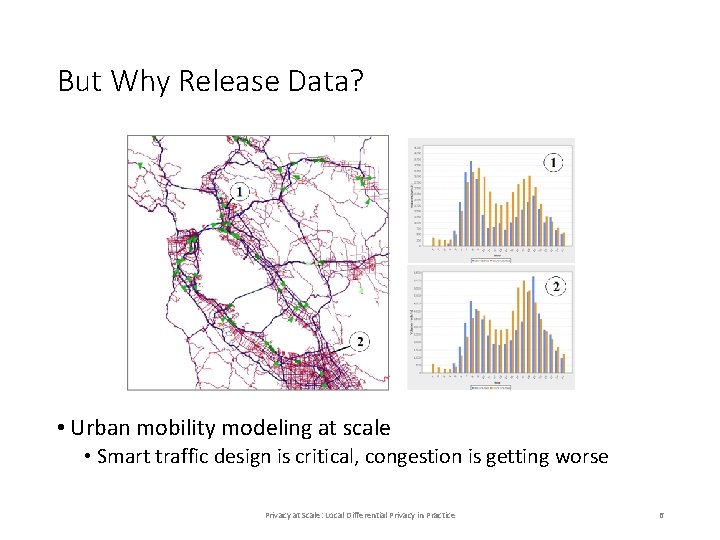
But Why Release Data? • Urban mobility modeling at scale • Smart traffic design is critical, congestion is getting worse Privacy at Scale: Local Differential Privacy in Practice 6
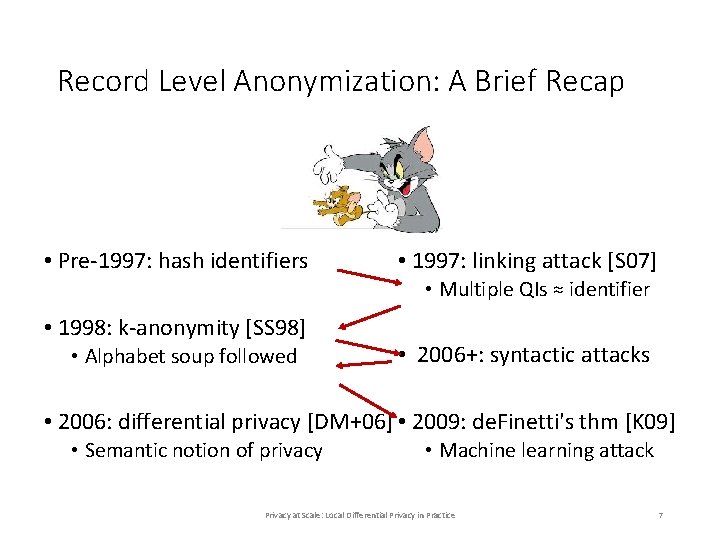
Record Level Anonymization: A Brief Recap • Pre-1997: hash identifiers • 1997: linking attack [S 07] • Multiple QIs ≈ identifier • 1998: k-anonymity [SS 98] • Alphabet soup followed • 2006+: syntactic attacks • 2006: differential privacy [DM+06] • 2009: de. Finetti's thm [K 09] • Semantic notion of privacy • Machine learning attack Privacy at Scale: Local Differential Privacy in Practice 7
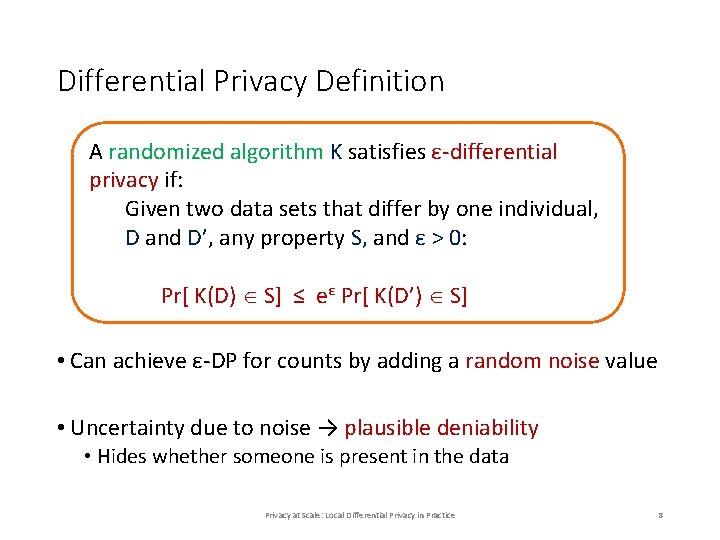
Differential Privacy Definition A randomized algorithm K satisfies ε-differential privacy if: Given two data sets that differ by one individual, D and D’, any property S, and ε > 0: Pr[ K(D) S] ≤ eε Pr[ K(D’) S] • Can achieve ε-DP for counts by adding a random noise value • Uncertainty due to noise → plausible deniability • Hides whether someone is present in the data Privacy at Scale: Local Differential Privacy in Practice 8
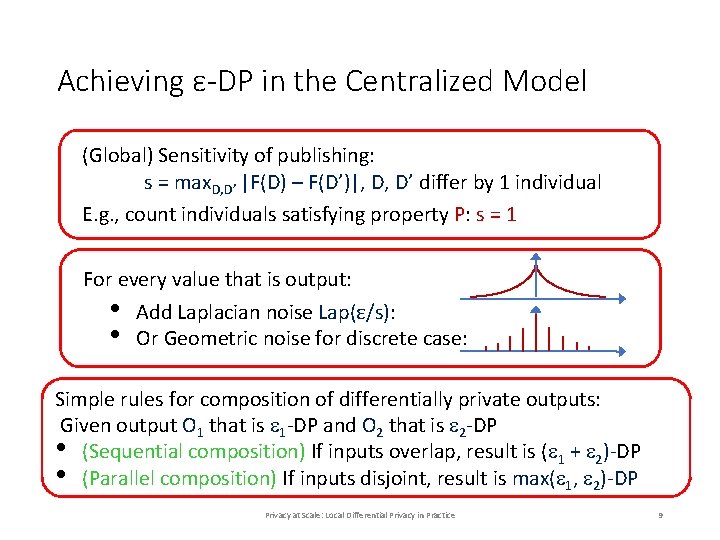
Achieving ε-DP in the Centralized Model (Global) Sensitivity of publishing: s = max. D, D’ |F(D) – F(D’)|, D, D’ differ by 1 individual E. g. , count individuals satisfying property P: s = 1 For every value that is output: • Add Laplacian noise Lap(ε/s): • Or Geometric noise for discrete case: Simple rules for composition of differentially private outputs: Given output O 1 that is 1 -DP and O 2 that is 2 -DP • (Sequential composition) If inputs overlap, result is ( 1 + 2)-DP • (Parallel composition) If inputs disjoint, result is max( 1, 2)-DP Privacy at Scale: Local Differential Privacy in Practice 9
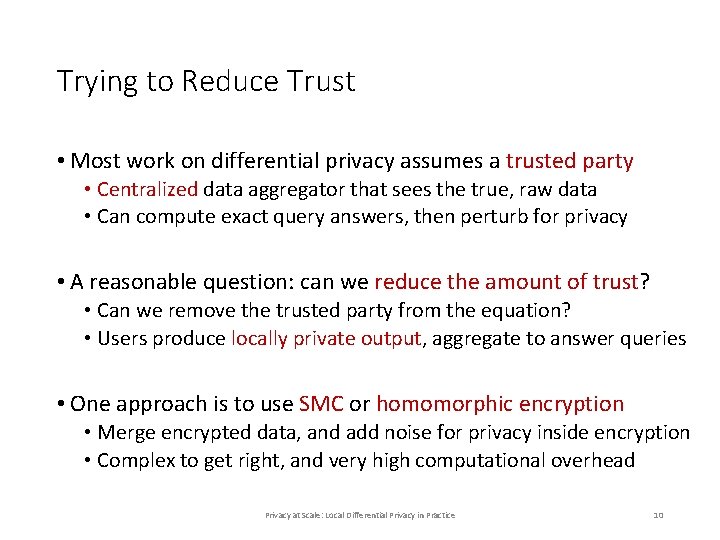
Trying to Reduce Trust • Most work on differential privacy assumes a trusted party • Centralized data aggregator that sees the true, raw data • Can compute exact query answers, then perturb for privacy • A reasonable question: can we reduce the amount of trust? • Can we remove the trusted party from the equation? • Users produce locally private output, aggregate to answer queries • One approach is to use SMC or homomorphic encryption • Merge encrypted data, and add noise for privacy inside encryption • Complex to get right, and very high computational overhead Privacy at Scale: Local Differential Privacy in Practice 10
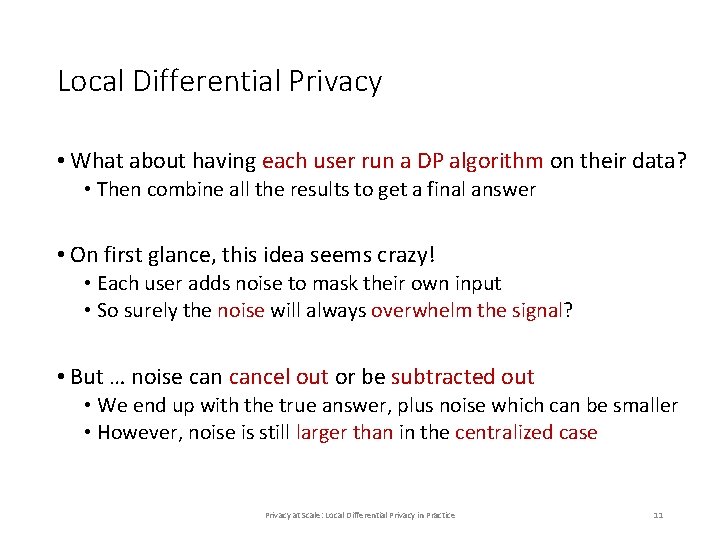
Local Differential Privacy • What about having each user run a DP algorithm on their data? • Then combine all the results to get a final answer • On first glance, this idea seems crazy! • Each user adds noise to mask their own input • So surely the noise will always overwhelm the signal? • But … noise cancel out or be subtracted out • We end up with the true answer, plus noise which can be smaller • However, noise is still larger than in the centralized case Privacy at Scale: Local Differential Privacy in Practice 11
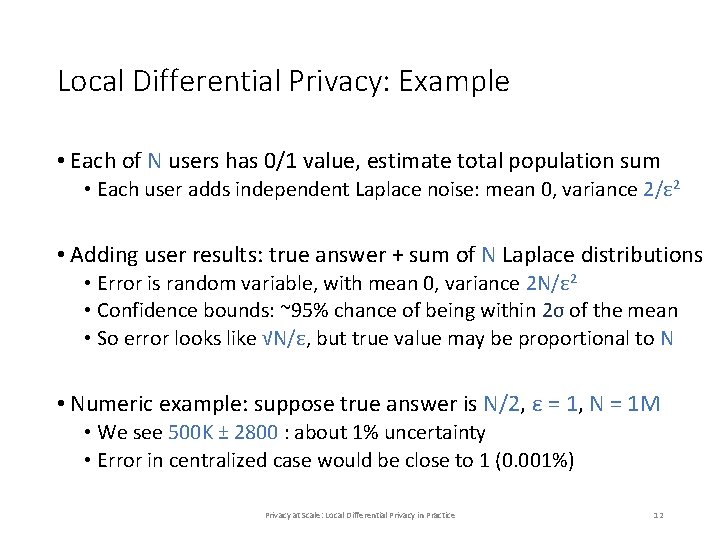
Local Differential Privacy: Example • Each of N users has 0/1 value, estimate total population sum • Each user adds independent Laplace noise: mean 0, variance 2/ε 2 • Adding user results: true answer + sum of N Laplace distributions • Error is random variable, with mean 0, variance 2 N/ε 2 • Confidence bounds: ~95% chance of being within 2σ of the mean • So error looks like √N/ε, but true value may be proportional to N • Numeric example: suppose true answer is N/2, ε = 1, N = 1 M • We see 500 K ± 2800 : about 1% uncertainty • Error in centralized case would be close to 1 (0. 001%) Privacy at Scale: Local Differential Privacy in Practice 12
Local Differential Privacy • We can achieve LDP, and obtain reasonable accuracy (for large N) • The error typically scales with √N • Generic approach: apply centralized DP algorithm to local data • But error might still be quite large • Unclear how to merge private outputs (e. g. private clustering) • So we seek to design new LDP algorithms • Maximize the accuracy of the results • Minimize the costs to the users (space, time, communication) • Ensure that there is an accurate algorithm for aggregation Privacy at Scale: Local Differential Privacy in Practice 13
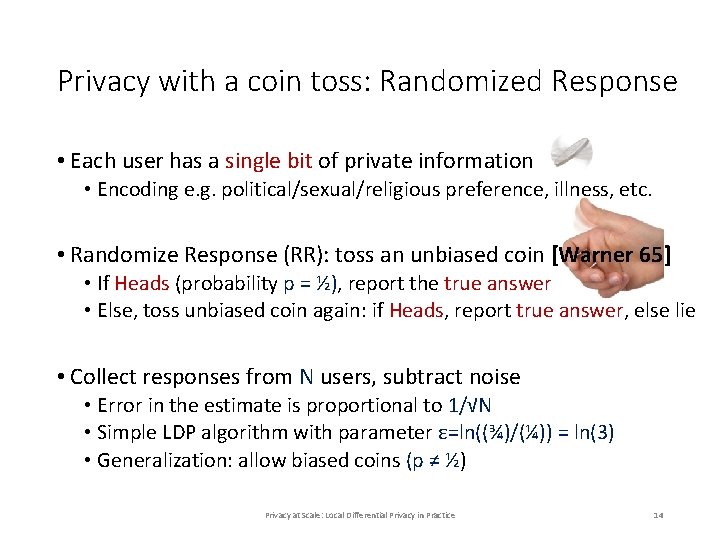
Privacy with a coin toss: Randomized Response • Each user has a single bit of private information • Encoding e. g. political/sexual/religious preference, illness, etc. • Randomize Response (RR): toss an unbiased coin [Warner 65] • If Heads (probability p = ½), report the true answer • Else, toss unbiased coin again: if Heads, report true answer, else lie • Collect responses from N users, subtract noise • Error in the estimate is proportional to 1/√N • Simple LDP algorithm with parameter ε=ln((¾)/(¼)) = ln(3) • Generalization: allow biased coins (p ≠ ½) Privacy at Scale: Local Differential Privacy in Practice 14
Privacy in practice • Differential privacy based on coin tossing is widely deployed! • In Google Chrome browser, to collect browsing statistics • In Apple i. OS and Mac. OS, to collect typing statistics • In Microsoft Windows to collect telemetry data over time • From Snap to perform modeling of user preference • This yields deployments of over 100 million users each • All deployments are based on RR, but extend it substantially • To handle the large space of possible values a user might have • Local Differential Privacy is state of the art today • Randomized response invented in 1965: over five decades ago! Privacy at Scale: Local Differential Privacy in Practice 15
Google’s RAPPOR • Each user has one value out of a very large set of possibilities • E. g. their favourite URL, www. nytimes. com • Attempt 1: run RR for all values: google. com? Bing. com? … • User has sparse binary vector with one 1: run RR on every bit • Satisfies 2ε-LDP: change user’s choice, 2 bits change: 1 → 0, 0 → 1 • Slow: sends 1 bit for every possible index in the vector • Limited: can’t handle new possibilities being added • Try to do better by reducing domain size through hashing Privacy at Scale: Local Differential Privacy in Practice 16
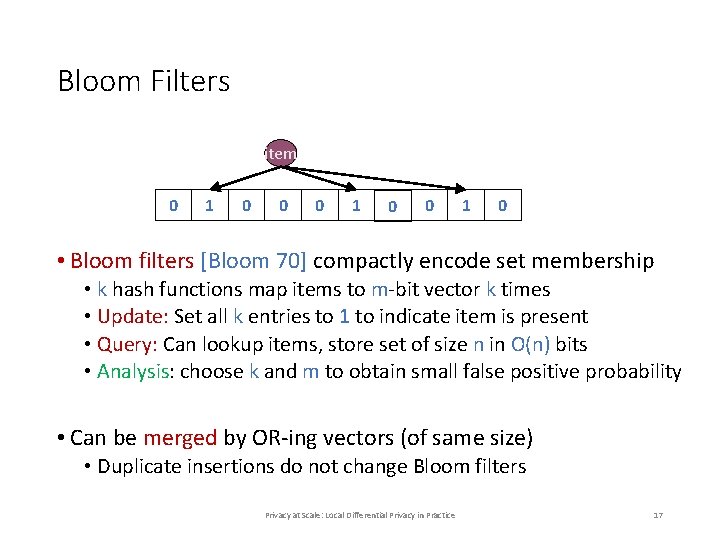
Bloom Filters item 0 1 0 • Bloom filters [Bloom 70] compactly encode set membership • k hash functions map items to m-bit vector k times • Update: Set all k entries to 1 to indicate item is present • Query: Can lookup items, store set of size n in O(n) bits • Analysis: choose k and m to obtain small false positive probability • Can be merged by OR-ing vectors (of same size) • Duplicate insertions do not change Bloom filters Privacy at Scale: Local Differential Privacy in Practice 17
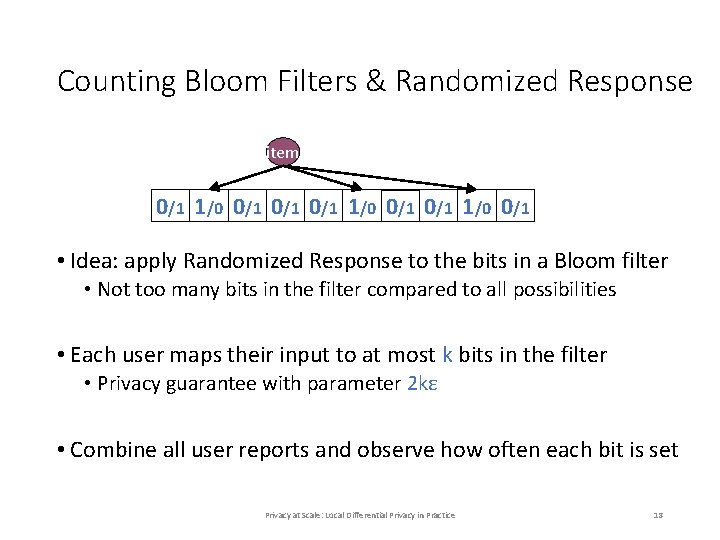
Counting Bloom Filters & Randomized Response item 0/1 1/0 0/1 • Idea: apply Randomized Response to the bits in a Bloom filter • Not too many bits in the filter compared to all possibilities • Each user maps their input to at most k bits in the filter • Privacy guarantee with parameter 2 kε • Combine all user reports and observe how often each bit is set Privacy at Scale: Local Differential Privacy in Practice 18
Decoding Noisy Counting Bloom Filters • We have a noisy Bloom filter, where each bit has a probability • To estimate the frequency of a particular value: • Look up its bit locations in the Bloom filter • Compute the unbiased estimate of the probability each is 1 • Take the minimum of these estimates as the frequency • More advanced decoding heuristics to decode all at once • How to find frequent strings without knowing them in advance? • Subsequent work: build up frequent strings character by character Privacy at Scale: Local Differential Privacy in Practice 19
RAPPOR in practice • The RAPPOR approach is implemented in the Chrome browser • Collects data from opt-in users, tens of millions per day • Open source implementation available • Tracks settings in the browser, e. g. home page, search engine • Many users unexpectedly change home page → possible malware • Typical configuration: • 128 bit Bloom filter, 2 hash functions, privacy parameter ~0. 5 • Needs about 10 K reports to identify a value with confidence Privacy at Scale: Local Differential Privacy in Practice 20
Apple: Sketches and Transforms • Similar problem to RAPPOR: count frequencies of many items • For simplicity, assume that each user holds a single item • To reduce burden of collection, can size of summary be reduced? • Instead of Bloom Filter, make use of sketches • Similar idea, but better suited to capturing frequencies Privacy at Scale: Local Differential Privacy in Practice 21
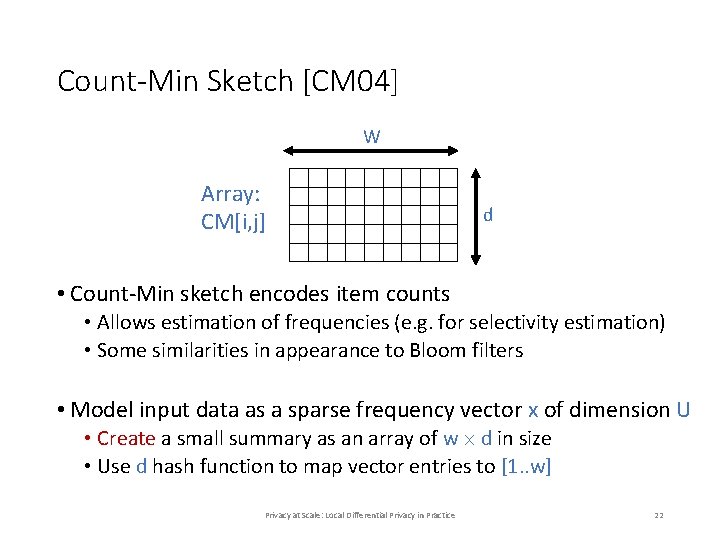
Count-Min Sketch [CM 04] W Array: CM[i, j] d • Count-Min sketch encodes item counts • Allows estimation of frequencies (e. g. for selectivity estimation) • Some similarities in appearance to Bloom filters • Model input data as a sparse frequency vector x of dimension U • Create a small summary as an array of w d in size • Use d hash function to map vector entries to [1. . w] Privacy at Scale: Local Differential Privacy in Practice 22
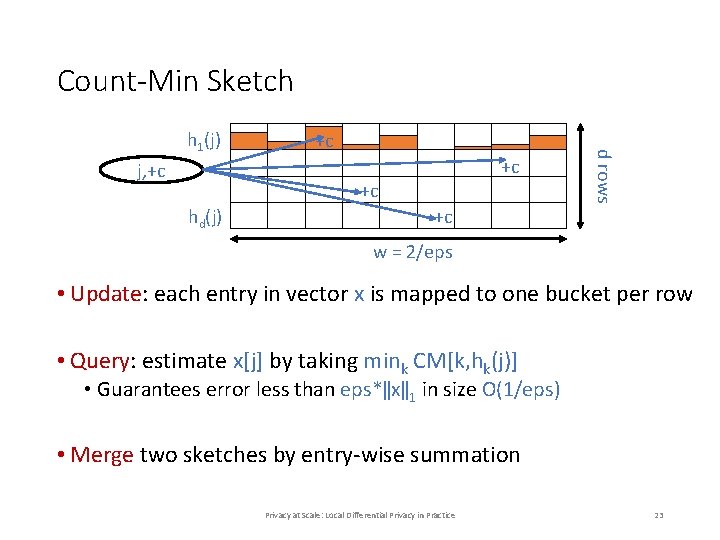
Count-Min Sketch j, +c +c hd(j) +c d rows h 1(j) w = 2/eps • Update: each entry in vector x is mapped to one bucket per row • Query: estimate x[j] by taking mink CM[k, hk(j)] • Guarantees error less than eps*‖x‖ 1 in size O(1/eps) • Merge two sketches by entry-wise summation Privacy at Scale: Local Differential Privacy in Practice 23
Count-Min Sketch + Randomized Response • Each user encodes their (unit) input with a Count-Min sketch • Then applies randomized response to each (binary) entry • Aggregator adds sketches, unbiases entries, estimates using mean • More robust than taking min when there is random noise • Error is a random variable with variance proportional to ‖x‖ 22/(wdn) • I. e. (absolute) error decreases proportional to 1/√n, 1/√sketch size • Bigger sketch more accuracy • But we want smaller communication Privacy at Scale: Local Differential Privacy in Practice 24
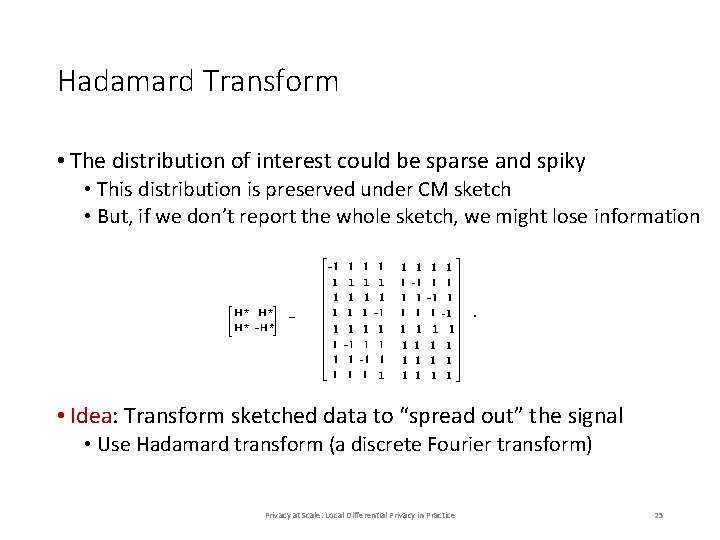
Hadamard Transform • The distribution of interest could be sparse and spiky • This distribution is preserved under CM sketch • But, if we don’t report the whole sketch, we might lose information • Idea: Transform sketched data to “spread out” the signal • Use Hadamard transform (a discrete Fourier transform) Privacy at Scale: Local Differential Privacy in Practice 25
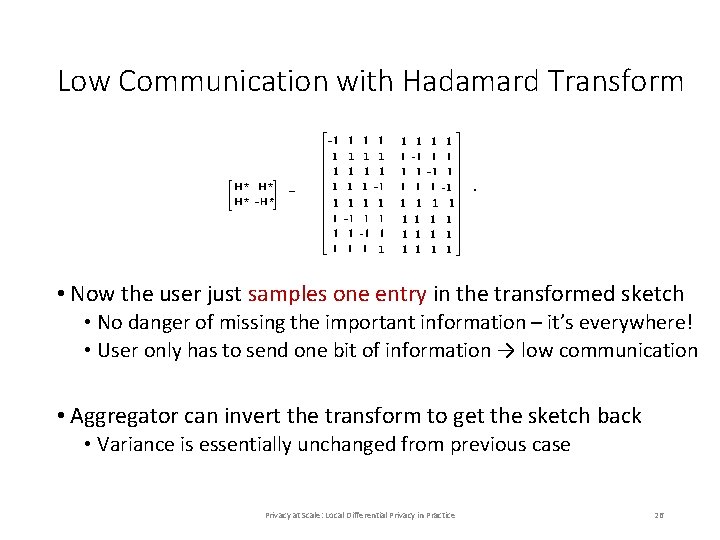
Low Communication with Hadamard Transform • Now the user just samples one entry in the transformed sketch • No danger of missing the important information – it’s everywhere! • User only has to send one bit of information → low communication • Aggregator can invert the transform to get the sketch back • Variance is essentially unchanged from previous case Privacy at Scale: Local Differential Privacy in Practice 26
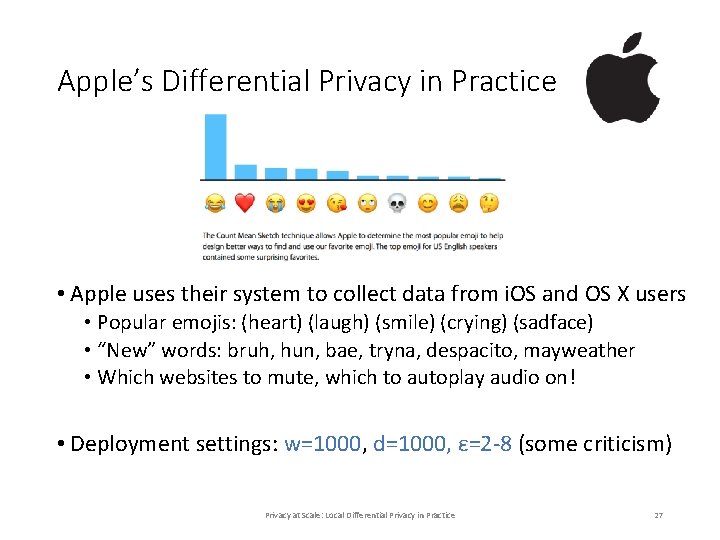
Apple’s Differential Privacy in Practice • Apple uses their system to collect data from i. OS and OS X users • Popular emojis: (heart) (laugh) (smile) (crying) (sadface) • “New” words: bruh, hun, bae, tryna, despacito, mayweather • Which websites to mute, which to autoplay audio on! • Deployment settings: w=1000, d=1000, ε=2 -8 (some criticism) Privacy at Scale: Local Differential Privacy in Practice 27
Microsoft telemetry data collection • Microsoft want to collect data on app usage • How much time was spent on a particular app today? • Allows finding patterns over time • Makes use of multiple subroutines: • 1 Bit. Mean to collect numeric data • d. Bit. Flip to collect (sparse) histogram data • Memoization and output perturbation to allow repeated probing • Has been implemented in Windows since 2017 Privacy at Scale: Local Differential Privacy in Practice 28
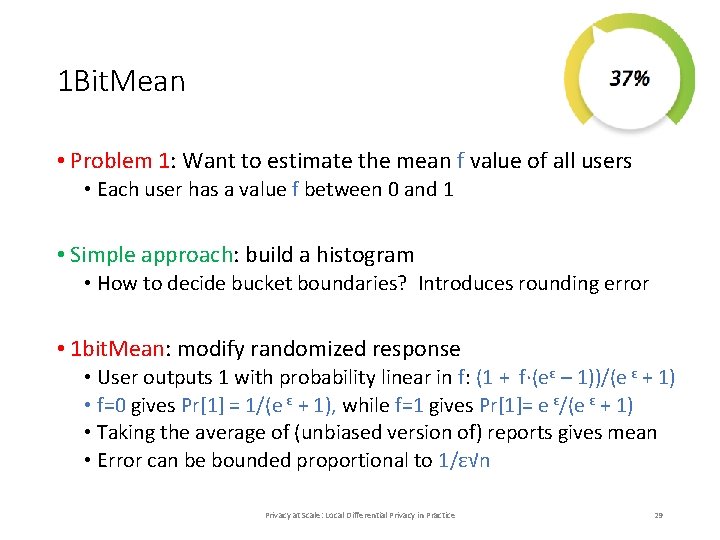
1 Bit. Mean • Problem 1: Want to estimate the mean f value of all users • Each user has a value f between 0 and 1 • Simple approach: build a histogram • How to decide bucket boundaries? Introduces rounding error • 1 bit. Mean: modify randomized response • User outputs 1 with probability linear in f: (1 + f·(eε – 1))/(e ε + 1) • f=0 gives Pr[1] = 1/(e ε + 1), while f=1 gives Pr[1]= e ε/(e ε + 1) • Taking the average of (unbiased version of) reports gives mean • Error can be bounded proportional to 1/ε√n Privacy at Scale: Local Differential Privacy in Practice 29
d. Bit. Flip • Problem 2: build a histogram over data items from a population • Each user has a single item value out of k possibilities • Essentially the same problem that Google and Apple tackle • Simple approach: apply RR to every bucket, costly when k is large • d. Bit. Flip: apply Randomized Response to a sample of buckets • User samples d buckets without replacement, applies RR to each • Aggregator sums and unbiases the noisy reports • Error proportional to √(k/d): trades off error for speed • Many alternative solutions for this “frequency oracle” problem Privacy at Scale: Local Differential Privacy in Practice 30
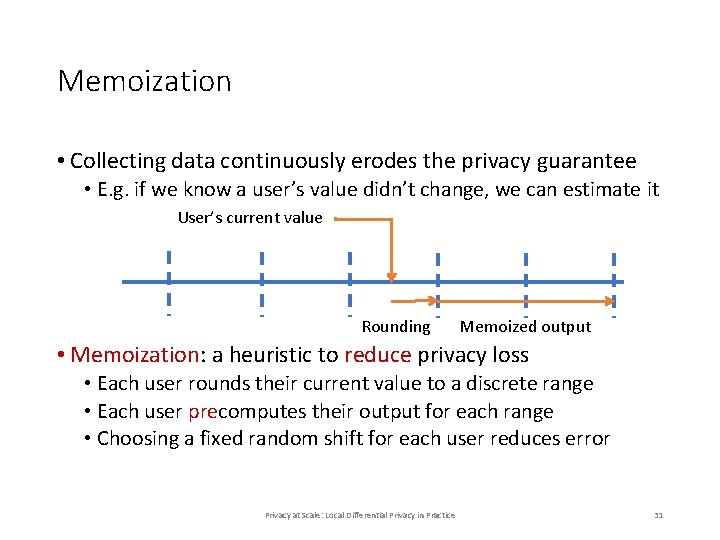
Memoization • Collecting data continuously erodes the privacy guarantee • E. g. if we know a user’s value didn’t change, we can estimate it User’s current value Rounding Memoized output • Memoization: a heuristic to reduce privacy loss • Each user rounds their current value to a discrete range • Each user precomputes their output for each range • Choosing a fixed random shift for each user reduces error Privacy at Scale: Local Differential Privacy in Practice 31
Output Perturbation • Note however “memoization violates differential privacy”! • Can tell the difference between change and no change • But at least this process hides what the value was • Output perturbation aims to address this problem • For each user output bit, flip it with small probability γ, e. g. 0. 2 • Increases error by a factor of 1/(1 - 2γ) (so 5/3 for γ=0. 2) • Increases uncertainty about exactly when a change happened • After long enough, can be certain that some change happened Privacy at Scale: Local Differential Privacy in Practice 32
MS Telemetry Collection in Practice • Deployed in Windows 10 Fall Creators Update (October 2017) • Collects number of seconds users spend in different apps • Parameters: ε =1 and γ = 0. 2 • Collection period: every 6 hours • Collects data on all app usage, not just one at a time • Can analyze based on the fact that total time spent is limited • Gives overall guarantee of ε = 1. 672 for a round of collection Privacy at Scale: Local Differential Privacy in Practice 33
Snap Private Machine Learning • Snap (parent company of Snapchat) propose LDP ML • “Federated Machine Learning”, with privacy • Maintain k current models • Each step, send one user a randomly chosen model • Receive an updated model, randomly replace one of the k • Deployment example: detecting phishing URLs • Model: Logistic regression, circa 1000 features • Parameters: k=20, ε = ? ? ? • Accuracy: reached 93% accuracy, after 1 billion updates Privacy at Scale: Local Differential Privacy in Practice 34
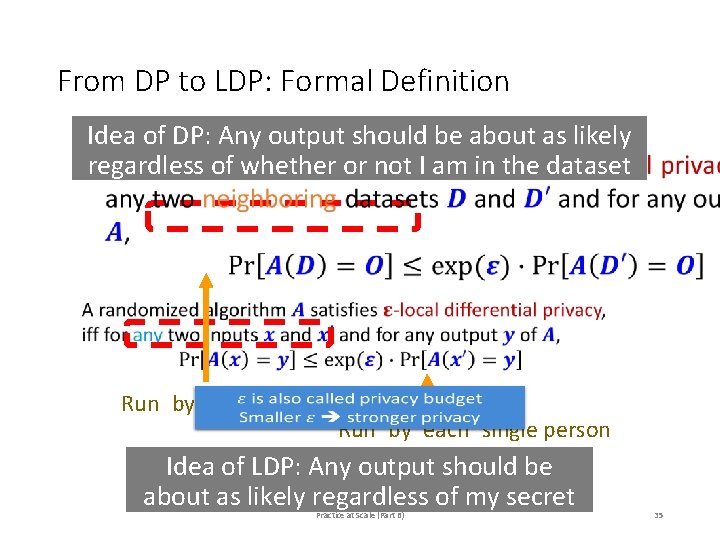
From DP to LDP: Formal Definition Idea of DP: Any output should be about as likely regardless of whether or not I am in the dataset Run by the server Run by each single person Idea of LDP: Any output should be about as likely regardless of my secret Practice at Scale (Part B) 35
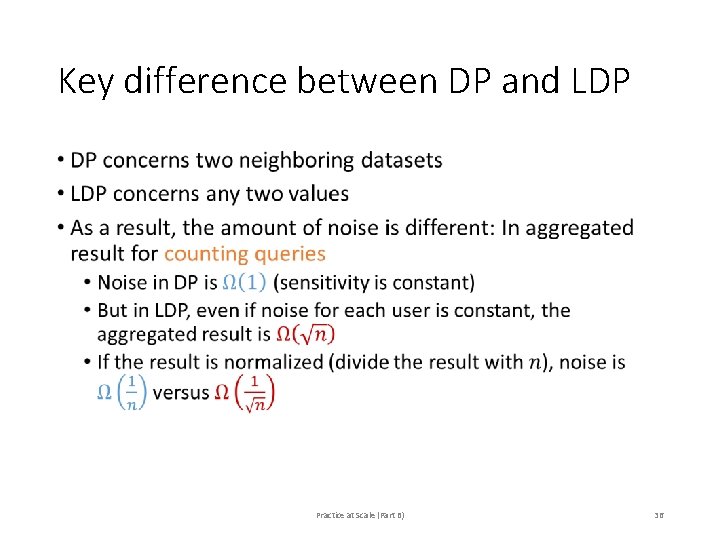
Key difference between DP and LDP • Practice at Scale (Part B) 36
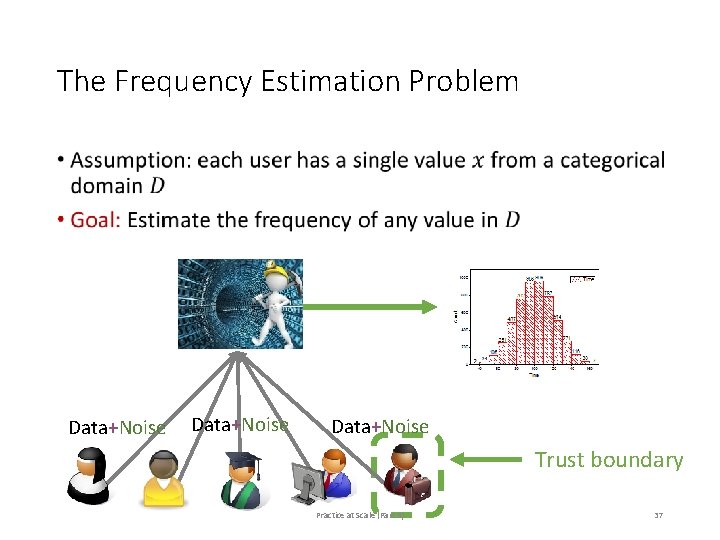
The Frequency Estimation Problem • Data+Noise Trust boundary Practice at Scale (Part B) 37
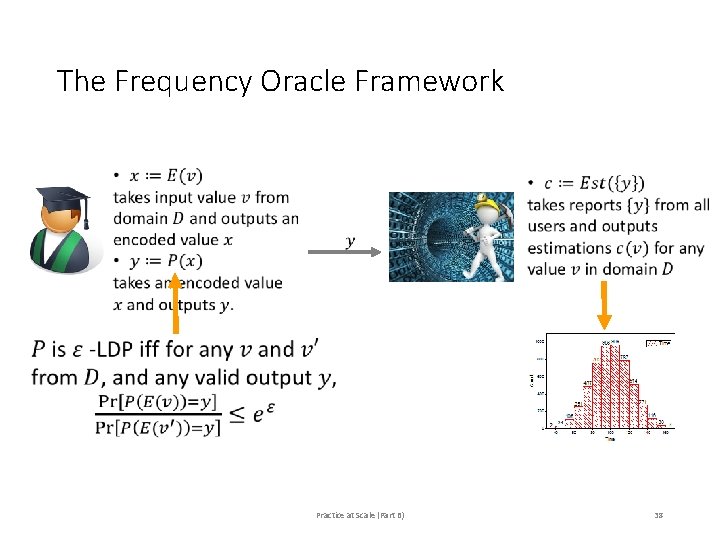
The Frequency Oracle Framework Practice at Scale (Part B) 38
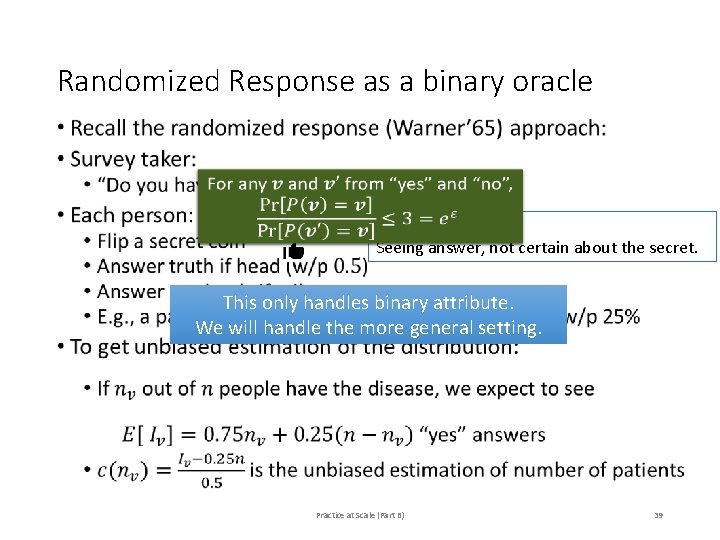
Randomized Response as a binary oracle • Provide deniability: Seeing answer, not certain about the secret. This only handles binary attribute. We will handle the more general setting. Practice at Scale (Part B) 39
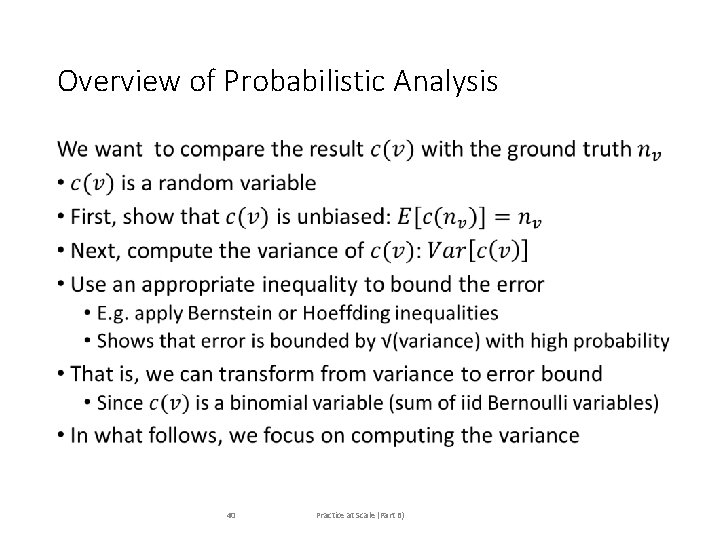
Overview of Probabilistic Analysis • 40 Practice at Scale (Part B)
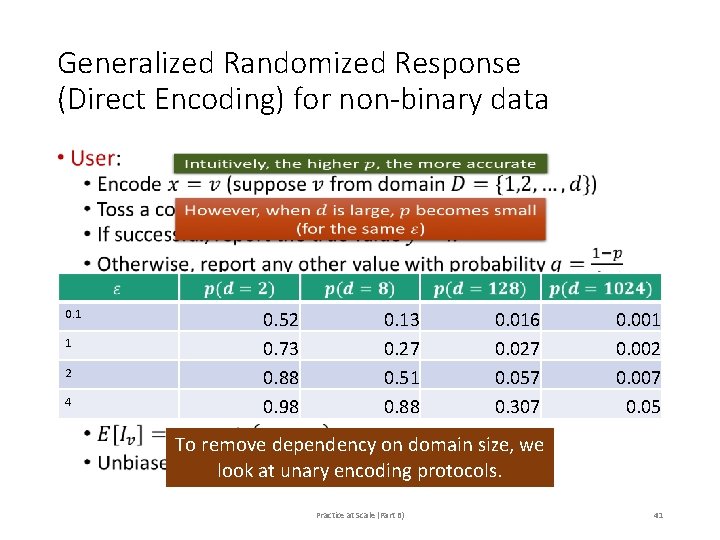
Generalized Randomized Response (Direct Encoding) for non-binary data • 0. 1 1 2 4 0. 52 0. 73 0. 88 0. 98 0. 13 0. 27 0. 51 0. 88 0. 016 0. 027 0. 057 0. 307 0. 001 0. 002 0. 007 0. 05 To remove dependency on domain size, we look at unary encoding protocols. Practice at Scale (Part B) 41
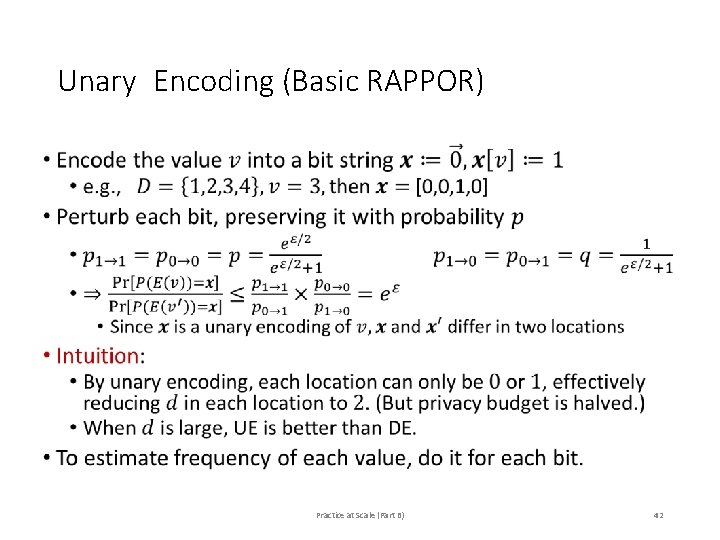
Unary Encoding (Basic RAPPOR) • Practice at Scale (Part B) 42
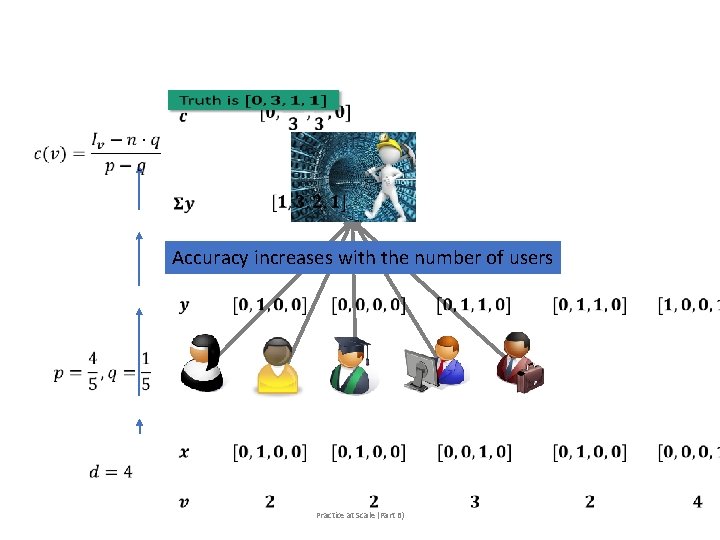
Accuracy increases with the number of users Practice at Scale (Part B)
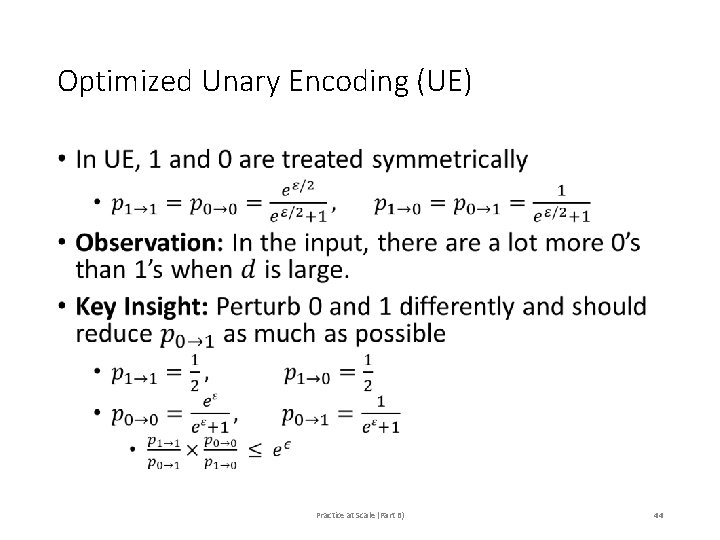
Optimized Unary Encoding (UE) • Practice at Scale (Part B) 44
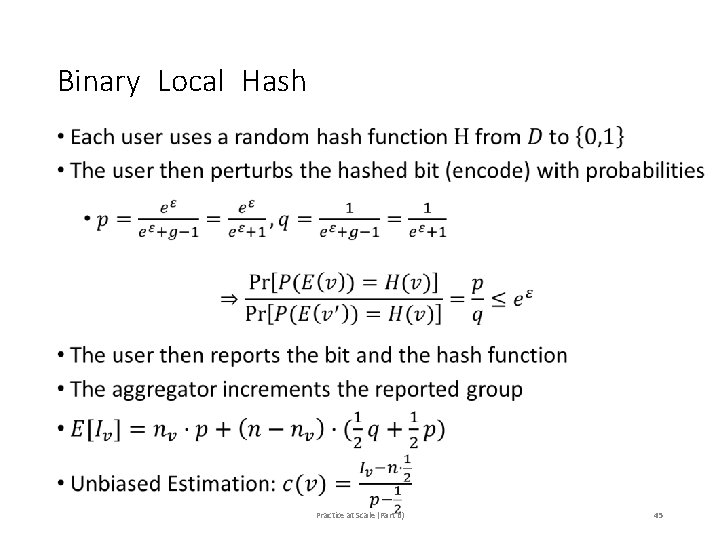
Binary Local Hash • Practice at Scale (Part B) 45
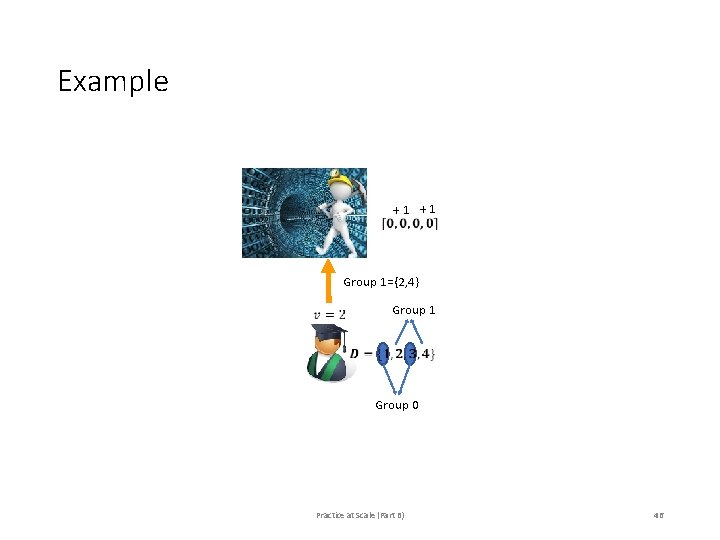
Example + 1 Group 1={2, 4} Group 1 Group 0 Practice at Scale (Part B) 46
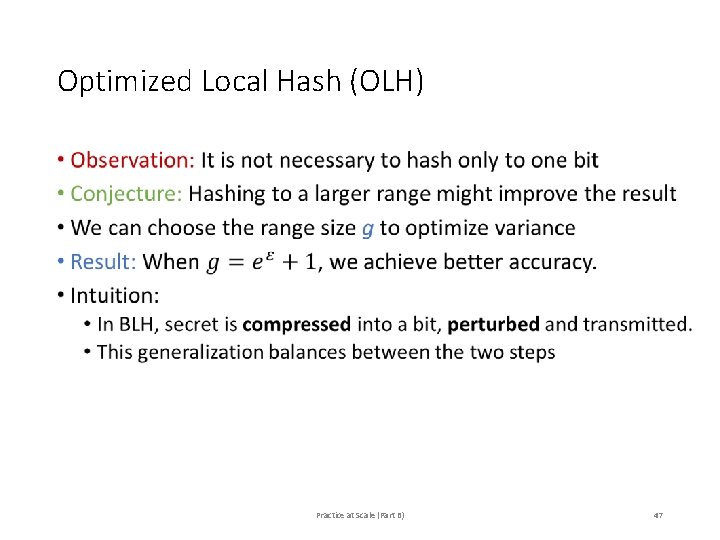
Optimized Local Hash (OLH) • Practice at Scale (Part B) 47
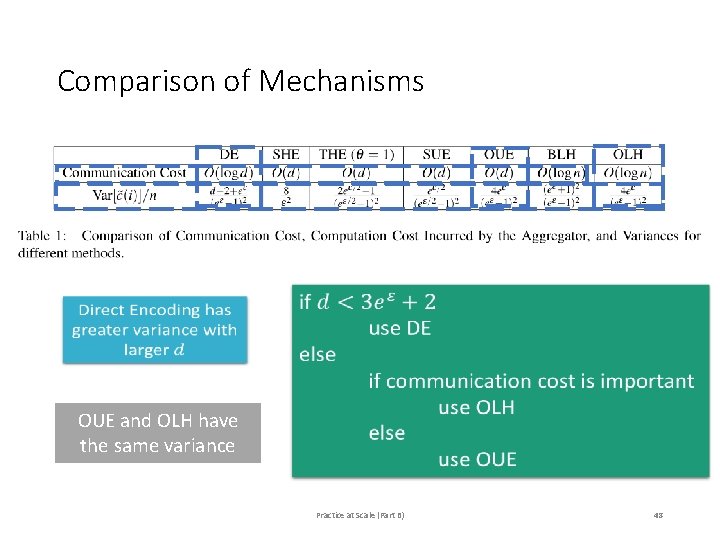
Comparison of Mechanisms OUE and OLH have the same variance Practice at Scale (Part B) 48
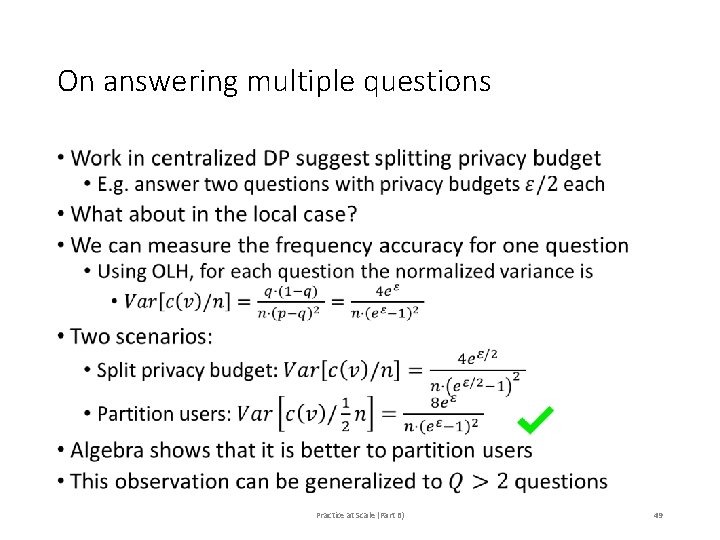
On answering multiple questions • Practice at Scale (Part B) 49
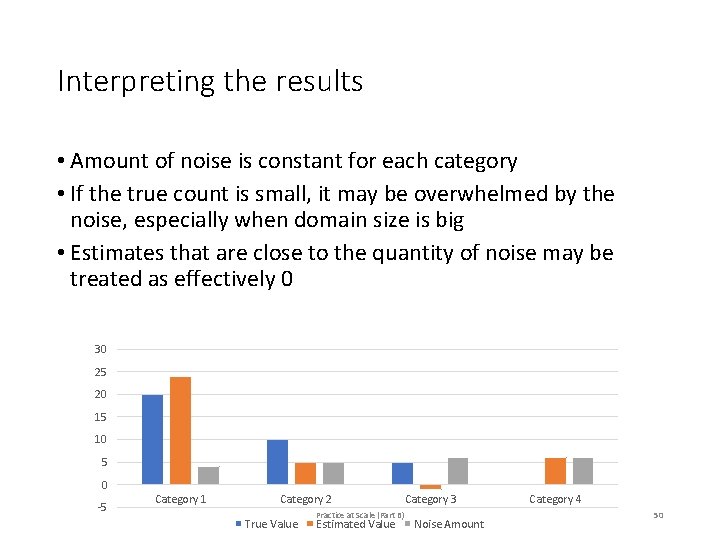
Interpreting the results • Amount of noise is constant for each category • If the true count is small, it may be overwhelmed by the noise, especially when domain size is big • Estimates that are close to the quantity of noise may be treated as effectively 0 30 25 20 15 10 5 0 -5 Category 1 Category 2 True Value Category 3 Practice at Scale (Part B) Estimated Value Noise Amount Category 4 50
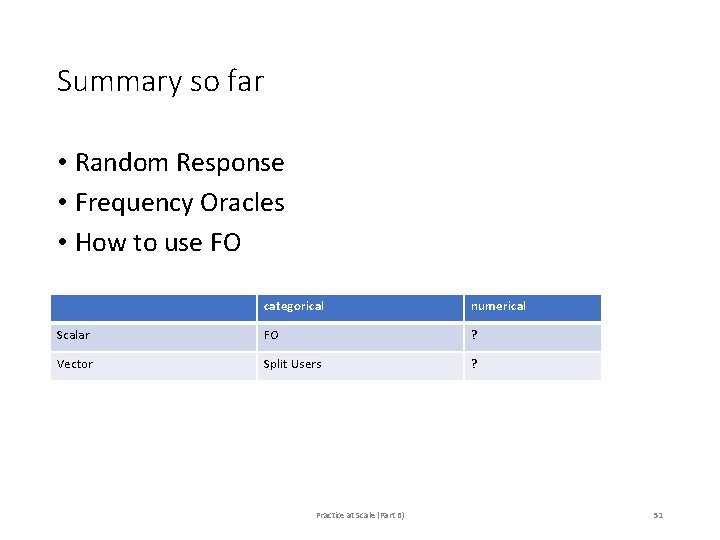
Summary so far • Random Response • Frequency Oracles • How to use FO categorical numerical Scalar FO ? Vector Split Users ? Practice at Scale (Part B) 51
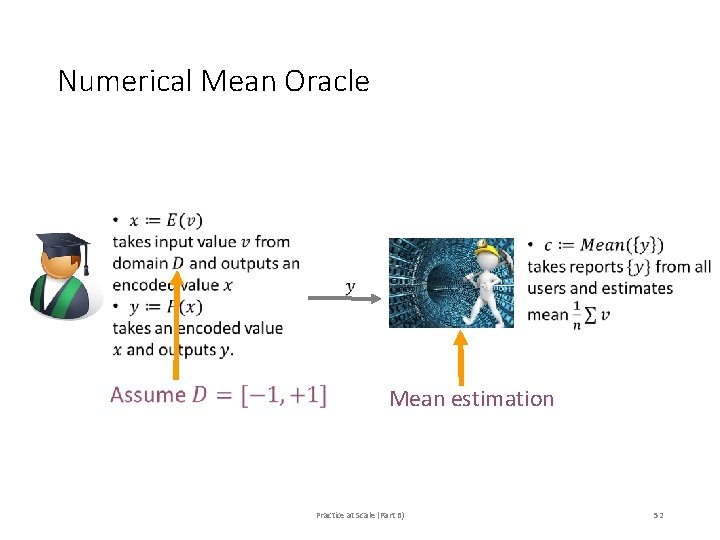
Numerical Mean Oracle Mean estimation Practice at Scale (Part B) 52
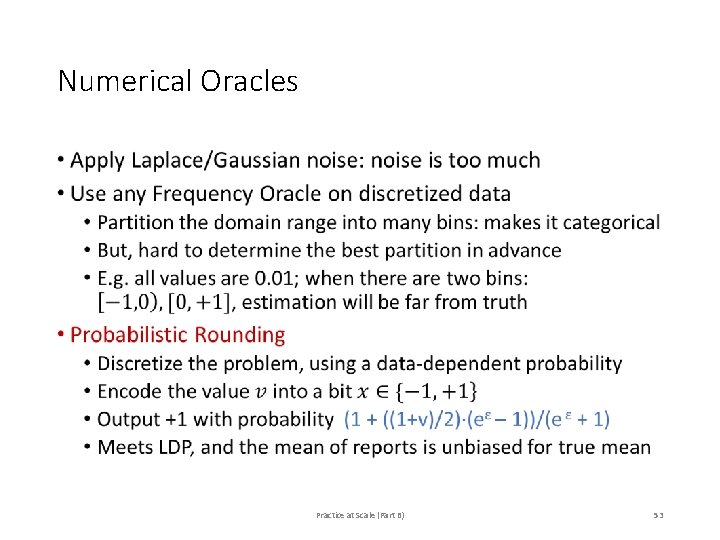
Numerical Oracles • Practice at Scale (Part B) 53
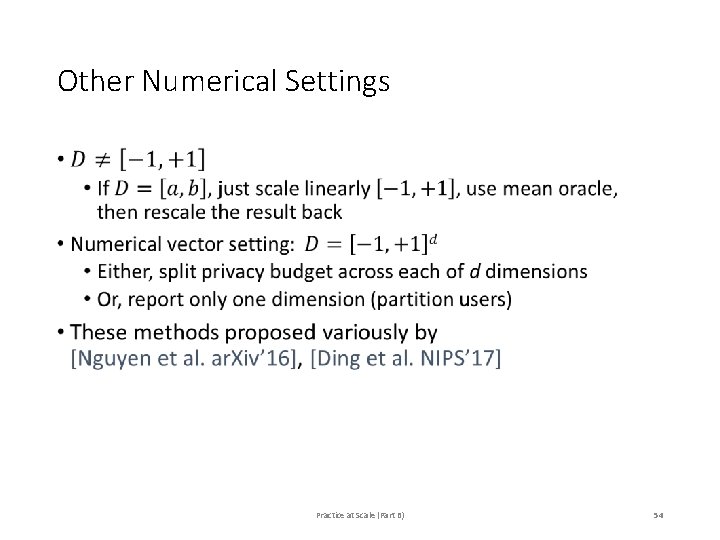
Other Numerical Settings • Practice at Scale (Part B) 54
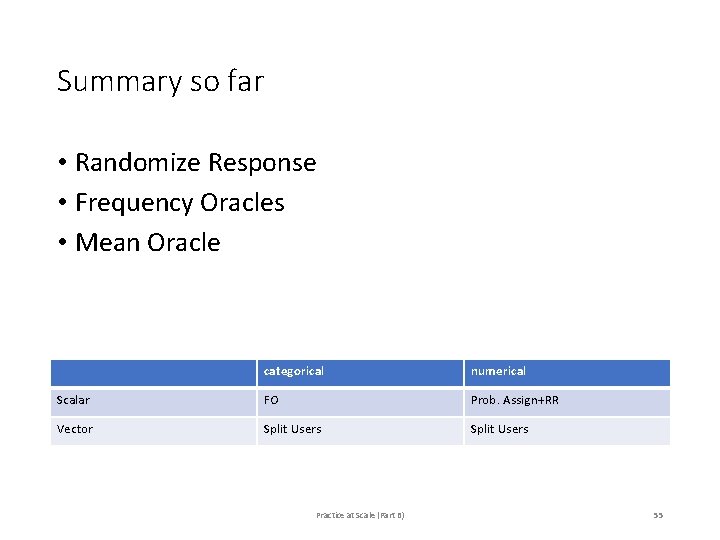
Summary so far • Randomize Response • Frequency Oracles • Mean Oracle categorical numerical Scalar FO Prob. Assign+RR Vector Split Users Practice at Scale (Part B) 55
Heavy Hitter Estimation Practice at Scale (Part B) 56
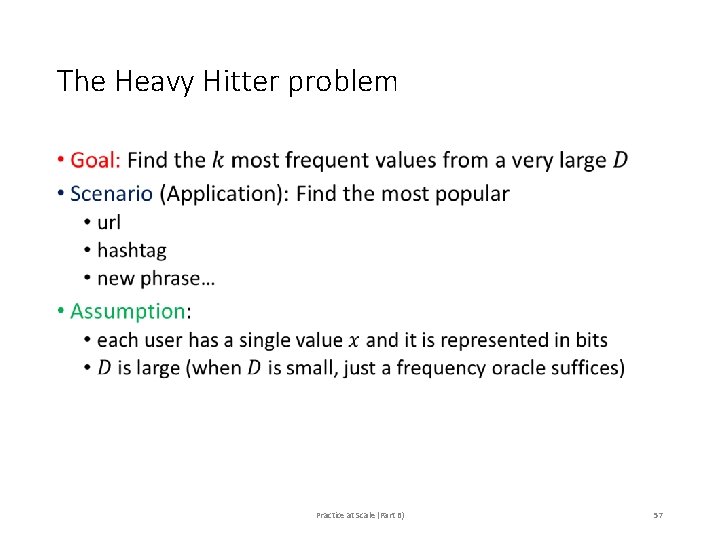
The Heavy Hitter problem • Practice at Scale (Part B) 57
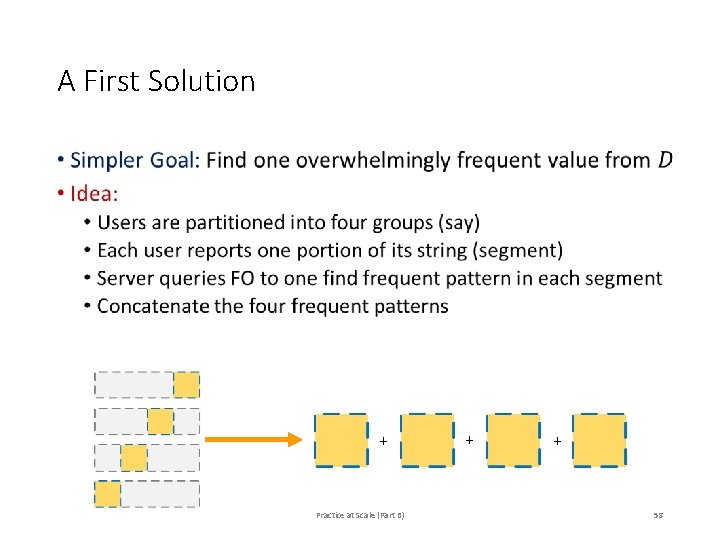
A First Solution • + Practice at Scale (Part B) + + 58
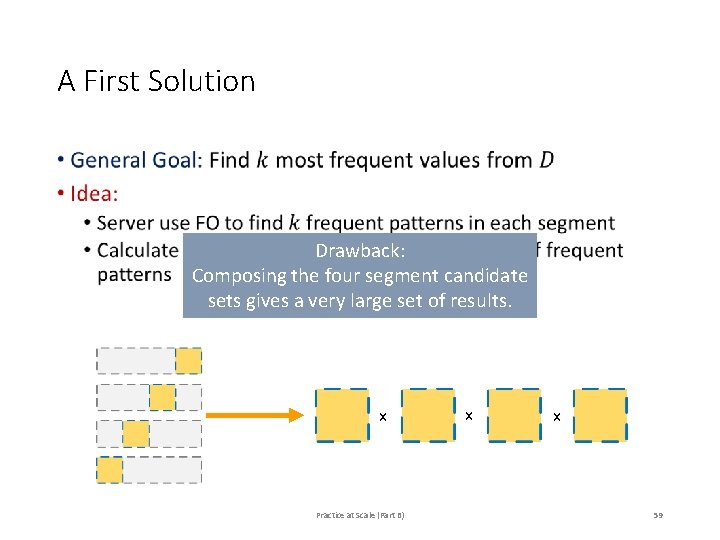
A First Solution • Drawback: Composing the four segment candidate sets gives a very large set of results. x Practice at Scale (Part B) x x 59
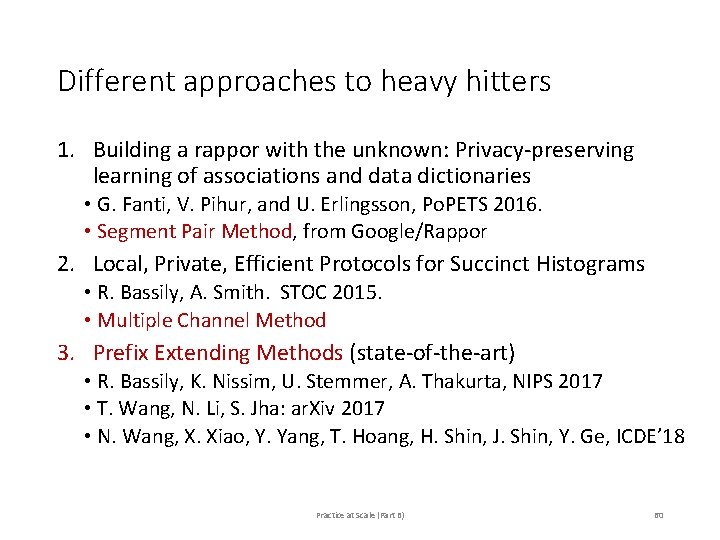
Different approaches to heavy hitters 1. Building a rappor with the unknown: Privacy-preserving learning of associations and data dictionaries • G. Fanti, V. Pihur, and U. Erlingsson, Po. PETS 2016. • Segment Pair Method, from Google/Rappor 2. Local, Private, Efficient Protocols for Succinct Histograms • R. Bassily, A. Smith. STOC 2015. • Multiple Channel Method 3. Prefix Extending Methods (state-of-the-art) • R. Bassily, K. Nissim, U. Stemmer, A. Thakurta, NIPS 2017 • T. Wang, N. Li, S. Jha: ar. Xiv 2017 • N. Wang, X. Xiao, Y. Yang, T. Hoang, H. Shin, J. Shin, Y. Ge, ICDE’ 18 Practice at Scale (Part B) 60
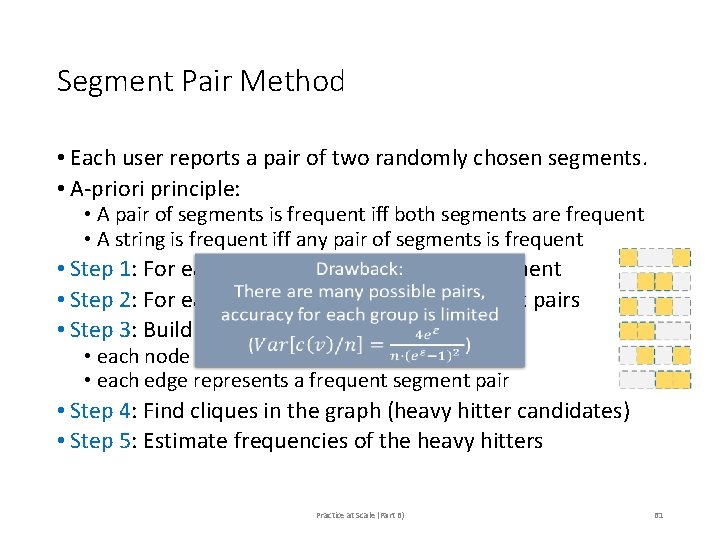
Segment Pair Method • Each user reports a pair of two randomly chosen segments. • A-priori principle: • A pair of segments is frequent iff both segments are frequent • A string is frequent iff any pair of segments is frequent • Step 1: For each location, test all possible segment • Step 2: For each pair, test all frequent segment pairs • Step 3: Build a k-partite graph where • each node represents a frequent segment • each edge represents a frequent segment pair • Step 4: Find cliques in the graph (heavy hitter candidates) • Step 5: Estimate frequencies of the heavy hitters Practice at Scale (Part B) 61
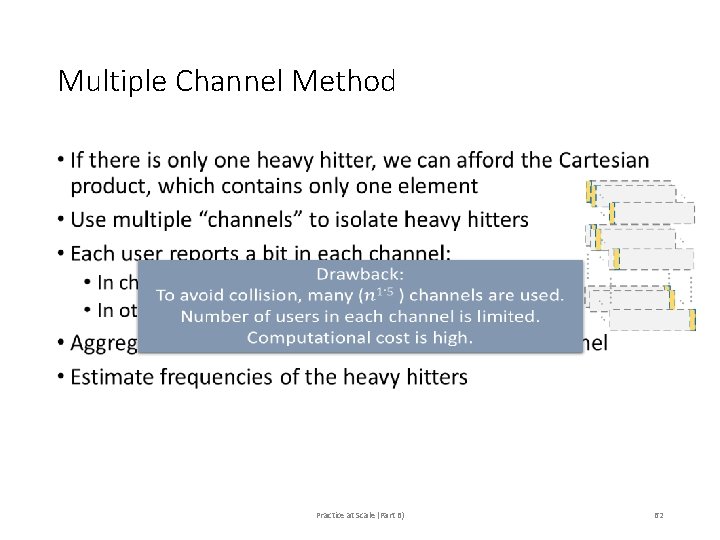
Multiple Channel Method • Practice at Scale (Part B) 62
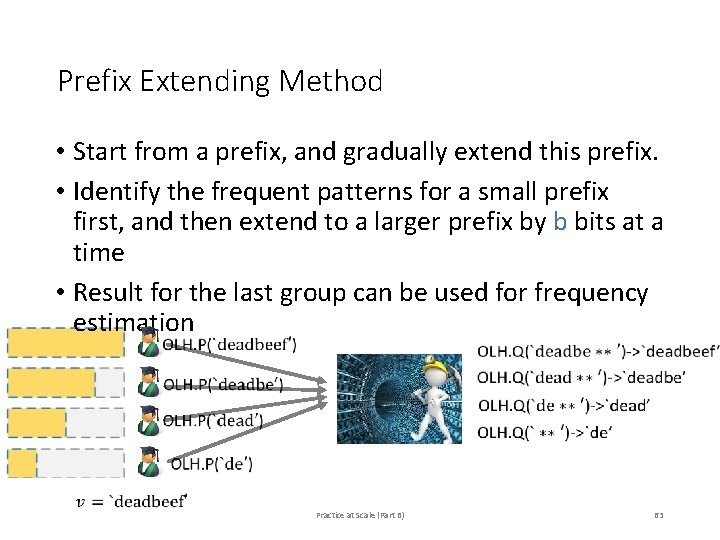
Prefix Extending Method • Start from a prefix, and gradually extend this prefix. • Identify the frequent patterns for a small prefix first, and then extend to a larger prefix by b bits at a time • Result for the last group can be used for frequency estimation Practice at Scale (Part B) 63
More Applications for LDP Beyond heavy hitters and simple statistics, many LDP applications: • Text and language modelling • Marginal distributions and correlation • Spatial data • Graphs and social networks • Machine learning Across all these LDP applications, some common features emerge
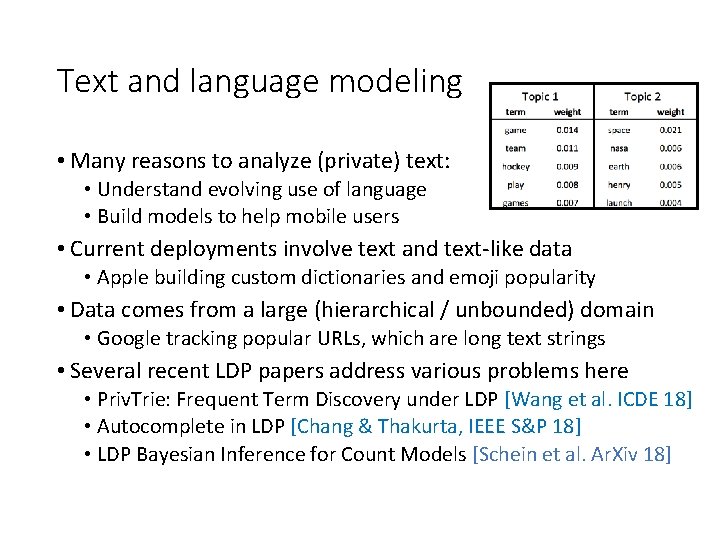
Text and language modeling • Many reasons to analyze (private) text: • Understand evolving use of language • Build models to help mobile users • Current deployments involve text and text-like data • Apple building custom dictionaries and emoji popularity • Data comes from a large (hierarchical / unbounded) domain • Google tracking popular URLs, which are long text strings • Several recent LDP papers address various problems here • Priv. Trie: Frequent Term Discovery under LDP [Wang et al. ICDE 18] • Autocomplete in LDP [Chang & Thakurta, IEEE S&P 18] • LDP Bayesian Inference for Count Models [Schein et al. Ar. Xiv 18]
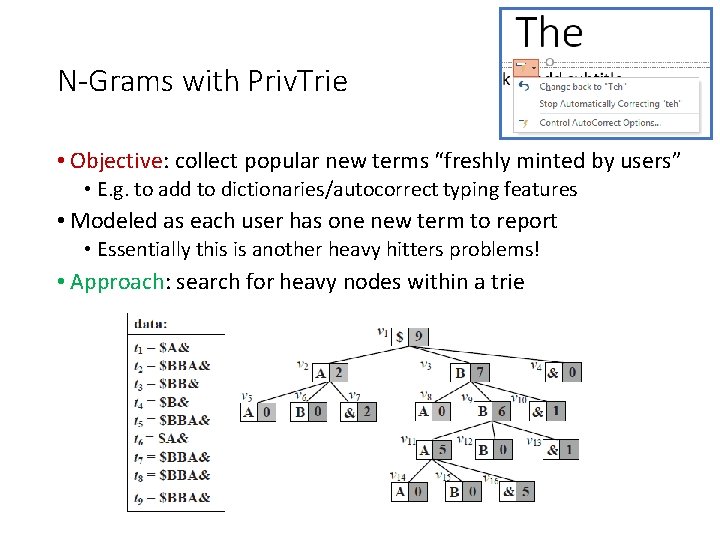
N-Grams with Priv. Trie • Objective: collect popular new terms “freshly minted by users” • E. g. to add to dictionaries/autocorrect typing features • Modeled as each user has one new term to report • Essentially this is another heavy hitters problems! • Approach: search for heavy nodes within a trie
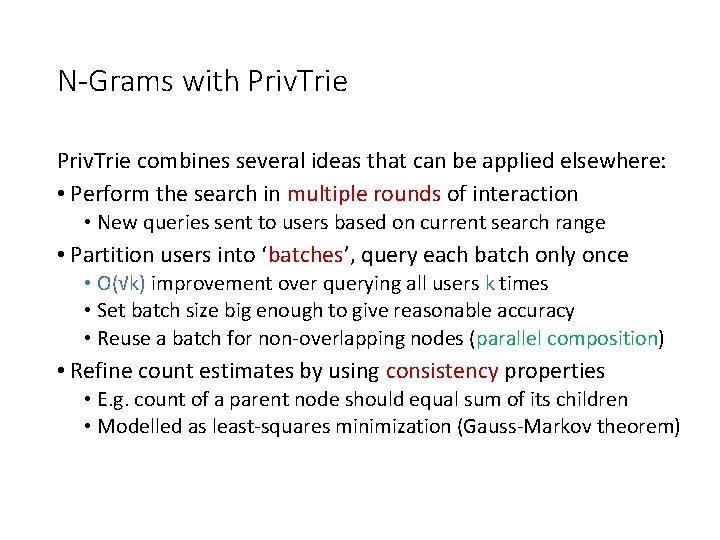
N-Grams with Priv. Trie combines several ideas that can be applied elsewhere: • Perform the search in multiple rounds of interaction • New queries sent to users based on current search range • Partition users into ‘batches’, query each batch only once • O(√k) improvement over querying all users k times • Set batch size big enough to give reasonable accuracy • Reuse a batch for non-overlapping nodes (parallel composition) • Refine count estimates by using consistency properties • E. g. count of a parent node should equal sum of its children • Modelled as least-squares minimization (Gauss-Markov theorem)
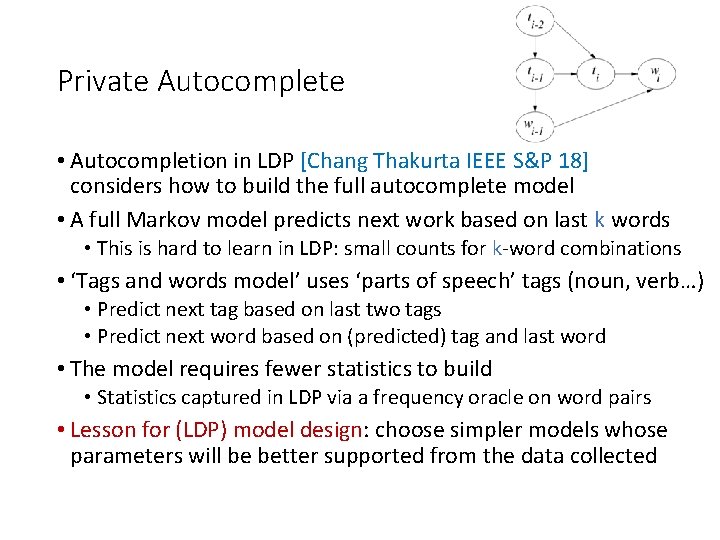
Private Autocomplete • Autocompletion in LDP [Chang Thakurta IEEE S&P 18] considers how to build the full autocomplete model • A full Markov model predicts next work based on last k words • This is hard to learn in LDP: small counts for k-word combinations • ‘Tags and words model’ uses ‘parts of speech’ tags (noun, verb…) • Predict next tag based on last two tags • Predict next word based on (predicted) tag and last word • The model requires fewer statistics to build • Statistics captured in LDP via a frequency oracle on word pairs • Lesson for (LDP) model design: choose simpler models whose parameters will be better supported from the data collected
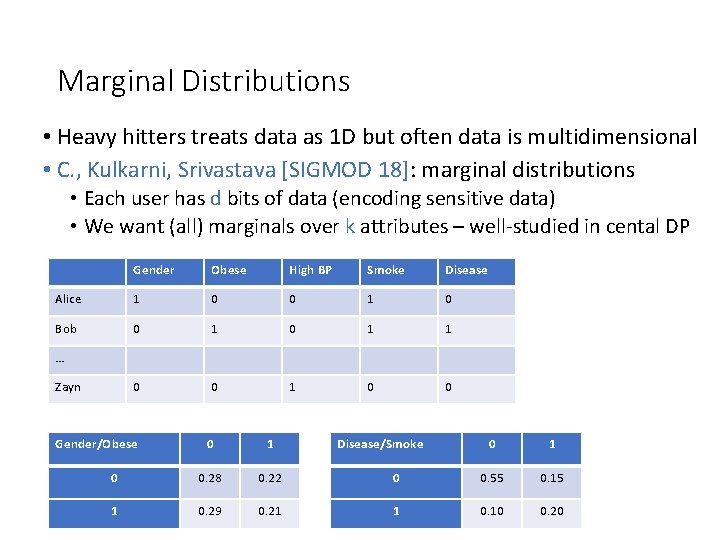
Marginal Distributions • Heavy hitters treats data as 1 D but often data is multidimensional • C. , Kulkarni, Srivastava [SIGMOD 18]: marginal distributions • Each user has d bits of data (encoding sensitive data) • We want (all) marginals over k attributes – well-studied in cental DP Gender Obese High BP Smoke Disease Alice 1 0 0 1 0 Bob 0 1 1 0 0 … Zayn Gender/Obese 0 1 0 0. 28 0. 22 1 0. 29 0. 21 Disease/Smoke 0 1 0 0. 55 0. 15 1 0. 10 0. 20
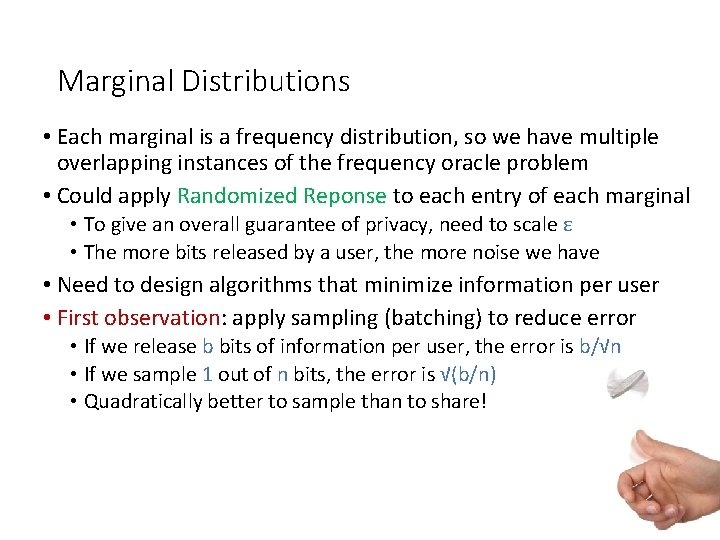
Marginal Distributions • Each marginal is a frequency distribution, so we have multiple overlapping instances of the frequency oracle problem • Could apply Randomized Reponse to each entry of each marginal • To give an overall guarantee of privacy, need to scale ε • The more bits released by a user, the more noise we have • Need to design algorithms that minimize information per user • First observation: apply sampling (batching) to reduce error • If we release b bits of information per user, the error is b/√n • If we sample 1 out of n bits, the error is √(b/n) • Quadratically better to sample than to share!
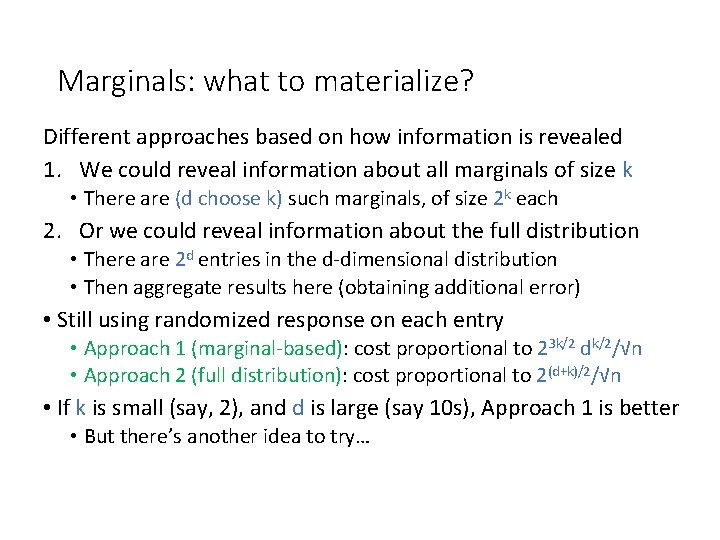
Marginals: what to materialize? Different approaches based on how information is revealed 1. We could reveal information about all marginals of size k • There are (d choose k) such marginals, of size 2 k each 2. Or we could reveal information about the full distribution • There are 2 d entries in the d-dimensional distribution • Then aggregate results here (obtaining additional error) • Still using randomized response on each entry • Approach 1 (marginal-based): cost proportional to 23 k/2 dk/2/√n • Approach 2 (full distribution): cost proportional to 2(d+k)/2/√n • If k is small (say, 2), and d is large (say 10 s), Approach 1 is better • But there’s another idea to try…
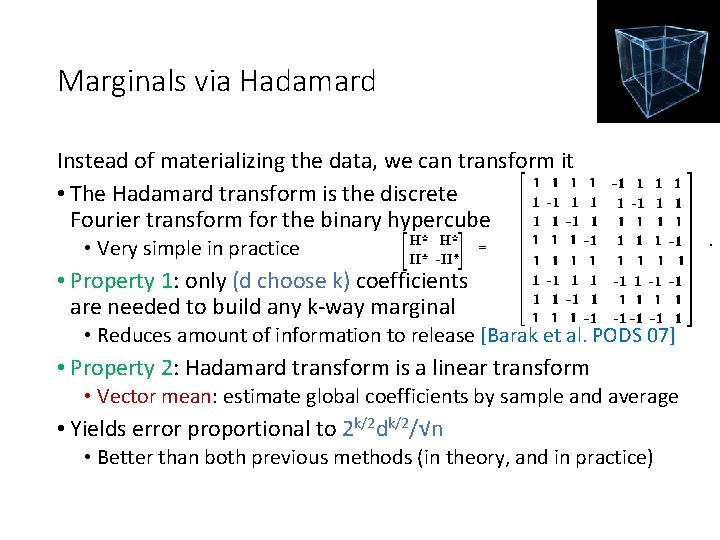
Marginals via Hadamard Instead of materializing the data, we can transform it • The Hadamard transform is the discrete Fourier transform for the binary hypercube • Very simple in practice • Property 1: only (d choose k) coefficients are needed to build any k-way marginal • Reduces amount of information to release [Barak et al. PODS 07] • Property 2: Hadamard transform is a linear transform • Vector mean: estimate global coefficients by sample and average • Yields error proportional to 2 k/2 dk/2/√n • Better than both previous methods (in theory, and in practice)
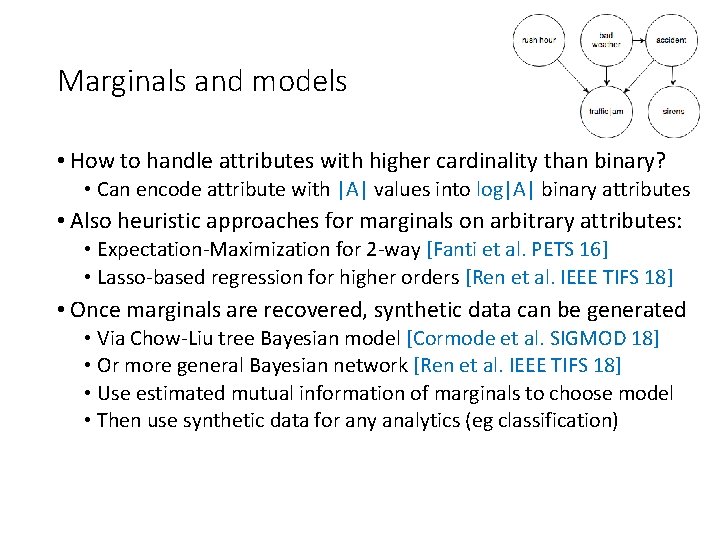
Marginals and models • How to handle attributes with higher cardinality than binary? • Can encode attribute with |A| values into log|A| binary attributes • Also heuristic approaches for marginals on arbitrary attributes: • Expectation-Maximization for 2 -way [Fanti et al. PETS 16] • Lasso-based regression for higher orders [Ren et al. IEEE TIFS 18] • Once marginals are recovered, synthetic data can be generated • Via Chow-Liu tree Bayesian model [Cormode et al. SIGMOD 18] • Or more general Bayesian network [Ren et al. IEEE TIFS 18] • Use estimated mutual information of marginals to choose model • Then use synthetic data for any analytics (eg classification)
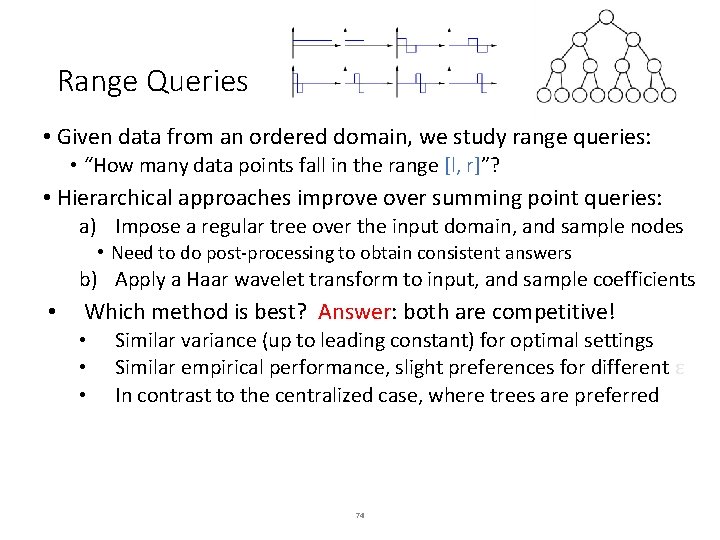
Range Queries • Given data from an ordered domain, we study range queries: • “How many data points fall in the range [l, r]”? • Hierarchical approaches improve over summing point queries: a) Impose a regular tree over the input domain, and sample nodes • Need to do post-processing to obtain consistent answers b) Apply a Haar wavelet transform to input, and sample coefficients • Which method is best? Answer: both are competitive! • • • Similar variance (up to leading constant) for optimal settings Similar empirical performance, slight preferences for different ε In contrast to the centralized case, where trees are preferred 74
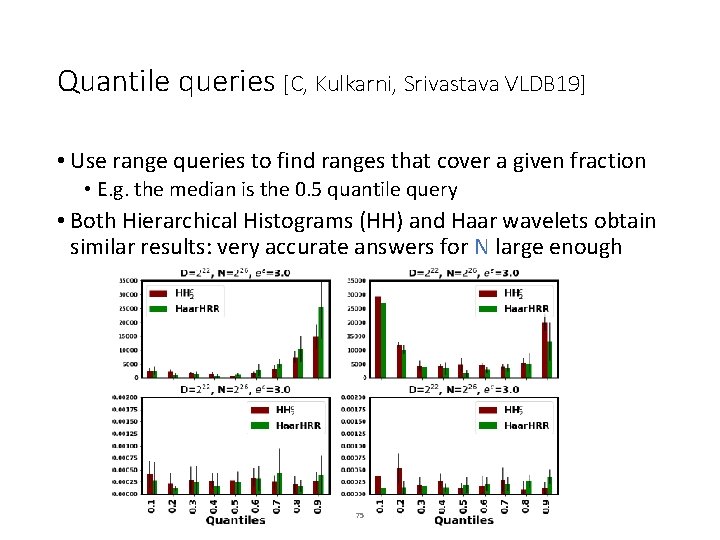
Quantile queries [C, Kulkarni, Srivastava VLDB 19] • Use range queries to find ranges that cover a given fraction • E. g. the median is the 0. 5 quantile query • Both Hierarchical Histograms (HH) and Haar wavelets obtain similar results: very accurate answers for N large enough 75
Spatial Data • People’s geographic locations can be very privacy sensitive • Canonical example: presence at a health clinic • But we want to capture population location distribution • First attempt: impose a hierarchical grid structure and count • Similar ideas successful in the centralized model • Identify heavy regions: a heavy hitter problem • Could be solved via frequency oracle (again)! • Limitations: • Doesn’t account for varying spatial density (the difference between Manhattan NY vs Manhattan KS) • Maybe too cautious: it’s fine to know what country I’m in
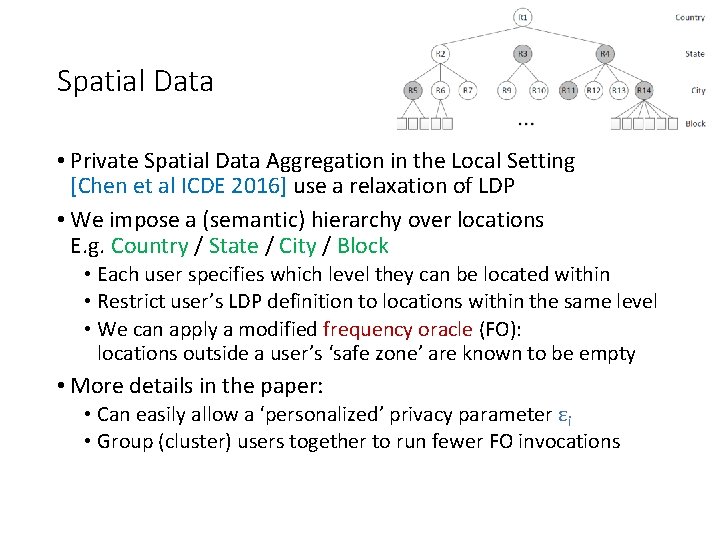
Spatial Data • Private Spatial Data Aggregation in the Local Setting [Chen et al ICDE 2016] use a relaxation of LDP • We impose a (semantic) hierarchy over locations E. g. Country / State / City / Block • Each user specifies which level they can be located within • Restrict user’s LDP definition to locations within the same level • We can apply a modified frequency oracle (FO): locations outside a user’s ‘safe zone’ are known to be empty • More details in the paper: • Can easily allow a ‘personalized’ privacy parameter εi • Group (cluster) users together to run fewer FO invocations
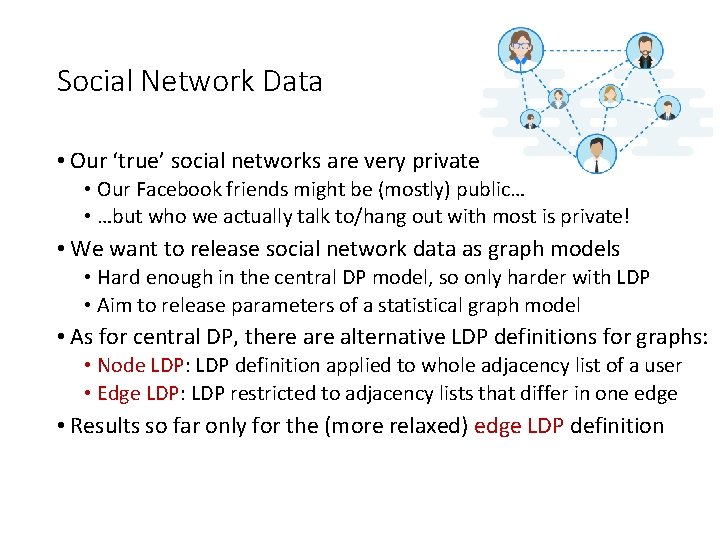
Social Network Data • Our ‘true’ social networks are very private • Our Facebook friends might be (mostly) public… • …but who we actually talk to/hang out with most is private! • We want to release social network data as graph models • Hard enough in the central DP model, so only harder with LDP • Aim to release parameters of a statistical graph model • As for central DP, there alternative LDP definitions for graphs: • Node LDP: LDP definition applied to whole adjacency list of a user • Edge LDP: LDP restricted to adjacency lists that differ in one edge • Results so far only for the (more relaxed) edge LDP definition
Synthetic Social Graphs • Generating Synthetic Decentralized Social Graphs with Local Differential Privacy [Qin et al. CCS 2017] considers two baselines: 1. Randomized neighbour list (RNL) on user’s adjacency list • Meets LDP, but introduces a lot of fake edges • Need a model where parameters have more support 2. Degree-based graph generation (DGG) • Compute degree of each node (accurate under edge LDP) • Sample from a graph model that only needs degrees (eg BTER) • Neither baseline is very satisfying • Goldilocks effect: RNL too detailed, DGG too coarse
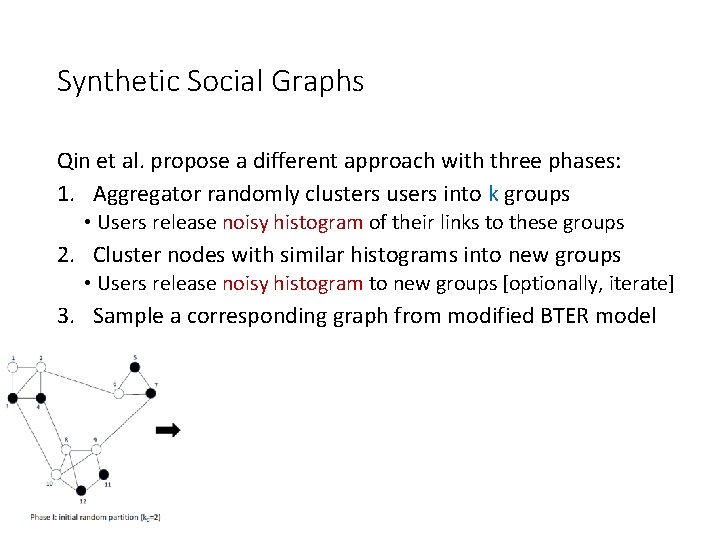
Synthetic Social Graphs Qin et al. propose a different approach with three phases: 1. Aggregator randomly clusters users into k groups • Users release noisy histogram of their links to these groups 2. Cluster nodes with similar histograms into new groups • Users release noisy histogram to new groups [optionally, iterate] 3. Sample a corresponding graph from modified BTER model
Machine Learning • Effective machine learning (ML) needs to learn from real data • For tasks like classification, regression, recommender systems • Traditional machine learning assumes centralized data • Training data to build the model, and test data to evaluate • Many ML tasks can be written as optimization problems: • Minimize a (regularized) loss function for training data points (x, y) • Learn parameters Θ to minimize ∑i Loss(Θ, xi, yi) + NΩ ‖Θ‖ 22 • E. g. linear regression, Loss(Θ, xi, yi) = (xi. T Θ – yi)2 • E. g. SVM with hinge loss, Loss(Θ, xi, yi) = max(0, 1 – yi xi. T Θ) • Can we find private ML models directly under LDP?
Machine Learning Collecting and Analyzing Data from Smart Device Users with LDP [Nguyen et al, Ar. Xiv 16] extend [Duchi et al FOCS 13]: • Adopt the approach of Stochastic Gradient Descent (SGD): • Pick a random data point, and the compute gradient of Loss() • Update the model by a (small) step in the direction of the gradient • For LDP, “clip” the gradient to [-1, 1]d and apply vector release • Working one user at a time is too noisy, so use (mini)batches • Each user participates in at most one batch • One interaction round to compute a noisy (mean) gradient update • When the data/model dimension d is high, not enough data • Apply dimensionality reduction to build smaller models • Multiply all data by a (fixed) random linear projection
Single-round Machine Learning Recent theoretical results aim to reduce rounds needed for ML: • Is Interaction Necessary for Distributed Private Learning? [Smith et al, S&P 17]: • Develops protocols with (provably) few rounds of interaction • Shows simple protocol for regression without interaction: each user sends (noisy) information about their data point • Collect at Once, Use Effectively: Making Non-interactive Locally Private Learning Possible [Zheng et al, ICML 17] uses: • Dimensionality reduction for sparse high dimensional problems • Approximation theory techniques for ‘smooth linear loss’ • Empirical Risk Minimization in Non-interactive Local Differential Privacy [Wang et al Ar. Xiv 18] try to improve on these • Give efficient polynomial approximations for smooth loss functions
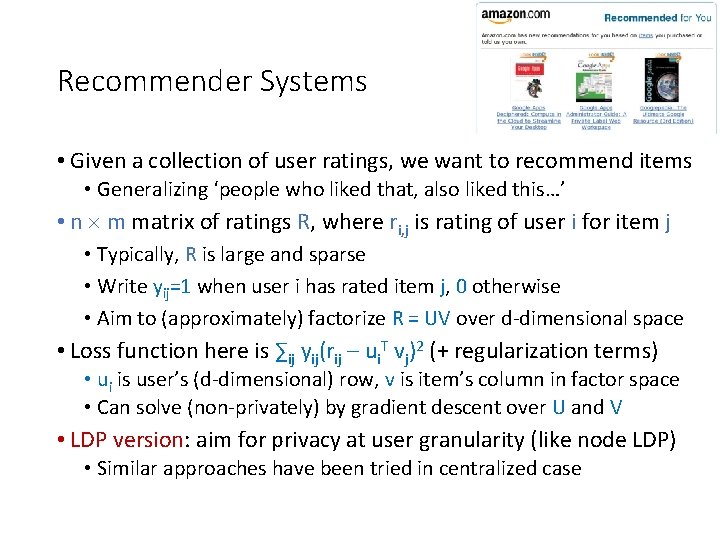
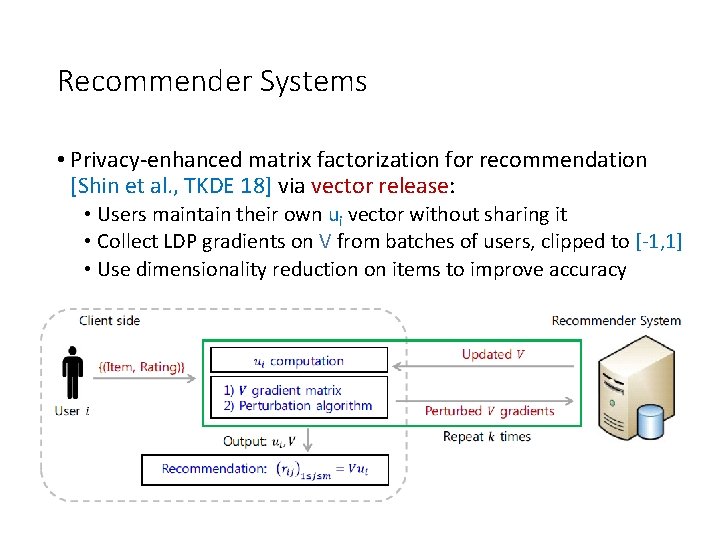
Recommender Systems • Given a collection of user ratings, we want to recommend items • Generalizing ‘people who liked that, also liked this…’ • n m matrix of ratings R, where ri, j is rating of user i for item j • Typically, R is large and sparse • Write yij=1 when user i has rated item j, 0 otherwise • Aim to (approximately) factorize R = UV over d-dimensional space • Loss function here is ∑ij yij(rij – ui. T vj)2 (+ regularization terms) • ui is user’s (d-dimensional) row, v is item’s column in factor space • Can solve (non-privately) by gradient descent over U and V • LDP version: aim for privacy at user granularity (like node LDP) • Similar approaches have been tried in centralized case
Recommender Systems • Privacy-enhanced matrix factorization for recommendation [Shin et al. , TKDE 18] via vector release: • Users maintain their own ui vector without sharing it • Collect LDP gradients on V from batches of users, clipped to [-1, 1] • Use dimensionality reduction on items to improve accuracy
Common Themes Across all these varied applications, a few themes emerge: • Finding a good (statistical) model is often the main challenge • Large models don’t work well under privacy due to the noise • Seek models where each parameter is supported by many users • Often we can map onto one of a few basic problems • Most methods use a frequency oracle, or vector generalizations • A few other tricks are seen multiple times: • Sample or split users into batches instead of dividing privacy budget • “Clip” data to ranges to reduce noise that must be added • Use multiple rounds to adaptively ask queries • Data transformation and dimensionality reduction often useful • Enforce consistency constraints when possible
Open Problems and Closing Thoughts
Immediate Open Problems for LDP • Take any data type or analysis goal and ask “Can we handle this under the LDP model? ”: • Sentiment analysis for (private) reviews: LDP-Trip. Advisor? • Trajectory analysis of GPS movements: LDP-Run. Keeper? • Social network data analysis: LDP-Facebook? • More challenging to apply to richer, unstructured data • E. g. Free text in written medical notes • E. g. Multimedia – images and videos • The semantics of privacy are not yet well defined here! • Algorithm engineering: make LDP widely available • RAPPOR is open source, but there’s no easy toolkit for LDP yet
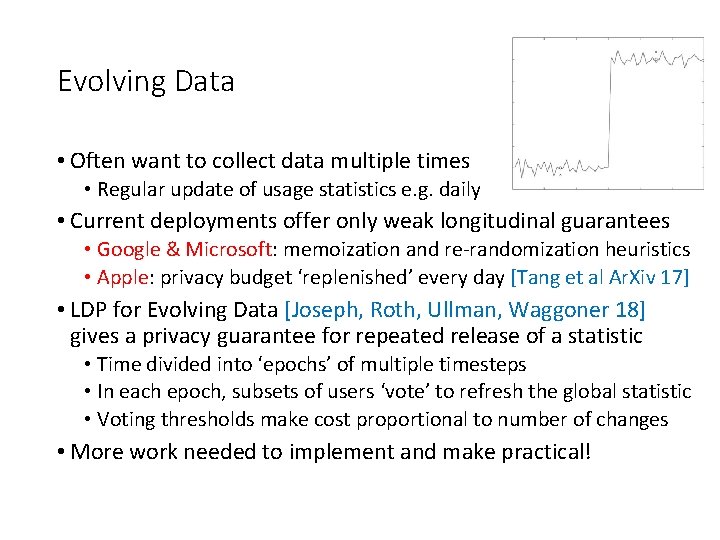
Evolving Data • Often want to collect data multiple times • Regular update of usage statistics e. g. daily • Current deployments offer only weak longitudinal guarantees • Google & Microsoft: memoization and re-randomization heuristics • Apple: privacy budget ‘replenished’ every day [Tang et al Ar. Xiv 17] • LDP for Evolving Data [Joseph, Roth, Ullman, Waggoner 18] gives a privacy guarantee for repeated release of a statistic • Time divided into ‘epochs’ of multiple timesteps • In each epoch, subsets of users ‘vote’ to refresh the global statistic • Voting thresholds make cost proportional to number of changes • More work needed to implement and make practical!
Deep Learning and Privacy • Methods based on ‘deep learning’ (neural networks) are currently very popular for accurate machine learning • This is challenging for privacy: they can (over)fit the data • ‘Federated learning’ promises some privacy gains • The model is learned with the help of distributed users • Each selected user updates the current model based on their data • Data never leaves the user – but gradients could still be revealing? • Some examples in other DP models are promising, e. g. Learning differentially private language models without losing accuracy [Mc. Mahan et al. ICLR 18] • Multiple rounds of federated training using batches of users • Almost (but not quite) LDP for an LSTM RNN model
Theoretical Underpinnings • LDP (re)emerged most recently from theory literature • What can we learn privately? [Kasiviswanathan et al, FOCS 08] Showed the model is equivalent to Kearns’ model of ‘statistical queries’ – up to polynomial blow up in population size n! • Local Privacy and Statistical Minimax Rates [Duchi et al, FOCS 13] Showed asymptotic optimality of basic LDP algorithms such as Laplace mechanism and Randomized Response • Still many theoretical questions about LDP: • Can we show more lower bounds for the accuracy tradeoff? • What problems don’t have efficient LDP protocols? • Can all LDP algorithms have each user output only 1 (noisy) bit? (Some good reasons to believe so)
Opening up Private Data • Deployments of LDP are still tightly controlled by aggregator • Google/MSR/Apple/Snap controls the code on your device • User reports typically sent over secure channel to aggregator • Could there be a more ‘open’ implementation of LDP? • Users could publish their LDP outputs • Multiple aggregators could perform independent analysis • Would require a big change in architecture and adoption! LDP data
Generalizing LDP • Additive error probability • Centralized DP allows an additional parameter δ, which relaxes the requirement to Pr[X ∈ S|D] ≤ eε Pr[X ∈ S|D’] + δ • LDP can be relaxed similarly, but makes no big difference (in theory) • What are the practical consequences of this relaxation? • Multiple rounds of data collection • Some LDP protocols collect data once, others interact with users • Queries in subsequent rounds depend on prior rounds • What is the tradeoff between rounds and accuracy/communication? • Distributed Differential Privacy e. g. for federated learning • Users in small groups trust their raw data to an aggregator • Aggregators release DP data to an untrusted global aggregator
LDP limitations • For LDP to really work with good accuracy we need to have: • Massive number of participating users (ideally millions) • Relaxed privacy parameters (ε = 8– 16 in Apple deployment) • “Flexible” attitude to composition results (daily “reset”) • Relatively simple analytics target (simple statistics) • LDP is really good for: • Large deployments by well-resourced tech companies • Academic research generating new papers in popular model • LDP does not seem so good for: • Everyone else? • RAPPOR has been replaced in current Chrome versions 94
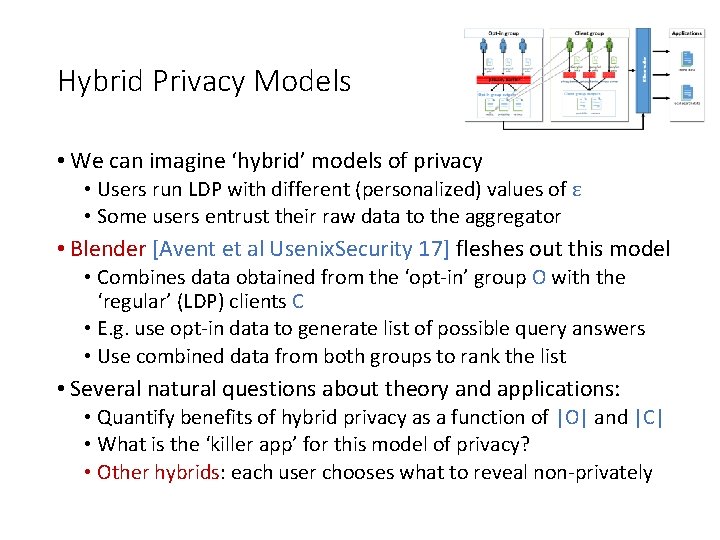
Hybrid Privacy Models • We can imagine ‘hybrid’ models of privacy • Users run LDP with different (personalized) values of ε • Some users entrust their raw data to the aggregator • Blender [Avent et al Usenix. Security 17] fleshes out this model • Combines data obtained from the ‘opt-in’ group O with the ‘regular’ (LDP) clients C • E. g. use opt-in data to generate list of possible query answers • Use combined data from both groups to rank the list • Several natural questions about theory and applications: • Quantify benefits of hybrid privacy as a function of |O| and |C| • What is the ‘killer app’ for this model of privacy? • Other hybrids: each user chooses what to reveal non-privately
SMC and DP • The main weakness of LDP is the magnitude of the error added • Compared to central DP, where the noise is essentially a constant • Could we obtain central DP error with a local guarantee? • Change the game: use secure multiparty computation (SMC) • Each participant encrypts their data, which is aggregated • Each user also adds some carefully chosen noise • The noise combines to be DP-level noise: “computational DP” • We can finally decrypt the answer with central DP noise • Several papers give protocols to achieve this BUT computational overheads are very high • Hence why Google, Apple, Microsoft went the LDP route?
Possible Compound Models LDP in isolation does not provide a rounded solution, but: • LDP plus deidentification of reports gives stronger privacy • “Shuffling” the messages gives O(ε/√n) (centralized) DP • Generic bounds for sufficiently restricted LDP protocols • Tight bounds for core problems (e. g. sums and counts) • Many recent results [Bittau et al 2017] [Erlingsson et al. 2019] [Balle et al 2019] [Cheu et al 2019] … • LDP protocols are good candidates for implementing with SMC • Simple partitions of quantities, small data per participant • One algorithm could “compile” to multiple target models? • LDP may be a stepping stone to more powerful privacy models 97
Reflecting on LDP • Local Differential Privacy is a big success for privacy research • Adopted by Google, Apple, Microsoft and more for deployment • Deployments affecting (hundreds of) millions of users • In contrast, centralized DP has smaller success (but, see US Census) • However, there are reasons to pause and reflect: • LDP only works when you can rely on millions of active participants • Companies using LDP also gather vast amounts of raw data directly! • Privacy settings are not very tight: deployed ε ranges from 0. 5 to 8+
Conclusions • Private data release is a challenging and exciting problem! • The model of Local Differential Privacy has been widely adopted • Intially for gathering counting statistics • LDP comes at a cost: need many more users than centralized model • Lots of research excitement developing new applications • Practical impact of these is still to be seen • Lots of opportunity for new work: • Designing optimal mechanisms for local differential privacy • Extend far beyond simple counts and marginals • Structured data: graphs, movement patterns • Unstructured data: text, images, video? 99
References - Deployments • Warner, S. L. Randomised response: a survey technique for eliminating evasive answer bias. J. ASA 1965. 60 (309): 63– 69 • Úlfar Erlingsson, Vasyl Pihur, Aleksandra Korolova. RAPPOR: Randomized Aggregatable Privacy-Preserving Ordinal Response. CCS 2014: 1054 -1067 • Burton H. Bloom. Space/Time Trade-offs in Hash Coding with Allowable Errors. Commun. ACM 13(7): 422 -426 (1970) • Differential Privacy Team, Apple. Learning with privacy at scale. Apple Machine Learning Journal, 2017. • Graham Cormode, S. Muthukrishnan. An improved data stream summary: the count-min sketch and its applications. J. Algorithms 55(1): 58 -75 (2005) • Bolin Ding, Janardhan Kulkarni, Sergey Yekhanin. Collecting Telemetry Data Privately. NIPS 2017: 3574 -3583 • Vasyl Pihur, Aleksandra Korolova, Frederick Liu, Subhash Sankuratripati, Moti Yung, Dachuan Huang, Ruogu Zeng. Differentially-Private "Draw and Discard" Machine Learning. Co. RR abs/1807. 04369 (2018) Privacy at Scale: Local Differential Privacy in Practice 100
References – Oracles and Heavy Hitters • Tianhao Wang, Jeremiah Blocki, Ninghui Li, Somesh Jha. Locally Differentially Private Protocols for Frequency Estimation. USENIX Security Symposium 2017: 729 -745 • Thông T. Nguyên, Xiaokui Xiao, Yin Yang, Siu Cheung Hui, Hyejin Shin, Junbum Shin. Collecting and Analyzing Data from Smart Device Users with Local Differential Privacy. Co. RR abs/1606. 05053 (2016) • Giulia C. Fanti, Vasyl Pihur, Úlfar Erlingsson. Building a RAPPOR with the Unknown: Privacy-Preserving Learning of Associations and Data Dictionaries. Po. PETs 2016(3): 41 -61 (2016) • Raef Bassily, Adam D. Smith. Local, Private, Efficient Protocols for Succinct Histograms. STOC 2015: 127 -135 • Raef Bassily, Kobbi Nissim, Uri Stemmer, Abhradeep Guha Thakurta. Practical Locally Private Heavy Hitters. NIPS 2017: 2285 -2293 • Tianhao Wang, Ninghui Li, Somesh Jha. Locally Differentially Private Heavy Hitter Identification. Co. RR abs/1708. 06674 (2017) Privacy at Scale: Local Differential Privacy in Practice 101
References – Text/NLP Applications • Ning Wang, Xiaokui Xiao, Yin Yang, Ta Duy Hoang, Hyejin Shin, Junbum Shin, Ge Yu. Priv. Trie: Effective Frequent Term Discovery under Local Differential Privacy. ICDE 2018: 821 -832 • Johnnie Chang, Abhradeep Guha Thakurta. Autocompletion in Local Differential Privacy. IEEE Security and Privacy Symposium (S&P 2018) • Aaron Schein, Zhiwei Steven Wu, Alexandra Schofield, Mingyuan Zhou, Hanna M. Wallach. Locally Private Bayesian Inference for Count Models. ICML 2019: 5638 -5648 Privacy at Scale: Local Differential Privacy in Practice 102
References – Marginals, Spatial Data, Graphs • Graham Cormode, Tejas Kulkarni, Divesh Srivastava. Marginal Release Under Local Differential Privacy. SIGMOD Conference 2018: 131 -146 • Boaz Barak, Kamalika Chaudhuri, Cynthia Dwork, Satyen Kale, Frank Mc. Sherry, Kunal Talwar. Privacy, accuracy, and consistency too: a holistic solution to contingency table release. PODS 2007: 273 -282 • Xuebin Ren, Chia-Mu Yu, Weiren Yu, Shusen Yang, Xinyu Yang, Julie A. Mc. Cann, Philip S. Yu. Lo. Pub: High-Dimensional Crowdsourced Data Publication With Local Differential Privacy. 2151 -2166 • Tejas Kulkarni, Graham Cormode, Divesh Srivastava. Answering Range Queries Under Local Differential Privacy. Co. RR abs/1812. 10942 (2018) • Rui Chen, Haoran Li, A. Kai Qin, Shiva Prasad Kasiviswanathan, Hongxia Jin. Private spatial data aggregation in the local setting. 289 -300 • Zhan Qin, Ting Yu, Yin Yang, Issa Khalil, Xiaokui Xiao, Kui Ren. Generating Synthetic Decentralized Social Graphs with Local Differential Privacy. 425 -438 Privacy at Scale: Local Differential Privacy in Practice 103
References – Machine Learning • John C. Duchi, Michael I. Jordan, Martin J. Wainwright. Local Privacy and Statistical Minimax Rates. FOCS 2013: 429 -438 • Adam D. Smith, Abhradeep Thakurta, Jalaj Upadhyay. Is Interaction Necessary for Distributed Private Learning? 58 -77 • Kai Zheng, Wenlong Mou, Liwei Wang. Collect at Once, Use Effectively: Making Non-interactive Locally Private Learning Possible. 4130 -4139 • Di Wang, Marco Gaboardi, Jinhui Xu. Empirical Risk Minimization in Noninteractive Local Differential Privacy Revisited. Neur. IPS 2018: 973 -982 • Hyejin Shin, Sungwook Kim, Junbum Shin, Xiaokui Xiao. Privacy Enhanced Matrix Factorization for Recommendation with Local Differential Privacy. 1770 -1782 Privacy at Scale: Local Differential Privacy in Practice 104
References – New Directions • Jun Tang, Aleksandra Korolova, Xiaolong Bai, Xueqiang Wang, Xiao. Feng Wang. Privacy Loss in Apple's Implementation of Differential Privacy on Mac. OS 10. 12. Co. RR abs/1709. 02753 (2017) • Matthew Joseph, Aaron Roth, Jonathan Ullman, Bo Waggoner. Local Differential Privacy for Evolving Data. Neur. IPS 2018: 2381 -2390 • H. Brendan Mc. Mahan, Daniel Ramage, Kunal Talwar, Li Zhang. Learning Differentially Private Recurrent Language Models. • Shiva Prasad Kasiviswanathan, Homin K. Lee, Kobbi Nissim, Sofya Raskhodnikova, Adam D. Smith What Can We Learn Privately? FOCS 2008: 531 -540 • Brendan Avent, Aleksandra Korolova, David Zeber, Torgeir Hovden, Benjamin Livshits. BLENDER: Enabling Local Search with a Hybrid Differential Privacy Model. USENIX Security Symposium 2017: 747 -764 Privacy at Scale: Local Differential Privacy in Practice 105
References - Shuffling • Andrea Bittau, Úlfar Erlingsson, Petros Maniatis, Ilya Mironov, Ananth Raghunathan, David Lie, Mitch Rudominer, Ushasree Kode, Julien Tinnés, Bernhard Seefeld. Prochlo: Strong Privacy for Analytics in the Crowd. SOSP 2017: 441 -459 • Borja Balle, James Bell, Adrià Gascón, Kobbi Nissim. The Privacy Blanket of the Shuffle Model. Co. RR abs/1903. 02837 (2019) • Albert Cheu, Adam D. Smith, Jonathan Ullman, David Zeber, Maxim Zhilyaev. Distributed Differential Privacy via Shuffling. 375 -403 • Úlfar Erlingsson, Vitaly Feldman, Ilya Mironov, Ananth Raghunathan, Kunal Talwar, Abhradeep Thakurta. Amplification by Shuffling: From Local to Central Differential Privacy via Anonymity. SODA 2019: 24682479 Privacy at Scale: Local Differential Privacy in Practice 106