PIP Overview American Society for Quality Design and




- Slides: 40
PIP Overview American Society for Quality Design and Construction Division September 2005
PIP Working in Harmony Improving Capital & Maintenance Efficiency
Objectives • Broaden understanding of PIP initiative. • Raise awareness of PIP “value proposition”. • Advocate “knowledge management” opportunity and quality of Practices. • Display current state of PIP Practices. • Validate PIP harmonization process and applicability to other industry segments.
Process Industry Practices A consortium of companies sharing the goal of reducing plant costs through development and implementation of common industry practices for detailed design, construction, procurement, operation, and maintenance of manufacturing facilities.
Value Proposition • Owners – Project costs reduced. Estimated 2 -5% reduction in Total Installed Costs. Application to maintenance work also. • Contractors – Visibility and working with clients. • Owners and Contractors - Impact on internal standards effort and effective use of technical resources: – Reduced creation / maintenance costs – Capturing “knowledge & experience” – Higher quality & consistently current – Leveraging of scarce resources – Networking opportunities within industry
PIP - “a small seed” • PIP indeed began in 1992 as “a small seed”, planted and nurtured in the minds of a few visionaries for our industry.
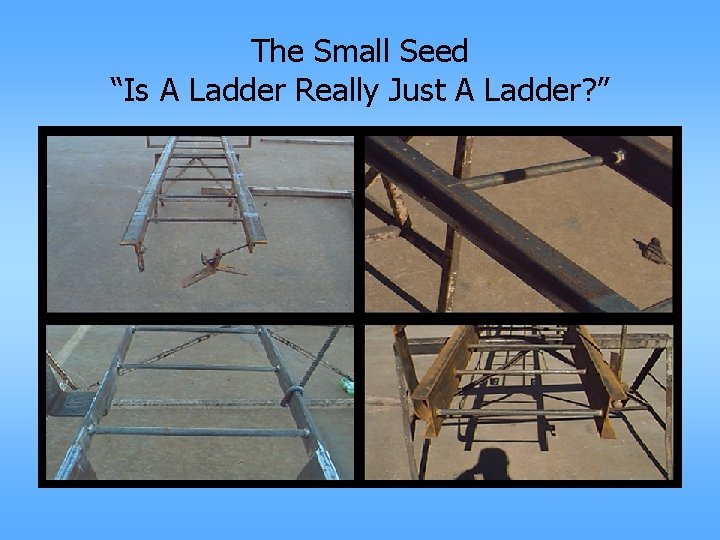
The Small Seed “Is A Ladder Really Just A Ladder? ”
PIP Member Consortium • Fifteen members established PIP in 1993. • Self-funded under CII. • Now includes 37 U. S. process industry companies: – 26 owners – 11 EPC contractors • Represents a significant share of the industry.
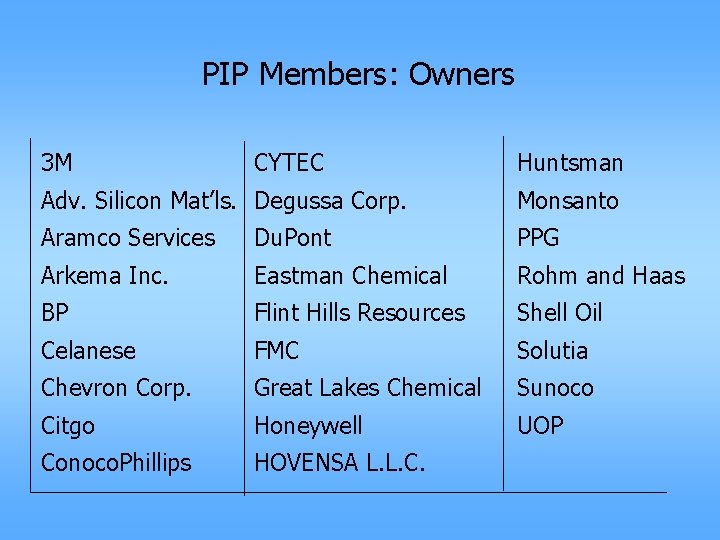
PIP Members: Owners 3 M CYTEC Huntsman Adv. Silicon Mat’ls. Degussa Corp. Monsanto Aramco Services Du. Pont PPG Arkema Inc. Eastman Chemical Rohm and Haas BP Flint Hills Resources Shell Oil Celanese FMC Solutia Chevron Corp. Great Lakes Chemical Sunoco Citgo Honeywell UOP Conoco. Phillips HOVENSA L. L. C.
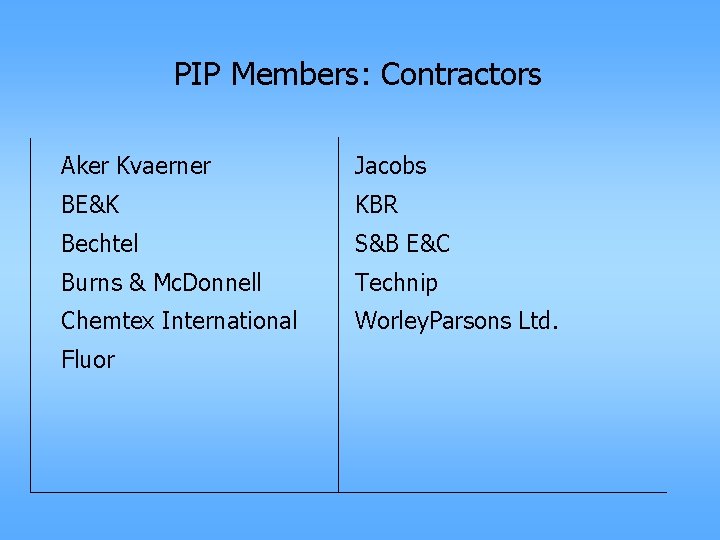
PIP Members: Contractors Aker Kvaerner Jacobs BE&K KBR Bechtel S&B E&C Burns & Mc. Donnell Technip Chemtex International Worley. Parsons Ltd. Fluor
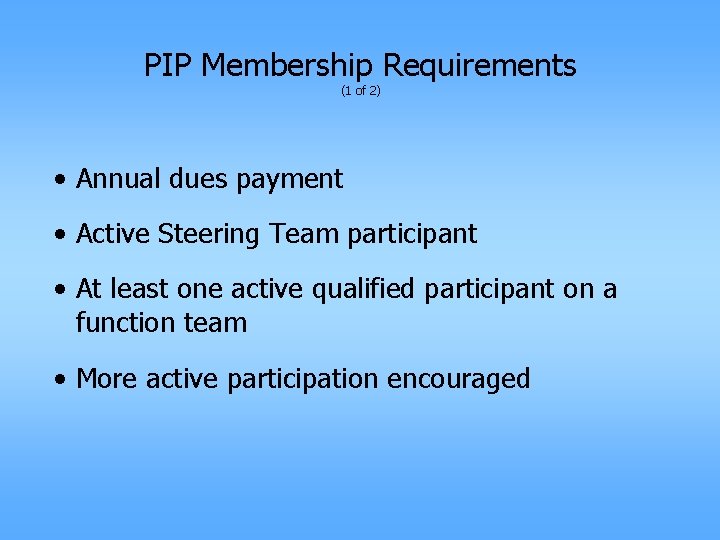
PIP Membership Requirements (1 of 2) • Annual dues payment • Active Steering Team participant • At least one active qualified participant on a function team • More active participation encouraged
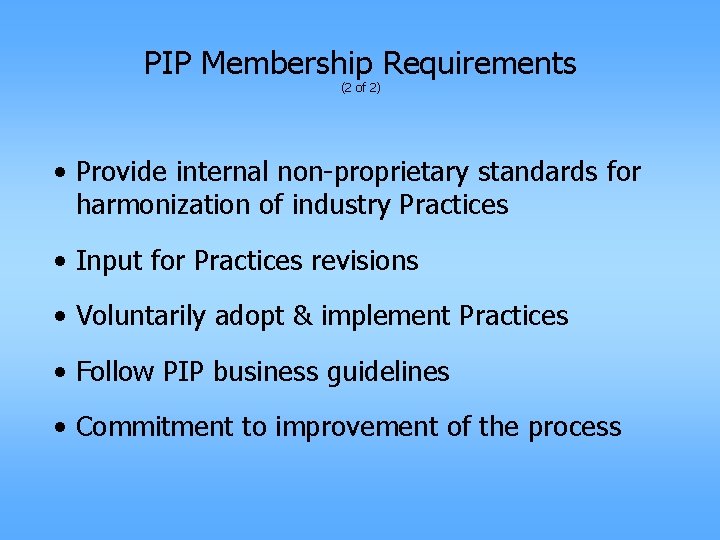
PIP Membership Requirements (2 of 2) • Provide internal non-proprietary standards for harmonization of industry Practices • Input for Practices revisions • Voluntarily adopt & implement Practices • Follow PIP business guidelines • Commitment to improvement of the process
PIP Vision PIP Practices are: • the “universal language” in the industry for engineering, procurement, and construction, • widely recognized and available electronically, • up to date, of high quality, and used essentially “as is”, • voluntarily adopted and used by a majority.
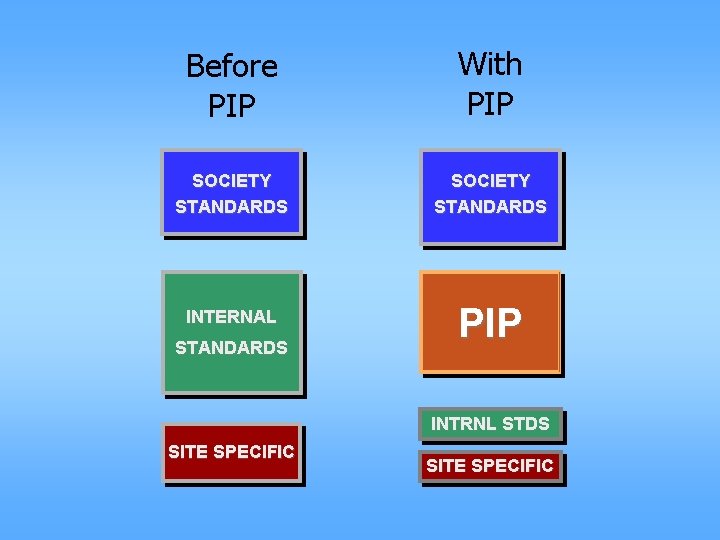
Before PIP With PIP SOCIETY STANDARDS INTERNAL PIP STANDARDS INTRNL STDS SITE SPECIFIC
Principles for Success (1 of 2) • Participation is voluntary and open to all qualified. • Funded & supported by participating companies. • Develop recommended Practices based on existing company internal standards. • Influence other organizations to adapt their standards to meet process industry needs. • No duplication of work of others. • Work only with non-proprietary information.
Principles for Success (2 of 2) • High level of participation. • Operate on “break-even” basis; small staff. • Published Practices available for purchase by any interested party. • Provide long-term support for updating. • Use streamlined, short cycle time, technically sound process.
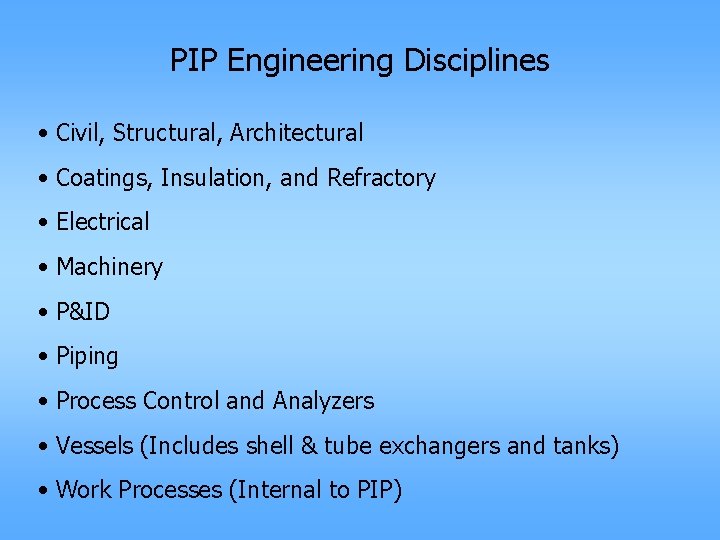
PIP Engineering Disciplines • Civil, Structural, Architectural • Coatings, Insulation, and Refractory • Electrical • Machinery • P&ID • Piping • Process Control and Analyzers • Vessels (Includes shell & tube exchangers and tanks) • Work Processes (Internal to PIP)
Organization STANDING COMMITTEES PIP STEERING TEAM LEGAL EXECUTIVE COMMITTEE FTS 1 MARKETING FTS 2 FTSn WORK PROCESSES STRATEGIC PLANNING FUNCTION TEAM LEADERS GLOBALIZATION (FUNCTION TEAM LEADERS & SPONSORS) FTL 2 FTL 6 FTL 4 FTL 8 ELECTRICAL MACHINERY P&ID PROC CTL TASK TEAMS FTL 1 CSA TASK TEAMS FTL 3 CIR TASK TEAMS FTL 5 FTL 7 PIPING VESSEL TASK TEAMS FTLn TASK TEAMS
Number of Practices by Discipline
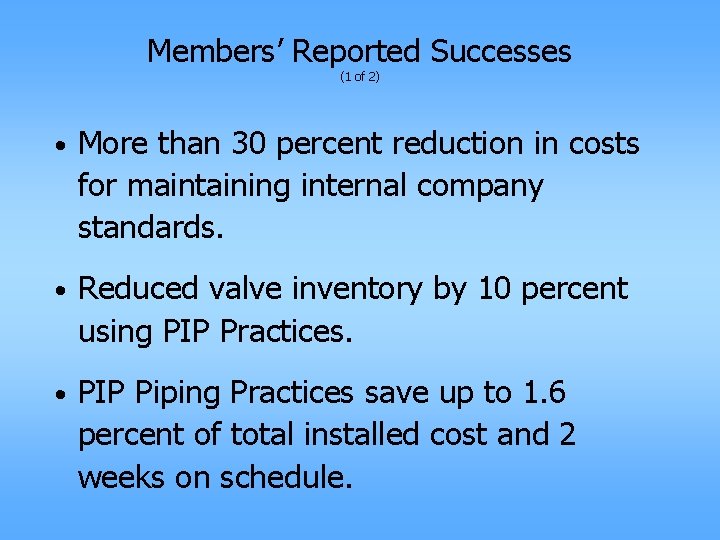
Members’ Reported Successes (1 of 2) • More than 30 percent reduction in costs for maintaining internal company standards. • Reduced valve inventory by 10 percent using PIP Practices. • PIP Piping Practices save up to 1. 6 percent of total installed cost and 2 weeks on schedule.
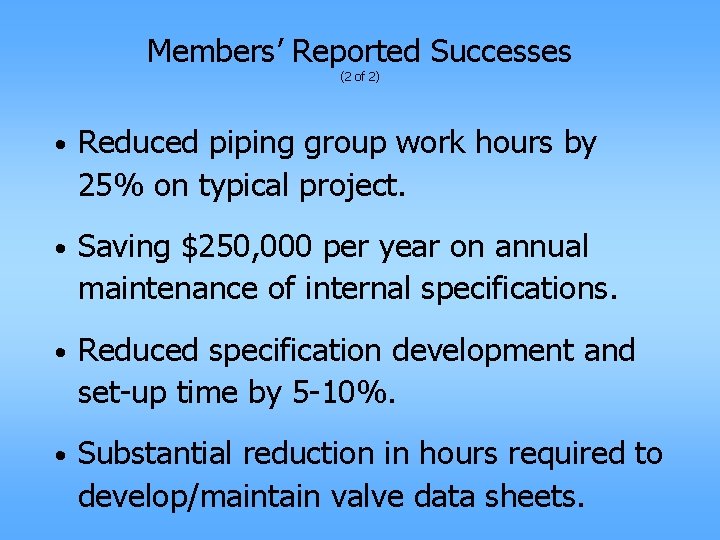
Members’ Reported Successes (2 of 2) • Reduced piping group work hours by 25% on typical project. • Saving $250, 000 per year on annual maintenance of internal specifications. • Reduced specification development and set-up time by 5 -10%. • Substantial reduction in hours required to develop/maintain valve data sheets.
Implementation Resource Center (www. pip. org/members/irc/index. html) • Member’s addenda • Systems examples • Success stories • Tools • Metrics • Lessons Learned
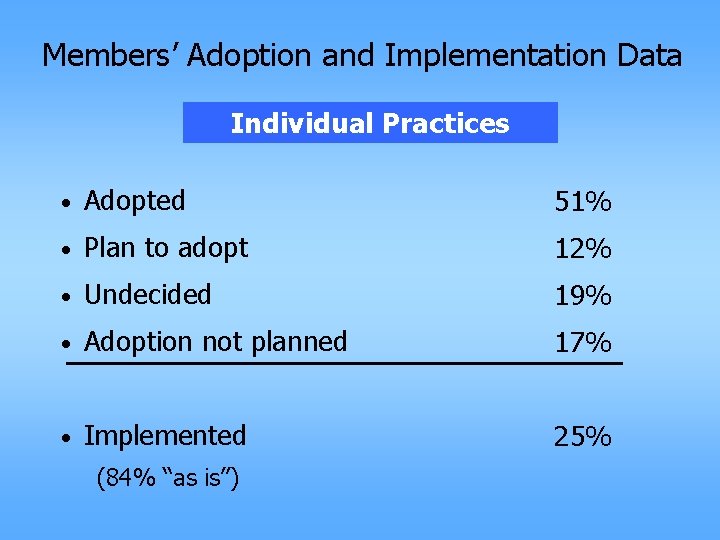
Members’ Adoption and Implementation Data Individual Practices • Adopted 51% • Plan to adopt 12% • Undecided 19% • Adoption not planned 17% • Implemented 25% (84% “as is”)
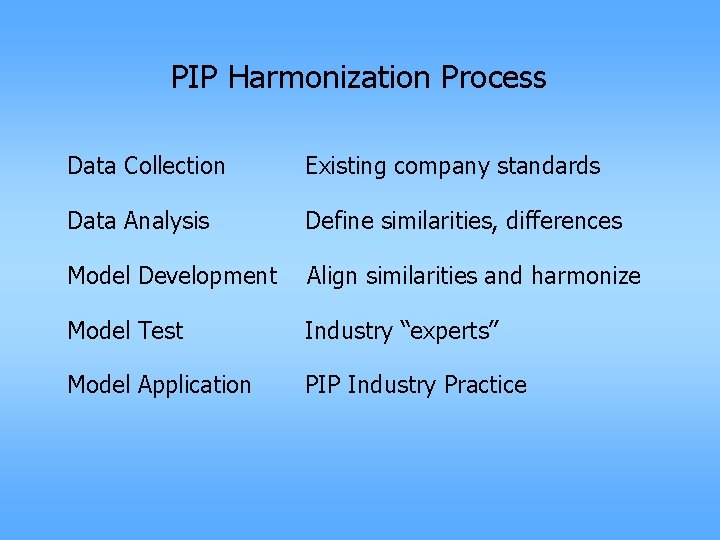
PIP Harmonization Process Data Collection Existing company standards Data Analysis Define similarities, differences Model Development Align similarities and harmonize Model Test Industry “experts” Model Application PIP Industry Practice
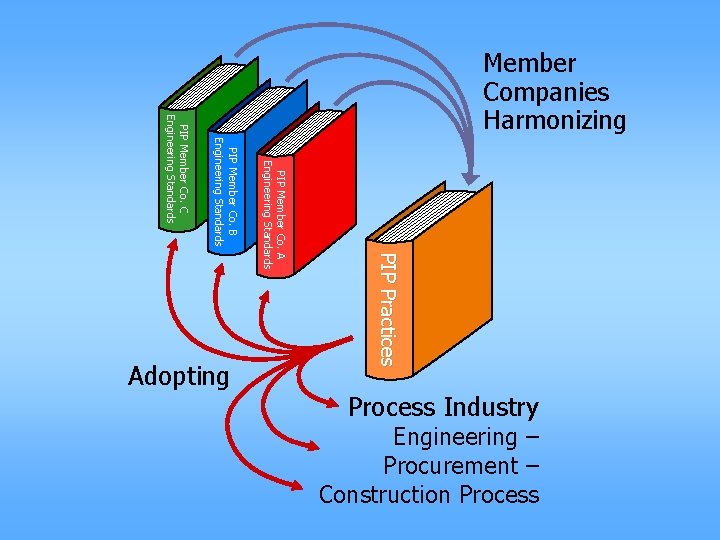
PIP Practices Engineering – Procurement – Construction Process Industry Adopting PIP Member Co. A Engineering Standards PIP Member Co. B Engineering Standards PIP Member Co. C Engineering Standards Member Companies Harmonizing
Harmonization Potential • Promote use of PIP as core for harmonizing EPC industry practices. • Key adjunct to “knowledge management” strategy with loss of technical resources. • Continue providing input to industry on standards and code development. • Guide technology development and application. • Help globalization of EPC industry practices.
PIP Impact: Industry “Voice” • Actively interfaced with other industry groups (e. g. Hydraulic Institute, Steel Plate Fabricators Association, Material Technology Institute, National Insulation Association, etc. ). • Successfully petitioned International Building Code (IBC) for code exceptions on industrial equipment platforms.
PIP Impact: Collaborative and Joint Efforts (1 of 2) • API (American Petroleum Institute) – Machinery Installation (API RP 686) – Welding (API RP 582) – DCS Process Instrumentation & Control (API RP 554) – Other Standards Revisions • ASME (American Society of Mechanical Engineers) – Pump Data Sheets (ASME B 73. 1) – Granular Storage Bins & Tanks • FIATECH (Fully Integrated & Automated Technologies) – AEX-XML Project for data sheets – Global Valve Cross-Reference e. Catalog
PIP Impact: Collaborative and Joint Efforts (2 of 2) • ISA (Instrumentation Systems & Automation Society) – P&IDs (Piping & Instrumentation Diagram) – Safety Instrumented Systems Guidelines • IEEE (The Institute of Electrical & Electronic Engineers) – Motor Data Sheets (IEEE 841) • NIA (National Insulation Association) – Insulation Practices for National training session
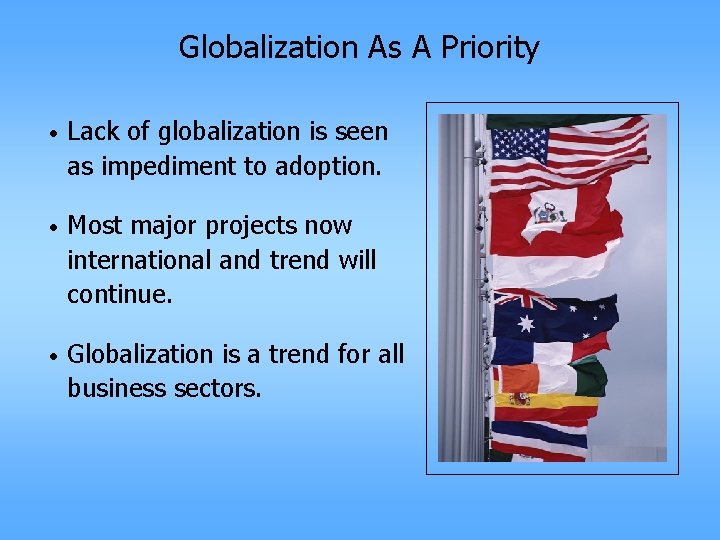
Globalization As A Priority • Lack of globalization is seen as impediment to adoption. • Most major projects now international and trend will continue. • Globalization is a trend for all business sectors.
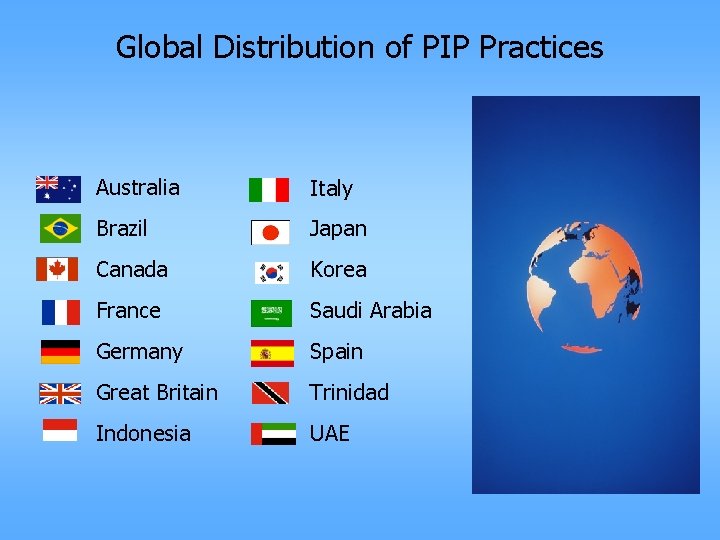
Global Distribution of PIP Practices Australia Italy Brazil Japan Canada Korea France Saudi Arabia Germany Spain Great Britain Trinidad Indonesia UAE
Purpose of Globalization Committee • Develop strategies and action plans to enable use of PIPs outside U. S. • Frame issues for presentation to Steering Team. • Result should be phased action plan. • Committee reports to Steering Team and will monitor, provide information regarding globalization progress.
Subscription Program • Annual electronic subscription (PDF files and Electronic Entry Data Sheets from PIP web site) • Potential subscribers: – Owners and contractors unable to commit resources to participate – Suppliers and vendors • Cost - All Practices $30 K per year (currently discounted from $33 K): - or by discipline ($500 $6 K )
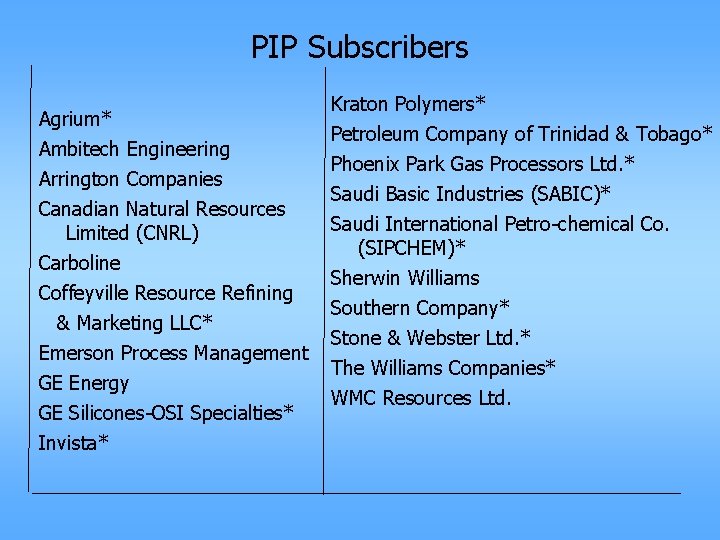
PIP Subscribers Agrium* Ambitech Engineering Arrington Companies Canadian Natural Resources Limited (CNRL) Carboline Coffeyville Resource Refining & Marketing LLC* Emerson Process Management GE Energy GE Silicones-OSI Specialties* Invista* Kraton Polymers* Petroleum Company of Trinidad & Tobago* Phoenix Park Gas Processors Ltd. * Saudi Basic Industries (SABIC)* Saudi International Petro-chemical Co. (SIPCHEM)* Sherwin Williams Southern Company* Stone & Webster Ltd. * The Williams Companies* WMC Resources Ltd.
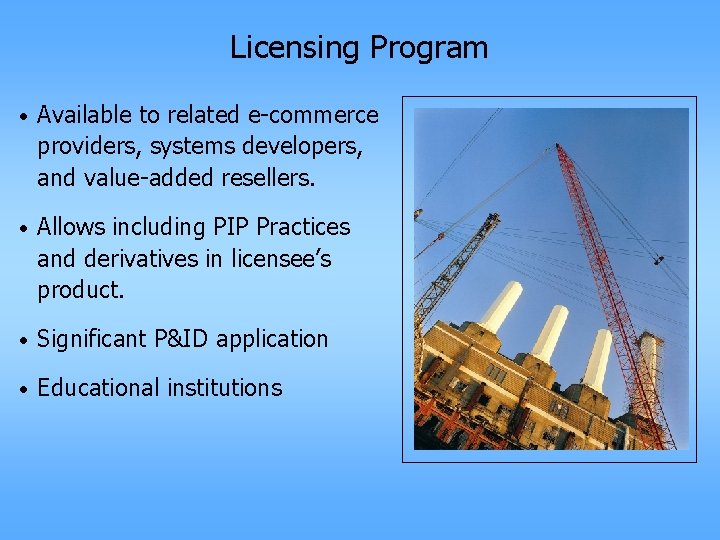
Licensing Program • Available to related e-commerce providers, systems developers, and value-added resellers. • Allows including PIP Practices and derivatives in licensee’s product. • Significant P&ID application • Educational institutions
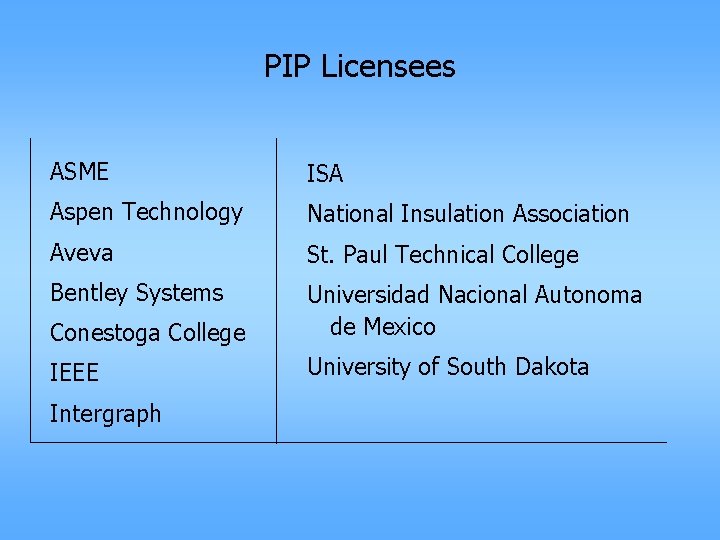
PIP Licensees ASME ISA Aspen Technology National Insulation Association Aveva St. Paul Technical College Bentley Systems Conestoga College Universidad Nacional Autonoma de Mexico IEEE University of South Dakota Intergraph
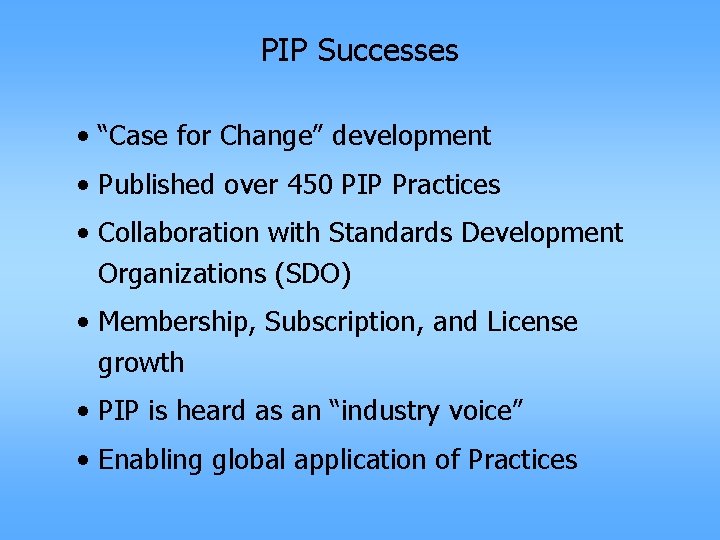
PIP Successes • “Case for Change” development • Published over 450 PIP Practices • Collaboration with Standards Development Organizations (SDO) • Membership, Subscription, and License growth • PIP is heard as an “industry voice” • Enabling global application of Practices
Practices Distribution Copyright: • “Process Industry Practices, Construction Industry Institute, The University of Texas at Austin” Distribution: • Member companies as benefit of membership • Unlimited right to copy for members and subscribers • Electronic to members and subscribers • Paper copies to non-members
Value Proposition for PIP • Reduced Costs for: – Projects and Maintenance – Maintaining internal standards – Commodity equipment procurement – Detail design and construction hours • Reduced inventories of valves and piping materials • Improved “Knowledge Management” & Quality: – Fewer spec conflicts and code inconsistencies – Alignment with industry “Best Practices” – Widespread understanding of common specs
Driving Greater Capital and Maintenance Efficiency Visit us on the Web www. pip. org