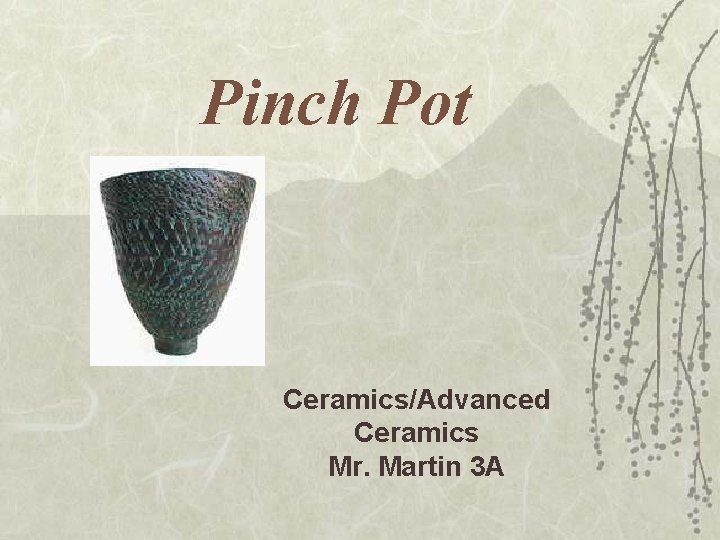
Pinch Pot CeramicsAdvanced Ceramics Mr Martin 3 A
- Slides: 30
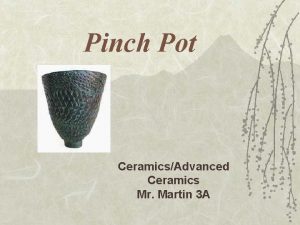
Pinch Pot Ceramics/Advanced Ceramics Mr. Martin 3 A
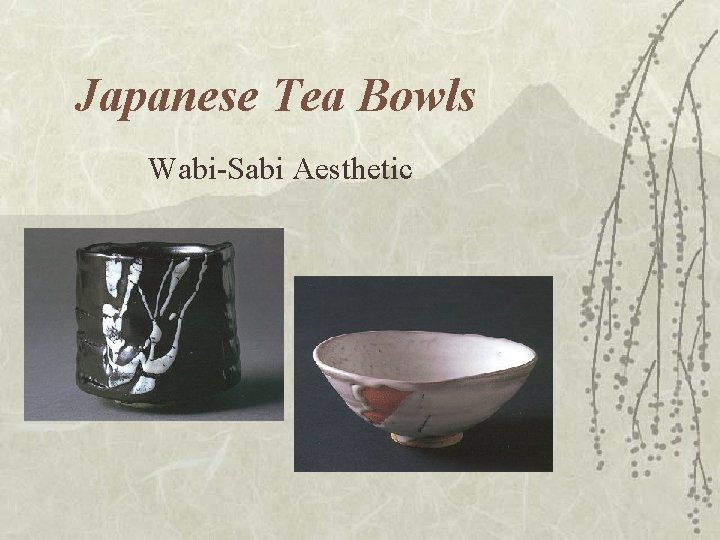
Japanese Tea Bowls Wabi-Sabi Aesthetic
Visual Arts Standards v 5. 0 Connections, Relationships, Applications – 5. 2 Create a work of art that communicates a cross-cultural or universal theme taken from literature or history. v 2. 0 Creative Expression – Solve a visual arts problem that involves the effective use of the elements of art and the principles of design.
Upon completing this unit, students will be able to. . . v v v Define the Japanese aesthetic of wabi-sabi. Compare and contrast winter tea bowls and summer tea bowls. Identify and synthesize wabi-sabi aesthetic standards into a tea bowl design. Form a functional and structurally sound tea bowl using pinching techniques. Define and apply a creative, original, design to the tea bowls’ surfaces.
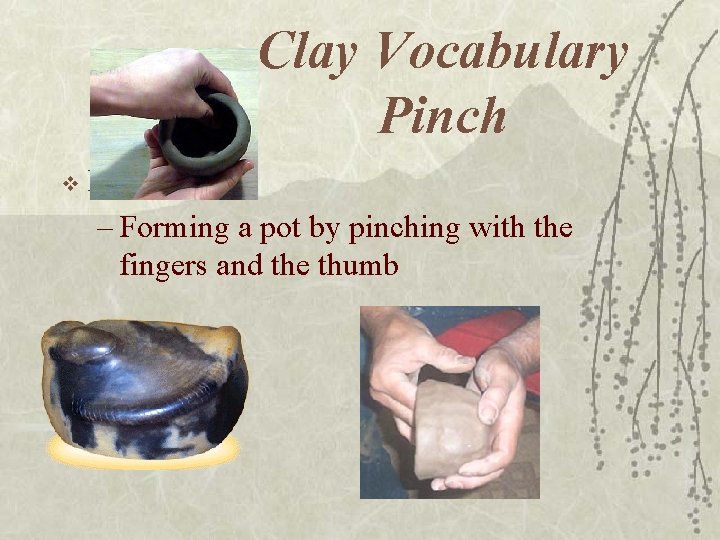
Clay Vocabulary Pinch v Pinch – Forming a pot by pinching with the fingers and the thumb
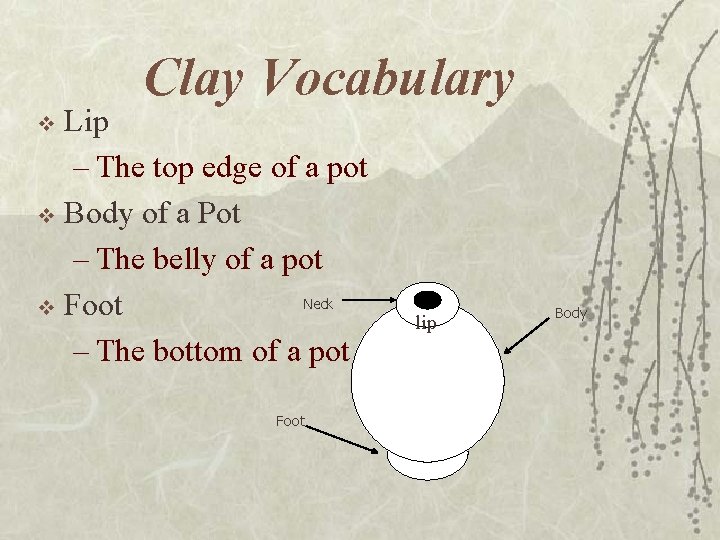
Clay Vocabulary Lip – The top edge of a pot v Body of a Pot – The belly of a pot Neck v Foot – The bottom of a pot v Foot lip Body
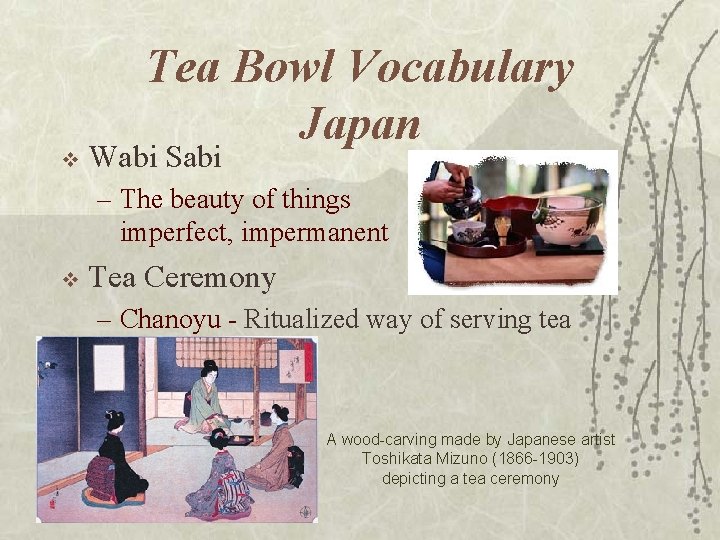
v Tea Bowl Vocabulary Japan Wabi Sabi – The beauty of things imperfect, impermanent v Tea Ceremony – Chanoyu - Ritualized way of serving tea A wood-carving made by Japanese artist Toshikata Mizuno (1866 -1903) depicting a tea ceremony
Ceremonies and Food What are some examples of foods or drinks that are connected to ceremonies or rituals that you have experienced?
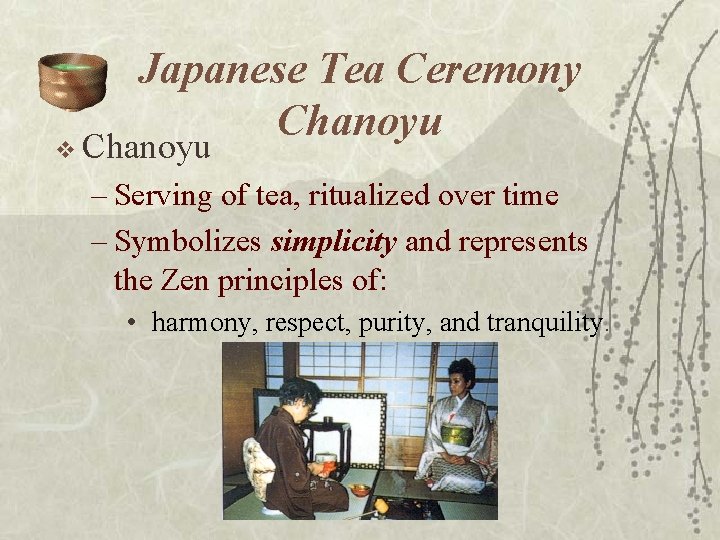
Japanese Tea Ceremony Chanoyu v Chanoyu – Serving of tea, ritualized over time – Symbolizes simplicity and represents the Zen principles of: • harmony, respect, purity, and tranquility.
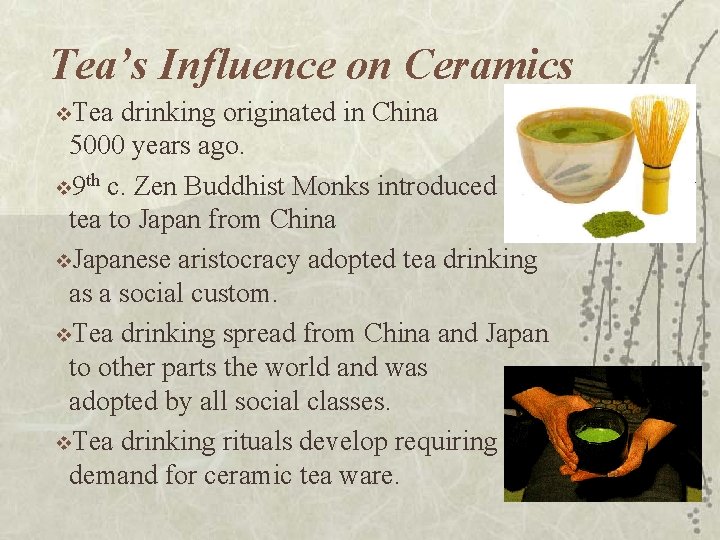
Tea’s Influence on Ceramics v. Tea drinking originated in China 5000 years ago. v 9 th c. Zen Buddhist Monks introduced tea to Japan from China v. Japanese aristocracy adopted tea drinking as a social custom. v. Tea drinking spread from China and Japan to other parts the world and was adopted by all social classes. v. Tea drinking rituals develop requiring demand for ceramic tea ware.
Aesthetics v Aesthetics – Value and beauty as they relate to the arts v Japanese Aesthetics – Affected by the Chinese and Buddhism – Value of harmony in all things • Nature-based, concerned with the beauty of simplicity and harmony with nature – Wabi-Sabi • Wabi – inner nature of human life • Sabi – outer, material side of life
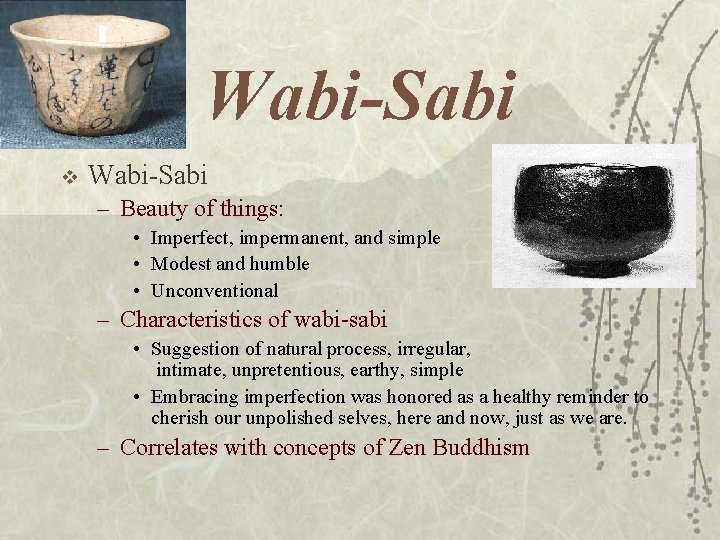
Wabi-Sabi v Wabi-Sabi – Beauty of things: • Imperfect, impermanent, and simple • Modest and humble • Unconventional – Characteristics of wabi-sabi • Suggestion of natural process, irregular, intimate, unpretentious, earthy, simple • Embracing imperfection was honored as a healthy reminder to cherish our unpolished selves, here and now, just as we are. – Correlates with concepts of Zen Buddhism
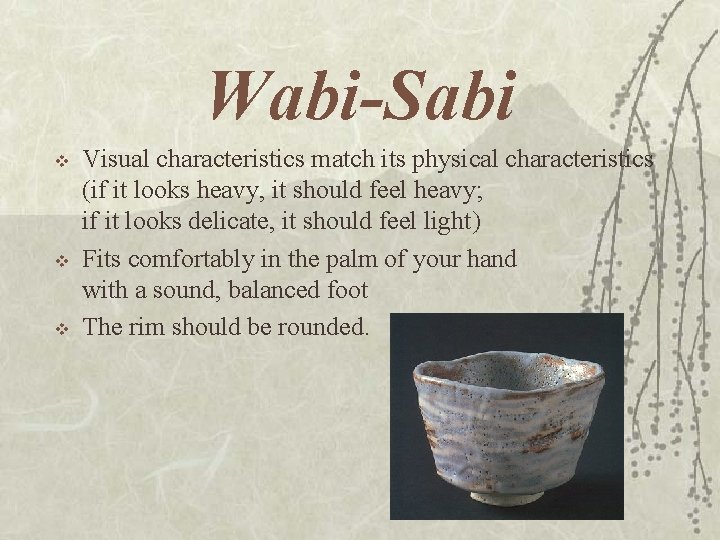
Wabi-Sabi v v v Visual characteristics match its physical characteristics (if it looks heavy, it should feel heavy; if it looks delicate, it should feel light) Fits comfortably in the palm of your hand with a sound, balanced foot The rim should be rounded.
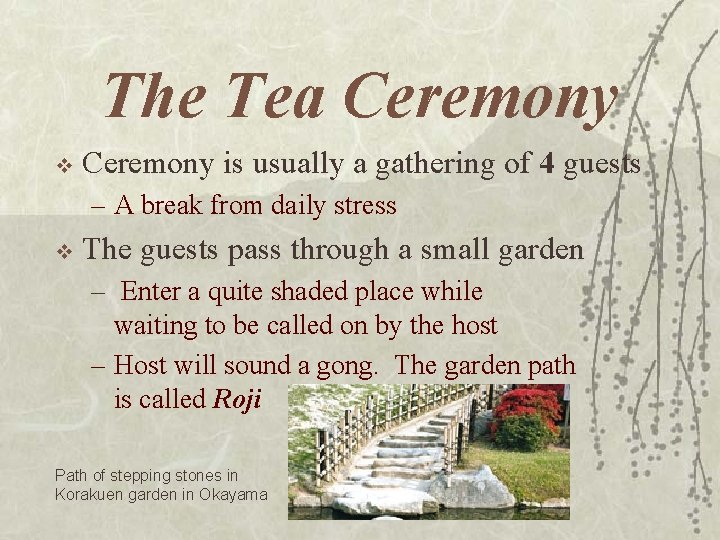
The Tea Ceremony v Ceremony is usually a gathering of 4 guests – A break from daily stress v The guests pass through a small garden – Enter a quite shaded place while waiting to be called on by the host – Host will sound a gong. The garden path is called Roji Path of stepping stones in Korakuen garden in Okayama
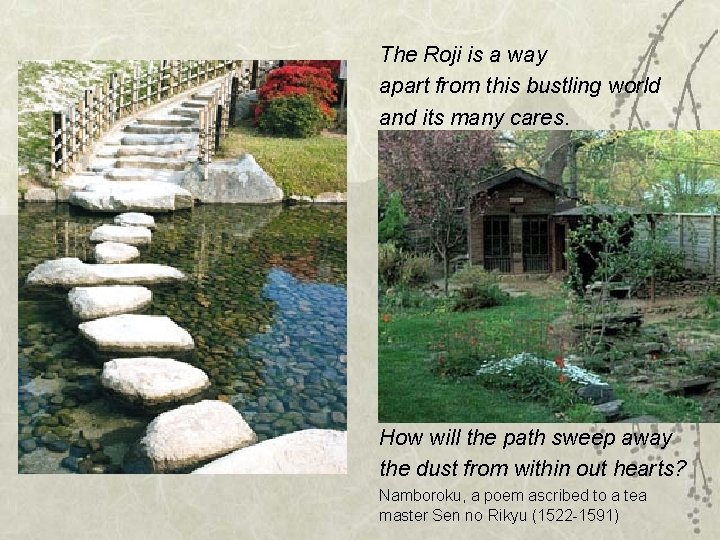
The Roji is a way apart from this bustling world and its many cares. How will the path sweep away the dust from within out hearts? Namboroku, a poem ascribed to a tea master Sen no Rikyu (1522 -1591)
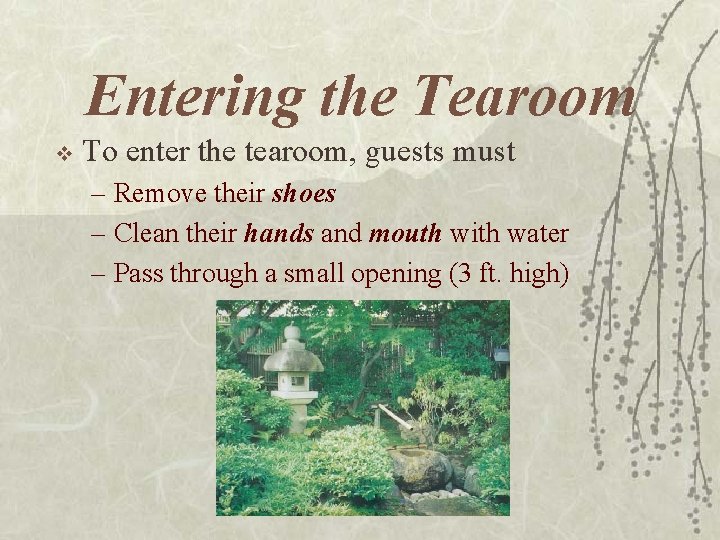
Entering the Tearoom v To enter the tearoom, guests must – Remove their shoes – Clean their hands and mouth with water – Pass through a small opening (3 ft. high)
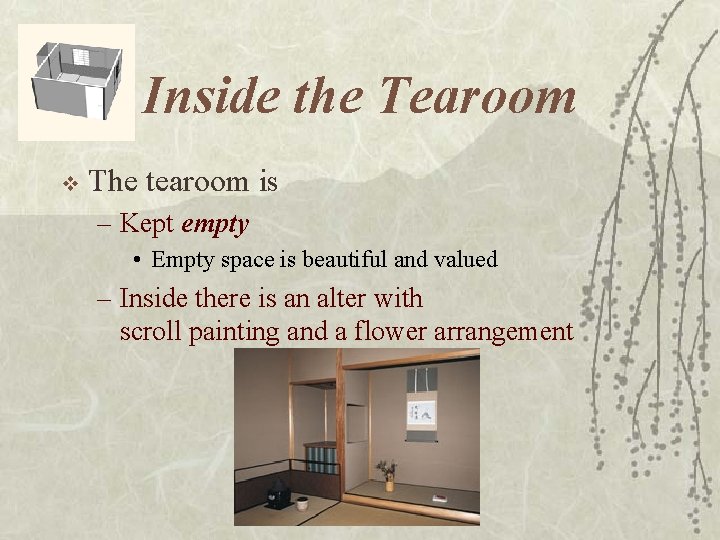
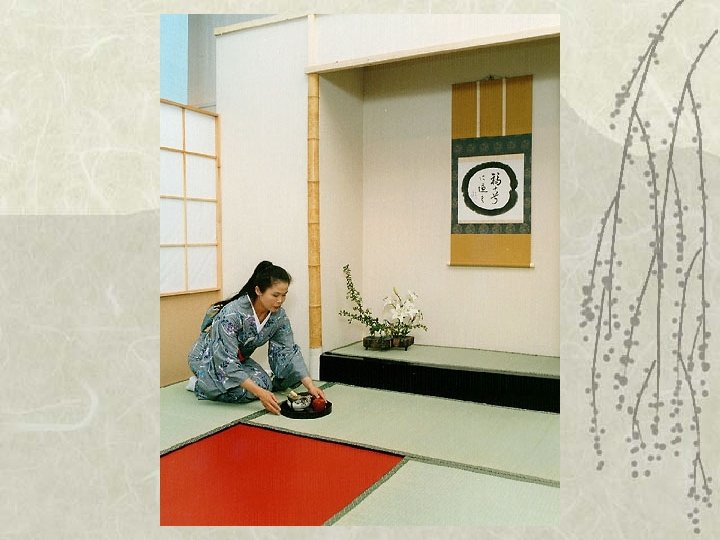
Inside the Tearoom v The tearoom is – Kept empty • Empty space is beautiful and valued – Inside there is an alter with scroll painting and a flower arrangement
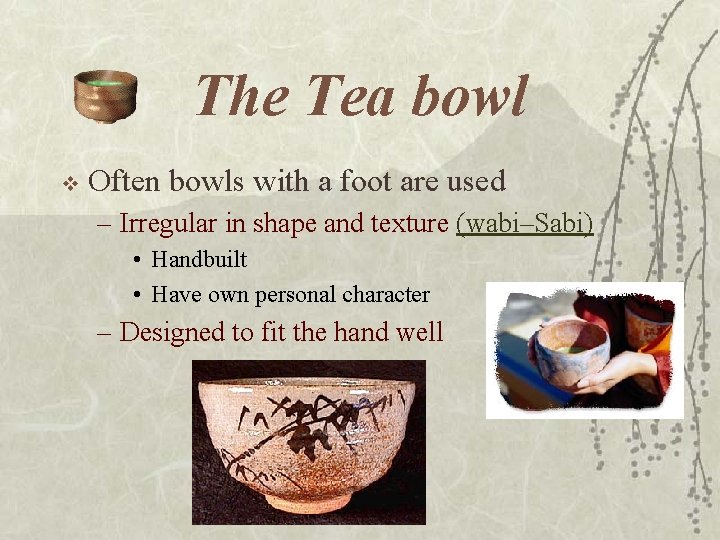
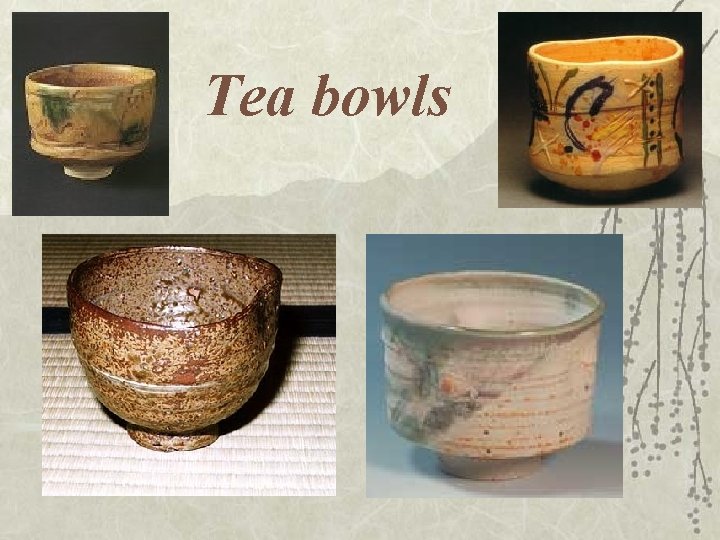
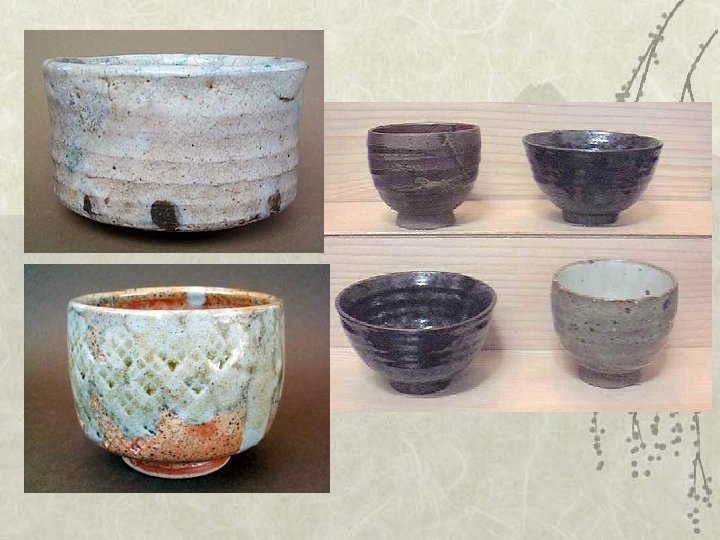
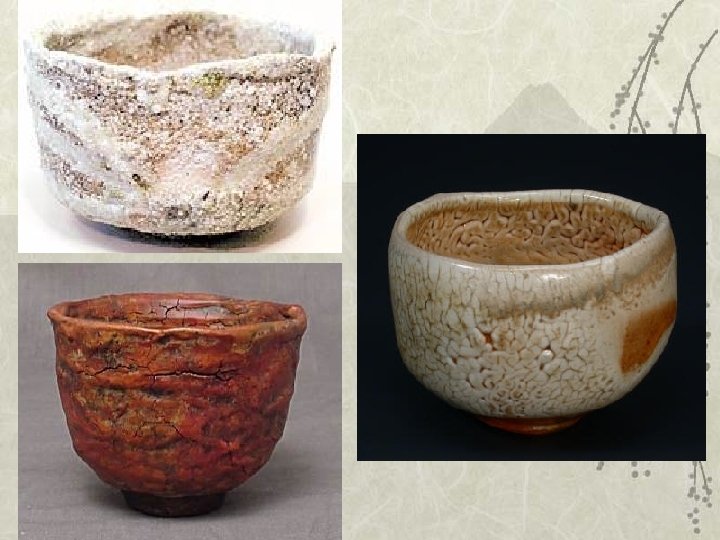
The Tea bowl v Often bowls with a foot are used – Irregular in shape and texture (wabi–Sabi) • Handbuilt • Have own personal character – Designed to fit the hand well
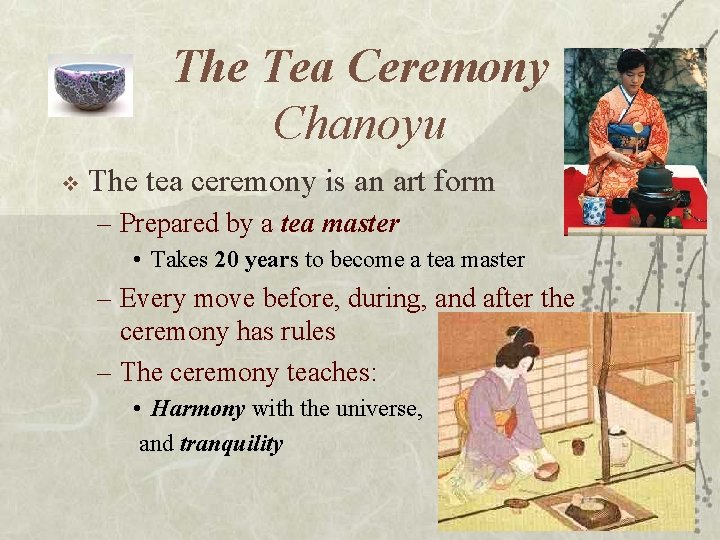
The Tea Ceremony Chanoyu v The tea ceremony is an art form – Prepared by a tea master • Takes 20 years to become a tea master – Every move before, during, and after the ceremony has rules – The ceremony teaches: • Harmony with the universe, and tranquility
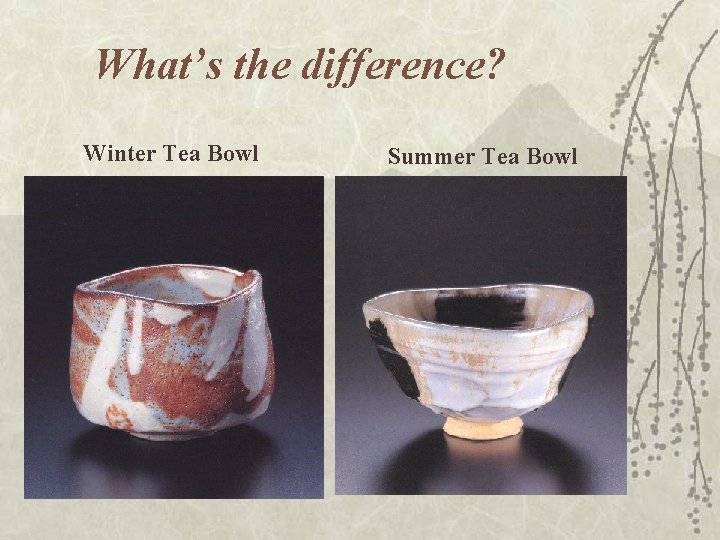
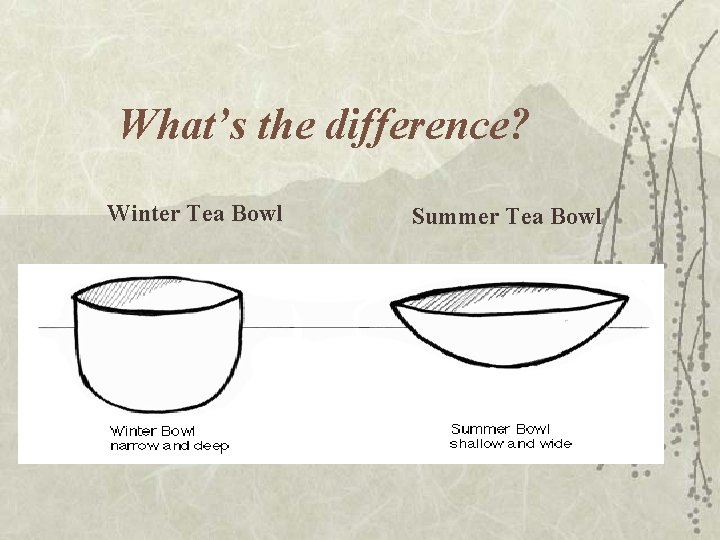
What’s the difference? Winter Tea Bowl Summer Tea Bowl
What’s the difference? Winter Tea Bowl Summer Tea Bowl
Tea bowls
Using Pinch Techniques to Create a Tea Bowl Three types of hand building v. Pinch - Forming a clay object by pinching with the fingers. v. Slab - Forming a clay object from a flat piece of clay. v. Coil - Forming a clay object with ropes of clay.
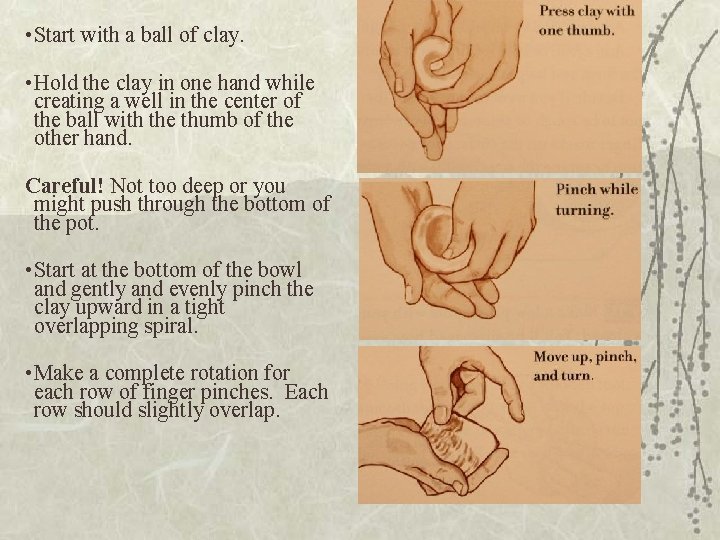
• Start with a ball of clay. • Hold the clay in one hand while creating a well in the center of the ball with the thumb of the other hand. Careful! Not too deep or you might push through the bottom of the pot. • Start at the bottom of the bowl and gently and evenly pinch the clay upward in a tight overlapping spiral. • Make a complete rotation for each row of finger pinches. Each row should slightly overlap.
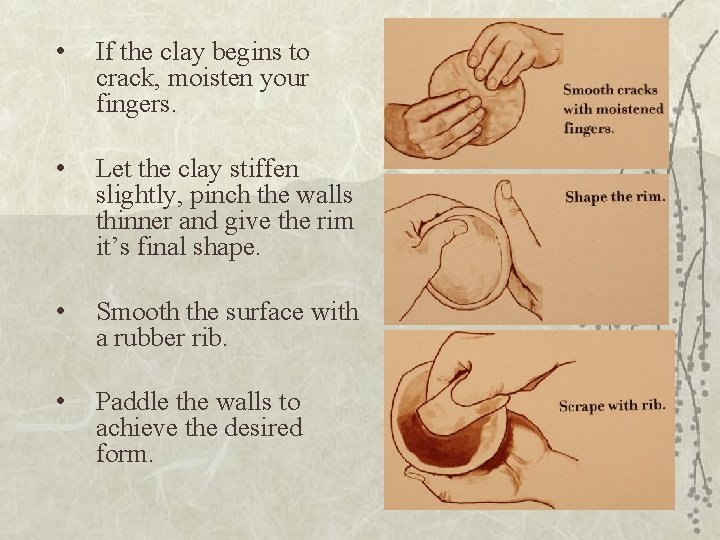
• If the clay begins to crack, moisten your fingers. • Let the clay stiffen slightly, pinch the walls thinner and give the rim it’s final shape. • Smooth the surface with a rubber rib. • Paddle the walls to achieve the desired form.
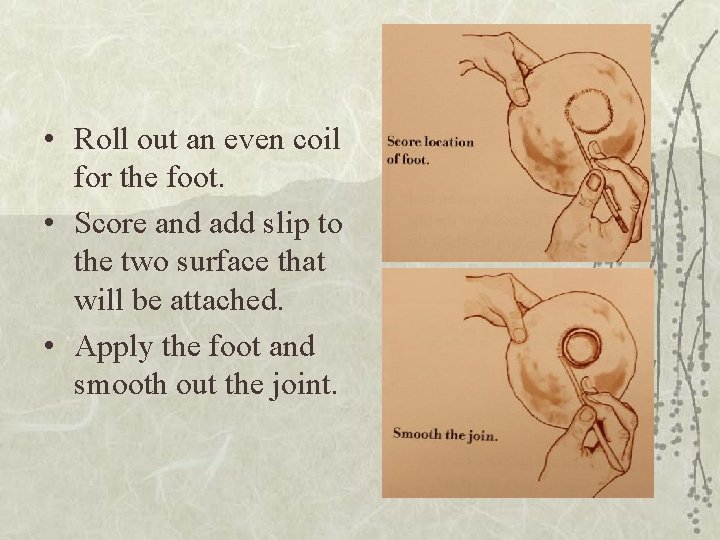
• Roll out an even coil for the foot. • Score and add slip to the two surface that will be attached. • Apply the foot and smooth out the joint.
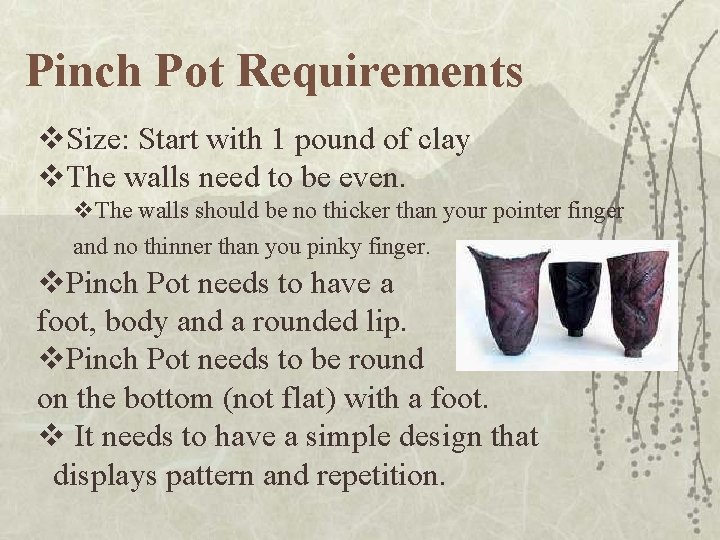
Pinch Pot Requirements v. Size: Start with 1 pound of clay v. The walls need to be even. v. The walls should be no thicker than your pointer finger and no thinner than you pinky finger. v. Pinch Pot needs to have a foot, body and a rounded lip. v. Pinch Pot needs to be round on the bottom (not flat) with a foot. v It needs to have a simple design that displays pattern and repetition.