
CHAPTER 13 APPLICATIONS AND PROCESSING OF CERAMICS ISSUES
- Slides: 17
CHAPTER 13: APPLICATIONS AND PROCESSING OF CERAMICS ISSUES TO ADDRESS. . . • How do we classify ceramics? • What are some applications of ceramics? • How is processing different than for metals? Chapter 13 - 1
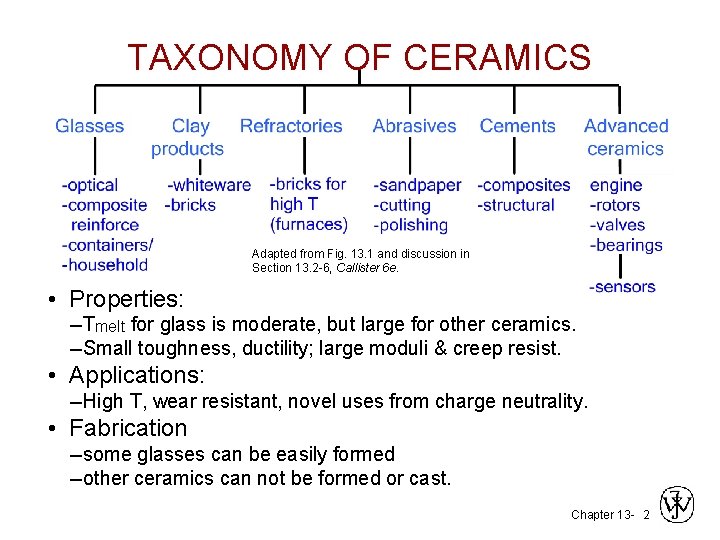
TAXONOMY OF CERAMICS Adapted from Fig. 13. 1 and discussion in Section 13. 2 -6, Callister 6 e. • Properties: --Tmelt for glass is moderate, but large for other ceramics. --Small toughness, ductility; large moduli & creep resist. • Applications: --High T, wear resistant, novel uses from charge neutrality. • Fabrication --some glasses can be easily formed --other ceramics can not be formed or cast. Chapter 13 - 2
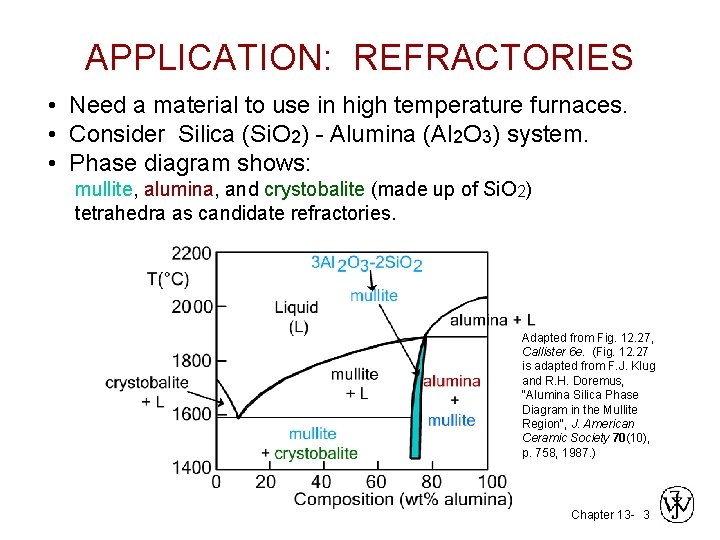
APPLICATION: REFRACTORIES • Need a material to use in high temperature furnaces. • Consider Silica (Si. O 2) - Alumina (Al 2 O 3) system. • Phase diagram shows: mullite, alumina, and crystobalite (made up of Si. O 2) tetrahedra as candidate refractories. Adapted from Fig. 12. 27, Callister 6 e. (Fig. 12. 27 is adapted from F. J. Klug and R. H. Doremus, "Alumina Silica Phase Diagram in the Mullite Region", J. American Ceramic Society 70(10), p. 758, 1987. ) Chapter 13 - 3
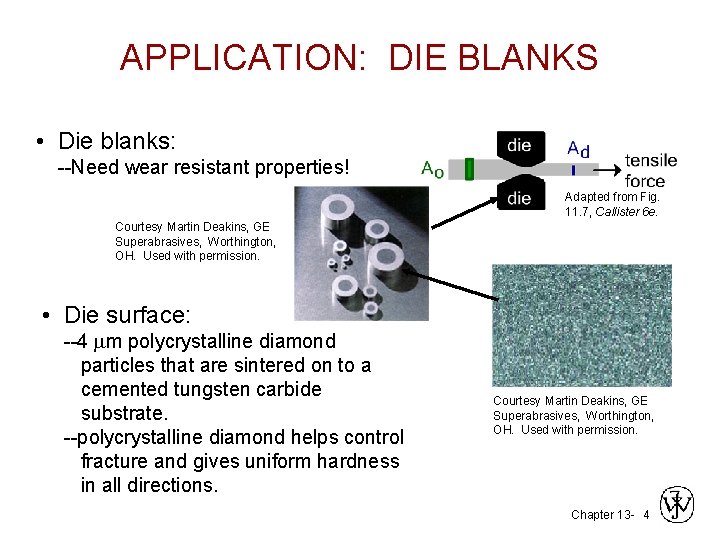
APPLICATION: DIE BLANKS • Die blanks: --Need wear resistant properties! Adapted from Fig. 11. 7, Callister 6 e. Courtesy Martin Deakins, GE Superabrasives, Worthington, OH. Used with permission. • Die surface: --4 mm polycrystalline diamond particles that are sintered on to a cemented tungsten carbide substrate. --polycrystalline diamond helps control fracture and gives uniform hardness in all directions. Courtesy Martin Deakins, GE Superabrasives, Worthington, OH. Used with permission. Chapter 13 - 4
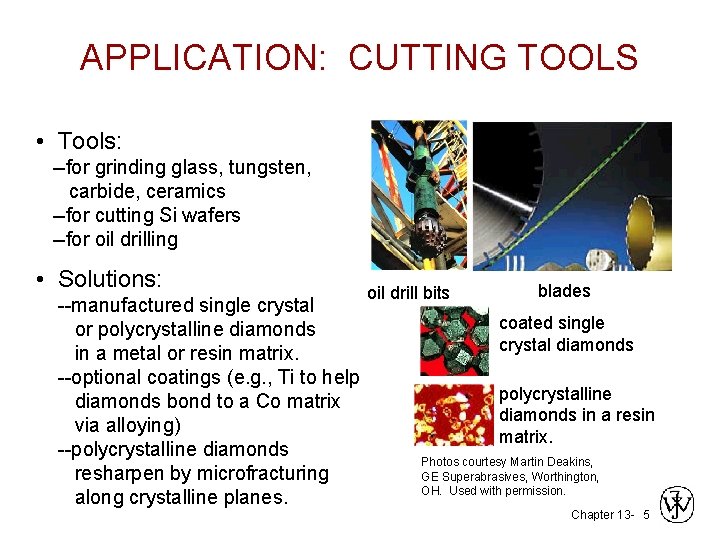
APPLICATION: CUTTING TOOLS • Tools: --for grinding glass, tungsten, carbide, ceramics --for cutting Si wafers --for oil drilling • Solutions: --manufactured single crystal or polycrystalline diamonds in a metal or resin matrix. --optional coatings (e. g. , Ti to help diamonds bond to a Co matrix via alloying) --polycrystalline diamonds resharpen by microfracturing along crystalline planes. oil drill bits blades coated single crystal diamonds polycrystalline diamonds in a resin matrix. Photos courtesy Martin Deakins, GE Superabrasives, Worthington, OH. Used with permission. Chapter 13 - 5
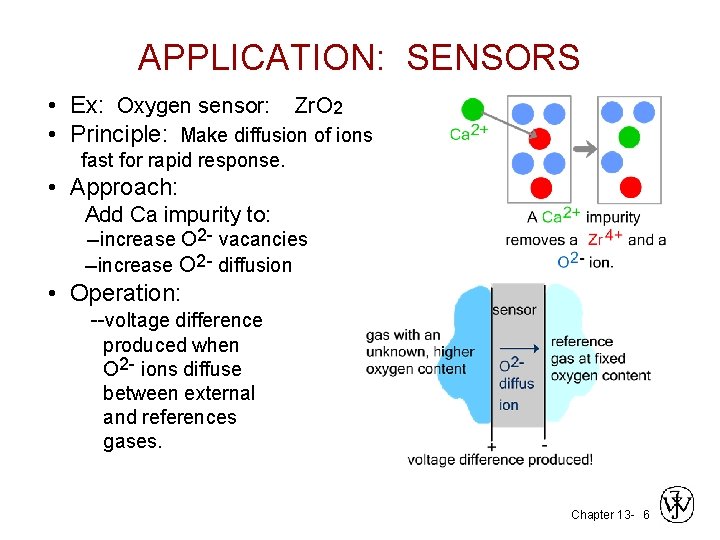
APPLICATION: SENSORS • Ex: Oxygen sensor: Zr. O 2 • Principle: Make diffusion of ions fast for rapid response. • Approach: Add Ca impurity to: --increase O 2 - vacancies --increase O 2 - diffusion • Operation: --voltage difference produced when O 2 - ions diffuse between external and references gases. Chapter 13 - 6
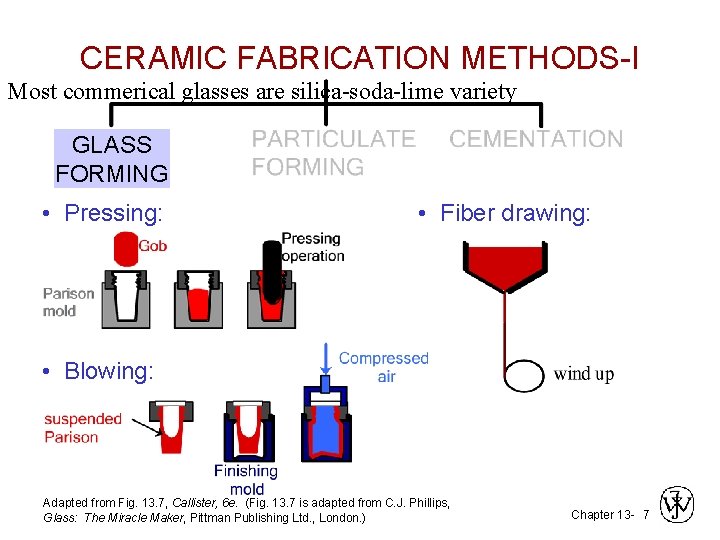
CERAMIC FABRICATION METHODS-I Most commerical glasses are silica-soda-lime variety GLASS FORMING • Pressing: • Fiber drawing: • Blowing: Adapted from Fig. 13. 7, Callister, 6 e. (Fig. 13. 7 is adapted from C. J. Phillips, Glass: The Miracle Maker, Pittman Publishing Ltd. , London. ) Chapter 13 - 7
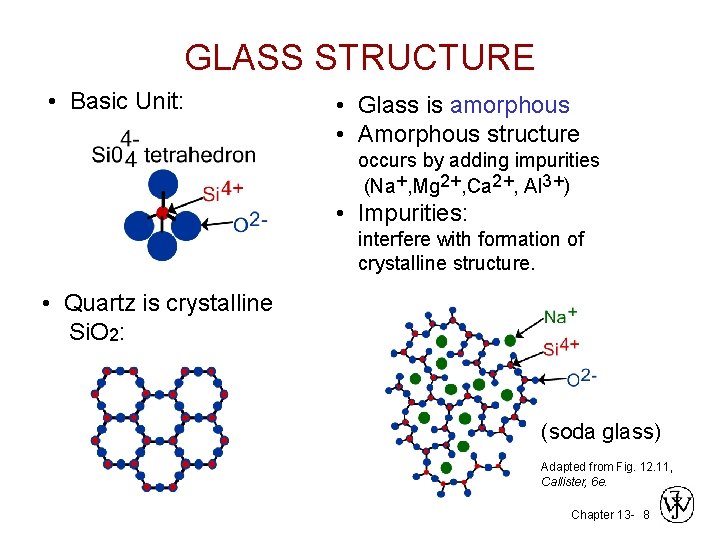
GLASS STRUCTURE • Basic Unit: • Glass is amorphous • Amorphous structure occurs by adding impurities (Na+, Mg 2+, Ca 2+, Al 3+) • Impurities: interfere with formation of crystalline structure. • Quartz is crystalline Si. O 2: (soda glass) Adapted from Fig. 12. 11, Callister, 6 e. Chapter 13 - 8
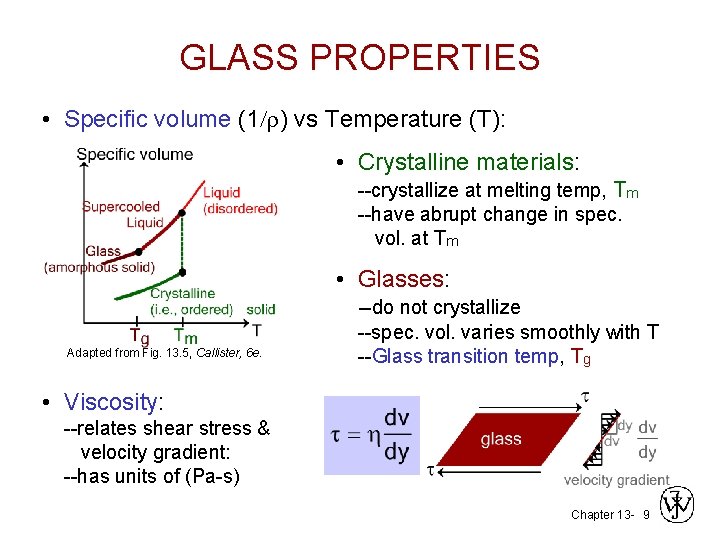
GLASS PROPERTIES • Specific volume (1/r) vs Temperature (T): • Crystalline materials: --crystallize at melting temp, Tm --have abrupt change in spec. vol. at Tm • Glasses: Adapted from Fig. 13. 5, Callister, 6 e. --do not crystallize --spec. vol. varies smoothly with T --Glass transition temp, Tg • Viscosity: --relates shear stress & velocity gradient: --has units of (Pa-s) Chapter 13 - 9
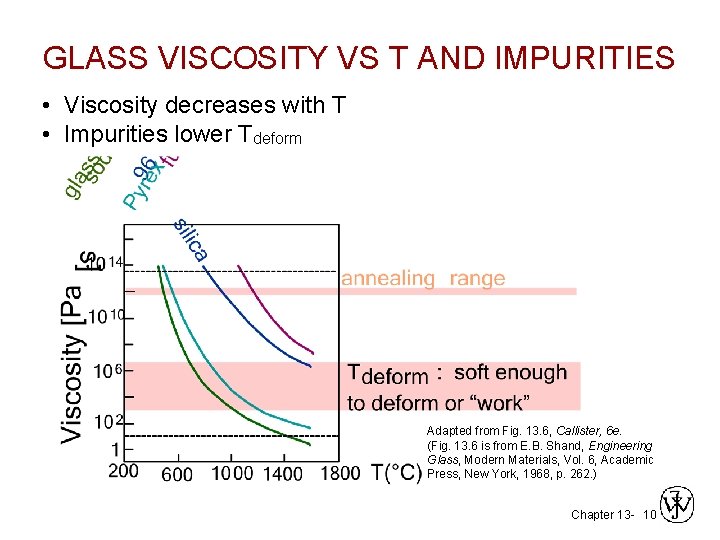
GLASS VISCOSITY VS T AND IMPURITIES • Viscosity decreases with T • Impurities lower Tdeform Adapted from Fig. 13. 6, Callister, 6 e. (Fig. 13. 6 is from E. B. Shand, Engineering Glass, Modern Materials, Vol. 6, Academic Press, New York, 1968, p. 262. ) Chapter 13 - 10
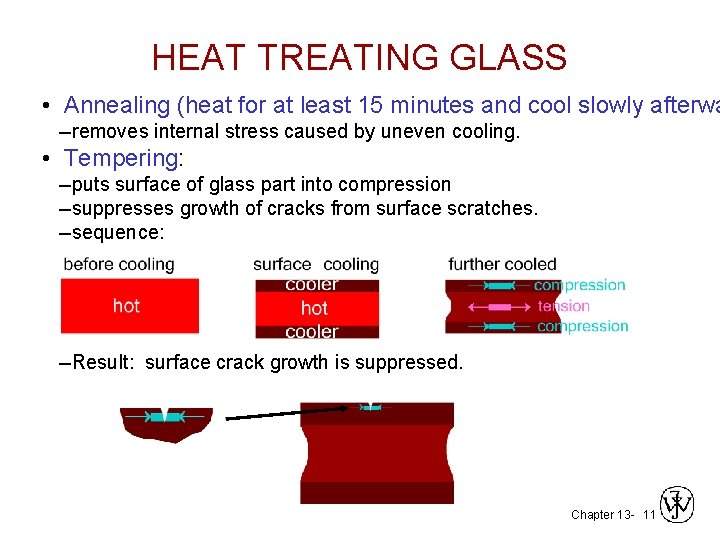
HEAT TREATING GLASS • Annealing (heat for at least 15 minutes and cool slowly afterwa --removes internal stress caused by uneven cooling. • Tempering: --puts surface of glass part into compression --suppresses growth of cracks from surface scratches. --sequence: --Result: surface crack growth is suppressed. Chapter 13 - 11
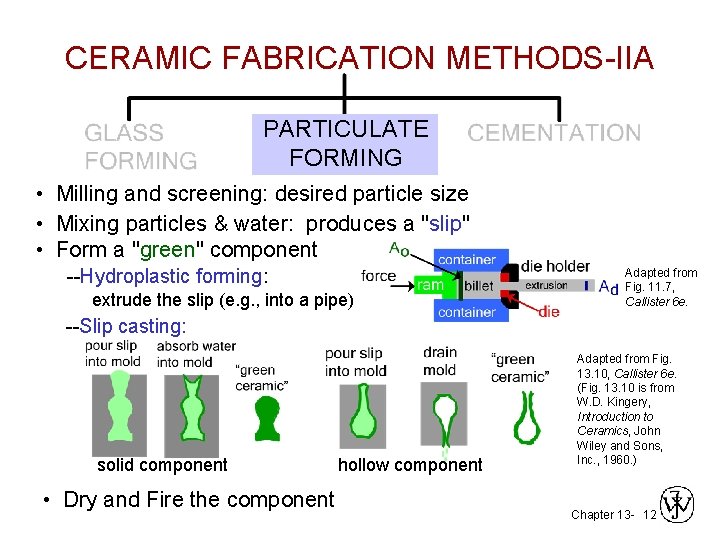
CERAMIC FABRICATION METHODS-IIA PARTICULATE FORMING • Milling and screening: desired particle size • Mixing particles & water: produces a "slip" • Form a "green" component --Hydroplastic forming: extrude the slip (e. g. , into a pipe) Adapted from Fig. 11. 7, Callister 6 e. --Slip casting: solid component • Dry and Fire the component hollow component Adapted from Fig. 13. 10, Callister 6 e. (Fig. 13. 10 is from W. D. Kingery, Introduction to Ceramics, John Wiley and Sons, Inc. , 1960. ) Chapter 13 - 12
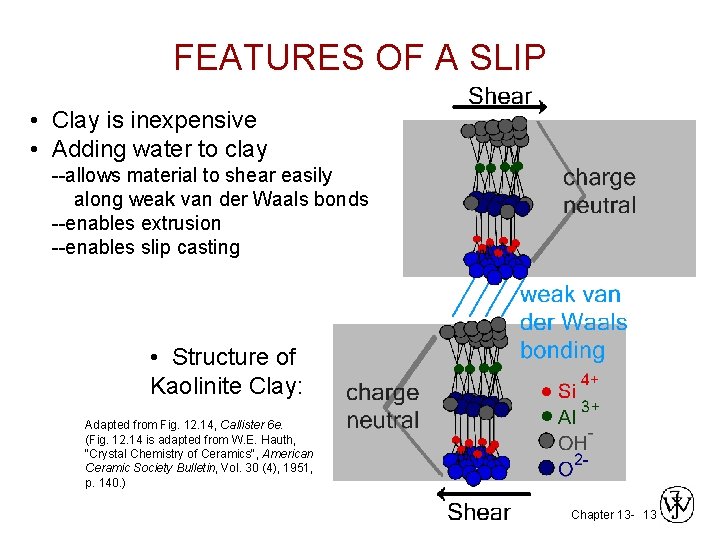
FEATURES OF A SLIP • Clay is inexpensive • Adding water to clay --allows material to shear easily along weak van der Waals bonds --enables extrusion --enables slip casting • Structure of Kaolinite Clay: Adapted from Fig. 12. 14, Callister 6 e. (Fig. 12. 14 is adapted from W. E. Hauth, "Crystal Chemistry of Ceramics", American Ceramic Society Bulletin, Vol. 30 (4), 1951, p. 140. ) Chapter 13 - 13
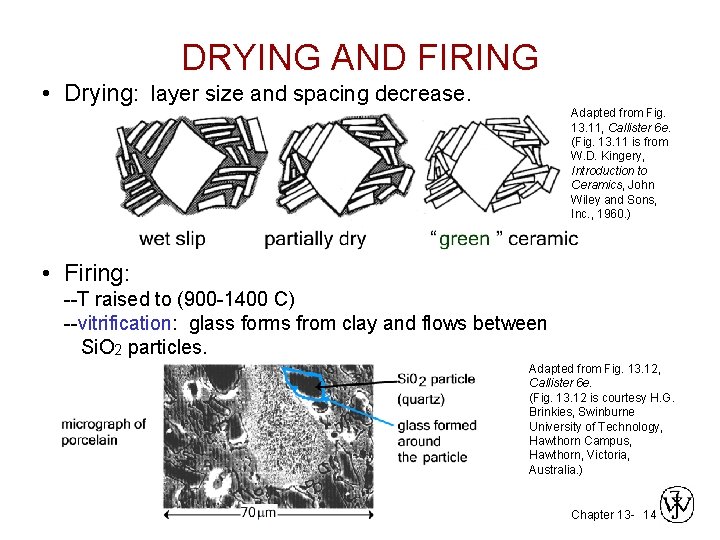
DRYING AND FIRING • Drying: layer size and spacing decrease. Adapted from Fig. 13. 11, Callister 6 e. (Fig. 13. 11 is from W. D. Kingery, Introduction to Ceramics, John Wiley and Sons, Inc. , 1960. ) • Firing: --T raised to (900 -1400 C) --vitrification: glass forms from clay and flows between Si. O 2 particles. Adapted from Fig. 13. 12, Callister 6 e. (Fig. 13. 12 is courtesy H. G. Brinkies, Swinburne University of Technology, Hawthorn Campus, Hawthorn, Victoria, Australia. ) Chapter 13 - 14
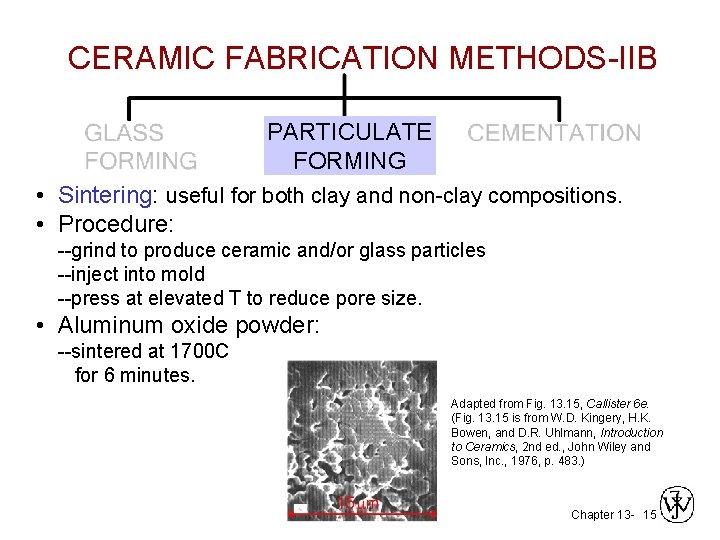
CERAMIC FABRICATION METHODS-IIB PARTICULATE FORMING • Sintering: useful for both clay and non-clay compositions. • Procedure: --grind to produce ceramic and/or glass particles --inject into mold --press at elevated T to reduce pore size. • Aluminum oxide powder: --sintered at 1700 C for 6 minutes. Adapted from Fig. 13. 15, Callister 6 e. (Fig. 13. 15 is from W. D. Kingery, H. K. Bowen, and D. R. Uhlmann, Introduction to Ceramics, 2 nd ed. , John Wiley and Sons, Inc. , 1976, p. 483. ) Chapter 13 - 15
CERAMIC FABRICATION METHODS-III CEMENTATION • Produced in extremely large quantities. • Portland cement: --mix clay and lime bearing materials --calcinate (heat to 1400 C) --primary constituents: tri-calcium silicate di-calcium silicate • Adding water --produces a paste which hardens --hardening occurs due to hydration (chemical reactions with the water). • Forming: done usually minutes after hydration begins. Chapter 13 - 16
SUMMARY • Basic categories of ceramics: --glasses --clay products --refractories --cements --advanced ceramics • Fabrication Techniques: --glass forming (impurities affect forming temp). --particulate forming (needed if ductility is limited) --cementation (large volume, room T process) • Heat treating: Used to --alleviate residual stress from cooling, --produce fracture resistant components by putting surface into compression. Chapter 13 - 17