PEDIATRIC NURSING Care of the Child and Family




- Slides: 56
PEDIATRIC NURSING Care of the Child and Family 1
Developmental Theorists q Maslow’s Hierarchy of Needs (1954) q Erikson - Psychosocial Theory q Jean Piaget - Cognitive Theory 2
Maslow’s Hierarchy of Needs Principles: q An individual’s needs are depicted in ascending levels on the hierarchy q Needs at one level must be met before one can focus on a higher level need Levels of Maslow’s Hierarchy of Needs: q Physiologic/Survival Needs q Safety and Security Needs q Affection or Belonging Needs q Self-esteem/Respect Needs q Self-actualization Needs 3
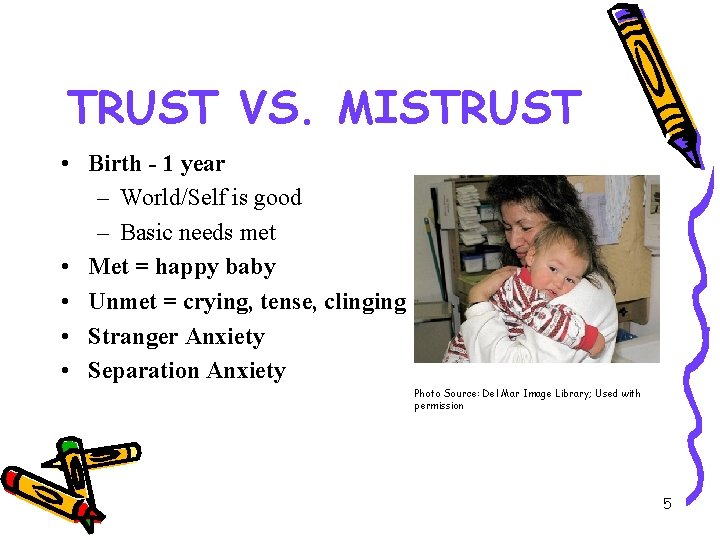
TRUST VS. MISTRUST • Birth - 1 year – World/Self is good – Basic needs met • Met = happy baby • Unmet = crying, tense, clinging • Stranger Anxiety • Separation Anxiety Photo Source: Del Mar Image Library; Used with permission 5
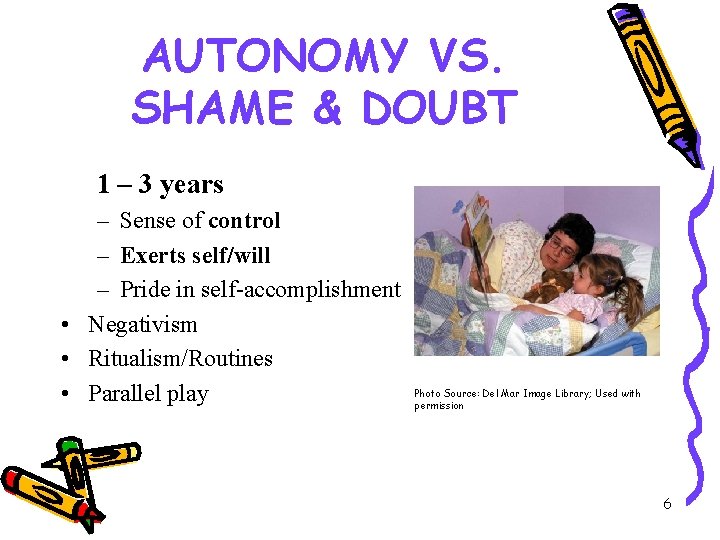
AUTONOMY VS. SHAME & DOUBT 1 – 3 years – Sense of control – Exerts self/will – Pride in self-accomplishment • Negativism • Ritualism/Routines • Parallel play Photo Source: Del Mar Image Library; Used with permission 6
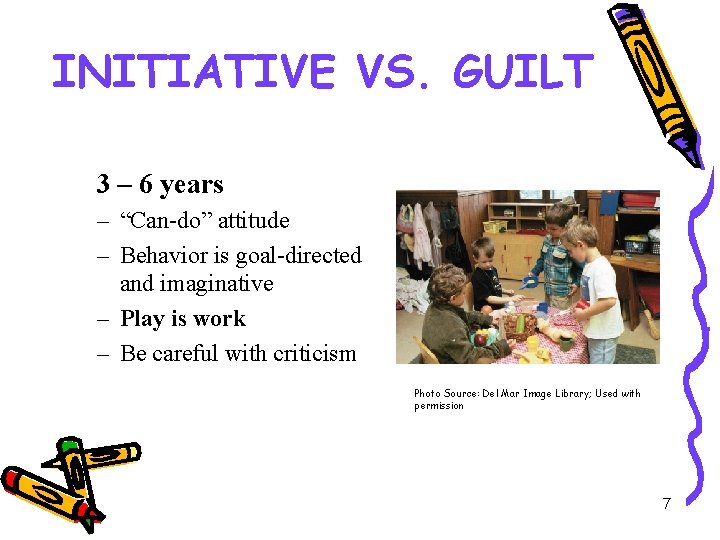
INITIATIVE VS. GUILT 3 – 6 years – “Can-do” attitude – Behavior is goal-directed and imaginative – Play is work – Be careful with criticism Photo Source: Del Mar Image Library; Used with permission 7
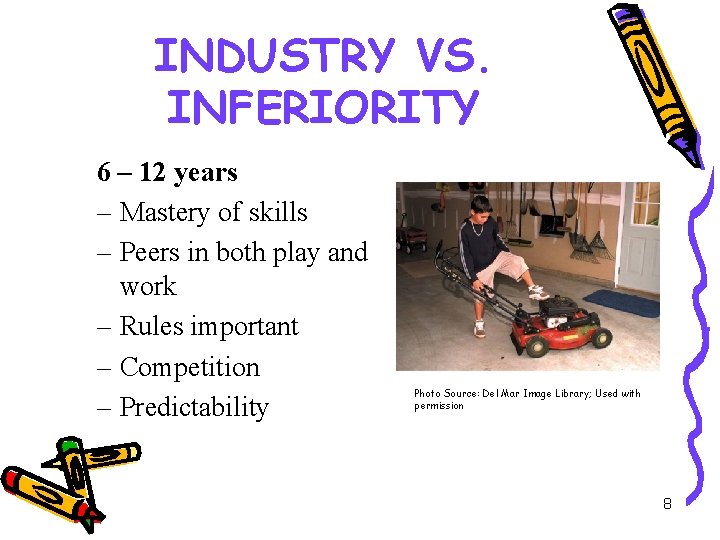
INDUSTRY VS. INFERIORITY 6 – 12 years – Mastery of skills – Peers in both play and work – Rules important – Competition – Predictability Photo Source: Del Mar Image Library; Used with permission 8
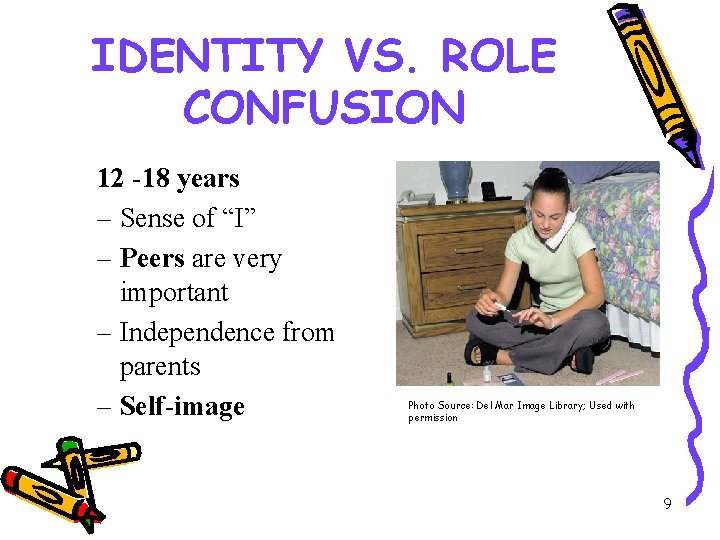
IDENTITY VS. ROLE CONFUSION 12 -18 years – Sense of “I” – Peers are very important – Independence from parents – Self-image Photo Source: Del Mar Image Library; Used with permission 9
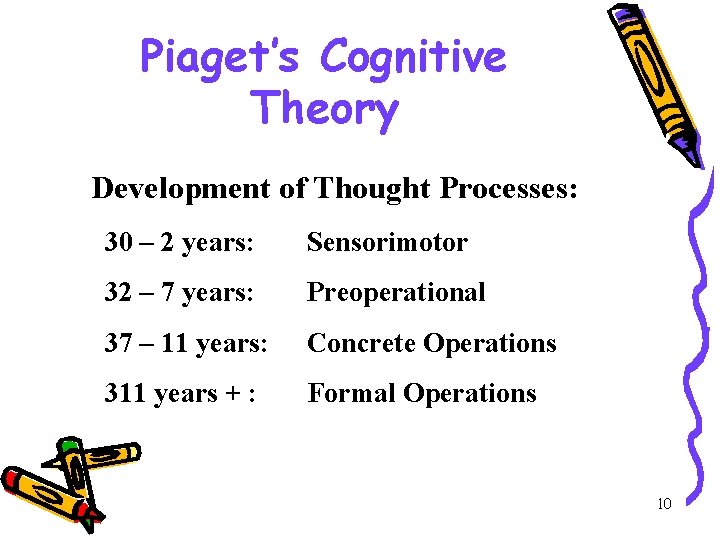
Piaget’s Cognitive Theory Development of Thought Processes: 30 – 2 years: Sensorimotor 32 – 7 years: Preoperational 37 – 11 years: Concrete Operations 311 years + : Formal Operations 10
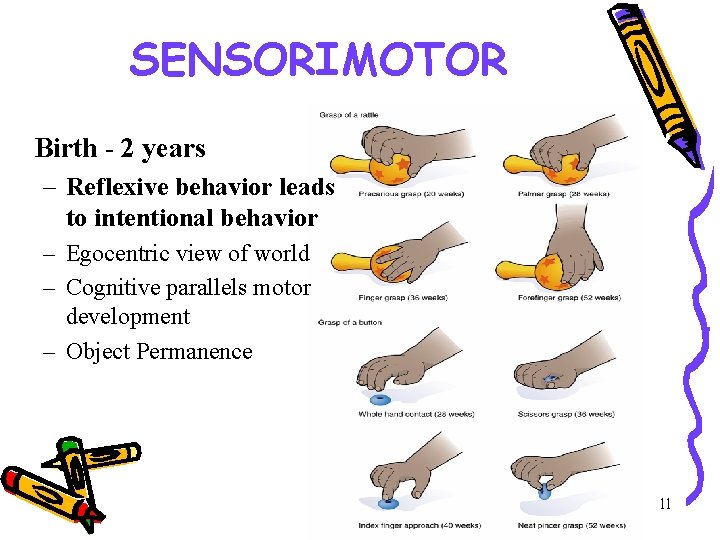
SENSORIMOTOR Birth - 2 years – Reflexive behavior leads to intentional behavior – Egocentric view of world – Cognitive parallels motor development – Object Permanence 11
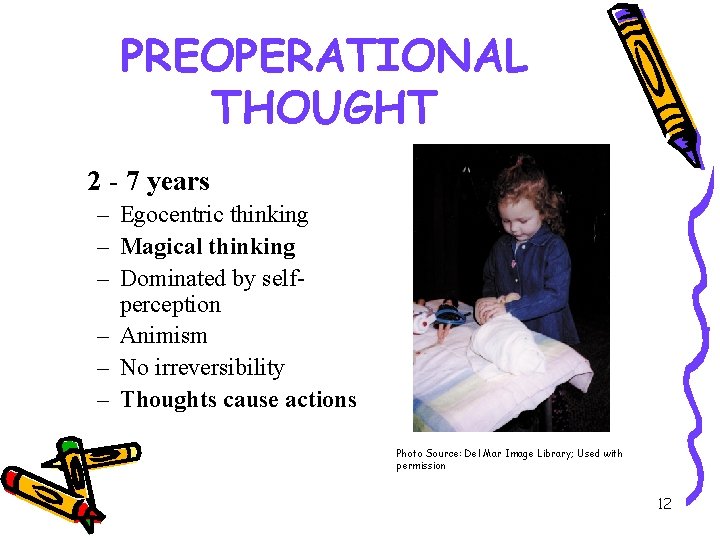
PREOPERATIONAL THOUGHT 2 - 7 years – Egocentric thinking – Magical thinking – Dominated by selfperception – Animism – No irreversibility – Thoughts cause actions Photo Source: Del Mar Image Library; Used with permission 12
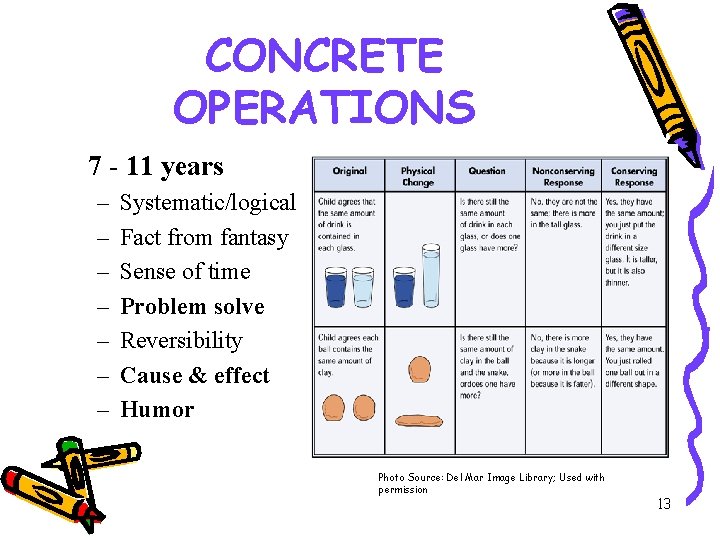
CONCRETE OPERATIONS 7 - 11 years – – – – Systematic/logical Fact from fantasy Sense of time Problem solve Reversibility Cause & effect Humor Photo Source: Del Mar Image Library; Used with permission 13
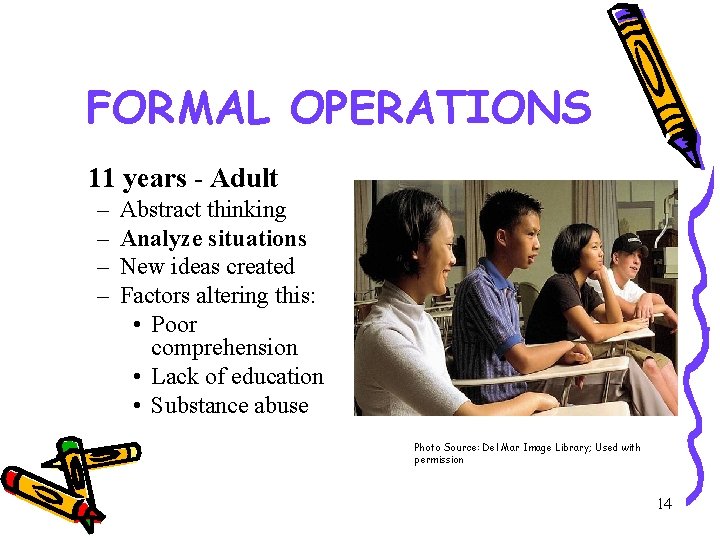
FORMAL OPERATIONS 11 years - Adult – – Abstract thinking Analyze situations New ideas created Factors altering this: • Poor comprehension • Lack of education • Substance abuse Photo Source: Del Mar Image Library; Used with permission 14
Infant Physical Tasks: 0 - 6 months: q Fastest growth period q Gains 5 -7 oz (142 -198 g) weekly for 6 months q Grows 1 inch (2. 5 cm) monthly for 6 months q Head circumference is equal to or larger than chest circumference q Posterior fontanel closes at 2 -3 months* q Obligate nose breathers* q Vital signs: HR and RR faster and irregular* q Motor: behavior is reflex controlled sits with or without support at 6 mo* rolls from abdomen to back q Sensory: able to differentiate between light and dark hearing and touch well developed TOYS = Mirror, Music, Mobile 15
Infant Physical Tasks 6 - 12 months: q Gains 3 -5 oz (84 -140 g) weekly for next 6 months q q * triples weight by 12 months Gains 1/2 in (1. 25 cm) monthly for next 6 months Teeth begin to come in Motor: Intentional rolling over from back to abdomen* Starts crawling and pulling to a stand* Develops pincer grasp* Sits without support by 9 months* Sensory: Can fixate on and follow objects Localizes sounds 16
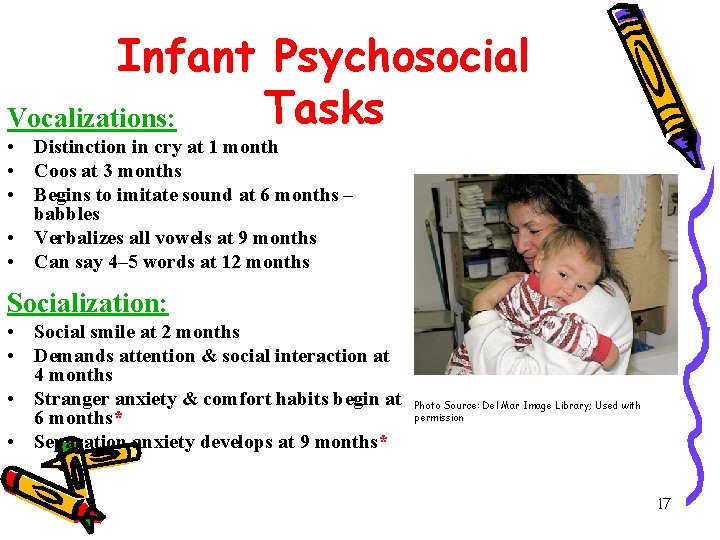
Infant Psychosocial Tasks Vocalizations: • Distinction in cry at 1 month • Coos at 3 months • Begins to imitate sound at 6 months – babbles • Verbalizes all vowels at 9 months • Can say 4– 5 words at 12 months Socialization: • Social smile at 2 months • Demands attention & social interaction at 4 months • Stranger anxiety & comfort habits begin at 6 months* • Separation anxiety develops at 9 months* Photo Source: Del Mar Image Library; Used with permission 17
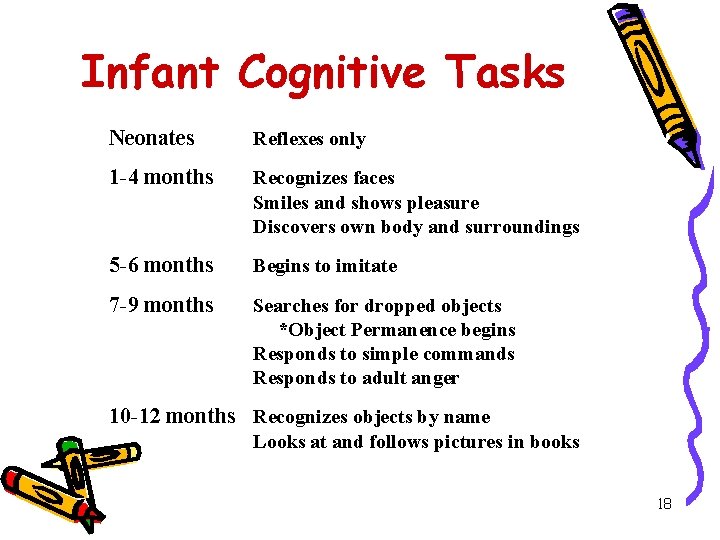
Infant Cognitive Tasks Neonates Reflexes only 1 -4 months Recognizes faces Smiles and shows pleasure Discovers own body and surroundings 5 -6 months Begins to imitate 7 -9 months Searches for dropped objects *Object Permanence begins Responds to simple commands Responds to adult anger 10 -12 months Recognizes objects by name Looks at and follows pictures in books 18
Toddler Physical Tasks: • • • Slow growth period Gains 11 lbs (5 kg) Grows 8 inches (20. 3 cm) Anterior fontanel closes at 12 - 18 months* Primary dentition (20 teeth) complete by 2½ years • Develops sphincter control – toilet training possible* Motor Tasks: • Walks alone by 12 - 18 months* • Climbs and runs fairly well by 2 years • Rides tricycle well by 3 years Photo Source: Del Mar Image Library; Used with permission 19
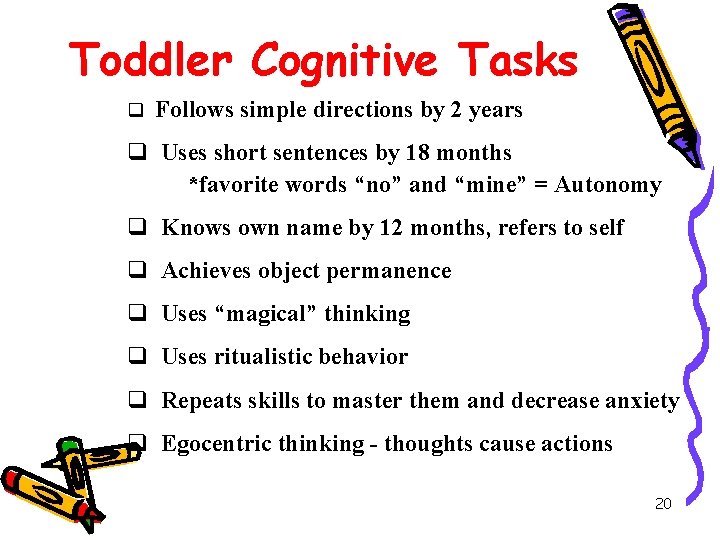
Toddler Cognitive Tasks q Follows simple directions by 2 years q Uses short sentences by 18 months *favorite words “no” and “mine” = Autonomy q Knows own name by 12 months, refers to self q Achieves object permanence q Uses “magical” thinking q Uses ritualistic behavior q Repeats skills to master them and decrease anxiety q Egocentric thinking - thoughts cause actions 20
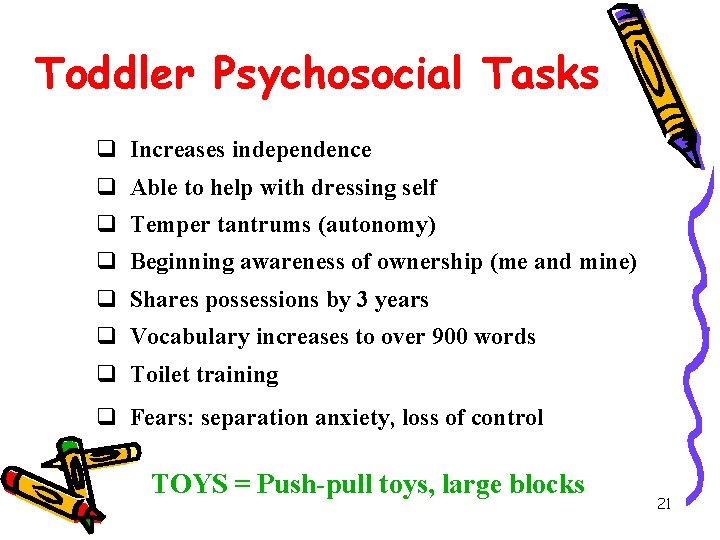
Toddler Psychosocial Tasks q Increases independence q Able to help with dressing self q Temper tantrums (autonomy) q Beginning awareness of ownership (me and mine) q Shares possessions by 3 years q Vocabulary increases to over 900 words q Toilet training q Fears: separation anxiety, loss of control TOYS = Push-pull toys, large blocks 21
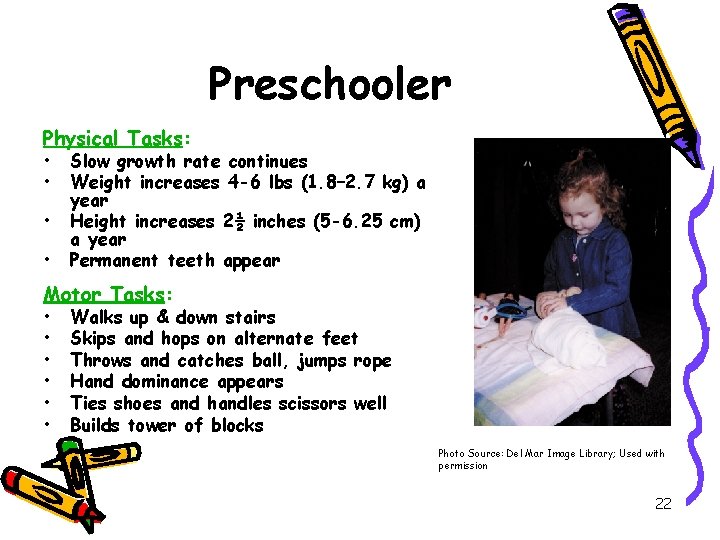
Preschooler Physical Tasks: • • Slow growth rate continues Weight increases 4 -6 lbs (1. 8– 2. 7 kg) a year Height increases 2½ inches (5 -6. 25 cm) a year Permanent teeth appear Motor Tasks: • • • Walks up & down stairs Skips and hops on alternate feet Throws and catches ball, jumps rope Hand dominance appears Ties shoes and handles scissors well Builds tower of blocks Photo Source: Del Mar Image Library; Used with permission 22
Preschooler Cognitive Tasks q Can only focus on one idea at a time q Begins awareness of racial and sexual differences q Develops an understanding of time • Learns sequence of daily events • Able to understand some time-oriented words q Begins to understand the concept of causality q Has 2, 000 word vocabulary q Is very inquisitive and curious 23
Preschooler Psychosocial Tasks q Becomes independent q Gender-specific behavior is evident by 5 years q Egocentricity changes to awareness of others q Understands sharing q Aggressiveness and impatience peak at 4 years q Eager to please and shows more manners by 5 years q Behavior is goal-directed and imaginative q Play is work* TOYS = Dolls, Dress-up, Imagination 24
Preschooler Psychosocial Tasks Fears: about body integrity (Fear & Injury) are common Magical and animistic thinking allows illogical fears to develop* Observing injuries or pain of others can precipitate fear Able to imagine an event without experiencing it Guilt and shame are common* 25
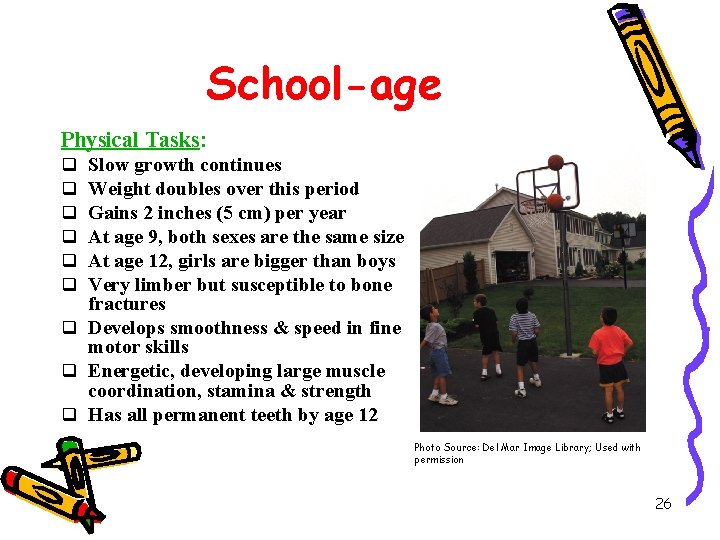
School-age Physical Tasks: Slow growth continues Weight doubles over this period Gains 2 inches (5 cm) per year At age 9, both sexes are the same size At age 12, girls are bigger than boys Very limber but susceptible to bone fractures q Develops smoothness & speed in fine motor skills q Energetic, developing large muscle coordination, stamina & strength q Has all permanent teeth by age 12 q q q Photo Source: Del Mar Image Library; Used with permission 26
School-Age Cognitive Tasks Period of Industry: • Likes to accomplish or produce • Interested in exploration & adventure • Develops confidence • Rules become important* Concepts of time and space develop: • Understands causality, permanence of mass & volume • Masters the concepts of conservation, reversibility, arithmetic and reading • Develops classification skills • Begins to understand cause and effect* 27
School-Age Psychosocial Tasks q School occupies half of waking hours; has cognitive and social impact on child q Morality develops q Peer relationships start to be developed q Enjoys family activities q Has increased self-direction - tasks are important q Has some ability to evaluate own strengths & weaknesses q Enjoys organizational activities (sports, scouts, etc. )* q Modesty develops as child becomes aware of own body* TOYS = Board games, computer games, learning activities 28
Adolescent Physical tasks: Period of rapid growth Puberty starts Girls: height increases 3 inches/year Boys: growth spurt around 13 -yrs-old height increases 4 inches/year weight doubles between 12 -18 yrs q Body shape changes: Girls have fat deposits in thighs, hips & breast, pelvis broadens Boys become leaner with a broader chest q q Photo Source: Del Mar Image Library; Used with permission 29
Adolescent Sexual Development Girls Boys Breasts develop Facial Hair growth Menses begins Voice changes First 1 – 2 years infertile Enlargement of testes at 13 yrs Nocturnal emission during sleep Reaches reproductive maturity with viable sperm at 17 yrs 30
Adolescent Cognitive Tasks q Develops abstract thinking abilities q Often unrealistic q Sense of invincibility = risk taking behavior* q Capable of scientific reasoning and formal logic q Enjoys intellectual abilities q Able to view problems comprehensively ACTIVITIES = Music, video games, communication with peers 31
Adolescent Psychosocial Tasks Early Adolescent: Prone to mood swings Needs limits and consistent discipline Changes in body alter self-concept Fantasy life, daydreams, crushes are normal Middle Adolescent: Separate from parents Identify own values and define self* Partakes/conforms to peer group/values* Increased sexual interest May form a “love” relationship Formal sex education begins 32
Adolescent Psychosocial Tasks Late Adolescent: Achieves greater independence* Chooses a vocation Finds an identity* Finds a mate Develops own morality Completes physical and emotional maturity Fears: Threats to body image – acne, obesity Rejection Injury or death, but have sense of “invincibility” The unknown 33
Infant Nutrition Birth – 6 months: q Breast milk is most complete diet q Iron-fortified formulas are acceptable q No solid foods before 4 months* 6 - 12 months: q q q Breast milk or formula continues* Diluted juices can be introduced Introduction of solid foods*(4 -6 mo): cereal, vegetables, fruits, meats Finger foods at 9 -10 months Chopped table foods at 12 months q Gradual weaning from bottle/breast q No honey (risk for botulism) 34
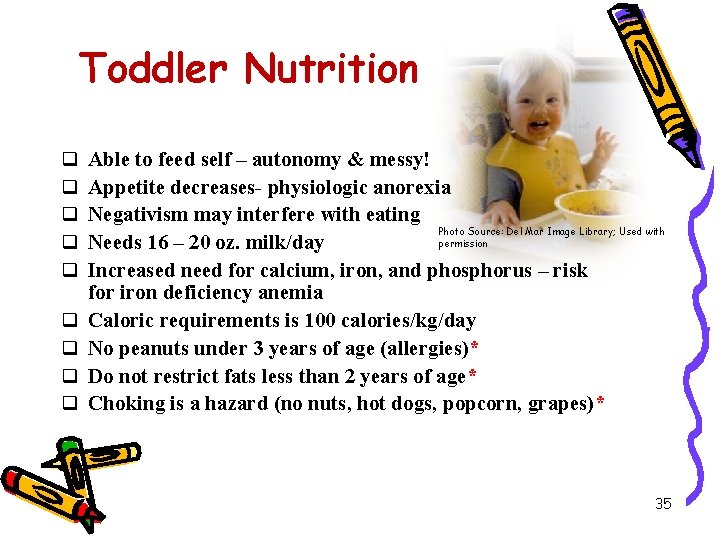
Toddler Nutrition q q q q q Able to feed self – autonomy & messy! Appetite decreases- physiologic anorexia Negativism may interfere with eating Photo Source: Del Mar Image Library; Used with permission Needs 16 – 20 oz. milk/day Increased need for calcium, iron, and phosphorus – risk for iron deficiency anemia Caloric requirements is 100 calories/kg/day No peanuts under 3 years of age (allergies)* Do not restrict fats less than 2 years of age* Choking is a hazard (no nuts, hot dogs, popcorn, grapes)* 35
Preschooler Nutrition q Caloric requirements is 90 calories/kg/day q May demonstrate strong taste preferences • 4 years old – picky eaters • 5 years old – influenced by food habits of others q Able to start social side of eating q More likely to try new foods if they assist in food preparation q Establish good eating habits - obesity 36
School-Age Nutrition q Caloric needs diminish, only need 85 kcal/kg q Foundation laid for increased growth needs q Likes and dislikes are well established q “Junk” food becomes a problem q Busy schedules – breakfast is important q Obesity continues to be a risk q Nutrition education should be integrated into the school program 37
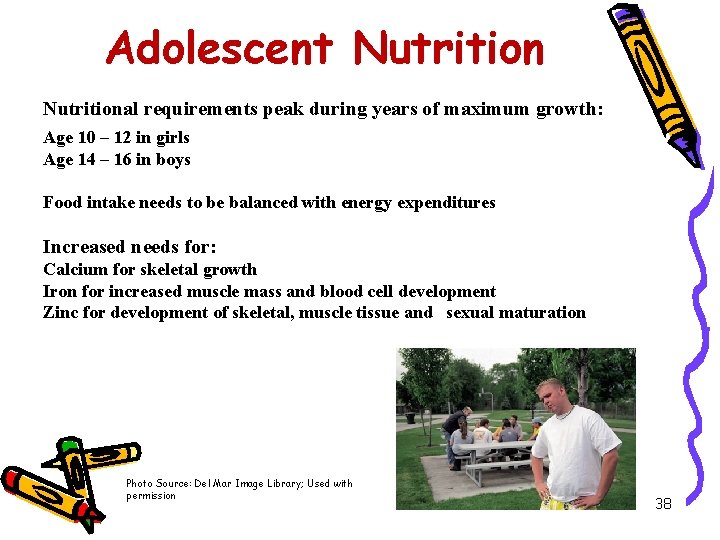
Adolescent Nutritional requirements peak during years of maximum growth: Age 10 – 12 in girls Age 14 – 16 in boys Food intake needs to be balanced with energy expenditures Increased needs for: Calcium for skeletal growth Iron for increased muscle mass and blood cell development Zinc for development of skeletal, muscle tissue and sexual maturation Photo Source: Del Mar Image Library; Used with permission 38
Adolescent Nutrition (continued) Eating and attitudes towards food are primarily family/peer centered Skipping breakfast, increased junk food, decreased fruits, veggies, milk Boys eat foods high in calories. Girls under-eat or have inadequate nutrient intake. 39
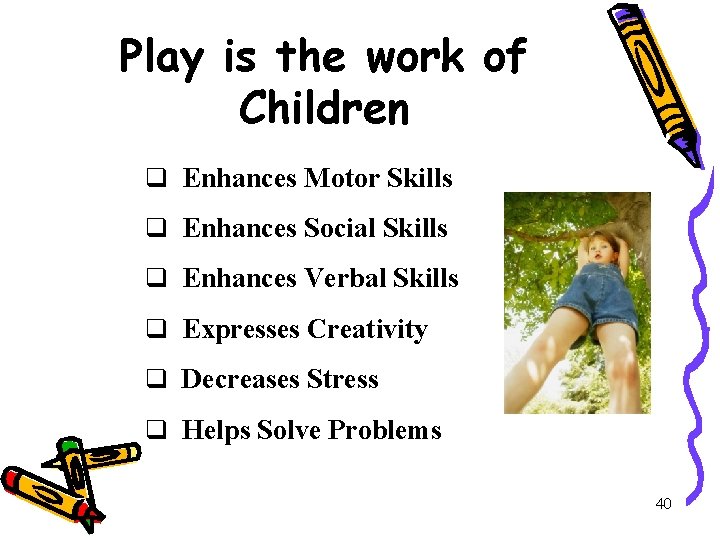
Play is the work of Children q Enhances Motor Skills q Enhances Social Skills q Enhances Verbal Skills q Expresses Creativity q Decreases Stress q Helps Solve Problems 40
Appropriate Play Activities Infants - Solitary Play, stimulation of senses (music, mirror) Toddler - Parallel Play, make believe, locomotion (push-pull toys), gross & fine motor, outlet for aggression & autonomy Preschooler - Associative Play, Imaginary Playmate, dramatic & imitative, gross & fine motor School Age - Cooperative Play, rules dominate play, team games/sports, quiet games/activities, joke books Adolescent - Group activities predominate, activities involving the opposite sex in later years 41
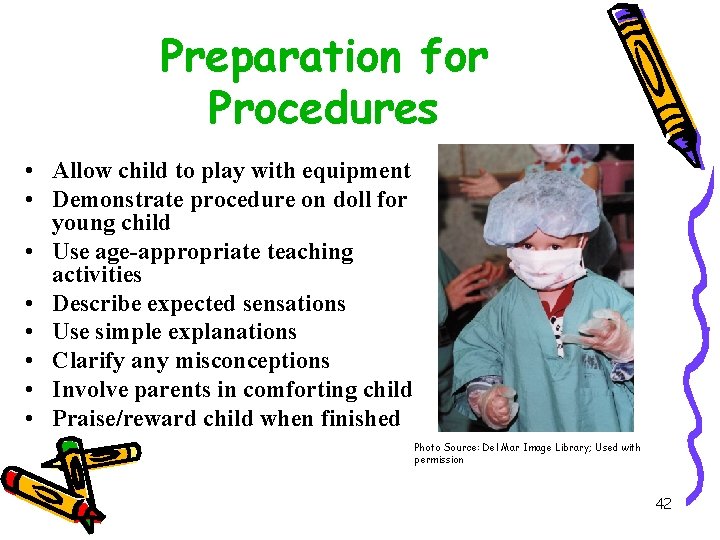
Preparation for Procedures • Allow child to play with equipment • Demonstrate procedure on doll for young child • Use age-appropriate teaching activities • Describe expected sensations • Use simple explanations • Clarify any misconceptions • Involve parents in comforting child • Praise/reward child when finished Photo Source: Del Mar Image Library; Used with permission 42
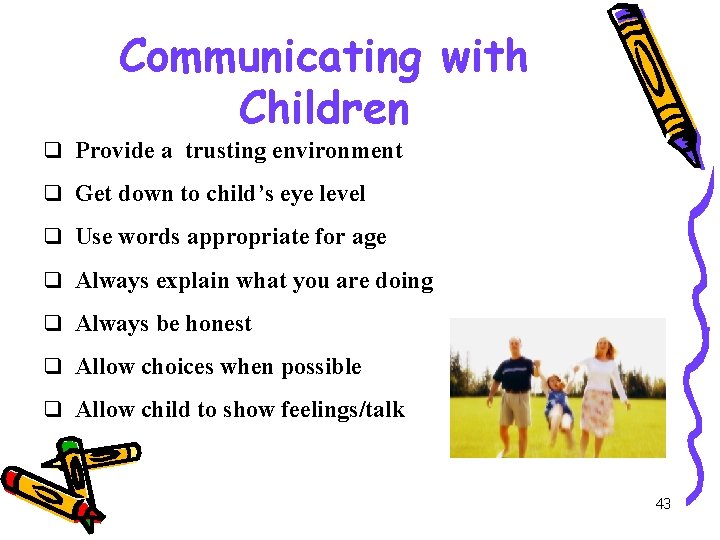
Communicating with Children q Provide a trusting environment q Get down to child’s eye level q Use words appropriate for age q Always explain what you are doing q Always be honest q Allow choices when possible q Allow child to show feelings/talk 43
Health Promotion Childhood Immunizations Well child check-ups Nutrition Screenings throughout childhood (APGARS, newborn screenings, lead poisoning, vision/hearing, scoliosis) Health Teaching 44
Immunizations q Primary prevention of many communicable diseases q Vaccines safety • MMR vaccine and autism (no correlation) • Reactions (pre-medicate with Tylenol) q Live attenuated vaccines (MMR, Varicella) • Weakened form of disease • Body produces immune response • Contraindicated in immunosupressed individuals q Inactivated (killed virus/bacteria or synthetic) • 1 st dose only “primes” system- immunity develops after 3 rd 45
Injury Prevention & Safety Issues q Accidents are the leading cause of death in infants and toddlers (falls, burns, poisons) q Toddlers and Preschoolers – drowning q School-age and adolescents – motor vehicle accidents and firearms q 90% of all accidents are preventable! q Safety education is the answer 46
Injury Prevention q Methods of Injury Prevention • Understanding and Applying Growth and • • Developmental Principles Anticipatory Guidance Childproofing the environment Educating caregivers and children Legislation q Precipitating Factors q Potential Outcomes 47
Pediatric Poisonings Highest incidence occurs in children in 2 -year-old age group and under 6 years of age Major contributing factor – improper storage, allowing children to play with “bottles” – rattling of pills, “drink” syrups, toxic portion of plants. Teach parents about proper storage Knowledge of plants in household, and keep away from infants and children who might “chew” Emergency treatment depends on agent ingested Teach parents to have poison control number available Refer to appropriate method according to substance ingested First Intervention is to call POISON CONTROL CENTER 48
Types of Poisonings Lead Poisoning Salicylate Poisoning Acetaminophen Ingestion 49
Lead Poisoning q q q q Major environmental health concern Found in older homes (built before 1978), leadcontaminated soil, water through lead pipes, lead-based paint in ceramics products, Mexican candies made in lead containers Body rapidly absorbs lead – specially in periods of rapid growth – most harmful to children under 6 years Absorbed in GI tract and accumulates in bones, brain, kidneys Low levels in blood can cause behavioral/learning problems, mid-levels anemia-like symptoms and skeletal growth interference, and high levels can be fatal from CNS edema and encephalopathy Diet high in fat, low in iron & calcium can increase lead absorption Intervention=teaching for prevention. If blood level ≥ 45, chelation therapy is needed – monitor kidney function during treatment. 50
Salicylate Poisoning q Can be acute or chronic ingestion q S/S = nausea, disorientation, vomiting, dehydration, hyperpyrexia, oliguria, coma, bleeding tendencies, tinnitus, seizures q Nursing interventions = activated charcoal, sodium bicarbonate for metabolic acidosis, external cooling measures for hyperpyrexia, anticonvulsant and seizure precautions (think patient safety!), vitamin K for bleeding, possible hemo (NOT peritoneal) dialysis 51
Acetaminophen Poisoning q Most common drug poisoning in children q Acute ingestion q S/S start as nausea, vomiting, pallor, sweating » hepatic involvement (jaundice, confusion, coagulation problems, RUQ pain) q Treatment is activated charcoal first, then the antidote N-acetylcysteine (Mucomyst) PO every 4 hours for 17 doses after a loading dose given Always assess Level of Consciousness (LOC) before administering PO med! 52
Physical Assessment of Infant q q q q Assessment is NOT in the head-to-toe manner When quiet, auscultate heart, lungs, abdomen Assess heart & respiratory rates before temperature Palpate and percuss same areas Perform traumatic procedures last Elicit reflexes as body part examined Elicit Moro reflex last Encourage caretaker to hold infant during exam Distract with soft voice, offer pacifier, music or toy 53
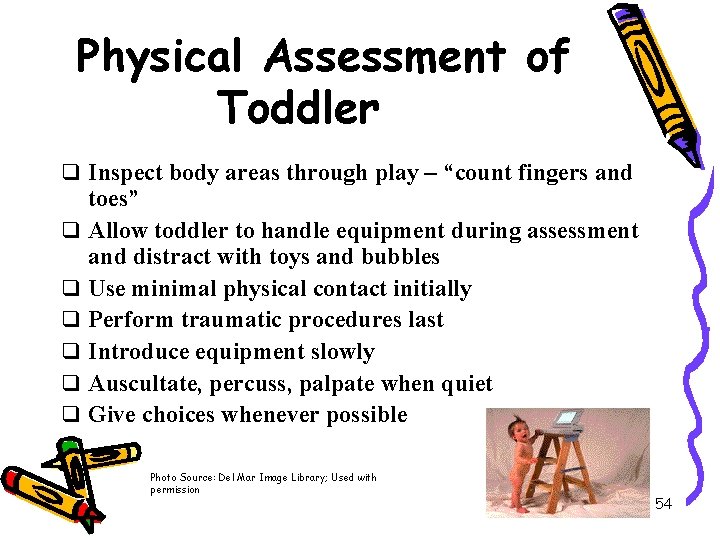
Physical Assessment of Toddler q Inspect body areas through play – “count fingers and q q q toes” Allow toddler to handle equipment during assessment and distract with toys and bubbles Use minimal physical contact initially Perform traumatic procedures last Introduce equipment slowly Auscultate, percuss, palpate when quiet Give choices whenever possible Photo Source: Del Mar Image Library; Used with permission 54
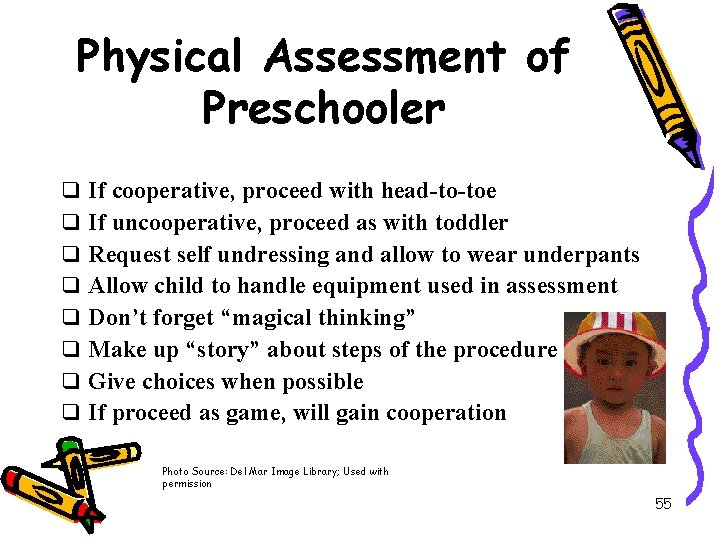
Physical Assessment of Preschooler q q q q If cooperative, proceed with head-to-toe If uncooperative, proceed as with toddler Request self undressing and allow to wear underpants Allow child to handle equipment used in assessment Don’t forget “magical thinking” Make up “story” about steps of the procedure Give choices when possible If proceed as game, will gain cooperation Photo Source: Del Mar Image Library; Used with permission 55
Physical Assessment of School-Age Child q Proceed in head-to-toe q May examine genitalia last in older children q Respect need for privacy – remember modesty! q Explain purpose of equipment and significance q Teach about body function and care of body 56
Physical Assessment of the Adolescent q Ask adolescent if he/she would like parent/caretaker q q q present during interview/assessment Provide privacy Head-to-toe assessment appropriate Incorporate questions/assessment related to genitals/sexuality in middle of exam Answer questions in a straightforward, noncondescending manner Include the adolescent in planning their care 57