
External Early Child Care for Working Parents Initiative
- Slides: 13
External Early Child Care for Working Parents Initiative Sarah Savage, Senior Policy Analyst
The views expressed are my own and not those of the Federal Reserve Bank of Boston or the Federal Reserve System. Federal Reserve Bank of Boston | bostonfed. org | Regional & Community Outreach, January 2019 | External 2
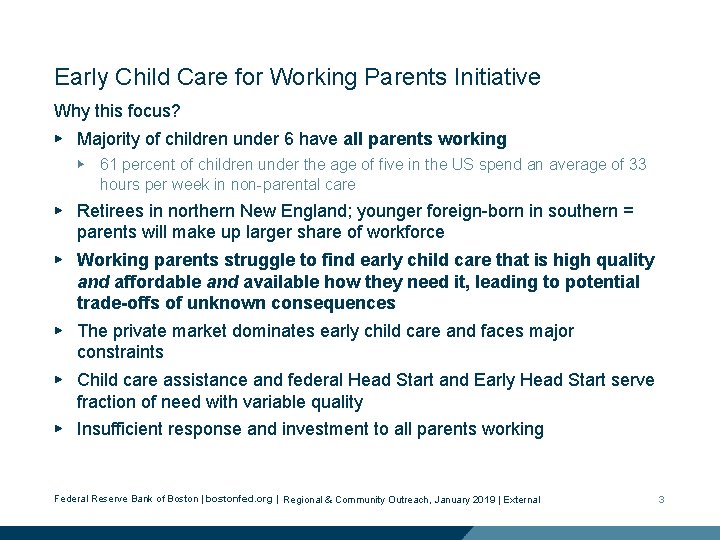
Early Child Care for Working Parents Initiative Why this focus? ▶ Majority of children under 6 have all parents working ▶ 61 percent of children under the age of five in the US spend an average of 33 hours per week in non-parental care ▶ Retirees in northern New England; younger foreign-born in southern = parents will make up larger share of workforce ▶ Working parents struggle to find early child care that is high quality and affordable and available how they need it, leading to potential trade-offs of unknown consequences ▶ The private market dominates early child care and faces major constraints ▶ Child care assistance and federal Head Start and Early Head Start serve fraction of need with variable quality ▶ Insufficient response and investment to all parents working Federal Reserve Bank of Boston | bostonfed. org | Regional & Community Outreach, January 2019 | External 3
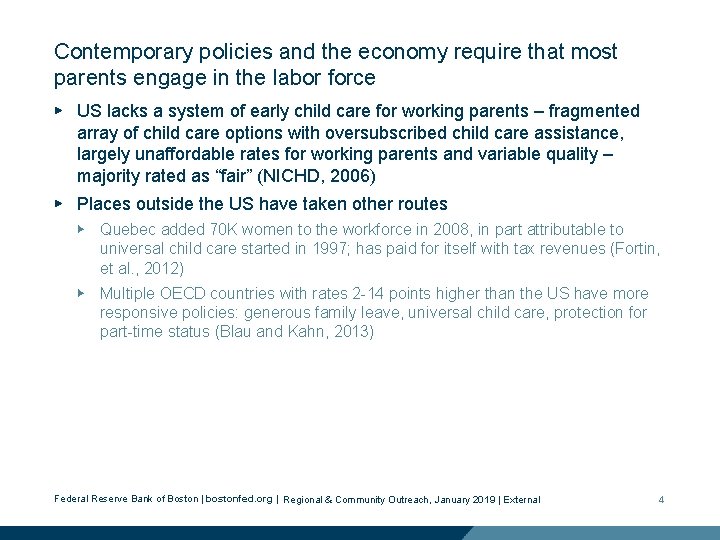
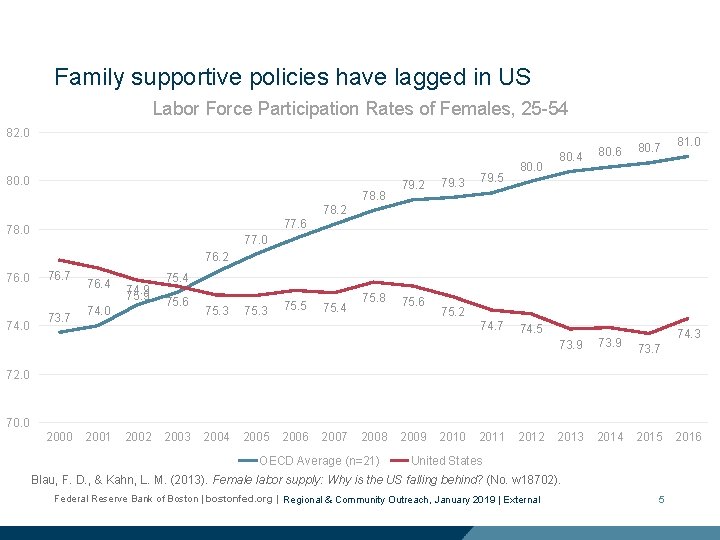
Contemporary policies and the economy require that most parents engage in the labor force ▶ US lacks a system of early child care for working parents – fragmented array of child care options with oversubscribed child care assistance, largely unaffordable rates for working parents and variable quality – majority rated as “fair” (NICHD, 2006) ▶ Places outside the US have taken other routes ▶ Quebec added 70 K women to the workforce in 2008, in part attributable to universal child care started in 1997; has paid for itself with tax revenues (Fortin, et al. , 2012) ▶ Multiple OECD countries with rates 2 -14 points higher than the US have more responsive policies: generous family leave, universal child care, protection for part-time status (Blau and Kahn, 2013) Federal Reserve Bank of Boston | bostonfed. org | Regional & Community Outreach, January 2019 | External 4
Family supportive policies have lagged in US Labor Force Participation Rates of Females, 25 -54 82. 0 80. 0 78. 8 79. 2 79. 3 79. 5 80. 0 80. 7 80. 4 80. 6 73. 9 73. 7 2013 2014 2015 81. 0 78. 2 77. 6 78. 0 77. 0 76. 2 76. 0 74. 0 76. 7 73. 7 76. 4 74. 9 75. 9 74. 0 75. 4 75. 6 75. 3 75. 5 75. 4 75. 8 75. 6 75. 2 74. 7 74. 5 74. 3 72. 0 70. 0 2001 2002 2003 2004 2005 2006 2007 2008 OECD Average (n=21) 2009 2010 2011 2012 United States Blau, F. D. , & Kahn, L. M. (2013). Female labor supply: Why is the US falling behind? (No. w 18702). Federal Reserve Bank of Boston | bostonfed. org | Regional & Community Outreach, January 2019 | External 5 2016
Support for focus on working parents ▶ Literature on effects of child care on parental employment ▶ A study of working parents of children under 3 estimates an annual economic burden of inadequate child care as $3, 350 per working parent and on businesses as $1, 150 per working parent, estimated as costing $12. 7 billion to US employers annually (Belfield, 2018) ▶ In Louisiana survey, 14% of respondents turned down a promotion with children under 5 (women were 6 times as likely to turn down a promotion) (Davis et al. , 2017) ▶ A study of recently hired welfare recipients found pervasive absenteeism linked to child care and transportation (Holzer et al. , 2001) Federal Reserve Bank of Boston | bostonfed. org | Regional & Community Outreach, January 2019 | External 6
Support to better understand how early child care affects working parents ▶ Paraphrased anecdotes from our 13 -member Family Council of working parents on what would be different if aligned ▶ Working one job instead of 5 million little jobs; working standard hours rather than 2 back-to-back jobs into the late evening ▶ Completing a college degree ▶ Less credit card debt Federal Reserve Bank of Boston | bostonfed. org | Regional & Community Outreach, January 2019 | External 7
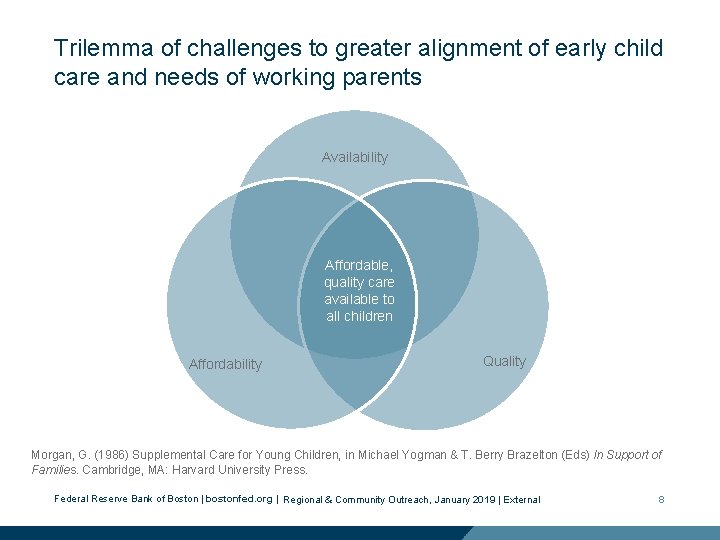
Trilemma of challenges to greater alignment of early child care and needs of working parents Availability Affordable, quality care available to all children Affordability Quality Morgan, G. (1986) Supplemental Care for Young Children, in Michael Yogman & T. Berry Brazelton (Eds) In Support of Families. Cambridge, MA: Harvard University Press. Federal Reserve Bank of Boston | bostonfed. org | Regional & Community Outreach, January 2019 | External 8
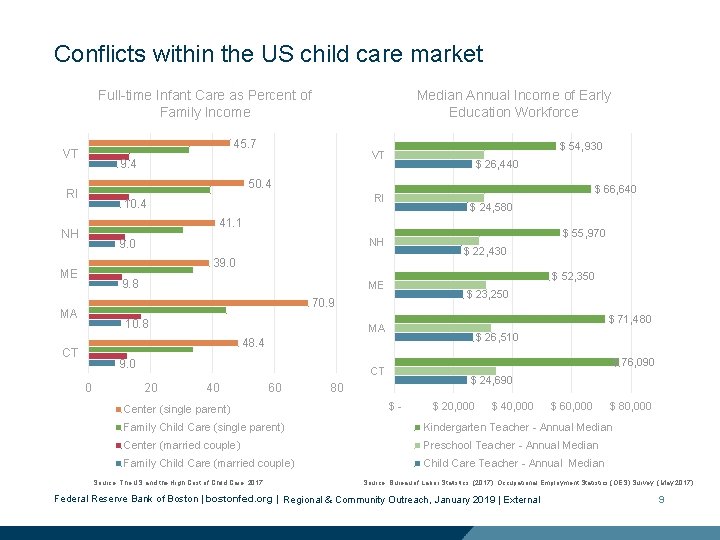
Conflicts within the US child care market Full-time Infant Care as Percent of Family Income Median Annual Income of Early Education Workforce 45. 7 VT $ 54, 930 VT 9. 4 $ 26, 440 50. 4 RI $ 66, 640 RI 10. 4 $ 24, 580 41. 1 NH Affordable, quality 39. 0 care available to all children 9. 0 ME 9. 8 MA $ 55, 970 NH $ 22, 430 $ 52, 350 ME $ 23, 250 70. 9 10. 8 $ 71, 480 MA $ 26, 510 48. 4 CT 9. 0 0 $ 76, 090 CT 20 40 60 Center (single parent) $ 24, 690 80 $- $ 20, 000 $ 40, 000 $ 60, 000 $ 80, 000 Family Child Care (single parent) Kindergarten Teacher - Annual Median Center (married couple) Preschool Teacher - Annual Median Family Child Care (married couple) Child Care Teacher - Annual Median Source: The US and the High Cost of Child Care: 2017. Source: Bureau of Labor Statistics. (2017). Occupational Employment Statistics (OES) Survey. (May 2017). Federal Reserve Bank of Boston | bostonfed. org | Regional & Community Outreach, January 2019 | External 9
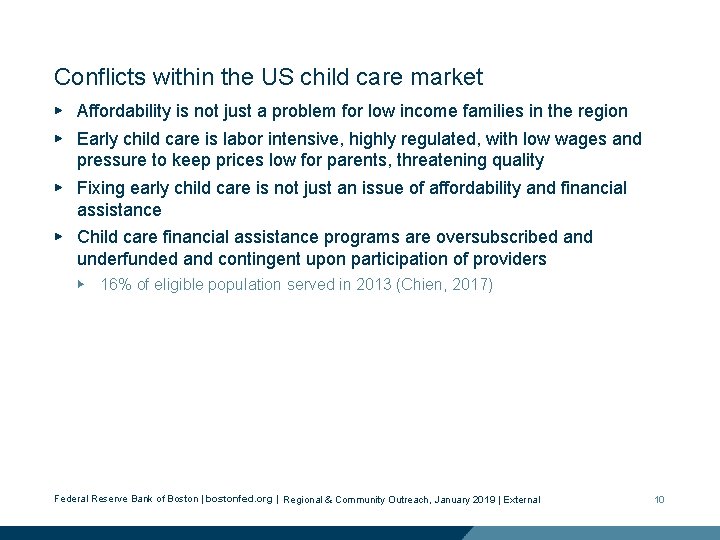
Conflicts within the US child care market ▶ Affordability is not just a problem for low income families in the region ▶ Early child care is labor intensive, highly regulated, with low wages and pressure to keep prices low for parents, threatening quality ▶ Fixing early child care is not just an issue of affordability and financial assistance ▶ Child care financial assistance programs are oversubscribed and underfunded and contingent upon participation of providers ▶ 16% of eligible population served in 2013 (Chien, 2017) Federal Reserve Bank of Boston | bostonfed. org | Regional & Community Outreach, January 2019 | External 10
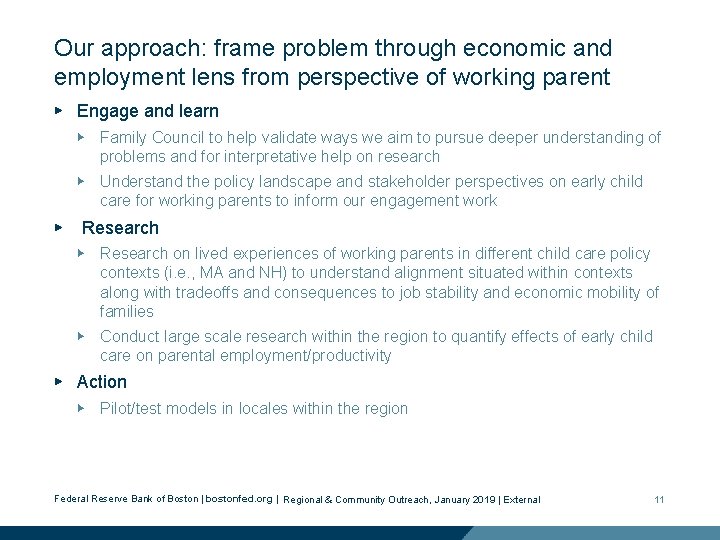
Our approach: frame problem through economic and employment lens from perspective of working parent ▶ Engage and learn ▶ Family Council to help validate ways we aim to pursue deeper understanding of problems and for interpretative help on research ▶ Understand the policy landscape and stakeholder perspectives on early child care for working parents to inform our engagement work ▶ Research on lived experiences of working parents in different child care policy contexts (i. e. , MA and NH) to understand alignment situated within contexts along with tradeoffs and consequences to job stability and economic mobility of families ▶ Conduct large scale research within the region to quantify effects of early child care on parental employment/productivity ▶ Action ▶ Pilot/test models in locales within the region Federal Reserve Bank of Boston | bostonfed. org | Regional & Community Outreach, January 2019 | External 11
Questions? bostonfed. org/childcaresurvey Federal Reserve Bank of Boston | bostonfed. org | Regional & Community Outreach, January 2019 | External 12
Notes ▶ A study of working parents of children under 3 estimates an annual economic burden of inadequate child care as $3, 350 per working parent and on businesses as $1, 150 per working parent (Belfield, 2018) ▶ 45% of parents absent from work an average of 4. 3 days per six-month period due to child care issues (Bright Horizons, 2007) ▶ 29% of employed parents experienced some kind of child care breakdown in a referenced recent 3 -month period, associated with absenteeism, tardiness, and reduced concentration at work (Bond et al. , 1998) ▶ In Louisiana survey, 14% of respondents turned down a promotion with children under 5 (women were 6 times as likely to turn down a promotion) (Davis et al. , 2017) ▶ A study of recently hired welfare recipients found pervasive absenteeism linked to child care and transportation (Holzer et al. , 2001) ▶ 10% reduction in the price of child care could lead to a 0. 25 -11% increase in maternal employment (Morrissey 2017) ▶ Parent absenteeism, productivity reductions, and turnover, attributable to child care problems estimated as costing US employers $3 billion annually (Friedman, 1986); recently estimated as $12. 7 billion [real dollars] (Belfield, 2018) Federal Reserve Bank of Boston | bostonfed. org | Regional & Community Outreach, January 2019 | External 13