Part IV SALES FORCE COMPETENCIES Chapter 7 Recruiting
- Slides: 35
Part IV SALES FORCE COMPETENCIES Chapter 7: Recruiting and Selecting Sales Personnel
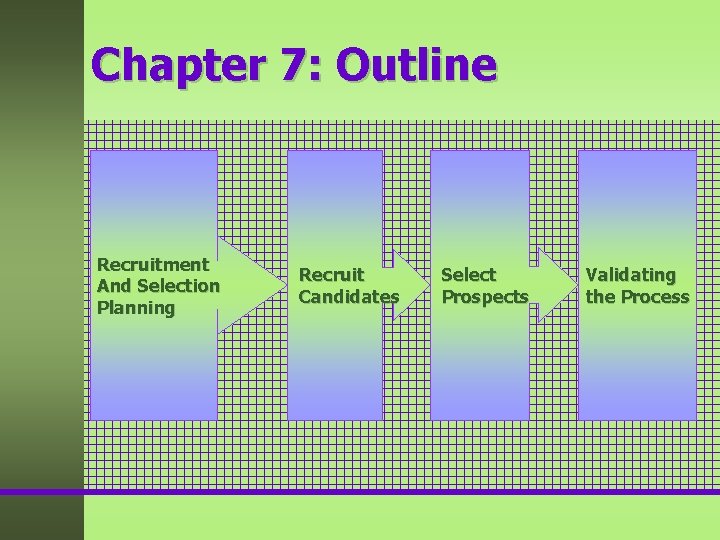
Chapter 7: Outline Recruitment And Selection Planning Recruit Candidates Select Prospects Validating the Process
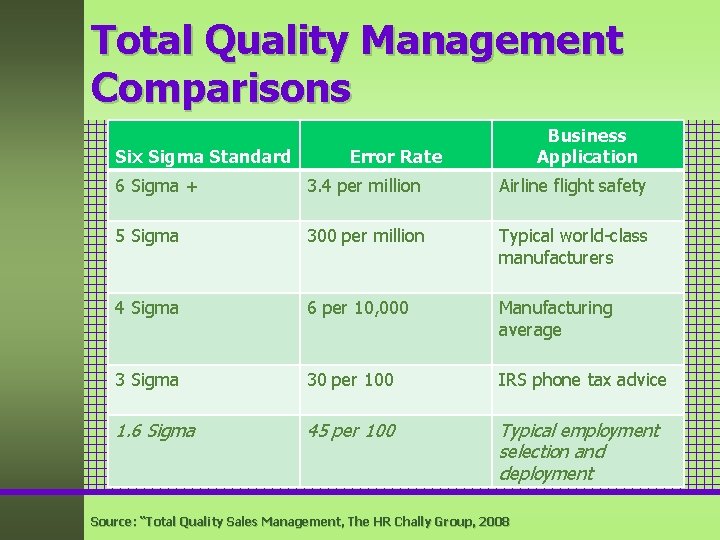
Total Quality Management Comparisons Six Sigma Standard Business Application Error Rate 6 Sigma + 3. 4 per million Airline flight safety 5 Sigma 300 per million Typical world-class manufacturers 4 Sigma 6 per 10, 000 Manufacturing average 3 Sigma 30 per 100 IRS phone tax advice 1. 6 Sigma 45 per 100 Typical employment selection and deployment Source: “Total Quality Sales Management, The HR Chally Group, 2008
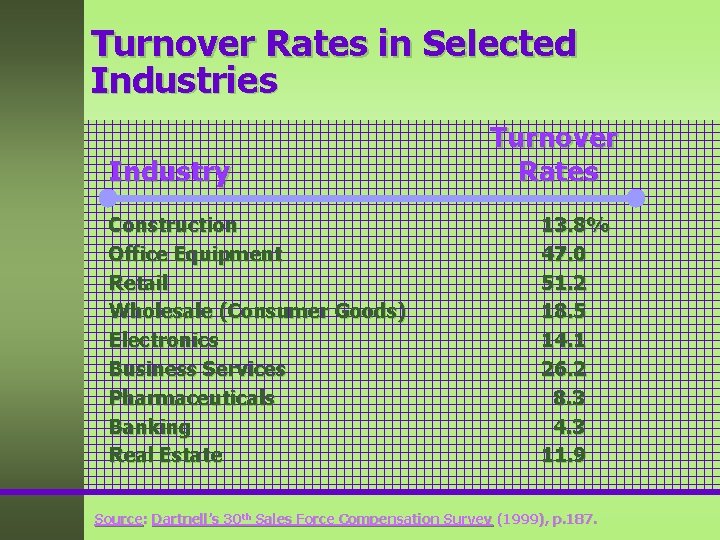
Turnover Rates in Selected Industries Industry Construction Office Equipment Retail Wholesale (Consumer Goods) Electronics Business Services Pharmaceuticals Banking Real Estate Turnover Rates 13. 8% 47. 0 51. 2 18. 5 14. 1 26. 2 8. 3 4. 3 11. 9 Source: Dartnell’s 30 th Sales Force Compensation Survey (1999), p. 187.
Company Culture and the Hiring Process n n Develop a hiring process related to core culture. What are the core cultures of these companies?
Aligning People to Core Job Responsibilities n n The Chally Group, a sales consulting company, found that matching a person’s skills set with the skills required by the sales job led to higher performing salespeople and greater job satisfaction. What skill sets are needed for the following sales positions? – – – Missionary? Sales Support? New Business?
Aligning People to Core Job Responsibilities n Missionary: – n Sales Support: – n Technical skills, relationship building skills Empathy, relationship building skills New Business: – Assertiveness, persuasiveness, time management, ability to close
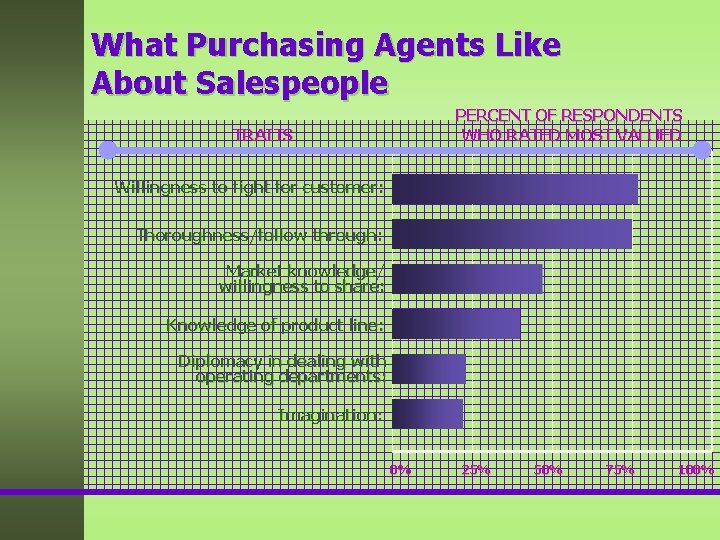
What Purchasing Agents Like About Salespeople PERCENT OF RESPONDENTS WHO RATED MOST VALUED TRAITS Willingness to fight for customer: Thoroughness/follow through: Market knowledge/ willingness to share: Knowledge of product line: Diplomacy in dealing with operating departments: Imagination: 0% 25% 50% 75% 100%
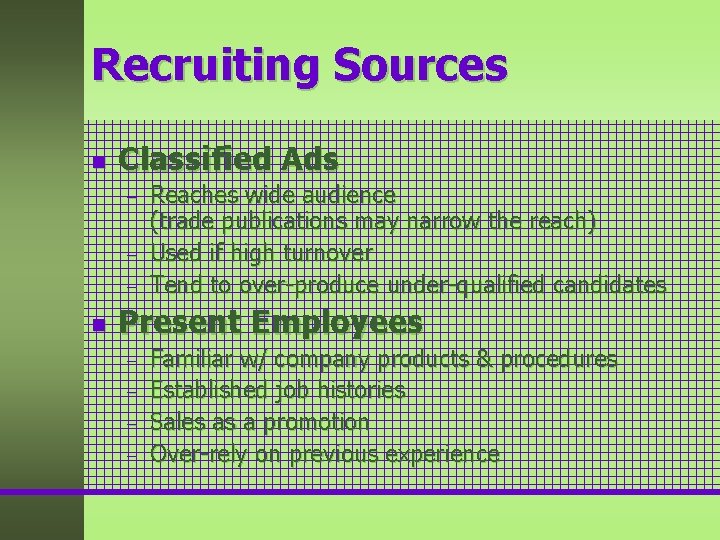
Recruiting Sources n Classified Ads – – – n Reaches wide audience (trade publications may narrow the reach) Used if high turnover Tend to over-produce under-qualified candidates Present Employees – – Familiar w/ company products & procedures Established job histories Sales as a promotion Over-rely on previous experience
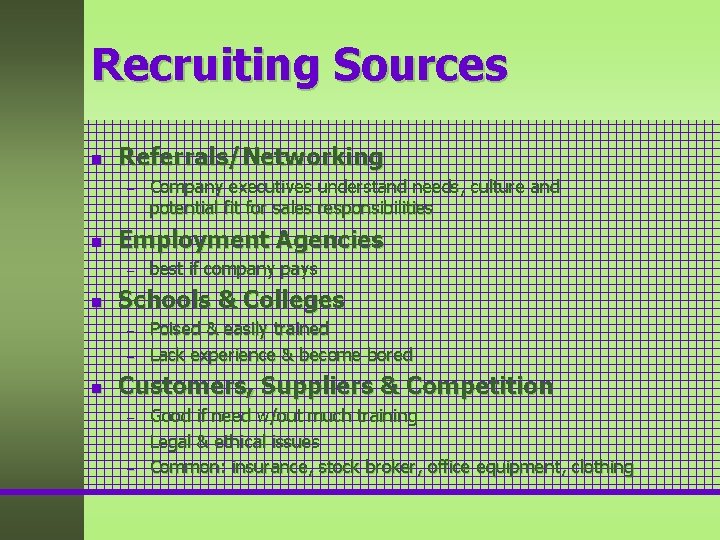
Recruiting Sources n Referrals/Networking – n Employment Agencies – n best if company pays Schools & Colleges – – n Company executives understand needs, culture and potential fit for sales responsibilities Poised & easily trained Lack experience & become bored Customers, Suppliers & Competition – – – Good if need w/out much training Legal & ethical issues Common: insurance, stock broker, office equipment, clothing
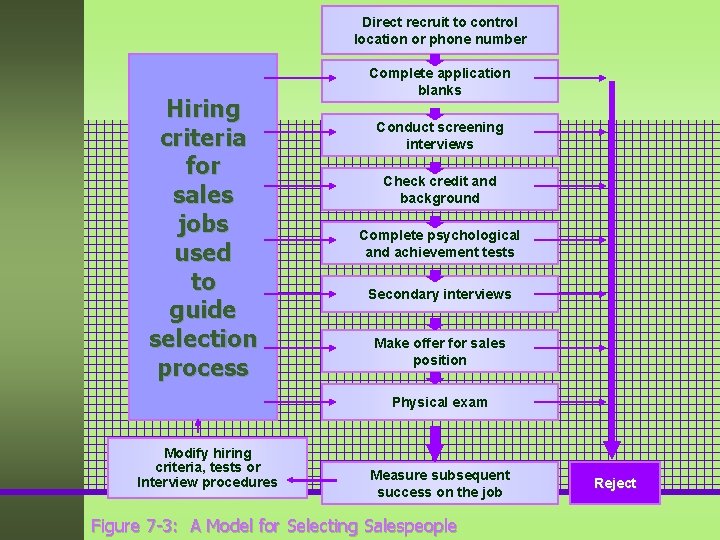
Direct recruit to control location or phone number Hiring criteria for sales jobs used to guide selection process Complete application blanks Conduct screening interviews Check credit and background Complete psychological and achievement tests Secondary interviews Make offer for sales position Physical exam Modify hiring criteria, tests or Interview procedures Measure subsequent success on the job Figure 7 -3: A Model for Selecting Salespeople Reject
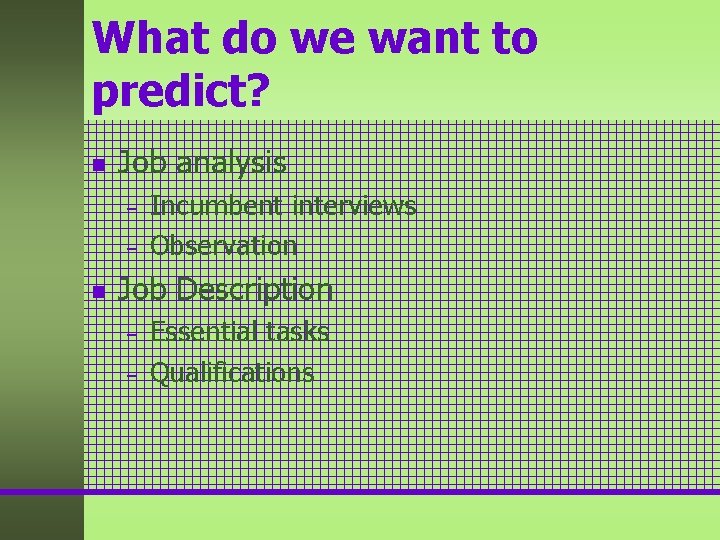
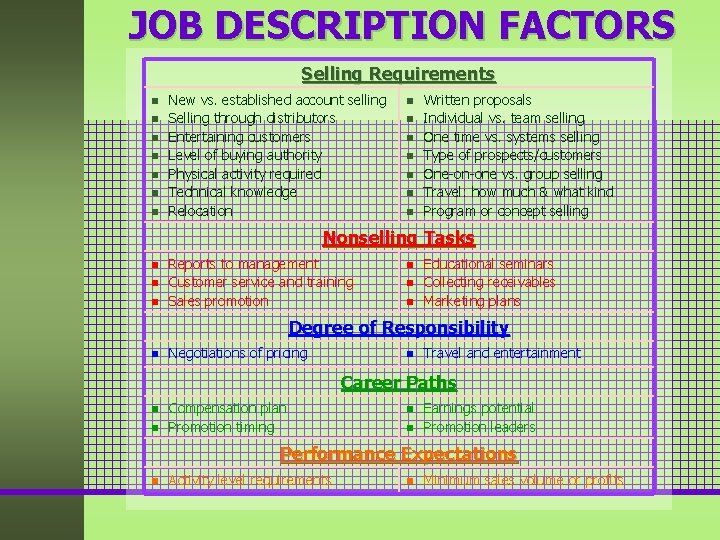
What do we want to predict? n Job analysis – – n Incumbent interviews Observation Job Description – – Essential tasks Qualifications
JOB DESCRIPTION FACTORS Selling Requirements n n n n New vs. established account selling Selling through distributors Entertaining customers Level of buying authority Physical activity required Technical knowledge Relocation n n n Written proposals Individual vs. team selling One time vs. systems selling Type of prospects/customers One-on-one vs. group selling Travel: how much & what kind Program or concept selling Nonselling Tasks n n n Reports to management Customer service and training Sales promotion n Educational seminars Collecting receivables Marketing plans Degree of Responsibility n Negotiations of pricing n Travel and entertainment Career Paths n n Compensation plan Promotion timing n n Earnings potential Promotion leaders Performance Expectations n Activity level requirements n Minimum sales volume or profits
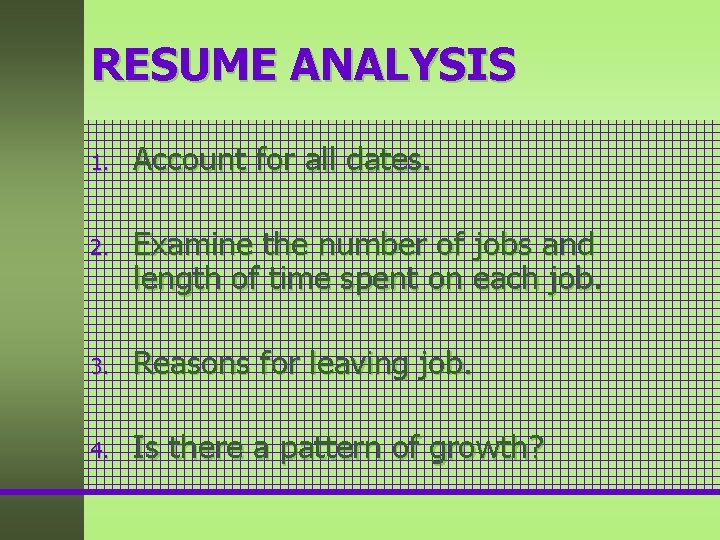
RESUME ANALYSIS 1. 2. Account for all dates. Examine the number of jobs and length of time spent on each job. 3. Reasons for leaving job. 4. Is there a pattern of growth?
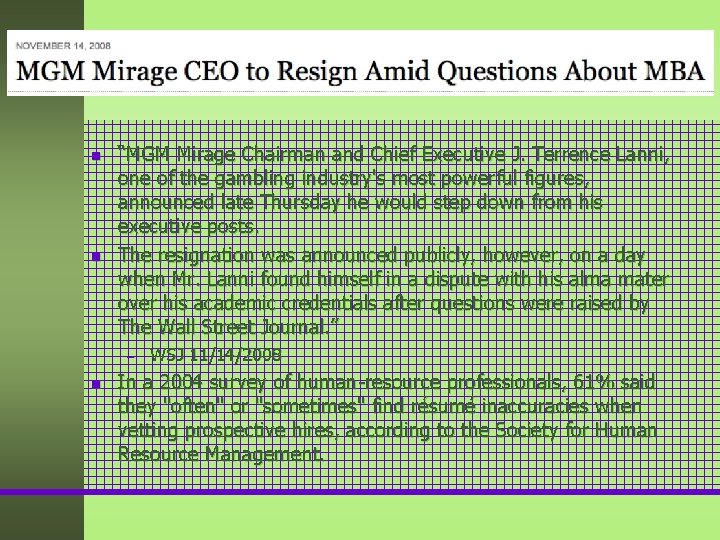
n n “MGM Mirage Chairman and Chief Executive J. Terrence Lanni, one of the gambling industry's most powerful figures, announced late Thursday he would step down from his executive posts. The resignation was announced publicly, however, on a day when Mr. Lanni found himself in a dispute with his alma mater over his academic credentials after questions were raised by The Wall Street Journal. ” – n WSJ 11/14/2008 In a 2004 survey of human-resource professionals, 61% said they "often" or "sometimes" find résumé inaccuracies when vetting prospective hires, according to the Society for Human Resource Management.
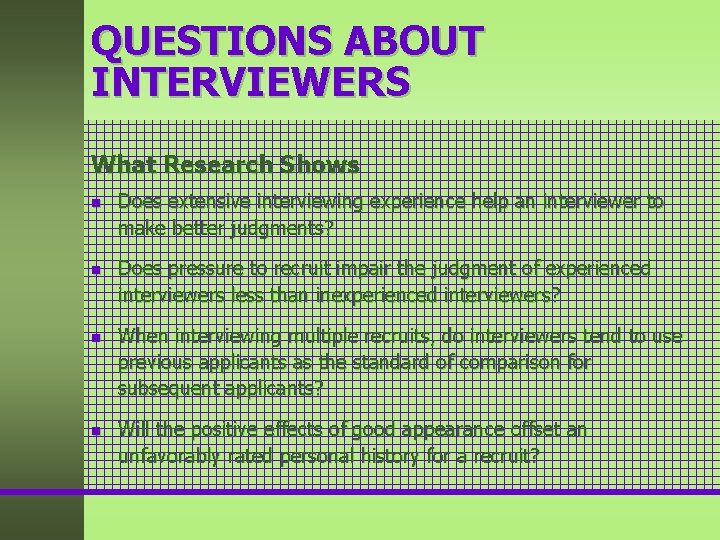
QUESTIONS ABOUT INTERVIEWERS What Research Shows n n Does extensive interviewing experience help an interviewer to make better judgments? Does pressure to recruit impair the judgment of experienced interviewers less than inexperienced interviewers? When interviewing multiple recruits, do interviewers tend to use previous applicants as the standard of comparison for subsequent applicants? Will the positive effects of good appearance offset an unfavorably rated personal history for a recruit?
QUESTIONS ABOUT INTERVIEWERS What Research Shows n n How much of the factual information presented in an interview will the interviewer remember immediately after a short interview if no notes are taken? How will lack of notes and factual recall affect the interviewer’s rating of the recruits interviewed? How reliably can a group of interviewers rate a recruit’s qualifications for a job? How reliably can a group of interviewers rate future job performance by a recruit?
COMMON INTERVIEWER MISTAKES 1. 2. 3. 4. 5. 6. 7. Failure to establish rapport Lack of plan Insufficient time Not listening Personal bias Questions First impressions
TYPICAL INTERVIEW QUESTIONS What is the interviewer trying to determine in the following questions? 1. What was the most monotonous job you ever had to do? – What are your values and general orientation in life? – How creative were you in eliminating boredom?
TYPICAL INTERVIEW QUESTIONS 2. In thinking about people you like, what is it you most like about them? – 3. Up to this point in your life, what do you consider to be your biggest disappointment? – 4. Reflects what person is and desires to become Have you done anything? -- more active = more disappointments How willing are you to relocate? To what extent are you willing to travel? – Motivation in wanting job -- involves travel
TYPICAL INTERVIEW QUESTIONS 5. How do you feel about the way your previous employer treated you? – How you react to supervision & organizational cultures 6. What are your long-term financial objectives and how do you intend to achieve them? – – Are you realistic & mature? Will this company enable you to achieve these goals? 7. What was the most difficult decision you ever had to make as a leader? – – Were the leadership positions in your resume demanding or ceremonial in nature? What is your leadership style & philosophy?
TYPICAL INTERVIEW QUESTIONS 8. Why should we hire you? – – – How badly do you want the job? What do you think of yourself? Do you believe in yourself? 9. Sell me this pen. – – – Do you really know how to make a sales presentation? Did you mention the main product benefits? Did you ask for the order?
ASKING THE RIGHT QUESTIONS About two weeks after starting a new job, doubts creep into your mind. The gap between what you were told and what’s actually happening gets wider by the day. When you’re on the job for three weeks, you say to yourself, “I think I made a mistake. ” One way to avoid making a costly mistake like this is to ask the right questions when interviewing. What questions would you ask when applying for a field sales position to avoid accepting the wrong job?
ASKING THE RIGHT QUESTIONS 1. Where will I get my leads? 2. May I review your sales literature? 3. When are your slow times? 4. May I go with you on a sales call? 5. May I visit your marketing department? 6. May I look at your resume?
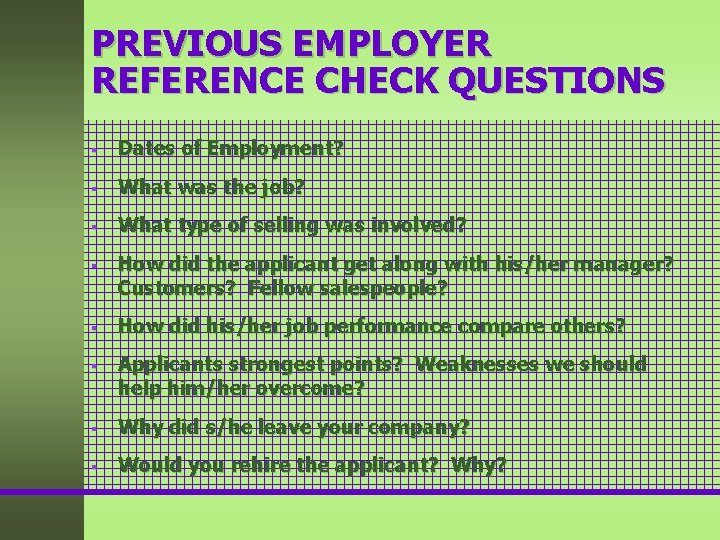
PREVIOUS EMPLOYER REFERENCE CHECK QUESTIONS § Dates of Employment? § What was the job? § What type of selling was involved? § § § How did the applicant get along with his/her manager? Customers? Fellow salespeople? How did his/her job performance compare others? Applicants strongest points? Weaknesses we should help him/her overcome? § Why did s/he leave your company? § Would you rehire the applicant? Why?
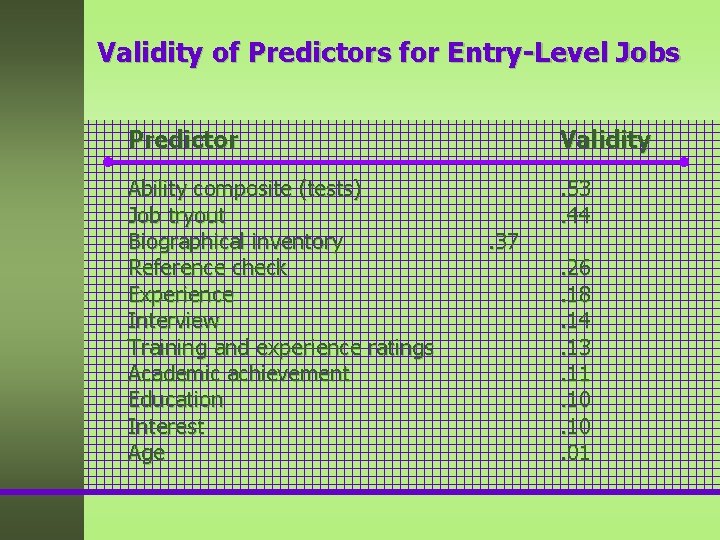
Validity of Predictors for Entry-Level Jobs Predictor Validity Ability composite (tests) Job tryout Biographical inventory Reference check Experience Interview Training and experience ratings Academic achievement Education Interest Age . 53. 44 . 37 . 26. 18. 14. 13. 11. 10. 01
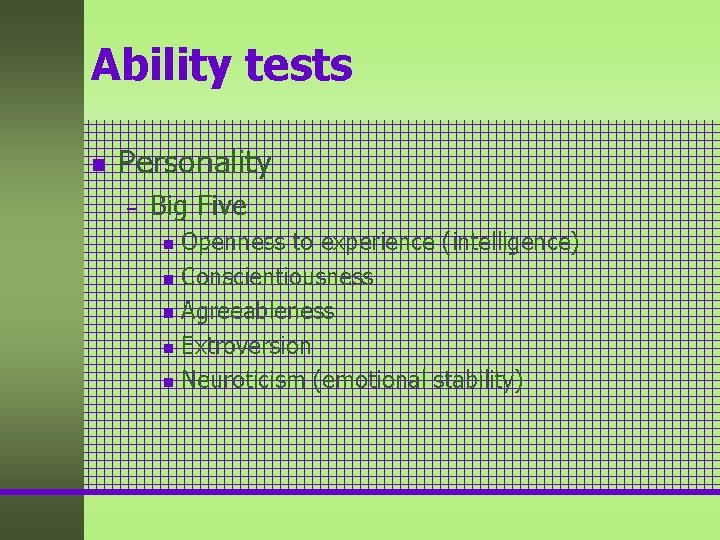
Ability tests n Personality – Big Five Openness to experience (intelligence) n Conscientiousness n Agreeableness n Extroversion n Neuroticism (emotional stability) n
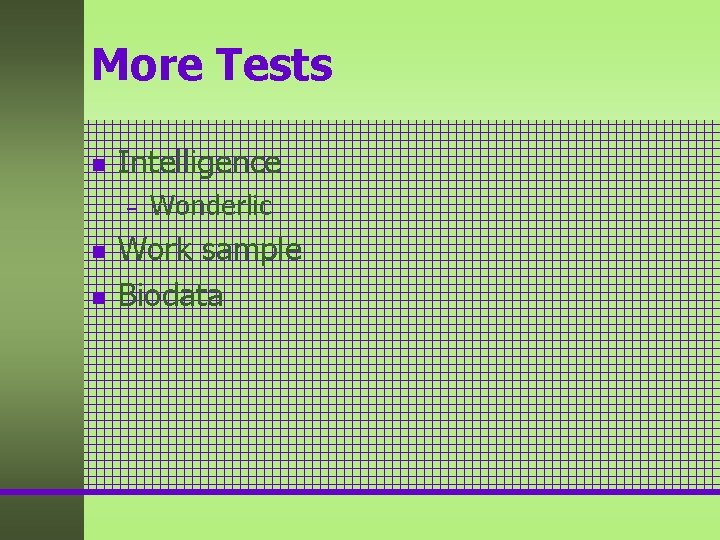
More Tests n Intelligence – n n Wonderlic Work sample Biodata
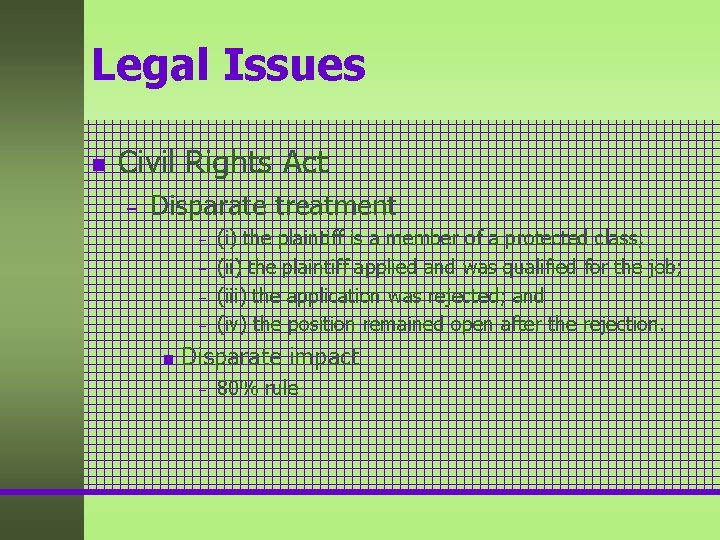
Legal Issues n Civil Rights Act – Disparate treatment – – n (i) the plaintiff is a member of a protected class; (ii) the plaintiff applied and was qualified for the job; (iii) the application was rejected; and (iv) the position remained open after the rejection. Disparate impact – 80% rule
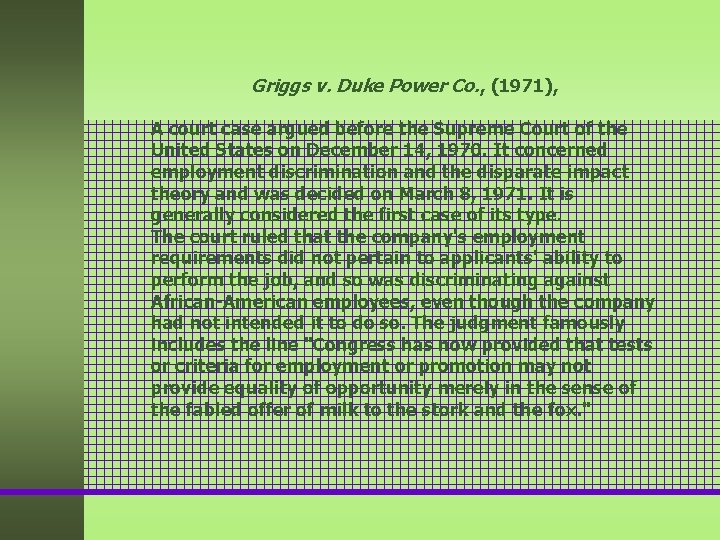
Griggs v. Duke Power Co. , (1971), A court case argued before the Supreme Court of the United States on December 14, 1970. It concerned employment discrimination and the disparate impact theory and was decided on March 8, 1971. It is generally considered the first case of its type. The court ruled that the company's employment requirements did not pertain to applicants' ability to perform the job, and so was discriminating against African-American employees, even though the company had not intended it to do so. The judgment famously includes the line "Congress has now provided that tests or criteria for employment or promotion may not provide equality of opportunity merely in the sense of the fabled offer of milk to the stork and the fox. "
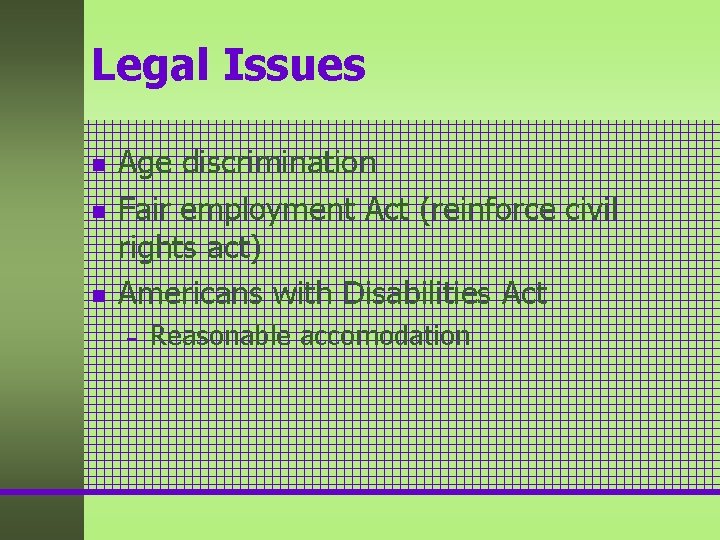
Legal Issues n n n Age discrimination Fair employment Act (reinforce civil rights act) Americans with Disabilities Act – Reasonable accomodation
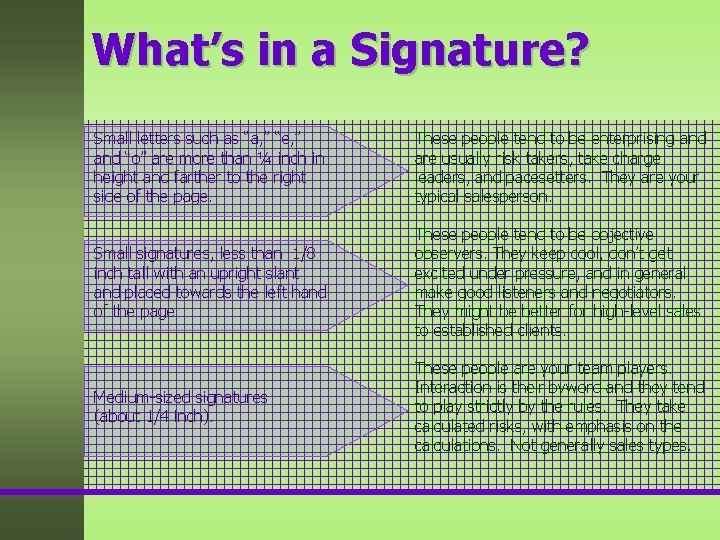
What’s in a Signature? Small letters such as “a, ” “e, ” and “o” are more than ¼ inch in height and farther to the right side of the page. These people tend to be enterprising and are usually risk takers, take charge leaders, and pacesetters. They are your typical salesperson. Small signatures, less than 1/8 inch tall with an upright slant and placed towards the left hand of the page These people tend to be objective observers. They keep cool, don’t get excited under pressure, and in general make good listeners and negotiators. They might be better for high-level sales to established clients. Medium-sized signatures (about 1/4 inch). These people are your team players. Interaction is their byword and they tend to play strictly by the rules. They take calculated risks, with emphasis on the calculations. Not generally sales types.
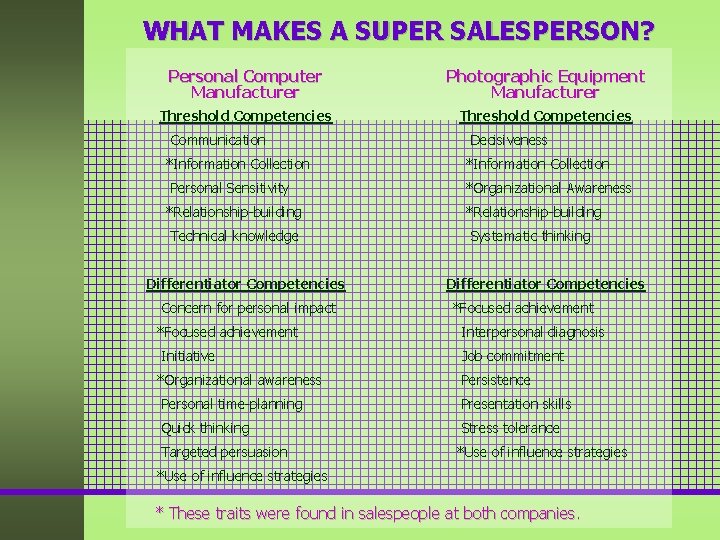
WHAT MAKES A SUPER SALESPERSON? Personal Computer Manufacturer Photographic Equipment Manufacturer Threshold Competencies Communication *Information Collection Personal Sensitivity Decisiveness *Information Collection *Organizational Awareness *Relationship-building Technical knowledge Systematic thinking Differentiator Competencies Concern for personal impact *Focused achievement Initiative *Organizational awareness Differentiator Competencies *Focused achievement Interpersonal diagnosis Job commitment Persistence Personal time-planning Presentation skills Quick thinking Stress tolerance Targeted persuasion *Use of influence strategies * These traits were found in salespeople at both companies.
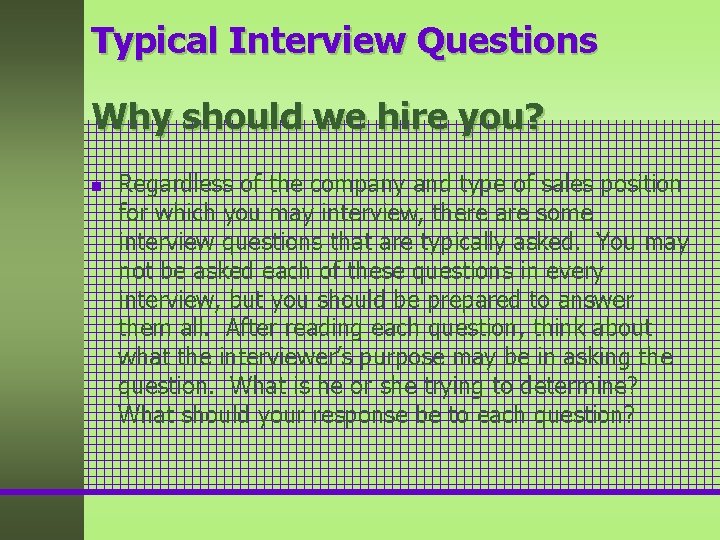
Typical Interview Questions Why should we hire you? n Regardless of the company and type of sales position for which you may interview, there are some interview questions that are typically asked. You may not be asked each of these questions in every interview, but you should be prepared to answer them all. After reading each question, think about what the interviewer’s purpose may be in asking the question. What is he or she trying to determine? What should your response be to each question?
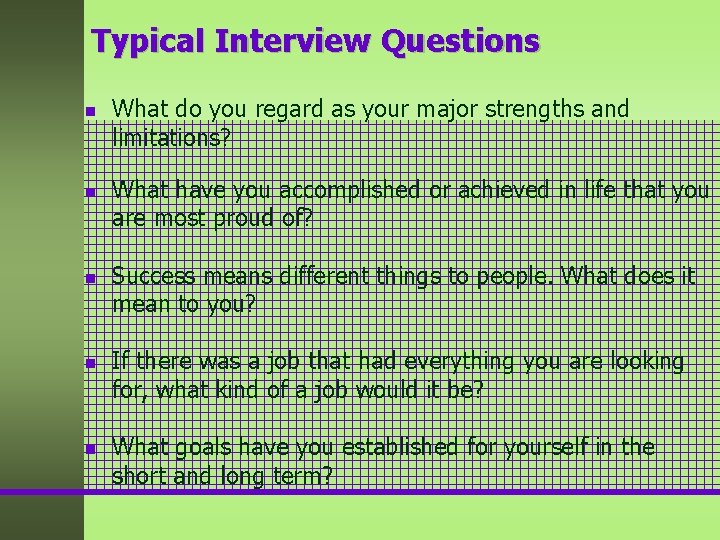
Typical Interview Questions n n n What do you regard as your major strengths and limitations? What have you accomplished or achieved in life that you are most proud of? Success means different things to people. What does it mean to you? If there was a job that had everything you are looking for, what kind of a job would it be? What goals have you established for yourself in the short and long term?