
Recruiting Generation X Millennial Physicians Strategies for Embracing

Recruiting Generation X & Millennial Physicians Strategies for Embracing the New Generation Presented by Jennifer Moody Ameri. Med Consulting
Should you believe the hype? Rumor has it…. Will the US have a shortage of up to 200, 000 physicians by 2020? Will the number of physicians accepting Medicaid and Medicare continue to decline? l Will younger female physicians see fewer patients than their older male counterparts did? l Will newly trained residents continue to seek employment models? l Will there be anyone left to take care of us when we need it most? l

Goodbye Marcus Welby… Hello Meredith Grey
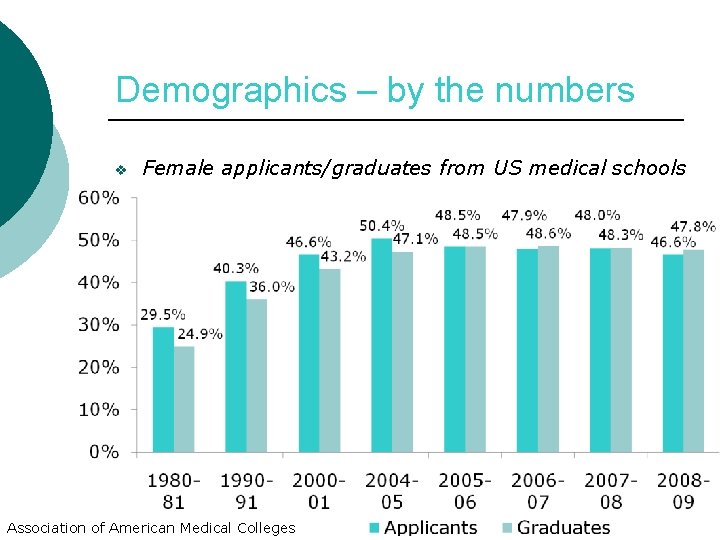
Demographics – by the numbers v Female applicants/graduates from US medical schools Association of American Medical Colleges
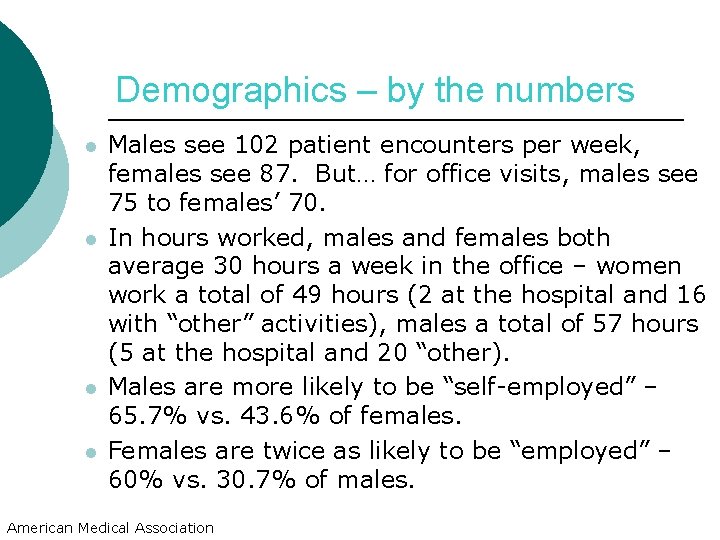
Demographics – by the numbers l l Males see 102 patient encounters per week, females see 87. But… for office visits, males see 75 to females’ 70. In hours worked, males and females both average 30 hours a week in the office – women work a total of 49 hours (2 at the hospital and 16 with “other” activities), males a total of 57 hours (5 at the hospital and 20 “other). Males are more likely to be “self-employed” – 65. 7% vs. 43. 6% of females. Females are twice as likely to be “employed” – 60% vs. 30. 7% of males. American Medical Association
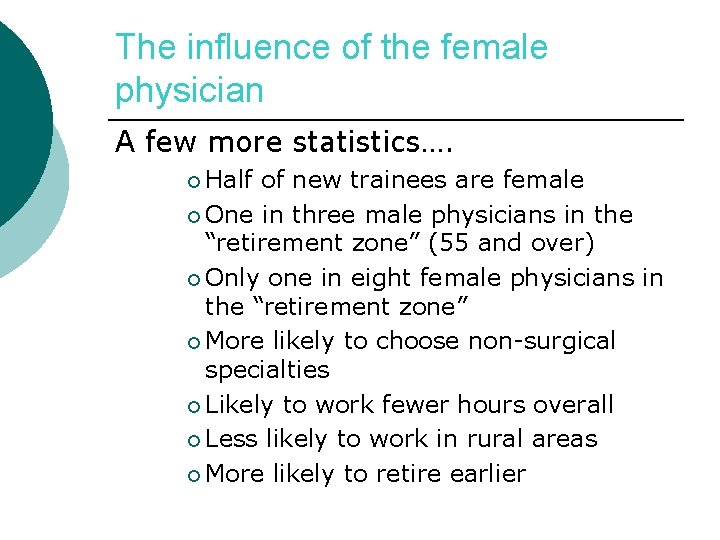
The influence of the female physician A few more statistics…. ¡ Half of new trainees are female ¡ One in three male physicians in the “retirement zone” (55 and over) ¡ Only one in eight female physicians in the “retirement zone” ¡ More likely to choose non-surgical specialties ¡ Likely to work fewer hours overall ¡ Less likely to work in rural areas ¡ More likely to retire earlier
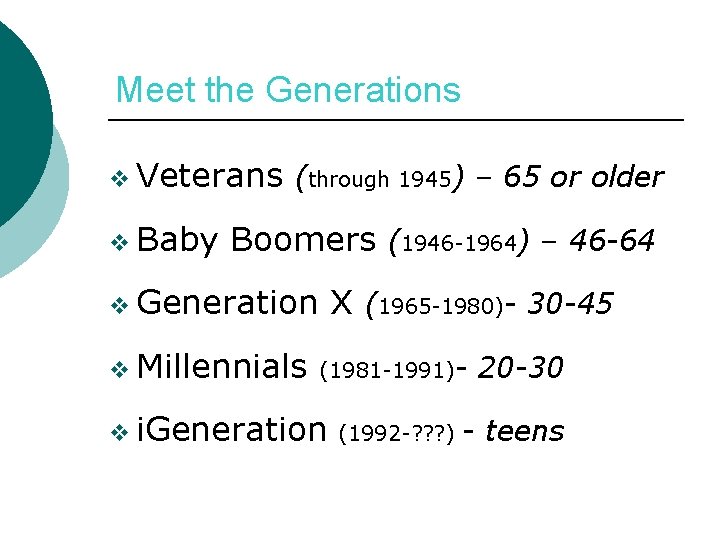
Meet the Generations v Veterans v Baby (through 1945) – 65 or older Boomers (1946 -1964) – 46 -64 v Generation X (1965 -1980)- 30 -45 v Millennials (1981 -1991)v i. Generation (1992 -? ? ? ) 20 -30 - teens
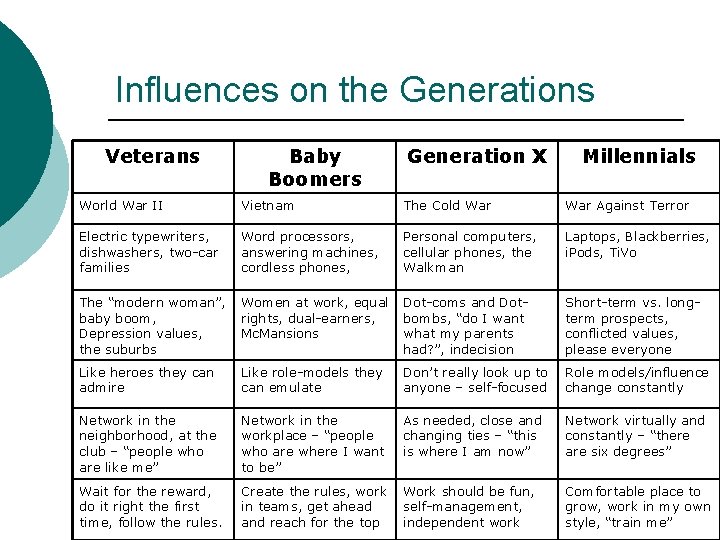
Influences on the Generations Veterans Baby Boomers Generation X Millennials World War II Vietnam The Cold War Against Terror Electric typewriters, dishwashers, two-car families Word processors, answering machines, cordless phones, Personal computers, cellular phones, the Walkman Laptops, Blackberries, i. Pods, Ti. Vo The “modern woman”, baby boom, Depression values, the suburbs Women at work, equal rights, dual-earners, Mc. Mansions Dot-coms and Dotbombs, “do I want what my parents had? ”, indecision Short-term vs. longterm prospects, conflicted values, please everyone Like heroes they can admire Like role-models they can emulate Don’t really look up to anyone – self-focused Role models/influence change constantly Network in the neighborhood, at the club – “people who are like me” Network in the workplace – “people who are where I want to be” As needed, close and changing ties – “this is where I am now” Network virtually and constantly – “there are six degrees” Wait for the reward, do it right the first time, follow the rules. Create the rules, work in teams, get ahead and reach for the top Work should be fun, self-management, independent work Comfortable place to grow, work in my own style, “train me”
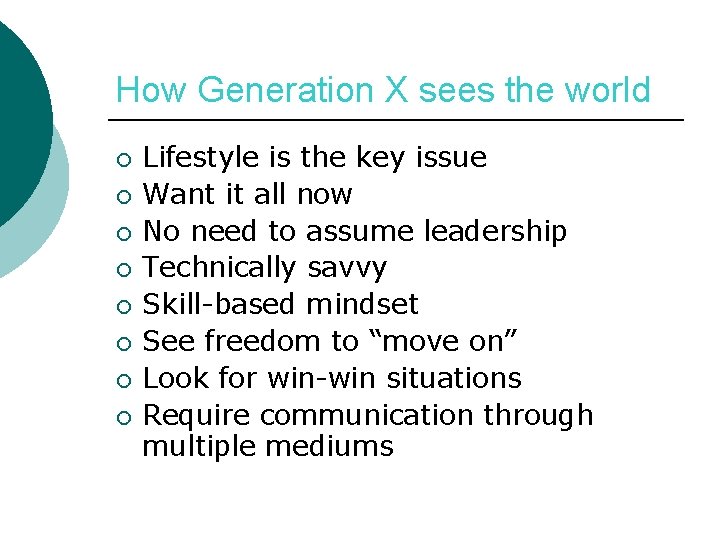
How Generation X sees the world ¡ ¡ ¡ ¡ Lifestyle is the key issue Want it all now No need to assume leadership Technically savvy Skill-based mindset See freedom to “move on” Look for win-win situations Require communication through multiple mediums
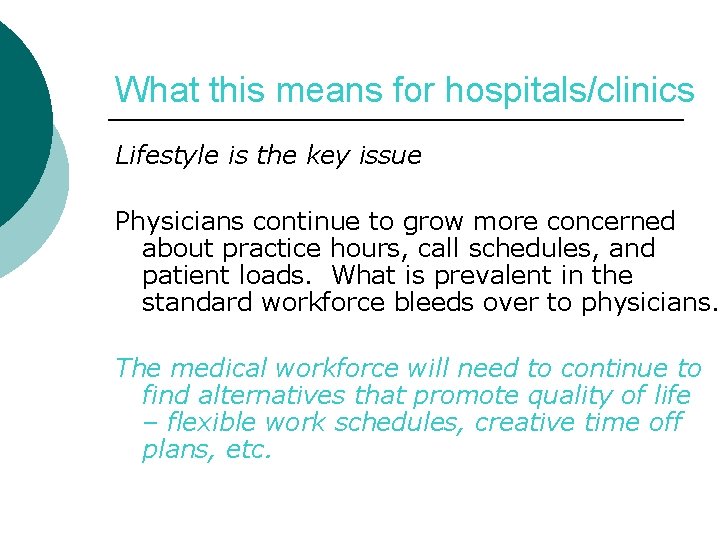
What this means for hospitals/clinics Lifestyle is the key issue Physicians continue to grow more concerned about practice hours, call schedules, and patient loads. What is prevalent in the standard workforce bleeds over to physicians. The medical workforce will need to continue to find alternatives that promote quality of life – flexible work schedules, creative time off plans, etc.
What this means for hospitals/clinics Want it all now Young physicians want to be relieved of debt, in financially lucrative situations, and in stable practice environments. In shortage areas/markets, they can hold practices hostage. Employment models becoming predominant. Practices must be open to tailoring packages that appeal to the generation – financial stability is demanded.
What this means for hospitals/clinics No need to assume leadership Physicians continue to focus more on their individual practices and move further away from the model of civic and hospital responsibility of yesteryear. Unlikely to attend after-hours meetings or engage in “optional” committees/involvement. Hospitals and groups must find a way to cultivate staff for leadership vs. assuming they will naturally fall into place (no “grooming oneself”).
What this means for hospitals/clinics Technically savvy The generation is accustomed to sophisticated technology. New physicians demand hightech equipment and connectivity. Get wired. Don’t overlook the obvious – the easy to implement, easy to use. How wired is your hospital?
What this means for hospitals/clinics Skill-based mindset Its not what you can do – its what you can’t do that hurts. Young physicians are used to “having it all” in an academic environment and struggle with community practice when training ends. The generation as a whole is used to being able to use what they have trained on elsewhere.
What this means for hospitals/clinics See freedom to “move on” Today’s physician often doesn’t find permanent roots in the community. The average Gen Xer will change jobs 14 to 16 times throughout a career. Groups across the country are succeeding in the recruitment market and simultaneously failing at retention. Successful practices will develop and implement a retention plan.
What this means for hospitals/clinics Look for win-win situations Conflict resolution can occur without loss on either side. Patients aren’t “owned” but “shared”. Compromise solutions are more critical than ever – Generation X has no tolerance for turf wars or office politics. This group will not “fight to the finish” – they will pick up and go home. They utilize hospitalists and don’t see long-term patient relationships as key.
What this means for hospitals/clinics Require communication through multiple mediums Often called the “ADD generation”, Gen X is used to a variety of inputs. Web based methods, as well as traditional written and spoken communication means are all utilized by this subgroup – often simultaneously. The paper “in-box” is dead for the most part and this group is more likely to hit “redial” than listen to a voice message.
How Millennials see the world ¡ ¡ ¡ ¡ ¡ Technically savvy * Skill-based mindset * Require communication through multiple mediums * Lifestyle is important, but not key * Strong community orientation Open and receptive to change Expect choices and variety Not used to making decisions without guidance Struggle to make choices that are ethically and morally “right” * Shared traits with Generation X
What this means for hospitals/clinics Strong community orientation Early feedback signals a return to medicine for the “right” reasons. This group is more likely to put down ties somewhere versus “seeing the world”. Communities have the opportunity to channel this to fill the leadership void expected to occur due to Generation X’s disengagement. These may be the new “Veterans”.
What this means for hospitals/clinics Open and receptive to change Millennials often take on the “peacemaker” role in workforce scenarios. This group will be the best opportunity since the Boomers for significant change to be instituted in the workforce – this could mean a dramatic alteration of how groups integrate the generations as this subgroup is poised to take on technological change and the “new” workplace.
What this means for hospitals/clinics Expect changes and variety Like Generation X, this group will get bored easily – unlike their older peers, however, they will look to institute change in place. Provide opportunities for growth and challenge that the Millennials will seek out in everything from work style to practice environment. Cross-training is considered “ideal” with this group – just be sure to keep them focused.
What this means for hospitals/clinics Not used to making decisions without guidance This will provide a challenge, particularly for new physicians to train and adapt to practice. Mentoring will be critical for this generation to adapt successfully to their roles in the workplace. Medical schools are already monitoring what changes may need to take place in the current teaching structure for residents to teach critical thinking skills.
What this means for hospitals/clinics Struggle to make choices that are ethically and morally “right”. This generation is conditioned to look at the large-scale impact of day-to-day decisions – can be prone to “paralysis”. It will be important to help this group develop frameworks for decision making that emphasize ethics and responsibility. Combined with the “decision” problem, this could be this generation’s biggest issue in the workplace.
Early perceptions - i. Generation ¡ ¡ ¡ ¡ ¡ Technically savvy * Require communication through multiple mediums * Expect choices and variety* Not used to making decisions without guidance * Want it all now * Constantly connected, no downtime Skilled multi-taskers Strong desire for “content” Social issues orientation * Shared traits with Generation X or Millennials
New Entrants – Perceptions and Trends l l l 40% of final year residents received more than 50 practice opportunities during their residency in 2008 (compared to 16% in 1999). 82% begin seriously considering their practice before their last year in 2008 (5% in 2001, 33% in 2006) In 1999, no residents expected to earn more than $250, 000 in their first year of practice. In 2008, 52% anticipate earning that (including 5% of primary care) In 1999 22% anticipated earning more than $150, 000 in their first year – in 2008, 5% anticipate earning LESS than $150, 000. 54% have $100, 000 or more in debt and in 2008 it’s the highest rated post educational concern (60%) of residents. 41% of residents are most concerned with their ability to find a practice. 2008 - Merritt Hawkins and Associates
Jennifer Moody Ameri. Med Consulting 301 Commerce Street, Suite 3131 Fort Worth, Texas 76102 888. 456. 1789 jmoody@amerimedconsulting. com www. amerimedconsulting. com
- Slides: 26