P 2 P Topologies Centralized Ring Hierarchical Decentralized


- Slides: 25
P 2 P Topologies • • • Centralized Ring Hierarchical Decentralized Hybrid
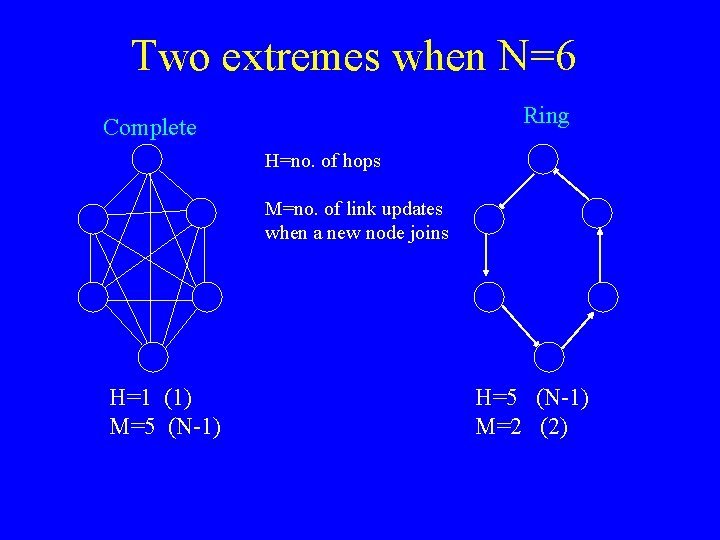
Two extremes when N=6 Ring Complete H=no. of hops M=no. of link updates when a new node joins H=1 (1) M=5 (N-1) H=5 (N-1) M=2 (2)
Consider Scale • But if N=232 (4 billion - population of the world) • Ring – M=2, H=232 – 1 (retrieval: week with fast net) – Does not scale • Complete – H=1, M= 232 – 1 – Does not scale • Key idea: place yourself in between – e. g. H=4 M=762 – e. g. H=8 M=120
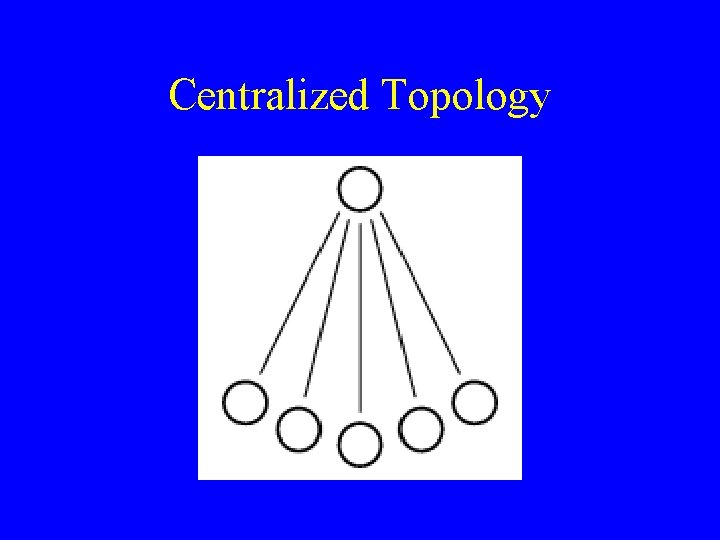
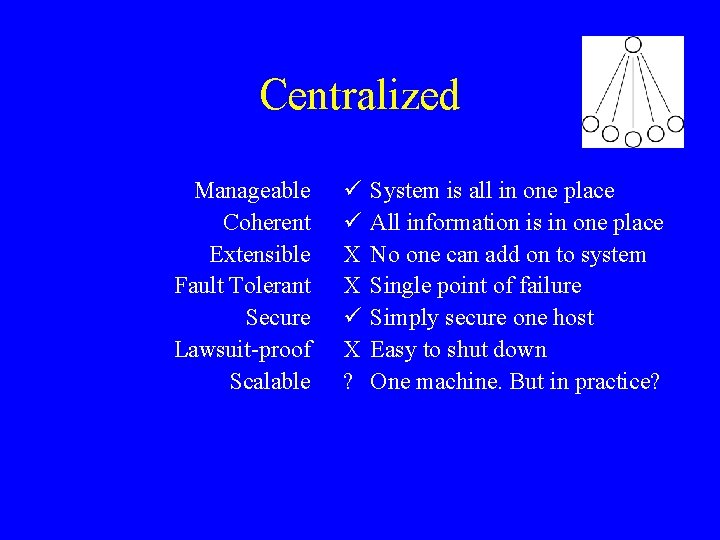
Centralized Topology
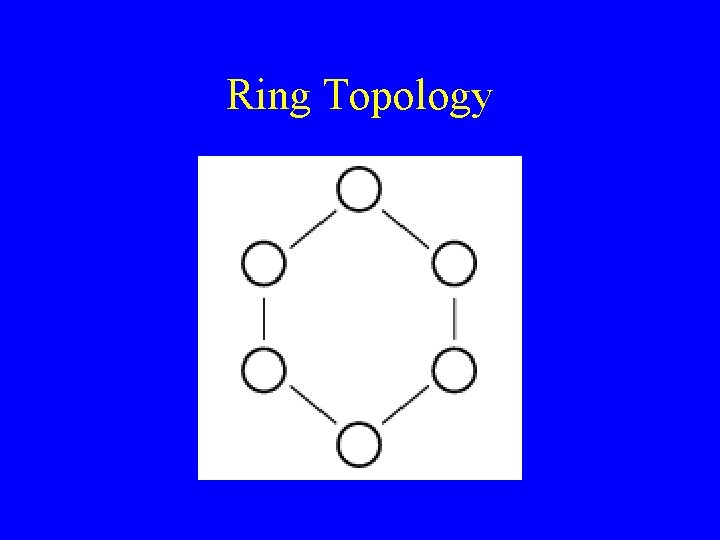
Ring Topology
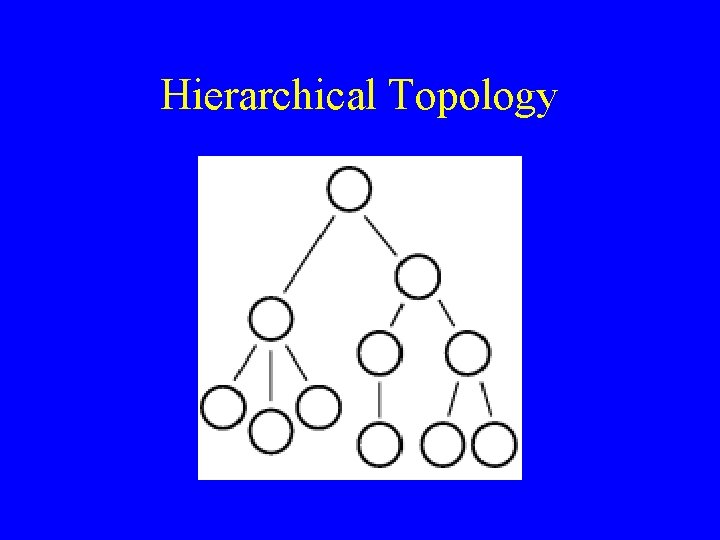
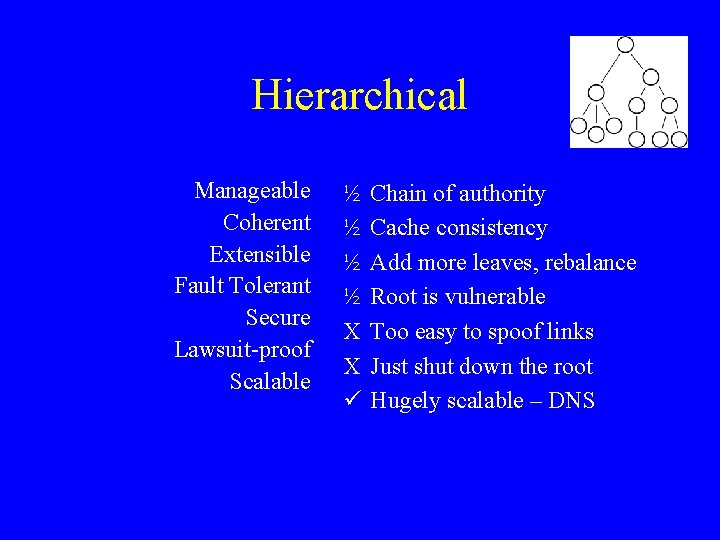
Hierarchical Topology
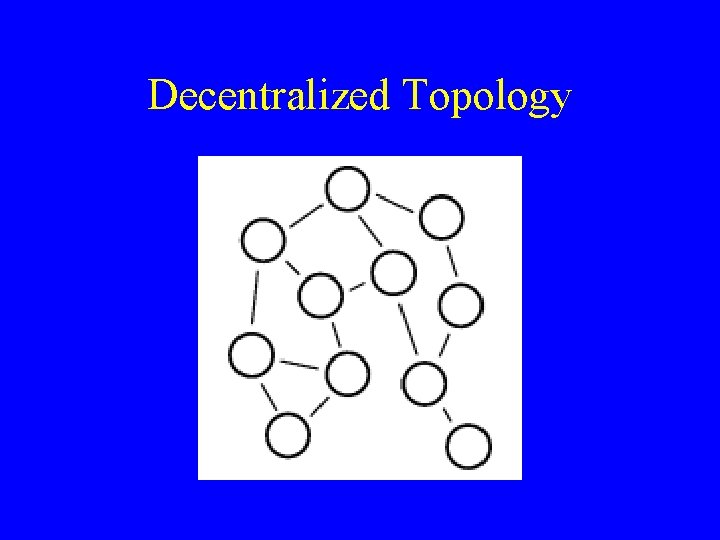
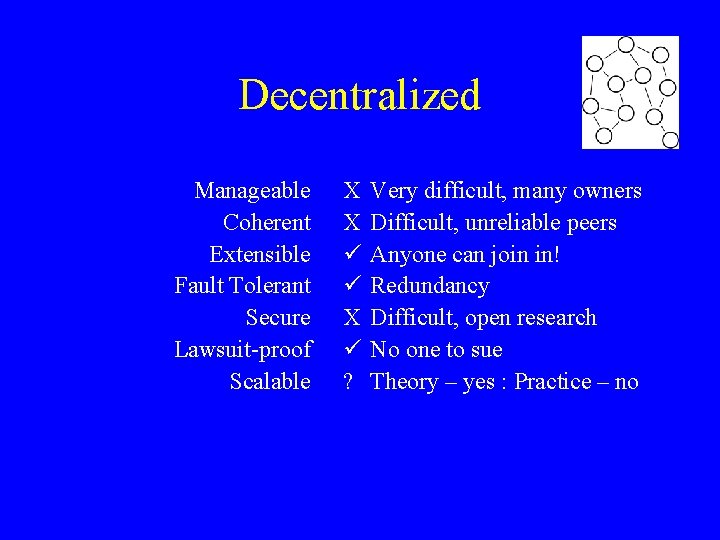
Decentralized Topology
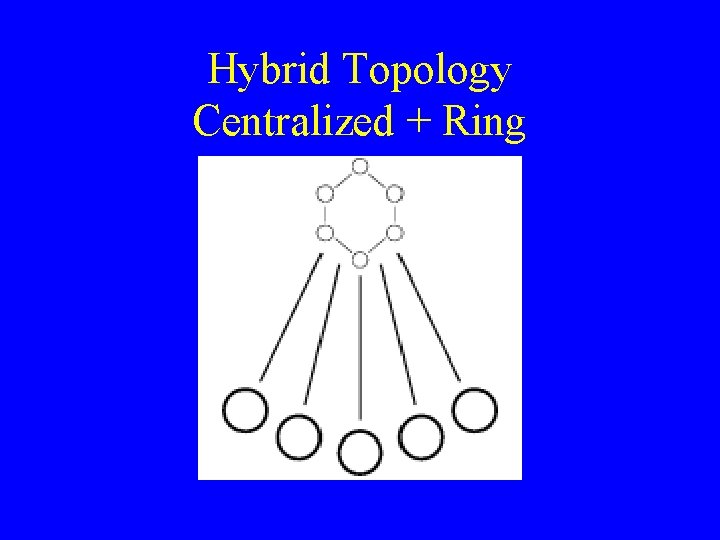
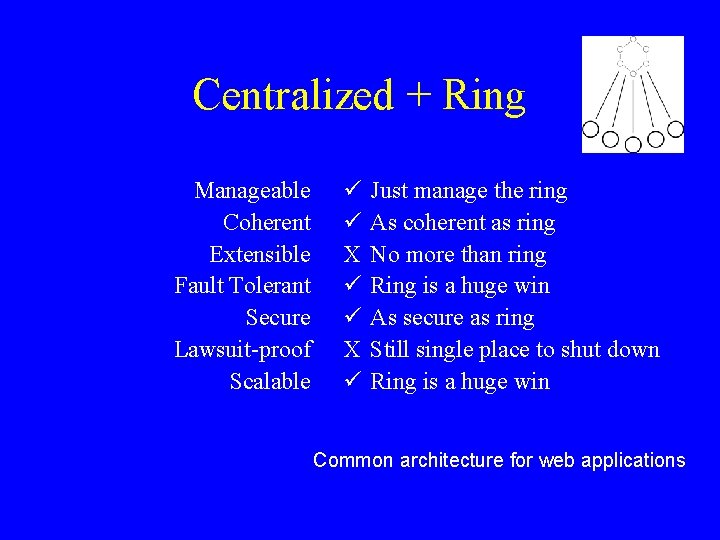
Hybrid Topology Centralized + Ring
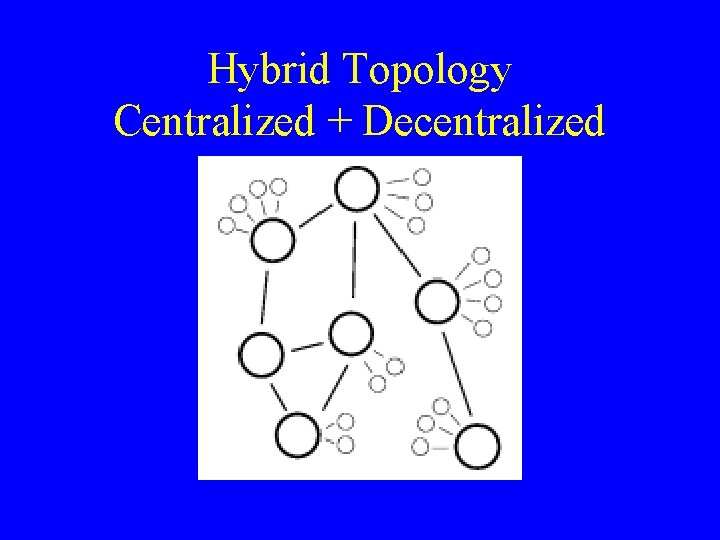
Hybrid Topology Centralized + Decentralized
Evaluating topologies • Manageability – How hard is it to keep working? • Information coherence – How authoritative is info? (Auditing, non-repudiation) • Extensibility – How easy is it to grow? • Fault tolerance – How well can it handle failures?
Evaluating topologies • Resistance to legal or political intervention – How hard is it to shut down? (Can be good or bad) • Security – How hard is it to subvert? • Scalability – How big can it grow?
Centralized Manageable Coherent Extensible Fault Tolerant Secure Lawsuit-proof Scalable ü ü X X ü X ? System is all in one place All information is in one place No one can add on to system Single point of failure Simply secure one host Easy to shut down One machine. But in practice?
Ring Manageable Coherent Extensible Fault Tolerant Secure Lawsuit-proof Scalable ü ü X ü Simple rules for relationships Easy logic for state Only ring owner can add Fail-over to next host As long as ring has one owner Shut down owner Just add more hosts
Hierarchical Manageable Coherent Extensible Fault Tolerant Secure Lawsuit-proof Scalable ½ ½ X X ü Chain of authority Cache consistency Add more leaves, rebalance Root is vulnerable Too easy to spoof links Just shut down the root Hugely scalable – DNS
Decentralized Manageable Coherent Extensible Fault Tolerant Secure Lawsuit-proof Scalable X X ü ü X ü ? Very difficult, many owners Difficult, unreliable peers Anyone can join in! Redundancy Difficult, open research No one to sue Theory – yes : Practice – no
Centralized + Ring Manageable Coherent Extensible Fault Tolerant Secure Lawsuit-proof Scalable ü ü X ü Just manage the ring As coherent as ring No more than ring Ring is a huge win As secure as ring Still single place to shut down Ring is a huge win Common architecture for web applications
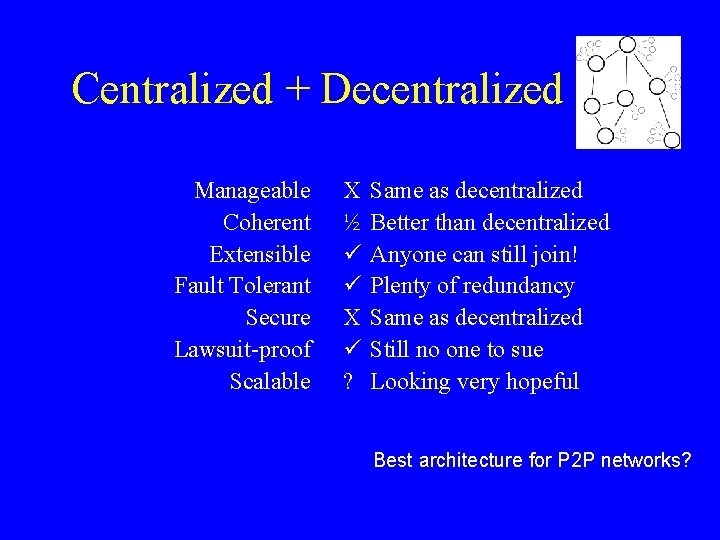
Centralized + Decentralized Manageable Coherent Extensible Fault Tolerant Secure Lawsuit-proof Scalable X ½ ü ü X ü ? Same as decentralized Better than decentralized Anyone can still join! Plenty of redundancy Same as decentralized Still no one to sue Looking very hopeful Best architecture for P 2 P networks?
Small Word Phenomenon • The small world phenomenon (also known as the small world effect) – is the hypothesis that everyone in the world can be reached through a short chain of social links
Early conceptions of the six degrees idea • The "shrinking world" of Frigyes Karinthy (Hungarian), 1929 – He believed that the modern world was shrinking due to technological advances in communications and travel – He believed that any two individuals could be connected through at most five connections – Experiment to prove that the population of the Earth is closer together now than they have ever been before • select any person from the 1. 5 billion inhabitants of the Earth – anyone, anywhere at all • using no more than five individuals, one of whom is a personal friend, he could contact the selected individual using nothing except the network of personal friends Karinthy is often regarded as the origin of the notion of Six Degrees of Separation
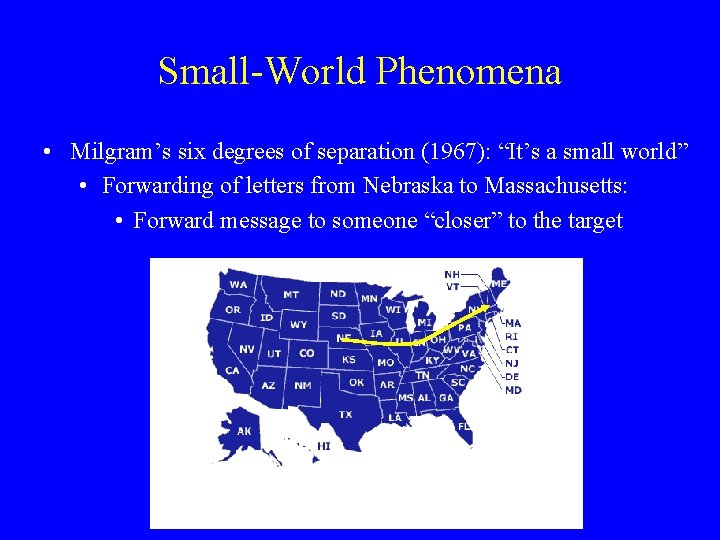
Six Degrees of separation • Stanley Milgram's small world experiments (1967) – Milgram's experiments provided evidence supporting the claim of a "small world. “ – People in the United States seemed to be connected by approximately six friendship links, on average • Milgram's experiment – sent 60 letters from Omaha, Nebraska to Sharon, Massachasetts – The participants could only pass the letters (by hand) to personal they thought might be able to reach the target — whether directly or via a "friend of a friend“ – 50 people responded – only three letters eventually reached their destination The expression “six degrees of separation” was born
The Small World Effect • • Stanley Milgram, 1967, Harvard University 60 letters sent to randomly chosen people in Nebraska Pass the letters to a target person in Boston using only intermediaries known to one another on a first-name basis. Each person passed the letter to a friend whom he/she thought might bring the letter closest to the target; the friend would then pass it on to another friend and so on until the letter reached the target person. 42 letters made it through via a median number of just 5. 5 intermediaries.
Small-World Phenomena • Milgram’s six degrees of separation (1967): “It’s a small world” • Forwarding of letters from Nebraska to Massachusetts: • Forward message to someone “closer” to the target
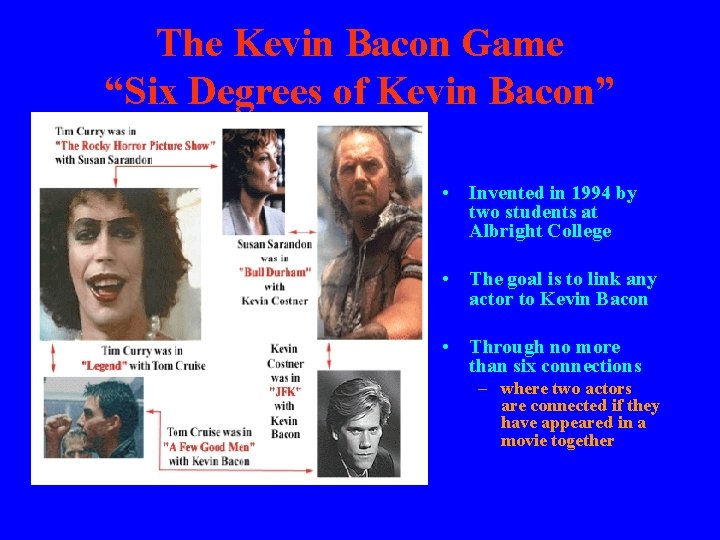
The Kevin Bacon Game “Six Degrees of Kevin Bacon” • Invented in 1994 by two students at Albright College • The goal is to link any actor to Kevin Bacon • Through no more than six connections – where two actors are connected if they have appeared in a movie together
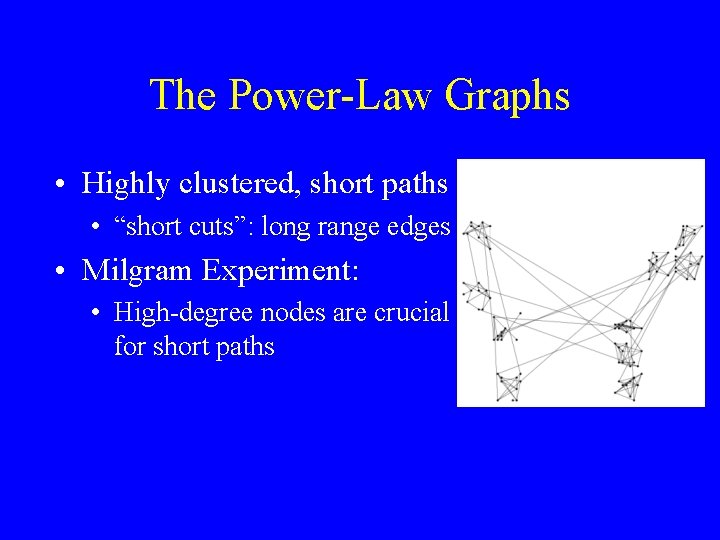
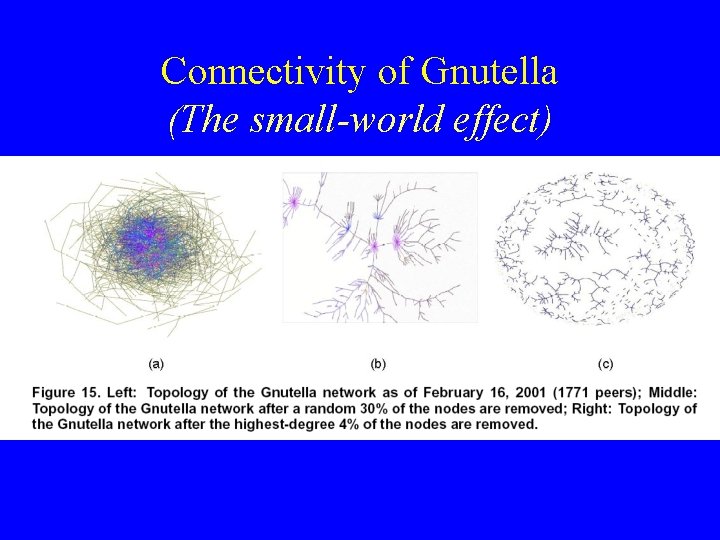
The Power-Law Graphs • Highly clustered, short paths • “short cuts”: long range edges • Milgram Experiment: • High-degree nodes are crucial for short paths
Connectivity of Gnutella (The small-world effect)