
Transportation and the Spatial Structure CHAPTER 2 Copyright



- Slides: 108
Transportation and the Spatial Structure CHAPTER 2 Copyright © 1998 -2020, Jean-Paul Rodrigue, Dept. of Global Studies & Geography, Hofstra University, Hempstead, NY, 11549 USA. Jean-Paul. Rodrigue@hofstra. edu You may use the figures within for educational purposes only. No modification or redistribution permitted. For more information: https: //transportgeography. org/ Copyright © 1998 -2020, Dr. Jean-Paul Rodrigue, Dept. of Global Studies & Geography, Hofstra University. For personal or classroom use ONLY. This material (including graphics) is not public domain and cannot be published, in whole or in part, in ANY form (printed or electronic) and on any media without consent. This includes conference
Usage Conditions • DO NOT COPY, TRANSLATE OR REDISTRIBUTE THIS DOCUMENT. • The contents of this document can be freely used for personal or classroom use ONLY. • Although the material contained in this document is freely available, it is not public domain. Its contents, in whole or in part (including graphics and datasets), cannot be copied and published in ANY form (printed or electronic) without consent. • If you have accessed this document through a third party (such as a content farm), keep in mind that this party is illegally redistributing this content. Please refer to the true source (https: //transportgeography. org/) instead of the third party. • Permission to use any graphic material herein in any form of publication, such as an article, a book or a conference presentation, on any media must be requested prior to use. • Information cited from this document should be referred as: Rodrigue, J-P et al. (2020) The Geography of Transport Systems, Hofstra University, Department of Global Studies & Geography, https: //transportgeography. org/. Copyright © 1998 -2020, Dr. Jean-Paul Rodrigue, Dept. of Global Studies & Geography, Hofstra University. For personal or classroom use ONLY. This material (including graphics) is not public domain and cannot be published, in whole or in part, in ANY form (printed or electronic) and on any media without consent. This includes conference
Table of Contents • The Geography of Transportation Networks • Transport and Spatial Organization • Transportation and Location • Information Technologies and Mobility Copyright © 1998 -2020, Dr. Jean-Paul Rodrigue, Dept. of Global Studies & Geography, Hofstra University. For personal or classroom use ONLY. This material (including graphics) is not public domain and cannot be published, in whole or in part, in ANY form (printed or electronic) and on any media without consent. This
The Geography of Transportation Networks Copyright © 1998 -2020, Dr. Jean-Paul Rodrigue, Dept. of Global Studies & Geography, Hofstra University. For personal or classroom use ONLY. This material (including graphics) is not public domain and cannot be published, in whole or in part, in ANY form (printed or electronic) and on any media without consent. This includes conference
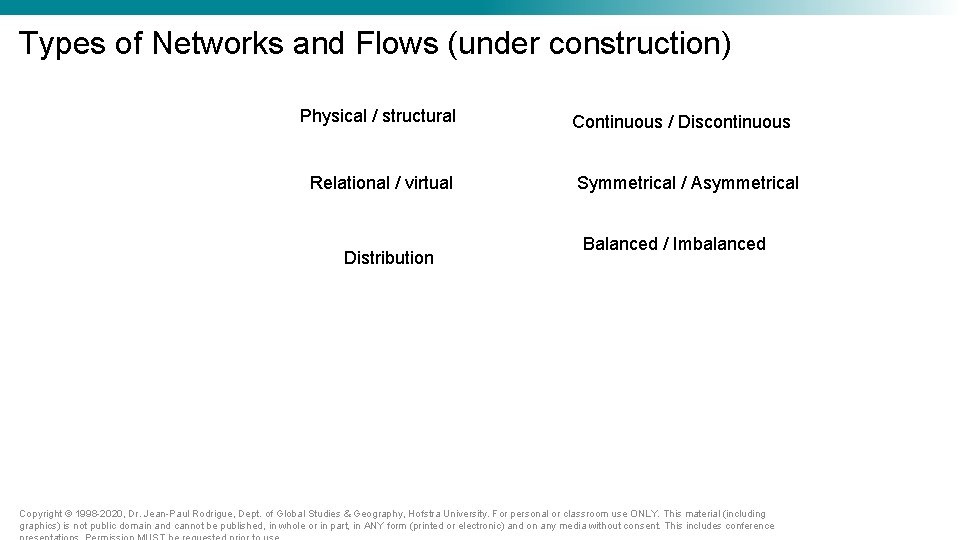
Types of Networks and Flows (under construction) Physical / structural Relational / virtual Distribution Continuous / Discontinuous Symmetrical / Asymmetrical Balanced / Imbalanced Copyright © 1998 -2020, Dr. Jean-Paul Rodrigue, Dept. of Global Studies & Geography, Hofstra University. For personal or classroom use ONLY. This material (including graphics) is not public domain and cannot be published, in whole or in part, in ANY form (printed or electronic) and on any media without consent. This includes conference
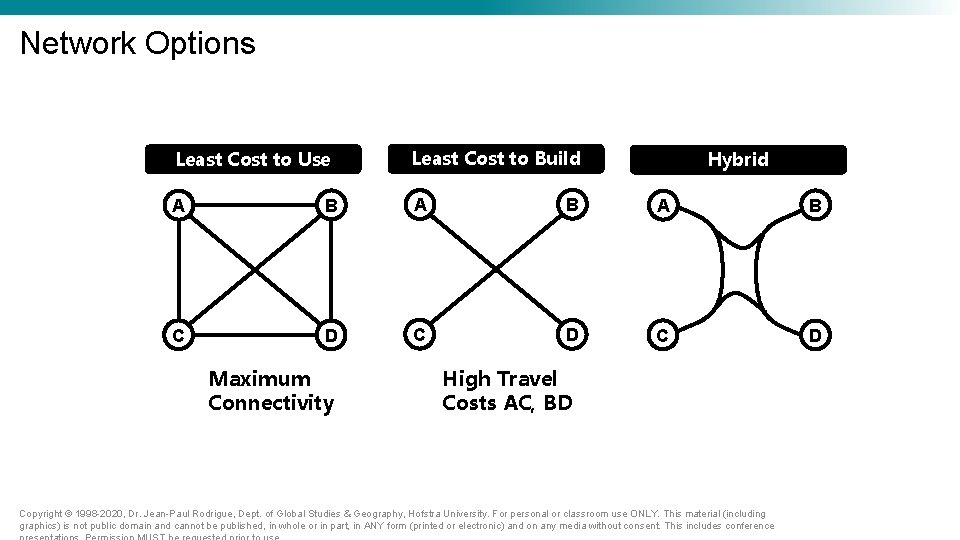
Network Options Least Cost to Use Least Cost to Build Hybrid A B A B C D C D Maximum Connectivity High Travel Costs AC, BD Copyright © 1998 -2020, Dr. Jean-Paul Rodrigue, Dept. of Global Studies & Geography, Hofstra University. For personal or classroom use ONLY. This material (including graphics) is not public domain and cannot be published, in whole or in part, in ANY form (printed or electronic) and on any media without consent. This includes conference
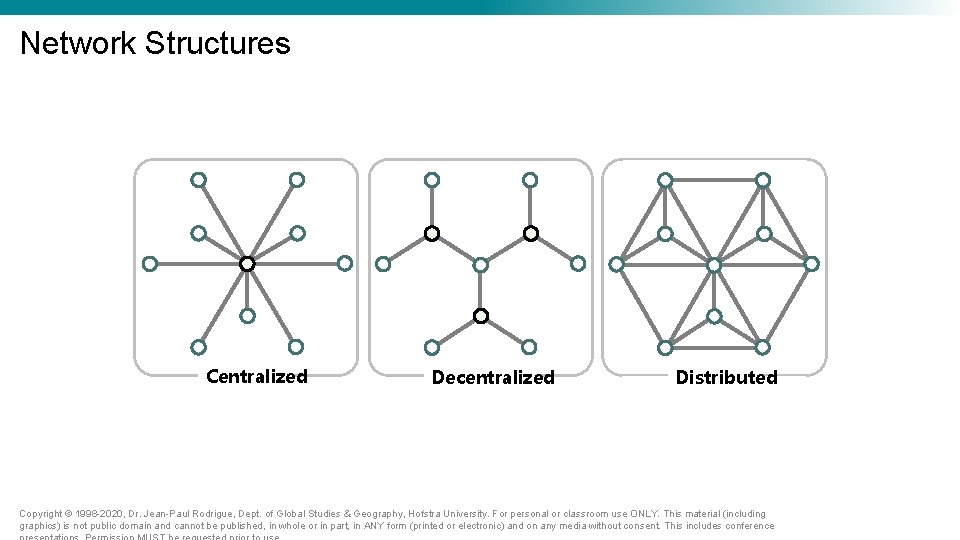
Network Structures Centralized Decentralized Distributed Copyright © 1998 -2020, Dr. Jean-Paul Rodrigue, Dept. of Global Studies & Geography, Hofstra University. For personal or classroom use ONLY. This material (including graphics) is not public domain and cannot be published, in whole or in part, in ANY form (printed or electronic) and on any media without consent. This includes conference
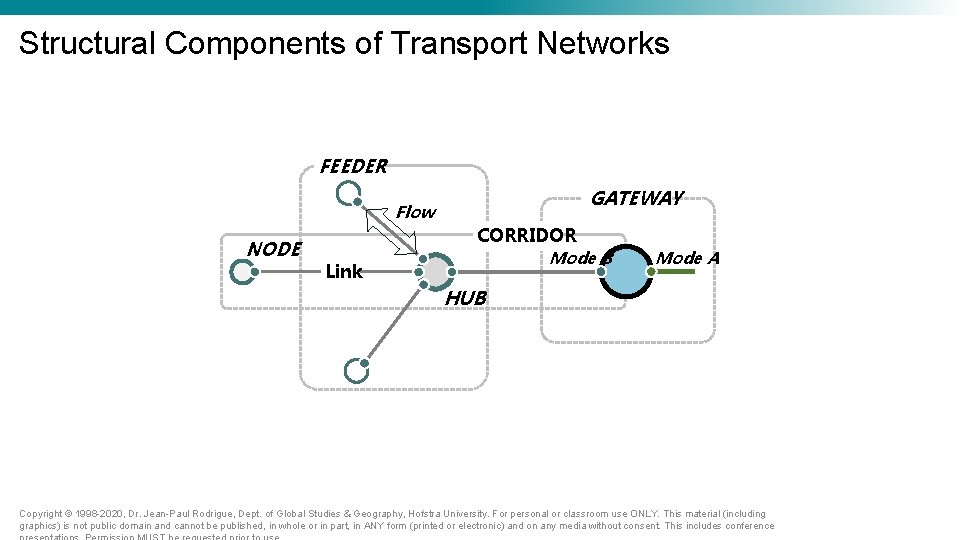
Structural Components of Transport Networks FEEDER GATEWAY Flow NODE CORRIDOR Mode B Link Mode A HUB Copyright © 1998 -2020, Dr. Jean-Paul Rodrigue, Dept. of Global Studies & Geography, Hofstra University. For personal or classroom use ONLY. This material (including graphics) is not public domain and cannot be published, in whole or in part, in ANY form (printed or electronic) and on any media without consent. This includes conference
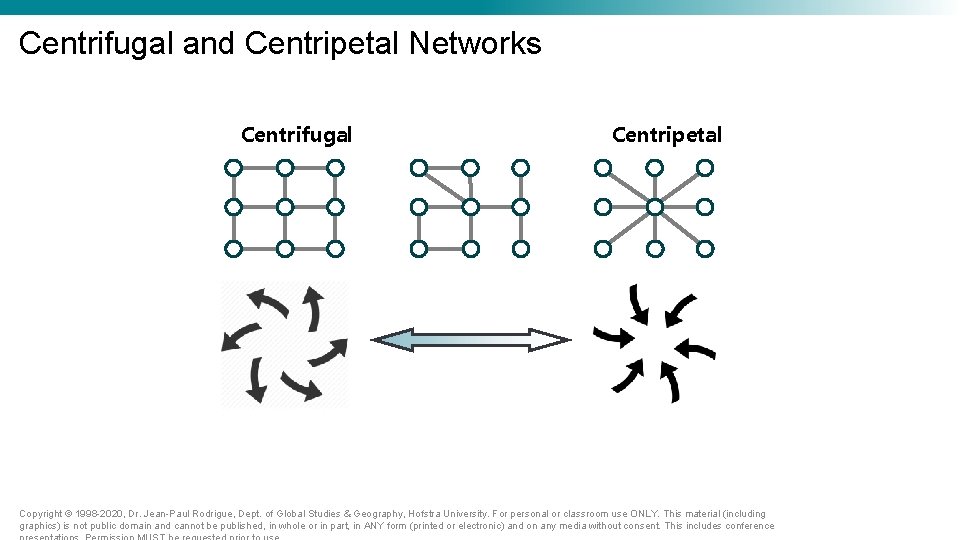
Centrifugal and Centripetal Networks Centrifugal Centripetal Copyright © 1998 -2020, Dr. Jean-Paul Rodrigue, Dept. of Global Studies & Geography, Hofstra University. For personal or classroom use ONLY. This material (including graphics) is not public domain and cannot be published, in whole or in part, in ANY form (printed or electronic) and on any media without consent. This includes conference
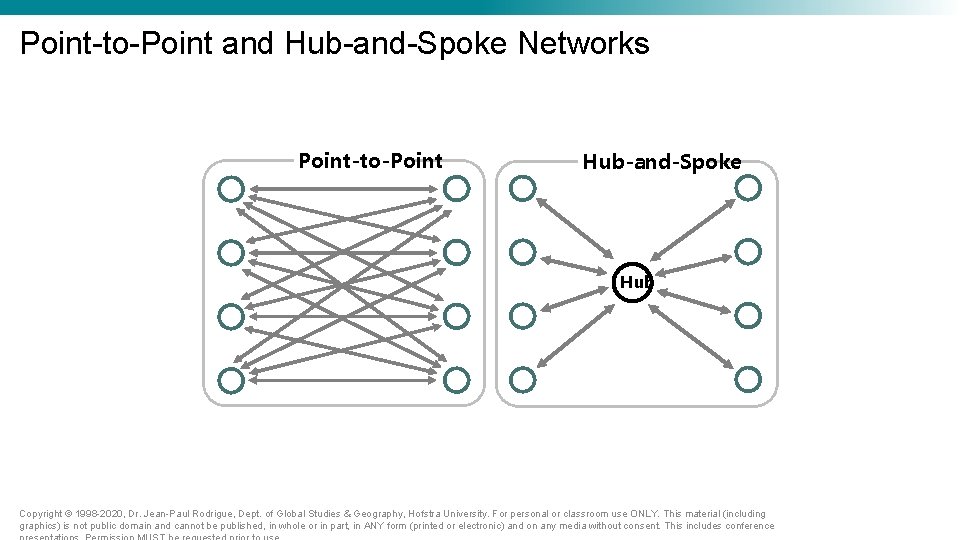
Point-to-Point and Hub-and-Spoke Networks Point-to-Point Hub-and-Spoke Hub Copyright © 1998 -2020, Dr. Jean-Paul Rodrigue, Dept. of Global Studies & Geography, Hofstra University. For personal or classroom use ONLY. This material (including graphics) is not public domain and cannot be published, in whole or in part, in ANY form (printed or electronic) and on any media without consent. This includes conference
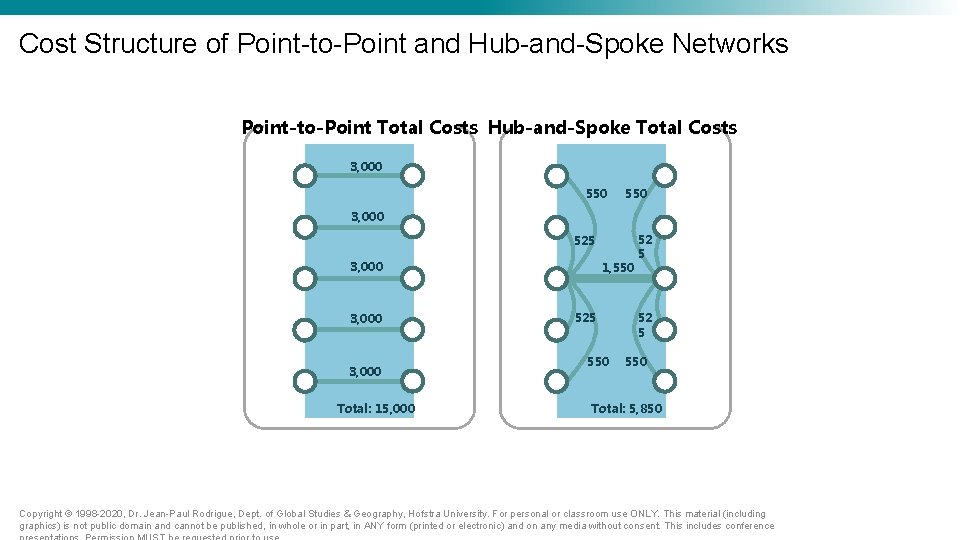
Cost Structure of Point-to-Point and Hub-and-Spoke Networks Point-to-Point Total Costs Hub-and-Spoke Total Costs 3, 000 550 3, 000 525 3, 000 Total: 15, 000 1, 550 525 550 52 5 550 Total: 5, 850 Copyright © 1998 -2020, Dr. Jean-Paul Rodrigue, Dept. of Global Studies & Geography, Hofstra University. For personal or classroom use ONLY. This material (including graphics) is not public domain and cannot be published, in whole or in part, in ANY form (printed or electronic) and on any media without consent. This includes conference
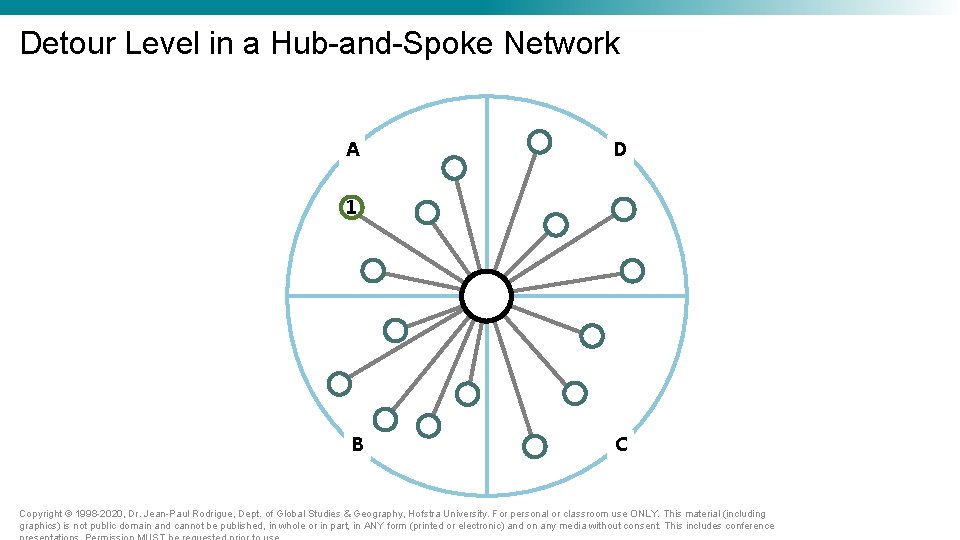
Detour Level in a Hub-and-Spoke Network A D 1 B C Copyright © 1998 -2020, Dr. Jean-Paul Rodrigue, Dept. of Global Studies & Geography, Hofstra University. For personal or classroom use ONLY. This material (including graphics) is not public domain and cannot be published, in whole or in part, in ANY form (printed or electronic) and on any media without consent. This includes conference
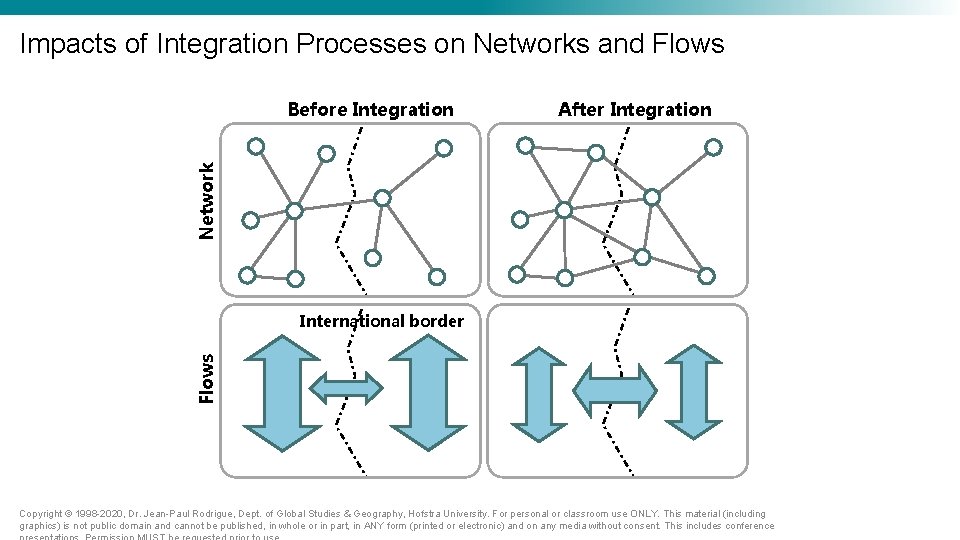
Impacts of Integration Processes on Networks and Flows After Integration Network Before Integration Flows International border Copyright © 1998 -2020, Dr. Jean-Paul Rodrigue, Dept. of Global Studies & Geography, Hofstra University. For personal or classroom use ONLY. This material (including graphics) is not public domain and cannot be published, in whole or in part, in ANY form (printed or electronic) and on any media without consent. This includes conference
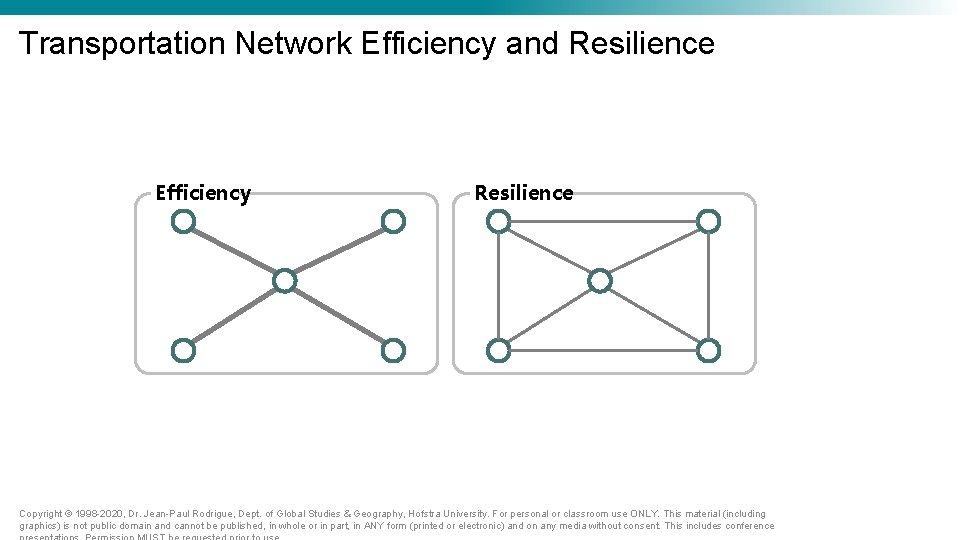
Transportation Network Efficiency and Resilience Efficiency Resilience Copyright © 1998 -2020, Dr. Jean-Paul Rodrigue, Dept. of Global Studies & Geography, Hofstra University. For personal or classroom use ONLY. This material (including graphics) is not public domain and cannot be published, in whole or in part, in ANY form (printed or electronic) and on any media without consent. This includes conference
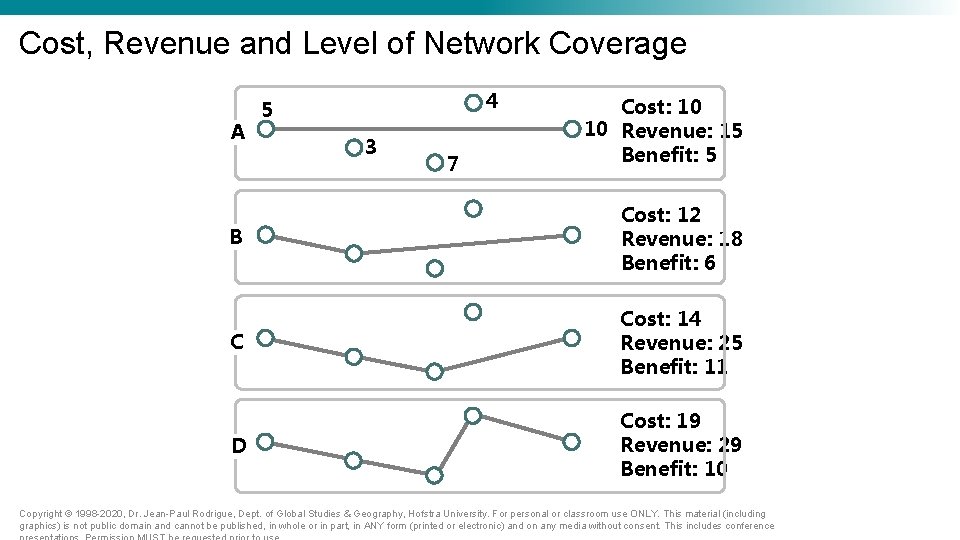
Cost, Revenue and Level of Network Coverage A 4 5 3 7 Cost: 10 10 Revenue: 15 Benefit: 5 B Cost: 12 Revenue: 18 Benefit: 6 C Cost: 14 Revenue: 25 Benefit: 11 D Cost: 19 Revenue: 29 Benefit: 10 Copyright © 1998 -2020, Dr. Jean-Paul Rodrigue, Dept. of Global Studies & Geography, Hofstra University. For personal or classroom use ONLY. This material (including graphics) is not public domain and cannot be published, in whole or in part, in ANY form (printed or electronic) and on any media without consent. This includes conference
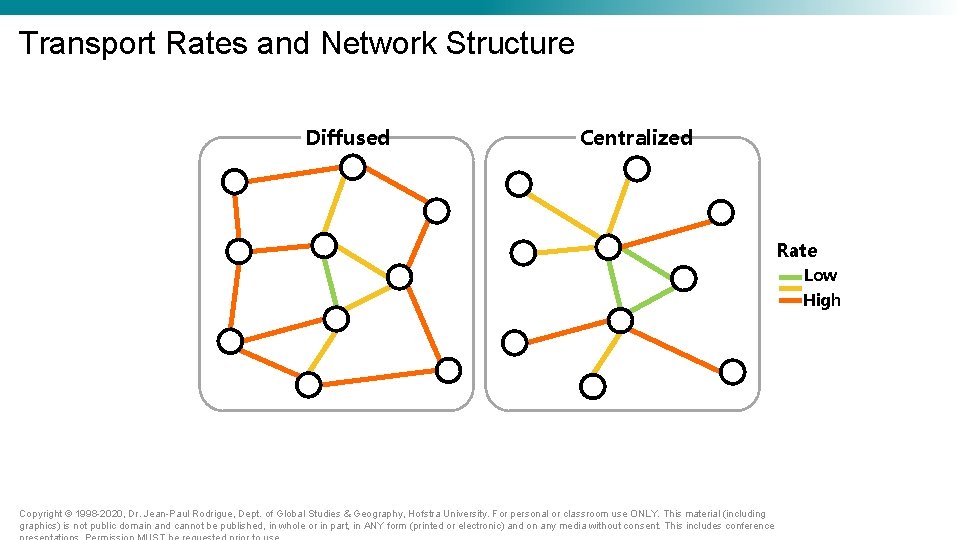
Transport Rates and Network Structure Diffused Centralized Rate Low High Copyright © 1998 -2020, Dr. Jean-Paul Rodrigue, Dept. of Global Studies & Geography, Hofstra University. For personal or classroom use ONLY. This material (including graphics) is not public domain and cannot be published, in whole or in part, in ANY form (printed or electronic) and on any media without consent. This includes conference
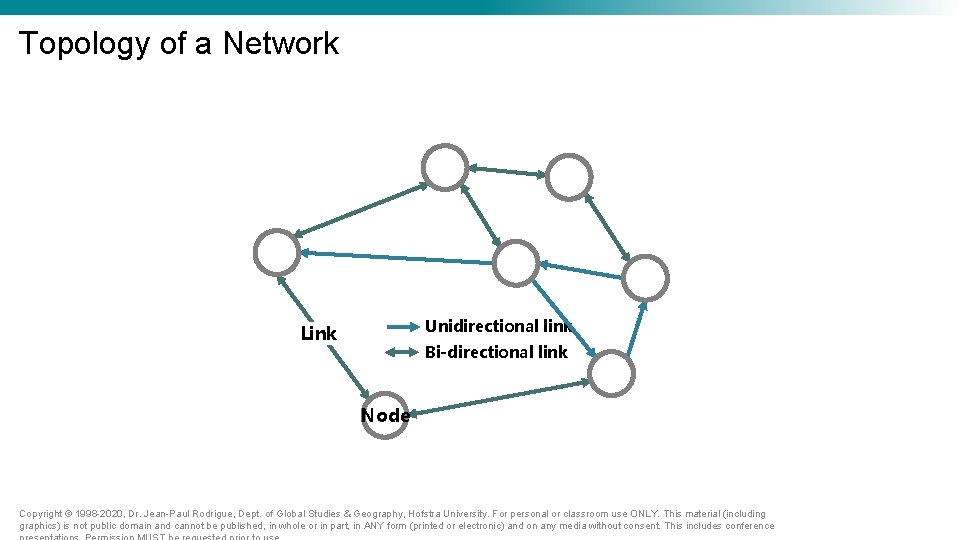
Topology of a Network Unidirectional link Link Bi-directional link Node Copyright © 1998 -2020, Dr. Jean-Paul Rodrigue, Dept. of Global Studies & Geography, Hofstra University. For personal or classroom use ONLY. This material (including graphics) is not public domain and cannot be published, in whole or in part, in ANY form (printed or electronic) and on any media without consent. This includes conference
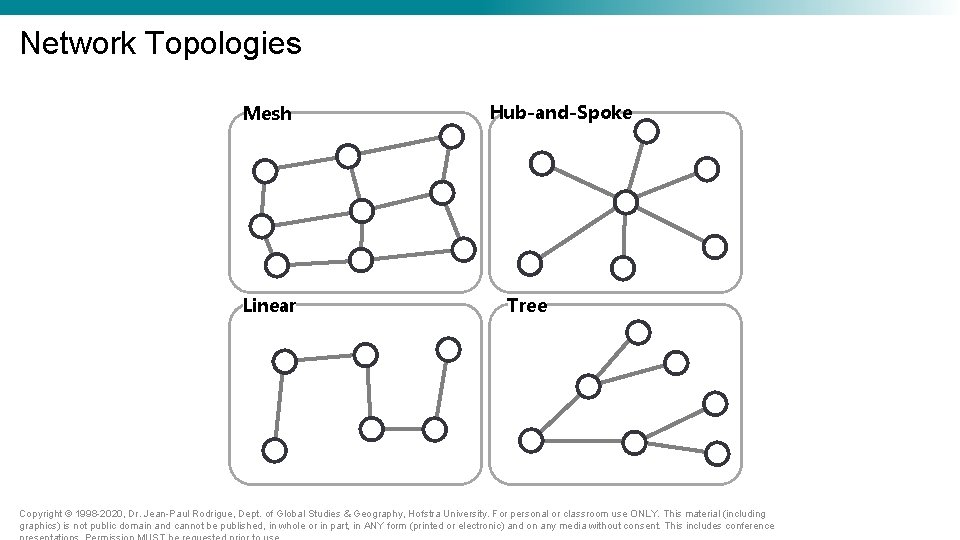
Network Topologies Mesh Linear Hub-and-Spoke Tree Copyright © 1998 -2020, Dr. Jean-Paul Rodrigue, Dept. of Global Studies & Geography, Hofstra University. For personal or classroom use ONLY. This material (including graphics) is not public domain and cannot be published, in whole or in part, in ANY form (printed or electronic) and on any media without consent. This includes conference
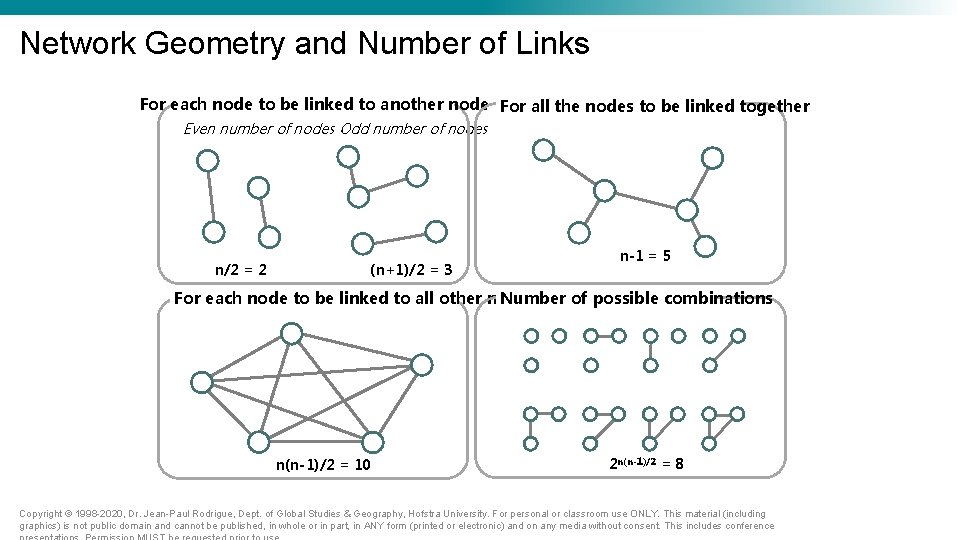
Network Geometry and Number of Links For each node to be linked to another node For all the nodes to be linked together Even number of nodes Odd number of nodes n/2 = 2 (n+1)/2 = 3 n-1 = 5 For each node to be linked to all other nodes Number of possible combinations n(n-1)/2 = 10 2 n(n-1)/2 = 8 Copyright © 1998 -2020, Dr. Jean-Paul Rodrigue, Dept. of Global Studies & Geography, Hofstra University. For personal or classroom use ONLY. This material (including graphics) is not public domain and cannot be published, in whole or in part, in ANY form (printed or electronic) and on any media without consent. This includes conference
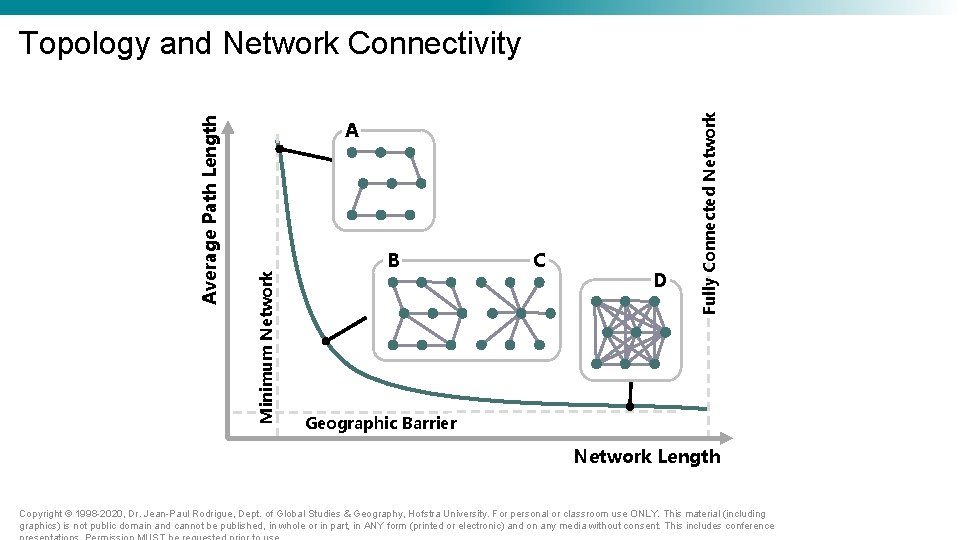
B C D Fully Connected Network A Minimum Network Average Path Length Topology and Network Connectivity Geographic Barrier Network Length Copyright © 1998 -2020, Dr. Jean-Paul Rodrigue, Dept. of Global Studies & Geography, Hofstra University. For personal or classroom use ONLY. This material (including graphics) is not public domain and cannot be published, in whole or in part, in ANY form (printed or electronic) and on any media without consent. This includes conference
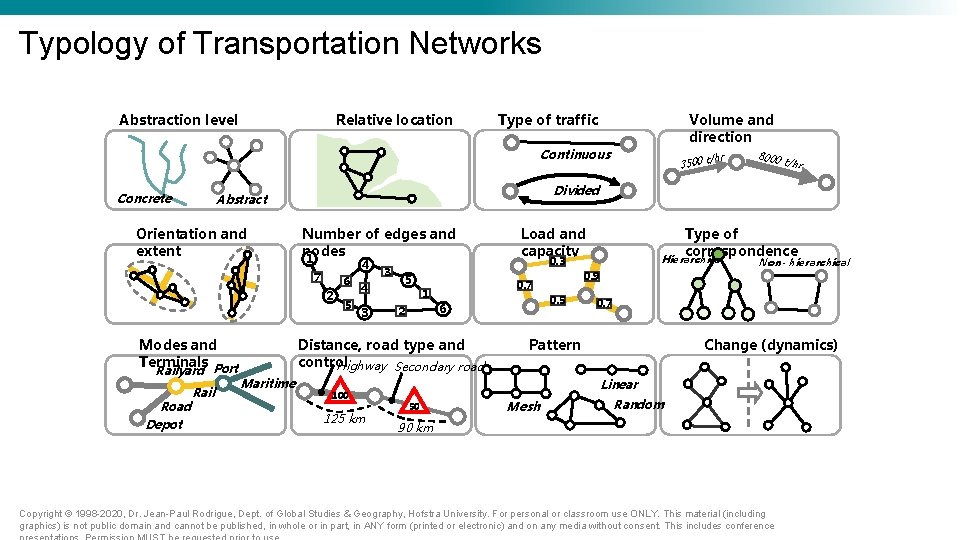
Typology of Transportation Networks Abstraction level Relative location Type of traffic Volume and direction Continuous Concrete Number of edges and nodes 1 4 7 2 Modes and Terminals Port Railyard Road Depot Rail 6 5 3 5 4 3 100 125 km Load and capacity t/hr 1 Hierarchical Non- hierarchical 0. 9 0. 5 6 2 Type of correspondence 0. 3 0. 7 Distance, road type and control Highway Secondary road Maritime 8000 Divided Abstract Orientation and extent /hr 3500 t 0. 7 Pattern Change (dynamics) Linear 50 Mesh Random 90 km Copyright © 1998 -2020, Dr. Jean-Paul Rodrigue, Dept. of Global Studies & Geography, Hofstra University. For personal or classroom use ONLY. This material (including graphics) is not public domain and cannot be published, in whole or in part, in ANY form (printed or electronic) and on any media without consent. This includes conference
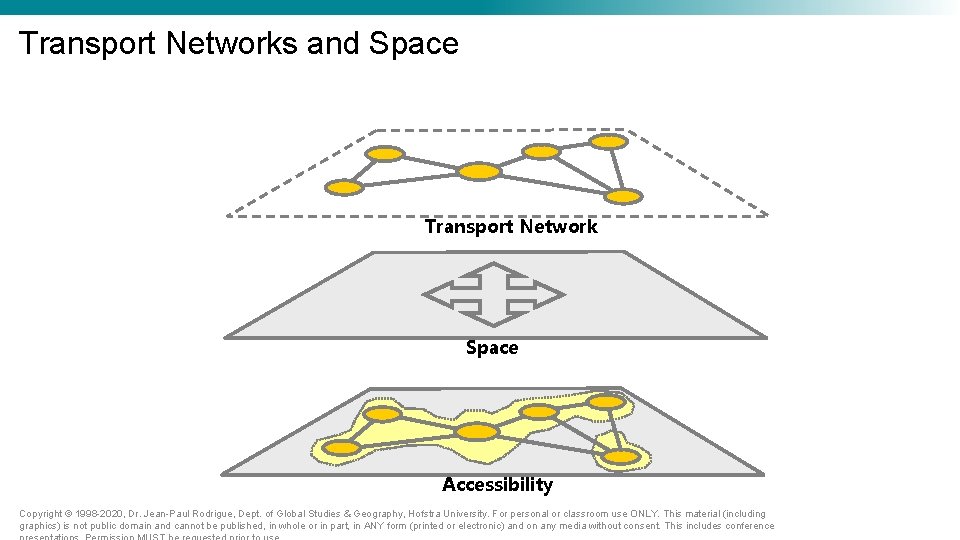
Transport Networks and Space Transport Network Space Accessibility Copyright © 1998 -2020, Dr. Jean-Paul Rodrigue, Dept. of Global Studies & Geography, Hofstra University. For personal or classroom use ONLY. This material (including graphics) is not public domain and cannot be published, in whole or in part, in ANY form (printed or electronic) and on any media without consent. This includes conference
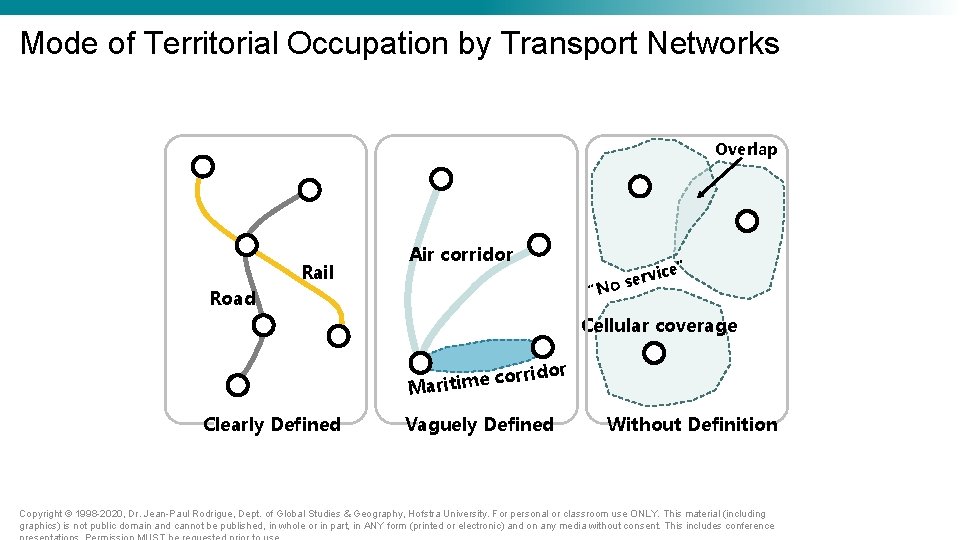
Mode of Territorial Occupation by Transport Networks Overlap Rail Air corridor ice” serv o N “ Road Cellular coverage orrido c e m i t i r Ma Clearly Defined Vaguely Defined r Without Definition Copyright © 1998 -2020, Dr. Jean-Paul Rodrigue, Dept. of Global Studies & Geography, Hofstra University. For personal or classroom use ONLY. This material (including graphics) is not public domain and cannot be published, in whole or in part, in ANY form (printed or electronic) and on any media without consent. This includes conference
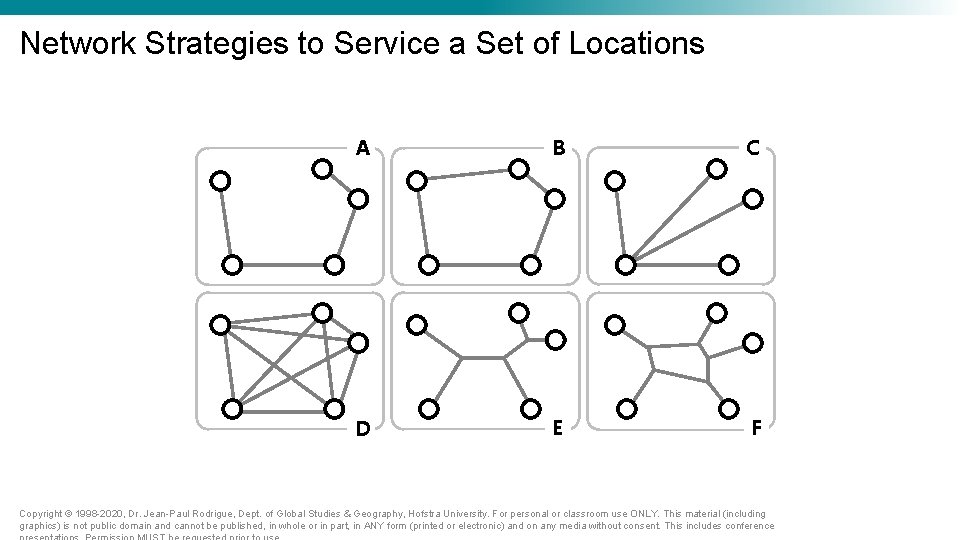
Network Strategies to Service a Set of Locations A B C D E F Copyright © 1998 -2020, Dr. Jean-Paul Rodrigue, Dept. of Global Studies & Geography, Hofstra University. For personal or classroom use ONLY. This material (including graphics) is not public domain and cannot be published, in whole or in part, in ANY form (printed or electronic) and on any media without consent. This includes conference
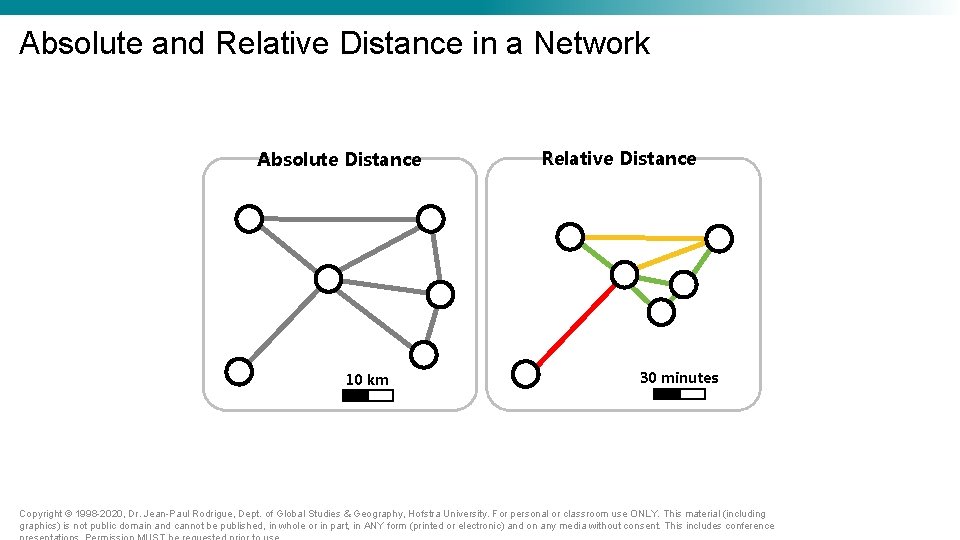
Absolute and Relative Distance in a Network Absolute Distance 10 km Relative Distance 30 minutes Copyright © 1998 -2020, Dr. Jean-Paul Rodrigue, Dept. of Global Studies & Geography, Hofstra University. For personal or classroom use ONLY. This material (including graphics) is not public domain and cannot be published, in whole or in part, in ANY form (printed or electronic) and on any media without consent. This includes conference
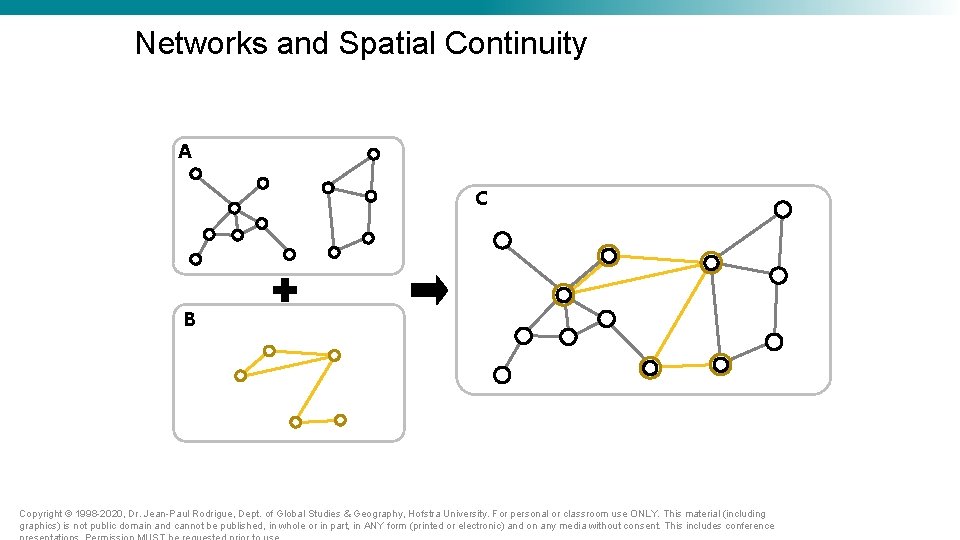
Networks and Spatial Continuity A C B Copyright © 1998 -2020, Dr. Jean-Paul Rodrigue, Dept. of Global Studies & Geography, Hofstra University. For personal or classroom use ONLY. This material (including graphics) is not public domain and cannot be published, in whole or in part, in ANY form (printed or electronic) and on any media without consent. This includes conference
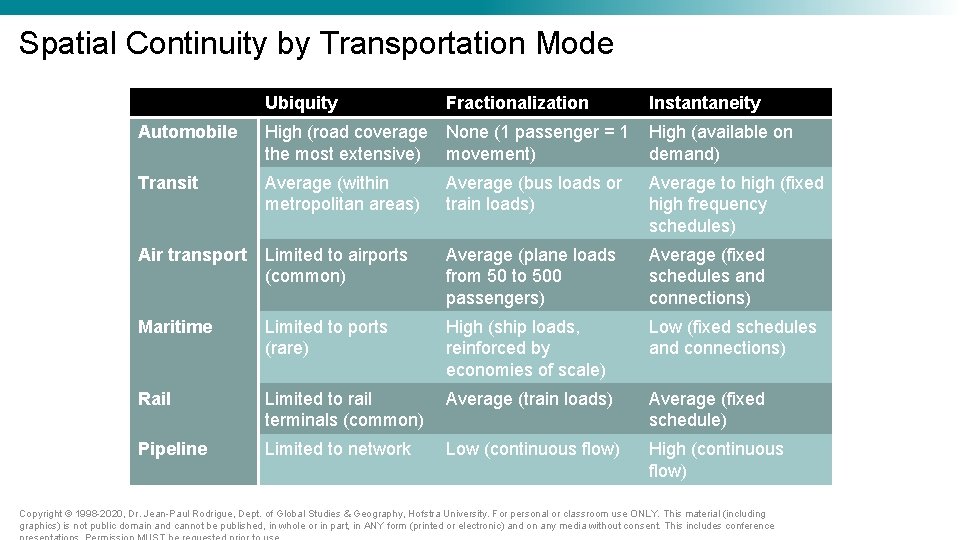
Spatial Continuity by Transportation Mode Ubiquity Fractionalization Instantaneity Automobile High (road coverage None (1 passenger = 1 the most extensive) movement) High (available on demand) Transit Average (within metropolitan areas) Average (bus loads or train loads) Average to high (fixed high frequency schedules) Air transport Limited to airports (common) Average (plane loads from 50 to 500 passengers) Average (fixed schedules and connections) Maritime Limited to ports (rare) High (ship loads, reinforced by economies of scale) Low (fixed schedules and connections) Rail Limited to rail terminals (common) Average (train loads) Average (fixed schedule) Pipeline Limited to network Low (continuous flow) High (continuous flow) Copyright © 1998 -2020, Dr. Jean-Paul Rodrigue, Dept. of Global Studies & Geography, Hofstra University. For personal or classroom use ONLY. This material (including graphics) is not public domain and cannot be published, in whole or in part, in ANY form (printed or electronic) and on any media without consent. This includes conference
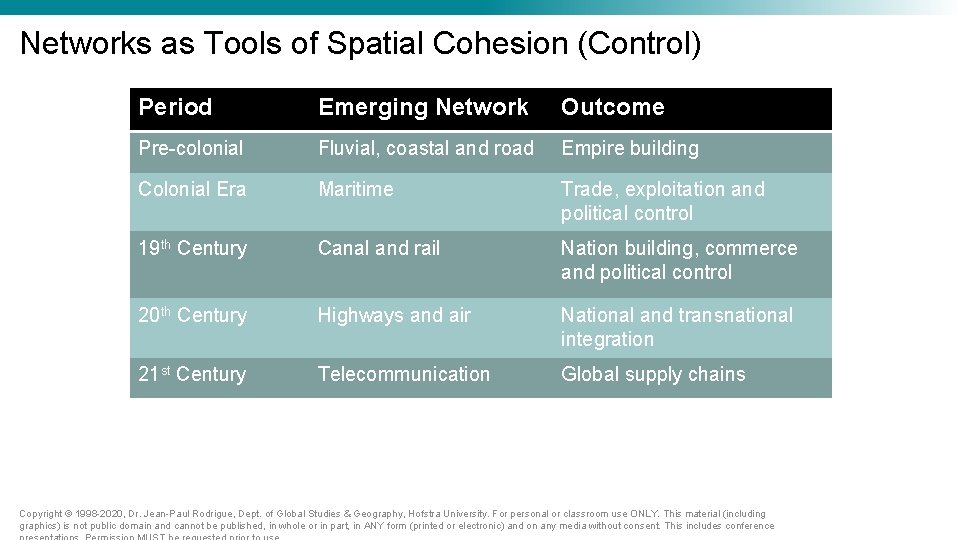
Networks as Tools of Spatial Cohesion (Control) Period Emerging Network Outcome Pre-colonial Fluvial, coastal and road Empire building Colonial Era Maritime Trade, exploitation and political control 19 th Century Canal and rail Nation building, commerce and political control 20 th Century Highways and air National and transnational integration 21 st Century Telecommunication Global supply chains Copyright © 1998 -2020, Dr. Jean-Paul Rodrigue, Dept. of Global Studies & Geography, Hofstra University. For personal or classroom use ONLY. This material (including graphics) is not public domain and cannot be published, in whole or in part, in ANY form (printed or electronic) and on any media without consent. This includes conference
Transport and Spatial Organization Copyright © 1998 -2020, Dr. Jean-Paul Rodrigue, Dept. of Global Studies & Geography, Hofstra University. For personal or classroom use ONLY. This material (including graphics) is not public domain and cannot be published, in whole or in part, in ANY form (printed or electronic) and on any media without consent. This includes conference
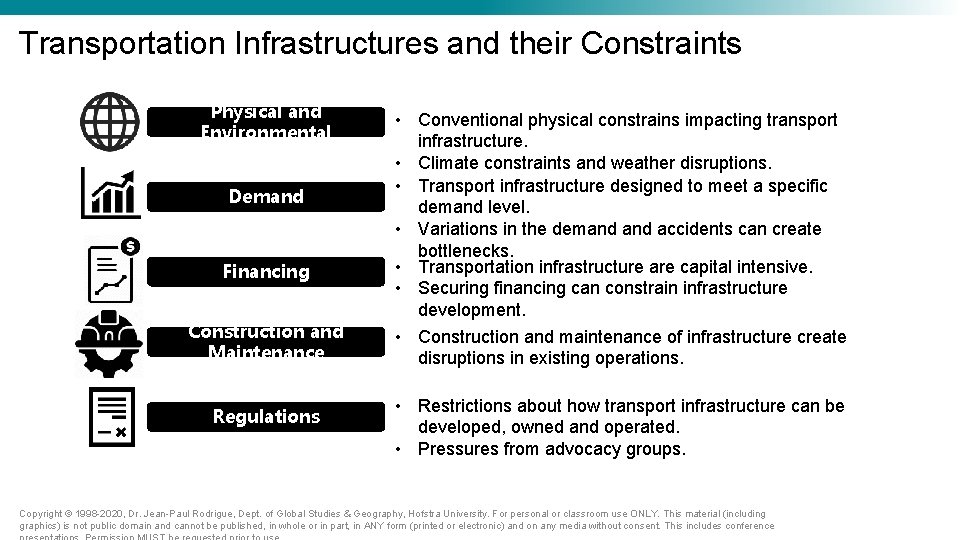
Transportation Infrastructures and their Constraints Physical and Environmental Demand Financing Construction and Maintenance Regulations • Conventional physical constrains impacting transport infrastructure. • Climate constraints and weather disruptions. • Transport infrastructure designed to meet a specific demand level. • Variations in the demand accidents can create bottlenecks. • Transportation infrastructure are capital intensive. • Securing financing can constrain infrastructure development. • Construction and maintenance of infrastructure create disruptions in existing operations. • Restrictions about how transport infrastructure can be developed, owned and operated. • Pressures from advocacy groups. Copyright © 1998 -2020, Dr. Jean-Paul Rodrigue, Dept. of Global Studies & Geography, Hofstra University. For personal or classroom use ONLY. This material (including graphics) is not public domain and cannot be published, in whole or in part, in ANY form (printed or electronic) and on any media without consent. This includes conference
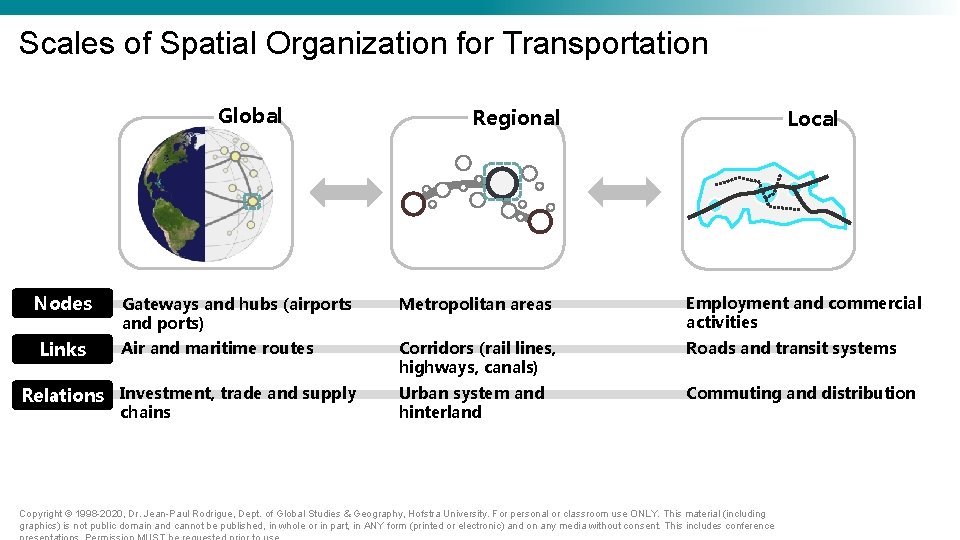
Scales of Spatial Organization for Transportation Global Nodes Links Regional Local Gateways and hubs (airports and ports) Metropolitan areas Employment and commercial activities Air and maritime routes Corridors (rail lines, highways, canals) Roads and transit systems Urban system and hinterland Commuting and distribution Relations Investment, trade and supply chains Copyright © 1998 -2020, Dr. Jean-Paul Rodrigue, Dept. of Global Studies & Geography, Hofstra University. For personal or classroom use ONLY. This material (including graphics) is not public domain and cannot be published, in whole or in part, in ANY form (printed or electronic) and on any media without consent. This includes conference
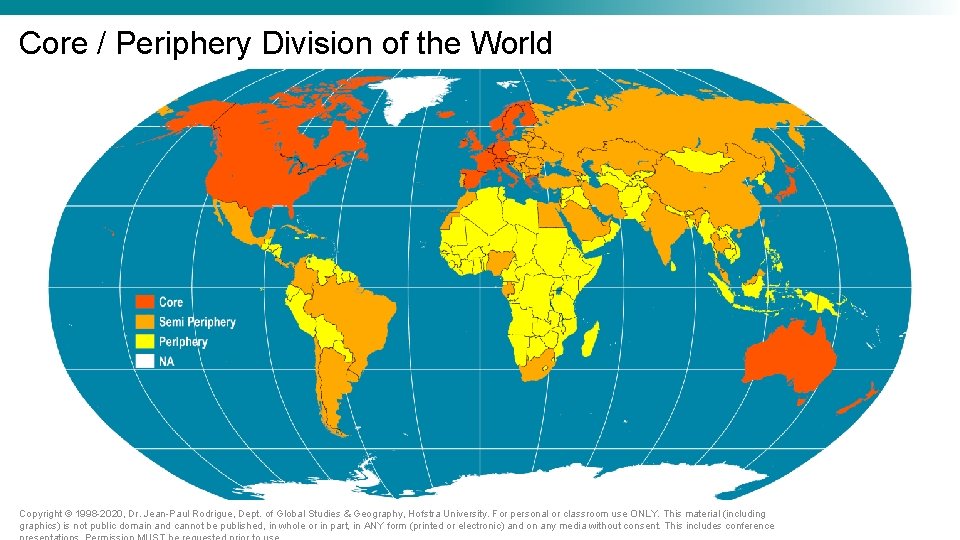
Core / Periphery Division of the World Copyright © 1998 -2020, Dr. Jean-Paul Rodrigue, Dept. of Global Studies & Geography, Hofstra University. For personal or classroom use ONLY. This material (including graphics) is not public domain and cannot be published, in whole or in part, in ANY form (printed or electronic) and on any media without consent. This includes conference
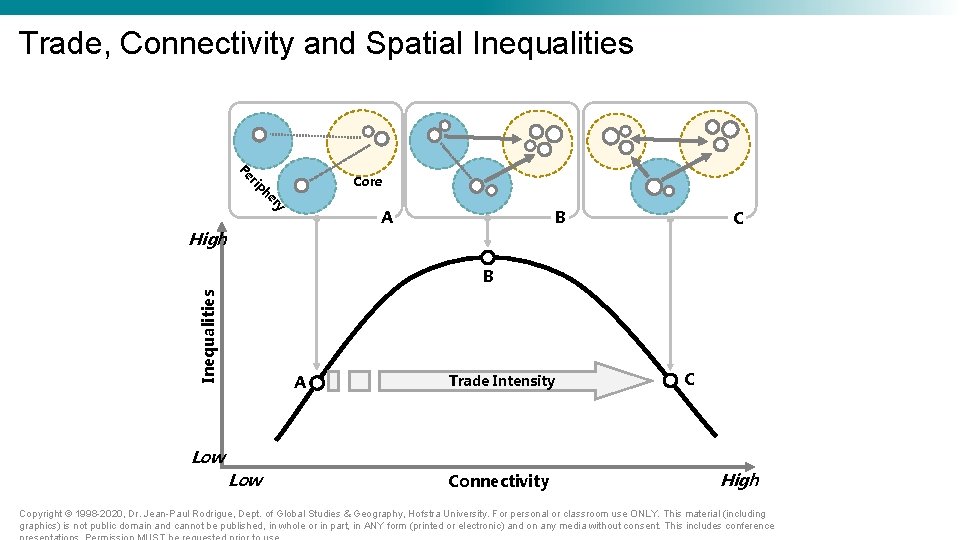
Trade, Connectivity and Spatial Inequalities r Pe ry he ip Core A High B C Inequalities B A Trade Intensity C Low Connectivity High Copyright © 1998 -2020, Dr. Jean-Paul Rodrigue, Dept. of Global Studies & Geography, Hofstra University. For personal or classroom use ONLY. This material (including graphics) is not public domain and cannot be published, in whole or in part, in ANY form (printed or electronic) and on any media without consent. This includes conference
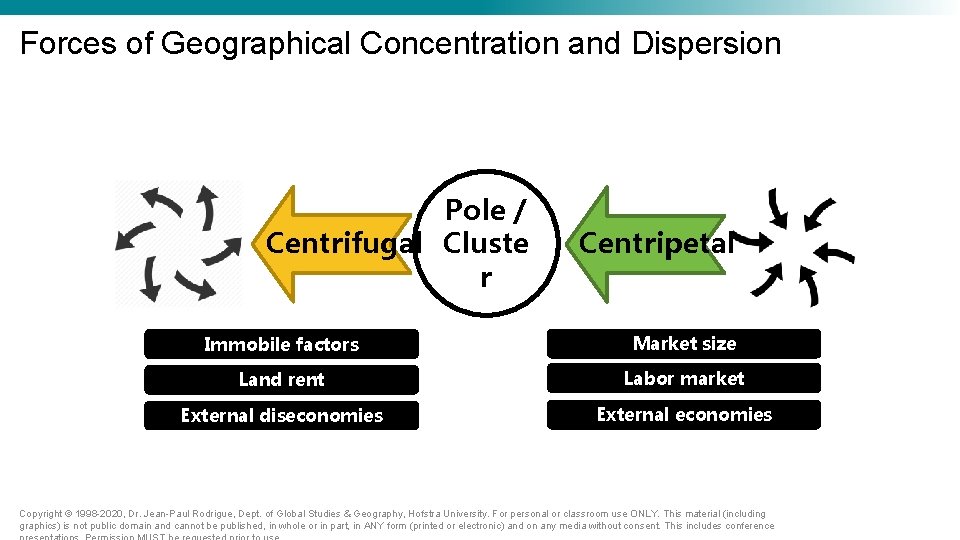
Forces of Geographical Concentration and Dispersion Pole / Centrifugal Cluste r Centripetal Immobile factors Market size Land rent Labor market External diseconomies External economies Copyright © 1998 -2020, Dr. Jean-Paul Rodrigue, Dept. of Global Studies & Geography, Hofstra University. For personal or classroom use ONLY. This material (including graphics) is not public domain and cannot be published, in whole or in part, in ANY form (printed or electronic) and on any media without consent. This includes conference
Factors of Polarization (under construction) Network Load break Competition Services Agglomeration economies Copyright © 1998 -2020, Dr. Jean-Paul Rodrigue, Dept. of Global Studies & Geography, Hofstra University. For personal or classroom use ONLY. This material (including graphics) is not public domain and cannot be published, in whole or in part, in ANY form (printed or electronic) and on any media without consent. This includes conference
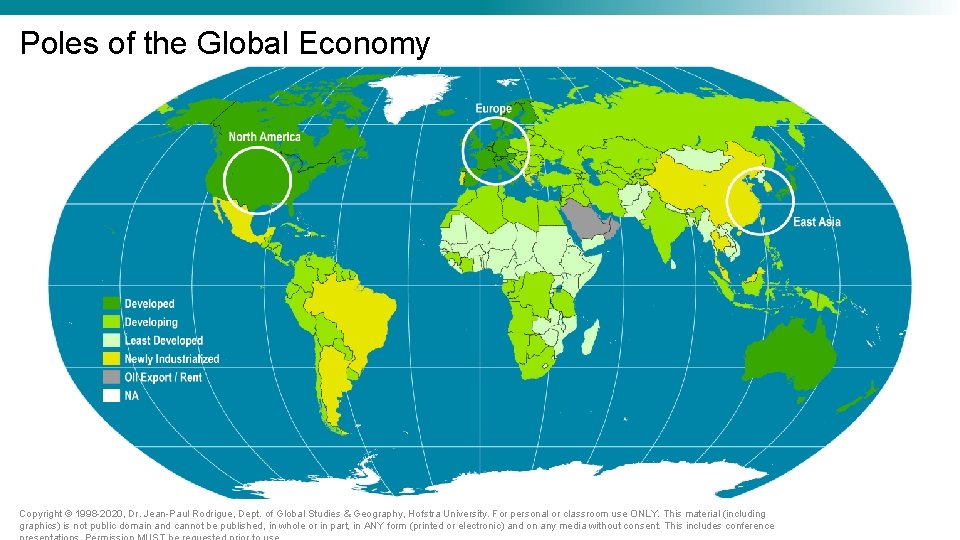
Poles of the Global Economy Copyright © 1998 -2020, Dr. Jean-Paul Rodrigue, Dept. of Global Studies & Geography, Hofstra University. For personal or classroom use ONLY. This material (including graphics) is not public domain and cannot be published, in whole or in part, in ANY form (printed or electronic) and on any media without consent. This includes conference
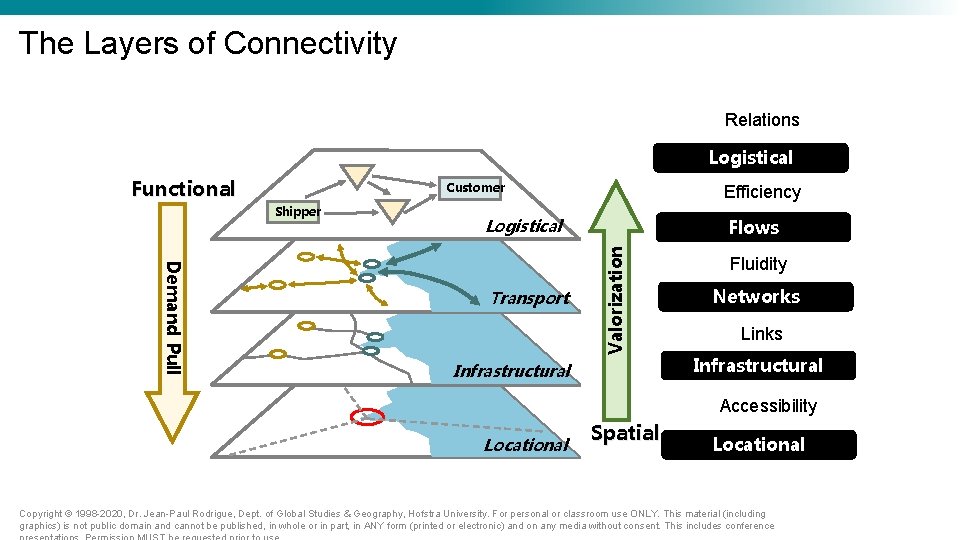
The Layers of Connectivity Relations Logistical Functional Customer Logistical Demand Pull Transport Flows Valorization Shipper Efficiency Infrastructural Fluidity Networks Links Infrastructural Accessibility Locational Spatial Locational Copyright © 1998 -2020, Dr. Jean-Paul Rodrigue, Dept. of Global Studies & Geography, Hofstra University. For personal or classroom use ONLY. This material (including graphics) is not public domain and cannot be published, in whole or in part, in ANY form (printed or electronic) and on any media without consent. This includes conference
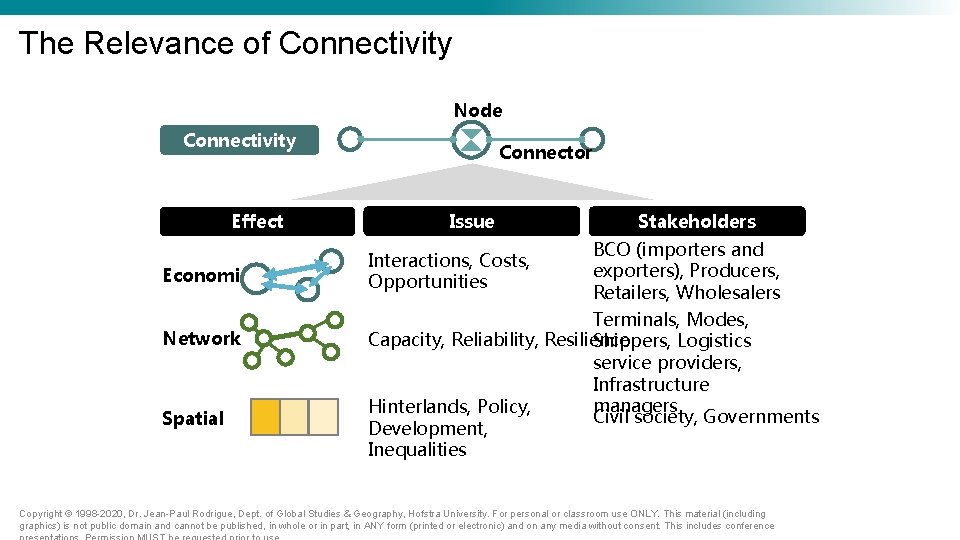
The Relevance of Connectivity Node Connectivity Effect Economic Network Spatial Connector Issue Stakeholders BCO (importers and exporters), Producers, Retailers, Wholesalers Terminals, Modes, Capacity, Reliability, Resilience Shippers, Logistics service providers, Infrastructure managers Hinterlands, Policy, Civil society, Governments Development, Inequalities Interactions, Costs, Opportunities Copyright © 1998 -2020, Dr. Jean-Paul Rodrigue, Dept. of Global Studies & Geography, Hofstra University. For personal or classroom use ONLY. This material (including graphics) is not public domain and cannot be published, in whole or in part, in ANY form (printed or electronic) and on any media without consent. This includes conference
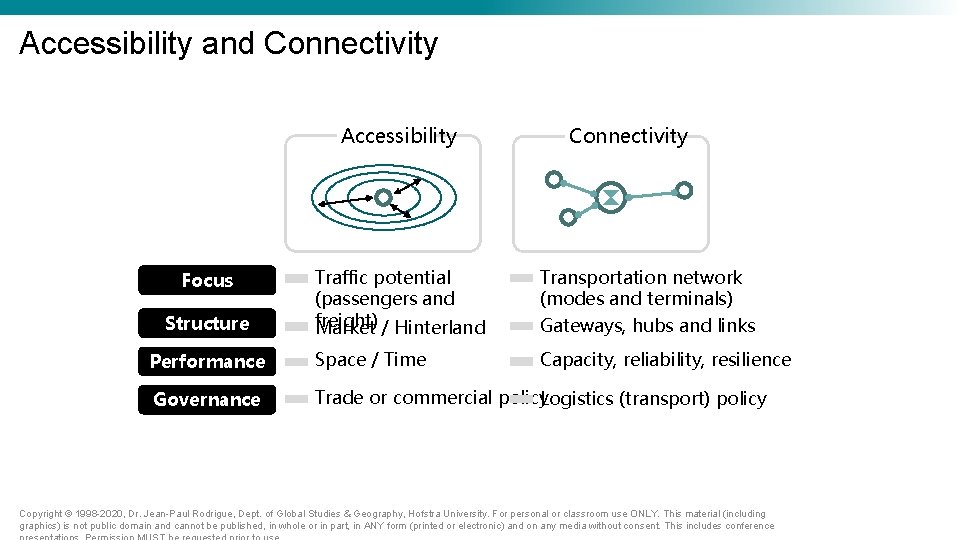
Accessibility and Connectivity Accessibility Connectivity Traffic potential (passengers and freight) Market / Hinterland Transportation network (modes and terminals) Performance Space / Time Capacity, reliability, resilience Governance Trade or commercial policy. Logistics (transport) policy Focus Structure Gateways, hubs and links Copyright © 1998 -2020, Dr. Jean-Paul Rodrigue, Dept. of Global Studies & Geography, Hofstra University. For personal or classroom use ONLY. This material (including graphics) is not public domain and cannot be published, in whole or in part, in ANY form (printed or electronic) and on any media without consent. This includes conference
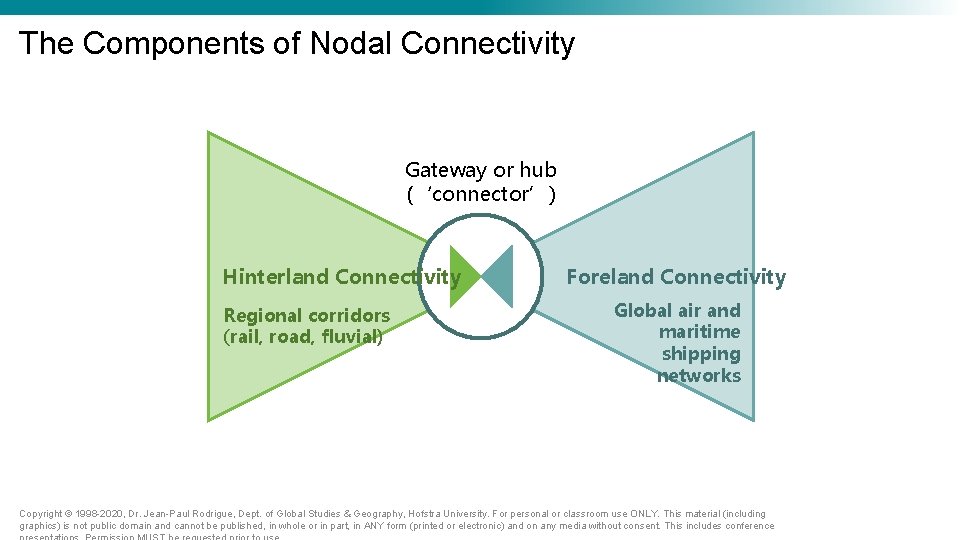
The Components of Nodal Connectivity Gateway or hub (‘connector’) Hinterland Connectivity Regional corridors (rail, road, fluvial) Foreland Connectivity Global air and maritime shipping networks Copyright © 1998 -2020, Dr. Jean-Paul Rodrigue, Dept. of Global Studies & Geography, Hofstra University. For personal or classroom use ONLY. This material (including graphics) is not public domain and cannot be published, in whole or in part, in ANY form (printed or electronic) and on any media without consent. This includes conference
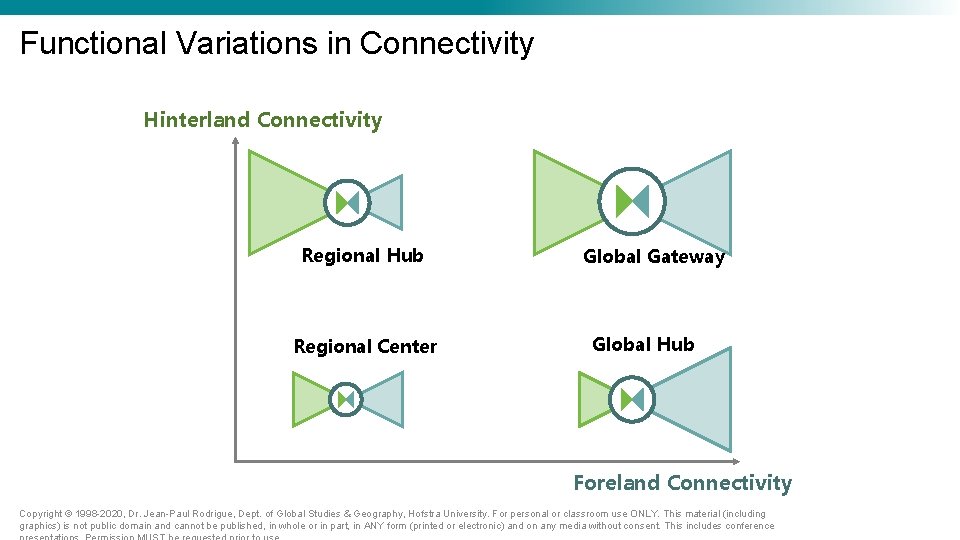
Functional Variations in Connectivity Hinterland Connectivity Regional Hub Regional Center Global Gateway Global Hub Foreland Connectivity Copyright © 1998 -2020, Dr. Jean-Paul Rodrigue, Dept. of Global Studies & Geography, Hofstra University. For personal or classroom use ONLY. This material (including graphics) is not public domain and cannot be published, in whole or in part, in ANY form (printed or electronic) and on any media without consent. This includes conference
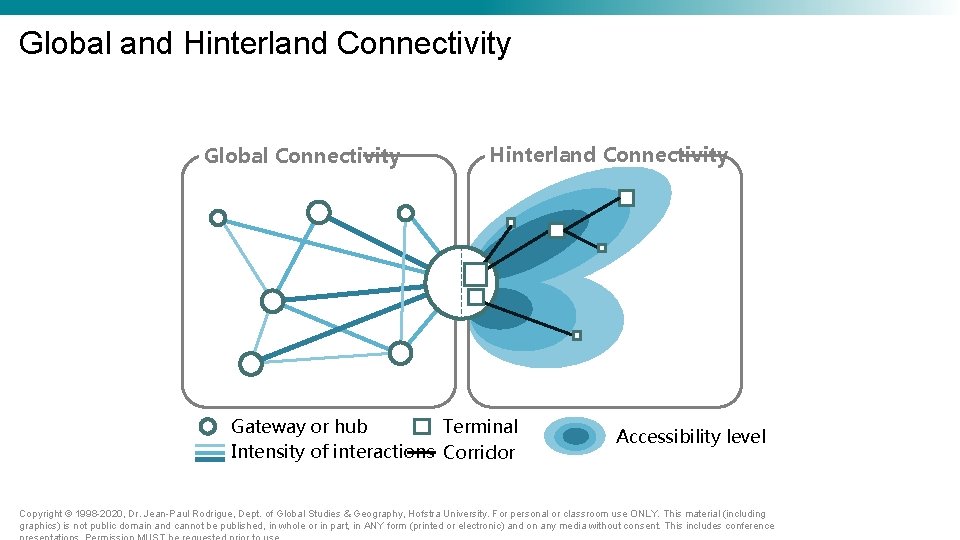
Global and Hinterland Connectivity Global Connectivity Hinterland Connectivity Gateway or hub Terminal Intensity of interactions Corridor Accessibility level Copyright © 1998 -2020, Dr. Jean-Paul Rodrigue, Dept. of Global Studies & Geography, Hofstra University. For personal or classroom use ONLY. This material (including graphics) is not public domain and cannot be published, in whole or in part, in ANY form (printed or electronic) and on any media without consent. This includes conference
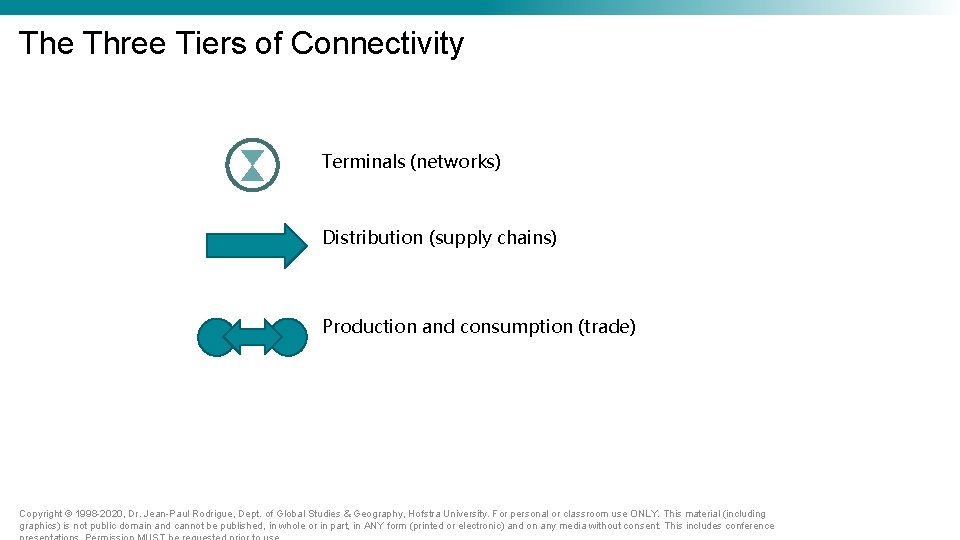
The Three Tiers of Connectivity Terminals (networks) Distribution (supply chains) Production and consumption (trade) Copyright © 1998 -2020, Dr. Jean-Paul Rodrigue, Dept. of Global Studies & Geography, Hofstra University. For personal or classroom use ONLY. This material (including graphics) is not public domain and cannot be published, in whole or in part, in ANY form (printed or electronic) and on any media without consent. This includes conference
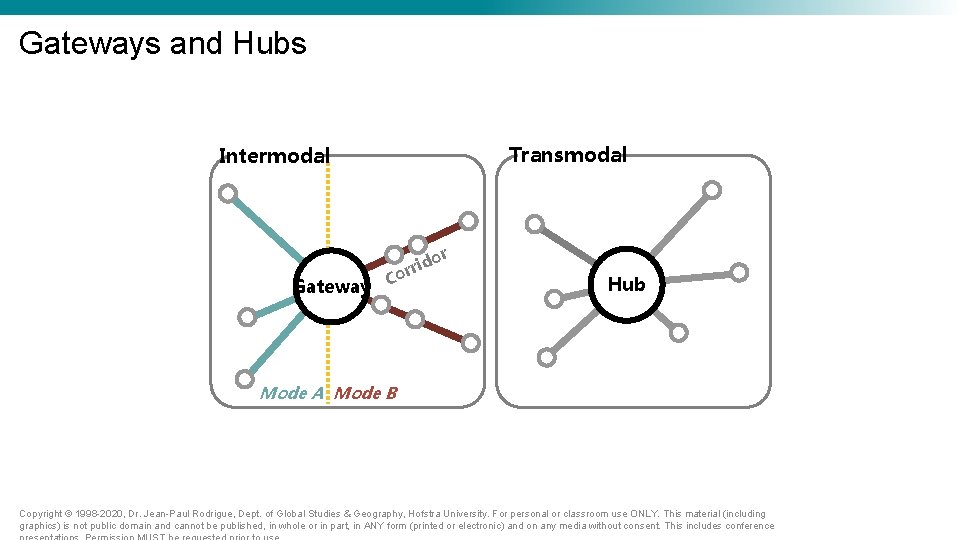
Gateways and Hubs Transmodal Intermodal Gateway rrid o C or Hub Mode A Mode B Copyright © 1998 -2020, Dr. Jean-Paul Rodrigue, Dept. of Global Studies & Geography, Hofstra University. For personal or classroom use ONLY. This material (including graphics) is not public domain and cannot be published, in whole or in part, in ANY form (printed or electronic) and on any media without consent. This includes conference
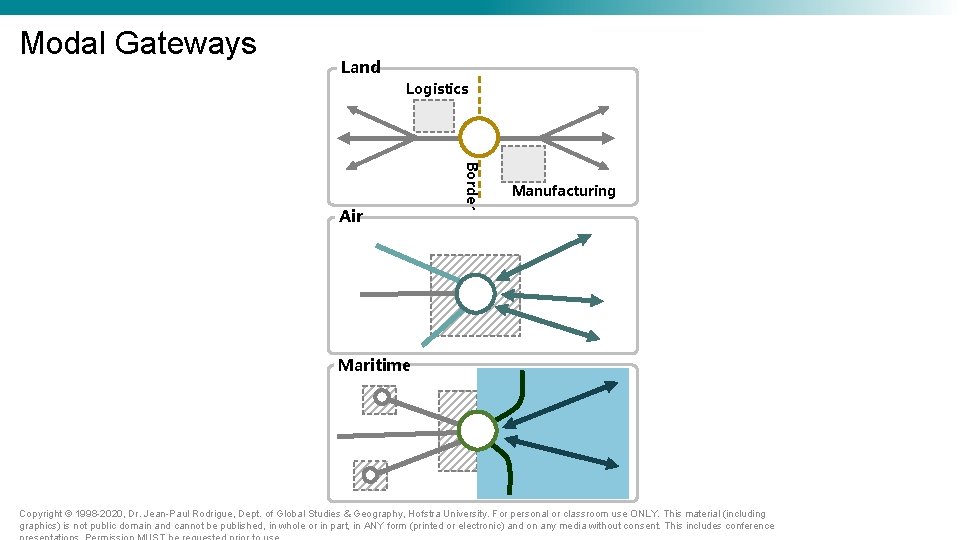
Modal Gateways Land Logistics Border Air Manufacturing Maritime Copyright © 1998 -2020, Dr. Jean-Paul Rodrigue, Dept. of Global Studies & Geography, Hofstra University. For personal or classroom use ONLY. This material (including graphics) is not public domain and cannot be published, in whole or in part, in ANY form (printed or electronic) and on any media without consent. This includes conference
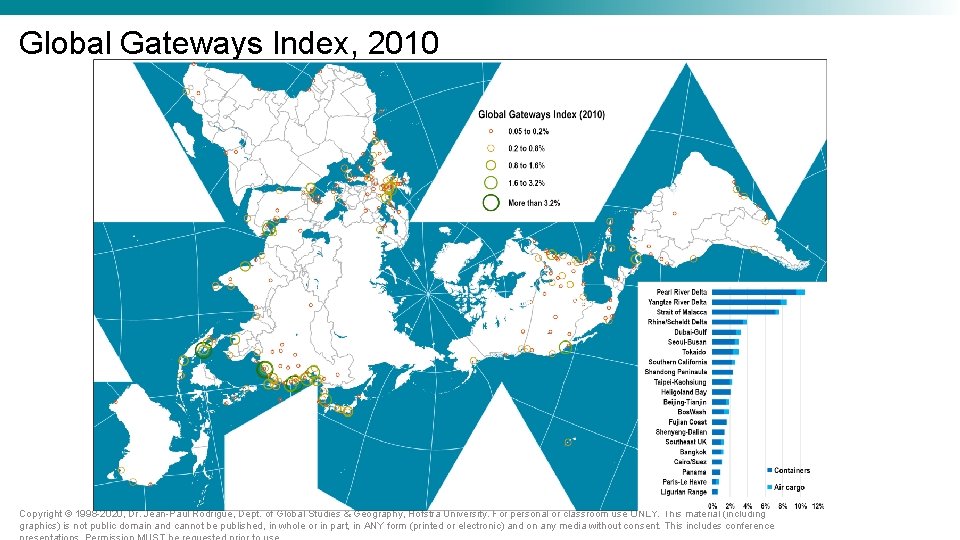
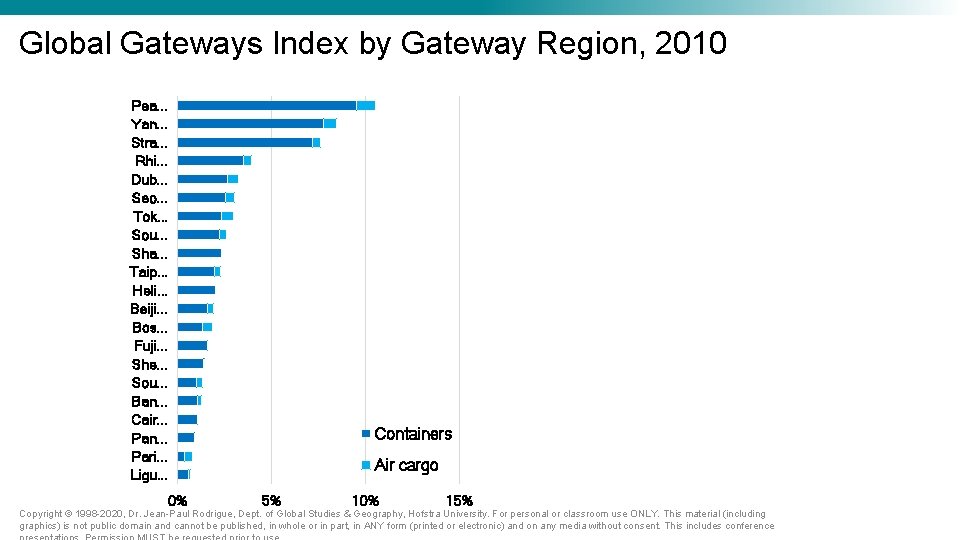
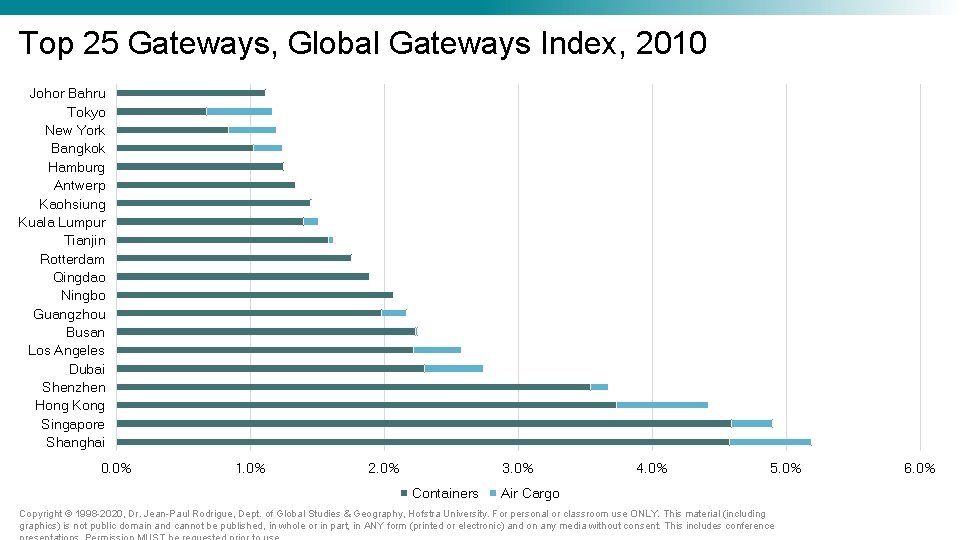
Global Gateways Index, 2010 Copyright © 1998 -2020, Dr. Jean-Paul Rodrigue, Dept. of Global Studies & Geography, Hofstra University. For personal or classroom use ONLY. This material (including graphics) is not public domain and cannot be published, in whole or in part, in ANY form (printed or electronic) and on any media without consent. This includes conference
Global Gateways Index by Gateway Region, 2010 Pea. . . Yan. . . Stra. . . Rhi. . . Dub. . . Seo. . . Tok. . . Sou. . . Sha. . . Taip. . . Heli. . . Beiji. . . Bos. . . Fuji. . . She. . . Sou. . . Ban. . . Cair. . . Pan. . . Pari. . . Ligu. . . 0% Containers Air cargo 5% 10% 15% Copyright © 1998 -2020, Dr. Jean-Paul Rodrigue, Dept. of Global Studies & Geography, Hofstra University. For personal or classroom use ONLY. This material (including graphics) is not public domain and cannot be published, in whole or in part, in ANY form (printed or electronic) and on any media without consent. This includes conference
Top 25 Gateways, Global Gateways Index, 2010 Johor Bahru Tokyo New York Bangkok Hamburg Antwerp Kaohsiung Kuala Lumpur Tianjin Rotterdam Qingdao Ningbo Guangzhou Busan Los Angeles Dubai Shenzhen Hong Kong Singapore Shanghai 0. 0% 1. 0% 2. 0% 3. 0% Containers 4. 0% 5. 0% Air Cargo Copyright © 1998 -2020, Dr. Jean-Paul Rodrigue, Dept. of Global Studies & Geography, Hofstra University. For personal or classroom use ONLY. This material (including graphics) is not public domain and cannot be published, in whole or in part, in ANY form (printed or electronic) and on any media without consent. This includes conference 6. 0%
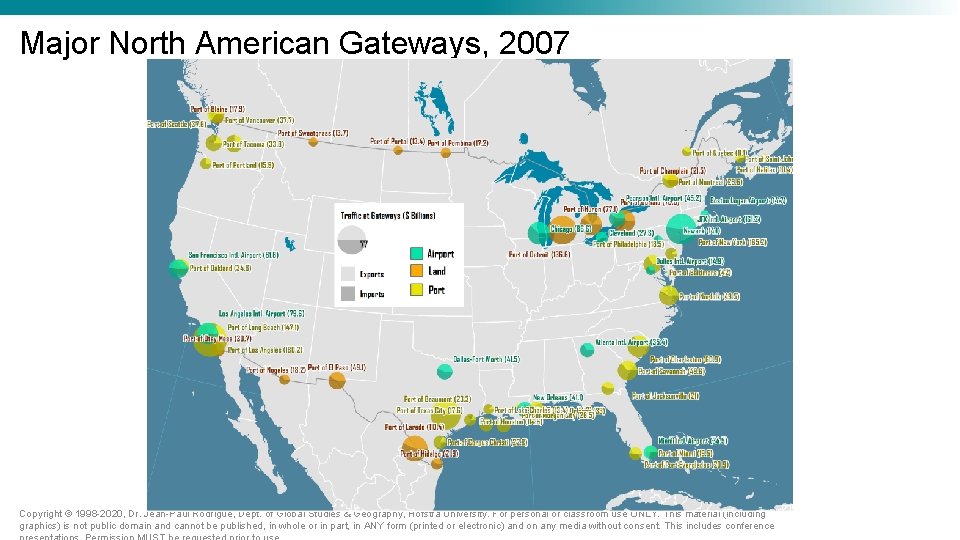
Major North American Gateways, 2007 Copyright © 1998 -2020, Dr. Jean-Paul Rodrigue, Dept. of Global Studies & Geography, Hofstra University. For personal or classroom use ONLY. This material (including graphics) is not public domain and cannot be published, in whole or in part, in ANY form (printed or electronic) and on any media without consent. This includes conference
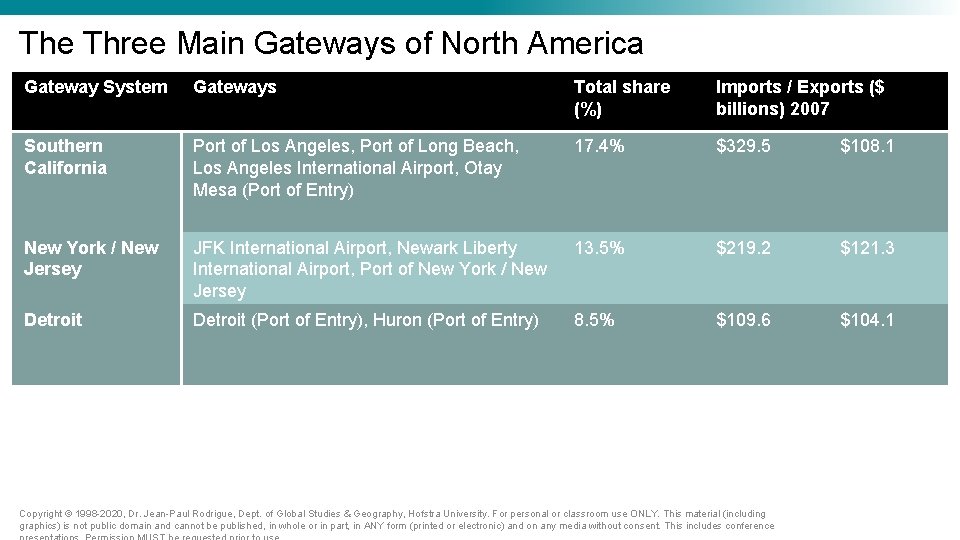
The Three Main Gateways of North America Gateway System Gateways Total share (%) Imports / Exports ($ billions) 2007 Southern California Port of Los Angeles, Port of Long Beach, Los Angeles International Airport, Otay Mesa (Port of Entry) 17. 4% $329. 5 $108. 1 New York / New Jersey JFK International Airport, Newark Liberty International Airport, Port of New York / New Jersey 13. 5% $219. 2 $121. 3 Detroit (Port of Entry), Huron (Port of Entry) 8. 5% $109. 6 $104. 1 Copyright © 1998 -2020, Dr. Jean-Paul Rodrigue, Dept. of Global Studies & Geography, Hofstra University. For personal or classroom use ONLY. This material (including graphics) is not public domain and cannot be published, in whole or in part, in ANY form (printed or electronic) and on any media without consent. This includes conference
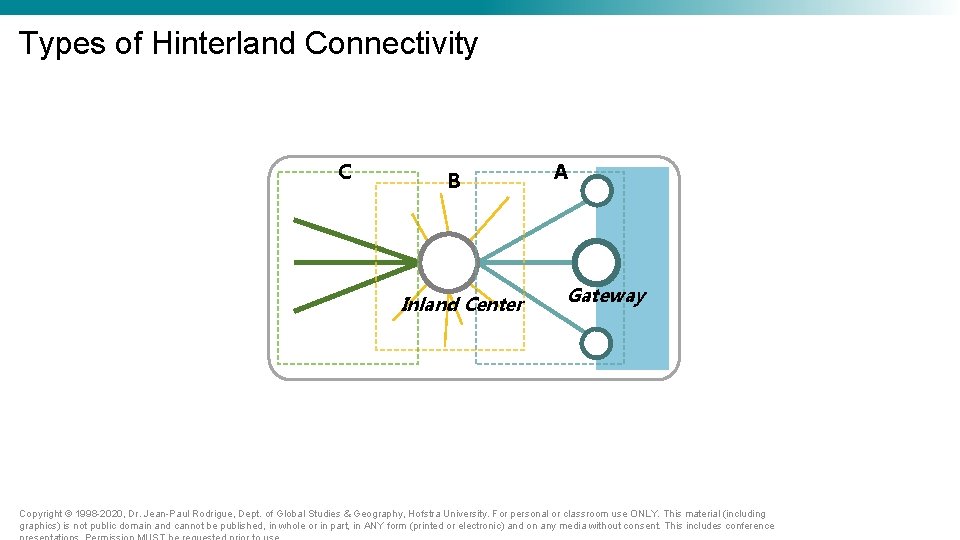
Types of Hinterland Connectivity C B Inland Center A Gateway Copyright © 1998 -2020, Dr. Jean-Paul Rodrigue, Dept. of Global Studies & Geography, Hofstra University. For personal or classroom use ONLY. This material (including graphics) is not public domain and cannot be published, in whole or in part, in ANY form (printed or electronic) and on any media without consent. This includes conference
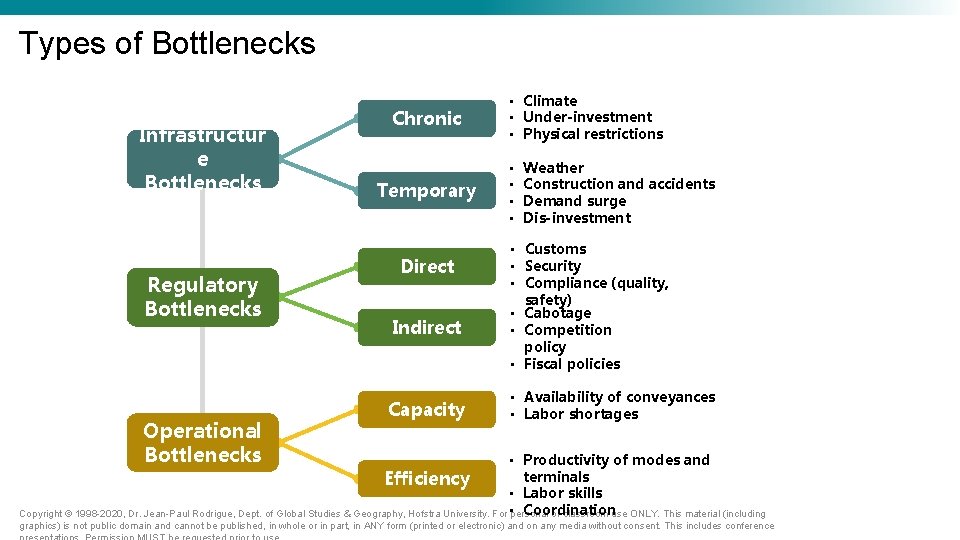
Types of Bottlenecks Infrastructur e Bottlenecks Regulatory Bottlenecks Operational Bottlenecks Chronic Temporary Direct Indirect Capacity • Climate • Under-investment • Physical restrictions • • Weather Construction and accidents Demand surge Dis-investment • Customs • Security • Compliance (quality, safety) • Cabotage • Competition policy • Fiscal policies • Availability of conveyances • Labor shortages • Productivity of modes and terminals Efficiency • Labor skills Coordination Copyright © 1998 -2020, Dr. Jean-Paul Rodrigue, Dept. of Global Studies & Geography, Hofstra University. For • personal or classroom use ONLY. This material (including graphics) is not public domain and cannot be published, in whole or in part, in ANY form (printed or electronic) and on any media without consent. This includes conference
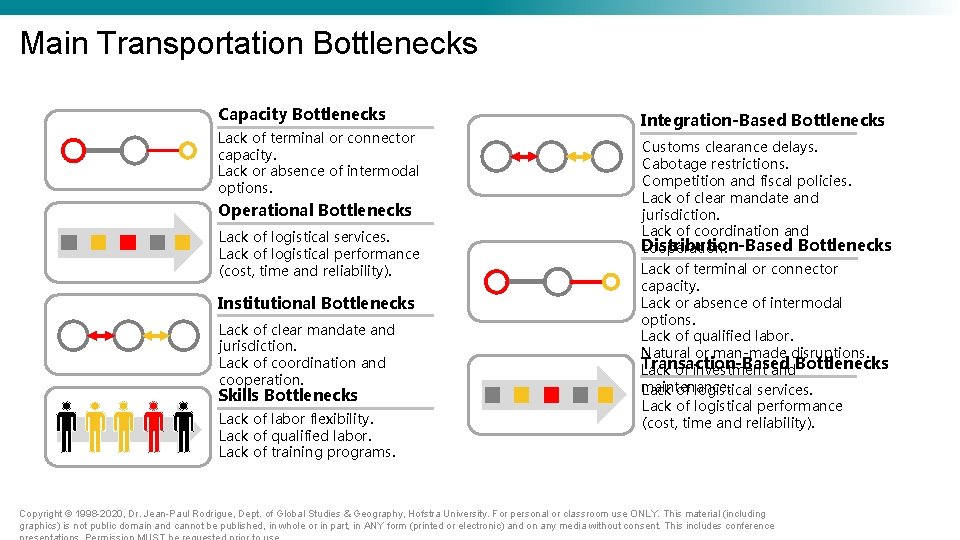
Main Transportation Bottlenecks Capacity Bottlenecks Lack of terminal or connector capacity. Lack or absence of intermodal options. Operational Bottlenecks Lack of logistical services. Lack of logistical performance (cost, time and reliability). Institutional Bottlenecks Lack of clear mandate and jurisdiction. Lack of coordination and cooperation. Skills Bottlenecks Lack of labor flexibility. Lack of qualified labor. Lack of training programs. Integration-Based Bottlenecks Customs clearance delays. Cabotage restrictions. Competition and fiscal policies. Lack of clear mandate and jurisdiction. Lack of coordination and Distribution-Based Bottlenecks cooperation. Lack of terminal or connector capacity. Lack or absence of intermodal options. Lack of qualified labor. Natural or man-made disruptions. Transaction-Based Bottlenecks Lack of investment and maintenance. Lack of logistical services. Lack of logistical performance (cost, time and reliability). Copyright © 1998 -2020, Dr. Jean-Paul Rodrigue, Dept. of Global Studies & Geography, Hofstra University. For personal or classroom use ONLY. This material (including graphics) is not public domain and cannot be published, in whole or in part, in ANY form (printed or electronic) and on any media without consent. This includes conference
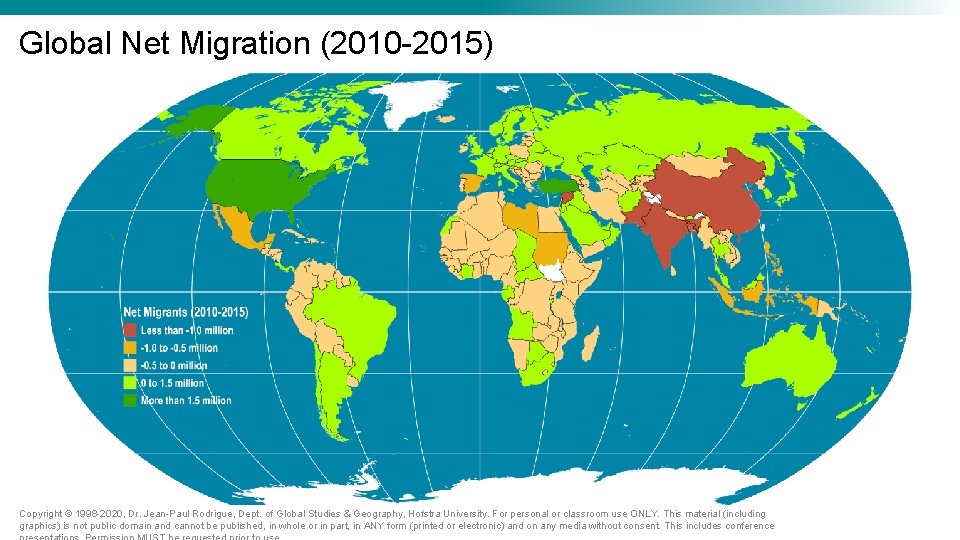
Global Net Migration (2010 -2015) Copyright © 1998 -2020, Dr. Jean-Paul Rodrigue, Dept. of Global Studies & Geography, Hofstra University. For personal or classroom use ONLY. This material (including graphics) is not public domain and cannot be published, in whole or in part, in ANY form (printed or electronic) and on any media without consent. This includes conference
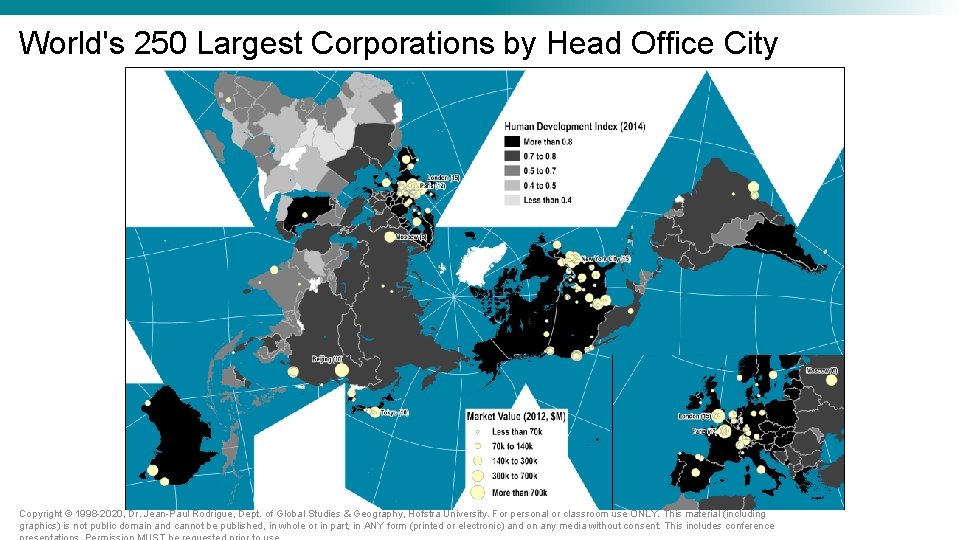
World's 250 Largest Corporations by Head Office City Copyright © 1998 -2020, Dr. Jean-Paul Rodrigue, Dept. of Global Studies & Geography, Hofstra University. For personal or classroom use ONLY. This material (including graphics) is not public domain and cannot be published, in whole or in part, in ANY form (printed or electronic) and on any media without consent. This includes conference
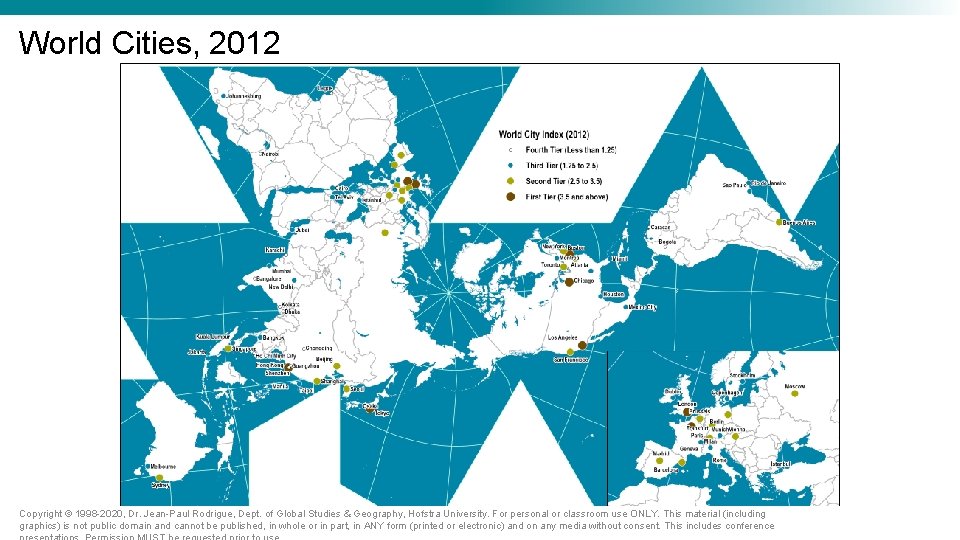
World Cities, 2012 Copyright © 1998 -2020, Dr. Jean-Paul Rodrigue, Dept. of Global Studies & Geography, Hofstra University. For personal or classroom use ONLY. This material (including graphics) is not public domain and cannot be published, in whole or in part, in ANY form (printed or electronic) and on any media without consent. This includes conference
Criteria to be a World City (Foreign Policy) Recognition First-name familiarity; a city is recognized without the need for a political subdivision (e. g. London, UK or Paris, France). Influence in international affairs Washington, Berlin, Brussels are major capitals of influence. New York; United Nations. Large population Population of at least one million, typically several million. Transport hub Major port and/or airport facilities. Several highways and/or a large mass transit network (rapid transit, light rail, regional rail, ferry, or bus). Large cultural communities Several international cultural groups and/or expatriate communities. International institutions Financial institutions, law firms, corporate headquarters, international conglomerates, and stock exchanges (influence on the global economy). Cultural institutions (museums and universities). Media and telecommunications Several powerful and influential media outlets with an international reach. Advanced communications infrastructure (fiber optics, Wi-Fi networks, cellular phone services). International events An active cultural scene (film festivals, music or theatre scene, an orchestra, an opera company, art galleries). Major sport events (e. g. Olympics, World Cup). Copyright © 1998 -2020, Dr. Jean-Paul Rodrigue, Dept. of Global Studies & Geography, Hofstra University. For personal or classroom use ONLY. This material (including graphics) is not public domain and cannot be published, in whole or in part, in ANY form (printed or electronic) and on any media without consent. This includes conference
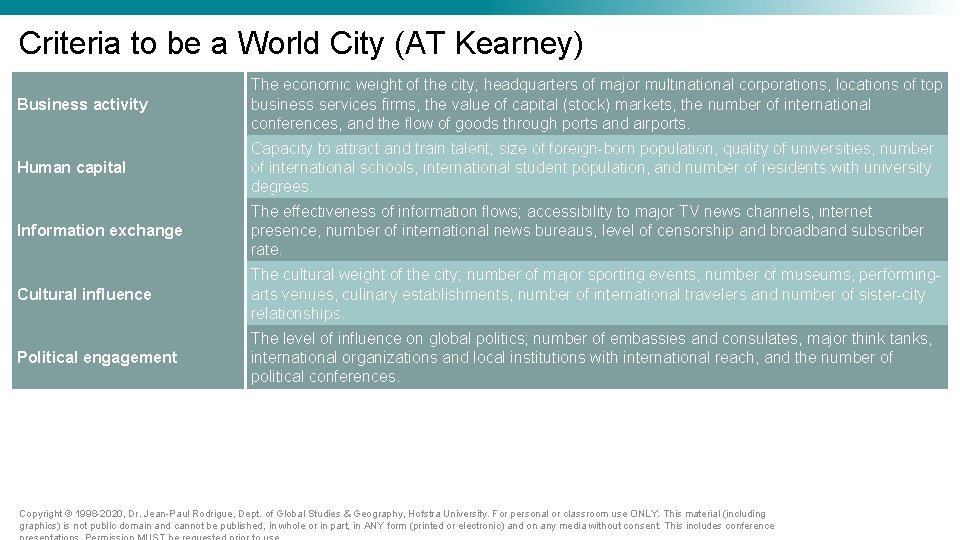
Criteria to be a World City (AT Kearney) Business activity The economic weight of the city; headquarters of major multinational corporations, locations of top business services firms, the value of capital (stock) markets, the number of international conferences, and the flow of goods through ports and airports. Human capital Capacity to attract and train talent; size of foreign-born population, quality of universities, number of international schools, international student population, and number of residents with university degrees. Information exchange The effectiveness of information flows; accessibility to major TV news channels, internet presence, number of international news bureaus, level of censorship and broadband subscriber rate. Cultural influence The cultural weight of the city; number of major sporting events, number of museums, performingarts venues, culinary establishments, number of international travelers and number of sister-city relationships. Political engagement The level of influence on global politics; number of embassies and consulates, major think tanks, international organizations and local institutions with international reach, and the number of political conferences. Copyright © 1998 -2020, Dr. Jean-Paul Rodrigue, Dept. of Global Studies & Geography, Hofstra University. For personal or classroom use ONLY. This material (including graphics) is not public domain and cannot be published, in whole or in part, in ANY form (printed or electronic) and on any media without consent. This includes conference
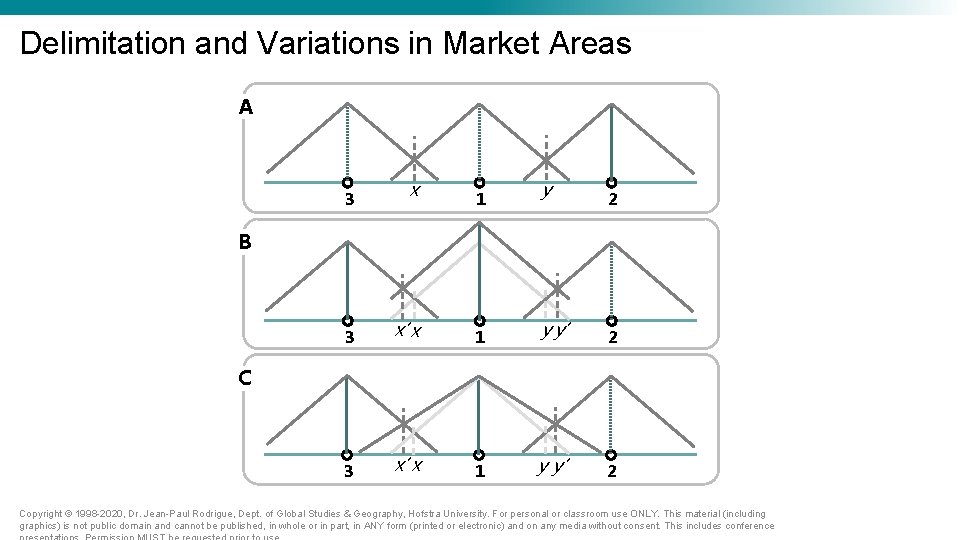
Delimitation and Variations in Market Areas A 3 x 1 y 2 B 3 x’ x 1 y y’ 2 3 x x’ 1 y y’ 2 C Copyright © 1998 -2020, Dr. Jean-Paul Rodrigue, Dept. of Global Studies & Geography, Hofstra University. For personal or classroom use ONLY. This material (including graphics) is not public domain and cannot be published, in whole or in part, in ANY form (printed or electronic) and on any media without consent. This includes conference
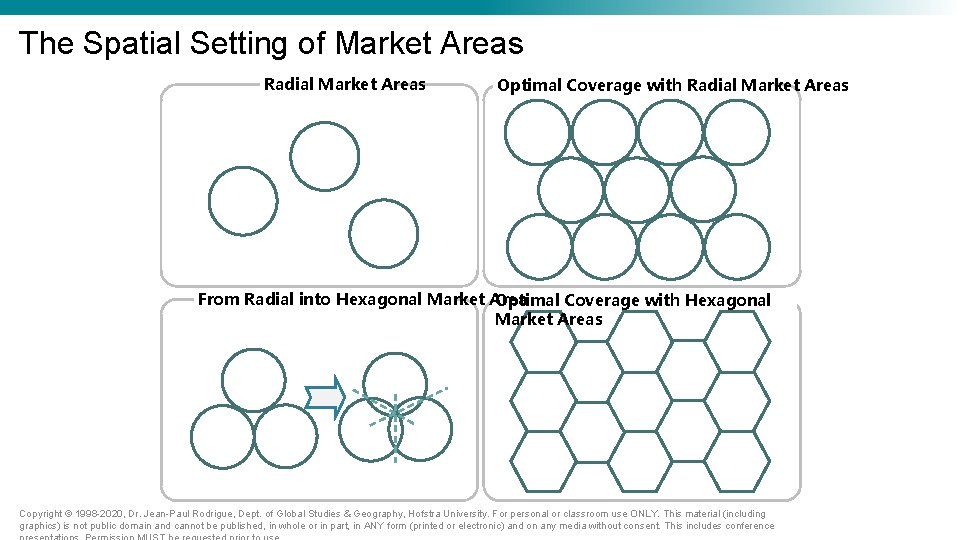
The Spatial Setting of Market Areas Radial Market Areas Optimal Coverage with Radial Market Areas From Radial into Hexagonal Market Area Optimal Coverage with Hexagonal Market Areas Copyright © 1998 -2020, Dr. Jean-Paul Rodrigue, Dept. of Global Studies & Geography, Hofstra University. For personal or classroom use ONLY. This material (including graphics) is not public domain and cannot be published, in whole or in part, in ANY form (printed or electronic) and on any media without consent. This includes conference
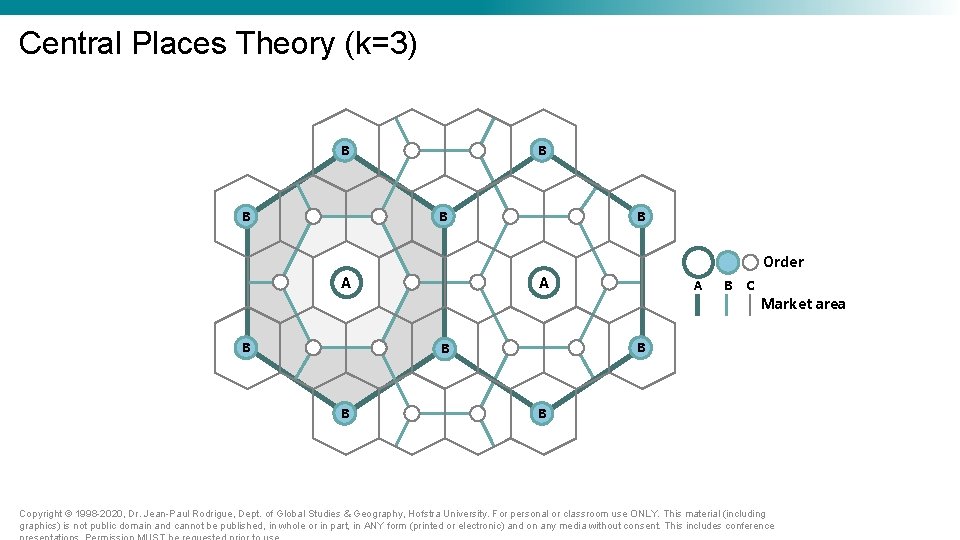
Central Places Theory (k=3) B B B Order A A A B C Market area B B B Copyright © 1998 -2020, Dr. Jean-Paul Rodrigue, Dept. of Global Studies & Geography, Hofstra University. For personal or classroom use ONLY. This material (including graphics) is not public domain and cannot be published, in whole or in part, in ANY form (printed or electronic) and on any media without consent. This includes conference
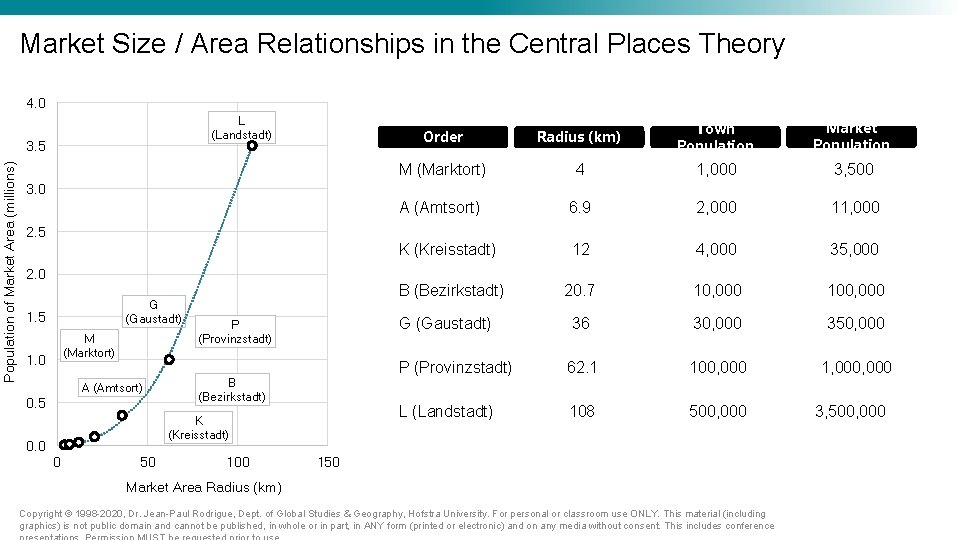
Market Size / Area Relationships in the Central Places Theory 4. 0 L (Landstadt) Population of Market Area (millions) 3. 5 Order Radius (km) Town Population Market Population M (Marktort) 4 1, 000 3, 500 A (Amtsort) 6. 9 2, 000 11, 000 K (Kreisstadt) 12 4, 000 35, 000 B (Bezirkstadt) 20. 7 10, 000 100, 000 36 30, 000 350, 000 P (Provinzstadt) 62. 1 100, 000 1, 000 L (Landstadt) 108 500, 000 3. 0 2. 5 2. 0 G (Gaustadt) 1. 5 M (Marktort) 1. 0 A (Amtsort) 0. 5 G (Gaustadt) P (Provinzstadt) B (Bezirkstadt) K (Kreisstadt) 0. 0 0 50 100 150 Market Area Radius (km) Copyright © 1998 -2020, Dr. Jean-Paul Rodrigue, Dept. of Global Studies & Geography, Hofstra University. For personal or classroom use ONLY. This material (including graphics) is not public domain and cannot be published, in whole or in part, in ANY form (printed or electronic) and on any media without consent. This includes conference 3, 500, 000
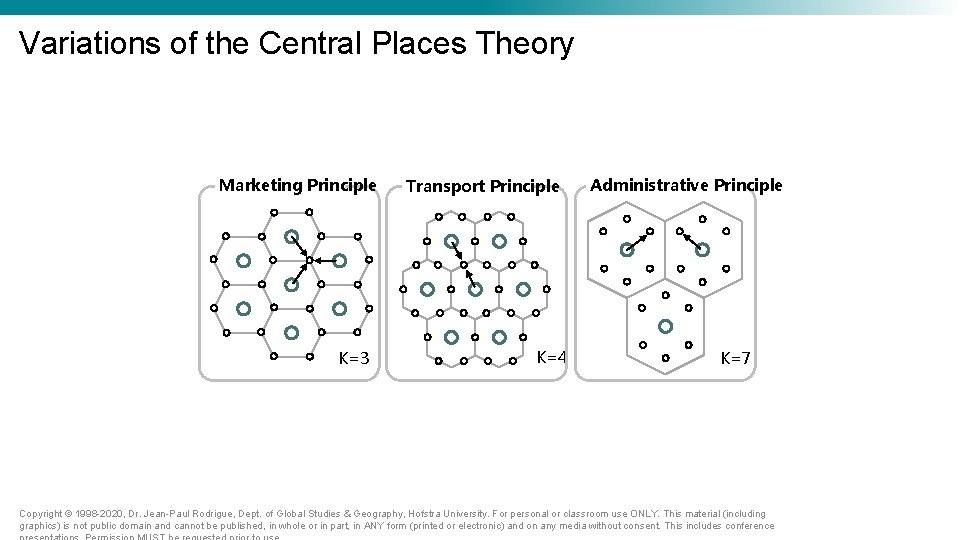
Variations of the Central Places Theory Marketing Principle K=3 Transport Principle K=4 Administrative Principle K=7 Copyright © 1998 -2020, Dr. Jean-Paul Rodrigue, Dept. of Global Studies & Geography, Hofstra University. For personal or classroom use ONLY. This material (including graphics) is not public domain and cannot be published, in whole or in part, in ANY form (printed or electronic) and on any media without consent. This includes conference
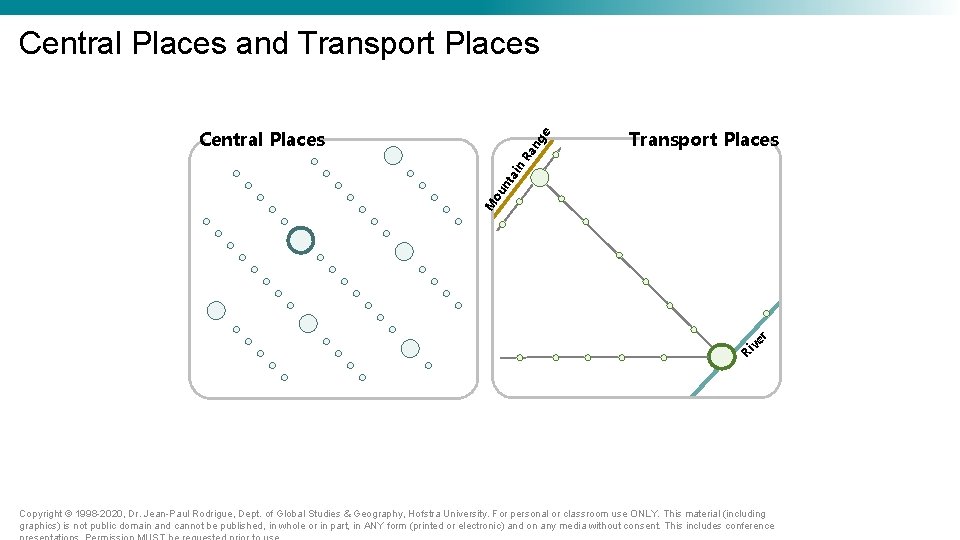
Central Places and Transport Places Ri ve r M ou nt ai n Ra ng e Central Places Copyright © 1998 -2020, Dr. Jean-Paul Rodrigue, Dept. of Global Studies & Geography, Hofstra University. For personal or classroom use ONLY. This material (including graphics) is not public domain and cannot be published, in whole or in part, in ANY form (printed or electronic) and on any media without consent. This includes conference
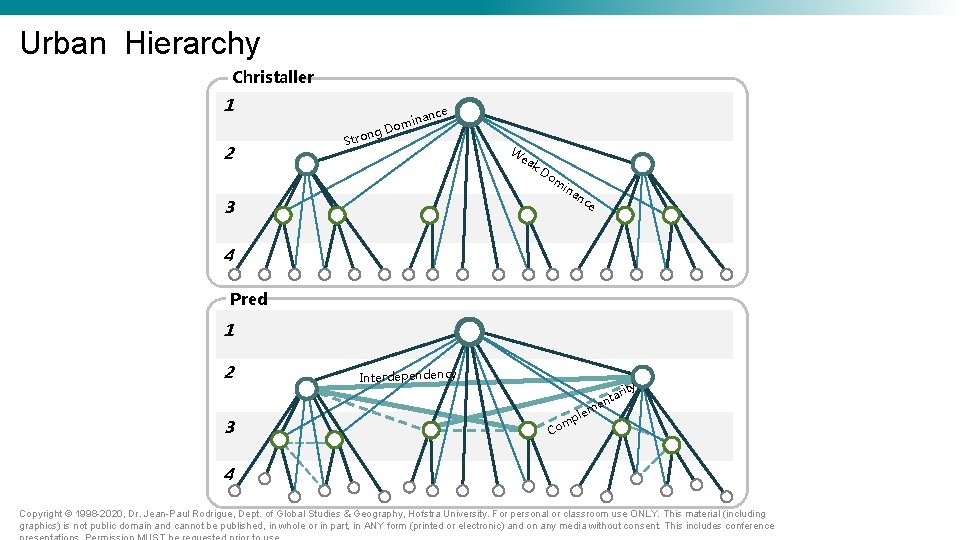
Urban Hierarchy Christaller 1 2 ce nan omi ng D Stro W ea k D om in 3 an ce 4 Pred 1 2 3 Interdependency rity a t n e lem p m Co 4 Copyright © 1998 -2020, Dr. Jean-Paul Rodrigue, Dept. of Global Studies & Geography, Hofstra University. For personal or classroom use ONLY. This material (including graphics) is not public domain and cannot be published, in whole or in part, in ANY form (printed or electronic) and on any media without consent. This includes conference
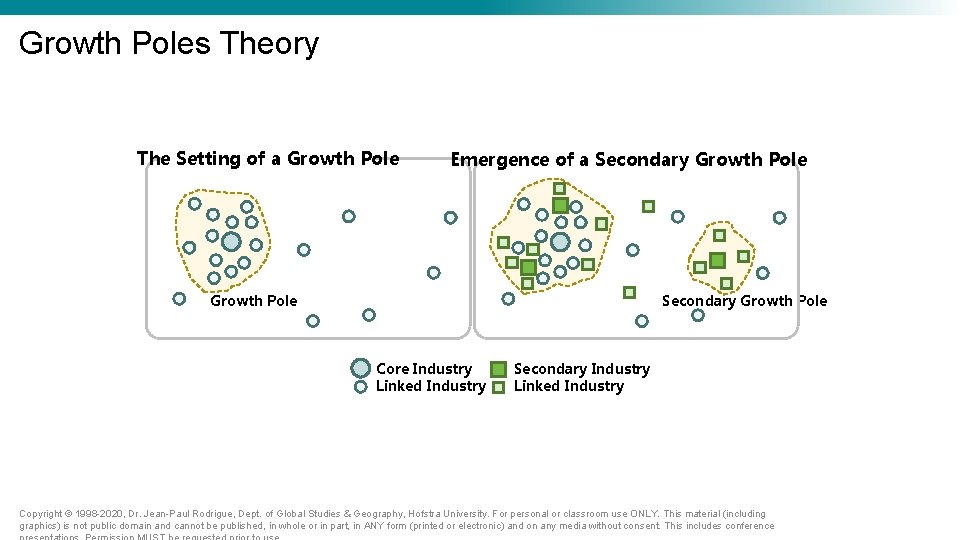
Growth Poles Theory The Setting of a Growth Pole Emergence of a Secondary Growth Pole Core Industry Linked Industry Secondary Industry Linked Industry Copyright © 1998 -2020, Dr. Jean-Paul Rodrigue, Dept. of Global Studies & Geography, Hofstra University. For personal or classroom use ONLY. This material (including graphics) is not public domain and cannot be published, in whole or in part, in ANY form (printed or electronic) and on any media without consent. This includes conference
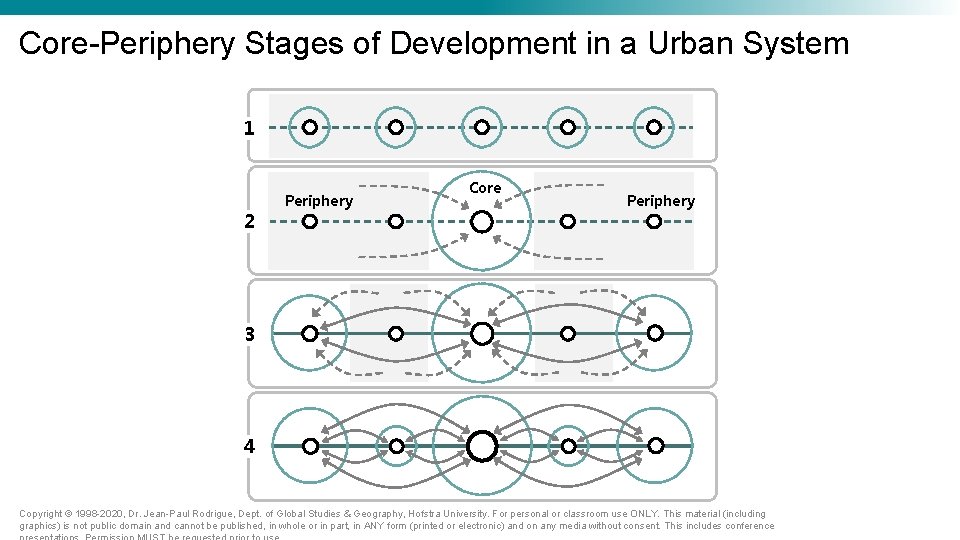
Core-Periphery Stages of Development in a Urban System 1 2 Periphery Core Periphery 3 4 Copyright © 1998 -2020, Dr. Jean-Paul Rodrigue, Dept. of Global Studies & Geography, Hofstra University. For personal or classroom use ONLY. This material (including graphics) is not public domain and cannot be published, in whole or in part, in ANY form (printed or electronic) and on any media without consent. This includes conference
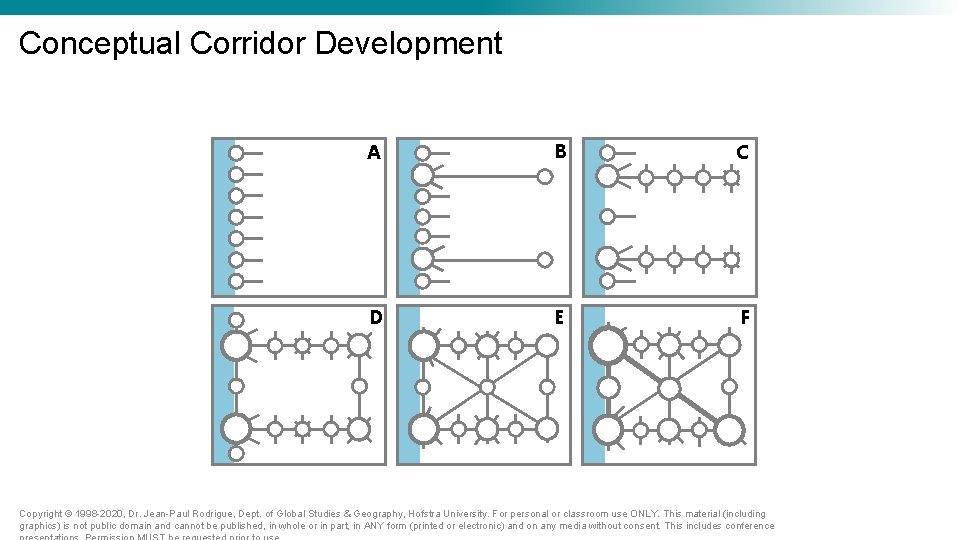
Conceptual Corridor Development A B C D E F Copyright © 1998 -2020, Dr. Jean-Paul Rodrigue, Dept. of Global Studies & Geography, Hofstra University. For personal or classroom use ONLY. This material (including graphics) is not public domain and cannot be published, in whole or in part, in ANY form (printed or electronic) and on any media without consent. This includes conference
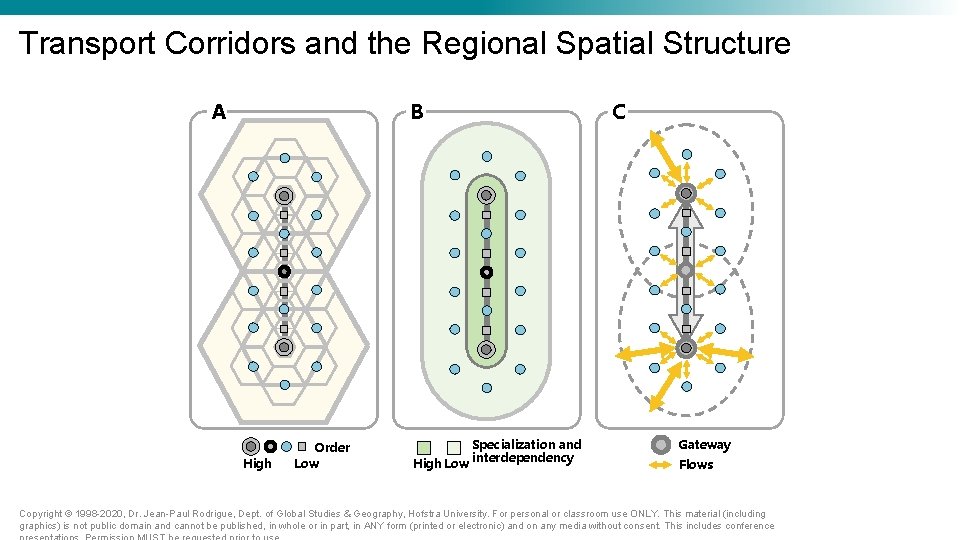
Transport Corridors and the Regional Spatial Structure A B High Order Low Specialization and High Low interdependency C Gateway Flows Copyright © 1998 -2020, Dr. Jean-Paul Rodrigue, Dept. of Global Studies & Geography, Hofstra University. For personal or classroom use ONLY. This material (including graphics) is not public domain and cannot be published, in whole or in part, in ANY form (printed or electronic) and on any media without consent. This includes conference
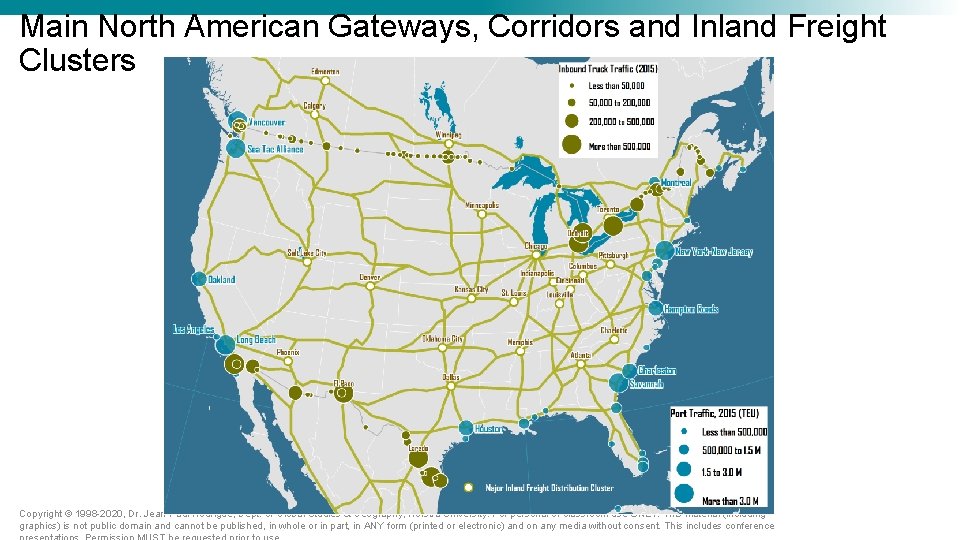
Main North American Gateways, Corridors and Inland Freight Clusters Copyright © 1998 -2020, Dr. Jean-Paul Rodrigue, Dept. of Global Studies & Geography, Hofstra University. For personal or classroom use ONLY. This material (including graphics) is not public domain and cannot be published, in whole or in part, in ANY form (printed or electronic) and on any media without consent. This includes conference
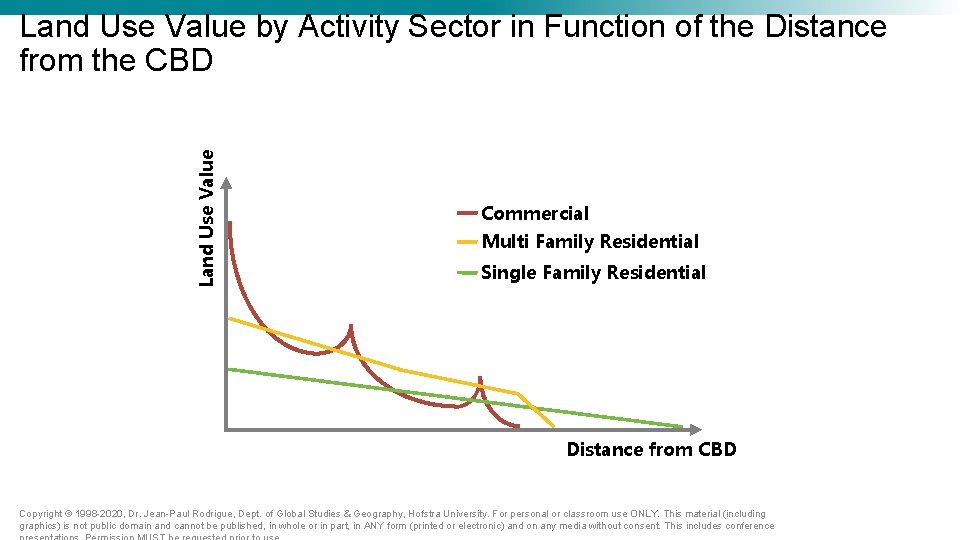
Land Use Value by Activity Sector in Function of the Distance from the CBD Commercial Multi Family Residential Single Family Residential Distance from CBD Copyright © 1998 -2020, Dr. Jean-Paul Rodrigue, Dept. of Global Studies & Geography, Hofstra University. For personal or classroom use ONLY. This material (including graphics) is not public domain and cannot be published, in whole or in part, in ANY form (printed or electronic) and on any media without consent. This includes conference
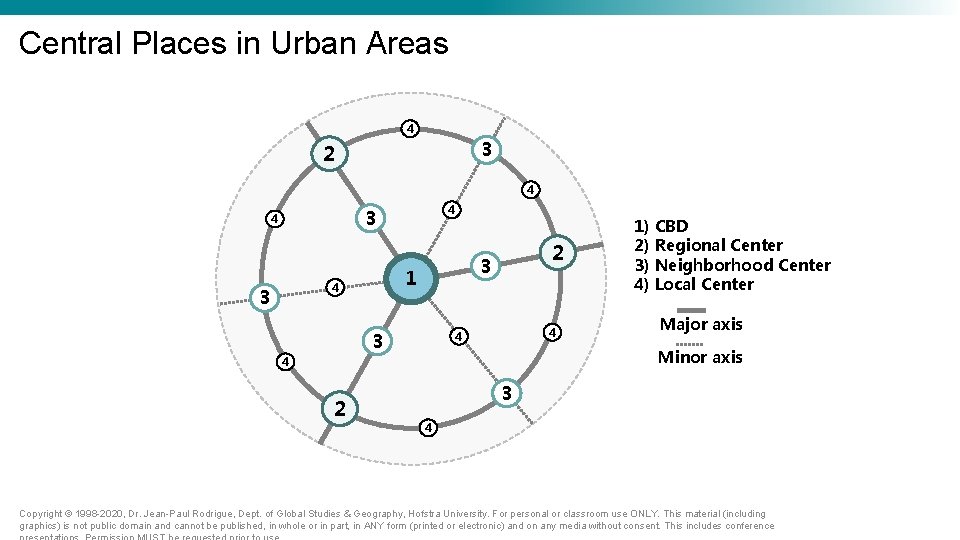
Central Places in Urban Areas 4 3 2 4 4 3 3 1 4 2 4 4 3 Major axis Minor axis 4 2 1) CBD 2) Regional Center 3) Neighborhood Center 4) Local Center 3 4 Copyright © 1998 -2020, Dr. Jean-Paul Rodrigue, Dept. of Global Studies & Geography, Hofstra University. For personal or classroom use ONLY. This material (including graphics) is not public domain and cannot be published, in whole or in part, in ANY form (printed or electronic) and on any media without consent. This includes conference
Transportation and Location Copyright © 1998 -2020, Dr. Jean-Paul Rodrigue, Dept. of Global Studies & Geography, Hofstra University. For personal or classroom use ONLY. This material (including graphics) is not public domain and cannot be published, in whole or in part, in ANY form (printed or electronic) and on any media without consent. This includes conference
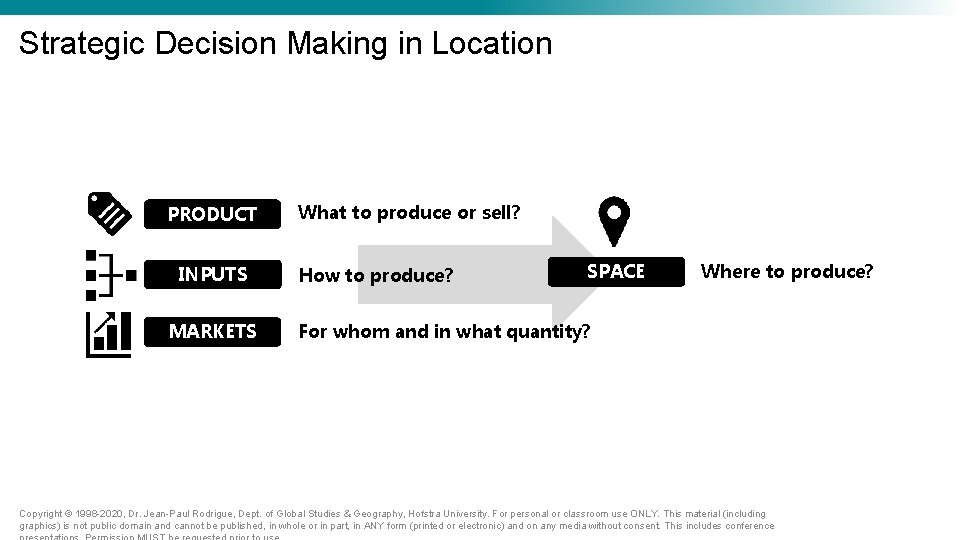
Strategic Decision Making in Location PRODUCT INPUTS MARKETS What to produce or sell? How to produce? SPACE Where to produce? For whom and in what quantity? Copyright © 1998 -2020, Dr. Jean-Paul Rodrigue, Dept. of Global Studies & Geography, Hofstra University. For personal or classroom use ONLY. This material (including graphics) is not public domain and cannot be published, in whole or in part, in ANY form (printed or electronic) and on any media without consent. This includes conference
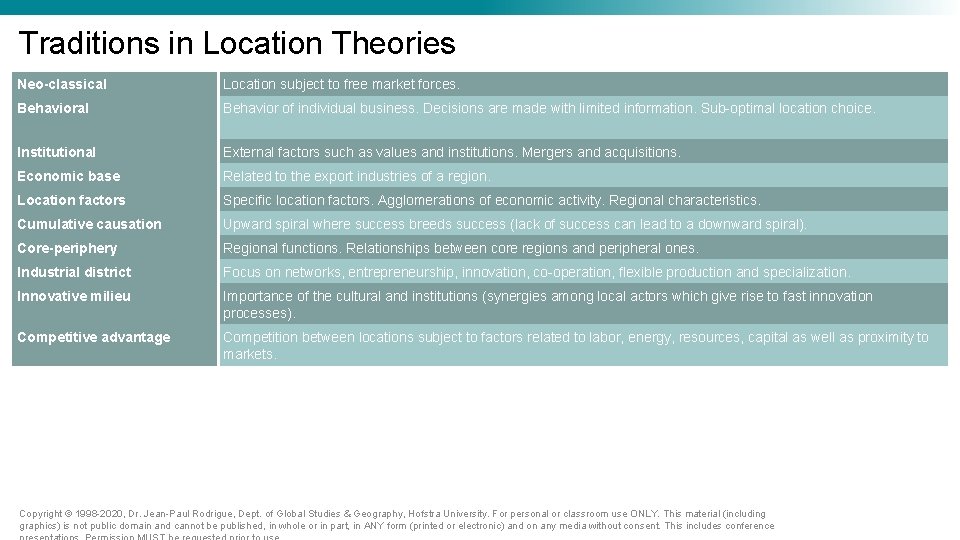
Traditions in Location Theories Neo-classical Location subject to free market forces. Behavioral Behavior of individual business. Decisions are made with limited information. Sub-optimal location choice. Institutional External factors such as values and institutions. Mergers and acquisitions. Economic base Related to the export industries of a region. Location factors Specific location factors. Agglomerations of economic activity. Regional characteristics. Cumulative causation Upward spiral where success breeds success (lack of success can lead to a downward spiral). Core-periphery Regional functions. Relationships between core regions and peripheral ones. Industrial district Focus on networks, entrepreneurship, innovation, co-operation, flexible production and specialization. Innovative milieu Importance of the cultural and institutions (synergies among local actors which give rise to fast innovation processes). Competitive advantage Competition between locations subject to factors related to labor, energy, resources, capital as well as proximity to markets. Copyright © 1998 -2020, Dr. Jean-Paul Rodrigue, Dept. of Global Studies & Geography, Hofstra University. For personal or classroom use ONLY. This material (including graphics) is not public domain and cannot be published, in whole or in part, in ANY form (printed or electronic) and on any media without consent. This includes conference
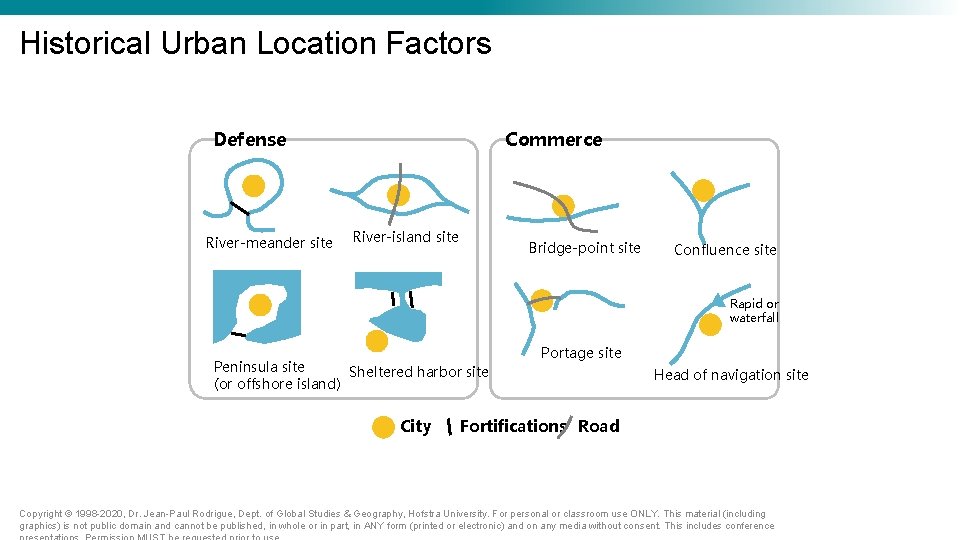
Historical Urban Location Factors Defense River-meander site Commerce River-island site Bridge-point site Confluence site Rapid or waterfall Peninsula site Sheltered harbor site (or offshore island) City Portage site Head of navigation site Fortifications Road Copyright © 1998 -2020, Dr. Jean-Paul Rodrigue, Dept. of Global Studies & Geography, Hofstra University. For personal or classroom use ONLY. This material (including graphics) is not public domain and cannot be published, in whole or in part, in ANY form (printed or electronic) and on any media without consent. This includes conference
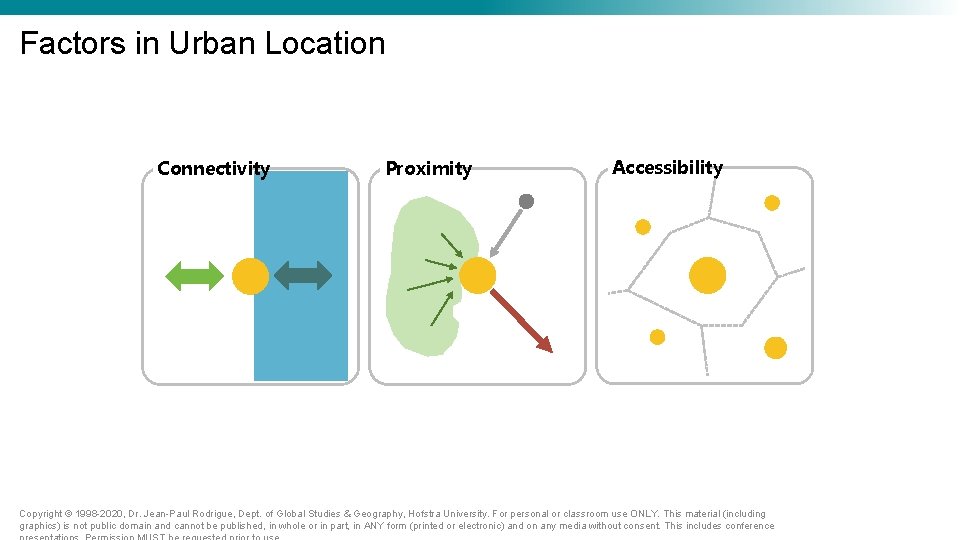
Factors in Urban Location Connectivity Proximity Accessibility Copyright © 1998 -2020, Dr. Jean-Paul Rodrigue, Dept. of Global Studies & Geography, Hofstra University. For personal or classroom use ONLY. This material (including graphics) is not public domain and cannot be published, in whole or in part, in ANY form (printed or electronic) and on any media without consent. This includes conference
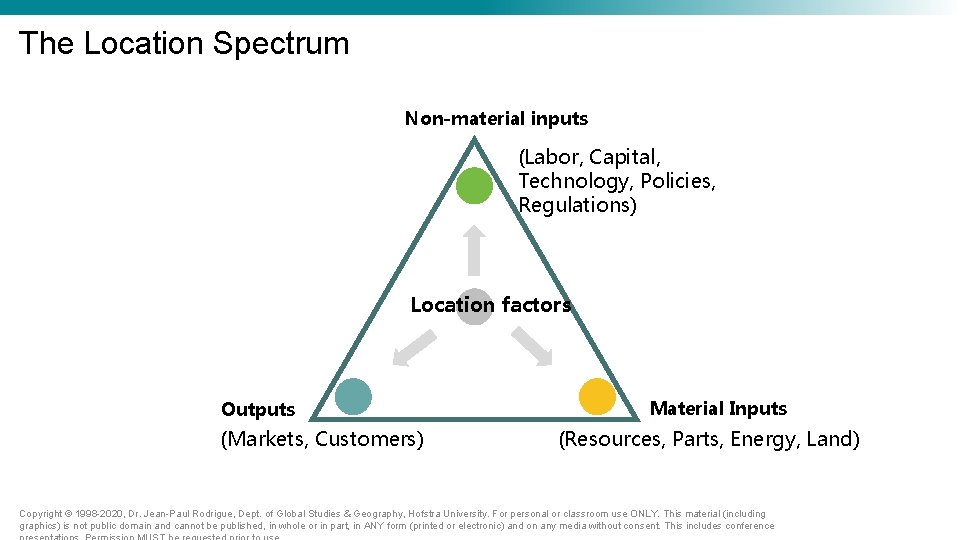
The Location Spectrum Non-material inputs (Labor, Capital, Technology, Policies, Regulations) Location factors Outputs (Markets, Customers) Material Inputs (Resources, Parts, Energy, Land) Copyright © 1998 -2020, Dr. Jean-Paul Rodrigue, Dept. of Global Studies & Geography, Hofstra University. For personal or classroom use ONLY. This material (including graphics) is not public domain and cannot be published, in whole or in part, in ANY form (printed or electronic) and on any media without consent. This includes conference
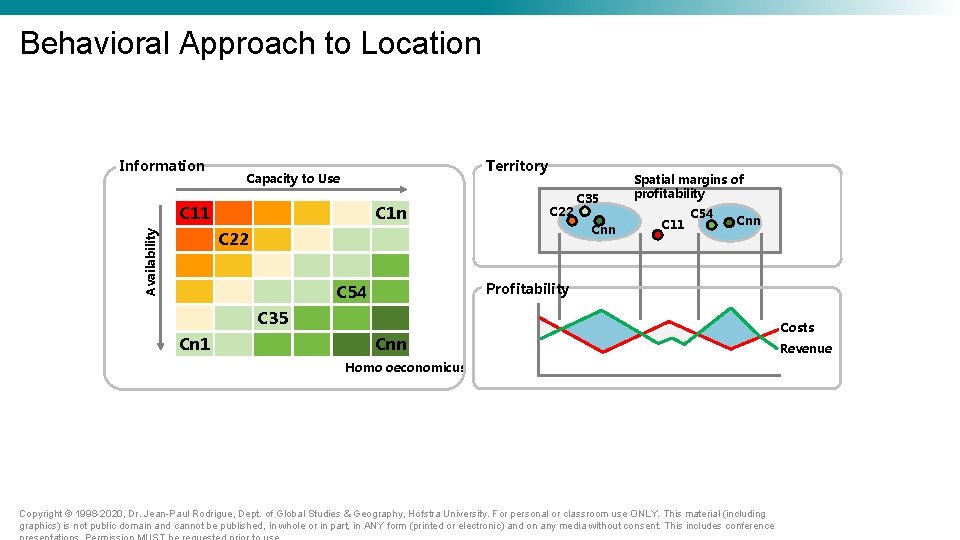
Behavioral Approach to Location Information Territory Capacity to Use C 11 C 1 n C 22 Cnn C 22 Availability C 35 Spatial margins of profitability C 11 C 54 Cnn Profitability C 54 C 35 Cn 1 Cnn Homo oeconomicus Copyright © 1998 -2020, Dr. Jean-Paul Rodrigue, Dept. of Global Studies & Geography, Hofstra University. For personal or classroom use ONLY. This material (including graphics) is not public domain and cannot be published, in whole or in part, in ANY form (printed or electronic) and on any media without consent. This includes conference Costs Revenue
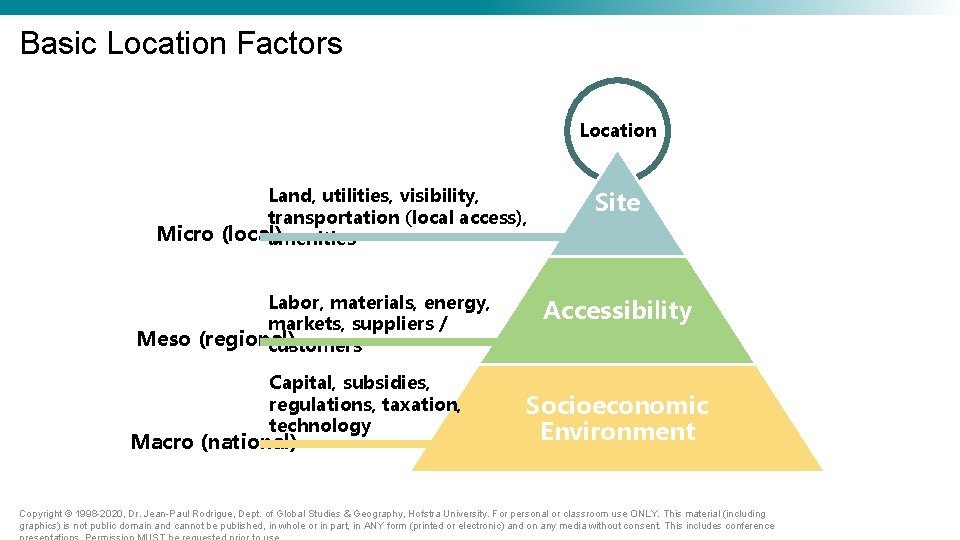
Basic Location Factors Location Land, utilities, visibility, transportation (local access), Micro (local) amenities Labor, materials, energy, markets, suppliers / Meso (regional) customers Capital, subsidies, regulations, taxation, technology Macro (national) Site Accessibility Socioeconomic Environment Copyright © 1998 -2020, Dr. Jean-Paul Rodrigue, Dept. of Global Studies & Geography, Hofstra University. For personal or classroom use ONLY. This material (including graphics) is not public domain and cannot be published, in whole or in part, in ANY form (printed or electronic) and on any media without consent. This includes conference
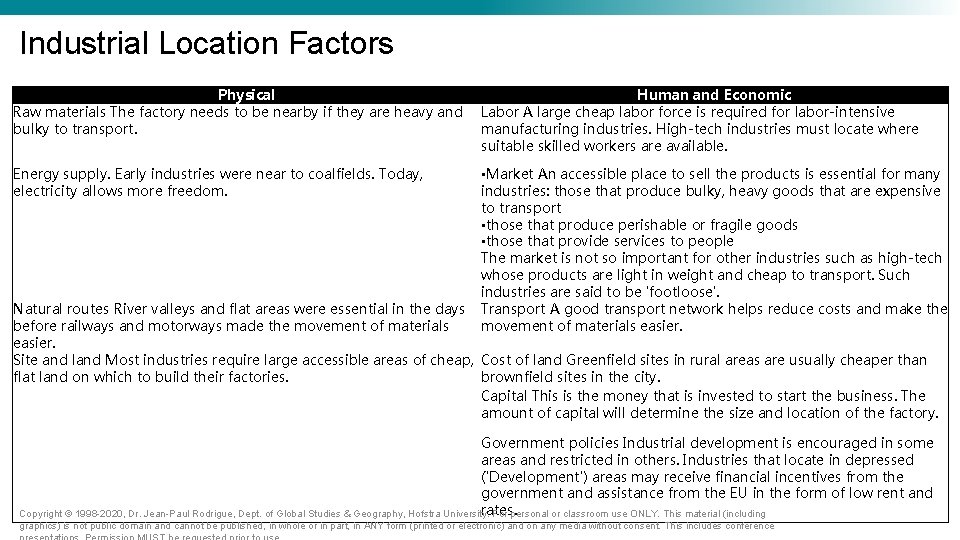
Industrial Location Factors Physical Raw materials The factory needs to be nearby if they are heavy and bulky to transport. Human and Economic Labor A large cheap labor force is required for labor-intensive manufacturing industries. High-tech industries must locate where suitable skilled workers are available. Energy supply. Early industries were near to coalfields. Today, electricity allows more freedom. • Market An accessible place to sell the products is essential for many industries: those that produce bulky, heavy goods that are expensive to transport • those that produce perishable or fragile goods • those that provide services to people The market is not so important for other industries such as high-tech whose products are light in weight and cheap to transport. Such industries are said to be 'footloose'. Natural routes River valleys and flat areas were essential in the days Transport A good transport network helps reduce costs and make the before railways and motorways made the movement of materials easier. Site and land Most industries require large accessible areas of cheap, Cost of land Greenfield sites in rural areas are usually cheaper than flat land on which to build their factories. brownfield sites in the city. Capital This is the money that is invested to start the business. The amount of capital will determine the size and location of the factory. Government policies Industrial development is encouraged in some areas and restricted in others. Industries that locate in depressed ('Development') areas may receive financial incentives from the government and assistance from the EU in the form of low rent and rates. Copyright © 1998 -2020, Dr. Jean-Paul Rodrigue, Dept. of Global Studies & Geography, Hofstra University. For personal or classroom use ONLY. This material (including graphics) is not public domain and cannot be published, in whole or in part, in ANY form (printed or electronic) and on any media without consent. This includes conference
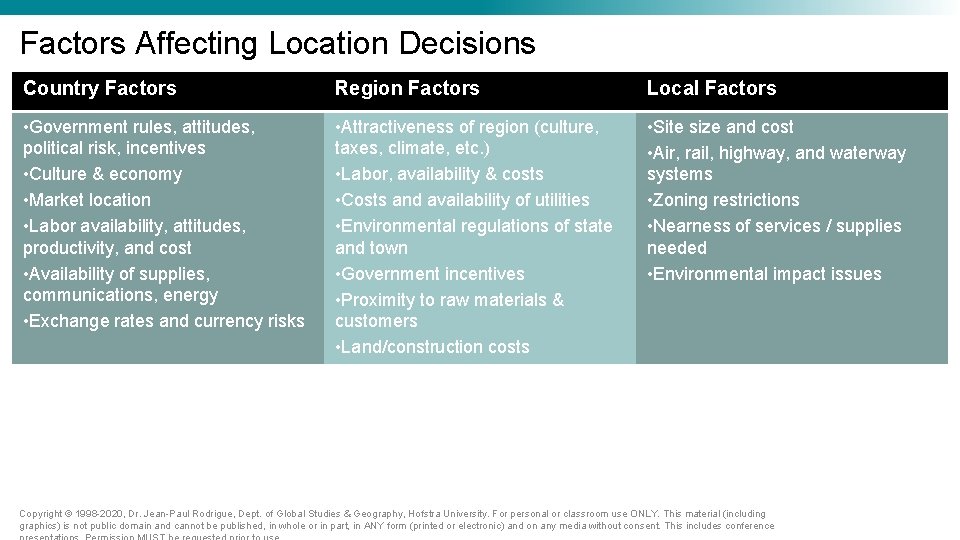
Factors Affecting Location Decisions Country Factors Region Factors Local Factors • Government rules, attitudes, political risk, incentives • Culture & economy • Market location • Labor availability, attitudes, productivity, and cost • Availability of supplies, communications, energy • Exchange rates and currency risks • Attractiveness of region (culture, taxes, climate, etc. ) • Labor, availability & costs • Costs and availability of utilities • Environmental regulations of state and town • Government incentives • Proximity to raw materials & customers • Land/construction costs • Site size and cost • Air, rail, highway, and waterway systems • Zoning restrictions • Nearness of services / supplies needed • Environmental impact issues Copyright © 1998 -2020, Dr. Jean-Paul Rodrigue, Dept. of Global Studies & Geography, Hofstra University. For personal or classroom use ONLY. This material (including graphics) is not public domain and cannot be published, in whole or in part, in ANY form (printed or electronic) and on any media without consent. This includes conference
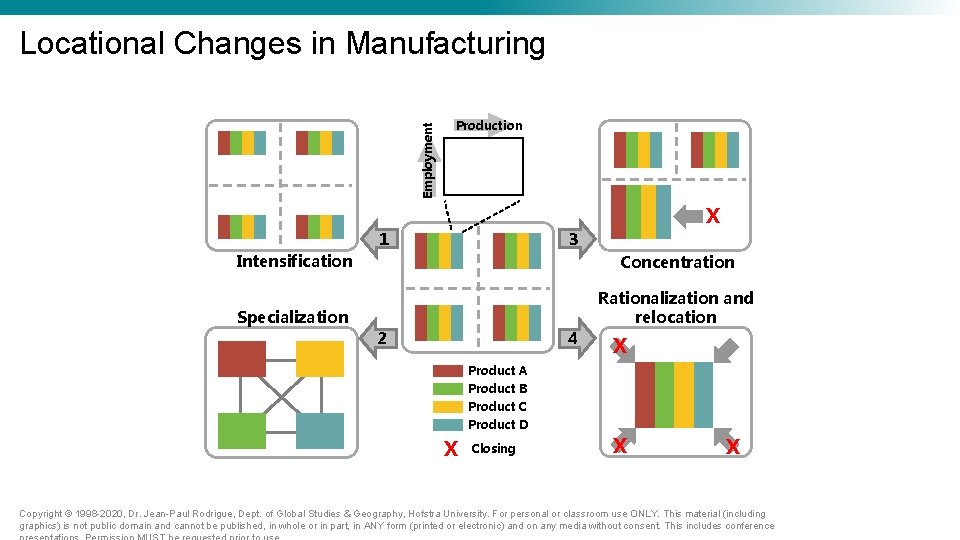
Employment Locational Changes in Manufacturing Production 1 X 3 Intensification Concentration Specialization Rationalization and relocation 2 4 X Product A Product B Product C Product D X Closing X X Copyright © 1998 -2020, Dr. Jean-Paul Rodrigue, Dept. of Global Studies & Geography, Hofstra University. For personal or classroom use ONLY. This material (including graphics) is not public domain and cannot be published, in whole or in part, in ANY form (printed or electronic) and on any media without consent. This includes conference
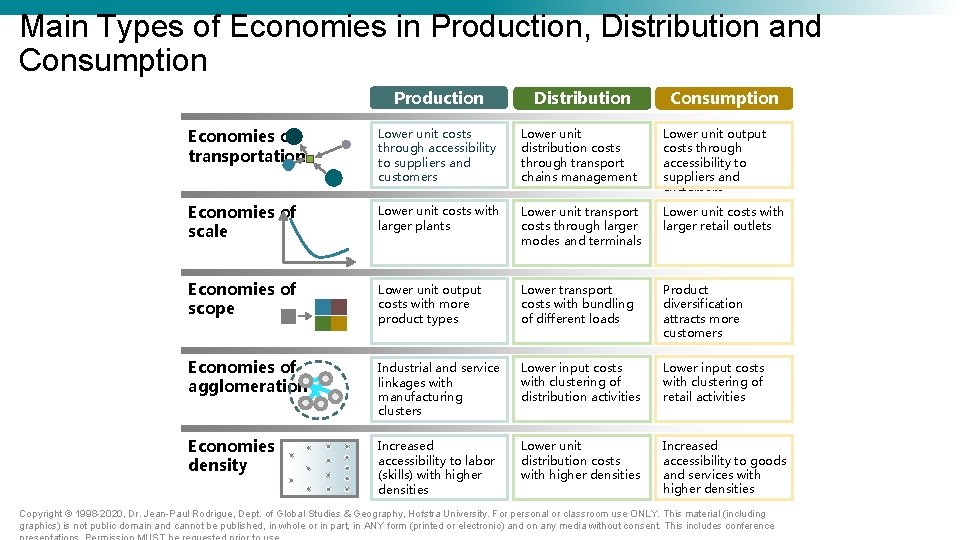
Main Types of Economies in Production, Distribution and Consumption Production Distribution Economies of transportation Lower unit costs through accessibility to suppliers and customers Lower unit distribution costs through transport chains management Lower unit output costs through accessibility to suppliers and customers Economies of scale Lower unit costs with larger plants Lower unit transport costs through larger modes and terminals Lower unit costs with larger retail outlets Economies of scope Lower unit output costs with more product types Lower transport costs with bundling of different loads Product diversification attracts more customers Economies of agglomeration Industrial and service linkages with manufacturing clusters Lower input costs with clustering of distribution activities Lower input costs with clustering of retail activities Economies of density Increased accessibility to labor (skills) with higher densities Lower unit distribution costs with higher densities Increased accessibility to goods and services with higher densities Consumption Copyright © 1998 -2020, Dr. Jean-Paul Rodrigue, Dept. of Global Studies & Geography, Hofstra University. For personal or classroom use ONLY. This material (including graphics) is not public domain and cannot be published, in whole or in part, in ANY form (printed or electronic) and on any media without consent. This includes conference
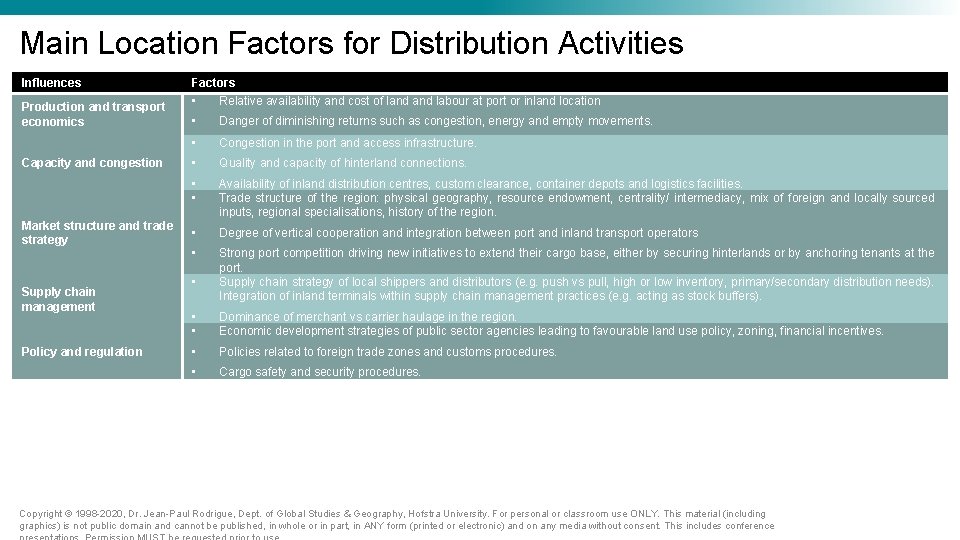
Main Location Factors for Distribution Activities Influences Production and transport economics Capacity and congestion Market structure and trade strategy Supply chain management Policy and regulation Factors • Relative availability and cost of land labour at port or inland location • Danger of diminishing returns such as congestion, energy and empty movements. • Congestion in the port and access infrastructure. • Quality and capacity of hinterland connections. • • Availability of inland distribution centres, custom clearance, container depots and logistics facilities. Trade structure of the region: physical geography, resource endowment, centrality/ intermediacy, mix of foreign and locally sourced inputs, regional specialisations, history of the region. • Degree of vertical cooperation and integration between port and inland transport operators • Strong port competition driving new initiatives to extend their cargo base, either by securing hinterlands or by anchoring tenants at the port. Supply chain strategy of local shippers and distributors (e. g. push vs pull, high or low inventory, primary/secondary distribution needs). Integration of inland terminals within supply chain management practices (e. g. acting as stock buffers). • • • Dominance of merchant vs carrier haulage in the region. Economic development strategies of public sector agencies leading to favourable land use policy, zoning, financial incentives. • Policies related to foreign trade zones and customs procedures. • Cargo safety and security procedures. Copyright © 1998 -2020, Dr. Jean-Paul Rodrigue, Dept. of Global Studies & Geography, Hofstra University. For personal or classroom use ONLY. This material (including graphics) is not public domain and cannot be published, in whole or in part, in ANY form (printed or electronic) and on any media without consent. This includes conference
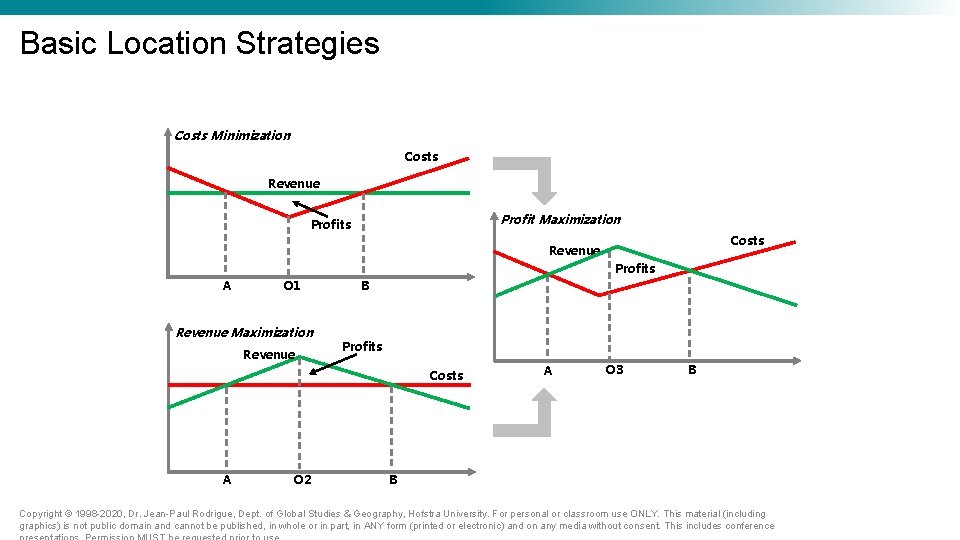
Basic Location Strategies Costs Minimization Costs Revenue Profit Maximization Profits Costs Revenue Profits A O 1 Revenue Maximization Revenue B Profits Costs A O 2 A O 3 B B Copyright © 1998 -2020, Dr. Jean-Paul Rodrigue, Dept. of Global Studies & Geography, Hofstra University. For personal or classroom use ONLY. This material (including graphics) is not public domain and cannot be published, in whole or in part, in ANY form (printed or electronic) and on any media without consent. This includes conference
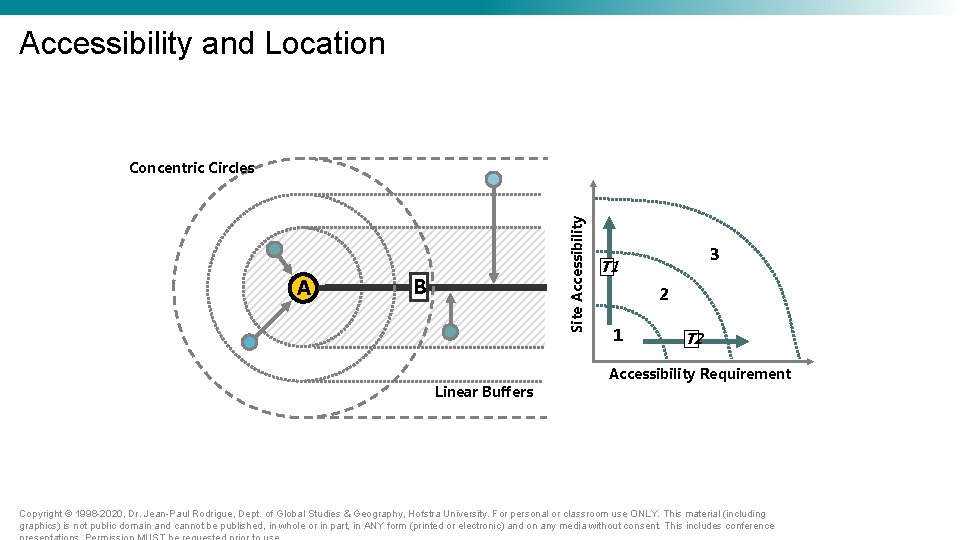
Accessibility and Location A Site Accessibility Concentric Circles B Linear Buffers 3 T 1 2 1 T 2 Accessibility Requirement Copyright © 1998 -2020, Dr. Jean-Paul Rodrigue, Dept. of Global Studies & Geography, Hofstra University. For personal or classroom use ONLY. This material (including graphics) is not public domain and cannot be published, in whole or in part, in ANY form (printed or electronic) and on any media without consent. This includes conference
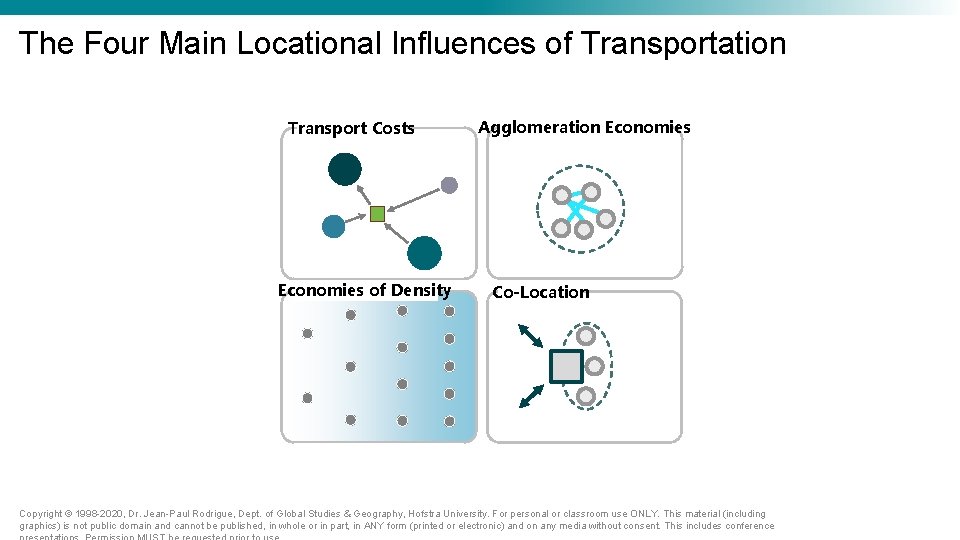
The Four Main Locational Influences of Transportation Transport Costs Economies of Density Agglomeration Economies Co-Location Copyright © 1998 -2020, Dr. Jean-Paul Rodrigue, Dept. of Global Studies & Geography, Hofstra University. For personal or classroom use ONLY. This material (including graphics) is not public domain and cannot be published, in whole or in part, in ANY form (printed or electronic) and on any media without consent. This includes conference
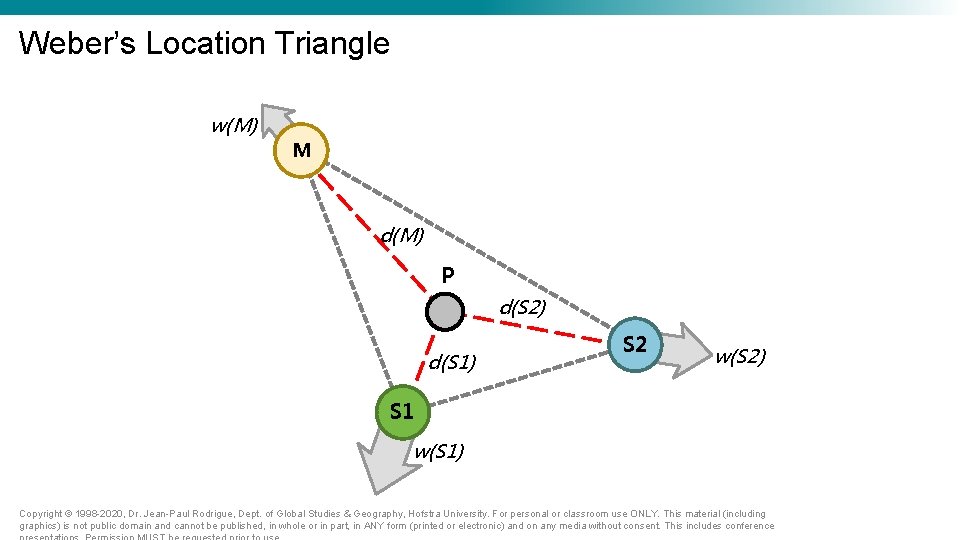
Weber’s Location Triangle w(M) M d(M) P d(S 2) d(S 1) S 2 w(S 2) S 1 w(S 1) Copyright © 1998 -2020, Dr. Jean-Paul Rodrigue, Dept. of Global Studies & Geography, Hofstra University. For personal or classroom use ONLY. This material (including graphics) is not public domain and cannot be published, in whole or in part, in ANY form (printed or electronic) and on any media without consent. This includes conference
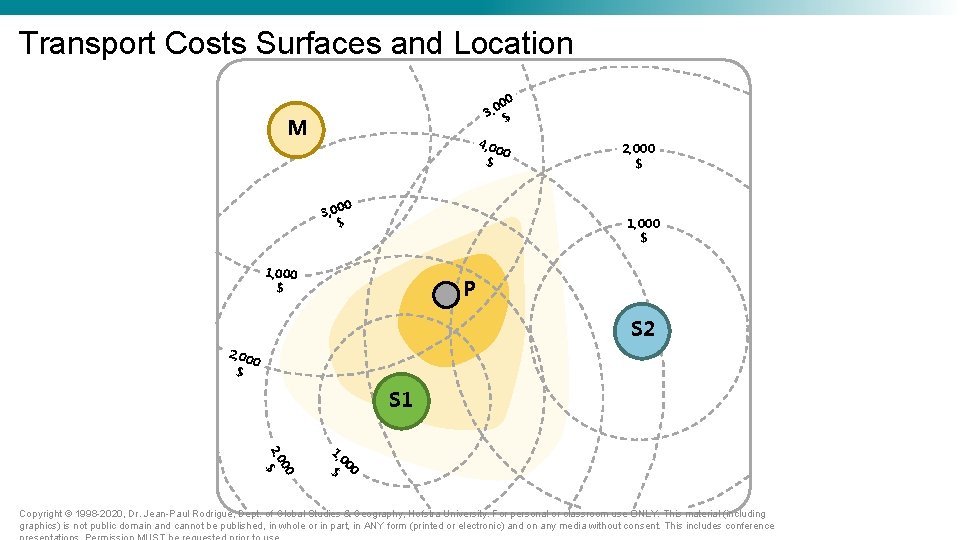
Transport Costs Surfaces and Location 00 3, 0 $ M 4, 0 00 $ 2, 000 $ 0 3, 00 $ 1, 000 $ P S 2 2, 0 00 $ S 1 00 2, 0 $ 1, 00 $ 0 Copyright © 1998 -2020, Dr. Jean-Paul Rodrigue, Dept. of Global Studies & Geography, Hofstra University. For personal or classroom use ONLY. This material (including graphics) is not public domain and cannot be published, in whole or in part, in ANY form (printed or electronic) and on any media without consent. This includes conference
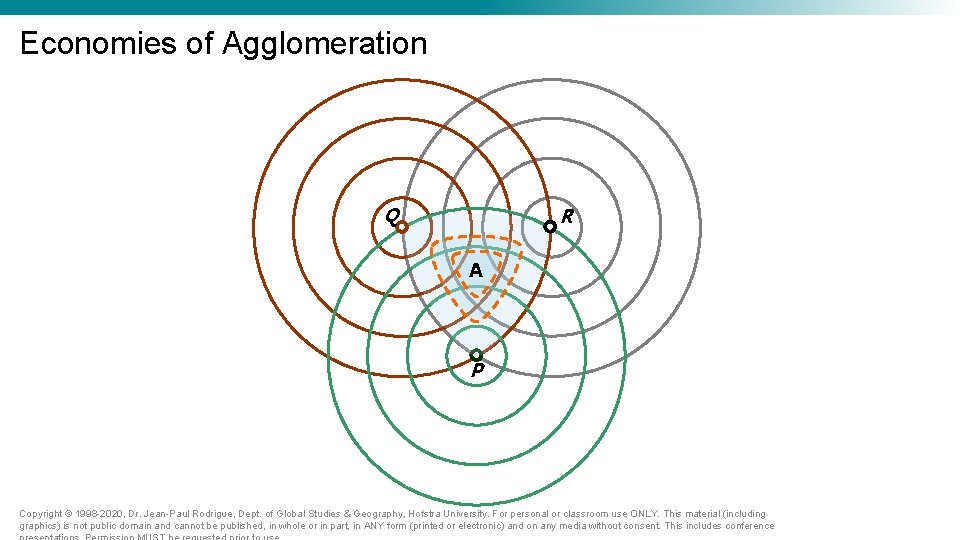
Economies of Agglomeration Q R A P Copyright © 1998 -2020, Dr. Jean-Paul Rodrigue, Dept. of Global Studies & Geography, Hofstra University. For personal or classroom use ONLY. This material (including graphics) is not public domain and cannot be published, in whole or in part, in ANY form (printed or electronic) and on any media without consent. This includes conference
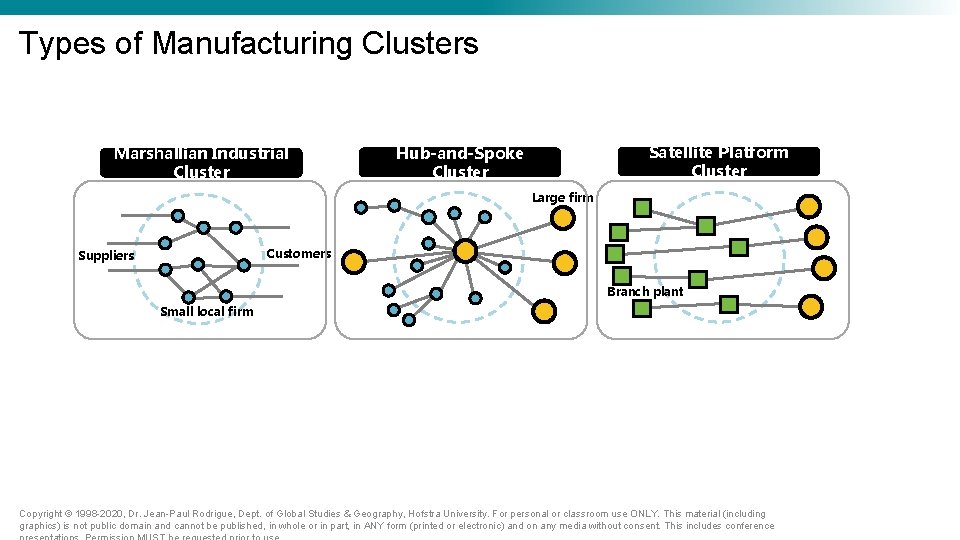
Types of Manufacturing Clusters Marshallian Industrial Cluster Satellite Platform Cluster Hub-and-Spoke Cluster Large firm Customers Suppliers Branch plant Small local firm Copyright © 1998 -2020, Dr. Jean-Paul Rodrigue, Dept. of Global Studies & Geography, Hofstra University. For personal or classroom use ONLY. This material (including graphics) is not public domain and cannot be published, in whole or in part, in ANY form (printed or electronic) and on any media without consent. This includes conference
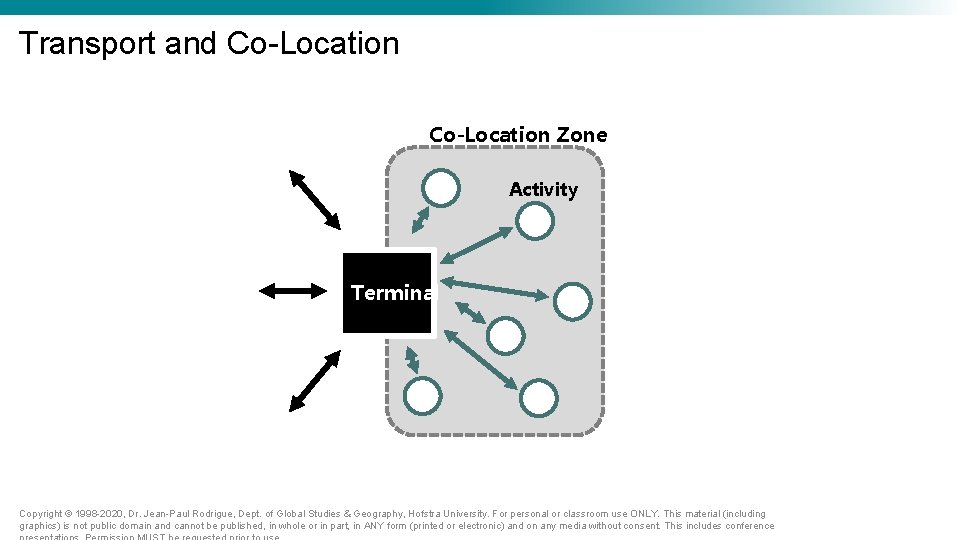
Transport and Co-Location Zone Activity Terminal Copyright © 1998 -2020, Dr. Jean-Paul Rodrigue, Dept. of Global Studies & Geography, Hofstra University. For personal or classroom use ONLY. This material (including graphics) is not public domain and cannot be published, in whole or in part, in ANY form (printed or electronic) and on any media without consent. This includes conference
Information Technologies and Mobility Copyright © 1998 -2020, Dr. Jean-Paul Rodrigue, Dept. of Global Studies & Geography, Hofstra University. For personal or classroom use ONLY. This material (including graphics) is not public domain and cannot be published, in whole or in part, in ANY form (printed or electronic) and on any media without consent. This includes conference
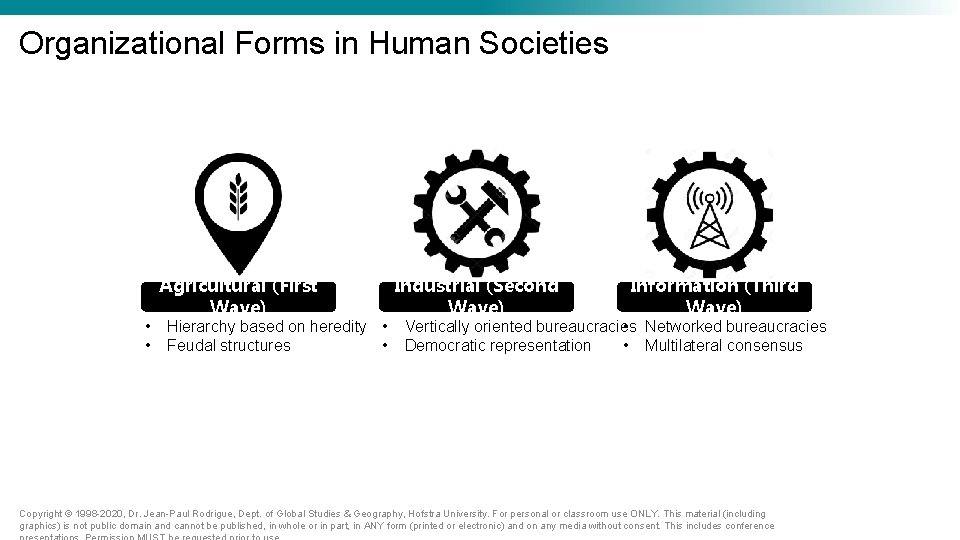
Organizational Forms in Human Societies • • Agricultural (First Wave) Hierarchy based on heredity • Feudal structures • Industrial (Second Wave) Information (Third Wave) Vertically oriented bureaucracies • Networked bureaucracies Democratic representation • Multilateral consensus Copyright © 1998 -2020, Dr. Jean-Paul Rodrigue, Dept. of Global Studies & Geography, Hofstra University. For personal or classroom use ONLY. This material (including graphics) is not public domain and cannot be published, in whole or in part, in ANY form (printed or electronic) and on any media without consent. This includes conference
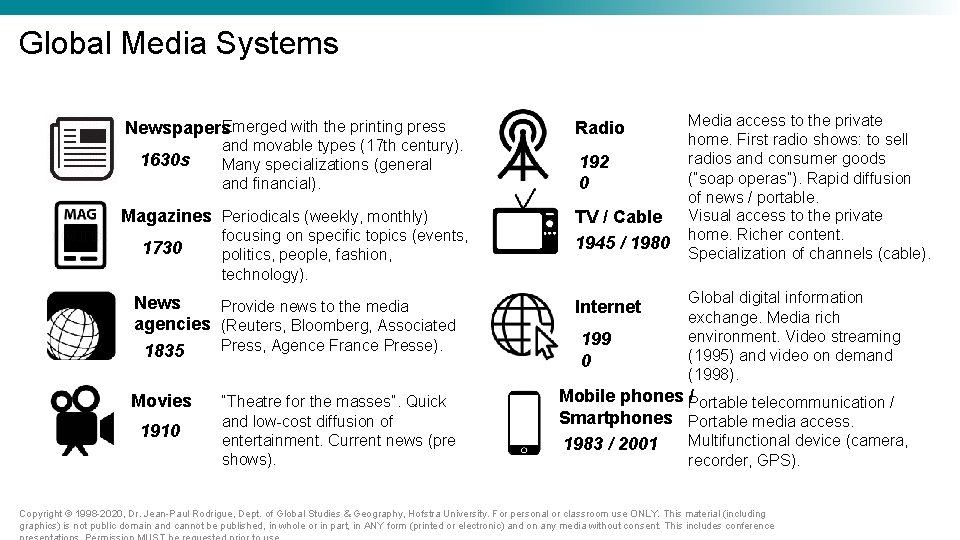
Global Media Systems Emerged with the printing press Newspapers 1630 s and movable types (17 th century). Many specializations (general and financial). Magazines Periodicals (weekly, monthly) 1730 focusing on specific topics (events, politics, people, fashion, technology). News Provide news to the media agencies (Reuters, Bloomberg, Associated Press, Agence France Presse). 1835 Movies 1910 “Theatre for the masses”. Quick and low-cost diffusion of entertainment. Current news (pre shows). Radio 192 0 TV / Cable 1945 / 1980 Internet 199 0 Media access to the private home. First radio shows: to sell radios and consumer goods (“soap operas”). Rapid diffusion of news / portable. Visual access to the private home. Richer content. Specialization of channels (cable). Global digital information exchange. Media rich environment. Video streaming (1995) and video on demand (1998). Mobile phones Portable / telecommunication / Smartphones Portable media access. Multifunctional device (camera, 1983 / 2001 recorder, GPS). Copyright © 1998 -2020, Dr. Jean-Paul Rodrigue, Dept. of Global Studies & Geography, Hofstra University. For personal or classroom use ONLY. This material (including graphics) is not public domain and cannot be published, in whole or in part, in ANY form (printed or electronic) and on any media without consent. This includes conference
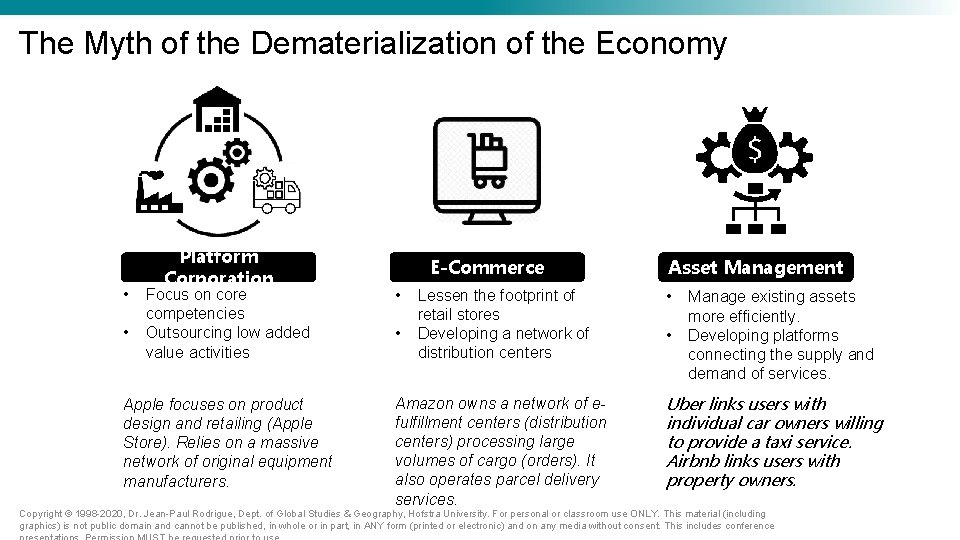
The Myth of the Dematerialization of the Economy • • Platform Corporation Focus on core competencies Outsourcing low added value activities Apple focuses on product design and retailing (Apple Store). Relies on a massive network of original equipment manufacturers. E-Commerce • • Lessen the footprint of retail stores Developing a network of distribution centers Amazon owns a network of efulfillment centers (distribution centers) processing large volumes of cargo (orders). It also operates parcel delivery services. Asset Management • • Manage existing assets more efficiently. Developing platforms connecting the supply and demand of services. Uber links users with individual car owners willing to provide a taxi service. Airbnb links users with property owners. Copyright © 1998 -2020, Dr. Jean-Paul Rodrigue, Dept. of Global Studies & Geography, Hofstra University. For personal or classroom use ONLY. This material (including graphics) is not public domain and cannot be published, in whole or in part, in ANY form (printed or electronic) and on any media without consent. This includes conference
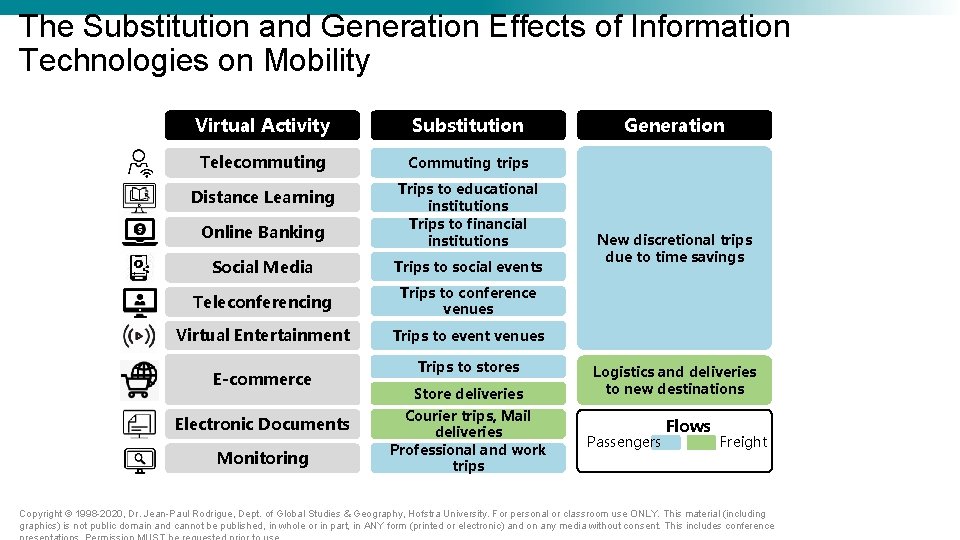
The Substitution and Generation Effects of Information Technologies on Mobility Virtual Activity Substitution Telecommuting Commuting trips Distance Learning Online Banking Trips to educational institutions Trips to financial institutions Social Media Trips to social events Teleconferencing Trips to conference venues Virtual Entertainment Trips to event venues E-commerce Electronic Documents Monitoring Trips to stores Store deliveries Courier trips, Mail deliveries Professional and work trips Generation New discretional trips due to time savings Logistics and deliveries to new destinations Passengers Flows Freight Copyright © 1998 -2020, Dr. Jean-Paul Rodrigue, Dept. of Global Studies & Geography, Hofstra University. For personal or classroom use ONLY. This material (including graphics) is not public domain and cannot be published, in whole or in part, in ANY form (printed or electronic) and on any media without consent. This includes conference
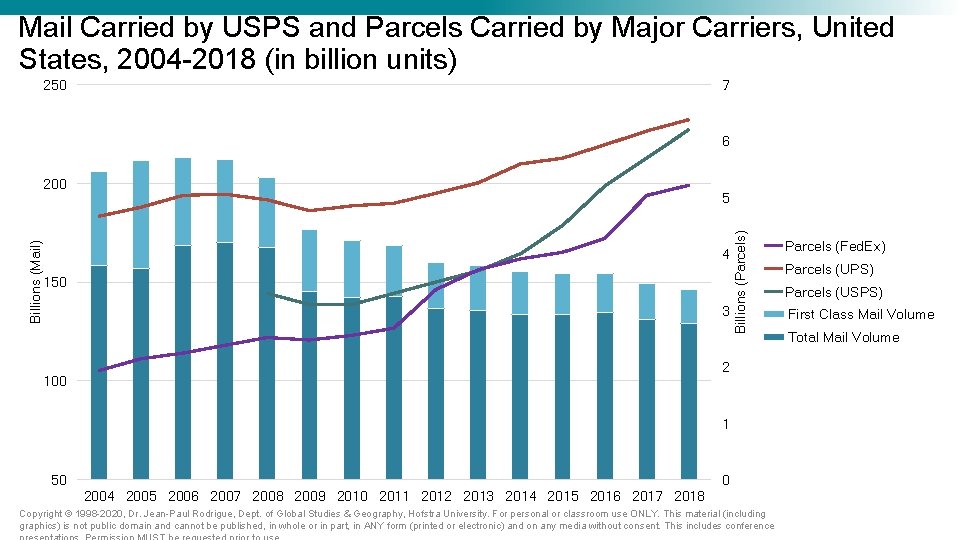
Mail Carried by USPS and Parcels Carried by Major Carriers, United States, 2004 -2018 (in billion units) 250 7 6 5 4 150 3 Billions (Parcels) Billions (Mail) 200 2 100 1 50 0 2004 2005 2006 2007 2008 2009 2010 2011 2012 2013 2014 2015 2016 2017 2018 Copyright © 1998 -2020, Dr. Jean-Paul Rodrigue, Dept. of Global Studies & Geography, Hofstra University. For personal or classroom use ONLY. This material (including graphics) is not public domain and cannot be published, in whole or in part, in ANY form (printed or electronic) and on any media without consent. This includes conference Parcels (Fed. Ex) Parcels (UPS) Parcels (USPS) First Class Mail Volume Total Mail Volume
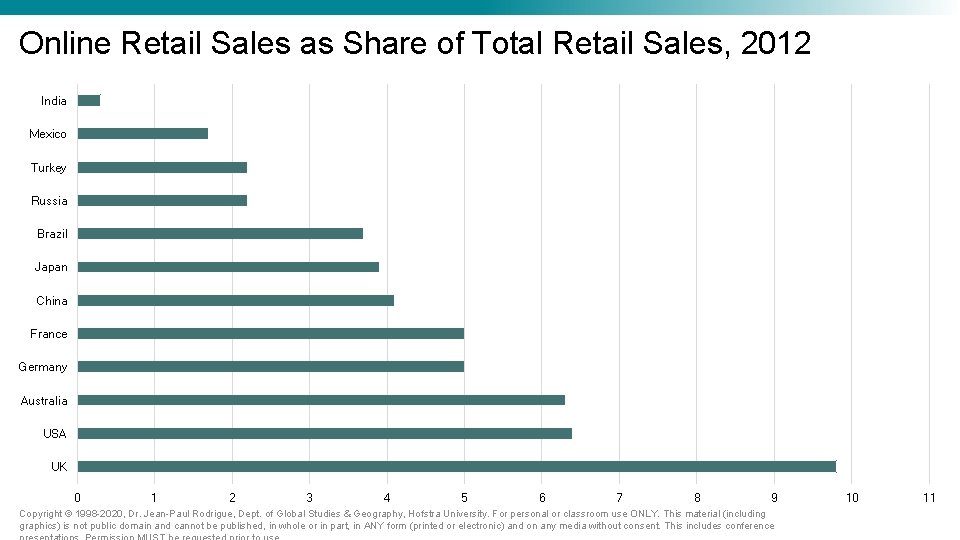
Online Retail Sales as Share of Total Retail Sales, 2012 India Mexico Turkey Russia Brazil Japan China France Germany Australia USA UK 0 1 2 3 4 5 6 7 8 9 Copyright © 1998 -2020, Dr. Jean-Paul Rodrigue, Dept. of Global Studies & Geography, Hofstra University. For personal or classroom use ONLY. This material (including graphics) is not public domain and cannot be published, in whole or in part, in ANY form (printed or electronic) and on any media without consent. This includes conference 10 11
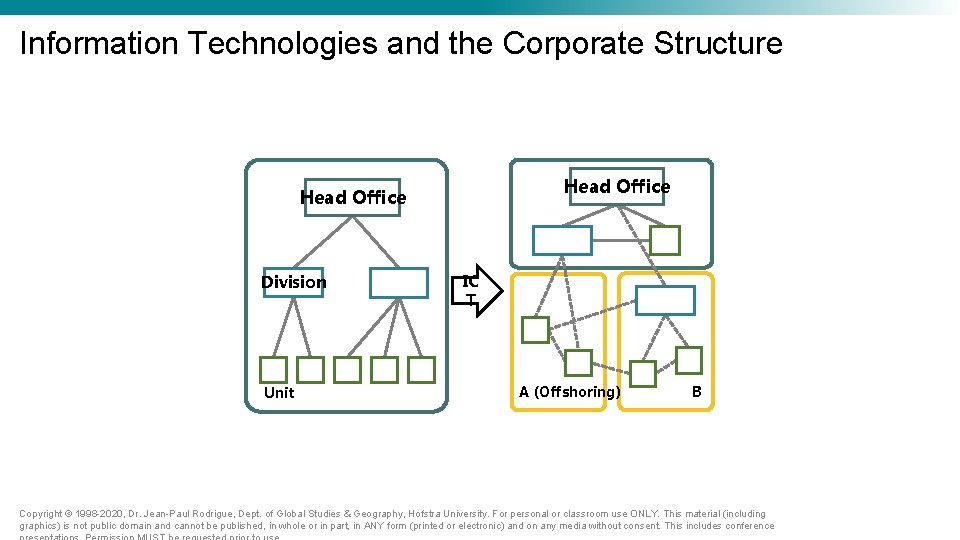
Information Technologies and the Corporate Structure Head Office Division Unit IC T A (Offshoring) B Copyright © 1998 -2020, Dr. Jean-Paul Rodrigue, Dept. of Global Studies & Geography, Hofstra University. For personal or classroom use ONLY. This material (including graphics) is not public domain and cannot be published, in whole or in part, in ANY form (printed or electronic) and on any media without consent. This includes conference
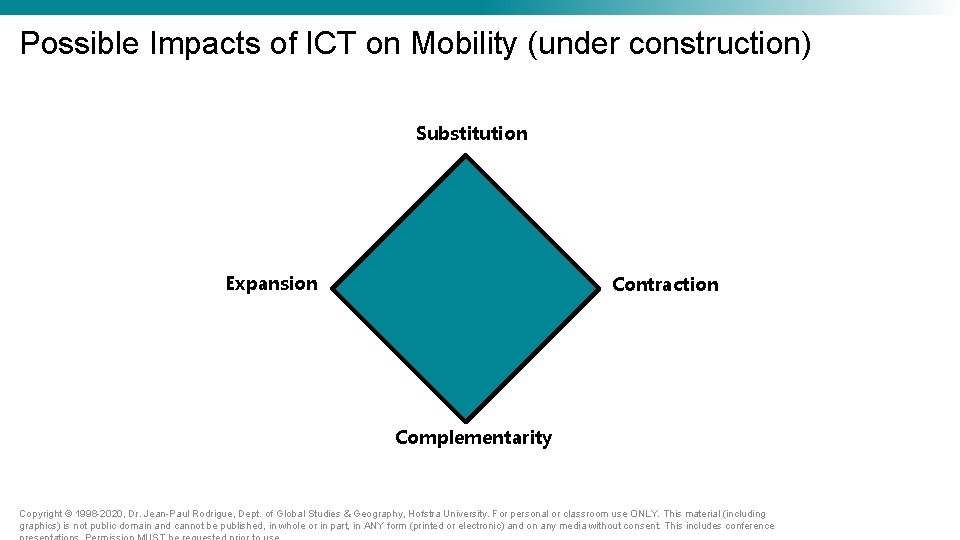
Possible Impacts of ICT on Mobility (under construction) Substitution Expansion Contraction Complementarity Copyright © 1998 -2020, Dr. Jean-Paul Rodrigue, Dept. of Global Studies & Geography, Hofstra University. For personal or classroom use ONLY. This material (including graphics) is not public domain and cannot be published, in whole or in part, in ANY form (printed or electronic) and on any media without consent. This includes conference
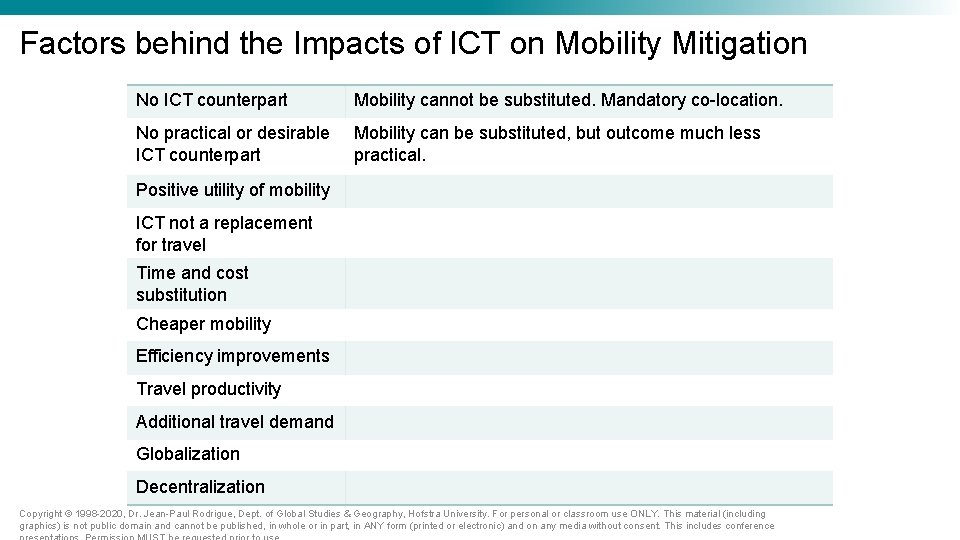
Factors behind the Impacts of ICT on Mobility Mitigation No ICT counterpart Mobility cannot be substituted. Mandatory co-location. No practical or desirable ICT counterpart Mobility can be substituted, but outcome much less practical. Positive utility of mobility ICT not a replacement for travel Time and cost substitution Cheaper mobility Efficiency improvements Travel productivity Additional travel demand Globalization Decentralization Copyright © 1998 -2020, Dr. Jean-Paul Rodrigue, Dept. of Global Studies & Geography, Hofstra University. For personal or classroom use ONLY. This material (including graphics) is not public domain and cannot be published, in whole or in part, in ANY form (printed or electronic) and on any media without consent. This includes conference
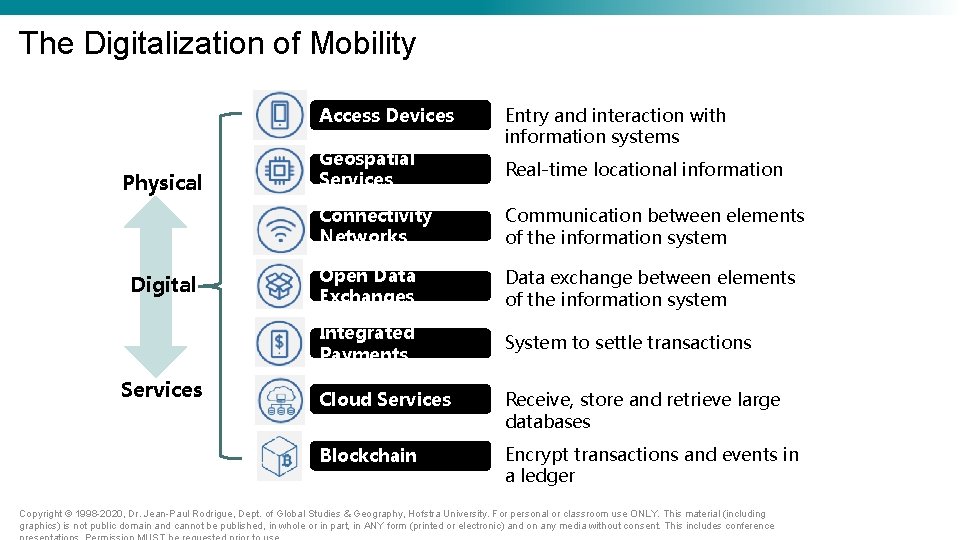
The Digitalization of Mobility Access Devices Physical Digital Services Geospatial Services Entry and interaction with information systems Real-time locational information Connectivity Networks Communication between elements of the information system Open Data Exchanges Data exchange between elements of the information system Integrated Payments System to settle transactions Cloud Services Receive, store and retrieve large databases Blockchain Encrypt transactions and events in a ledger Copyright © 1998 -2020, Dr. Jean-Paul Rodrigue, Dept. of Global Studies & Geography, Hofstra University. For personal or classroom use ONLY. This material (including graphics) is not public domain and cannot be published, in whole or in part, in ANY form (printed or electronic) and on any media without consent. This includes conference
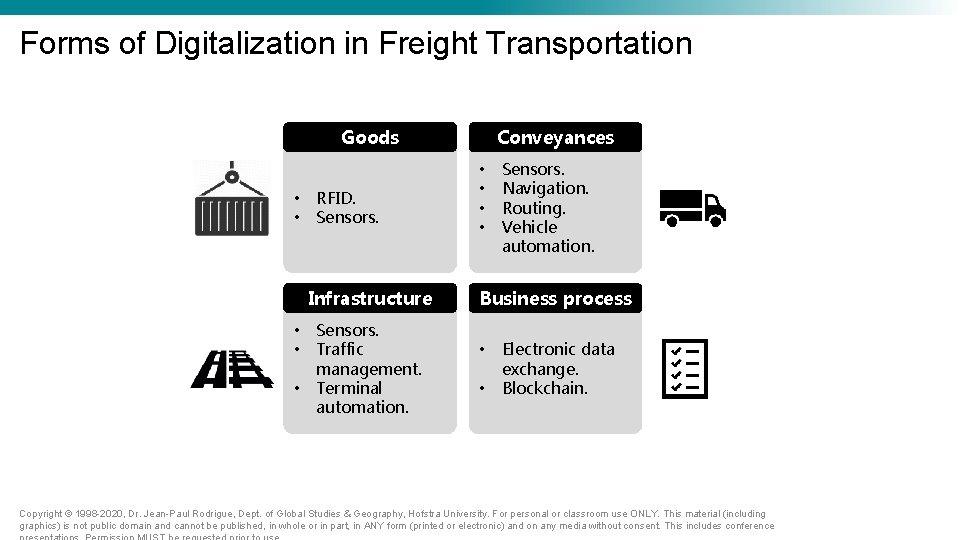
Forms of Digitalization in Freight Transportation Goods • • RFID. Sensors. Infrastructure • • • Sensors. Traffic management. Terminal automation. Conveyances • • Sensors. Navigation. Routing. Vehicle automation. Business process • • Electronic data exchange. Blockchain. Copyright © 1998 -2020, Dr. Jean-Paul Rodrigue, Dept. of Global Studies & Geography, Hofstra University. For personal or classroom use ONLY. This material (including graphics) is not public domain and cannot be published, in whole or in part, in ANY form (printed or electronic) and on any media without consent. This includes conference
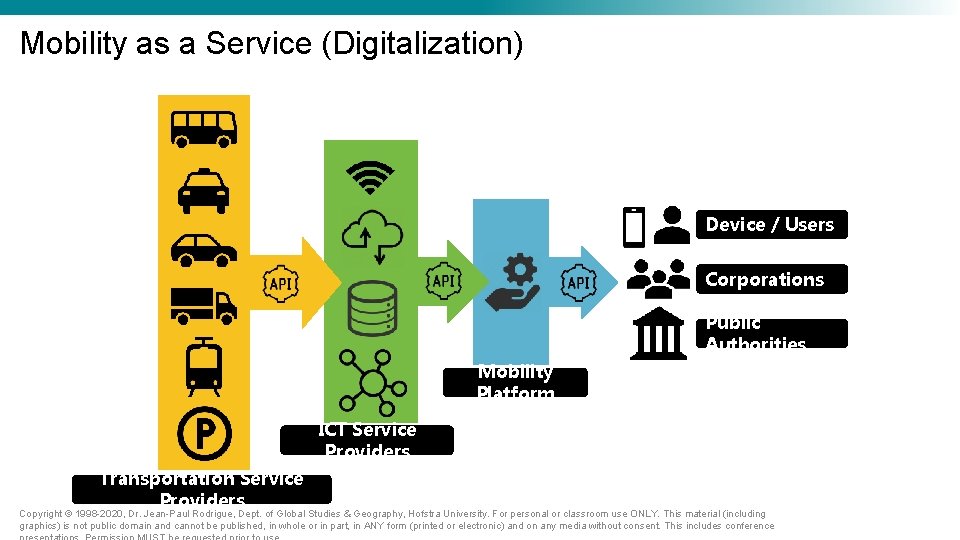
Mobility as a Service (Digitalization) Device / Users Corporations Public Authorities Mobility Platform ICT Service Providers Transportation Service Providers Copyright © 1998 -2020, Dr. Jean-Paul Rodrigue, Dept. of Global Studies & Geography, Hofstra University. For personal or classroom use ONLY. This material (including graphics) is not public domain and cannot be published, in whole or in part, in ANY form (printed or electronic) and on any media without consent. This includes conference
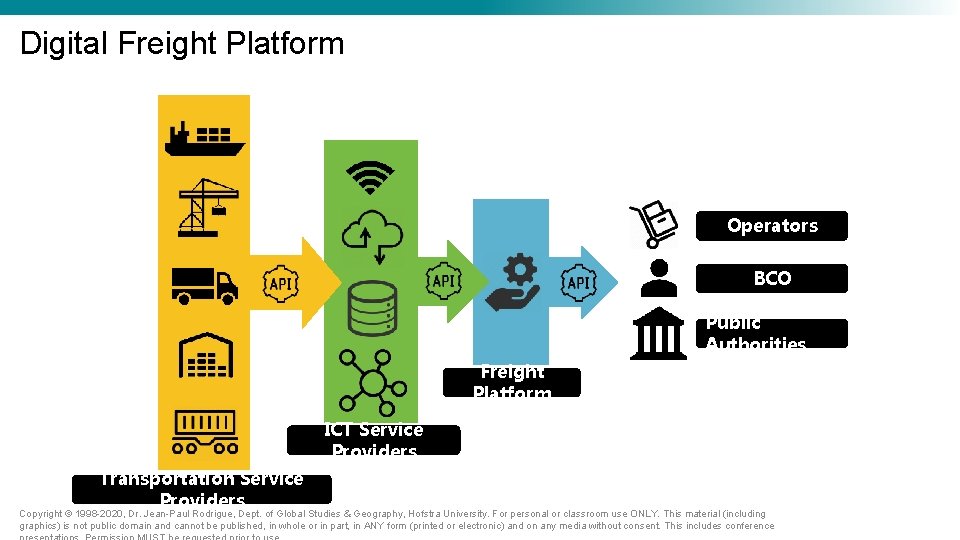
Digital Freight Platform Operators BCO Public Authorities Freight Platform ICT Service Providers Transportation Service Providers Copyright © 1998 -2020, Dr. Jean-Paul Rodrigue, Dept. of Global Studies & Geography, Hofstra University. For personal or classroom use ONLY. This material (including graphics) is not public domain and cannot be published, in whole or in part, in ANY form (printed or electronic) and on any media without consent. This includes conference
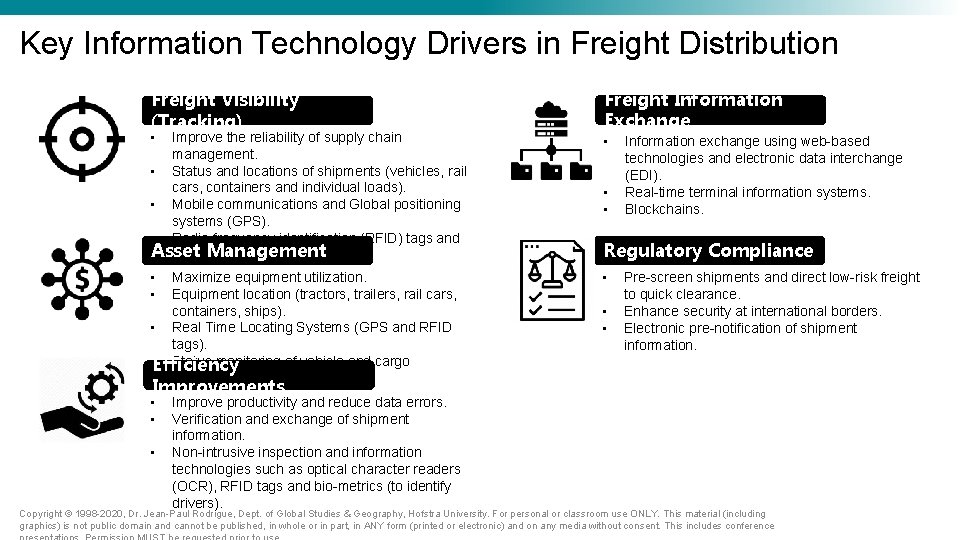
Key Information Technology Drivers in Freight Distribution Freight Visibility (Tracking) • Freight Information Exchange Improve the reliability of supply chain management. • Status and locations of shipments (vehicles, rail cars, containers and individual loads). • Mobile communications and Global positioning systems (GPS). • Radio-frequency identification (RFID) tags and Asset Management bar codes. • • Maximize equipment utilization. Equipment location (tractors, trailers, rail cars, containers, ships). • Real Time Locating Systems (GPS and RFID tags). • Efficiency Status monitoring of vehicle and cargo conditions. • • Information exchange using web-based technologies and electronic data interchange (EDI). Real-time terminal information systems. Blockchains. Regulatory Compliance • • Pre-screen shipments and direct low-risk freight to quick clearance. Enhance security at international borders. Electronic pre-notification of shipment information. Improvements • • • Improve productivity and reduce data errors. Verification and exchange of shipment information. Non-intrusive inspection and information technologies such as optical character readers (OCR), RFID tags and bio-metrics (to identify drivers). Copyright © 1998 -2020, Dr. Jean-Paul Rodrigue, Dept. of Global Studies & Geography, Hofstra University. For personal or classroom use ONLY. This material (including graphics) is not public domain and cannot be published, in whole or in part, in ANY form (printed or electronic) and on any media without consent. This includes conference