Other Forms of Technical Writing LETTERS 2 DEFINITION

- Slides: 49
Other Forms of Technical Writing LETTERS
2 DEFINITION
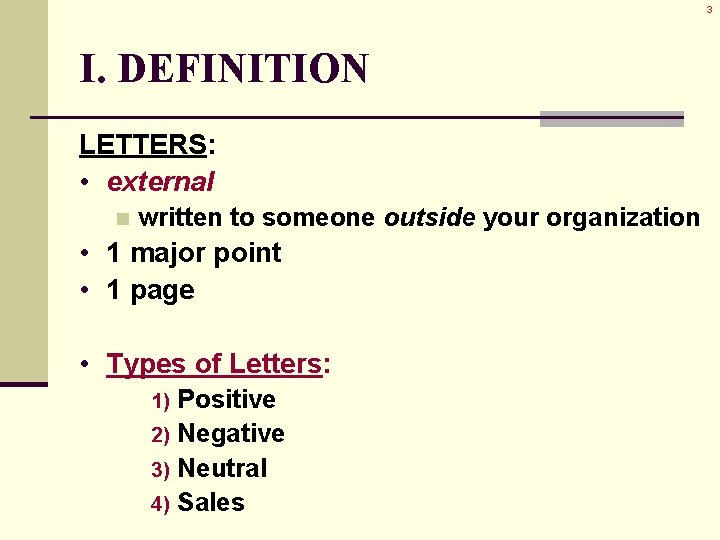
3 I. DEFINITION LETTERS: • external n written to someone outside your organization • 1 major point • 1 page • Types of Letters: Positive 2) Negative 3) Neutral 4) Sales 1)
4 GENERAL GUIDELINES
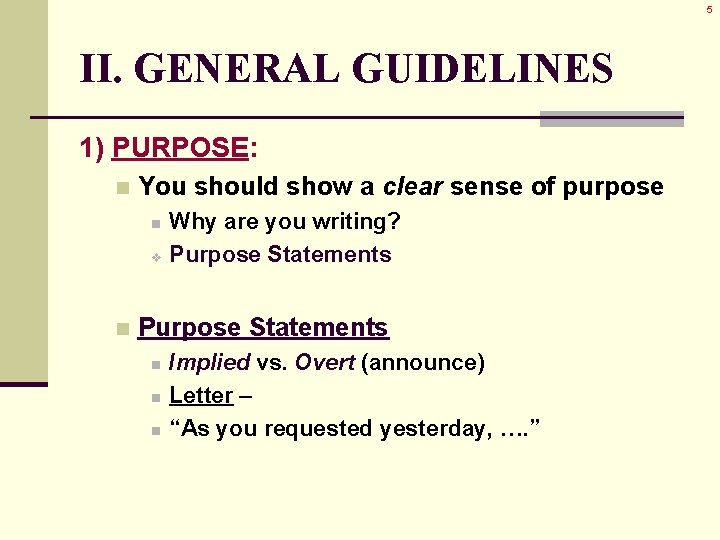
5 II. GENERAL GUIDELINES 1) PURPOSE: n You should show a clear sense of purpose Why are you writing? v Purpose Statements n n n Implied vs. Overt (announce) Letter – “As you requested yesterday, …. ”
6 II. GENERAL GUIDELINES 2) READER ANALYSIS: Know your readers’ needs n Know their technical levels v Planning Form n
7 II. GENERAL GUIDELINES 2) READER ANALYSIS: n Whom you are trying to inform or influences your – n n vocabulary argument tone Multiple Readers/Complex Audience: n n n = varied audience (regarding technical skill level) (1) reduce the level of technicality or (2) write different parts for different readers
8 II. GENERAL GUIDELINES 3) FORMAT: n Pay attention to correct formats v Guidelines n Follow company guidelines n for uniformity
9 II. GENERAL GUIDELINES 3) FORMAT • Formats: (1) block format (2) modified block format n with indented paragraphs, CC & signature under date on the right-hand side (3) simplified format
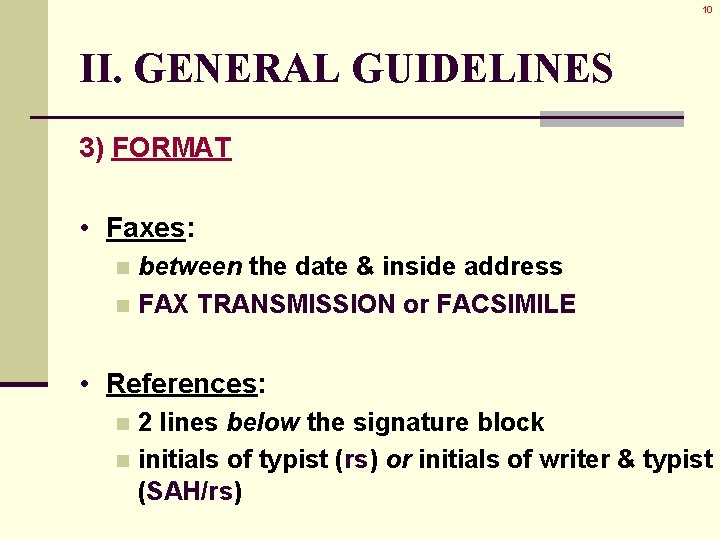
10 II. GENERAL GUIDELINES 3) FORMAT • Faxes: between the date & inside address n FAX TRANSMISSION or FACSIMILE n • References: 2 lines below the signature block n initials of typist (rs) or initials of writer & typist (SAH/rs) n
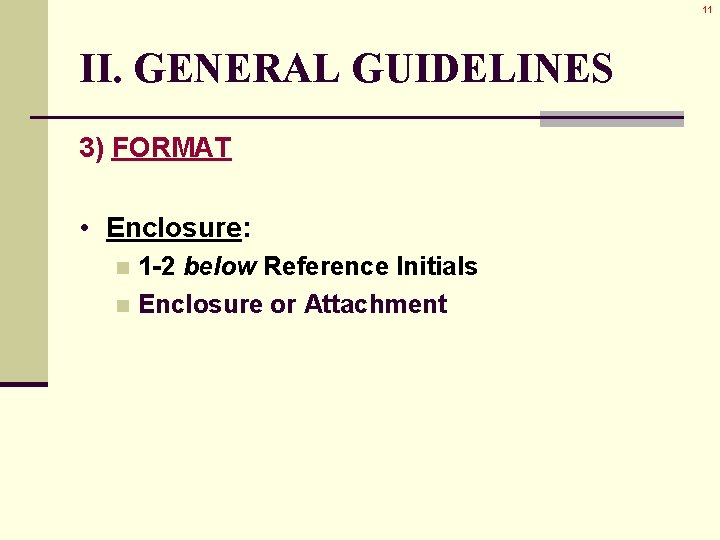
11 II. GENERAL GUIDELINES 3) FORMAT • Enclosure: 1 -2 below Reference Initials n Enclosure or Attachment n
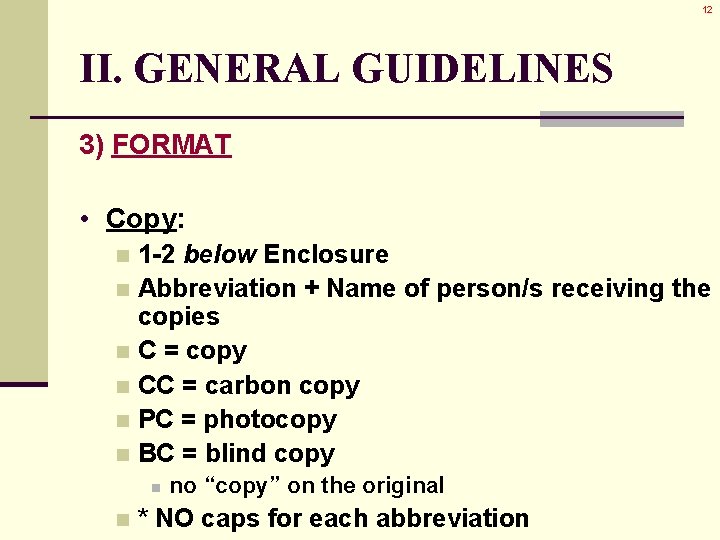
12 II. GENERAL GUIDELINES 3) FORMAT • Copy: 1 -2 below Enclosure n Abbreviation + Name of person/s receiving the copies n C = copy n CC = carbon copy n PC = photocopy n BC = blind copy n no “copy” on the original * NO caps for each abbreviation
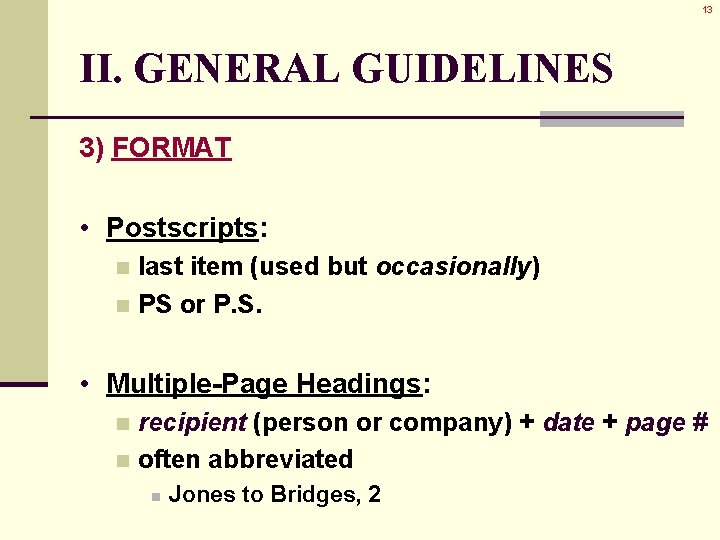
13 II. GENERAL GUIDELINES 3) FORMAT • Postscripts: last item (used but occasionally) n PS or P. S. n • Multiple-Page Headings: recipient (person or company) + date + page # n often abbreviated n n Jones to Bridges, 2
14 II. GUIDELINES 4) ABC Format: • ABSTRACT Introduce the purpose n Purpose Statement n Summarize main points n 1 -2 small paragraphs n
15 II. GUIDELINES 4) ABC Format: • BODY Lists to break-up the text n Headings to break-up the text, divide info n Use Personal names n names of readers Paragraphs = Deduction n n General Specific main point = 1 st
16 II. GUIDELINES 4) ABC Format: • CONCLUSION Summary of the Main Idea n Clear Statement of what will happen next n n Reader Analysis and Firsts & Lasts
17 II. GUIDELINES 5) 3 C’s STRATEGY of PERSUASION: • CAPTURE • CONVINCE • CONTROL
18 II. GUIDELINES 5) 3 C’s STRATEGY of PERSUASION: • CAPTURE Capture interest with a good opener n Tell readers what the letter/memo can do for them n
19 II. GUIDELINES 5) 3 C’s STRATEGY of PERSUASION: • CONVINCE Convince the reader with supporting points n Evidence supports opening claim: n n this document will make their lives easier
20 II. GUIDELINES 5) 3 C’s STRATEGY of PERSUASION: • CONTROL Control the closing n Use a statement that n n n puts you in the position of following up on the letter/memo and solidifies your relationship with the reader
21 II. GUIDELINES 6) “YOU”: • Focus on the reader • Anticipate & answer questions the reader may raise n “How will this affect the cost? By allowing…. ” • Replace “I” & “me” with “you” & “your”
22 II. GUIDELINES 7) ATTACHMENTS: • Letters/Memos = brief v Detail = in the attachment keeps the focus on the main point/message n doesn’t distract, avoids clutter n details = for future reference n
23 II. GUIDELINES 8) DIPLOMACY: • Be tactful persuade & entice, don’t command n be mindful of your TONE & DICTION n don’t be pushy, 1 -sided, condescending n • Positive (good news) letters = n in the active voice • Negative (bad news) letters = n in the passive voice
24 II. GUIDELINES 9) EDIT-PROOFREAD: • Errors = obvious in short pieces • Grammar – missing or improper punctuation n faulty subject-verb agreement n faulty pronoun-reference agreement n n “sexist” language
25 II. GUIDELINES 9) EDIT-PROOFREAD: • Mechanics – spelling errors n old or wrong address n wrong title, job title n
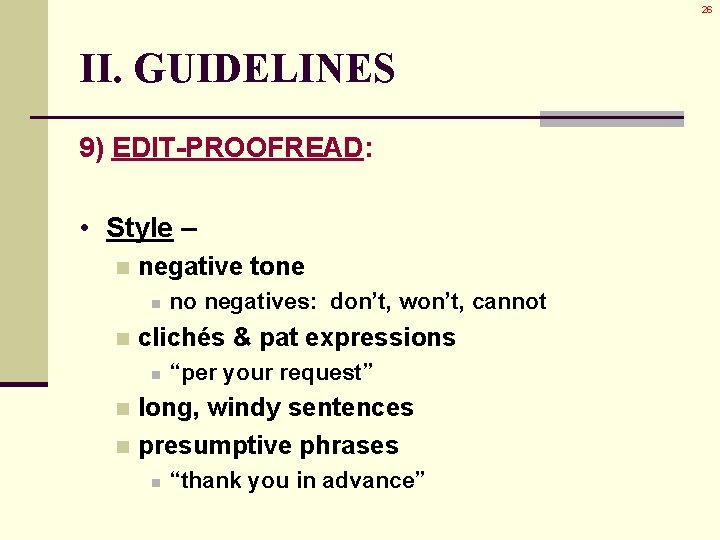
26 II. GUIDELINES 9) EDIT-PROOFREAD: • Style – n negative tone n n no negatives: don’t, won’t, cannot clichés & pat expressions n “per your request” long, windy sentences n presumptive phrases n n “thank you in advance”
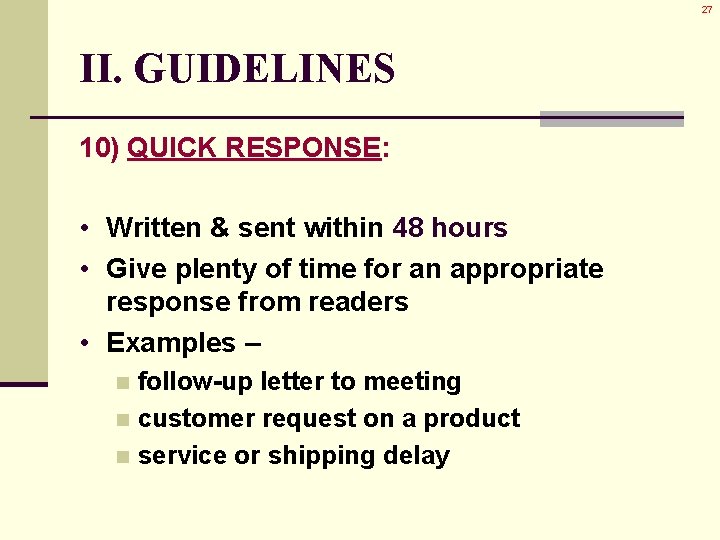
27 II. GUIDELINES 10) QUICK RESPONSE: • Written & sent within 48 hours • Give plenty of time for an appropriate response from readers • Examples – follow-up letter to meeting n customer request on a product n service or shipping delay n
28 SPECIFIC GUIDELINES
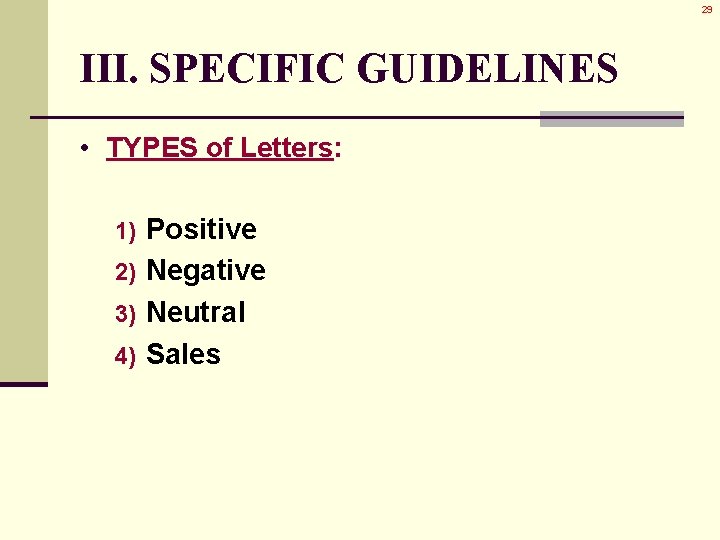
29 III. SPECIFIC GUIDELINES • TYPES of Letters: Positive 2) Negative 3) Neutral 4) Sales 1)
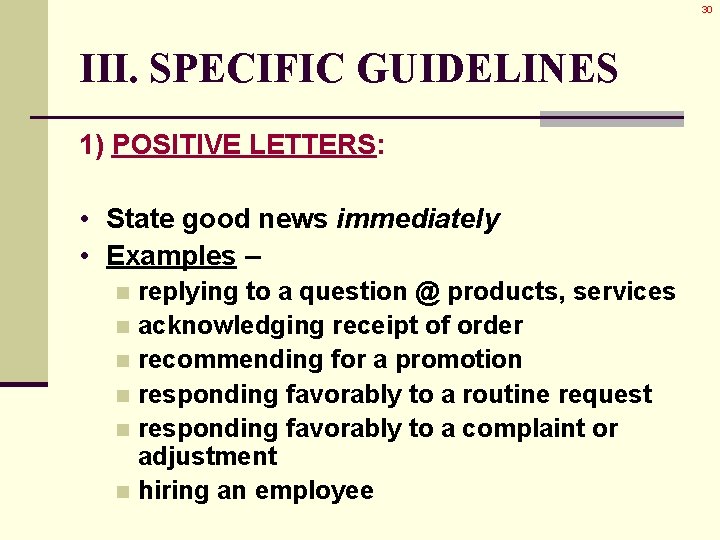
30 III. SPECIFIC GUIDELINES 1) POSITIVE LETTERS: • State good news immediately • Examples – replying to a question @ products, services n acknowledging receipt of order n recommending for a promotion n responding favorably to a routine request n responding favorably to a complaint or adjustment n hiring an employee n
31 III. SPECIFIC GUIDELINES 1) POSITIVE LETTERS: • ABC n Abstract – n n bridge between this letter & previous communication clear statement of good news
32 III. SPECIFIC GUIDELINES 1) POSITIVE LETTERS: • ABC n Body – n n n supporting data of main point clarification of possible questions reader may have qualification of good news, if any
33 III. SPECIFIC GUIDELINES 1) POSITIVE LETTERS: • ABC n Conclusion – n n statement of eagerness to continue relationship, complete project, … clear statement of what happens next, if relevant
34 III. SPECIFIC GUIDELINES 2) NEGATIVE LETTERS: • Buffer the bad news BUT be clear • Examples – explaining delays n declining requests n registering complaints n refusing adjustments n denying credit n giving poor performance review n explaining changes in original orders n
35 III. SPECIFIC GUIDELINES 2) NEGATIVE LETTERS: • ABC n Abstract – n n bridge between this letter & previous communication general statement of purpose or appreciation (buffer) § to find common bond § to find area of agreement
36 III. SPECIFIC GUIDELINES 2) NEGATIVE LETTERS: • ABC n Body – n n strong emphasis on what can be done, when possible buffered but clear statement of what cannot be done § with clear statement of reasons for negative news n facts that support your views (support)
37 III. SPECIFIC GUIDELINES 2) NEGATIVE LETTERS: • ABC n Conclusion – n n closing remarks that express interest in continued association clear statement of what happens next, if relevant
38 III. SPECIFIC GUIDELINES 3) NEUTRAL LETTERS: • Be absolutely clear about your inquiry or response • Examples – n n n requesting information inviting reader to an event responding to an invitation or routine request placing orders providing transmittal letter for a fax transmission sending solicited or unsolicited items through the mail
39 III. SPECIFIC GUIDELINES 3) NEUTRAL LETTERS: • ABC n Abstract – n n bridge between this letter & previous communication clear statement of purpose § response § request § invitation
40 III. SPECIFIC GUIDELINES 3) NEUTRAL LETTERS: • ABC n Body – n n n details that support the Purpose Statement description of items requested or sent requirements related to invitation
41 III. SPECIFIC GUIDELINES 3) NEUTRAL LETTERS: • ABC n Conclusion – n n statement of appreciation description of actions that should happen next
42 III. SPECIFIC GUIDELINES 4) SALES LETTERS: • Help solve their problems • Examples – n ALL correspondence with a customer n from 1 st contact to thank-you letter starting a relationship n following a phone call n following a meeting n following completion of a sale or project n seeking repeat business n
43 III. SPECIFIC GUIDELINES 4) SALES LETTERS: • ABC (3 C’s) n Abstract – n Capture attention § § § § § cite a surprising fact announce a new product or service (that client needs) ask a question show an understanding of the client’s problem show potential for solving client’s problem present a testimonial make a challenging claim summarize the results of a meeting answer a question the reader previously asked
44 III. SPECIFIC GUIDELINES 4) SALES LETTERS: • ABC (3 C’s) n Body – n Convince the reader § stress one main problem about which the reader has a concern § stress one main selling point of your solution § emphasize what is unique about your solution § focus on value & quality § rather than price § put details in enclosures § briefly explain the value of the enclosures
45 III. SPECIFIC GUIDELINES 4) SALES LETTERS: • ABC (3 C’s) n Conclusion – n Control the next step in the sales process § leave the reader with one crucial point to ponder or remember § offer to call § (1 st choice) § ask reader to call § (last choice)
46 SUMMARY
47 IV. SUMMARY • Make wise use of ATTACHMENTS place details in attachments n keep particulars, specifics out of these brief communiqués n • Complete READER ANALYSIS address their needs n write to their technical skill levels n follow the Rule of “Firsts & Lasts” n
48 IV. SUMMARY • Follow the ABC Format Abstract n Body n Conclusion n • Plus the 3 C’s Strategy of Persuasion Capture n Convince n Control n
49 IV. SUMMARY • Have a clear PURPOSE & ORGANIZATION Purpose Statements n ABC & #3 C’s n Planning Forms n • Astutely employ PAGE DESIGN elements Headings n Lists n