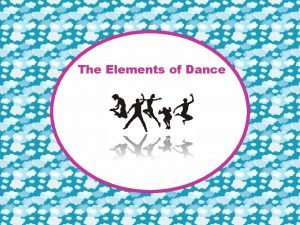
The Elements of Dance The Elements of Dance
- Slides: 104
The Elements of Dance
The Elements of Dance There are 3 Elements of Dance.
The Elements of Dance SPACE
The Elements of Dance SPACE TIME
The Elements of Dance SPACE TIME FORCE
1 st Element of Dance SPACE
1 st Element of Dance SPACE Area surrounding a person in which he/she is able to move.
SPACE • Shape:
SPACE • Shape: circles, squares, triangles, etc. made with parts of the body, the whole body, with groups of people, or by moving through space.
SPACE • Level:
SPACE • Level: The vertical distance from the floor.
SPACE • Level: The vertical distance from the floor. (High, Medium, or Low)
SPACE • Direction:
SPACE • Direction: Where the body moves.
SPACE • Direction: Where the body moves. • (e. g. Forward, backward, up, down, sideways, diagonally, etc. )
SPACE • Pathways:
SPACE • Pathways: Patterns we make as we move through the air or across the floor.
SPACE • Focus:
SPACE • Focus: Where the dancer’s eyes look as he/she is dancing.
SPACE • Size:
SPACE • Size: How large or small movements.
SPACE • Shape • Level • Direction • Pathways • Focus • Size
2 nd Element of Dance TIME
2 nd Element of Dance TIME The duration of the movement
TIME • Beat:
TIME • Beat: The on going underlying pulse.
TIME • Tempo:
TIME • Tempo: How fast or slow the movements.
TIME • Accent:
TIME • Accent: Strong beats that usually occur at regular intervals.
TIME • Rhythmic Patterns:
TIME • Rhythmic Patterns: Patterns made by arranging long and short movement or strong and light movement.
TIME • Duration:
TIME • Duration: The length of time the movement lasts.
TIME • Beat • Tempo • Accent • Rhythmic Patterns • Duration
3 rd Element of Dance FORCE
3 rd Element of Dance FORCE How the body uses energy while moving.
FORCE = ENERGY
FORCE = ENERGY • Heavy / Light
FORCE = ENERGY • Heavy / Light • Sharp / Smooth
FORCE = ENERGY • Heavy / Light • Sharp / Smooth • Tensed / Relaxed
FORCE = ENERGY • Heavy / Light • Sharp / Smooth • Tensed / Relaxed • Bound / Flowing
FORCE • Bound / Flowing
FORCE Bound = releasing energy in a controlled, restrained manner
FORCE Flowing = releasing energy freely.
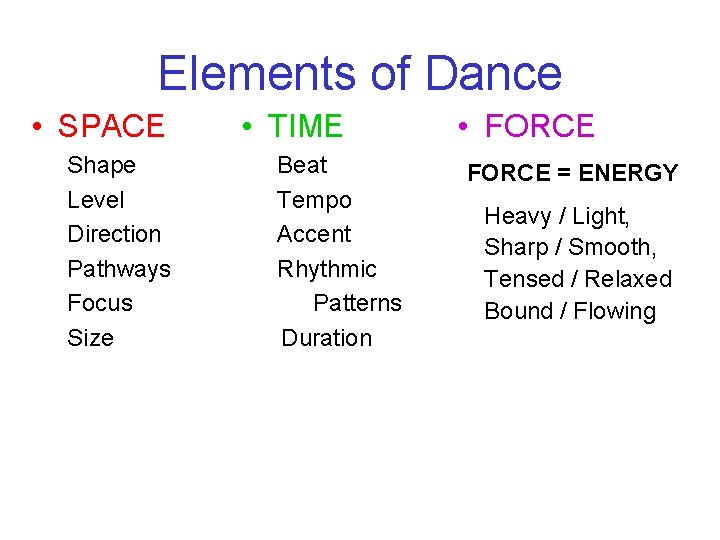
Elements of Dance • SPACE Shape Level Direction Pathways Focus Size • TIME Beat Tempo Accent Rhythmic Patterns Duration • FORCE = ENERGY Heavy / Light, Sharp / Smooth, Tensed / Relaxed Bound / Flowing
MOVEMENTS
MOVEMENTS Locomotor & Nonlocomotor
MOVEMENTS • Locomotor:
MOVEMENTS • Locomotor: Movements that take the body from one point to another.
MOVEMENTS Locomotor • Examples:
MOVEMENTS Locomotor • Examples: Step
MOVEMENTS Locomotor • Examples: Step Hop
MOVEMENTS Locomotor • Examples: Step Hop Grapevine
MOVEMENTS Locomotor • Examples: Step Hop Grapevine Polka
MOVEMENTS Locomotor Examples: Step Hop Grapevine Polka Waltz
MOVEMENTS Locomotor Examples: Step Hop Grapevine Polka Waltz Two-step
MOVEMENTS • Nonlocomotor:
MOVEMENTS • Nonlocomotor: Movements that the body can do and still stay in one place.
MOVEMENTS Nonlocomotor Examples:
MOVEMENTS Nonlocomotor Examples: Push
MOVEMENTS Nonlocomotor Examples: Push Pull
MOVEMENTS Nonlocomotor • Examples: Push Pull Rise
MOVEMENTS Nonlocomotor Examples: Push Pull Rise Fall
MOVEMENTS Nonlocomotor Examples: Push Pull Rise Fall Dodge
MOVEMENTS Nonlocomotor Examples: Push Pull Rise Fall Dodge Sway
COMPOSITIONAL FORMS
COMPOSITIONAL FORMS AB
COMPOSITIONAL FORMS AB • A dance with a 2 -part structure…
COMPOSITIONAL FORMS AB • A dance with a 2 -part structure • with the second part being different from the first part.
COMPOSITIONAL FORMS ABA
COMPOSITIONAL FORMS ABA • A dance with a 3 -part structure…
COMPOSITIONAL FORMS ABA • A dance with a 3 -part structure… • With the second part being different from the first part…
COMPOSITIONAL FORMS ABA • A dance with a 3 -part structure… • With the second part being different from the first part… • And the last part being the same as the first part.
COMPOSITIONAL FORMS Call and Response
COMPOSITIONAL FORMS Call and Response st • 1 soloist/group moves, with the nd 2 soloist/group moving in “response”.
COMPOSITIONAL FORMS Narrative
COMPOSITIONAL FORMS Narrative • A dance that tells a story using only movement. • NO WORDS!
COMPOSITIONAL FORMS Narrative Examples:
COMPOSITIONAL FORMS Narrative Examples: Ballets like… The Nutcracker Cinderella Swan Lake Sleeping Beauty
COMPOSITIONAL FORMS Narrative Examples: and some FOLK DANCES such as Native American Dances or the Hula
SKILLS OF BODY ALIGNMENT
SKILLS OF BODY ALIGNMENT • Body Alignment:
SKILLS OF BODY ALIGNMENT • Body Alignment: Body placement or posture, when done properly, lessens body strain and promotes dance skills.
SKILLS OF BODY ALIGNMENT • Balance:
SKILLS OF BODY ALIGNMENT • Balance: An equal distribution of weight, force, or influence
SKILLS OF BODY ALIGNMENT • Isolation of body parts:
SKILLS OF BODY ALIGNMENT • Isolation of body parts: The ability to move separate parts of the body independently.
SKILLS OF BODY ALIGNMENT • Elevation:
SKILLS OF BODY ALIGNMENT • Elevation: Movement of the body or parts of the body to a higher level.
SKILLS OF BODY ALIGNMENT • Landing:
SKILLS OF BODY ALIGNMENT • Landing: The manner and quality in which the body returns to earth following an action of elevation (e. g. leap, hop, jump, etc. )
SKILLS OF BODY ALIGNMENT • Body Alignment • Balance • Isolation of Body Parts • Elevation • Landing
PURPOSES OF DANCE
PURPOSES OF DANCE Ceremonial
PURPOSES OF DANCE Ceremonial • Dance done by a dancer in order to celebrate or commemorate a special occasion.
PURPOSES OF DANCE Ceremonial • Perform a ritual such as an initiation of members into a group in some cultures.
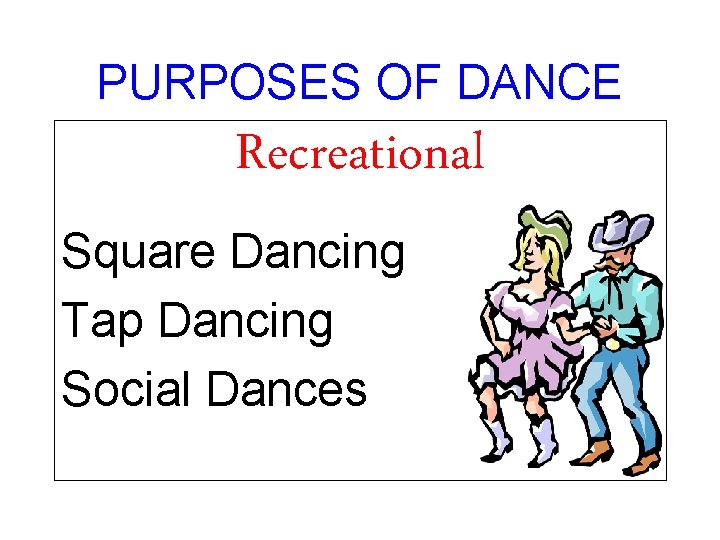
PURPOSES OF DANCE Recreational
PURPOSES OF DANCE Recreational • Dance done by a dancer in order to have FUN!
PURPOSES OF DANCE Recreational Square Dancing Tap Dancing Social Dances
PURPOSES OF DANCE ~ ARTISTIC ~
PURPOSES OF DANCE ~ ARTISTIC ~ • Dance done by a dancer so that the viewer can appreciate the artistry of the dance.
PURPOSES OF DANCE ~ ARTISTIC ~ Ballet Jazz Modern
The Elements of Dance