Ordering and Consistent Cuts Dan Deng 103011 1

- Slides: 43
Ordering and Consistent Cuts Dan Deng 10/30/11 1
Introduction • Distributed systems • Loosely coupled processes cooperating to solve a bigger problem • Novelty of distributed systems • Lamport published his paper in 1978 • ARPANET was just “operational” in 1975 • Temporal characteristics poorly understood • Need a mechanism for processes to agree on time 2
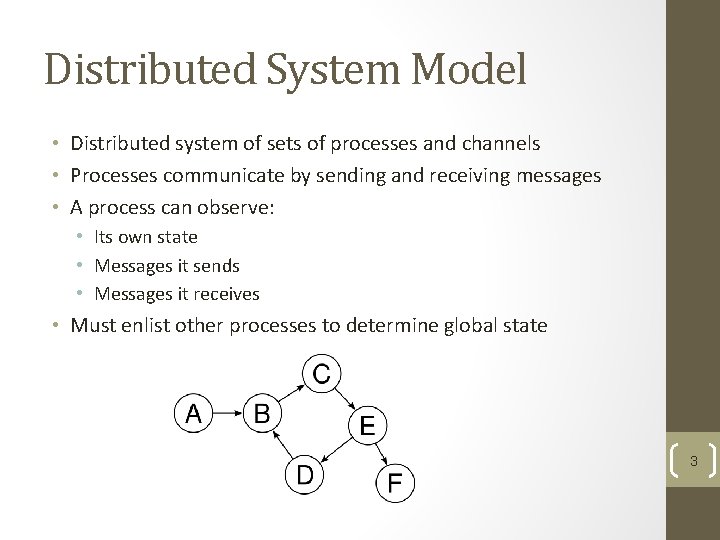
Distributed System Model • Distributed system of sets of processes and channels • Processes communicate by sending and receiving messages • A process can observe: • Its own state • Messages it sends • Messages it receives • Must enlist other processes to determine global state 3
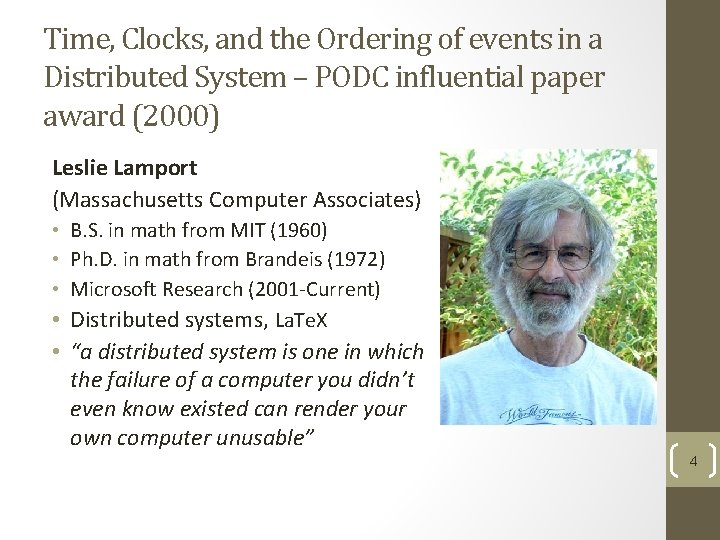
Time, Clocks, and the Ordering of events in a Distributed System – PODC influential paper award (2000) Leslie Lamport (Massachusetts Computer Associates) • B. S. in math from MIT (1960) • Ph. D. in math from Brandeis (1972) • Microsoft Research (2001 -Current) • Distributed systems, La. Te. X • “a distributed system is one in which the failure of a computer you didn’t even know existed can render your own computer unusable” 4
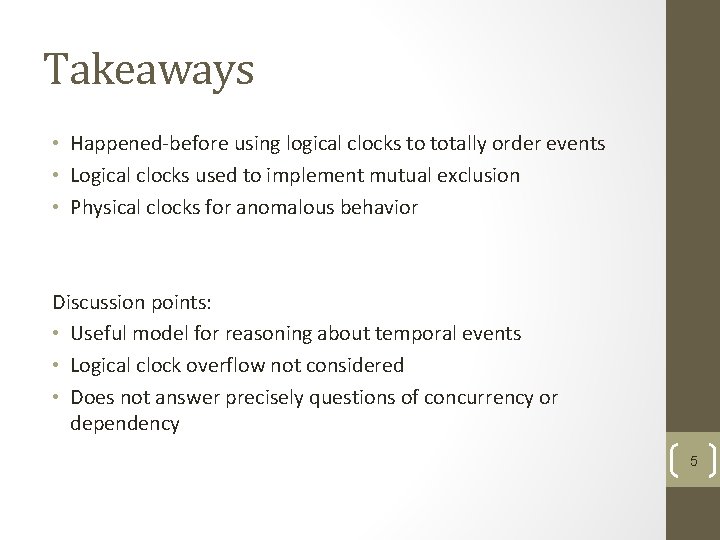
Takeaways • Happened-before using logical clocks to totally order events • Logical clocks used to implement mutual exclusion • Physical clocks for anomalous behavior Discussion points: • Useful model for reasoning about temporal events • Logical clock overflow not considered • Does not answer precisely questions of concurrency or dependency 5
Outline • • Motivation Partial ordering Logical clocks Total ordering Mutual exclusion Anomalous behavior Physical clocks 6
Motivation • • Our notion of event ordering is derived using time Time is implemented on machines using clocks Local clocks on machines may not be accurate Need another mechanism to agree on time 7
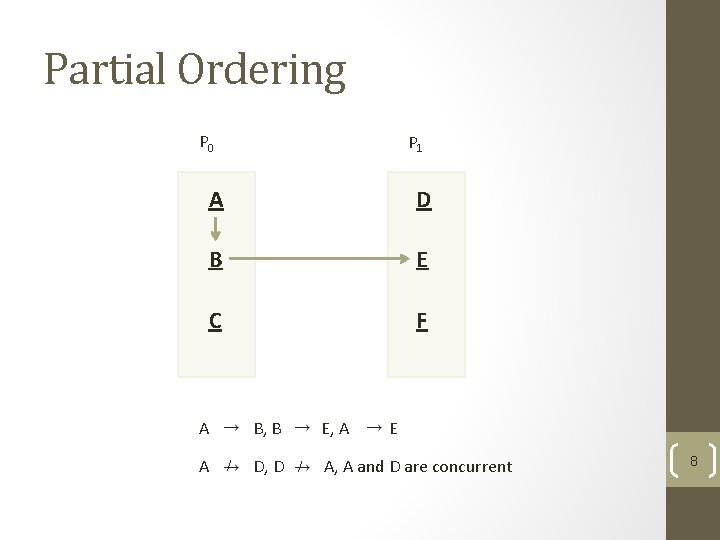
Partial Ordering P 0 P 1 A D B E C F A A B, B / D, D E, A / E A, A and D are concurrent 8
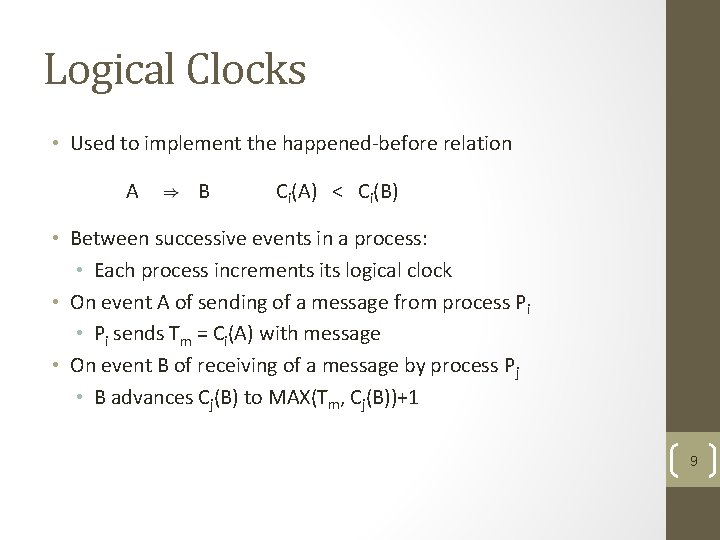
Logical Clocks • Used to implement the happened-before relation A B Ci(A) < Ci(B) • Between successive events in a process: • Each process increments its logical clock • On event A of sending of a message from process Pi • Pi sends Tm = Ci(A) with message • On event B of receiving of a message by process Pj • B advances Cj(B) to MAX(Tm, Cj(B))+1 9
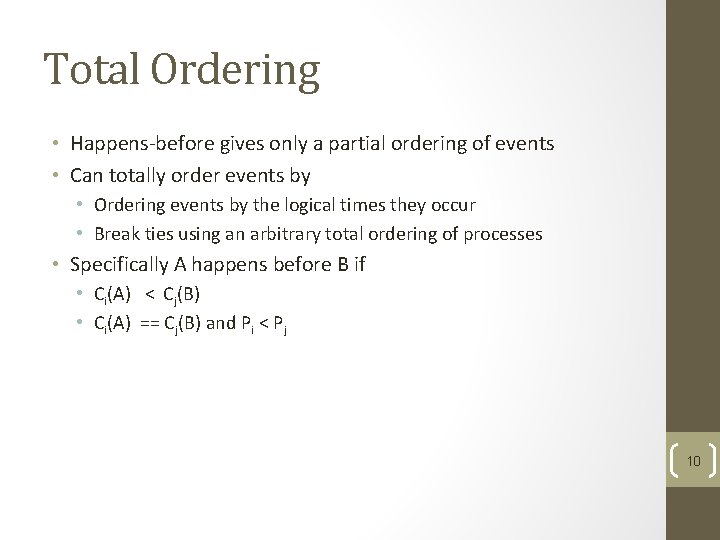
Total Ordering • Happens-before gives only a partial ordering of events • Can totally order events by • Ordering events by the logical times they occur • Break ties using an arbitrary total ordering of processes • Specifically A happens before B if • Ci(A) < Cj(B) • Ci(A) == Cj(B) and Pi < Pj 10
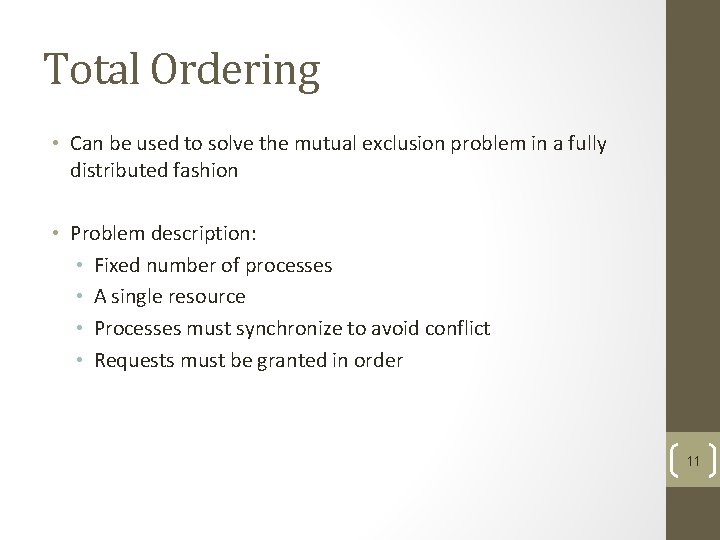
Total Ordering • Can be used to solve the mutual exclusion problem in a fully distributed fashion • Problem description: • Fixed number of processes • A single resource • Processes must synchronize to avoid conflict • Requests must be granted in order 11
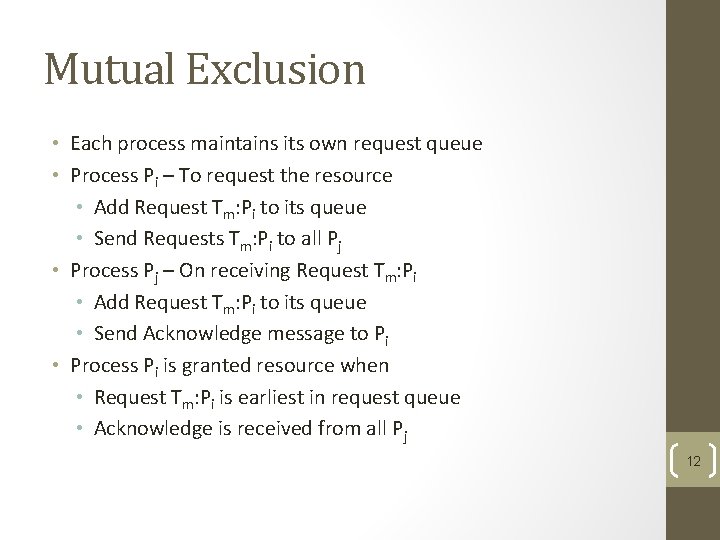
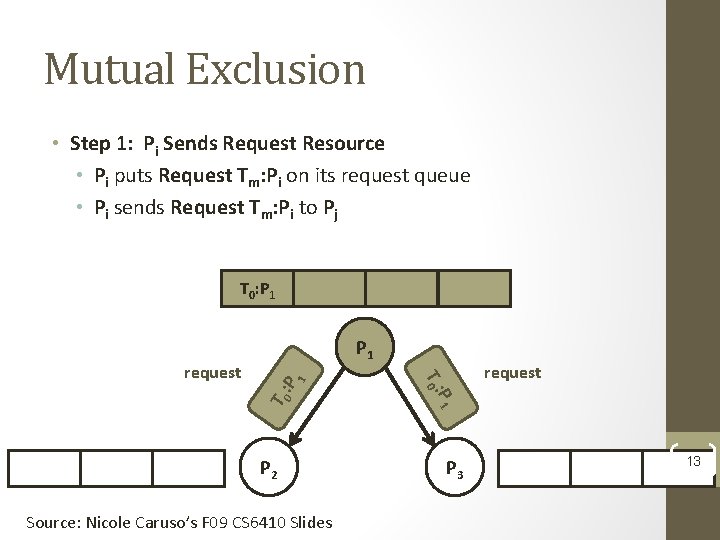
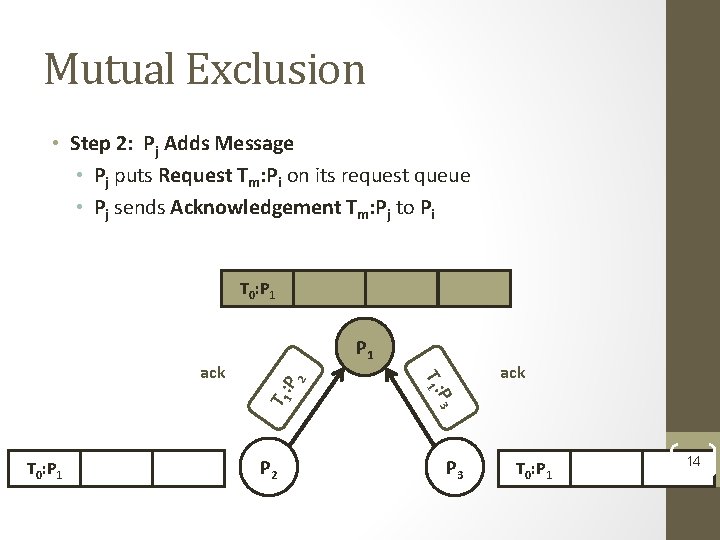
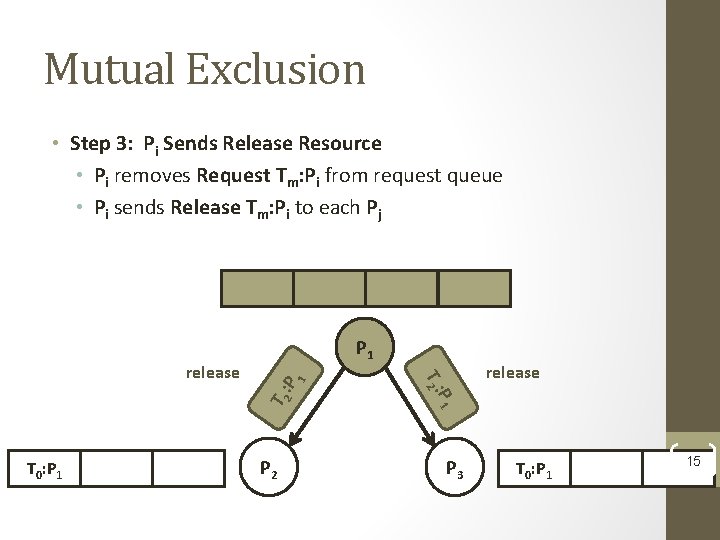
Mutual Exclusion • Each process maintains its own request queue • Process Pi – To request the resource • Add Request Tm: Pi to its queue • Send Requests Tm: Pi to all Pj • Process Pj – On receiving Request Tm: Pi • Add Request Tm: Pi to its queue • Send Acknowledge message to Pi • Process Pi is granted resource when • Request Tm: Pi is earliest in request queue • Acknowledge is received from all Pj 12
Mutual Exclusion • Step 1: Pi Sends Request Resource • Pi puts Request Tm: Pi on its request queue • Pi sends Request Tm: Pi to Pj T 0: P 1 1 P T 0 : Source: Nicole Caruso’s F 09 CS 6410 Slides request P 1 P 2 T 0: request P 1 P 3 13
Mutual Exclusion • Step 2: Pj Adds Message • Pj puts Request Tm: Pi on its request queue • Pj sends Acknowledgement Tm: Pj to Pi T 0: P 1 2 P T 1 : P 2 ack P 3 T 0: P 1 T 1: ack P 1 P 3 T 0: P 1 14
Mutual Exclusion • Step 3: Pi Sends Release Resource • Pi removes Request Tm: Pi from request queue • Pi sends Release Tm: Pi to each Pj 1 P T 2 : P 2 release P 1 T 0: P 1 T 2: release P 1 P 3 T 0: P 1 15
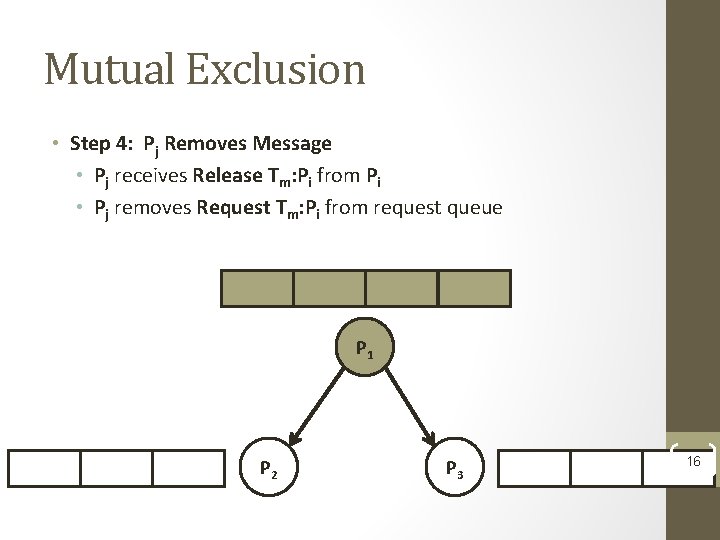
Mutual Exclusion • Step 4: Pj Removes Message • Pj receives Release Tm: Pi from Pi • Pj removes Request Tm: Pi from request queue P 1 P 2 P 3 16
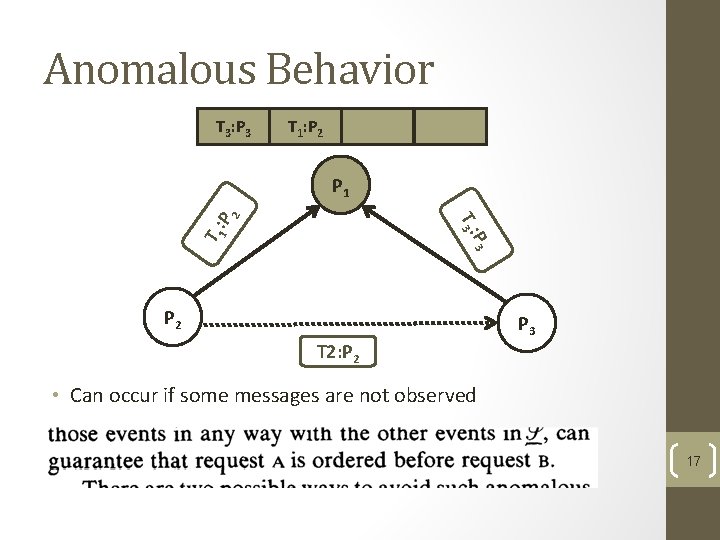
Anomalous Behavior T 3: P 3 T 1: P 2 T 1 : P P 3 T 3: 2 P 1 P 2 P 3 T 2: P 2 • Can occur if some messages are not observed 17
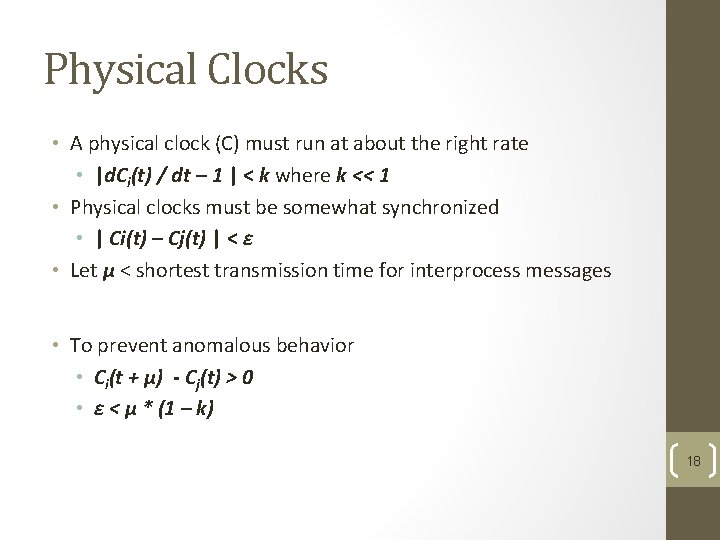
Physical Clocks • A physical clock (C) must run at about the right rate • |d. Ci(t) / dt – 1 | < k where k << 1 • Physical clocks must be somewhat synchronized • | Ci(t) – Cj(t) | < ε • Let μ < shortest transmission time for interprocess messages • To prevent anomalous behavior • Ci(t + μ) - Cj(t) > 0 • ε < μ * (1 – k) 18
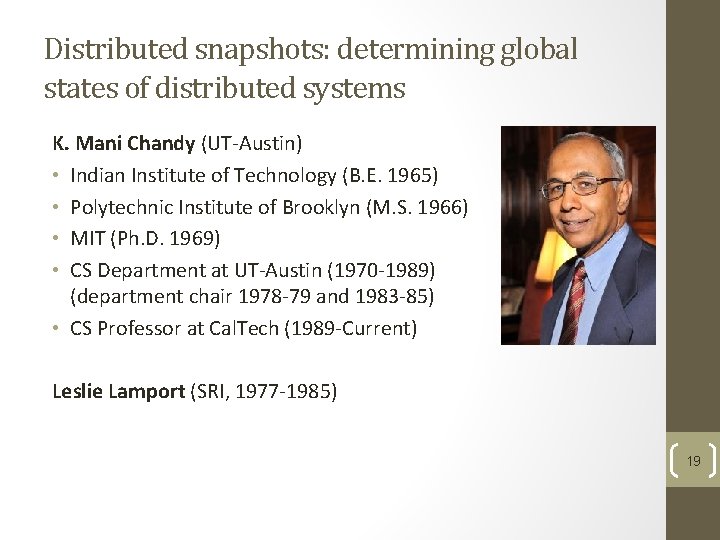
Distributed snapshots: determining global states of distributed systems K. Mani Chandy (UT-Austin) • Indian Institute of Technology (B. E. 1965) • Polytechnic Institute of Brooklyn (M. S. 1966) • MIT (Ph. D. 1969) • CS Department at UT-Austin (1970 -1989) (department chair 1978 -79 and 1983 -85) • CS Professor at Cal. Tech (1989 -Current) Leslie Lamport (SRI, 1977 -1985) 19
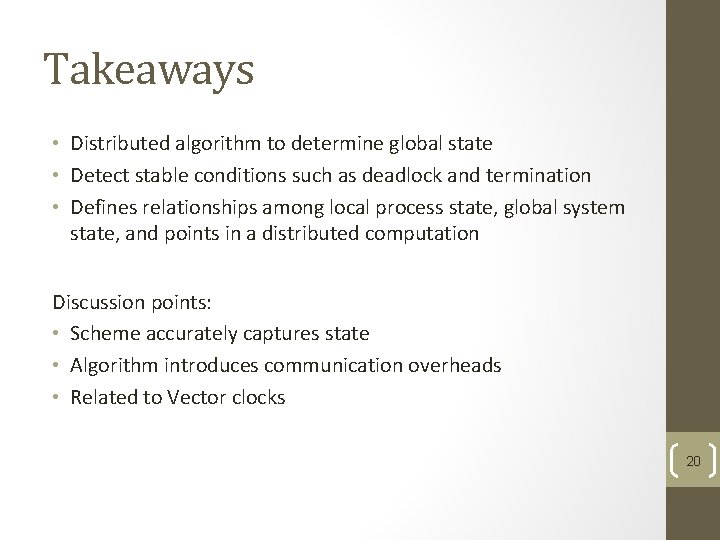
Takeaways • Distributed algorithm to determine global state • Detect stable conditions such as deadlock and termination • Defines relationships among local process state, global system state, and points in a distributed computation Discussion points: • Scheme accurately captures state • Algorithm introduces communication overheads • Related to Vector clocks 20
21
Outline • • • Motivation Distributed system model Consistent cuts Global state detection Stable state detection 22
Motivation • Algorithms for determining global states are incorrect • Relationships among local process states, global system states, and points in a distributed computation are not well understood • Attempt to define those relationships • Correctly identify stable states in a distributed system 23
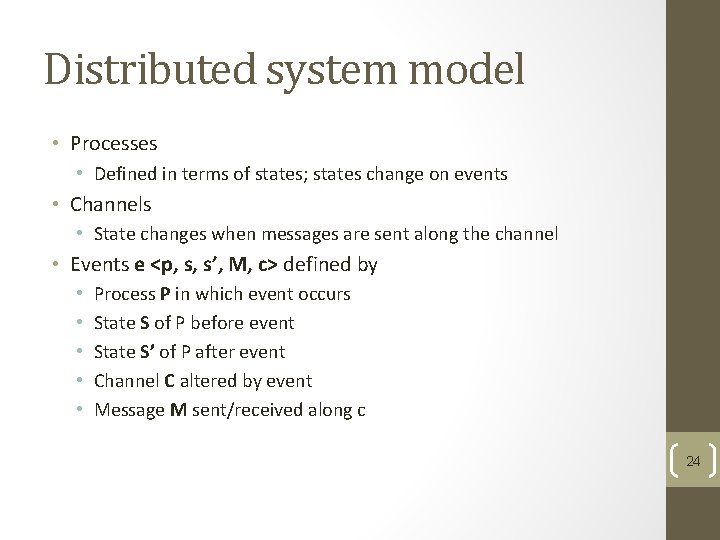
Distributed system model • Processes • Defined in terms of states; states change on events • Channels • State changes when messages are sent along the channel • Events e <p, s, s’, M, c> defined by • • • Process P in which event occurs State S of P before event State S’ of P after event Channel C altered by event Message M sent/received along c 24
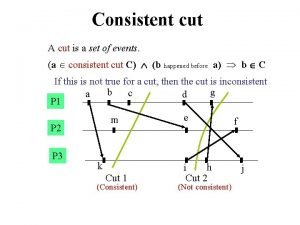
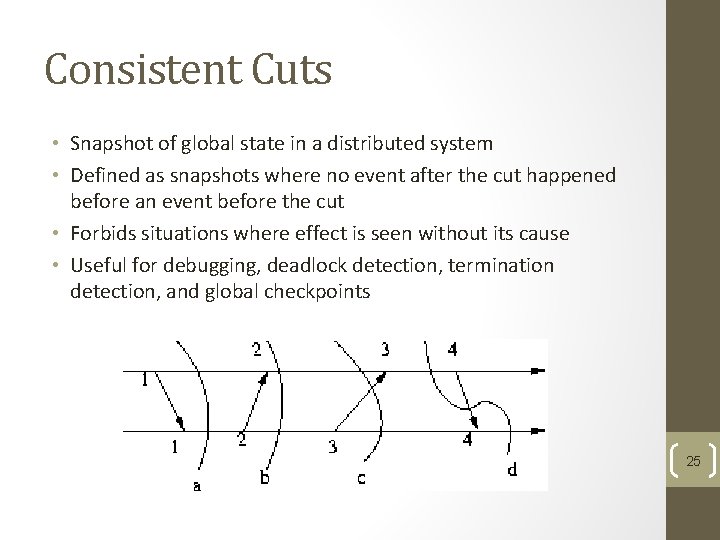
Consistent Cuts • Snapshot of global state in a distributed system • Defined as snapshots where no event after the cut happened before an event before the cut • Forbids situations where effect is seen without its cause • Useful for debugging, deadlock detection, termination detection, and global checkpoints 25
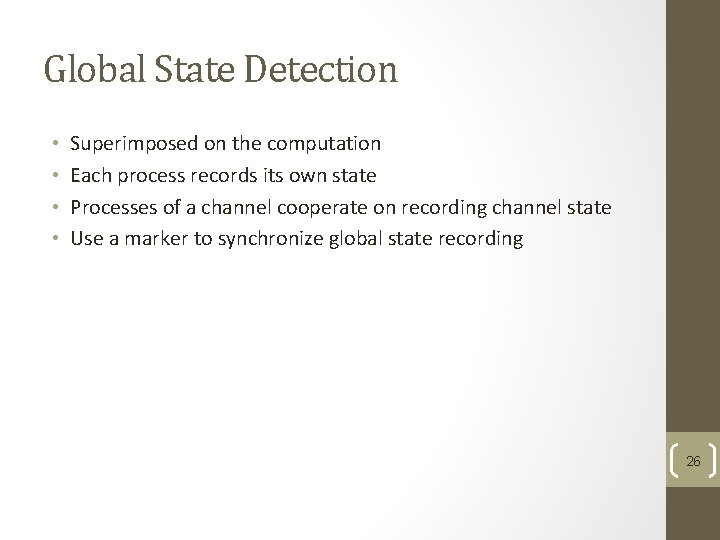
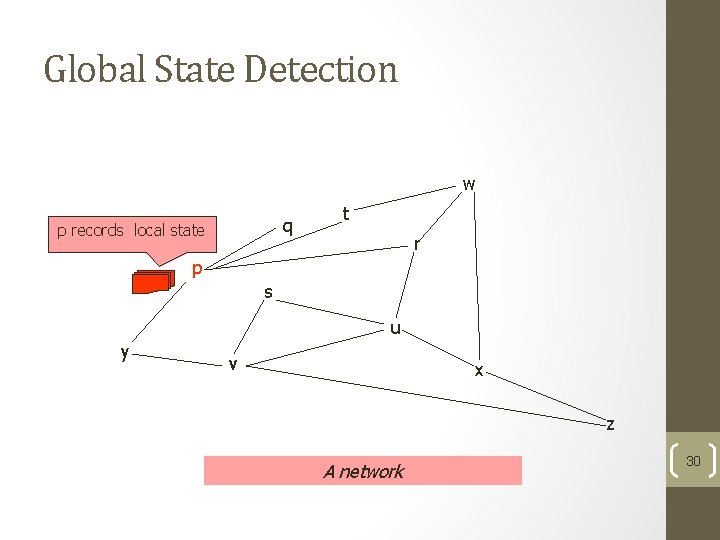
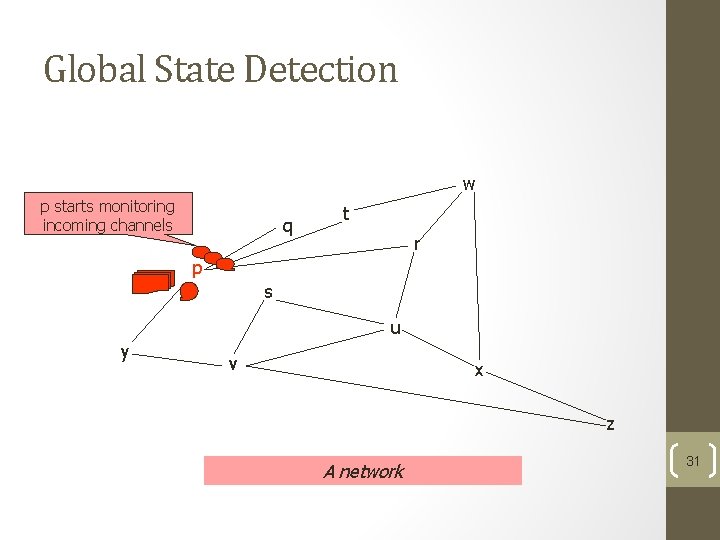
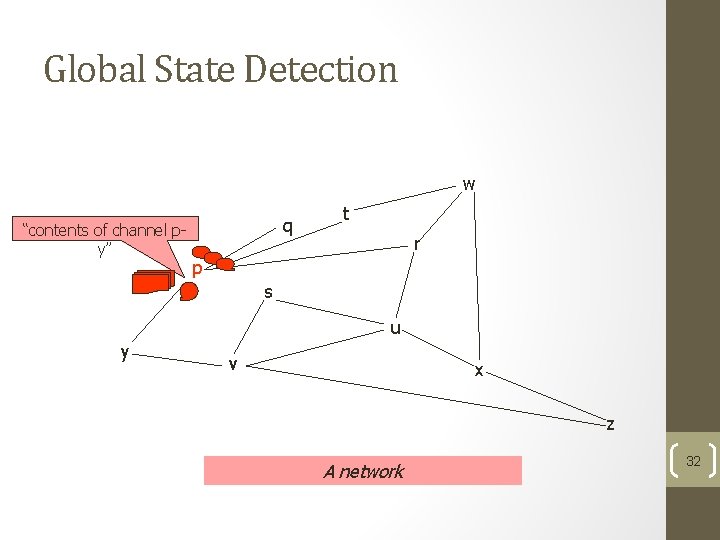
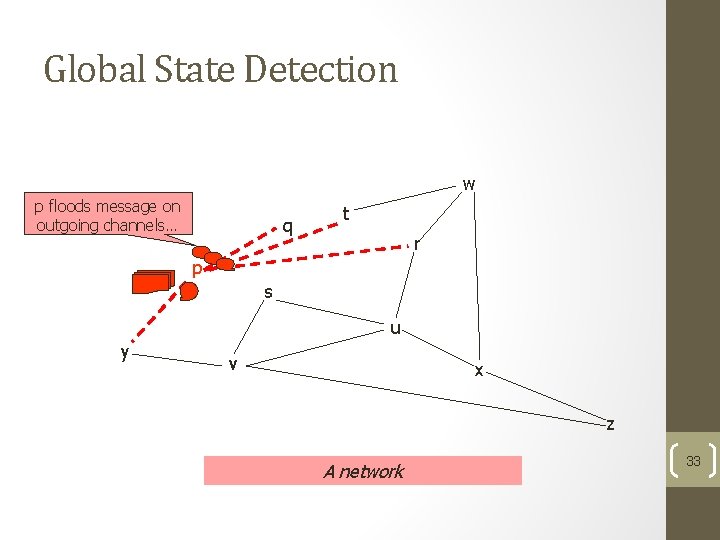
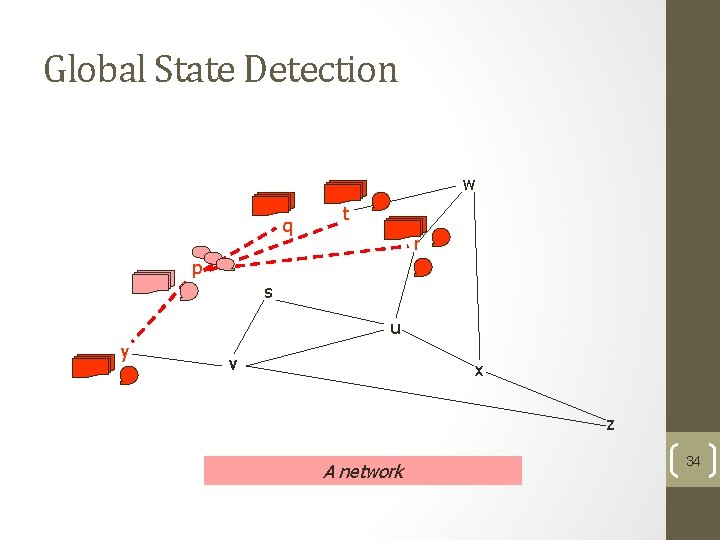
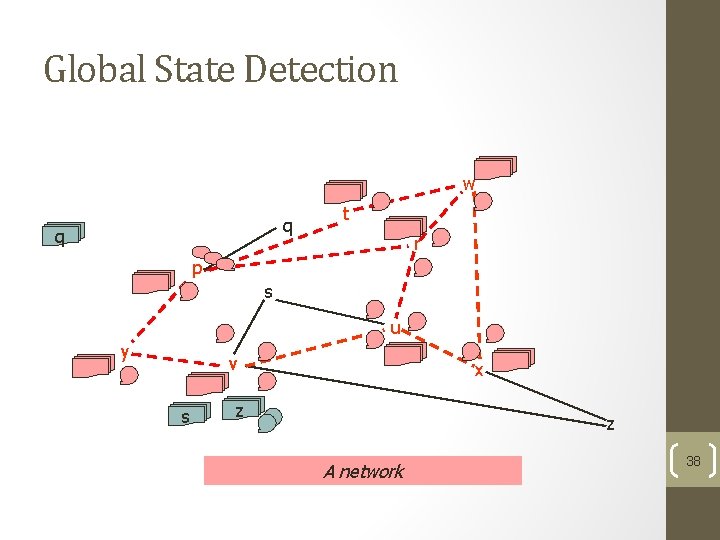
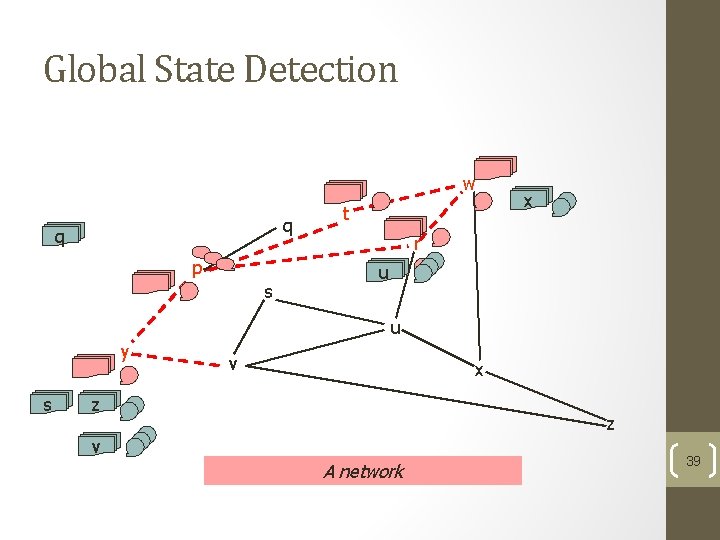
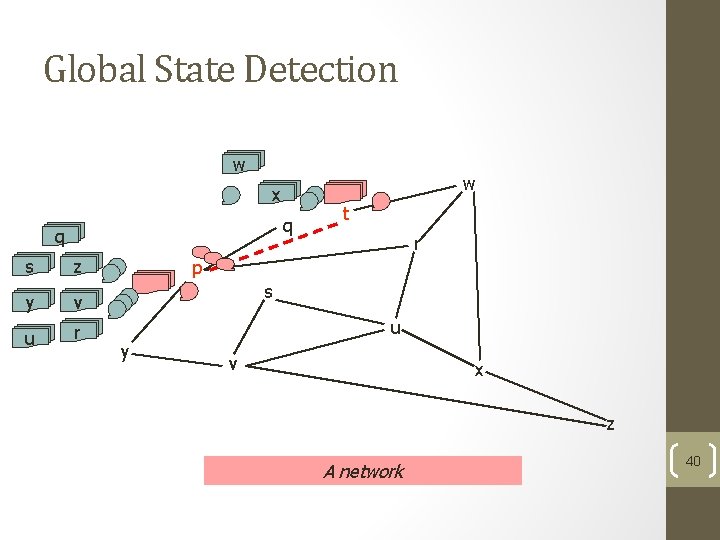
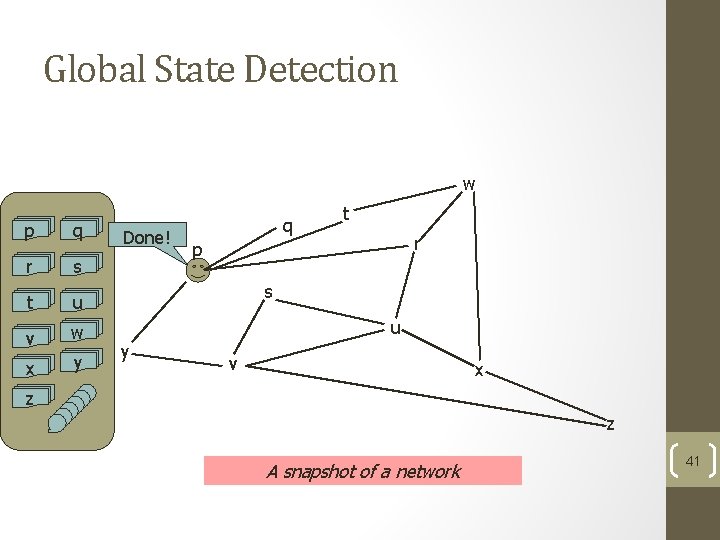
Global State Detection • • Superimposed on the computation Each process records its own state Processes of a channel cooperate on recording channel state Use a marker to synchronize global state recording 26
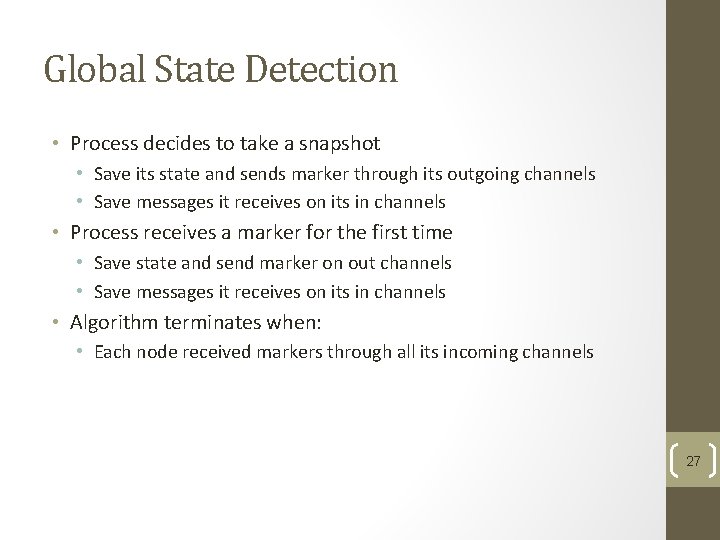
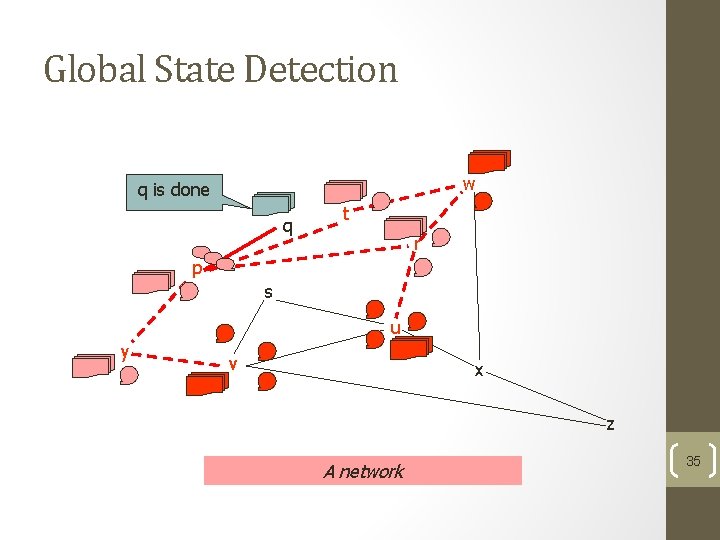
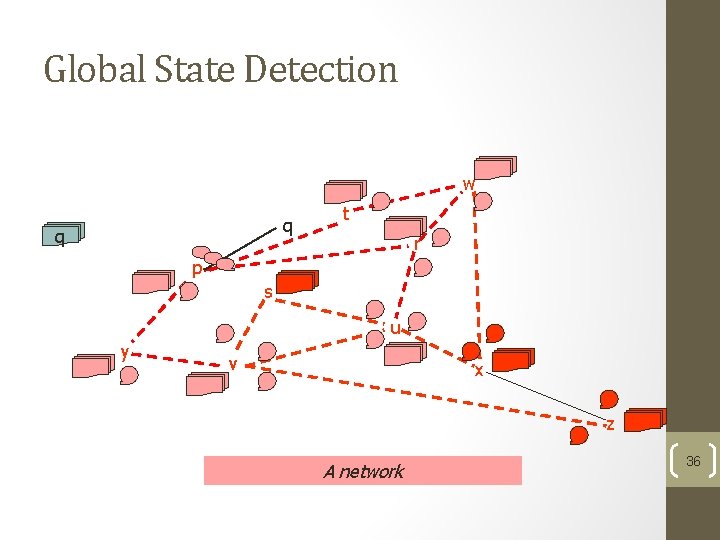
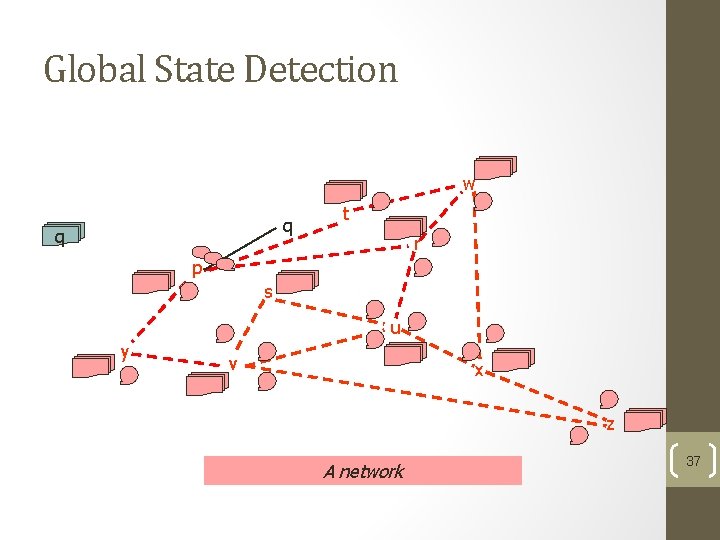
Global State Detection • Process decides to take a snapshot • Save its state and sends marker through its outgoing channels • Save messages it receives on its in channels • Process receives a marker for the first time • Save state and send marker on out channels • Save messages it receives on its in channels • Algorithm terminates when: • Each node received markers through all its incoming channels 27
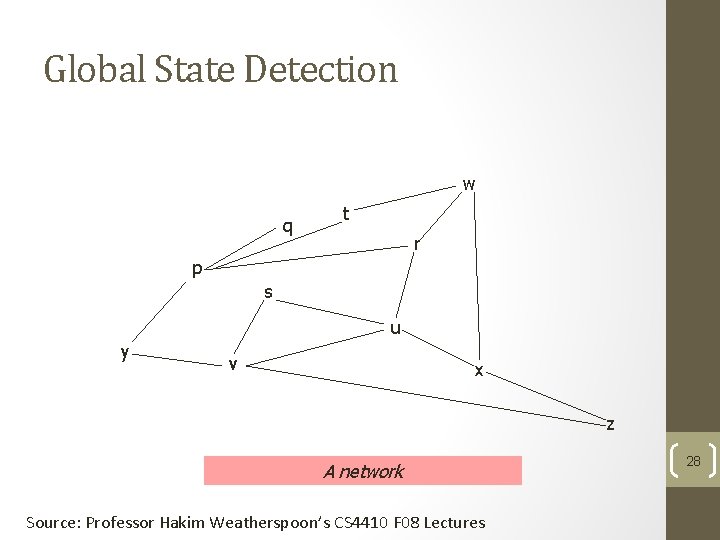
Global State Detection w q t r p s u y v x z A network Source: Professor Hakim Weatherspoon’s CS 4410 F 08 Lectures 28
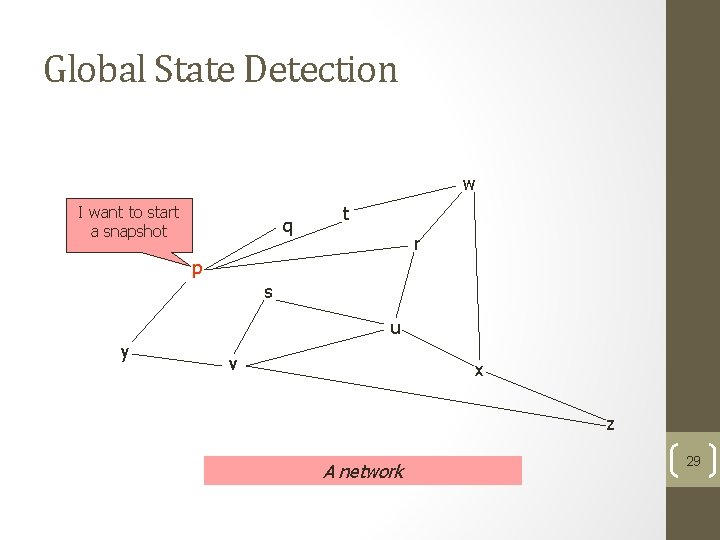
Global State Detection w I want to start a snapshot q t r p s u y v x z A network 29
Global State Detection w q p records local state t r p s u y v x z A network 30
Global State Detection w p starts monitoring incoming channels q t r p s u y v x z A network 31
Global State Detection w “contents of channel py” q t r p s u y v x z A network 32
Global State Detection w p floods message on outgoing channels… q t r p s u y v x z A network 33
Global State Detection w q t r p s u y v x z A network 34
Global State Detection w q is done q t r p s u y v x z A network 35
Global State Detection w q q t r p s u y v x z A network 36
Global State Detection w q q t r p s u y v x z A network 37
Global State Detection w q q t r p s u y v s x z z A network 38
Global State Detection w q q p s t x r u u y s v x z z v A network 39
Global State Detection w w x q q s z y v u r t r p s u y v x z A network 40
Global State Detection w p q r s t u v w x y Done! q t r p s u y v x z z A snapshot of a network 41
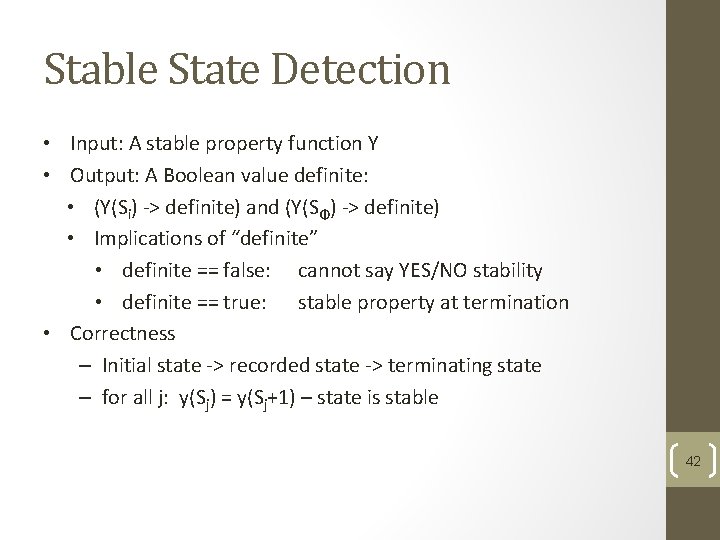
Stable State Detection • Input: A stable property function Y • Output: A Boolean value definite: • (Y(Si) -> definite) and (Y(SΦ) -> definite) • Implications of “definite” • definite == false: cannot say YES/NO stability • definite == true: stable property at termination • Correctness – Initial state -> recorded state -> terminating state – for all j: y(Sj) = y(Sj+1) – state is stable 42
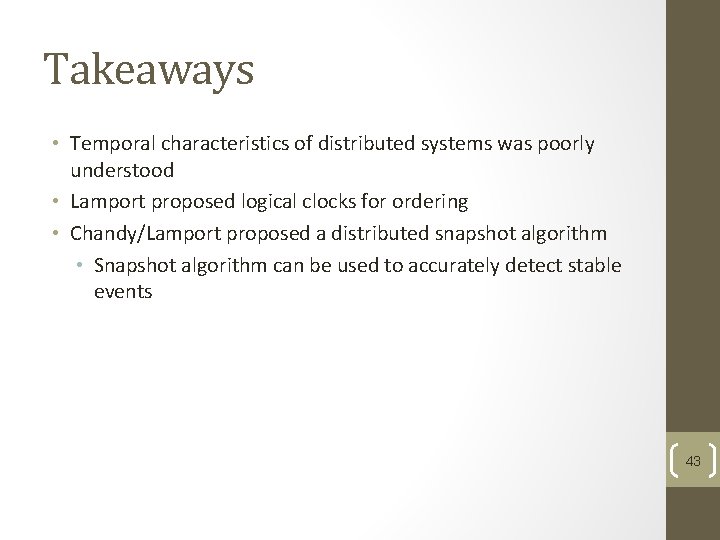
Takeaways • Temporal characteristics of distributed systems was poorly understood • Lamport proposed logical clocks for ordering • Chandy/Lamport proposed a distributed snapshot algorithm • Snapshot algorithm can be used to accurately detect stable events 43