Chinese Music Chapter 13 Deng Haiqiong Haiqiong Deng
- Slides: 21
Chinese Music Chapter 13
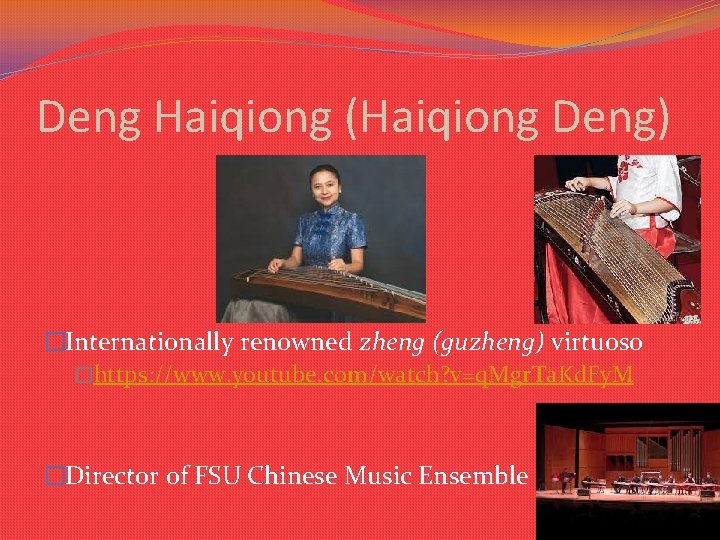
Deng Haiqiong (Haiqiong Deng) �Internationally renowned zheng (guzheng) virtuoso �https: //www. youtube. com/watch? v=q. Mgr. Ta. Kd. Fy. M �Director of FSU Chinese Music Ensemble
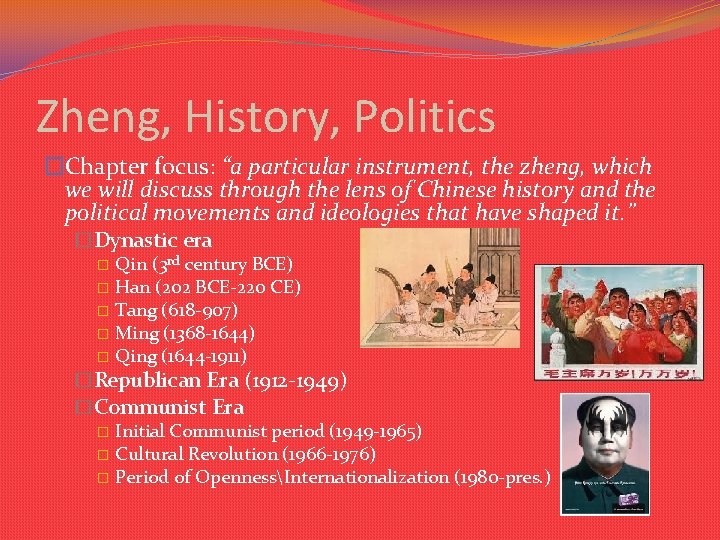
Zheng, History, Politics �Chapter focus: “a particular instrument, the zheng, which we will discuss through the lens of Chinese history and the political movements and ideologies that have shaped it. ” �Dynastic era � Qin (3 rd century BCE) � Han (202 BCE-220 CE) � Tang (618 -907) � Ming (1368 -1644) � Qing (1644 -1911) �Republican Era (1912 -1949) �Communist Era � Initial Communist period (1949 -1965) � Cultural Revolution (1966 -1976) � Period of OpennessInternationalization (1980 -pres. )
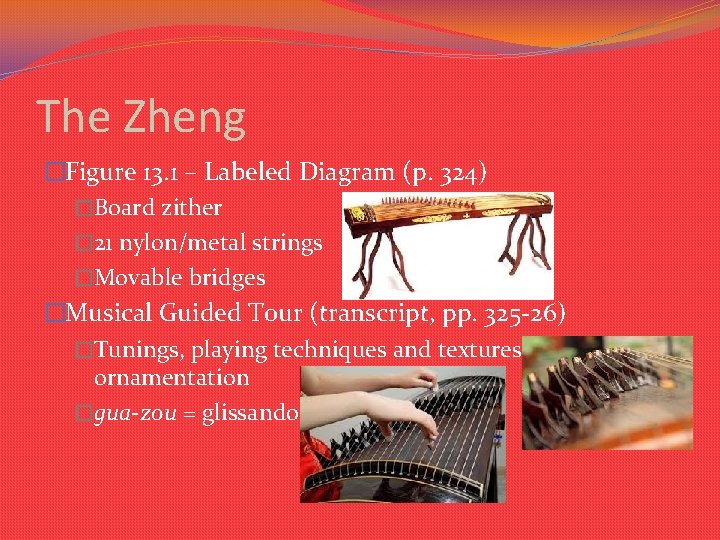
The Zheng �Figure 13. 1 – Labeled Diagram (p. 324) �Board zither � 21 nylon/metal strings �Movable bridges �Musical Guided Tour (transcript, pp. 325 -26) �Tunings, playing techniques and textures, ornamentation �gua-zou = glissando
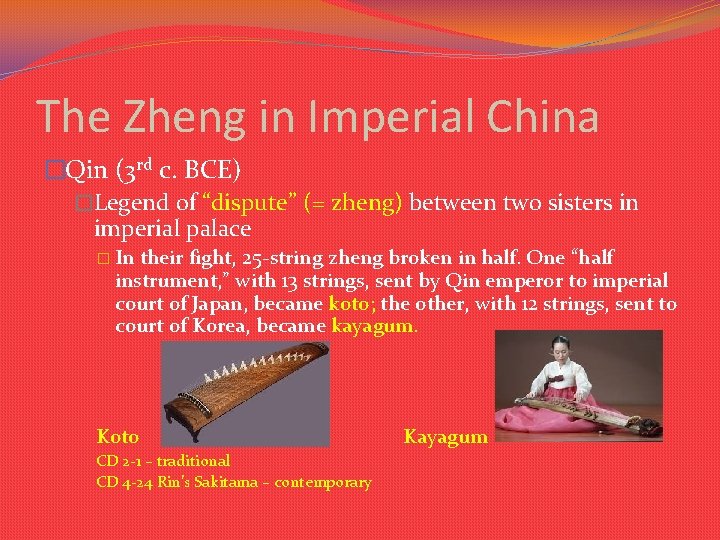
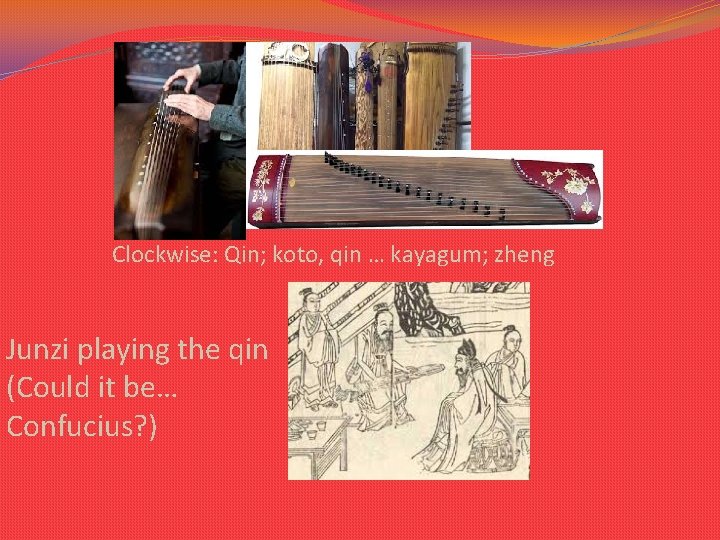
The Zheng in Imperial China �Qin (3 rd c. BCE) �Legend of “dispute” (= zheng) between two sisters in imperial palace � In their fight, 25 -string zheng broken in half. One “half instrument, ” with 13 strings, sent by Qin emperor to imperial court of Japan, became koto; the other, with 12 strings, sent to court of Korea, became kayagum. Koto CD 2 -1 – traditional CD 4 -24 Rin’s Sakitama – contemporary Kayagum
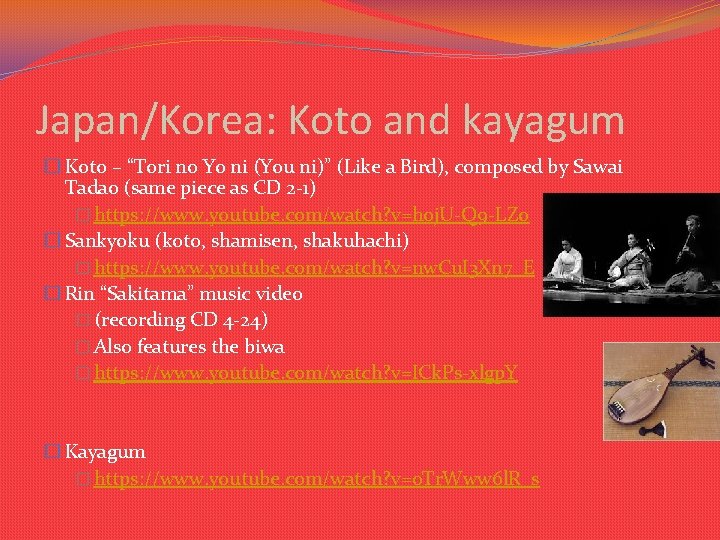
Japan/Korea: Koto and kayagum � Koto – “Tori no Yo ni (You ni)” (Like a Bird), composed by Sawai Tadao (same piece as CD 2 -1) � https: //www. youtube. com/watch? v=hoj. U-Q 9 -LZo � Sankyoku (koto, shamisen, shakuhachi) � https: //www. youtube. com/watch? v=nw. Cu. I 3 Xn 7_E � Rin “Sakitama” music video � (recording CD 4 -24) � Also features the biwa � https: //www. youtube. com/watch? v=ICk. Ps-xlgp. Y � Kayagum � https: //www. youtube. com/watch? v=0 Tr. Www 6 l. R_s
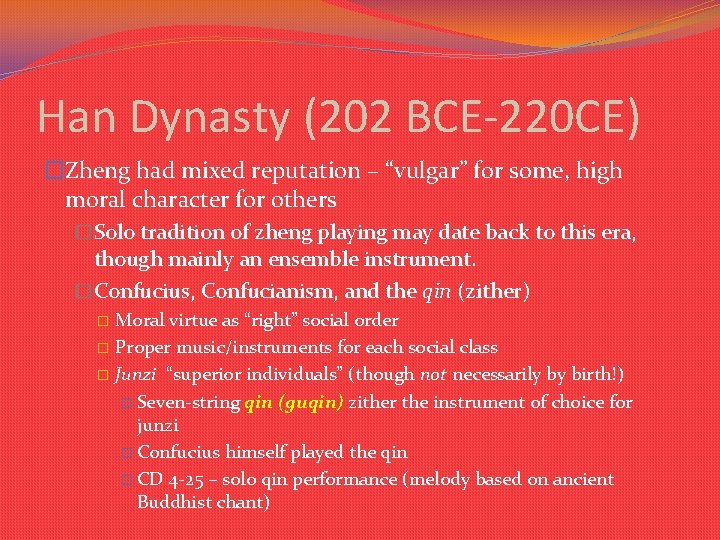
Han Dynasty (202 BCE-220 CE) �Zheng had mixed reputation – “vulgar” for some, high moral character for others �Solo tradition of zheng playing may date back to this era, though mainly an ensemble instrument. �Confucius, Confucianism, and the qin (zither) Moral virtue as “right” social order � Proper music/instruments for each social class � Junzi “superior individuals” (though not necessarily by birth!) � Seven-string qin (guqin) zither the instrument of choice for junzi � Confucius himself played the qin � CD 4 -25 – solo qin performance (melody based on ancient Buddhist chant) �
Clockwise: Qin; koto, qin … kayagum; zheng Junzi playing the qin (Could it be… Confucius? )
Qin videos �“Remember Old Friends, ” perf. by Deng Haiqiong �https: //www. youtube. com/watch? v=q. Mgr. Ta. Kd. Fy. M �From 8: 20 -end of the video (which is a TV profile of Haiqiong) � Tao-Chu Shen qin performance � https: //www. youtube. com/watch? v=nvh. KTFz. QG 8 Y � Fight scene (Jet Li vs. Donnie Yen) from Hero (2004) � https: //www. youtube. com/watch? v=Aeeo. Epmyb 2 Y
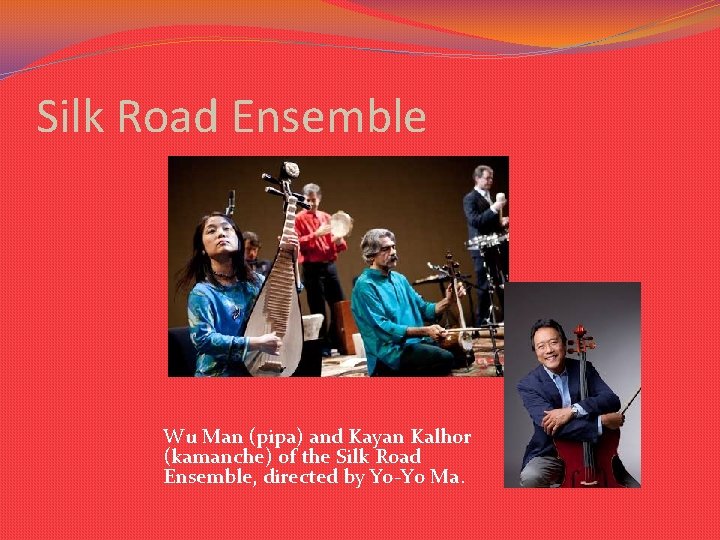
Tang Dynasty (618 -907) �Another golden age for China �Zheng reached its apogee during this period �Music ministry – 30, 000 musicians and dancers from throughout empire employed �Zheng In many different ensembles � elaborate decoration (silver-engraved frames, jade bridges), � earliest known examples of notation � Women performers (continuing association) – Emperor Xuanzong � �Silk Road – pipa and other instruments brought to China (CD 4 -26 – zheng, pipa duet)
Silk Road Ensemble Wu Man (pipa) and Kayan Kalhor (kamanche) of the Silk Road Ensemble, directed by Yo-Yo Ma.
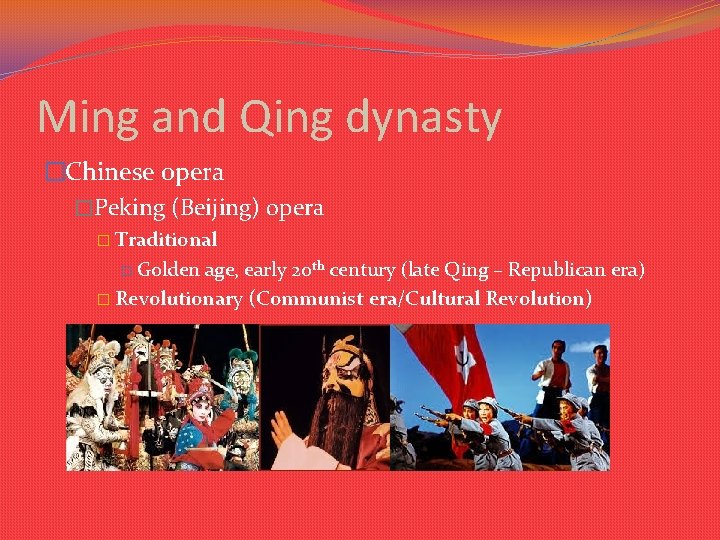
Ming and Qing dynasty �Chinese opera �Peking (Beijing) opera � Traditional � Golden age, early 20 th century (late Qing – Republican era) � Revolutionary (Communist era/Cultural Revolution)
Peking Opera examples �UNESCO Intangible Cultural Heritage “Peking Opera” video �https: //www. youtube. com/watch? v=vt. V 3 i. Au. YN 48 � The Red Lantern (Legend of the Red Lantern) -- Revolutionary/Model Opera – 1964) � Plot: three generations in family of Chinese revolutionaries, China-Japan war (1937 -1945) � CD 1 -5 (vocalist Wei Li) � https: //www. youtube. com/watch? v=g 0 mtij. Wi. R 6 g � Leehom Wang “Mistake in the Flower Fields” � https: //www. youtube. com/watch? v=l. SNVCPk. Nl 4 U
Regional Styles: Traditional Solo Zheng Music �Crystallized late Qing dynasty era (mid/late 19 th c. ) �Shandong, Henan, etc. �Each regional style: distinctive yun (regional character) �Deng Haiqiong studied Shandong style w. Gao Zicheng �“Autumn Moon over the Han Palace” (CD 4 -27; pp. 332 -34) �Baban form -- length per cycle 68 ban (1 ban = ban + yan) � 8 phrases per cycle � All phrases 8 ban in length, except Phrase 5 (12 ban) � Yijing of sadness (but complex – “gentle, moderate, controlled”) � Intricate ornamentation of melody � 16 steel-stringed zheng (rather than 21 nylon-steel)
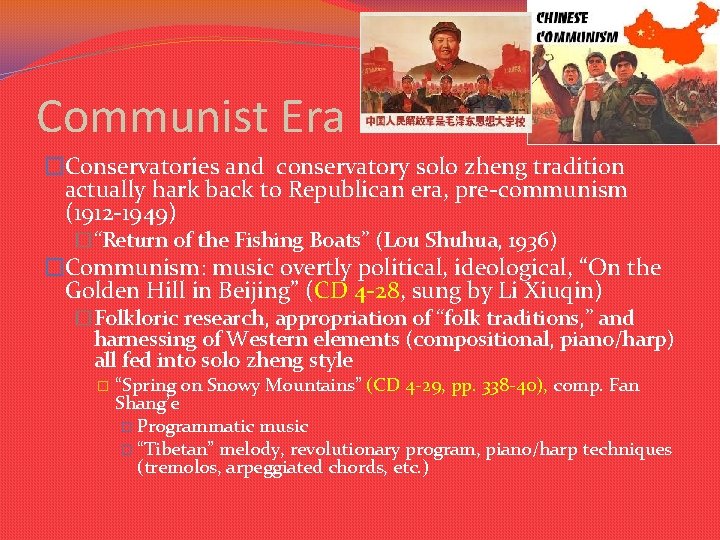
Communist Era �Conservatories and conservatory solo zheng tradition actually hark back to Republican era, pre-communism (1912 -1949) �“Return of the Fishing Boats” (Lou Shuhua, 1936) �Communism: music overtly political, ideological, “On the Golden Hill in Beijing” (CD 4 -28, sung by Li Xiuqin) �Folkloric research, appropriation of “folk traditions, ” and harnessing of Western elements (compositional, piano/harp) all fed into solo zheng style � “Spring on Snowy Mountains” (CD 4 -29, pp. 338 -40), comp. Fan Shang’e � Programmatic music � “Tibetan” melody, revolutionary program, piano/harp techniques (tremolos, arpeggiated chords, etc. )
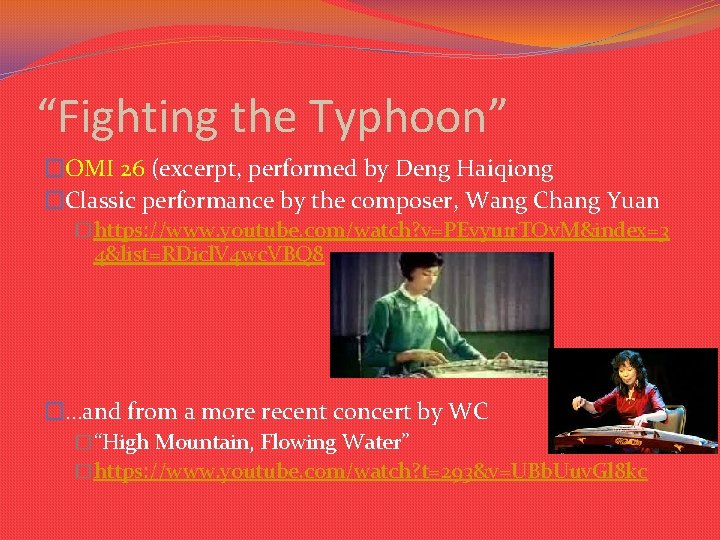
“Fighting the Typhoon” �OMI 26 (excerpt, performed by Deng Haiqiong �Classic performance by the composer, Wang Chang Yuan �https: //www. youtube. com/watch? v=PEvyu 1 r. TOv. M&index=3 4&list=RDicl. V 4 wc. VBQ 8 �…and from a more recent concert by WC �“High Mountain, Flowing Water” �https: //www. youtube. com/watch? t=293&v=UBb. Uuv. Gl 8 kc
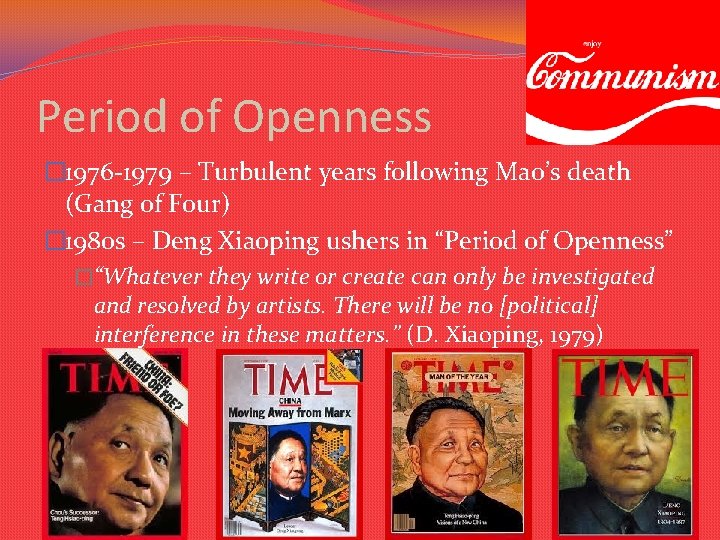
Period of Openness � 1976 -1979 – Turbulent years following Mao’s death (Gang of Four) � 1980 s – Deng Xiaoping ushers in “Period of Openness” �“Whatever they write or create can only be investigated and resolved by artists. There will be no [political] interference in these matters. ” (D. Xiaoping, 1979)
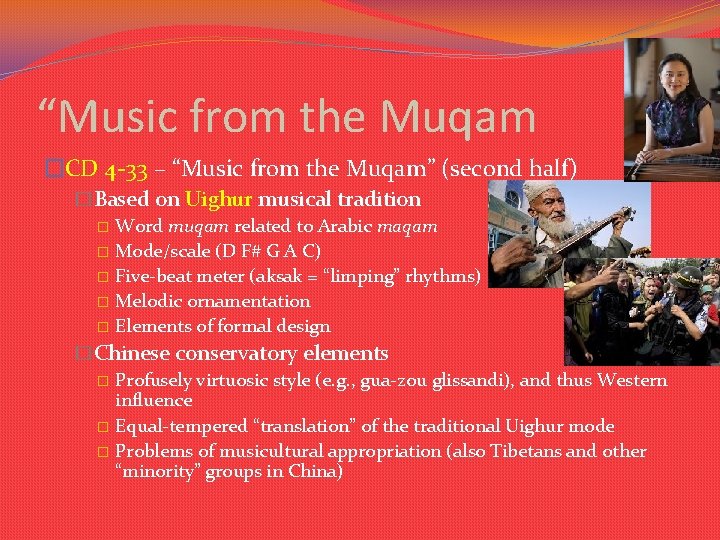
“Music from the Muqam �CD 4 -33 – “Music from the Muqam” (second half) �Based on Uighur musical tradition � Word muqam related to Arabic maqam � Mode/scale (D F# G A C) � Five-beat meter (aksak = “limping” rhythms) � Melodic ornamentation � Elements of formal design �Chinese conservatory elements � Profusely virtuosic style (e. g. , gua-zou glissandi), and thus Western influence � Equal-tempered “translation” of the traditional Uighur mode � Problems of musicultural appropriation (also Tibetans and other “minority” groups in China)
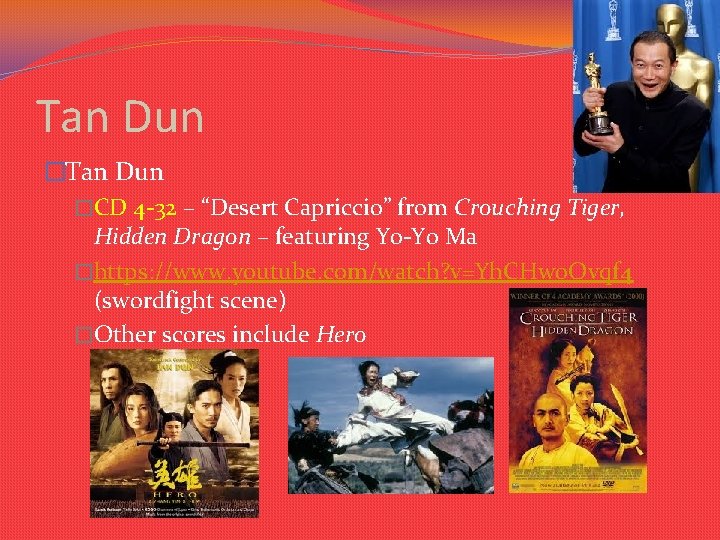
Tan Dun �CD 4 -32 – “Desert Capriccio” from Crouching Tiger, Hidden Dragon – featuring Yo-Yo Ma �https: //www. youtube. com/watch? v=Yh. CHw 0 Ovqf 4 (swordfight scene) �Other scores include Hero
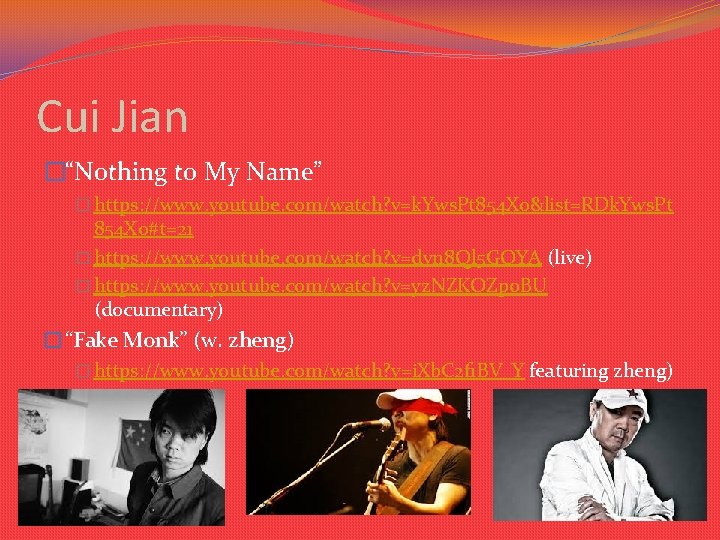
Cui Jian �“Nothing to My Name” � https: //www. youtube. com/watch? v=k. Yws. Pt 854 Xo&list=RDk. Yws. Pt 854 Xo#t=21 � https: //www. youtube. com/watch? v=dvn 8 Ql 5 GOYA (live) � https: //www. youtube. com/watch? v=yz. NZKOZpo. BU (documentary) �“Fake Monk” (w. zheng) � https: //www. youtube. com/watch? v=i. Xb. C 2 f 1 BV_Y featuring zheng)
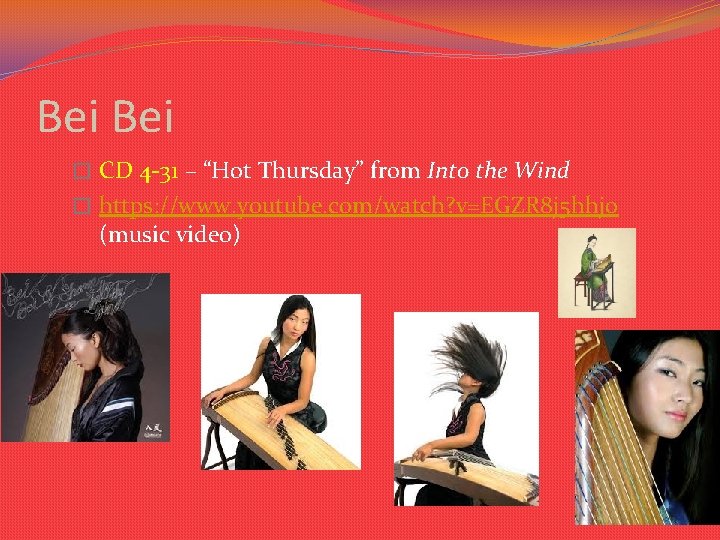
Bei � CD 4 -31 – “Hot Thursday” from Into the Wind � https: //www. youtube. com/watch? v=EGZR 8 j 5 hhjo (music video)