Ontologies at Your Service Yigal Arens Eduard Hovy




- Slides: 19
Ontologies at Your Service Yigal Arens Eduard Hovy USC/ISI
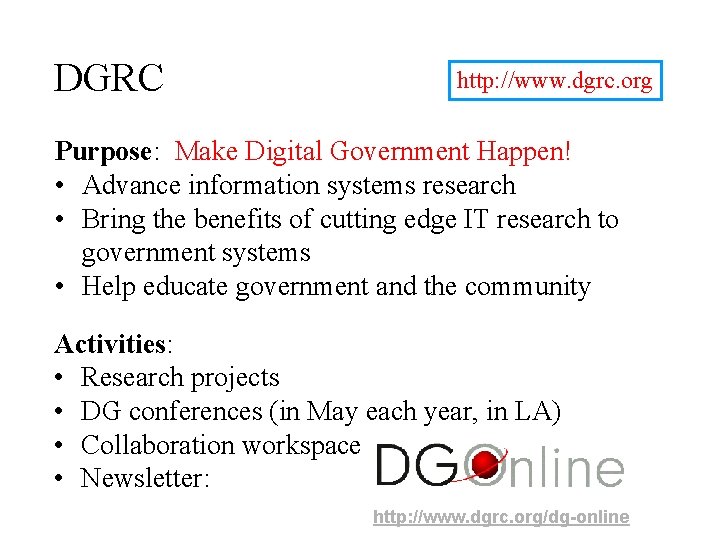
DGRC http: //www. dgrc. org Purpose: Make Digital Government Happen! • Advance information systems research • Bring the benefits of cutting edge IT research to government systems • Help educate government and the community Activities: • Research projects • DG conferences (in May each year, in LA) • Collaboration workspace • Newsletter: http: //www. dgrc. org/dg-online
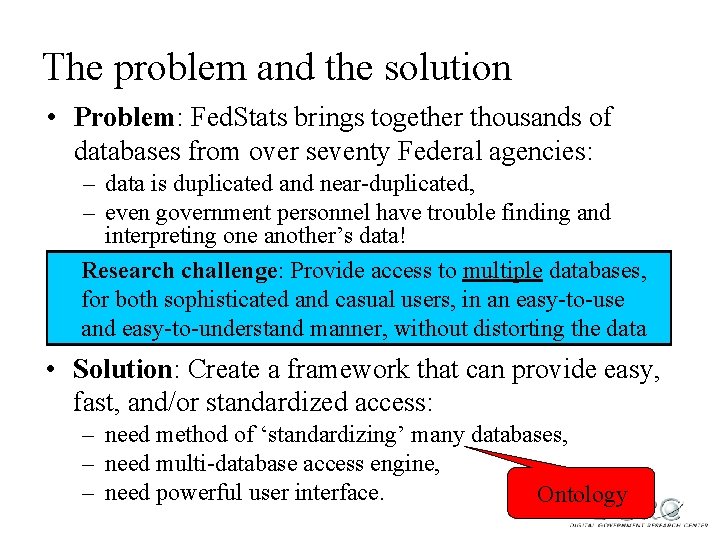
The problem and the solution • Problem: Fed. Stats brings together thousands of databases from over seventy Federal agencies: – data is duplicated and near-duplicated, – even government personnel have trouble finding and interpreting one another’s data! Research challenge: Provide access to multiple databases, for both sophisticated and casual users, in an easy-to-use and easy-to-understand manner, without distorting the data • Solution: Create a framework that can provide easy, fast, and/or standardized access: – need method of ‘standardizing’ many databases, – need multi-database access engine, – need powerful user interface. Ontology
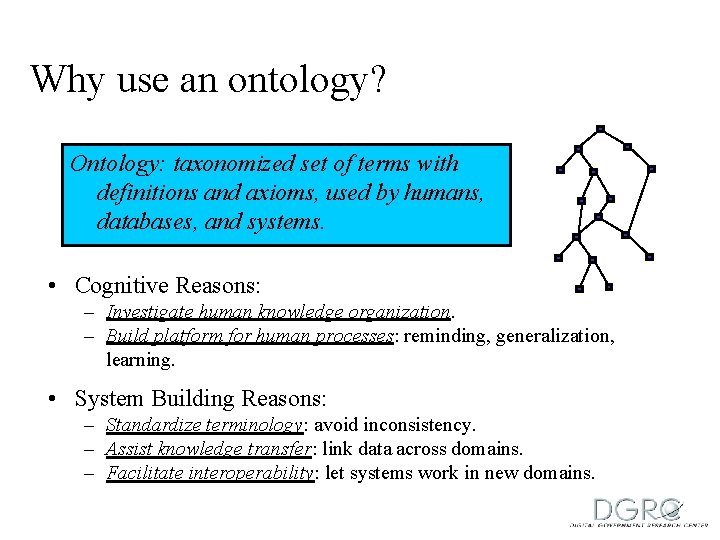
Why use an ontology? Ontology: taxonomized set of terms with definitions and axioms, used by humans, databases, and systems. • Cognitive Reasons: – Investigate human knowledge organization. – Build platform for human processes: reminding, generalization, learning. • System Building Reasons: – Standardize terminology: avoid inconsistency. – Assist knowledge transfer: link data across domains. – Facilitate interoperability: let systems work in new domains.
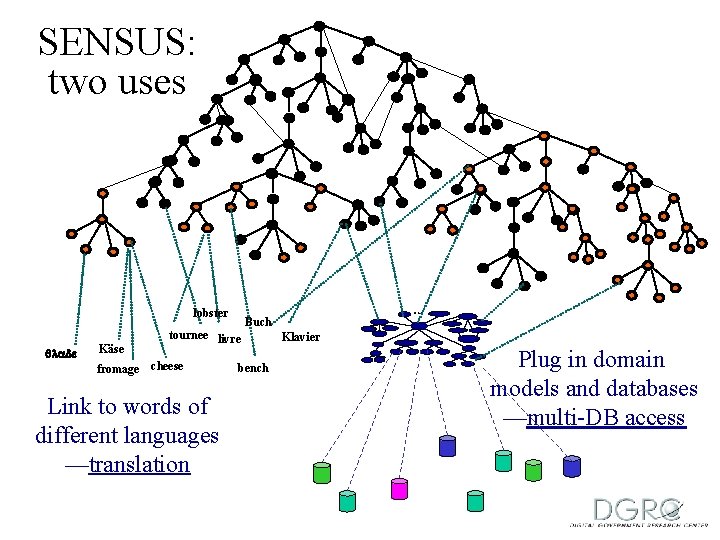
SENSUS: two uses lobster Käse tournee livre fromage cheese Link to words of different languages —translation Buch bench Klavier Plug in domain models and databases —multi-DB access
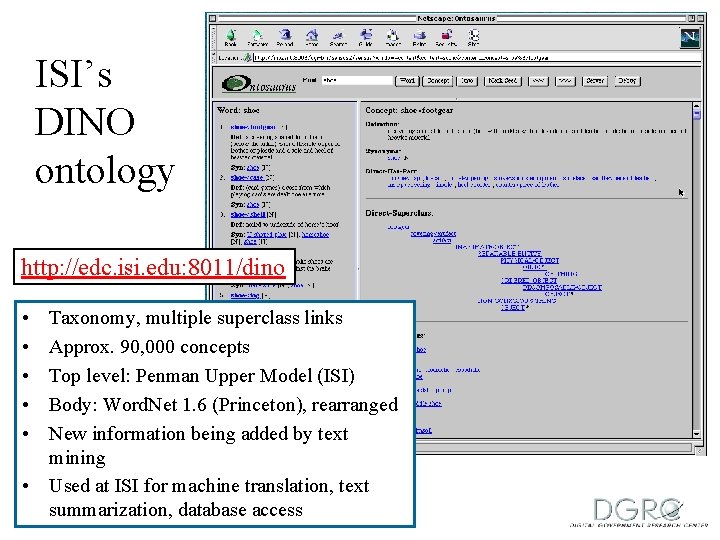
ISI’s DINO ontology http: //edc. isi. edu: 8011/dino • • • Taxonomy, multiple superclass links Approx. 90, 000 concepts Top level: Penman Upper Model (ISI) Body: Word. Net 1. 6 (Princeton), rearranged New information being added by text mining • Used at ISI for machine translation, text summarization, database access
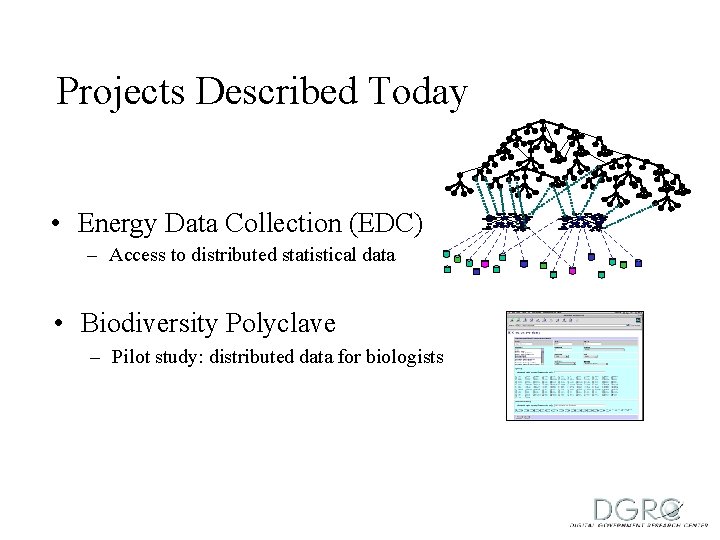
Projects Described Today • Energy Data Collection (EDC) – Access to distributed statistical data • Biodiversity Polyclave – Pilot study: distributed data for biologists
1. EDC Project
EDC: Access to gasoline data • Government partners: – – Energy Information Administration (EIA) Bureau of Labor Statistics (BLS) Census Bureau (also data from California Energy Commission) • Central problems attacked: – Proliferation of terminology – Difficulty requesting and interpreting data – Need to integrate data from autonomous sources • Current databases and models: – – – SENSUS ontology: 90, 000 nodes (from ISI’s NLP technology) Domain model: 500 nodes (manual; for database access planner) LKB: 6000 nodes (NL term/info extraction from glossaries) Databases: 58, 000+ series (EIA OGIRS and others) Webpages: 60+ (BLS, CEC tables)
The idea behind SIMS • There are many types of data sources: databases, pdf files, text files, html files. . . • The user doesn’t want to know this! • Solution: 1. ‘Wrap’ each source in software that handles access to its data 2. Record the types of info in each source in a ‘source model’ 3. Arrange all source models together in the same space—the Domain Model 4. Use a data access planner (SIMS) to transform a user’s request for data into a set of individual access queries that extracts the right data from the appropriate sources Sources: x x Xx xxx X Xxx x x xx Xxx xx X xxx x Xx xxxxxx Models:
A super domain model: the ontology • Given many domain models—how can you integrate ? them consistently, without overlap or redundancy? ? ? • Solution: ? ? ? • Use a large general-purpose concept network to provide the background—the DINO Ontology (90, 000 nodes) • Embed the Domain Models inside it, linking to the appropriate concepts (This ensures that different sources with related data share the appropriate Domain Model nodes) • Develop merging methods • The ontology provides a formal modeling language http: //edc. isi. edu: 8011/dino ? ? ?
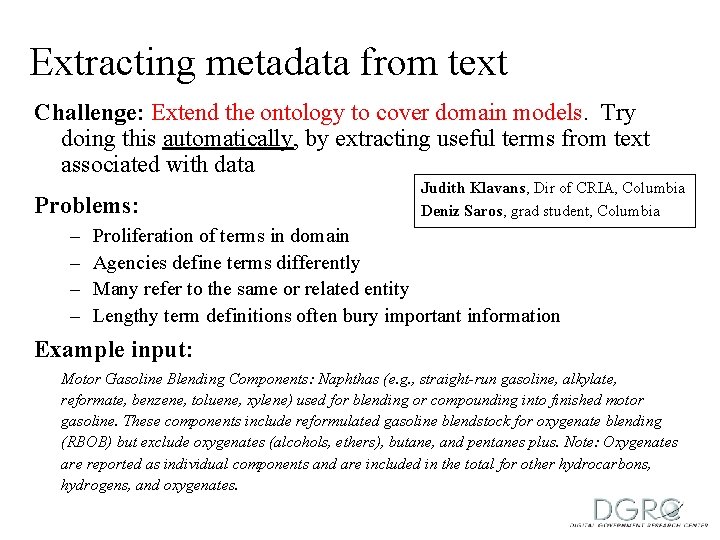
Extracting metadata from text Challenge: Extend the ontology to cover domain models. Try doing this automatically, by extracting useful terms from text associated with data Problems: – – Judith Klavans, Dir of CRIA, Columbia Deniz Saros, grad student, Columbia Proliferation of terms in domain Agencies define terms differently Many refer to the same or related entity Lengthy term definitions often bury important information Example input: Motor Gasoline Blending Components: Naphthas (e. g. , straight-run gasoline, alkylate, reformate, benzene, toluene, xylene) used for blending or compounding into finished motor gasoline. These components include reformulated gasoline blendstock for oxygenate blending (RBOB) but exclude oxygenates (alcohols, ethers), butane, and pentanes plus. Note: Oxygenates are reported as individual components and are included in the total for other hydrocarbons, hydrogens, and oxygenates.
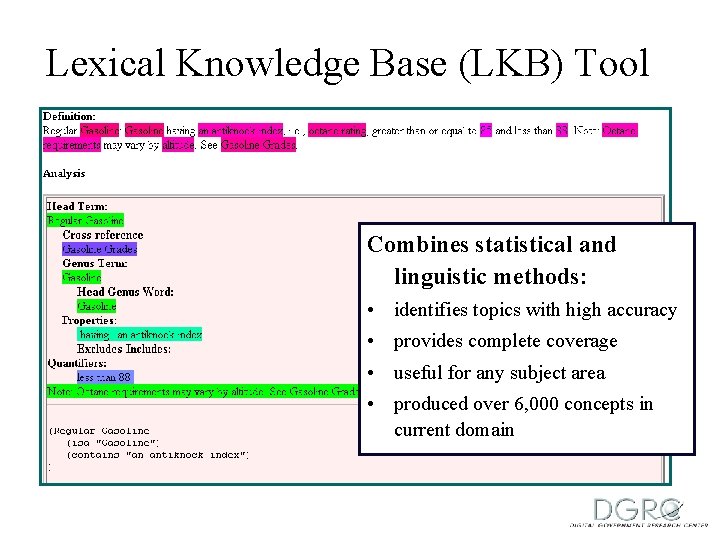
Lexical Knowledge Base (LKB) Tool Combines statistical and linguistic methods: • identifies topics with high accuracy • provides complete coverage • useful for any subject area • produced over 6, 000 concepts in current domain
2. A Biology Polyclave
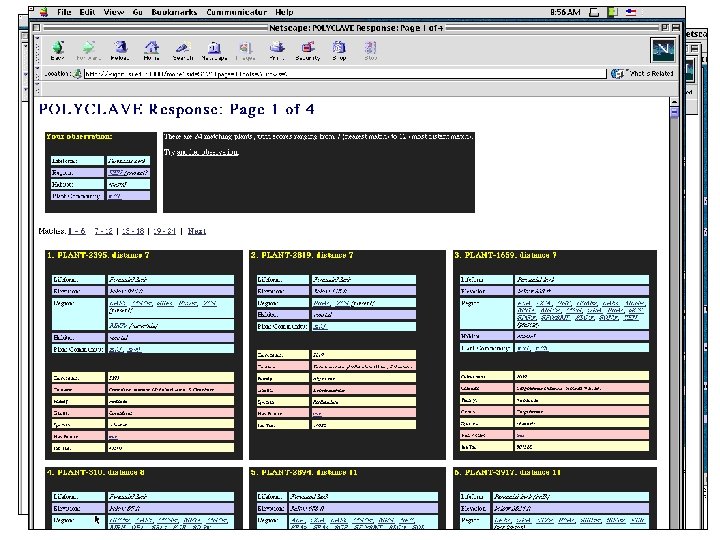
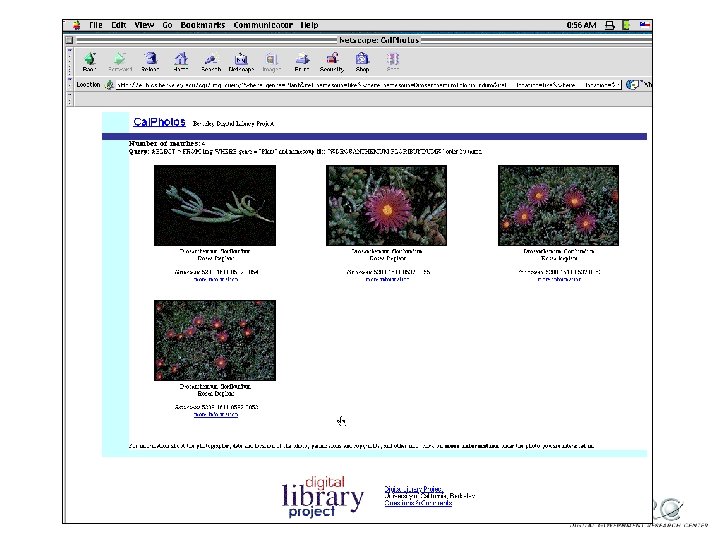
Polyclave • Challenge: at NSF Biodiversity Infrastructure workshop, field biologists asked for hand-held polyclave: – need to identify plant species in the field, tramping through Colorado – workers sometimes not fully expert in tens of thousands of varieties – existing polyclave built by someone, but proprietary; not hand-held • Experiment: we used ISI knowledge rep (ontology) technology to build a polyclave and populated it with information from UC Davis—see http: //vigor. isi. edu: 8888/
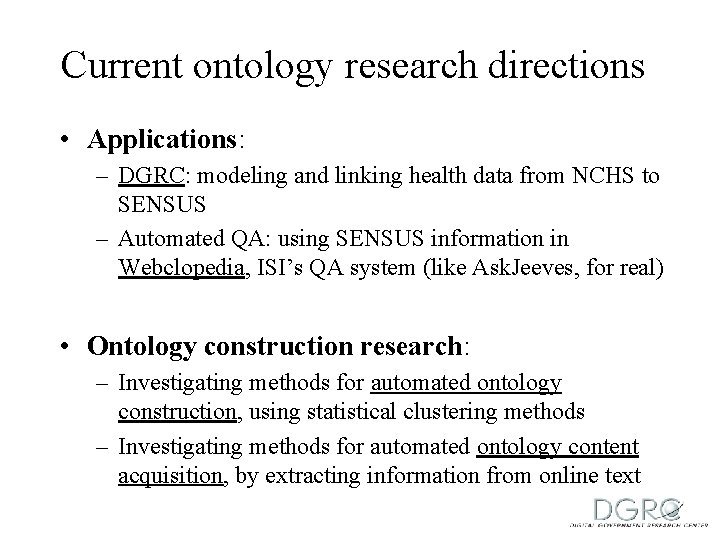
Current ontology research directions • Applications: – DGRC: modeling and linking health data from NCHS to SENSUS – Automated QA: using SENSUS information in Webclopedia, ISI’s QA system (like Ask. Jeeves, for real) • Ontology construction research: – Investigating methods for automated ontology construction, using statistical clustering methods – Investigating methods for automated ontology content acquisition, by extracting information from online text
Thank you! Any questions?