Oak Specialist Independent Living Unit 5 World of
- Slides: 26
Oak Specialist Independent Living Unit 5 - World of Work Applying Learning
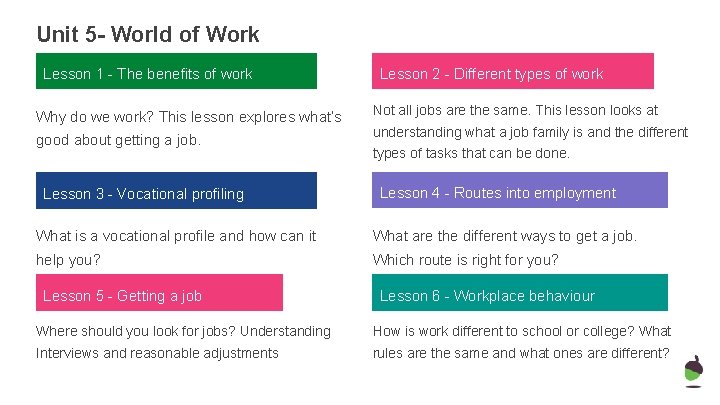
Unit 5 - World of Work Lesson 1 - The benefits of work Why do we work? This lesson explores what’s good about getting a job. Lesson 2 - Different types of work Not all jobs are the same. This lesson looks at understanding what a job family is and the different types of tasks that can be done. Option Lesson 33 - Vocational profiling Option Lesson 44 - Routes into employment What is a vocational profile and how can it What are the different ways to get a job. help you? Which route is right for you? Lesson 35 - Getting a job Option Lesson 46 - Workplace behaviour Option Where should you look for jobs? Understanding How is work different to school or college? What Interviews and reasonable adjustments rules are the same and what ones are different?
Lesson 6 - Workplace behaviour
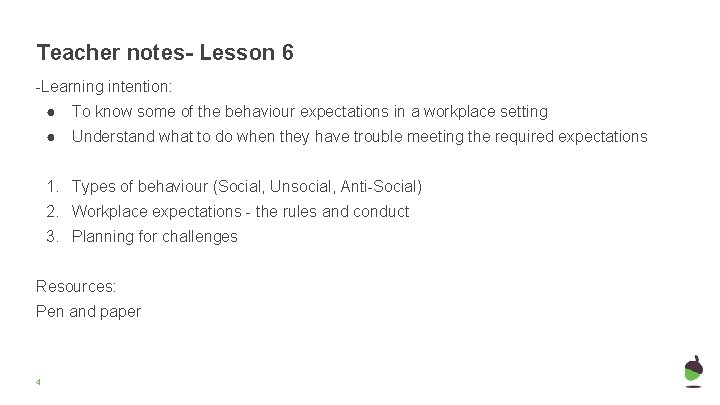
Teacher notes- Lesson 6 -Learning intention: ● To know some of the behaviour expectations in a workplace setting ● Understand what to do when they have trouble meeting the required expectations 1. Types of behaviour (Social, Unsocial, Anti-Social) 2. Workplace expectations - the rules and conduct 3. Planning for challenges Resources: Pen and paper 4
World of Workplace behaviour Applying Learning
Lesson Activity Stages This lesson will be taught in 3 parts: 1. Types of behaviour 1. The rules of work 1. Predicting and planning for challenges 6
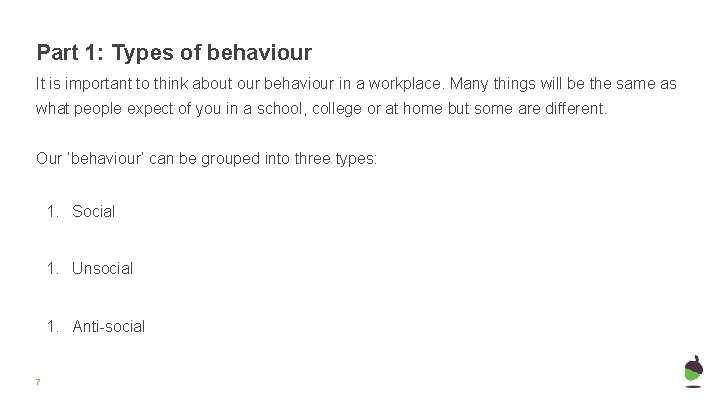
Part 1: Types of behaviour It is important to think about our behaviour in a workplace. Many things will be the same as what people expect of you in a school, college or at home but some are different. Our ‘behaviour’ can be grouped into three types: 1. Social 1. Unsocial 1. Anti-social 7
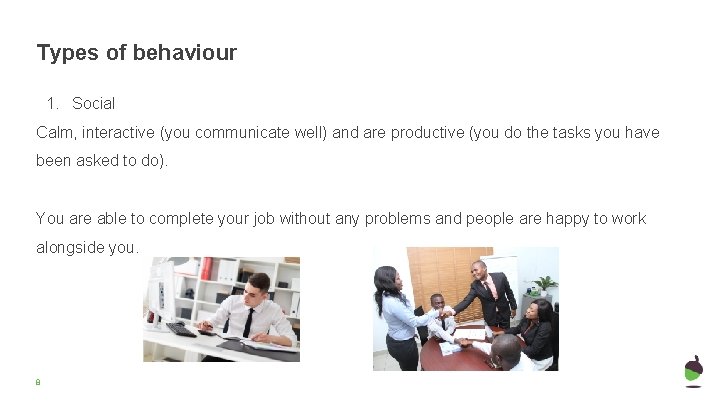
Types of behaviour 1. Social Calm, interactive (you communicate well) and are productive (you do the tasks you have been asked to do). You are able to complete your job without any problems and people are happy to work alongside you. 8
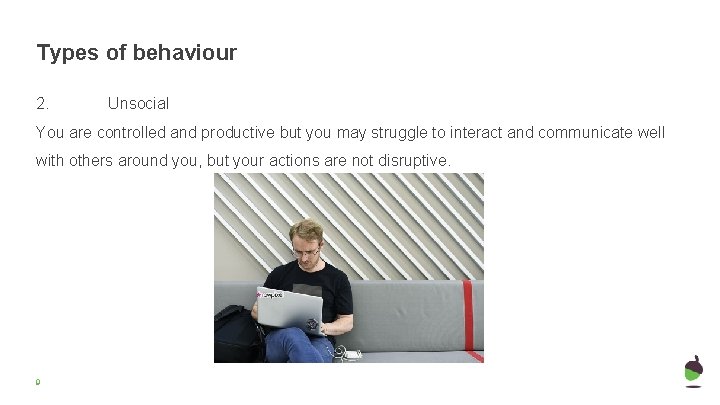
Types of behaviour 2. Unsocial You are controlled and productive but you may struggle to interact and communicate well with others around you, but your actions are not disruptive. 9
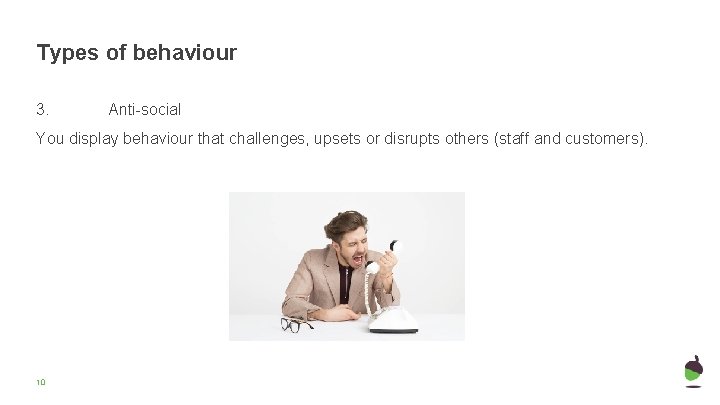
Types of behaviour 3. Anti-social You display behaviour that challenges, upsets or disrupts others (staff and customers). 10
Types of behaviour On the next three slides you will see some examples of people displaying different types of behaviour. With your teaching partner discuss whether you think it is an example of social, unsocial or anti-social behaviour. Can you explain why this type of behaviour would be appropriate or inappropriate in the workplace? 11
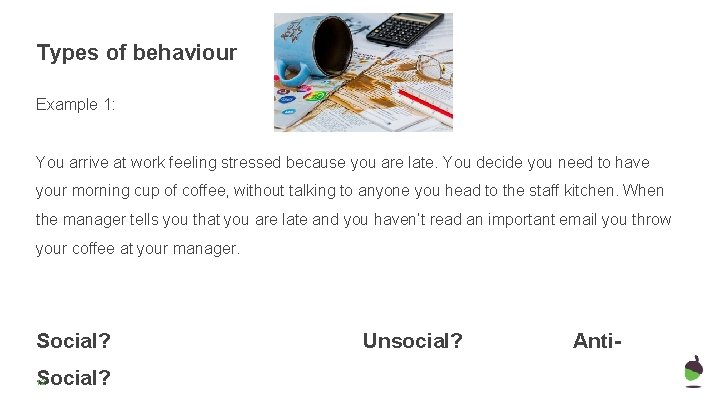
Types of behaviour Example 1: You arrive at work feeling stressed because you are late. You decide you need to have your morning cup of coffee, without talking to anyone you head to the staff kitchen. When the manager tells you that you are late and you haven’t read an important email you throw your coffee at your manager. Social? 12 Unsocial? Anti-
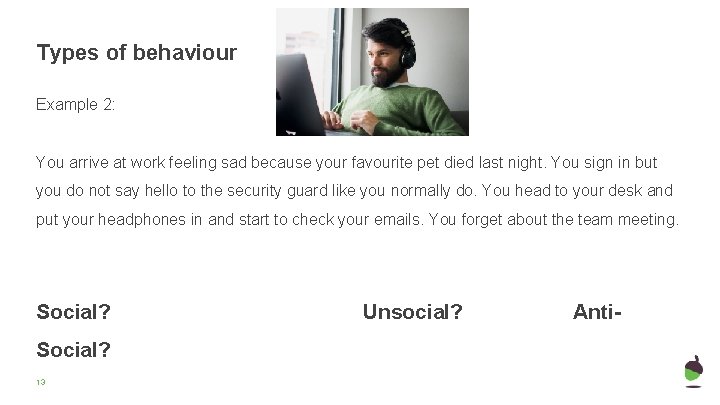
Types of behaviour Example 2: You arrive at work feeling sad because your favourite pet died last night. You sign in but you do not say hello to the security guard like you normally do. You head to your desk and put your headphones in and start to check your emails. You forget about the team meeting. Social? 13 Unsocial? Anti-
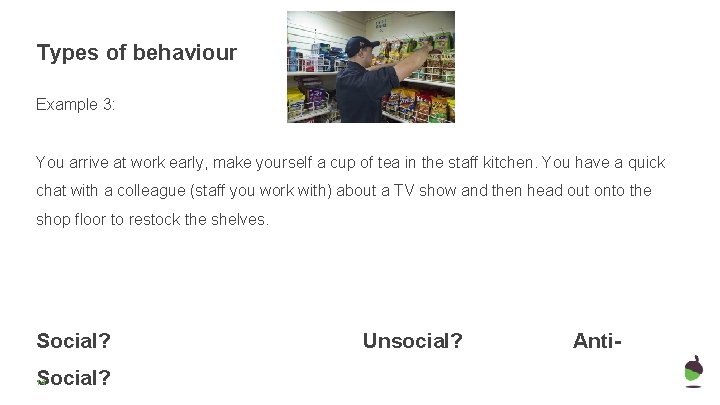
Types of behaviour Example 3: You arrive at work early, make yourself a cup of tea in the staff kitchen. You have a quick chat with a colleague (staff you work with) about a TV show and then head out onto the shop floor to restock the shelves. Social? 14 Unsocial? Anti-
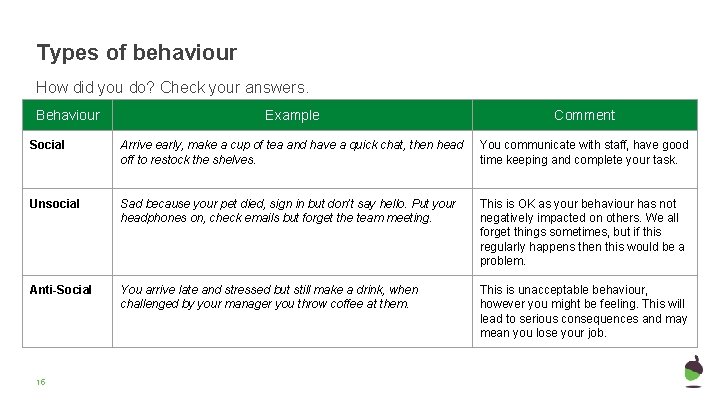
Types of behaviour How did you do? Check your answers. Behaviour Example Comment Social Arrive early, make a cup of tea and have a quick chat, then head off to restock the shelves. You communicate with staff, have good time keeping and complete your task. Unsocial Sad because your pet died, sign in but don’t say hello. Put your headphones on, check emails but forget the team meeting. This is OK as your behaviour has not negatively impacted on others. We all forget things sometimes, but if this regularly happens then this would be a problem. Anti-Social You arrive late and stressed but still make a drink, when challenged by your manager you throw coffee at them. This is unacceptable behaviour, however you might be feeling. This will lead to serious consequences and may mean you lose your job. 15
Part 2: The rules of work A workplace comes with rules which can be separated into two groups. Instructions: something you MUST do - for example not to use your mobile phone in-front of customers. Conduct: the positive social behaviour that should be displayed Instructions can be quite simple to follow, whilst conduct does not always come with examples which can make it difficult to understand. 16
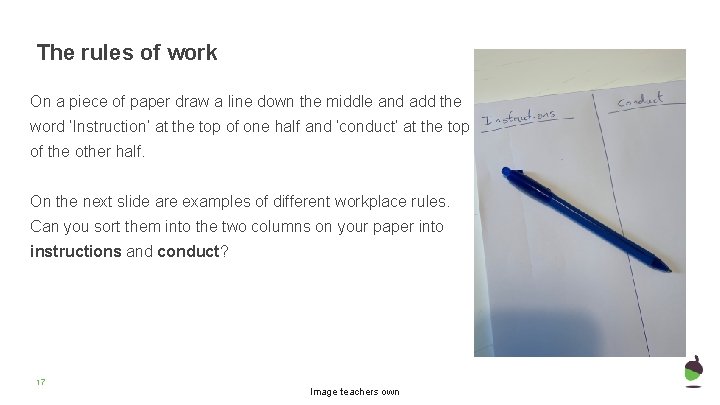
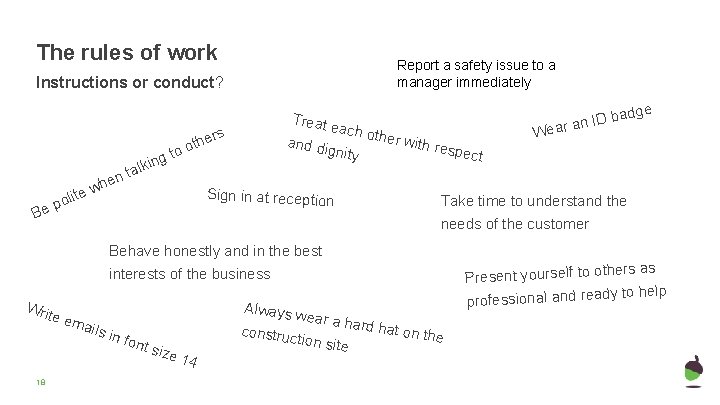
The rules of work On a piece of paper draw a line down the middle and add the word ‘Instruction’ at the top of one half and ‘conduct’ at the top of the other half. On the next slide are examples of different workplace rules. Can you sort them into the two columns on your paper into instructions and conduct? 17 Image teachers own
The rules of work Report a safety issue to a manager immediately Instructions or conduct? Treat each o ther w and di ith res gnity pect s hen w e olit ing k l ta to er oth Sign in at reception ep B bad r an ID Wea ge Take time to understand the needs of the customer Behave honestly and in the best interests of the business Writ 18 Always e em ails in font size 1 4 wear a h ard hat construc on the tion site hers as Present yourself to ot y to help professional and read
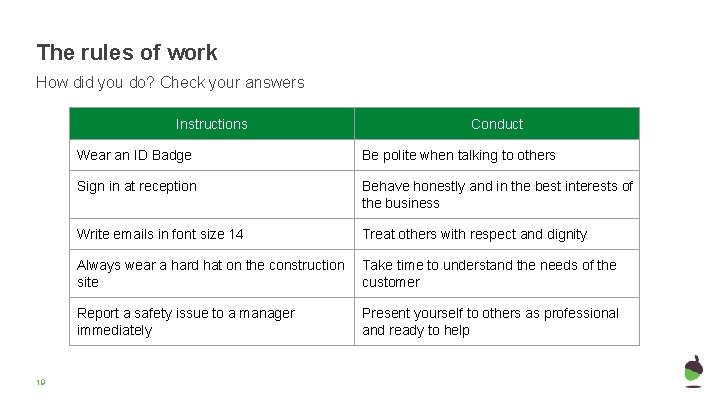
The rules of work How did you do? Check your answers Instructions 19 Conduct Wear an ID Badge Be polite when talking to others Sign in at reception Behave honestly and in the best interests of the business Write emails in font size 14 Treat others with respect and dignity Always wear a hard hat on the construction site Take time to understand the needs of the customer Report a safety issue to a manager immediately Present yourself to others as professional and ready to help
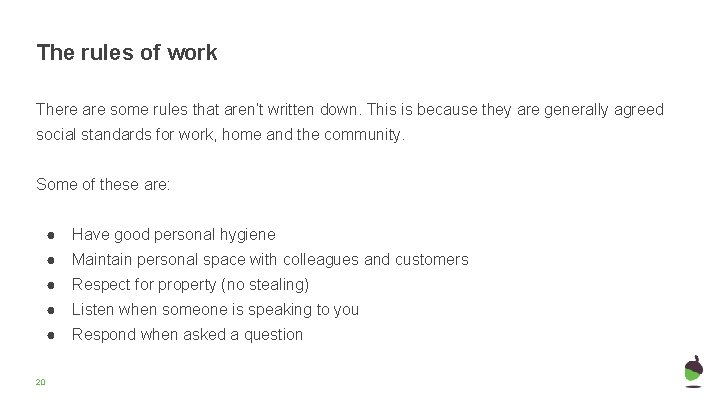
The rules of work There are some rules that aren’t written down. This is because they are generally agreed social standards for work, home and the community. Some of these are: 20 ● Have good personal hygiene ● Maintain personal space with colleagues and customers ● Respect for property (no stealing) ● Listen when someone is speaking to you ● Respond when asked a question
Part 3: Predicting and planning for challenges In part 1 and 2 we have seen how positive social behaviour is the expected behaviour for a workplace, whilst unsocial behaviour may be acceptable on occasions but anti-social behaviour is not ok. However, we all feel overwhelmed sometimes and when we are, we find it more challenging to display positive social behaviour. Therefore it is important that we have a plan to manage our feelings and actions so that our behaviour does not become anti-social. 21
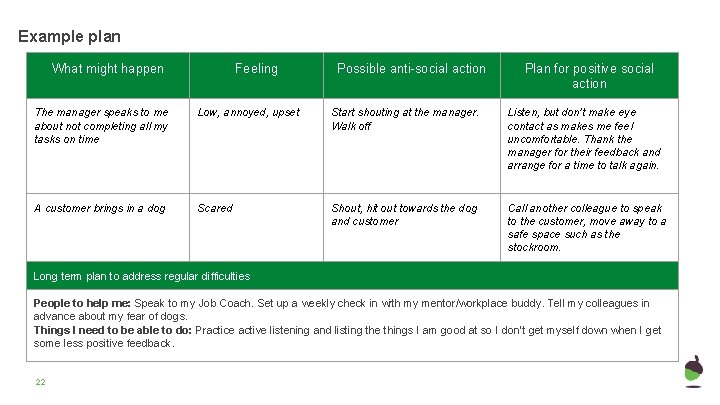
Example plan What might happen Feeling Possible anti-social action Plan for positive social action The manager speaks to me about not completing all my tasks on time Low, annoyed, upset Start shouting at the manager. Walk off Listen, but don’t make eye contact as makes me feel uncomfortable. Thank the manager for their feedback and arrange for a time to talk again. A customer brings in a dog Scared Shout, hit out towards the dog and customer Call another colleague to speak to the customer, move away to a safe space such as the stockroom. Long term plan to address regular difficulties People to help me: Speak to my Job Coach. Set up a weekly check in with my mentor/workplace buddy. Tell my colleagues in advance about my fear of dogs. Things I need to be able to do: Practice active listening and listing the things I am good at so I don’t get myself down when I get some less positive feedback. 22
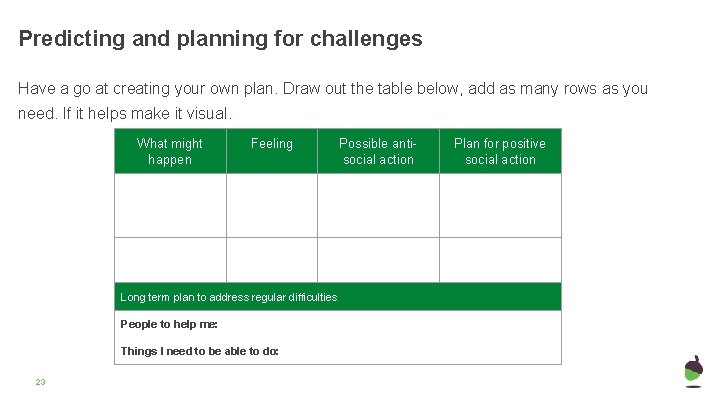
Predicting and planning for challenges Have a go at creating your own plan. Draw out the table below, add as many rows as you need. If it helps make it visual. What might happen Feeling Long term plan to address regular difficulties People to help me: Things I need to be able to do: 23 Possible antisocial action Plan for positive social action
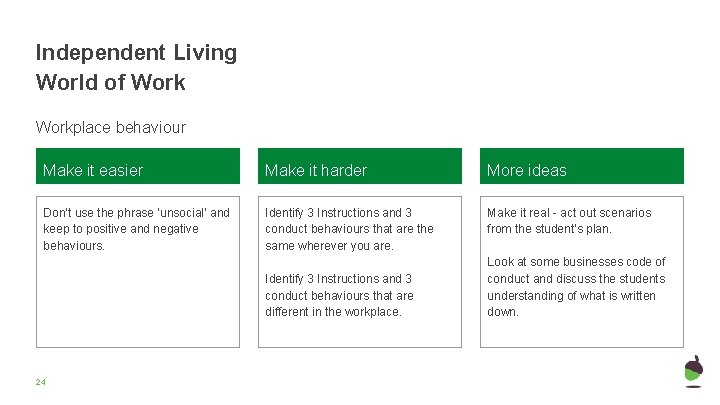
Independent Living World of Workplace behaviour Make it easier Make it harder More ideas Don’t use the phrase ‘unsocial’ and keep to positive and negative behaviours. Identify 3 Instructions and 3 conduct behaviours that are the same wherever you are. Make it real - act out scenarios from the student’s plan. Identify 3 Instructions and 3 conduct behaviours that are different in the workplace. 24 Look at some businesses code of conduct and discuss the students understanding of what is written down.
Further Learning with Oak National Independent Living: ● Applying Learning- People who help us (Unit 4) ● Applying Learning- Community safety (Unit 6) External sites: ● Use a search engine and type ‘code of conduct’ to find real examples of workplace rules and expectations 25
References Slide 8 - Man at desk, User 11472009, Freepik / Colleagues seminar, Needpix Slide 9 - Alone casual, Pxfuel Slide 10 - Man wearing brown suit jacket, Pexels Slide 12 - Spilt coffee, Piqsels Slide 13 - Man wearing headphones, Piqsels Slide 14 - MEDITERRANEAN SEA, U. S. Naval Forces, Wikimedia Commons 26