Oak Specialist Independent Living Unit 3 Daily Living
- Slides: 21
Oak Specialist Independent Living Unit 3 - Daily Living Skills Building Understanding
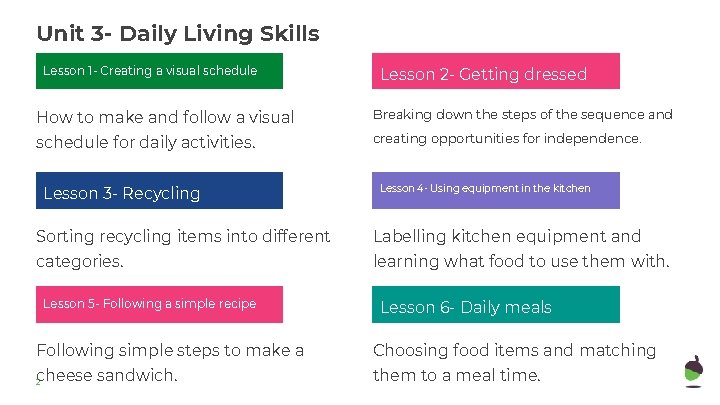
Unit 3 - Daily Living Skills Lesson 1 - Creating a visual schedule Lesson 2 - Getting dressed How to make and follow a visual Breaking down the steps of the sequence and schedule for daily activities. creating opportunities for independence. Option Lesson 33 - Recycling Lesson 4 - Using Option 4 equipment in the kitchen Sorting recycling items into different Labelling kitchen equipment and categories. learning what food to use them with. Option Lesson 5 -3 Following a simple recipe Option Lesson 46 - Daily meals Following simple steps to make a Choosing food items and matching cheese sandwich. them to a meal time. 2
Lesson 2 - Getting dressed
Teacher notes- Getting dressed Learning Intention: To explore strategies for independence in dressing. 1. Skills required for dressing- introduction to each one. 2. How to support independent dressing- supporting environment and approach. 3. Backward chaining- teaching for success. Breaking a dressing sequence into steps. 4. Top tips for developing independence with specific clothing items- tops, zips and shoelaces. Resources: clothing items 4
Daily Living Skills Getting dressed Building Understanding
1. Independent dressing All learners will develop independence in dressing at different stages. Skills required for dressing- 6 - Motor skills (fine and gross) - Co-ordination - Balance - Perception - Stereognosis - Body Schema
Motor skills (fine and gross) Requires muscle strength and flexibility in joints and limbs. 7
Co-ordination Requires the ability to create co-ordinated movements with limbs, e. g. pulling t-shirt down with one arm whilst pushing the other arm through a sleeve. 8
Balance The ability to maintain balance whilst shifting position and posture, e. g. putting one leg through trousers whilst standing on the other. 9
Perception Knowing that things are different shapes and sizes, eg. fitting buttons through holes. 10
Stereognosis The ability to feel around clothing items without being able to see, e. g putting arms through a jumper whilst it is covering a head. 11
Body Schema Knowing the difference between body parts and right and left. 12
2. Environment to support independence ● Ensure your learner is in the right position e. g. sat on the floor or chair depending on the item of clothing they are putting on. ● Sit in front of a mirror if possible. ● Put clothes out in the correct order either in a pile or sequence. 13
Approach to support independence ● TIME - give your learner time to complete the steps they are working on. ● Choose a time of the day when you will have time to teach dressing. ● Follow a consistent sequence and technique to prompt your learner. ● Prompt your learner to ‘fix’ their mistakes instead of doing it for them. ● Praise your learner when they complete part of the dressing sequence independently! 14
3. Backward chaining When teaching dressing, choose an item of clothing and break the task into steps e. g. putting on a t-shirt 1. Open t-shirt 2. Put over head 3. Put one arm in 4. Put other arm in 5. Pull down. Chain the steps by completing the first four together. When you get to the last step, encourage your learner to do this by themselves. Once they can complete the last step independently, complete the first three together and then let them do the last two by themselves. Continue backward chaining each step until they can complete the sequence independently. 15
4. Top Tips: T-shirts/jumpers ● Use t-shirt with an image on the front to help visually identify the front and back. ● Lay t-shirt front down flat on the floor or bed so learner can pick it up from the bottom at the back (to pull over head). ● Mark the inside of the front at the bottom with pen or coloured thread. Lay the top flat, facing downwards. When you roll the back of the top, this visually identifies that it is the correct way to put on. ● Use labels to teach the back of a top. Encourage your learner to find this before putting on. 16
Top Tips: Zips ● Practise fine motor activities to develop pincer grip needed for zipping. ● First teach by putting item out on table or floor in front of the learner. ● Attach a ring pull or keyring to the end of the zip to aid grip. ● Support your learner to use both hands when zipping. One hand holding the bottom and one holding the zip. 17
Top Tips: Shoelaces ● Practise with shoe on lap first. ● Observe how much of the sequence they can already do before deciding the teaching point. ● Practise ‘tying’ using string or wool. ● Velcro fastening shoes. ● Use elastic laces for pull on and off. 18
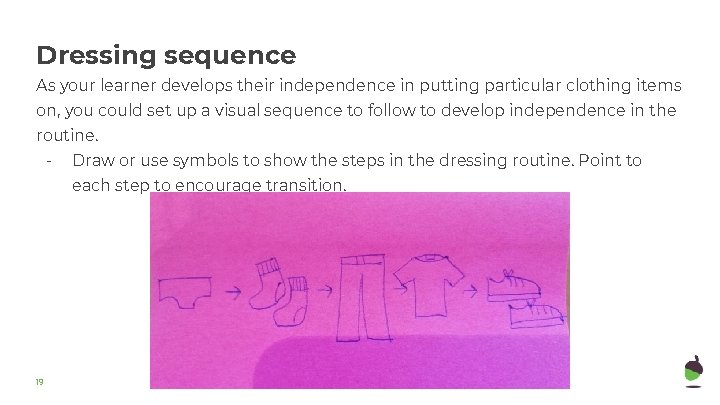
Dressing sequence As your learner develops their independence in putting particular clothing items on, you could set up a visual sequence to follow to develop independence in the routine. - Draw or use symbols to show the steps in the dressing routine. Point to each step to encourage transition. 19
Independent Living Daily Living Skills Getting dressed Make it easier Make it harder More ideas Choose one item of clothing to work on and follow the backward chaining approach. Play dress up and practise skills out of context. Seek advice from an Occupational Therapist for specific support strategies and activities. 20 Help pull clothes the right way round when emptying wet washing from the machine.
Further Learning with Oak National Independent Living: ● Building Understanding- Fine/gross motor circuit (Unit 2) Occupational Therapy: 21 ● Fine Motor Skills (Unit 2) ● Activities of Daily Living (Unit 6)