np pairing in NZ nuclei reality or fiction








- Slides: 30
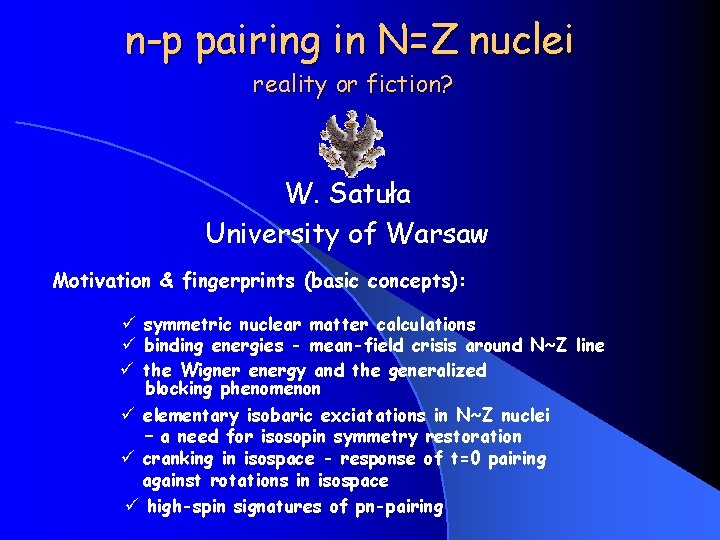
n-p pairing in N=Z nuclei reality or fiction? W. Satuła University of Warsaw Motivation & fingerprints (basic concepts): ü symmetric nuclear matter calculations ü binding energies - mean-field crisis around N~Z line ü the Wigner energy and the generalized blocking phenomenon ü elementary isobaric exciatations in N~Z nuclei – a need for isosopin symmetry restoration ü cranking in isospace - response of t=0 pairing against rotations in isospace ü high-spin signatures of pn-pairing
Structure of nucleonic pairs N=Z nucleons start to occupy „identical” spatial orbitals l Nuclear interaction favoures L=0 coupling l Pair-structure is governed by the Pauli principle: – Isovector (or 1 S 0) pairs T=1, S=0 l + Tz +1 0 -1 - Isoscalar (deuteron-like or 3 S 1) pairs T=0, S=1 Sz +1 0 -1 Neutron Proton
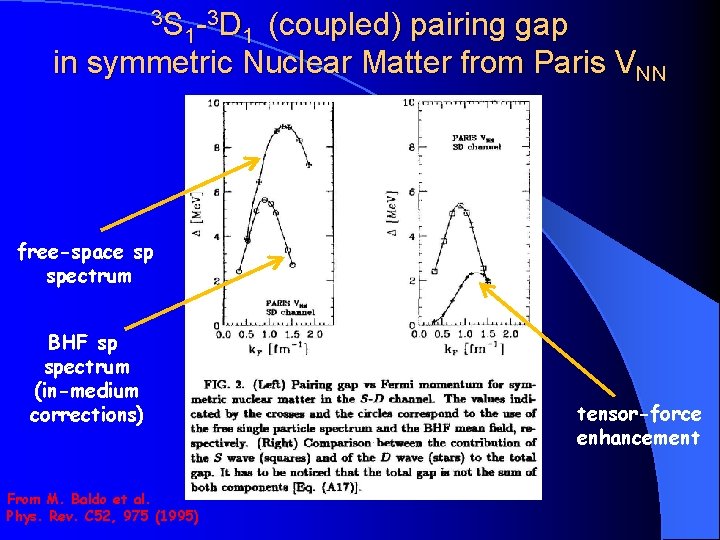
3 S -3 D 1 1 (coupled) pairing gap in symmetric Nuclear Matter from Paris VNN free-space sp spectrum BHF sp spectrum (in-medium corrections) From M. Baldo et al. Phys. Rev. C 52, 975 (1995) tensor-force enhancement
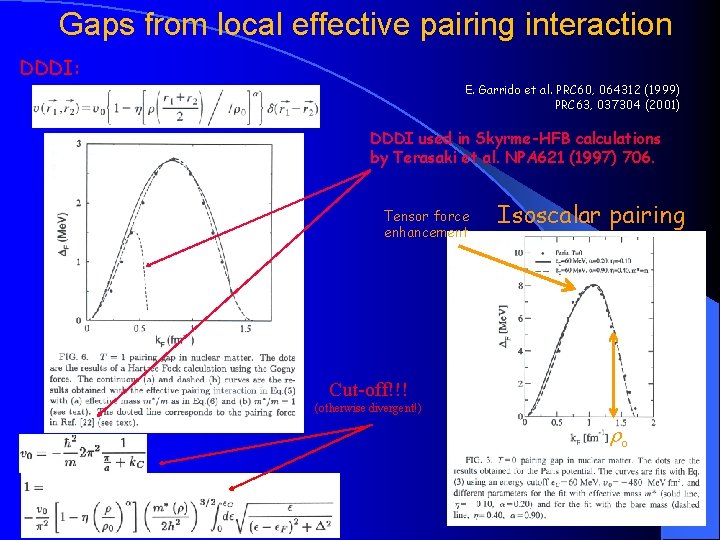
Gaps from local effective pairing interaction DDDI: E. Garrido et al. PRC 60, 064312 (1999) PRC 63, 037304 (2001) DDDI used in Skyrme-HFB calculations by Terasaki et al. NPA 621 (1997) 706. Tensor force enhancement Isoscalar pairing Cut-off!!! (otherwise divergent!) ro
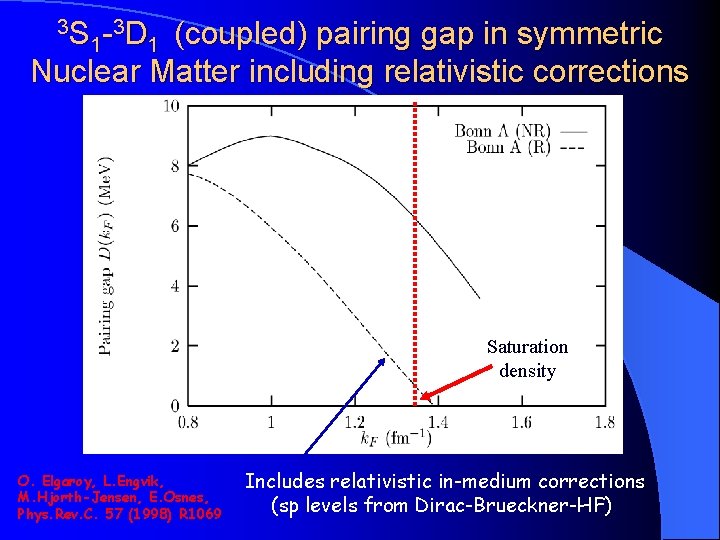
3 S -3 D 1 1 (coupled) pairing gap in symmetric Nuclear Matter including relativistic corrections Saturation density O. Elgaroy, L. Engvik, M. Hjorth-Jensen, E. Osnes, Phys. Rev. C. 57 (1998) R 1069 Includes relativistic in-medium corrections (sp levels from Dirac-Brueckner-HF)
Empirical NN interaction in N~Z v T=1 channel: Ø J=0 coupling dominates v T=0 channel: Ø J=1 and J=2 j are similar Ø T=0 is, on the average, stronger than T=1 by a factor of ~1. 3 Dufour & Zucker, Phys. Rev. C 54, 1641 (1996) N. Anantaraman & J. P. Schiffer PL 37 B (1971) 229
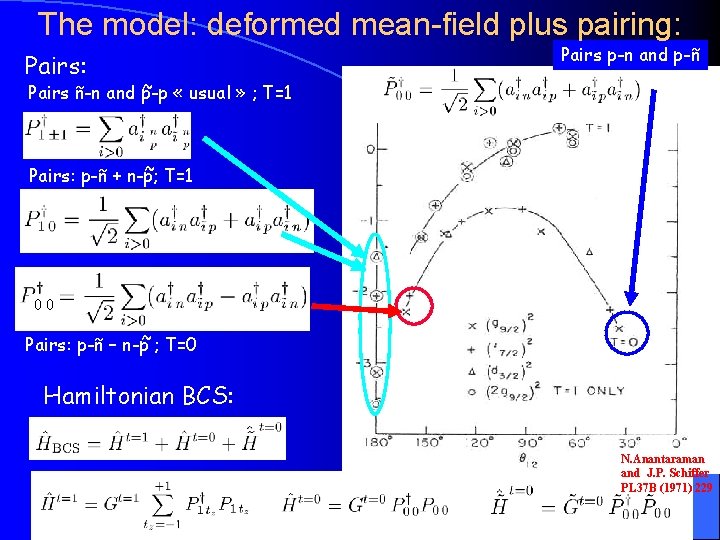
The model: deformed mean-field plus pairing: Pairs: Pairs p-n and p-ñ ~ « usual » ; T=1 Pairs ñ-n and p-p ~ T=1 Pairs: p-ñ + n-p; 00 Pairs: p-ñ – n-p~ ; T=0 Hamiltonian BCS: N. Anantaraman and J. P. Schiffer PL 37 B (1971) 229
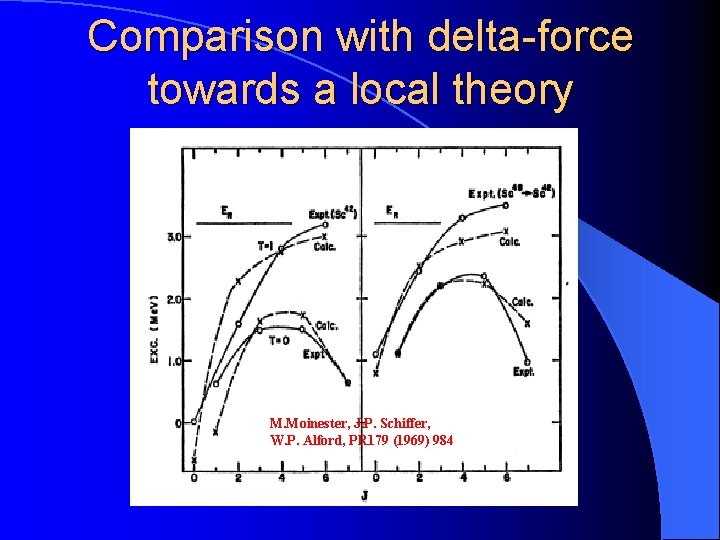
Comparison with delta-force towards a local theory M. Moinester, J. P. Schiffer, W. P. Alford, PR 179 (1969) 984
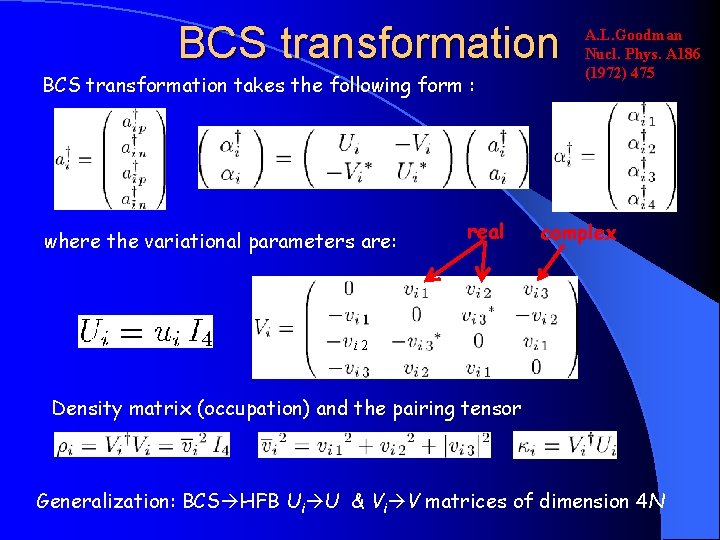
BCS transformation takes the following form : where the variational parameters are: real A. L. Goodman Nucl. Phys. A 186 (1972) 475 complex i 2 Density matrix (occupation) and the pairing tensor Generalization: BCS HFB Ui U & Vi V matrices of dimension 4 N
Energy (Routhian) BCS Solution Variational equation in N=Z system (without Coulomb) Occupation probabilities ; quasiparticle energies: Pair gaps: n-ñ, p-p~ Gap T=0 aã ~ T=1 n-p + p-ñ Gap T=0 aa
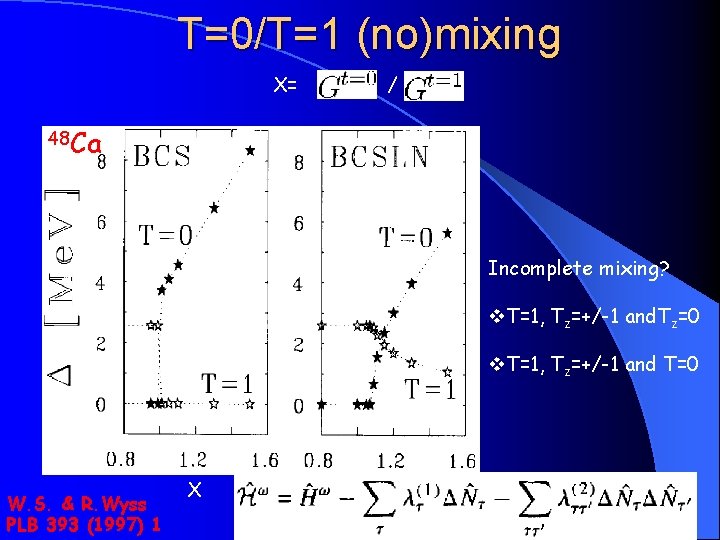
T=0/T=1 (no)mixing X= / 48 Ca Incomplete mixing? v. T=1, Tz=+/-1 and. Tz=0 v. T=1, Tz=+/-1 and T=0 W. S. & R. Wyss PLB 393 (1997) 1 X X
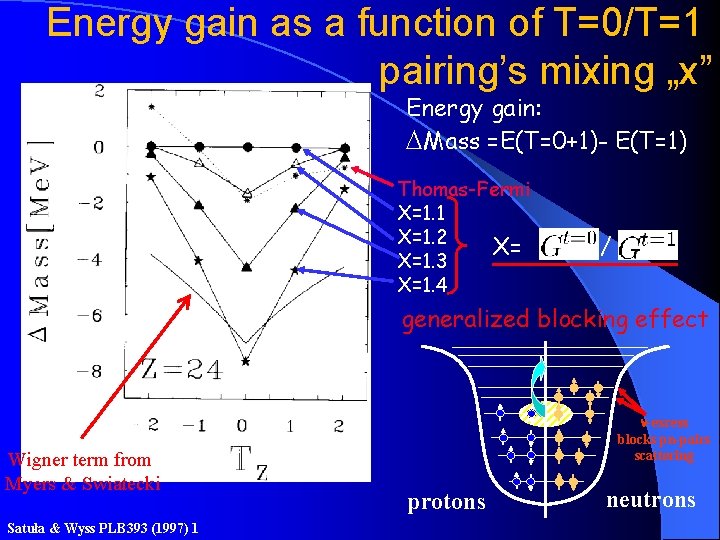
Energy gain as a function of T=0/T=1 pairing’s mixing „x” Energy gain: DMass =E(T=0+1)- E(T=1) Thomas-Fermi X=1. 1 X=1. 2 X= X=1. 3 X=1. 4 / generalized blocking effect Wigner term from Myers & Swiatecki Satuła & Wyss PLB 393 (1997) 1 n-excess blocks pn-pairs scattering protons neutrons
Wigner effect from self-consistent Skyrme-HF l N=Z Defficiency of conventional selfconsistent models: HF or HFB including standard T=1, |Tz|=1 ~ p-p & n-n pairs: ü (N-Z)2 ~ T 2 term is OK! ü no (or very weak) |N-Z| ~ term Exp. HFBCS T=1 Sph. HFBCS T=1 Def. (SIII) |N-Z|=2, 4 (black) A. S. Jensen, P. G. Hansen, B. Jonson, Nucl. Phys. A 431(1984) 393 o-o e-e
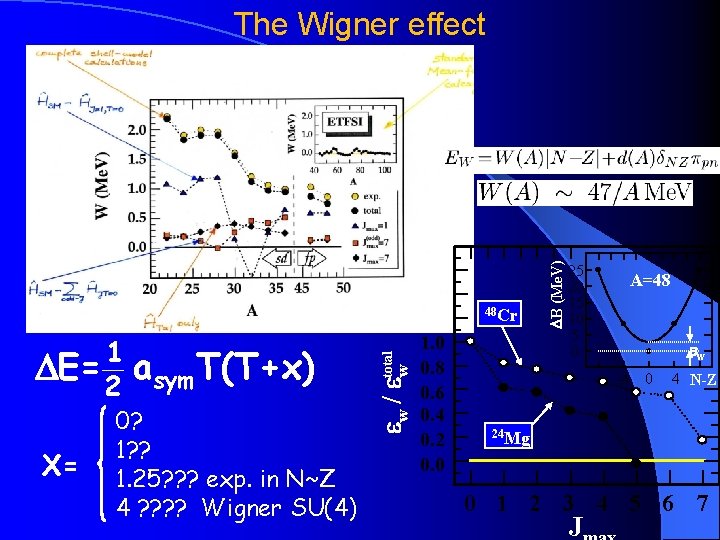
1 E= 2 X= asym. T(T+x) 0? 1? ? 1. 25? ? ? exp. in N~Z 4 ? ? Wigner SU(4) w / total w 48 Cr 1. 0 0. 8 0. 6 0. 4 0. 2 0. 0 B (Me. V) The Wigner effect 25 20 15 10 5 0 A=48 w -4 0 4 N-Z 24 Mg 0 1 2 3 4 5 6 7 J
W(A) [Me. V] Isobaric excitations 2. 0 in N~Z nuclei 47/A [Me. V] 1. 5 1. 0 0. 5 1. 4 ØThe lowest: T=0, T=1 & T=2 in e-e nuclei T=0 & T=1 states in o-o nuclei ØThe model needs to be extended to include isospin projection isospin cranking J. Janecke, Nucl. Phys. A 73 (1965) 73 A. Macchiavelli et al. Phys. Rev. C 61 (2000) 041303(R) P. Vogel, Nucl. Phys. A 662 (2000) 148 GT=0 GT=1 0. 6 30 40 A strong T=0 pairing limit!
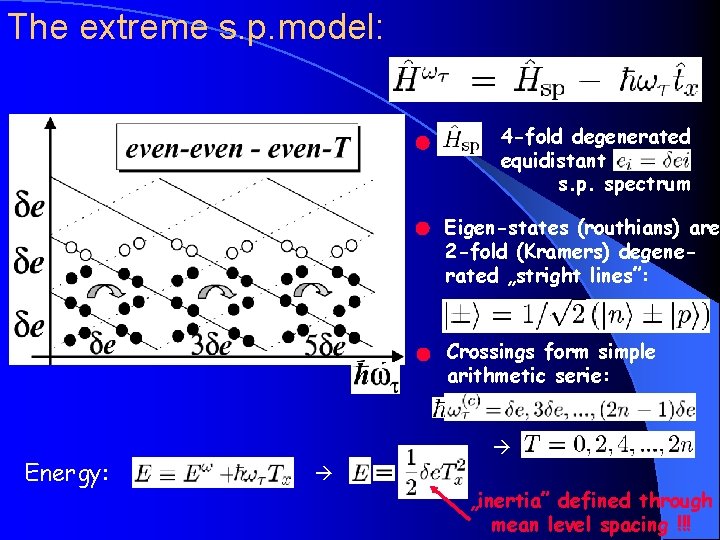
The extreme s. p. model: 4 -fold degenerated equidistant s. p. spectrum Eigen-states (routhians) are 2 -fold (Kramers) degenerated „stright lines”: Crossings form simple arithmetic serie: Energy: „inertia” defined through mean level spacing !!!
T=2 states in e-e nuclei 20 ET=2 [Me. V] 20 14 28 15 iso-cranking T=2 h. WS+HT=1 +HT=0 -wtx 10 h. WS+HT=1 -wtx 5 0 20 30 40 50 A Iso-cranking gives excitation energy which goes like: E= 1 de. T 2 + Epair 2 vacuum mean level spaceing at the Fermi energy
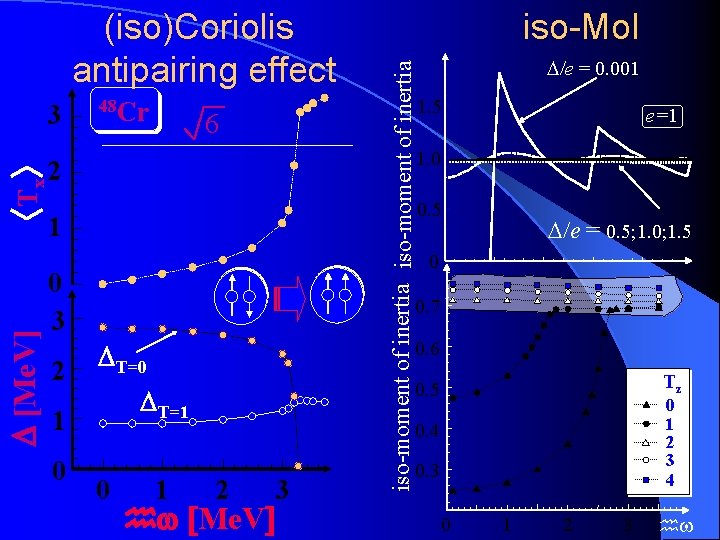
Tx 3 48 Cr 6 2 [Me. V] 1 0 3 2 D/e = 0. 001 1. 5 e=1 1. 0 0. 5 D/e = 0. 5; 1. 0; 1. 5 0 0. 7 0. 6 T=0 0 1 Tz 0. 5 T=1 1 0 iso-Mo. I iso-moment of inertia (iso)Coriolis antipairing effect 0 1 2 3 4 0. 4 2 3 hw [Me. V] 0. 3 0 1 2 3 hw
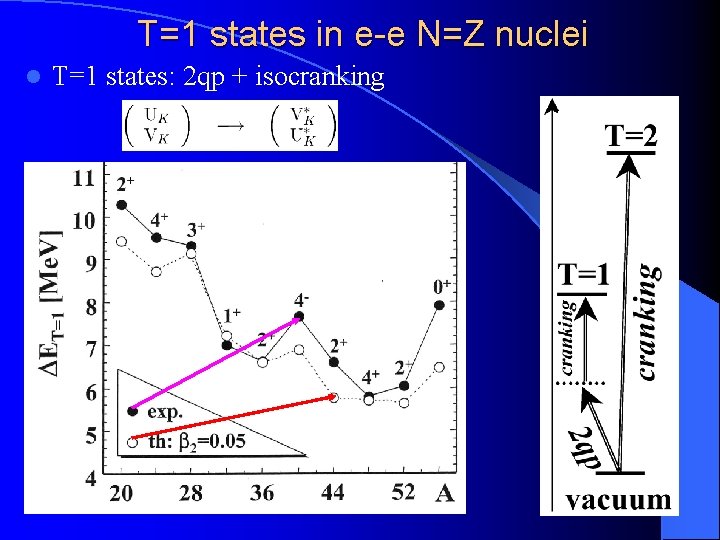
T=1 states in e-e N=Z nuclei l T=1 states: 2 qp + isocranking
Isocranking N=Z odd-odd nuclei odd-T sequence T de 5 de de 2 de 6 de 4 de even-T sequence 4 hw 3 de 2 de de de 3 de 5 de Eeven-T = 1/2 de. Tx 2 Eodd-T = 1/2 de. Tx 2 - 1/2 de hw 01 iso-signature selection rule
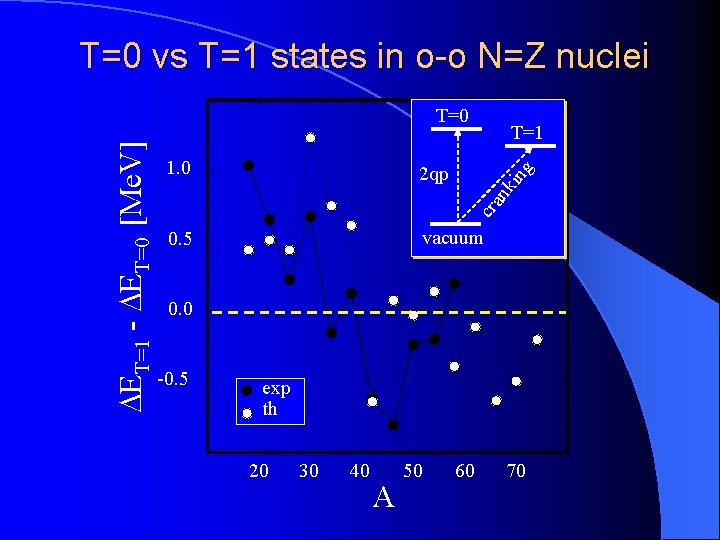
T=0 vs T=1 states in o-o N=Z nuclei T=1 2 qp 0. 5 vacuum an k in g 1. 0 cr DET=1 - DET=0 [Me. V] T=0 0. 0 -0. 5 exp th 20 30 40 A 50 60 70
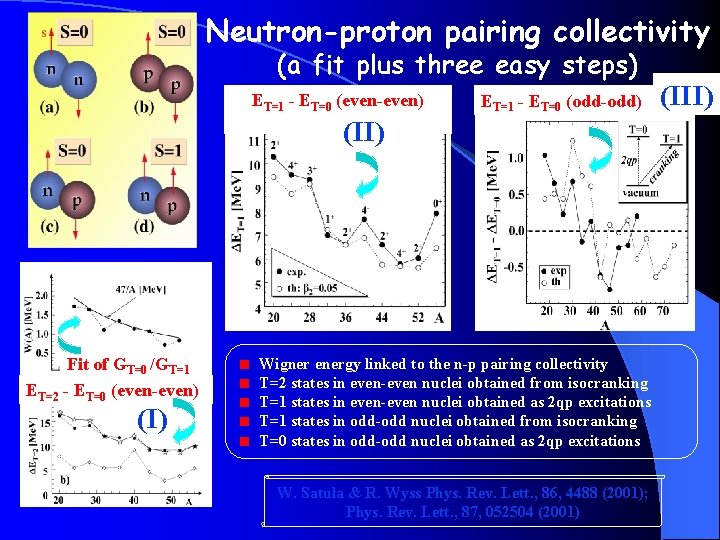
Neutron-proton pairing collectivity (a fit plus three easy steps) ET=1 - ET=0 (even-even) ET=1 - ET=0 (odd-odd) (II) Fit of GT=0 /GT=1 ET=2 - ET=0 (even-even) (I) Wigner energy linked to the n-p pairing collectivity T=2 states in even-even nuclei obtained from isocranking T=1 states in even-even nuclei obtained as 2 qp excitations T=1 states in odd-odd nuclei obtained from isocranking T=0 states in odd-odd nuclei obtained as 2 qp excitations W. Satuła & R. Wyss Phys. Rev. Lett. , 86, 4488 (2001); Phys. Rev. Lett. , 87, 052504 (2001) (III)
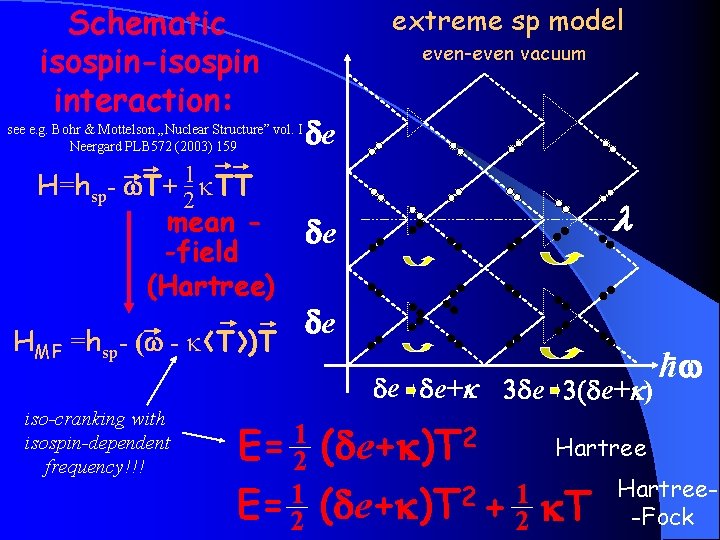
Schematic isospin-isospin interaction: extreme sp model even-even vacuum see e. g. Bohr & Mottelson „Nuclear Structure” vol. I Neergard PLB 572 (2003) 159 de H=hsp- w. T+ 21 k. TT mean -field (Hartree) de HMF =hsp- (w - k T )T l de de de+k 3 de 3(de+k) iso-cranking with isospin-dependent frequency!!! 1 E= 2 hw Hartree (de+k)T 2 Hartree 1 2 (de+k)T + 2 k. T -Fock
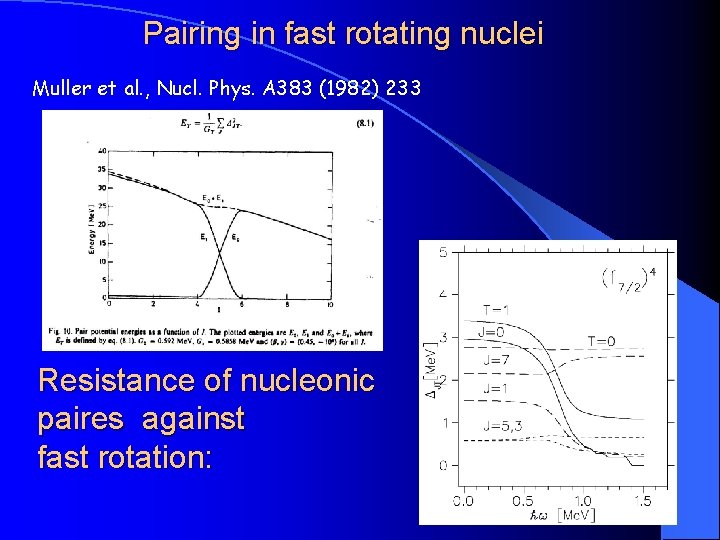
Pairing in fast rotating nuclei Muller et al. , Nucl. Phys. A 383 (1982) 233 Resistance of nucleonic paires against fast rotation:
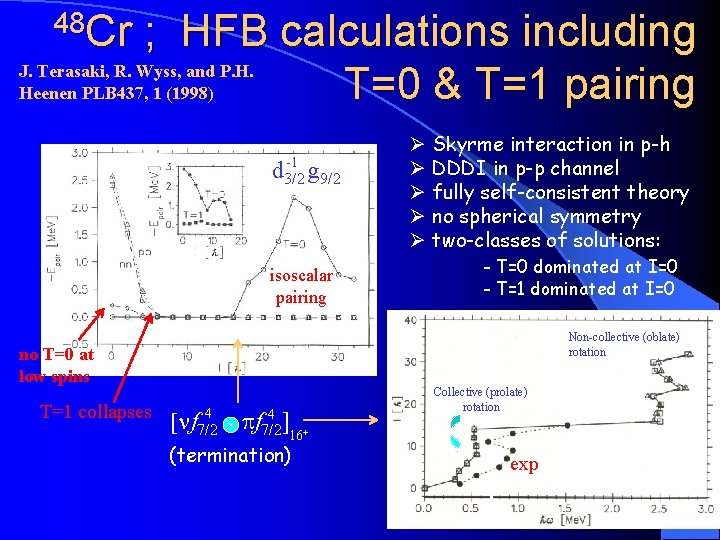
48 Cr ; HFB calculations including J. Terasaki, R. Wyss, and P. H. Heenen PLB 437, 1 (1998) T=0 & T=1 pairing -1 d 3/2 g 9/2 isoscalar pairing - T=0 dominated at I=0 - T=1 dominated at I=0 Non-collective (oblate) rotation no T=0 at low spins T=1 collapses Ø Skyrme interaction in p-h Ø DDDI in p-p channel Ø fully self-consistent theory Ø no spherical symmetry Ø two-classes of solutions: 4 [nf 7/2 4 pf 7/2 ]16 (termination) Collective (prolate) rotation + exp
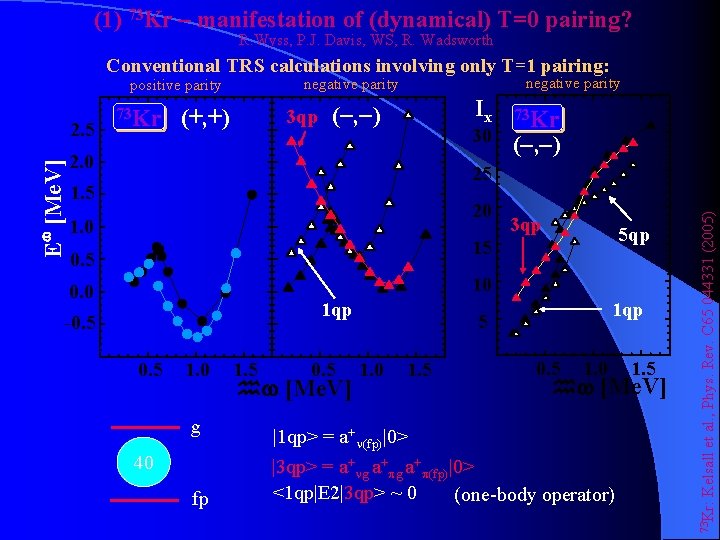
(1) 73 Kr – manifestation of (dynamical) T=0 pairing? R. Wyss, P. J. Davis, WS, R. Wadsworth Conventional TRS calculations involving only T=1 pairing: (+, +) 3 qp Ix (-, -) 30 2. 0 73 Kr (-, -) 1. 5 20 1. 0 3 qp 5 qp 15 0. 5 10 0. 0 1 qp -0. 5 1. 0 g 40 fp 1. 5 0. 5 hw [Me. V] 1 qp 5 1. 0 1. 5 0. 5 1. 0 1. 5 hw [Me. V] |1 qp> = a+n(fp)|0> |3 qp> = a+ng a+p(fp)|0> <1 qp|E 2|3 qp> ~ 0 (one-body operator) Kelsall et al. , Phys. Rev. C 65 044331 (2005) 25 73 Kr: Ew [Me. V] 2. 5 73 Kr negative parity positive parity
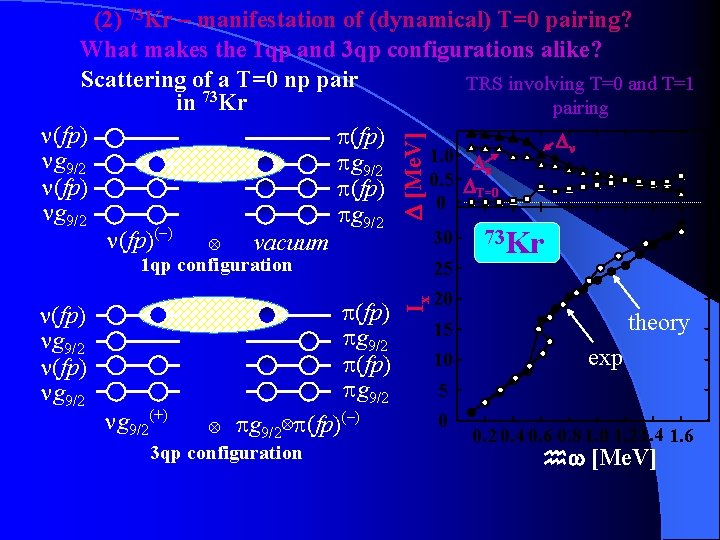
[Me. V] (2) 73 Kr – manifestation of (dynamical) T=0 pairing? What makes the 1 qp and 3 qp configurations alike? Scattering of a T=0 np pair TRS involving T=0 and T=1 73 in Kr pairing n(fp) p(fp) n 1. 0 ng 9/2 p 0. 5 T=0 n(fp) p(fp) 0 ng 9/2 pg 9/2 73 Kr 30 n(fp)(-) vacuum 1 qp configuration ng 9/2(+) p(fp) pg 9/2 p(fp)(-) 3 qp configuration Ix n(fp) ng 9/2 25 20 theory 15 10 exp 5 0 0. 2 0. 4 0. 6 0. 8 1. 0 1. 2 1. 4 1. 6 hw [Me. V]
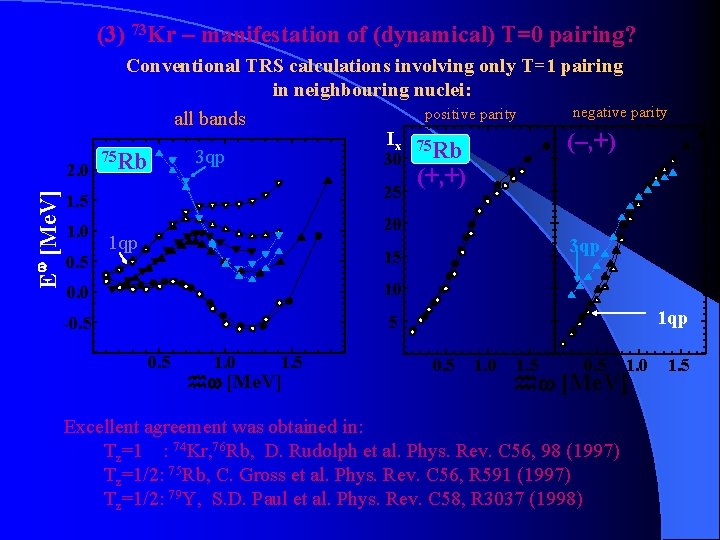
(3) 73 Kr – manifestation of (dynamical) T=0 pairing? Ew [Me. V] 2. 0 Conventional TRS calculations involving only T=1 pairing in neighbouring nuclei: negative parity positive parity all bands Ix 75 (-, +) Rb 75 Rb 3 qp 30 1. 5 25 1. 0 20 0. 5 1 qp (+, +) 3 qp 15 0. 0 10 -0. 5 5 0. 5 1. 0 1. 5 hw [Me. V] 1 qp 0. 5 1. 0 1. 5 0. 5 1. 0 hw [Me. V] Excellent agreement was obtained in: Tz=1 : 74 Kr, 76 Rb, D. Rudolph et al. Phys. Rev. C 56, 98 (1997) Tz=1/2: 75 Rb, C. Gross et al. Phys. Rev. C 56, R 591 (1997) Tz=1/2: 79 Y, S. D. Paul et al. Phys. Rev. C 58, R 3037 (1998) 1. 5
SUMMARY Part of T=0 correlations in N~Z nuclei is definitely beyond standard formulation of mean-field (Wigner energy) Adding T=0 pairing helps but cannot solve the problem of the Wigner energy (symmetry energy) in N~Z nuclei which seems to be beyond mean-field There is no convincing arguments for coherency of the T=0 phase Theoretical treatment of T=1 states in e-e nuclei and T=0 states o-o nuclei requires angular momentum and isospin projections
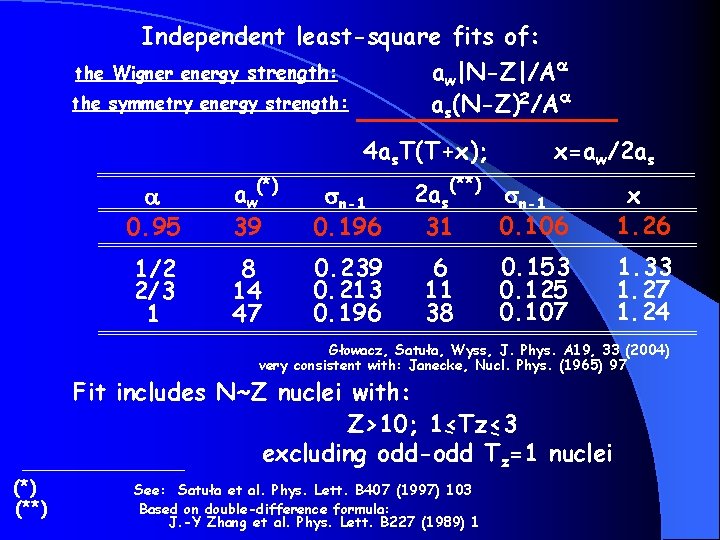
Independent least-square fits of: the Wigner energy strength: aw|N-Z|/Aa the symmetry energy strength: as(N-Z)2/Aa 4 as. T(T+x); a 0. 95 aw(*) 39 sn-1 0. 196 1/2 2/3 1 8 14 47 0. 239 0. 213 0. 196 x=aw/2 as 2 as(**) sn-1 0. 106 31 x 1. 26 0. 153 0. 125 0. 107 1. 33 1. 27 1. 24 6 11 38 Głowacz, Satuła, Wyss, J. Phys. A 19, 33 (2004) very consistent with: Janecke, Nucl. Phys. (1965) 97 Fit includes N~Z nuclei with: Z>10; 1<Tz<3 excluding odd-odd Tz=1 nuclei - See: Satuła et al. Phys. Lett. B 407 (1997) 103 Based on double-difference formula: J. -Y Zhang et al. Phys. Lett. B 227 (1989) 1 - (*) (**)