
The search for Giant Pairing Vibrations Pairing vibrations
The search for Giant Pairing Vibrations • Pairing vibrations • How to describe ? • How to measure ? E. Khan
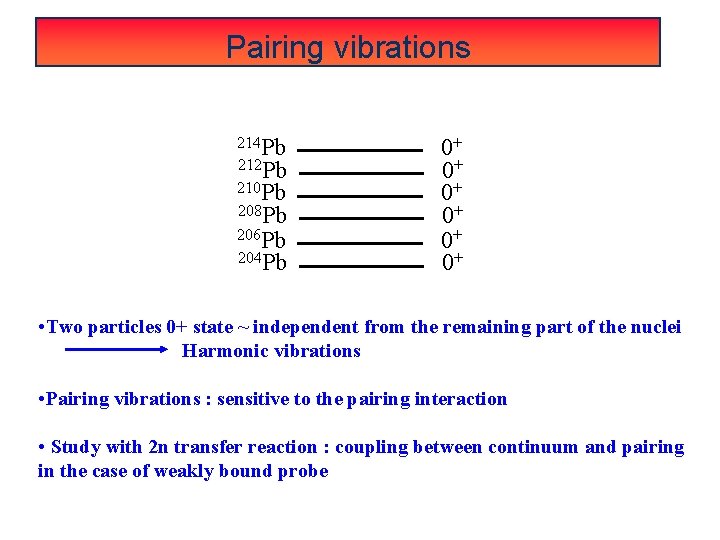
Pairing vibrations 214 Pb 212 Pb 210 Pb 208 Pb 206 Pb 204 Pb 0+ 0+ 0+ • Two particles 0+ state ~ independent from the remaining part of the nuclei Harmonic vibrations • Pairing vibrations : sensitive to the pairing interaction • Study with 2 n transfer reaction : coupling between continuum and pairing in the case of weakly bound probe
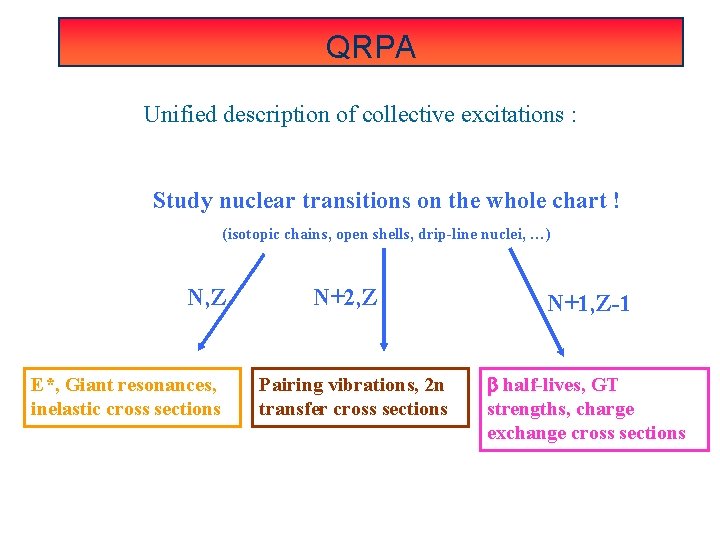
QRPA Unified description of collective excitations : Study nuclear transitions on the whole chart ! (isotopic chains, open shells, drip-line nuclei, …) N, Z E*, Giant resonances, inelastic cross sections N+2, Z Pairing vibrations, 2 n transfer cross sections N+1, Z-1 b half-lives, GT strengths, charge exchange cross sections
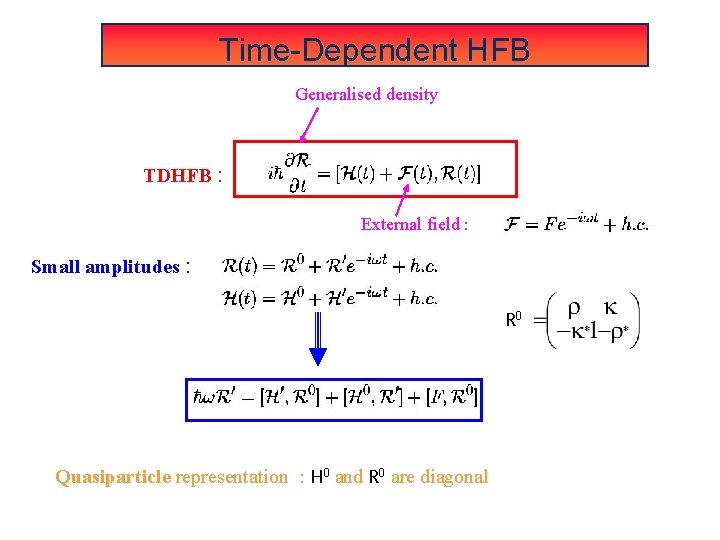
Time-Dependent HFB Generalised density TDHFB : External field : Small amplitudes : R 0 Quasiparticle representation : H 0 and R 0 are diagonal
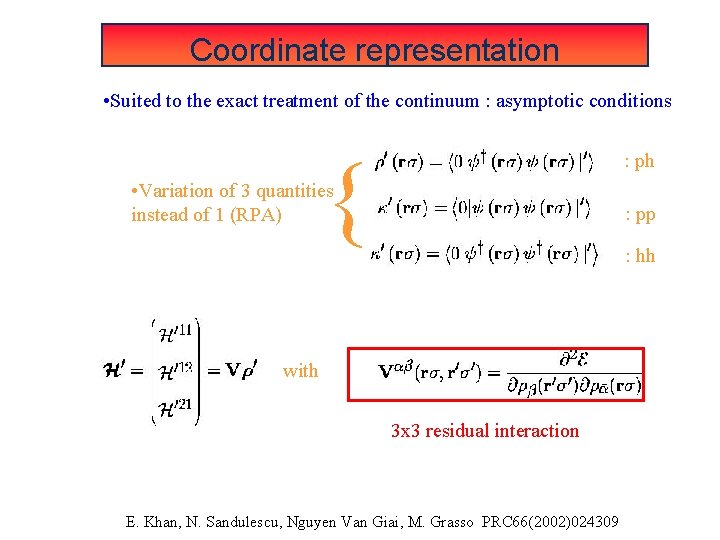
Coordinate representation • Suited to the exact treatment of the continuum : asymptotic conditions { : ph • Variation of 3 quantities instead of 1 (RPA) : pp : hh with 3 x 3 residual interaction E. Khan, N. Sandulescu, Nguyen Van Giai, M. Grasso PRC 66(2002)024309
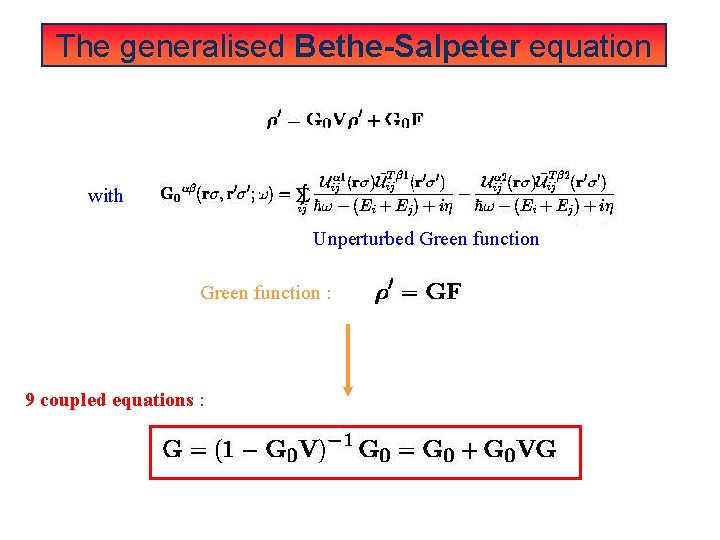
The generalised Bethe-Salpeter equation with Unperturbed Green function : 9 coupled equations :
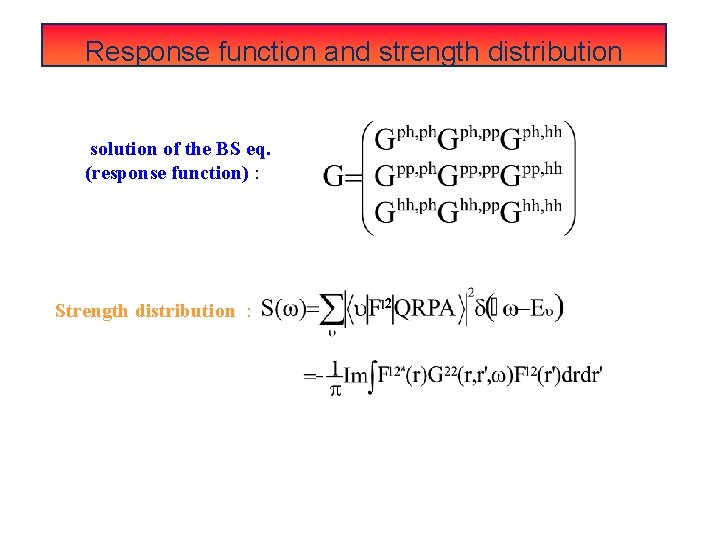
Response function and strength distribution solution of the BS eq. (response function) : Strength distribution : 2
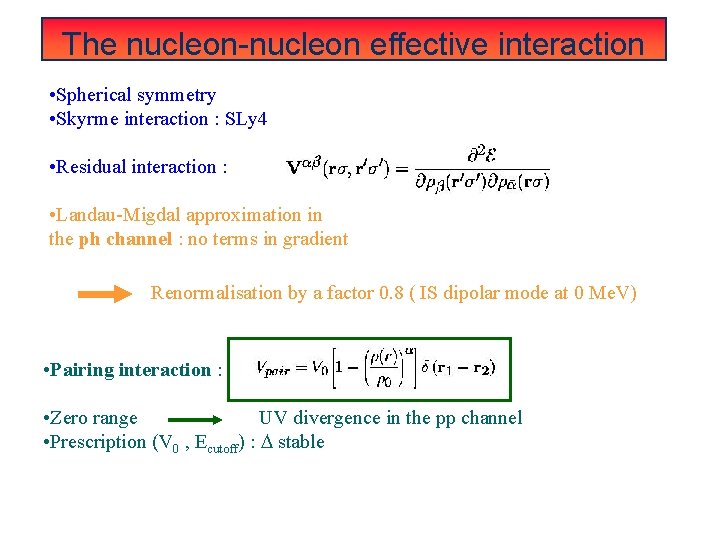
The nucleon-nucleon effective interaction • Spherical symmetry • Skyrme interaction : SLy 4 • Residual interaction : • Landau-Migdal approximation in the ph channel : no terms in gradient Renormalisation by a factor 0. 8 ( IS dipolar mode at 0 Me. V) • Pairing interaction : • Zero range UV divergence in the pp channel • Prescription (V 0 , Ecutoff) : D stable
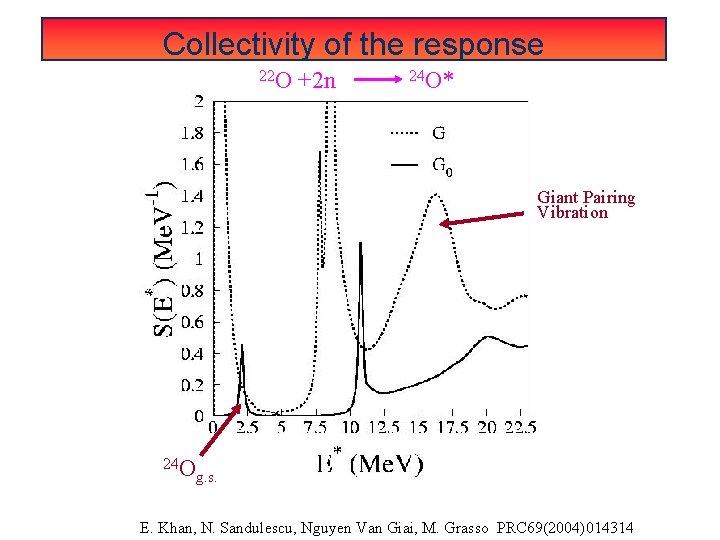
Collectivity of the response 22 O +2 n 24 O* Giant Pairing Vibration 24 O g. s. E. Khan, N. Sandulescu, Nguyen Van Giai, M. Grasso PRC 69(2004)014314
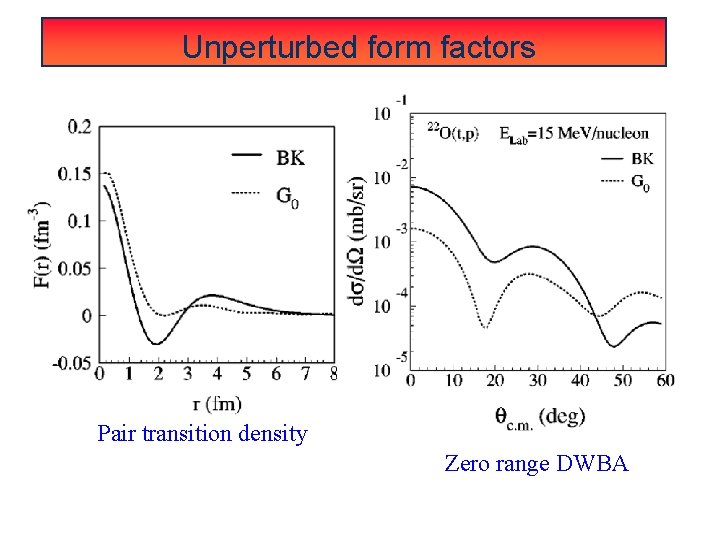
Unperturbed form factors Pair transition density Zero range DWBA
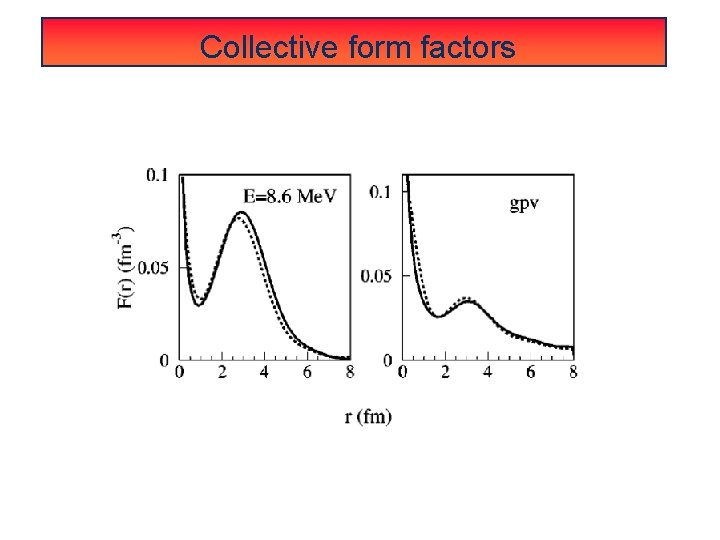
Collective form factors
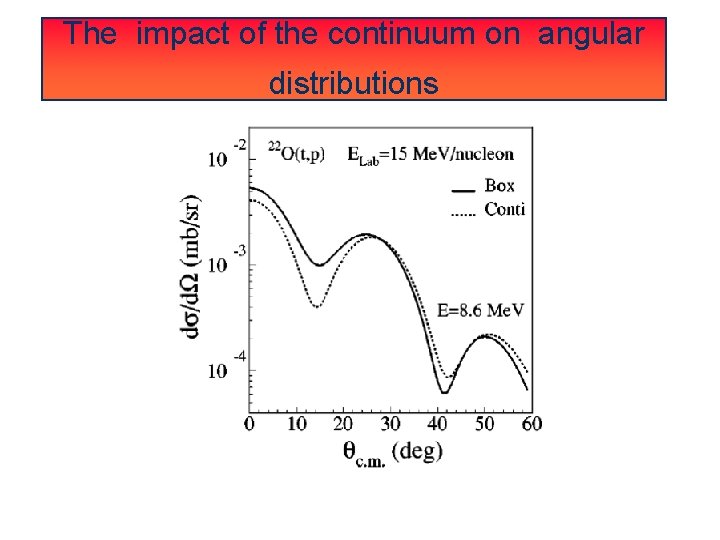
The impact of the continuum on angular distributions
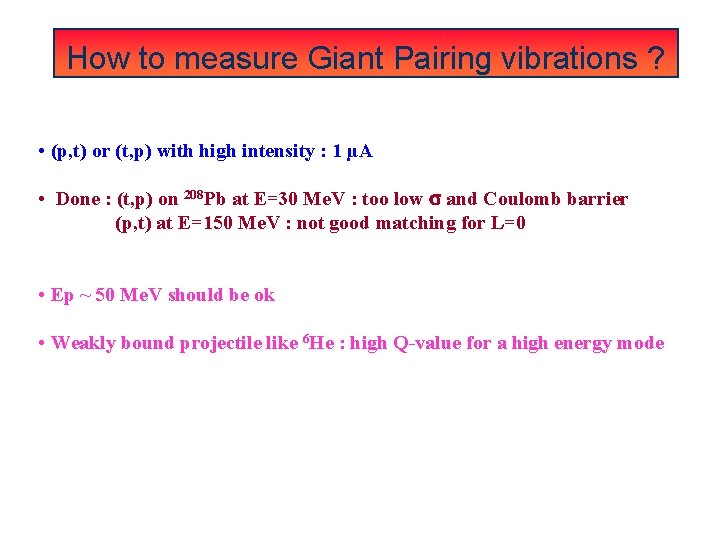
How to measure Giant Pairing vibrations ? • (p, t) or (t, p) with high intensity : 1 µA • Done : (t, p) on 208 Pb at E=30 Me. V : too low s and Coulomb barrier (p, t) at E=150 Me. V : not good matching for L=0 • Ep ~ 50 Me. V should be ok • Weakly bound projectile like 6 He : high Q-value for a high energy mode
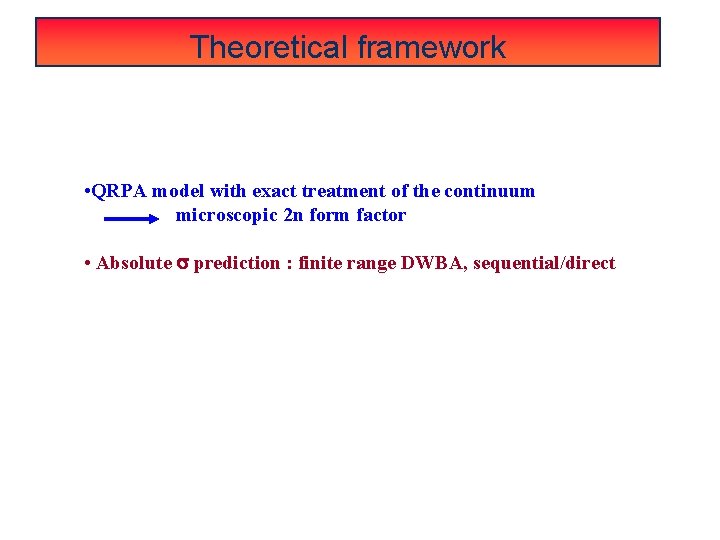
Theoretical framework • QRPA model with exact treatment of the continuum microscopic 2 n form factor • Absolute s prediction : finite range DWBA, sequential/direct
- Slides: 14