Nonsense Nursery Rhymes 1 Can I write a

- Slides: 56
Nonsense Nursery Rhymes 1
Can I write a different ending for a nursery rhyme? Today we are going to look at nursery rhymes that have gone wrong! • What nursery rhymes do you know? • Children to recall some familiar nursery rhymes 2
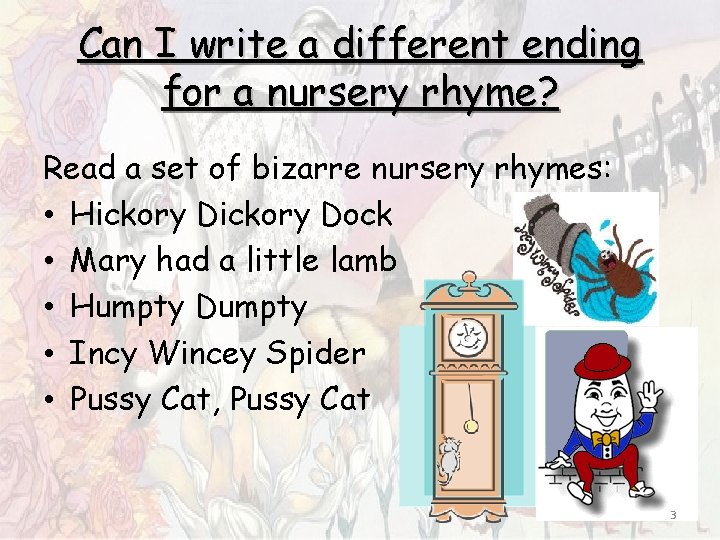
Can I write a different ending for a nursery rhyme? Read a set of bizarre nursery rhymes: • Hickory Dock • Mary had a little lamb • Humpty Dumpty • Incy Wincey Spider • Pussy Cat, Pussy Cat 3
Can I write a different ending for a nursery rhyme? • How could we change one of these to make it unusual and also funny? • When we change a nursery rhyme or story to make it funny, we call it a fractured nursery rhyme. 4
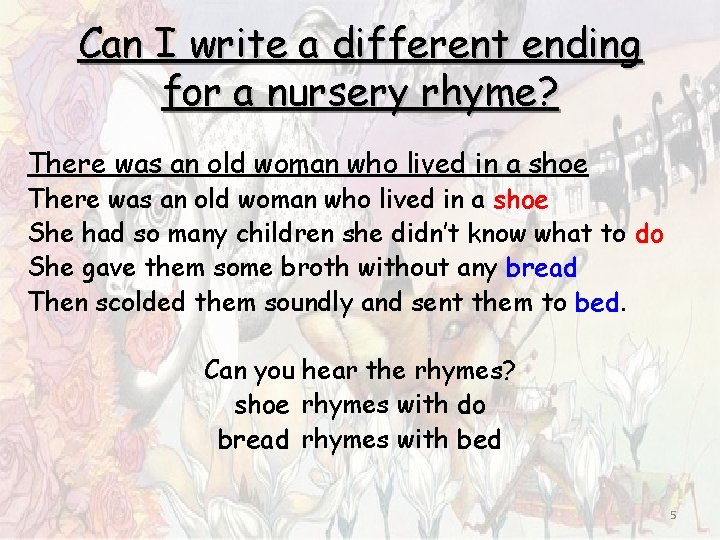
Can I write a different ending for a nursery rhyme? There was an old woman who lived in a shoe She had so many children she didn’t know what to do She gave them some broth without any bread Then scolded them soundly and sent them to bed. Can you hear the rhymes? shoe rhymes with do bread rhymes with bed 5
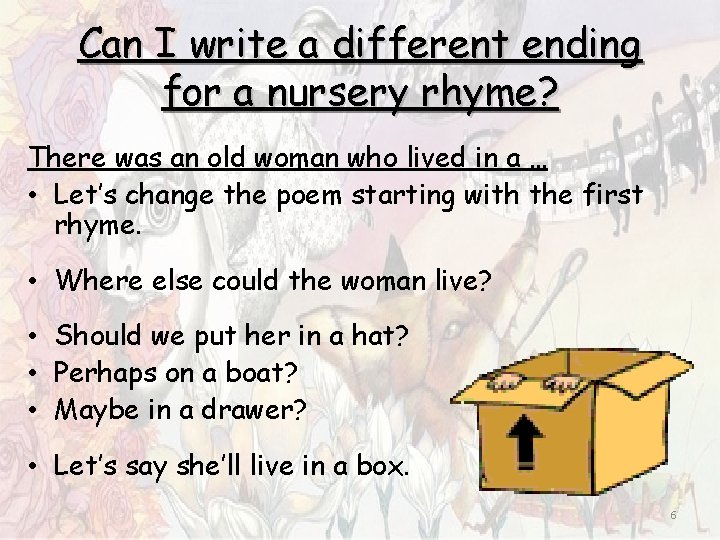
Can I write a different ending for a nursery rhyme? There was an old woman who lived in a … • Let’s change the poem starting with the first rhyme. • Where else could the woman live? • Should we put her in a hat? • Perhaps on a boat? • Maybe in a drawer? • Let’s say she’ll live in a box. 6
Can I write a different ending for a nursery rhyme? There was an old woman who lived in a box • Now we need to find some words that rhyme with box. • I like socks, fox, rocks and locks, but I think locks will work best, as houses usually have locks. There was an old woman who lived in a box It didn’t have windows or doorknobs or locks 7
Can I write a different ending for a nursery rhyme? • Now I want to make this rhyme/poem funny. • Although living in a box is quite funny, let’s think of the things you might do if your house was a box. – Would you wrap your house for Christmas? – Maybe you would be happy that you no longer lived in a shoe? She wanted to travel the world, and so She mailed her house where she wanted to go. 8
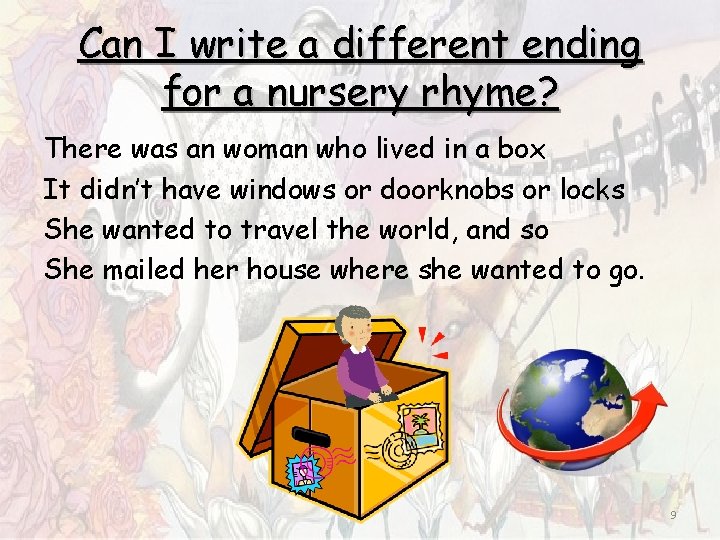
Can I write a different ending for a nursery rhyme? There was an woman who lived in a box It didn’t have windows or doorknobs or locks She wanted to travel the world, and so She mailed her house where she wanted to go. 9
Can I write a different ending for a nursery rhyme? Independent Activity Try changing the words to Teddy Bear, teddy bear stand on your head Teddy bear, teddy bear ______ you bed. Teddy bear, teddy bear, crawl like a snail Teddy bear, teddy bear, swim like a _____ Teddy bear, teddy bear, hop like a frog Teddy bear, teddy bear _____________. If you finish, make up a fourth verse. 10
Can I write a different ending for a nursery rhyme? Success Criteria q Used the correct punctuation. q Wrote a different ending for a nursery rhyme. q Used rhyming words. q Included some adventurous language. q Spelt all the words correctly. 11
Nonsense Poems 12
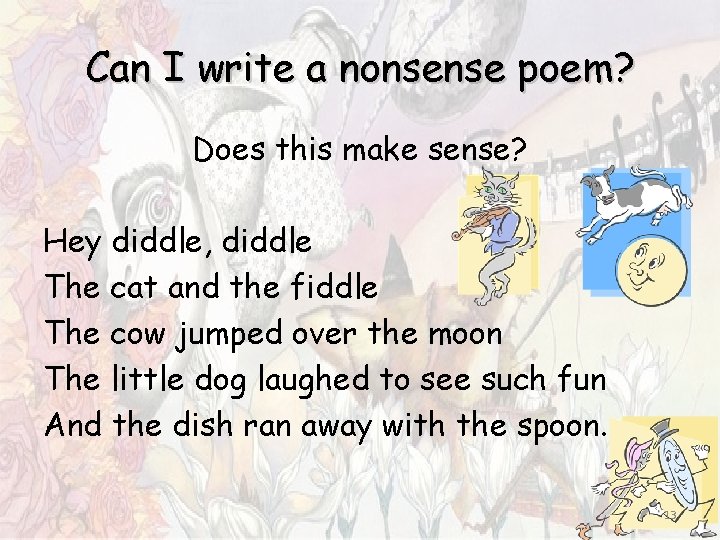
Can I write a nonsense poem? Does this make sense? Hey diddle, diddle The cat and the fiddle The cow jumped over the moon The little dog laughed to see such fun And the dish ran away with the spoon. 13
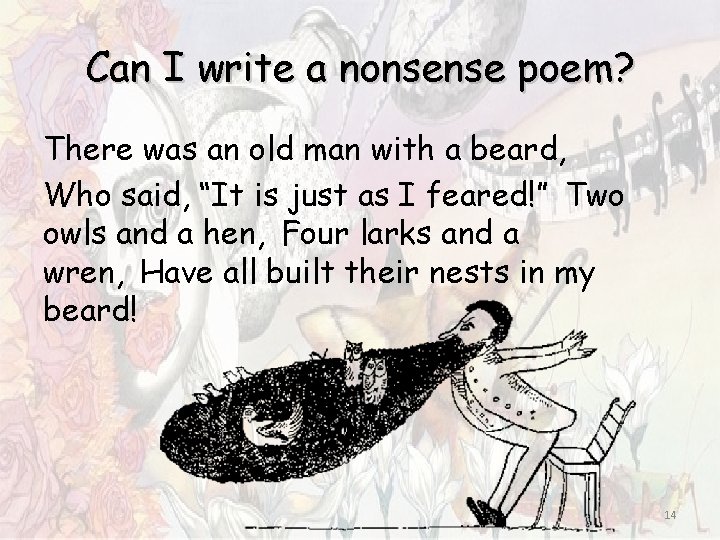
Can I write a nonsense poem? There was an old man with a beard, Who said, “It is just as I feared!” Two owls and a hen, Four larks and a wren, Have all built their nests in my beard! 14
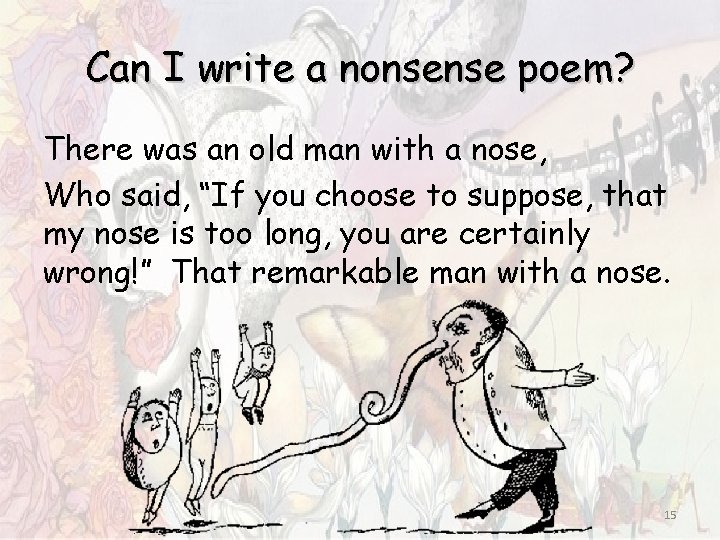
Can I write a nonsense poem? There was an old man with a nose, Who said, “If you choose to suppose, that my nose is too long, you are certainly wrong!” That remarkable man with a nose. 15
Can I write a nonsense poem? Whole Class Find some nonsense words which rhyme with… Tail Wig Dog Cat _______ _______ _______ 16
Can I write a nonsense poem? Whole Class Let’s make up our own old man nonsense poem. There was an old man with a ______ Who said _____ 17
Can I write a nonsense poem? Independent Activity Make up your own old man nonsense poem. There was an old man with a ______ Who said _____ Success Criteria Rhyming words Funny or silly Correct punctuation (capital letters, finger spaces and full stops) Neat writing 18
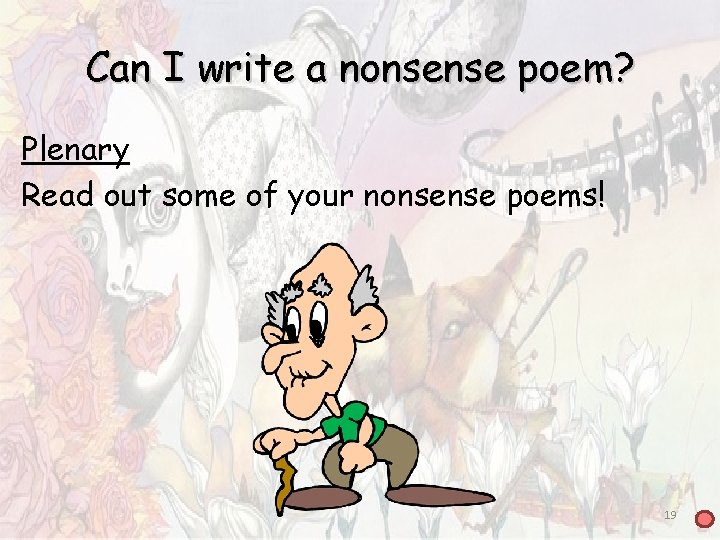
Can I write a nonsense poem? Plenary Read out some of your nonsense poems! 19
Nonsense Poems 20
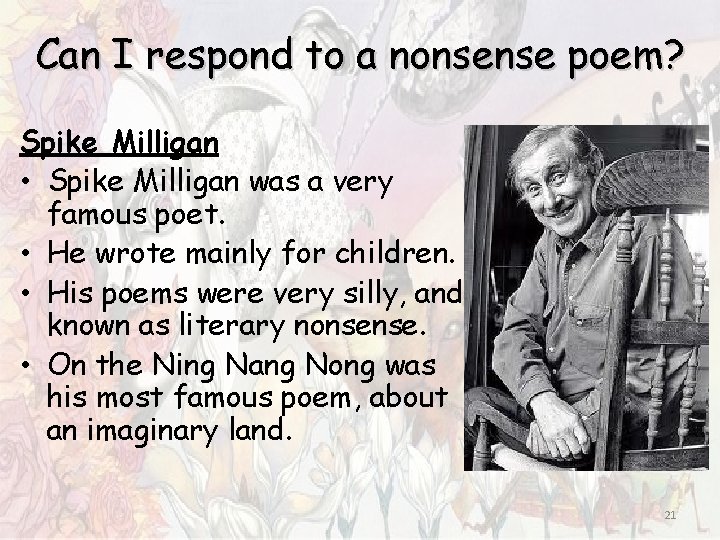
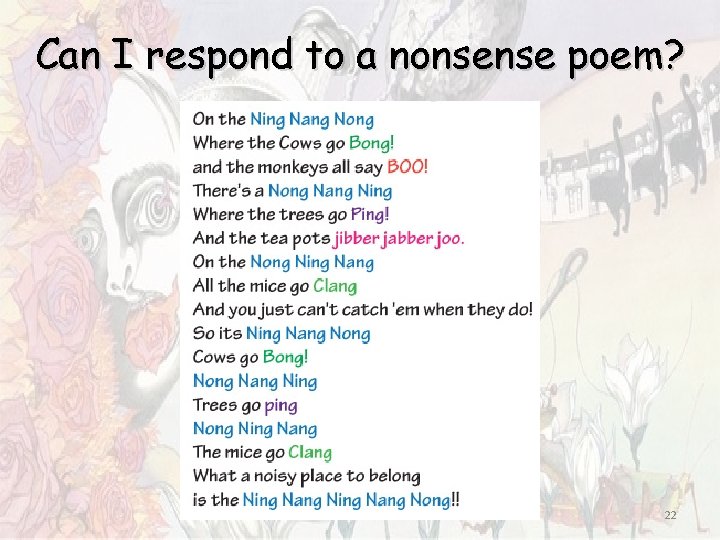
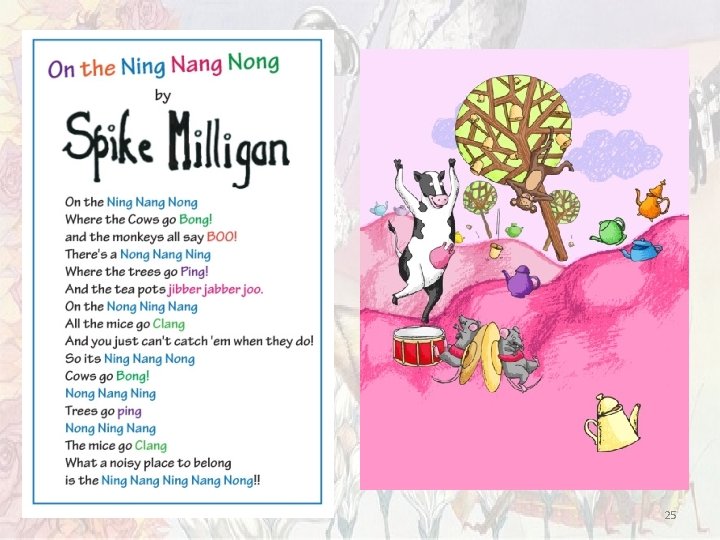
Can I respond to a nonsense poem? Spike Milligan • Spike Milligan was a very famous poet. • He wrote mainly for children. • His poems were very silly, and known as literary nonsense. • On the Ning Nang Nong was his most famous poem, about an imaginary land. 21
Can I respond to a nonsense poem? 22
Can I respond to a nonsense poem? Whole Class – Shared Reading • Re-read the poem together • Look at the silly words – Does it matter what they mean? – What do they mean? Discuss your favourite bit of the poem Think, pair, share! 23
Can I respond to a nonsense poem? Independent Activity Under the copy of the poem, draw a picture of what you imagine the poem is about. Perfect Punctuators – highlight the rhyming words and then illustrate the poem Clever Connectives – highlight the rhyming words, illustrate the poem and label as necessary Amazing Adjectives – highlight the rhyming words, illustrate the poem, add labels and extra lines of the poem 24
25
Nonsense Poems 26
Can I use alliteration? • Re-read On the Ning Nang Nong How do we know the text is a poem and not a story? Think, pair, share! • What poetry devices have been used? 27
Can I use alliteration? Whole Class • What is alliteration? • Alliteration is using the same phoneme two or more times in a sentence. • Listen to these tongue twisters: – She sells sea shells on the sea shore – How much wood would a woodchuck if a woodchuck could chuck wood? 28
Can I use alliteration? Whole Class – Shared Reading • Display On the Ning Nang Nong • Find all the alliterative phrases • Highlight the same phoneme in the same coloured pen • Draw attention to the order of the alliteration – Why might this have been done? 29
Can I use alliteration? Whole Class – Shared Writing Rewrite the beginning of the poem On the ___ ___ Where the ___ ___ And the ___ ___ ___. 30
Can I use alliteration? Independent Activity Rewrite part of the poem using your own alliterative phrase. On the ___ ___ ___ Where the ___ ___ ___ And the ___ ___ ___. On the ___ ___ Where the ___ ___ And the ___ ___ ___. 31
Can I use alliteration? Success Criteria • Correct punctuation (capital letters, finger spaces and full stops) • Neat, joined-up handwriting • Alliteration • Spelling using phonic knowledge • Perfect Punctuators: 1 -2 verses • Clever Connectives: 2 -3 verses • Amazing Adjectives: 3 verses « Challenge: finish off the poem 32
Metaphors and Simile Poems 33
Can I use similes and metaphors in my poems? - An inviting fire glowing brightly - A flickering candle flame - A comforting warmth - Or a good feeling - The forthcoming heat - On a fresh summer morning
Can I use similes and metaphors in my poems? -A calm sea floating on nothing, -Tumbling waterfalls from a deep rock face, -A glowing jewel giving off a special light,
Can I use similes and metaphors in my poems? • When we say something is like something else we are using a simile. • Similes contain the words ‘like’ or ‘as’. • They can be used to make our writing more interesting or humorous.
Can I use similes and metaphors in my poems? As poor as a _______ As strong as an ______ As cute as a ______ As smart as ______ As thin as a ______ As white as a ______ As fit as a ______ As dumb as a ______ As bald as an ______ As neat as a ______ As proud as a ______ As ugly as ______
Rhyming Poems 38
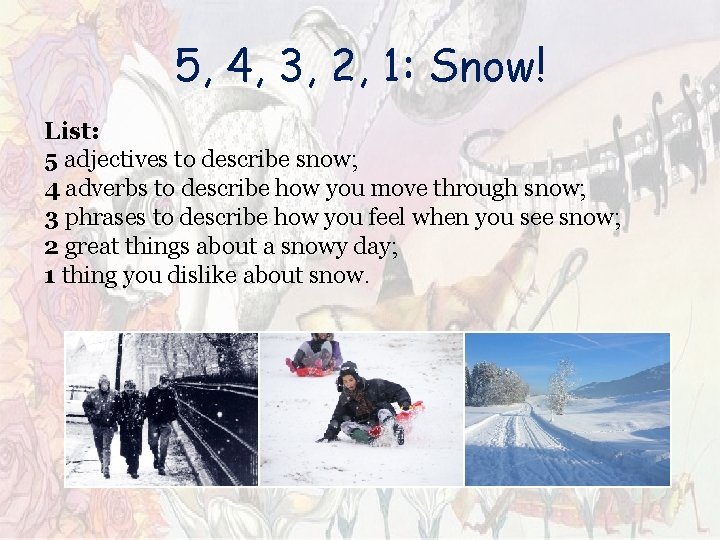
5, 4, 3, 2, 1: Snow! List: 5 adjectives to describe snow; 4 adverbs to describe how you move through snow; 3 phrases to describe how you feel when you see snow; 2 great things about a snowy day; 1 thing you dislike about snow.
Writing a Tanka A five line poem Tanka poems date back almost 1200 years ago, and they focus on nature, seasons, love, sadness and other strong emotions. • line one has five syllables • line two has seven syllables • line three has five syllables • line four has seven syllables • line five has seven syllables Dancing Snow Dots Snow drifts by my glass (5 syllables) Spiders of ice form a branch (7 syllables) Dancing on a breeze (5 syllables) Small white dots move back and forth (7 syllables) Sway to Mother Nature's call (7 syllables)
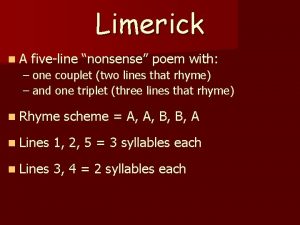
Writing a Limerick There once was a lady named Sue Who had nothing whatever to do And who did it so badly I thought she would gladly Have stopped before she was through. There once was a Thingamajig-Like a Whatsis, but three times as big. When it first came in view It looked something like you But it stayed and turned into a pig. There once was a Martian named Zed With antennae all over his head. He sent out a lot Of di-di-dash-dot But nobody knows what he said.
Writing a Limerick • • All limericks begin with the phrase; "There once was a _____ from ____. " or "There was a _____________ from _____. " This is a nice limerick pattern to follow: Line 1: Tell who the person is and where he or she is from Line 2: Describe the person or tell something interesting about him or her Line 3 & 4: Give more interesting detail about what was mentioned in line two Line 5: Based on the first four lines, finish off the limerick with a surprising and/or funny ending
Patterns and picture Poems 43
Poets use patterns to give their poems an interesting shape! Hair I like hair that is healthy, wavy, shiny, tidy I brush mine with care, Hair. Ants I like that ants that are tiny, shiny, lazy, crazy, climbing up your pants, ants!
Poets use patterns to give their poems an interesting shape! The Subject Ants I like + the subject I like that ants that are 4 adjectives about the subject tiny, shiny, lazy, crazy, A sentence about the subject climbing up your pants, Repeat the subject ants!
Now write your own poem using this pattern. Here is a list of possible subjects for your poem. Choose one, or invent one of your own. Cheese Fish School Babies Spiders Trees Teachers Lessons Clouds Clothes Dogs Brothers You could even change the “I like” part to “I hate”!!
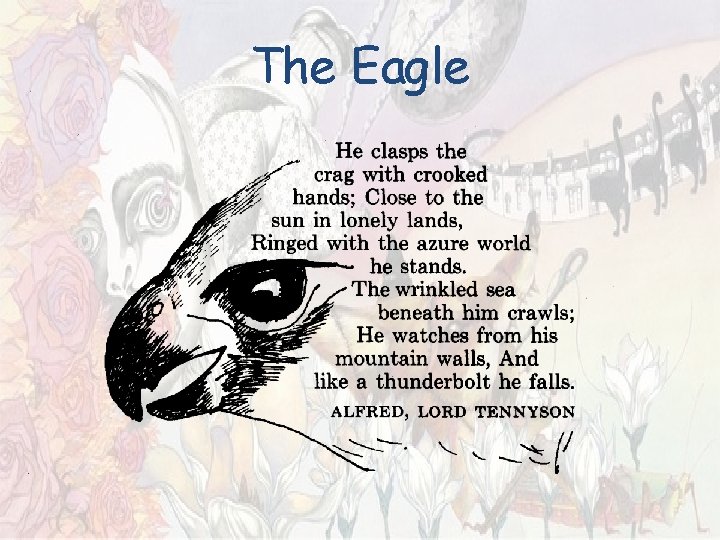
Here is a shape poem by a famous poet, Alfred Lord Tennyson He clasps the crag with crooked hands; close to the sun in lonely lands, Ringed with the azure world he stands. The wrinkled sea beneath him crawls He watches from his mountain walls, And like a thunderbolt, he falls. What do you think the poem is about? Use the words and the shape to help you figure it out. Hint: the picture is in profile. Hint: The poem is about an animal. Hint: Imagine the poem as a picture!
The Eagle
Now write a picture poem of your own! • Choose a subject to write about. Pick something that has an obvious shape. Here are some examples you could choose from: rain; snake; river; balls; school ties; television. • Write an interesting sentence about your subject. Try to use an alliteration if you can. • Now, put your sentence into the shape of the subject and draw an interesting illustration to go with your poem!
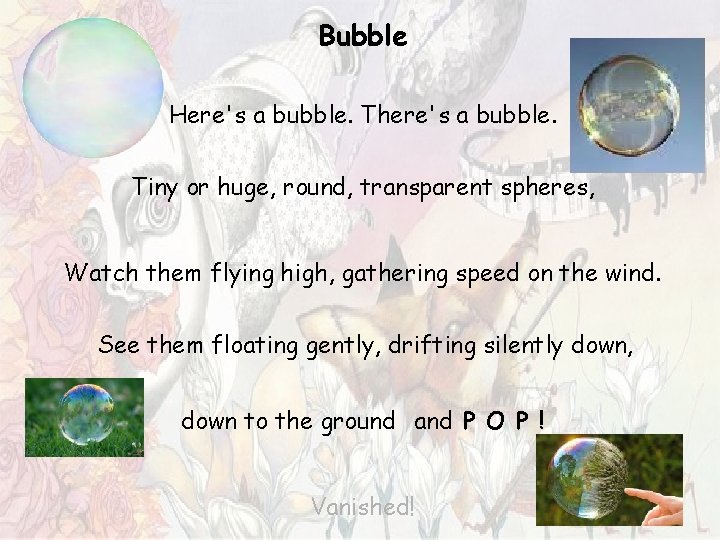
Bubble Here's a bubble. There's a bubble. Tiny or huge, round, transparent spheres, Watch them flying high, gathering speed on the wind. See them floating gently, drifting silently down, down to the ground and P O P ! Vanished!
Bubbles Floating holes Reflecting spheres Little rainbow heads Glued together like magnets Liquid crystal balls Silent popcorn Bubbles Round, translucent Floating, blowing, drifting Lifting spirits Pop
Collect some ideas of words you used to describe the bubbles phrases about how they moved, phrases about how they popped! sentences about what they reminded you of
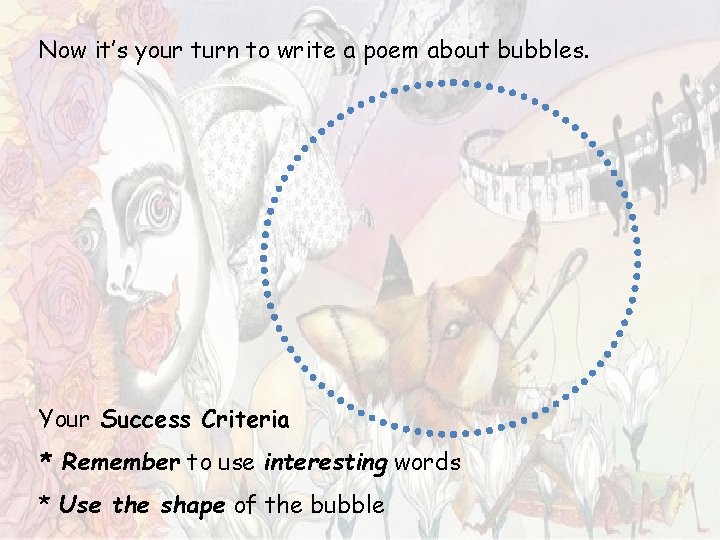
Now it’s your turn to write a poem about bubbles. Your Success Criteria * Remember to use interesting words * Use the shape of the bubble
Using adjectives and alliteration Poems 54
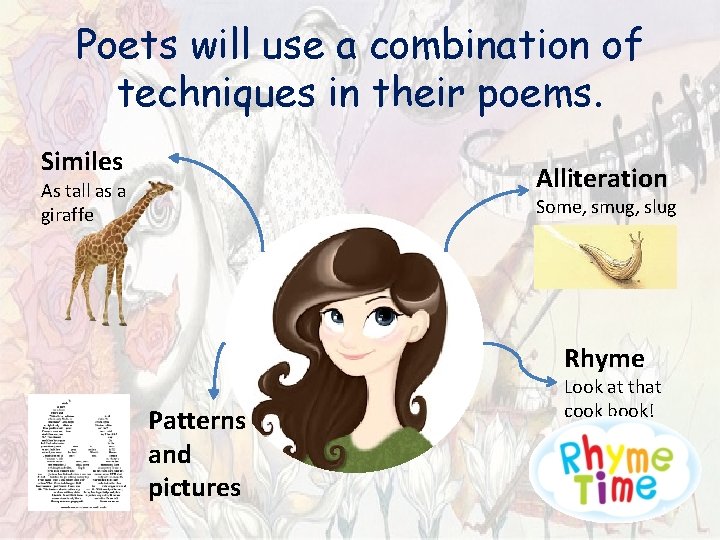
Poets will use a combination of techniques in their poems. Similes Alliteration As tall as a giraffe Some, smug, slug Rhyme Patterns and pictures Look at that cook book!
It’s All About Alliteration Kaylie just couldn’t keep her classroom quiet. The kids all cackled and caused a riot! She cooked them some cupcakes to keep them calm Using kittens and cow pats she’d found on the farm!