National Cooling Action Plan Seminar Indian Polyurethane Association




- Slides: 21
National Cooling Action Plan Seminar Indian Polyurethane Association 17 Jan 2018 New Delhi 1
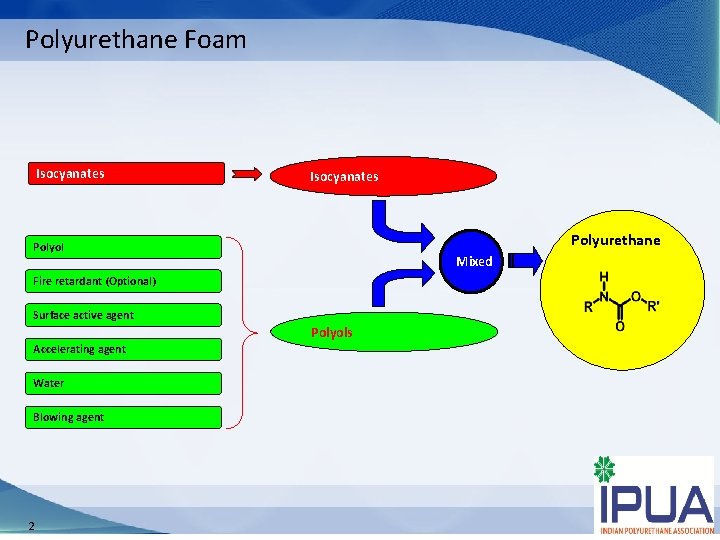
Polyurethane Foam Isocyanates Polyurethane Polyol Mixed Fire retardant (Optional) Surface active agent Polyols Accelerating agent Water Blowing agent 2
India Insulation Forum (IIF) q India Insulation Forum (IIF ) was created as a sub unit under IPUA to promote INSULATION in the building envelop/Cold Chain industry to enhance and promote Energy Efficiency. q IIF is represented by reputed companies and processors who make different materials for Insulation used for energy efficiency in buildings and Cold Storages. q IIF is heterogenous group , but is, q Technology NEUTRAL q Product NEUTRAL q Company NEUTRAL q Promotes the concept of Energy Efficiency 3
Spray Foam Alliance of India ( SFAI ) q A sub-unit of IPUA created to address two important issues. q First – to bring into effect the simplest and most effective form of INSULATION – Spray Polyurethane Foam q Second – to train the crucial link in the industry chain – the APPLICATOR alongwith machinery manufacturers q INSULATION is a game changing factor in the Energy Efficiency program Technical Manual A Guide to Energy Security WORKING WITH SPRAY POLYURETHANE FOAM 4
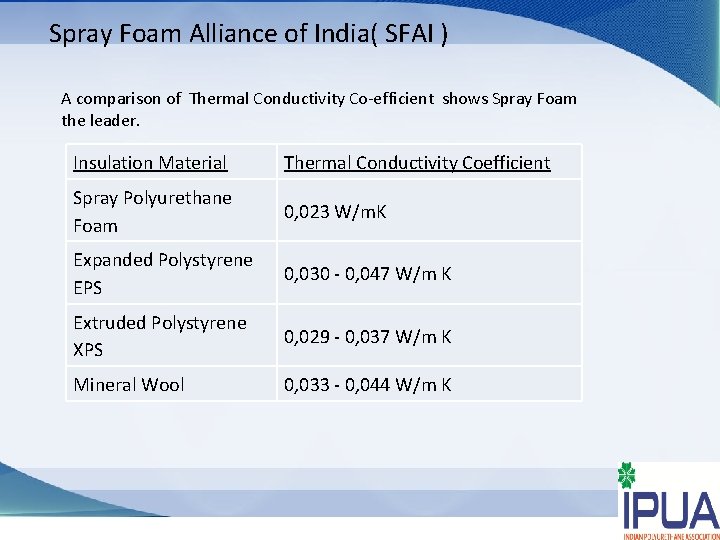
Spray Foam Alliance of India( SFAI ) A comparison of Thermal Conductivity Co-efficient shows Spray Foam the leader. Insulation Material Thermal Conductivity Coefficient Spray Polyurethane Foam 0, 023 W/m. K Expanded Polystyrene EPS 0, 030 - 0, 047 W/m K Extruded Polystyrene XPS 0, 029 - 0, 037 W/m K Mineral Wool 0, 033 - 0, 044 W/m K 5
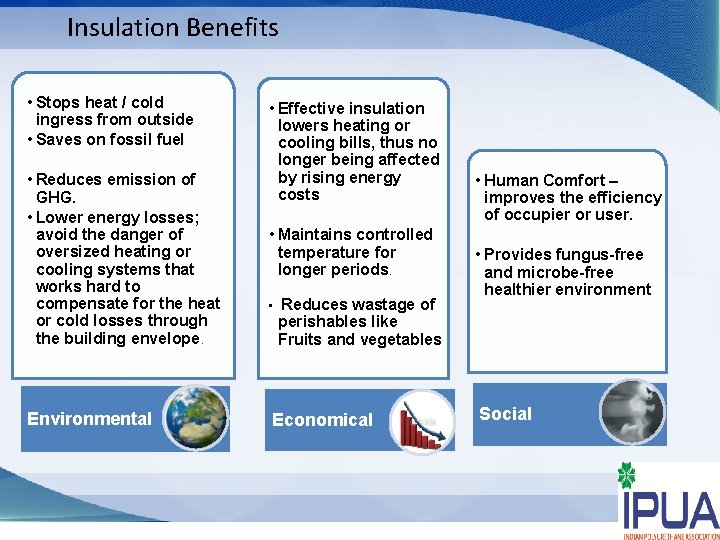
Insulation Benefits • Stops heat / cold ingress from outside • Saves on fossil fuel • Reduces emission of GHG. • Lower energy losses; avoid the danger of oversized heating or cooling systems that works hard to compensate for the heat or cold losses through the building envelope. Environmental • Effective insulation lowers heating or cooling bills, thus no longer being affected by rising energy costs • Maintains controlled temperature for longer periods. • Reduces wastage of perishables like Fruits and vegetables Economical • Human Comfort – improves the efficiency of occupier or user. • Provides fungus-free and microbe-free healthier environment Social 6
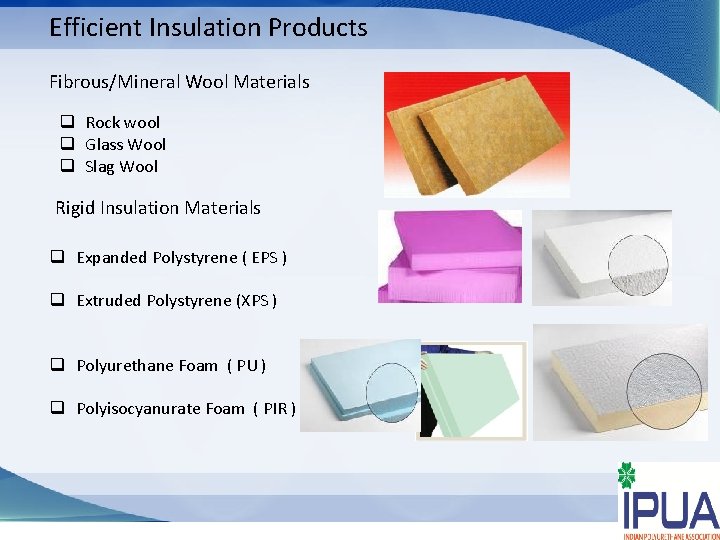
Efficient Insulation Products Fibrous/Mineral Wool Materials q Rock wool q Glass Wool q Slag Wool Rigid Insulation Materials q Expanded Polystyrene ( EPS ) q Extruded Polystyrene (XPS ) q Polyurethane Foam ( PU ) q Polyisocyanurate Foam ( PIR ) 7
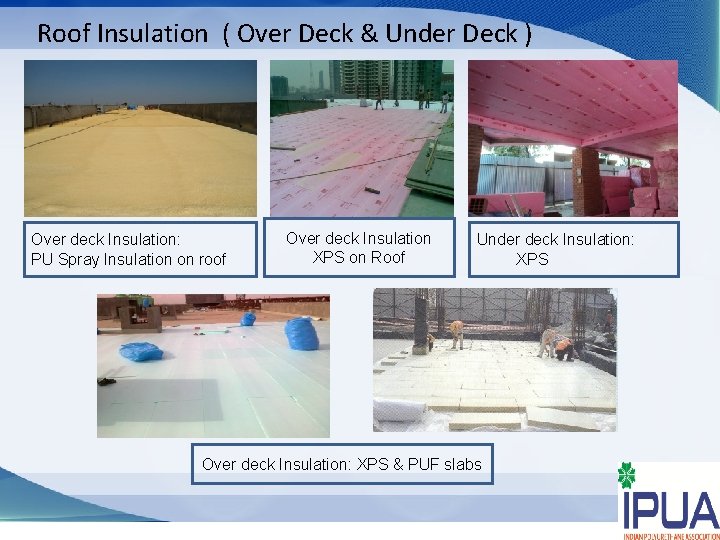
Roof Insulation ( Over Deck & Under Deck ) Over deck Insulation: PU Spray Insulation on roof Over deck Insulation XPS on Roof Under deck Insulation: XPS Over deck Insulation: XPS & PUF slabs 8
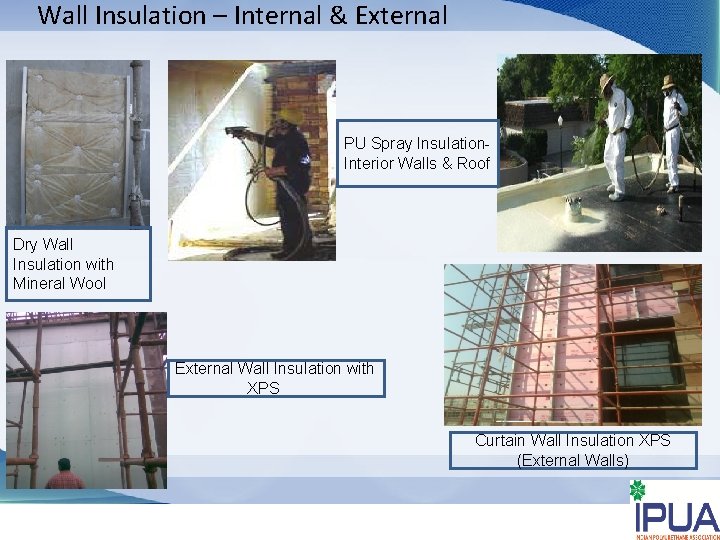
Wall Insulation – Internal & External PU Spray Insulation. Interior Walls & Roof Dry Wall Insulation with Mineral Wool External Wall Insulation with XPS Curtain Wall Insulation XPS (External Walls) 9
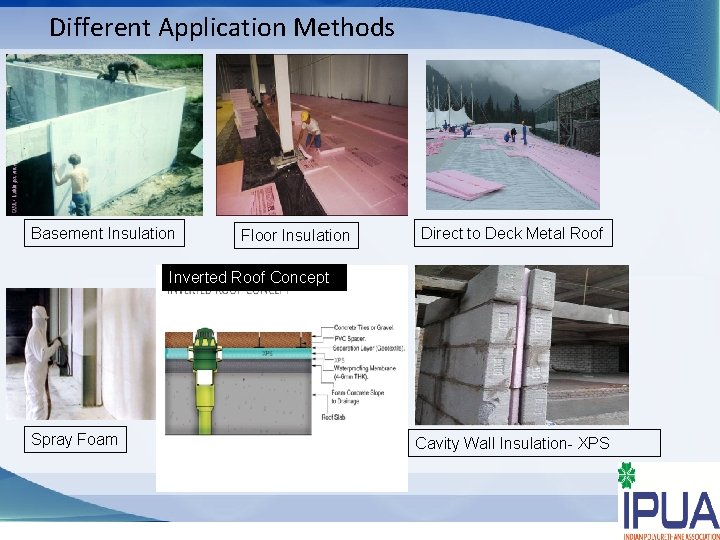
Different Application Methods Basement Insulation Floor Insulation Direct to Deck Metal Roof Inverted Roof Concept Spray Foam Cavity Wall Insulation- XPS 10
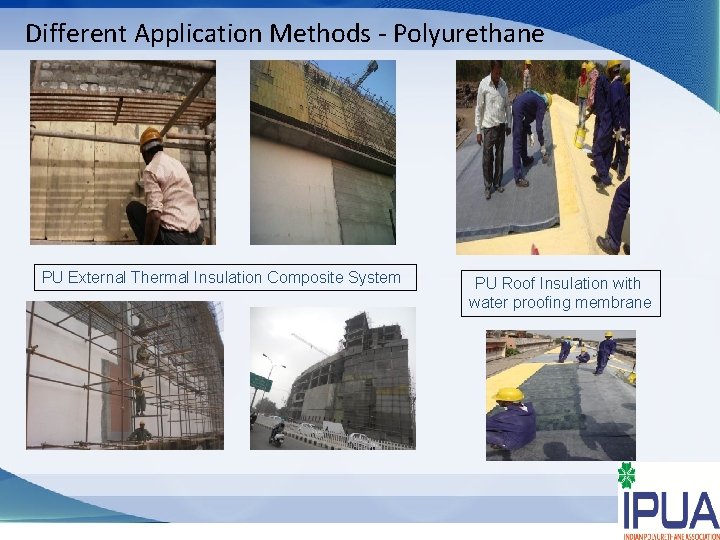
Different Application Methods - Polyurethane PU External Thermal Insulation Composite System PU Roof Insulation with water proofing membrane 11
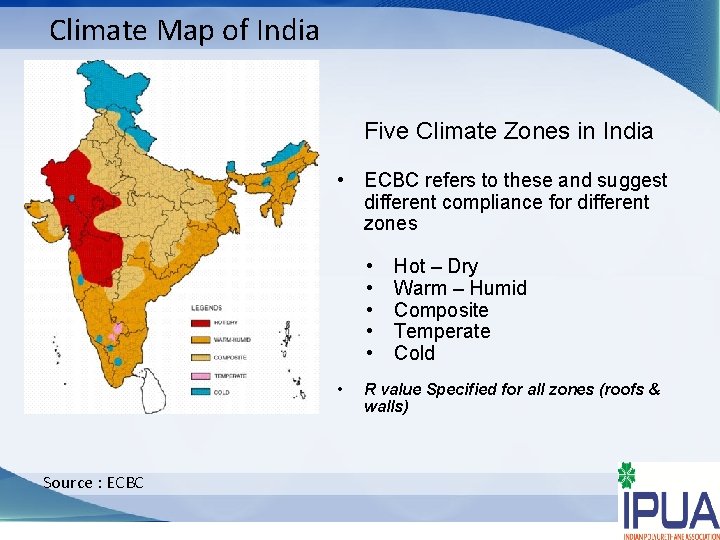
Climate Map of India Five Climate Zones in India • ECBC refers to these and suggest different compliance for different zones • • • Hot – Dry Warm – Humid Composite Temperate Cold R value Specified for all zones (roofs & walls) Source : ECBC 12
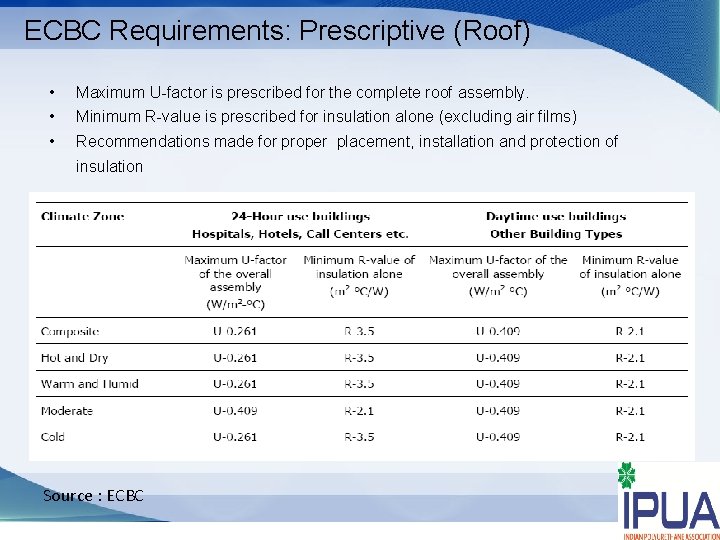
ECBC Requirements: Prescriptive (Roof) • Maximum U-factor is prescribed for the complete roof assembly. • Minimum R-value is prescribed for insulation alone (excluding air films) • Recommendations made for proper placement, installation and protection of insulation Source : ECBC 13
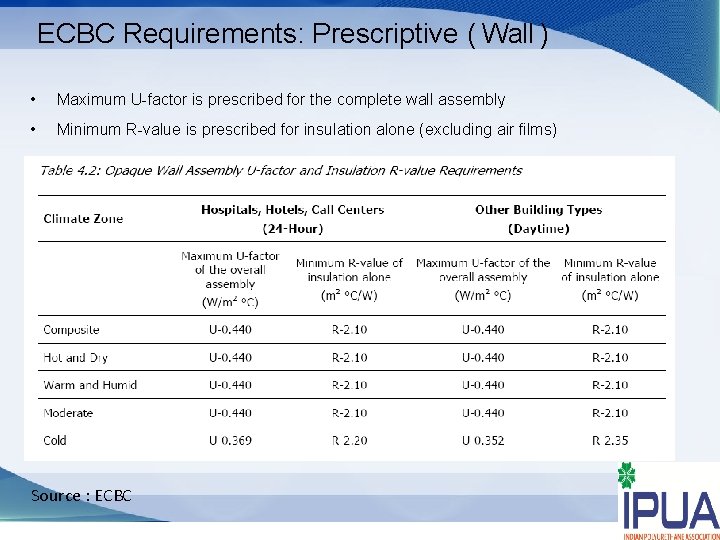
ECBC Requirements: Prescriptive ( Wall ) • Maximum U-factor is prescribed for the complete wall assembly • Minimum R-value is prescribed for insulation alone (excluding air films) Source : ECBC 14
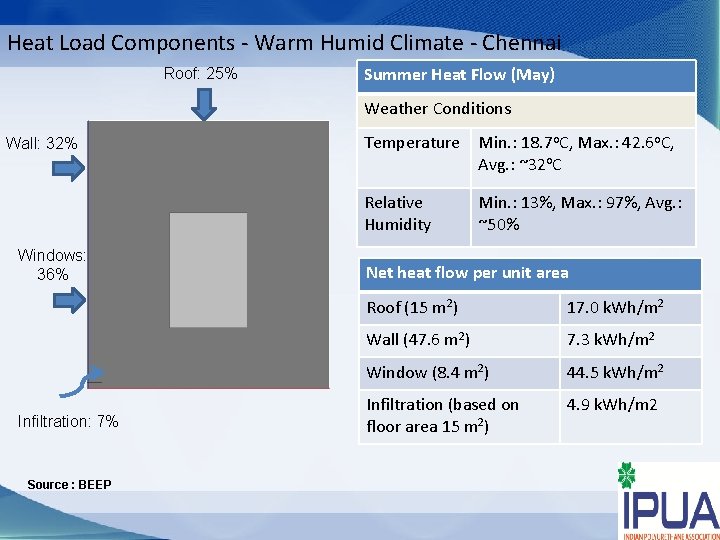
Heat Load Components - Warm Humid Climate - Chennai Roof: 25% Summer Heat Flow (May) Weather Conditions Wall: 32% Windows: 36% Infiltration: 7% Temperature Min. : 18. 7 o. C, Max. : 42. 6 o. C, Avg. : ~32 o. C Relative Humidity Min. : 13%, Max. : 97%, Avg. : ~50% Net heat flow per unit area Roof (15 m 2) 17. 0 k. Wh/m 2 Wall (47. 6 m 2) 7. 3 k. Wh/m 2 Window (8. 4 m 2) 44. 5 k. Wh/m 2 Infiltration (based on floor area 15 m 2) 4. 9 k. Wh/m 2 Source : BEEP 15
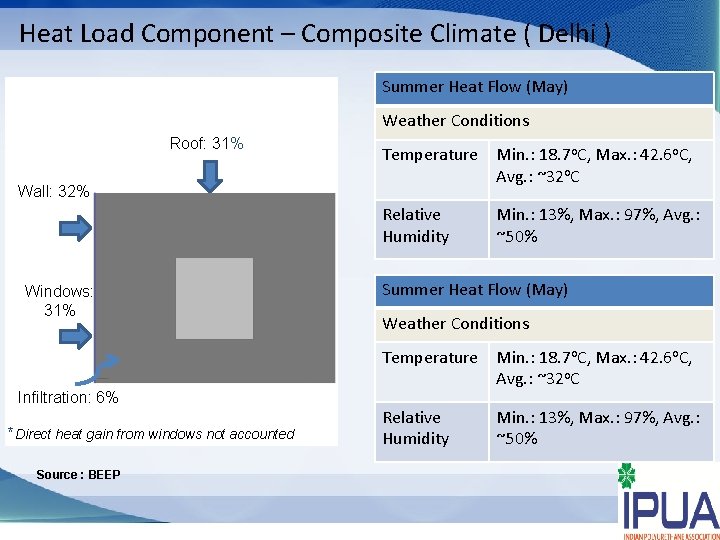
Heat Load Component – Composite Climate ( Delhi ) Summer Heat Flow (May) Weather Conditions Roof: 31% Temperature Min. : 18. 7 o. C, Max. : 42. 6 o. C, Avg. : ~32 o. C Relative Humidity Min. : 13%, Max. : 97%, Avg. : ~50% Wall: 32% Windows: 31% Infiltration: 6% *Direct heat gain from windows not accounted Summer Heat Flow (May) Weather Conditions Temperature Min. : 18. 7 o. C, Max. : 42. 6 o. C, Avg. : ~32 o. C Relative Humidity Min. : 13%, Max. : 97%, Avg. : ~50% Source : BEEP 16
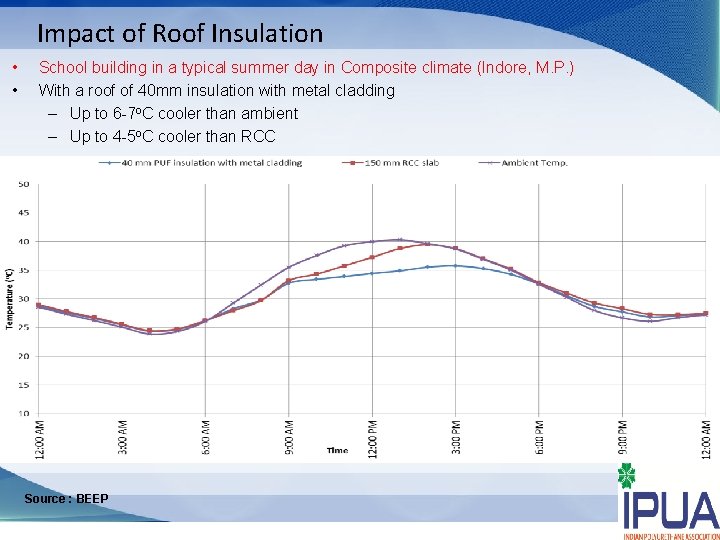
Impact of Roof Insulation • • School building in a typical summer day in Composite climate (Indore, M. P. ) With a roof of 40 mm insulation with metal cladding – Up to 6 -7 o. C cooler than ambient – Up to 4 -5 o. C cooler than RCC Source : BEEP 17
18
Challenges q Awareness q Mandatory q Implementation issues q Energy Guzzling Buildings q Life Cycle Analysis q Standardization 19
Conclusion q Indian Polyurethane Association in its own way tries to promote Energy Efficiency through its sub-groups of IIF & SFAI. q IPUA conducts Training programs at different locations to keep the industry abreast of the needs q IPUA conducts Seminars on Insulation with specialists in the field of Energy Efficiency q IPUA conducts training programs on Insulation in Polytechnics 20
Thank You 21