National 5 Proteins Enzymes G r M on

- Slides: 25
National 5 Proteins & Enzymes G r M on Da s vid
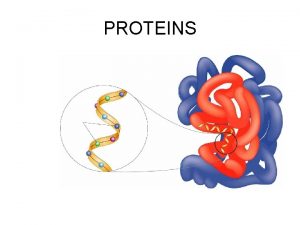
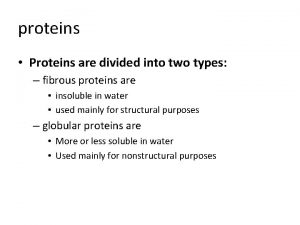
Variety of Proteins • Proteins are complex molecules composed of a large number of sub-units called amino acids. • They contain the elements carbon (C), hydrogen (H), oxygen (O) and nitrogen (N). 19 February 2021 Mr G Davidson 2
Variety of Proteins • There about 20 different amino acids. • As seen in the last unit, the sequence of amino acids is determined by the genetic code on DNA. • Depending on the sequence of the amino acids, proteins can take the form of different shapes. 19 February 2021 Mr G Davidson 3
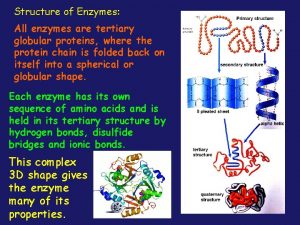
Variety of Proteins • The shape of the protein can determine the function of the protein, e. g. 1. Structural proteins such as those present in the cell membrane. These proteins kepp the membrane together as well as allowing the transport of materials across it. 2. Carrier proteins such as those found in the cell membrane. These are responsible for the transport of certain materials across the cell membrane. 3. Enzymes are spherical shaped protein molecules and they are important in the metabolism of the cell. They are also important outside the cell in organisms, e. g. digestive enzymes in the human gut, enzymes to convert glucose to starch in plants, etc. . . 19 February 2021 Mr G Davidson 4
Variety of Proteins 4. Hormones are also proteins. These are chemical messengers transported in the blood to target organs or tissues where they are responsible for causing a change. Examples include regulating growth in an organism, controlling blood glucose level in human blood (insulin), osmoregulation in animals, etc. . 5. Antibodies are also composed of protein molecules. They are made by white blood cells and their function is to fight off bacteria which cause diseases. 19 February 2021 Mr G Davidson 5
Enzymes • Chemical reactions all occur at different rates. • Some are very quick and some are extremely slow. • We can speed up some chemical reactions by: – Increasing the temperature – Adding a catalyst 19 February 2021 Mr G Davidson 6
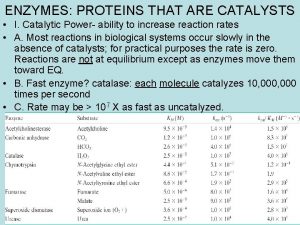
Enzymes • Since it is not always appropriate to increase the temperature of a living organism, biological catalysts called ENZYMES are used to increase the rate of reactions. • Enzymes are made by all living cells. • Although they speed up reactions, enzymes remain unaltered by the reaction and can therefore be used again and again. 19 February 2021 Mr G Davidson 7
Enzymes • Catalase is an enzyme, made by living cells, which can break down hydrogen peroxide. • If we add a piece of living tissue to hydrogen peroxide, we can see bubbles of oxygen being released. • The more bubbles released, the more catalase there is in the tissue. 19 February 2021 Mr G Davidson 8
Specificity • Catalase can only speed up the breakdown of hydrogen peroxide, not any other reaction. • It is said to be specific. • Each enzyme catalyses only one reaction. • The substance the enzyme catalyses is called the substrate. 19 February 2021 Mr G Davidson 9
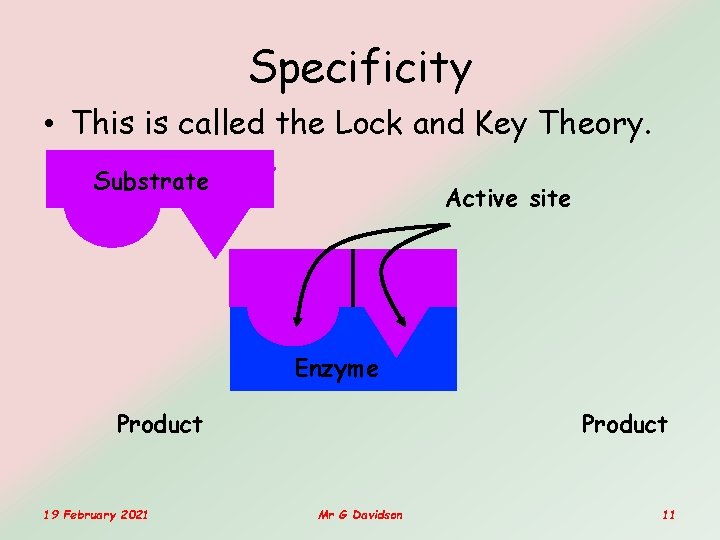
Specificity • Enzymes have an area on their surface which is a specific shape, and it is here that the substrate attaches. • This area is called the active site. • The enzyme’s shape and the substrate’s shape are said to be complementary. • The substrate locks onto the enzyme at the active site and the reaction occurs. 19 February 2021 Mr G Davidson 10
Specificity • This is called the Lock and Key Theory. Substrate Active site Enzyme Product 19 February 2021 Product Mr G Davidson 11
Enzyme Action • In order to function at its best, enzymes require the best possible conditions. • We call these conditions the optimum conditions. • Two important factors in ensuring enzymes work at their optimum are temperature and p. H. 19 February 2021 Mr G Davidson 12
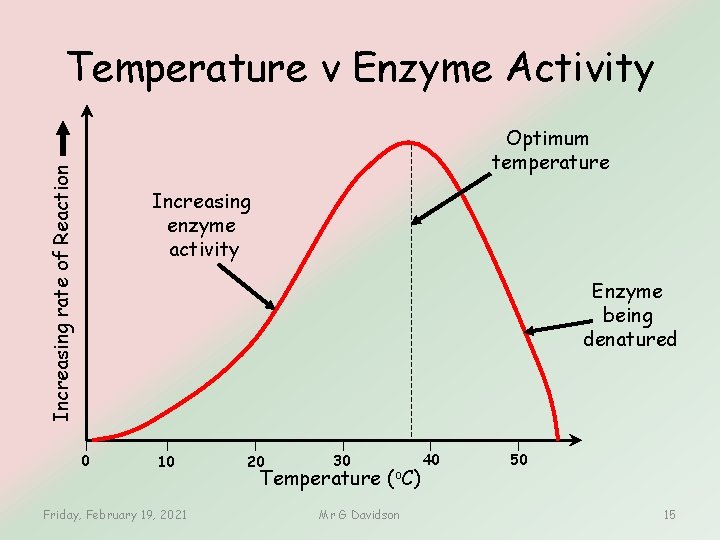
Enzyme Action • At very low temperatures, enzymes work very slowly or not at all. • As the temperature rises, the substrate molecules and the enzyme molecules bump into each other more often and, therefore the reaction speeds up. 19 February 2021 Mr G Davidson 13
Enzyme Action • There will be a temperature (usually around 35 o. C) when the enzyme cannot work any faster. • This will be that particular enzyme’s optimum temperature. • Once the temperature is too high the enzyme (being a protein) is damaged and we say it has been denatured. 19 February 2021 Mr G Davidson 14
Temperature v Enzyme Activity Increasing rate of Reaction Optimum temperature Increasing enzyme activity Enzyme being denatured 0 10 Friday, February 19, 2021 20 30 Temperature (o. C) Mr G Davidson 40 50 15
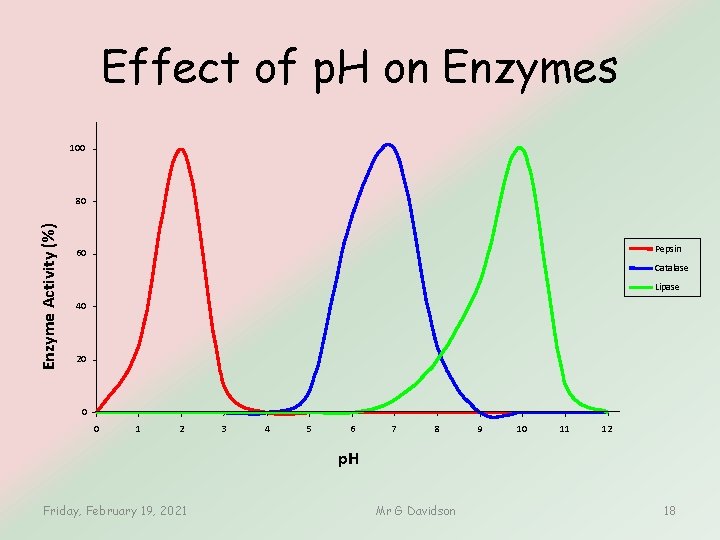
Effect of p. H on Enzymes • p. H is a measure of how acid or alkali something is. • The p. H scale goes from 0 to 14, with 0 being very acidic, 14 being very alkaline and 7 being neutral. • The shape of an enzyme can be affected by changes in p. H and this will affect how well the enzymes work. Friday, February 19, 2021 Mr G Davidson 16
Effect of p. H on Enzymes • Like temperature, enzymes have an optimum p. H, i. e. a p. H when they are most efficient. • The optimum p. H varies from enzyme to enzyme. • Our digestive system has a range of p. H’s as the food passes through it, and this creates ideal conditions for specific enzymes. Friday, February 19, 2021 Mr G Davidson 17
Effect of p. H on Enzymes 100 Enzyme Activity (%) 80 Pepsin 60 Catalase Lipase 40 20 0 0 1 2 3 4 5 6 7 8 9 10 11 12 p. H Friday, February 19, 2021 Mr G Davidson 18
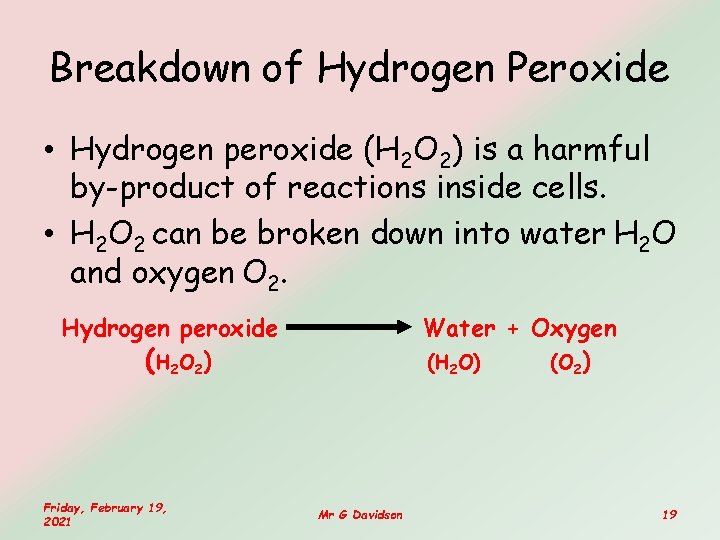
Breakdown of Hydrogen Peroxide • Hydrogen peroxide (H 2 O 2) is a harmful by-product of reactions inside cells. • H 2 O 2 can be broken down into water H 2 O and oxygen O 2. Hydrogen peroxide (H 2 O 2) Friday, February 19, 2021 Water + Oxygen (H 2 O) (O 2) Mr G Davidson 19
Breakdown of Hydrogen Peroxide • Hydrogen peroxide can be broken down to water and oxygen by increasing the temperature. • If it is placed in water baths of increasing temperatures, the number of bubbles of oxygen released increases with temperature. Friday, February 19, 2021 Mr G Davidson 20
Breakdown of Hydrogen Peroxide • Catalase is the enzyme, made by living cells, which can break down hydrogen peroxide. • If we add a piece of living tissue to hydrogen peroxide, we can see bubbles of oxygen being released. • The more bubbles released, the more catalase there is in the tissue. Friday, February 19, 2021 Mr G Davidson 21
Starch & Amylase • Starch is a carbohydrate. • It contains energy and is found in many foods. • Starch molecules are very large and cannot pass through cell membranes. • Therefore, they need to be broken down to smaller molecules. Friday, February 19, 2021 Mr G Davidson 22
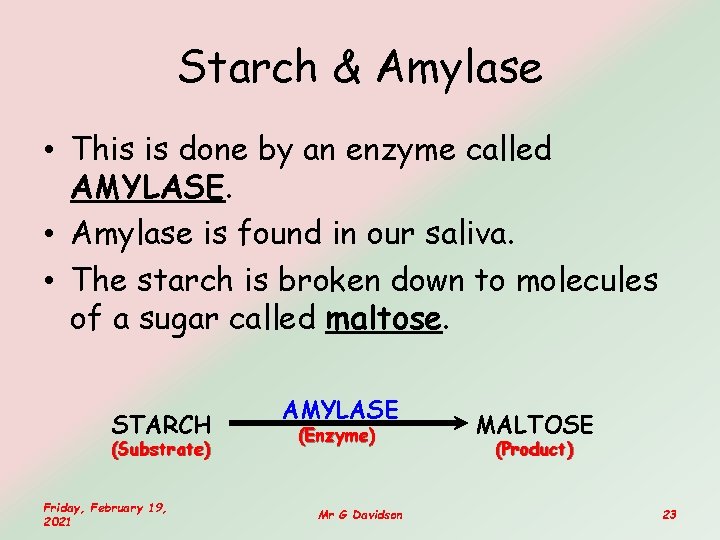
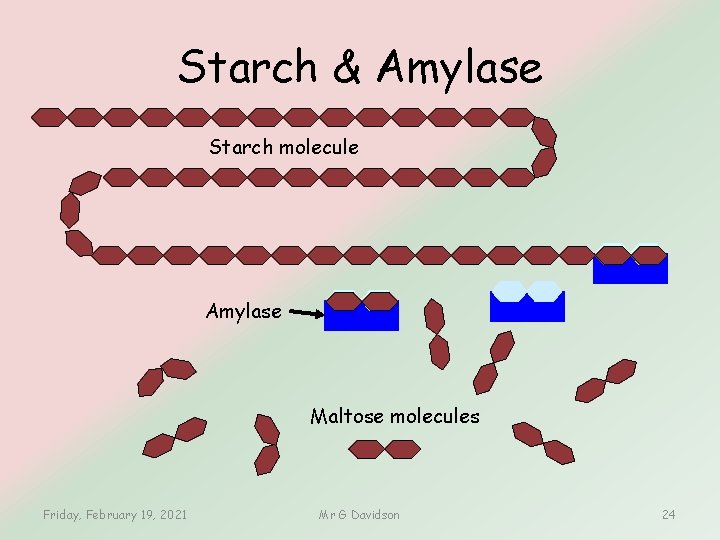
Starch & Amylase • This is done by an enzyme called AMYLASE. • Amylase is found in our saliva. • The starch is broken down to molecules of a sugar called maltose. STARCH (Substrate) Friday, February 19, 2021 AMYLASE (Enzyme) Mr G Davidson MALTOSE (Product) 23
Starch & Amylase Starch molecule Amylase Maltose molecules Friday, February 19, 2021 Mr G Davidson 24
Uses of Enzymes • Enzymes have many uses and some examples are below. – Used in our digestive system to break down food. – Used in biological washing powders to digest stains. – Used to make bread. – Used to make cheese. – Used to make yoghurt. 19 February 2021 Mr G Davidson 25